
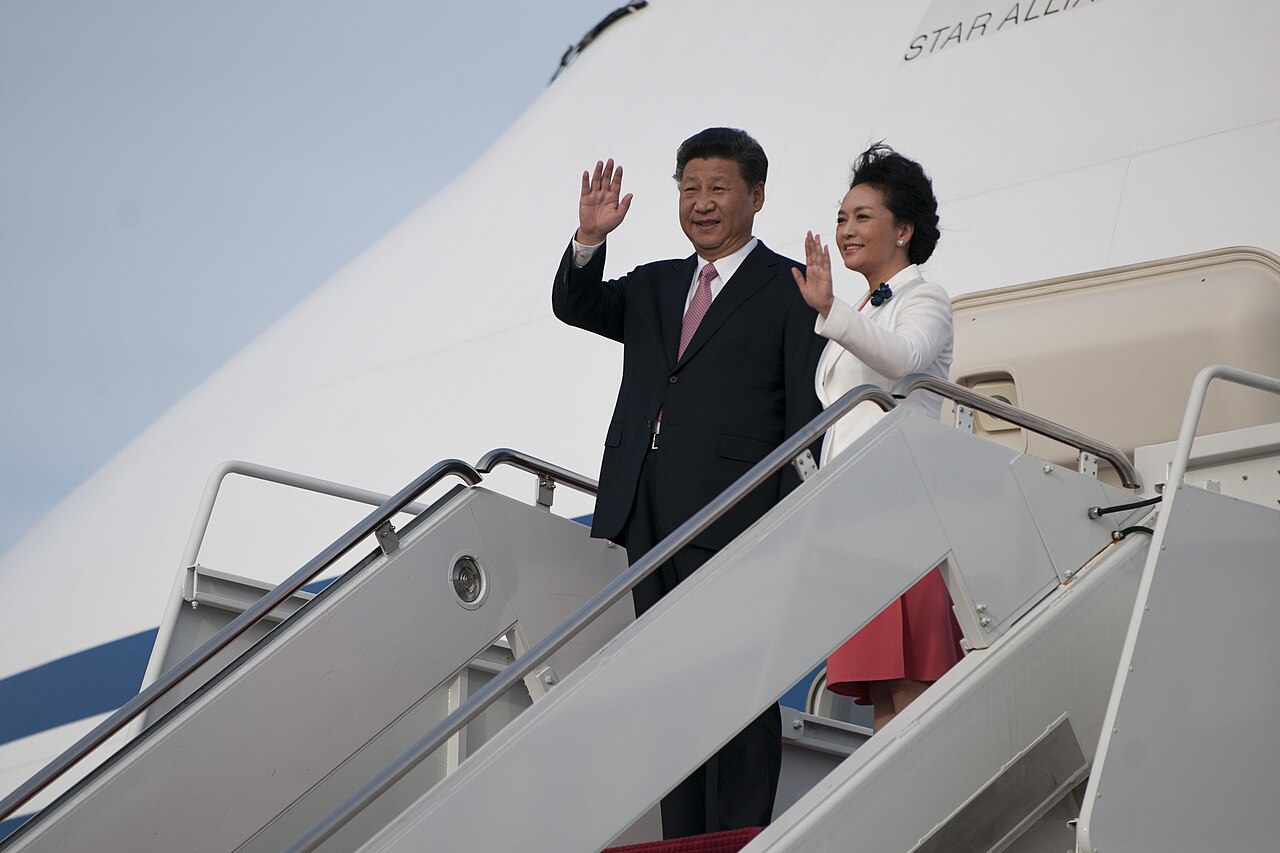
The Trump-Xi summit bucks an emerging trend — Xi Jinping is traveling less. The data bears this out. Since the pandemic, Xi has left China fewer times, visited fewer countries, spent fewer days abroad, and logged fewer miles since resuming foreign travel in 2022. The engagements he prioritizes have also changed, favoring visits within China’s own neighborhood, multilateral settings, and global south countries.
Information about the inner workings of Zhongnanhai and the lives of China’s senior leadership is highly limited, making satisfying explanations for Xi’s declining foreign travel elusive. But a look at the numbers and Xi’s travel tendencies points to possible adjustments in his recent diplomatic priorities.
Xi’s Declining Foreign Travel
From 2013 to 2020, Xi consistently visited more countries, took more separate overseas trips, spent more days abroad, and traveled longer distances than from 2022 to 2026. Compared to the period from 2013 to 2019,1In 2020, Xi only visited Myanmar in January before the pandemic began, so 2020 is excluded from these average calculations as pandemic circumstances meant Xi could not travel for 11 months in 2020. he averaged eight fewer country visits, two fewer distinct trips abroad, less than half as much time abroad, and less than half the miles traveled per year after COVID.
Xi’s pre-COVID journeys also covered more countries, with 3-, 4-, and 5-country trips common. Excluding stopovers, he took eight trips to four or more countries through 2018, the first full year of his second term. Since December 2018, he has not taken a single four-country excursion and has logged only two three-country trips post-COVID.
The Outliers: 2017 and 2024
Two years stand out in the pre- and post-COVID periods: 2017 and 2024. In 2017, Xi visited far fewer countries (7), traveled far less distance (about 40,745 miles), and spent far fewer days abroad (19) than in any other year prior to the pandemic, although his four distinct journeys matched the numbers for 2013, 2016, and 2018. Three of Xi’s 2017 foreign visits were oriented around multilateral engagements — the World Economic Forum (WEF), the G20 leaders’ summit, and the Asia-Pacific Economic Cooperation summit (APEC). The other was his Mar-a-Lago summit with Donald Trump. The most likely explanation for this dip in foreign engagement is that Xi was focused on the October 2017 Party Congress in which he secured his second term. Xiamen also hosted the 2017 BRICS Summit, meaning Xi did not have to travel abroad to attend.
On the other hand, 2024 marks an uptick in Xi’s usually more limited post-pandemic foreign engagement. That year, he visited substantially more countries (10), though two were stopovers. His approximately 48,537 miles traveled and 24 days spent abroad were also higher than in any other post-COVID year, but they were packed into the same number of foreign trips (4) as every other year in that period. Three of these trips were organized around multilateral events. The other was a series of state visits to three European countries.
The simplest explanation for the 2024 spike is that China was not hosting any major summits in 2024, so Xi had to travel to all of them. His trip to Europe may also have been motivated by worsening China-EU trade tensions or the need to manage narratives surrounding the Russia-Ukraine conflict and world order conceptions, all of which were key talking points on that trip. That possibility is somewhat undermined by Xi’s complete lack of European travel in the following two years despite the continued salience of those issues.
Possible Explanations
Some analysts have pointed to Xi’s age to explain his slower pace of travel, claiming that his declining health is keeping him home while his deputies travel abroad. This is not impossible, as Xi is now 73 years old. But these arguments often lean on anonymous sources and rumors, and Xi’s older U.S. counterparts have maintained a more ambitious travel schedule post-COVID.
Another explanation is that more foreign leaders are traveling to China. This “home court diplomacy” carries advantages — it is easier to manage the optics of meetings in Beijing, and these visits give China the opportunity to show off to the world. But they may also give the appearance of lopsided engagement, which is at odds with Xi’s promotion of a new style of more egalitarian state-to-state diplomacy.
Xi’s limited travel in 2017 offers another possible explanation. That year, a packed domestic slate may have kept him in Beijing. With China’s economy still sluggish following the pandemic, Xi may be feeling pressure to tend more closely to matters at home.
Xi’s Post-COVID Priorities
Xi is not only traveling less post-COVID; he is traveling differently. His remaining foreign trips are more concentrated around China’s periphery — Russia and Central, South, Southeast, and East Asia — and tend toward the global south. They also lean on multilateral events as an anchor rather than stringing together bilateral visits.
Sixty percent of Xi’s travel post-COVID has been to Central Asia, South Asia, Southeast Asia, East Asia, or Russia compared to 42.4% before the pandemic. Of these, Central Asia and Southeast Asia have seen the largest increase in their share of total visits post-COVID as opposed to pre-COVID. The post-COVID data also shows a 15% uptick in visits to China’s neighbors as a percentage of Xi’s total foreign travel, further suggesting a focus on China’s periphery.
South Asia and the Middle East and North Africa (MENA) are the exceptions. South Asia is the only region on China’s periphery to have seen a decline in visits as a percentage of total travel, with the recent BRICS summit in New Delhi being Xi’s only post-COVID trip. MENA is the only region outside of China’s periphery to see an increase in visits as a percentage of total travel. Interestingly, Xi did not visit a MENA country after taking office until his three-country visit to Saudi Arabia, Egypt, and Iran in January 2016.
The neglect of South Asia might be down to China-India tensions — potentially somewhat eased by Xi’s first visit to the region since 2019 — and China-Pakistan frustrations. Repeat trips to MENA may follow from China’s efforts to involve itself more actively in conflict mediation, presenting itself as a potential facilitator of US-Iran and Israel-Palestine peace settlements.
Xi’s travel has also tended toward the global south, defined here as the Group of 77 plus the post-Soviet states of Central Asia. From 2013 through 2020, these countries accounted for 59.6% of travel. That number has risen to 66.7% post-COVID. This reflects Xi’s often-repeated emphasis on South-South cooperation, China’s longtime desire to be seen as a leader of the developing world, and its vision of a more multipolar world influenced less by the United States and Europe.
Xi’s post-pandemic travel has also skewed toward multilateral engagements. Through 2020, 68.7% of his foreign visits were primarily bilateral affairs revolving around leader-to-leader engagements. However, nearly half of his post-pandemic country visits have been anchored by a multilateral engagement. In 2022, his first opportunity to travel post-pandemic, all three of Xi’s journeys involved multilateral engagements, with a one-day state visit to Kazakhstan on his way to the SCO summit in Uzbekistan the only bilateral country visit. Xi’s multilateral agenda prioritizes regional forums such as APEC and the SCO or groupings such as BRICS that fall outside of the UN or OECD-country led frameworks.
Xi’s attendance at the G20 has been the exception. He attended every one of its leaders’ meetings through 2019, maintaining a pattern of Chinese leaders’ attendance that stretches back to 2008. Since the G20 resumed in-person meetings in 2021, Xi has attended only two of five summits in person. It remains to be seen whether he will attend this year’s meeting in December in Doral, Florida.
This shift toward multilateralism could reflect Xi’s Global Governance Initiative, which contrasts China’s commitment to true multilateralism with an increasing U.S. preference for unilateralism and like-minded arrangements. It could also serve to maximize Xi’s more limited travel, packing more leader-to-leader meetings into each trip.
These trends may ultimately be mutually reinforcing. Regardless of why Xi is traveling less, it is not surprising that a less ambitious international schedule would prioritize nearby countries and regions or larger forums with many leaders. China’s more proximate partners are, after all, key to its border security and expanding trade routes, making them priorities for visits. The countries in China’s neighborhood also include more global south countries as defined here, so shorter trips are likely to skew in that direction.
It is difficult to say with any certainty why Xi is traveling less, but understanding the patterns of his less ambitious foreign agenda sheds light on his diplomatic priorities. Whether the decline in his travel is due to waning energy, pressing domestic issues, a purposeful policy recalibration, or some combination of these factors, Xi’s overseas visits in recent years appear to favor China’s periphery, multilateral engagements, and the global south. Still, his visit to Washington leaves little doubt that US-China relations take top billing.
Methodology
Data was primarily sourced through a People’s Daily Online database compiling People’s Daily, Xinhua, and Qiushi articles pertaining to Xi Jinping’s overseas visits. A variety of other sources were used for verification and supplementation.
This analysis takes pre-COVID and post-COVID as its two primary periods of comparison, as the pandemic travel pause provides a clear “before and after” logic rooted in world events and better reflects the discourse on Xi’s declining travel. Comparing Xi’s terms does not provide an even comparison. The pandemic ruled out travel during a large portion of Xi’s second term, and his third term is not yet complete. Comparing, for example, Xi’s first 30 journeys to his most recent 29 would also be insufficient, relying on an arbitrary cutoff not rooted in real-world events and not aligning with the public discourse on Xi’s reduced travel.
“Working visits” are included in the data. Technical stopovers are also included in the data for country visits, days abroad, and distance traveled. If Xi visited multiple places in one country for different purposes, these were not counted as two separate country visits as long as he did not visit another country in between. If he visited the same country twice in the same year as part of separate journeys, these were counted as separate visits.
Limitations
The pre-pandemic period encompassed three more years than the post-pandemic period, though there was only one trip in 2020 before COVID. That period contains 40 journeys, while the post-COVID data includes 19 journeys. While the difference is partially explained by Xi’s reduced travel cadence, a perfect comparison would encompass the same number of years. Comparing shares of period total data provides more balanced comparisons across the two periods, but it will be important to observe Xi’s journeys in the coming years to further test this analysis against a more comparable dataset.
Distance traveled data was calculated using great-circle distance between each city but may vary slightly from the actual flight paths taken.








Community Adaptation for a Water Festival Without Clean Water