
Editor’s Note: Giulia Neaher and Isaac Halaszi are the Managing Editors of the RAI Scenarios. The Responsible AI Fellows developed each scenario during an in-person workshop, and the editing team consolidated and revised them for publication.
Status Quo
Microsoft’s 2025 AI Diffusion Report highlights uneven AI adoption across the Global South. Globally, AI diffusion rose from 15.1% to 16.3% between the first and second halves of 2025. But in the Global North, adoption increased by 1.8% (from 22.9% to 24.7%), while the Global South saw only a 1% increase (from 13.1% to 14.1%).
Sub-Saharan Africa, Latin America and the Caribbean, and Central and Southeast Asia report some of the world’s lowest AI adoption rates, while countries and regions such as Australia, Canada, the United Arab Emirates, and the European Union (EU), lead globally. Yet optimism around AI remains high across much of the Global South. A recent Anthropic report found that users in Africa, South and Central Asia, the Middle East, and Latin America often associate AI with entrepreneurship and economic opportunity. In Central and South Asia, users emphasized AI’s educational potential, while East Asian users focused on personal transformation and financial stability tied to family obligations.
Amid this optimism in the Global South, many leaders are demanding greater sovereignty over AI — whether at the data, model, and/or hardware layer. Recent UN proceedings emphasized the Global South’s desire that AI diffusion should not equate to increased dependencies on the Global North.
Inciting Event(s)
By 2031, India has made significant progress building an AI development pathway that combines public digital infrastructure, expanding domestic compute and data capacity, renewable-energy investment, and tools designed for linguistic diversity. Its emphasis on AI sovereignty, dating back to 2026, has led the country to emerge as a Global South leader and sets a precedent for many other nations.
India’s framework becomes scalable and replicable for other low-resource environments in the Global South, with countries developing models for hyperlocal use in partnership with tech hyperscalers and working to localize data storage and creation.
Mechanism(s)
Following the Indian model, community co-creation models emerge across the Global South as a practical approach to developing AI solutions that meet local needs. Information about successful projects spread through social media, inspiring entrepreneurs and local leaders to replicate and adapt them in their own contexts. These models enable communities to co-design AI applications and inform public policy, while independent grievance, audit, and redress mechanisms provide accountability for harmful outcomes.
AI systems prioritize environmental sustainability through mobile-first deployment, energy-efficient models, and infrastructure powered by renewable energy. Data ownership and community licensing become central principles, ensuring local data collectors and annotators share in revenue from data flows. As a result, early experiments with proprietary AI embedded into common apps like WhatsApp develop into more flexible models with higher degrees of autonomy and sovereignty. For example, early frameworks utilizing Meta AI in WhatsApp give way to edge AI downloaded directly onto shared smartphones in lower-resourced areas and open-source alternatives. Human-in-the-loop oversight also becomes normalized to maintain the effectiveness and accountability of AI-enabled systems.
Outcomes
In this scenario, AI adoption works around digital infrastructure gaps by prioritizing mobile-first systems due to the widespread use of mobile phones in both urban and rural communities, rather than desktop computers. AI developers integrate specialized tools into familiar platforms, such as WhatsApp or Instagram, or install local AI on mobile devices, accelerating community-level adoption to improve efficiency in farming, local commerce, and education. Rather than fall behind, rural communities act as leaders in practical, high-impact AI usage, unlocking productivity, expanding income opportunities, and improving quality of life. By improving conditions for those at the bottom of the socioeconomic ladder, Global South countries reduce poverty and narrow global inequalities at scale.
This transformation is driven by developments in education, labor, governance, and community engagement. Labor and education systems build the AI literacy and practical STEAM skills needed to develop and maintain local AI tools. Localized data becomes central to the creation of context-specific systems, even when that data is incomplete or imperfect. As communities learn to shape and apply AI to local needs, governance models emerge through community co-creation focused on trust, cultural norms, and peer guidance. Together, these factors create a system where low-tech access enables high-impact outcomes.
Next Steps: Achieving This Scenario by 2031
Alternative scenarios are, first and foremost, thought exercises that illustrate different versions of potential futures. The next phase of the Responsible AI Fellowship will build policy and technical playbooks to make these desired futures a reality by 2031. Key to this process is the solicitation of suggestions from partners, community members, and regional experts to identify practical tools and pathways; if you have ideas for how particular parts of this scenario can become reality, please fill out the survey here.
Stimson Responsible AI Fellowship Scenario Feedback – Fill out form
In the meantime, we’ve drafted several potential mechanisms to spark discussion, which are included below.
Policy Options
Managing Dependencies in Mobile-first AI
In this scenario, users primarily use AI on their mobile devices, whether smartphones or “dumbphones” that may not have internet access but do have local AI. A shared international framework for rural AI diffusion accepts the reality that early AI experimentation on mobile may require the use of proprietary models but builds in a transition sequence for mobile devices to begin providing tailored, regional AI at the edge, moving towards increased sovereignty. This transition is managed by national government support for open-source alternatives, shared compute resources, and improved DPI in rural areas.
Community Data Ownership Testbeds
Given many communities’ desire for increased autonomy over their data, Global South countries may initiate pilots for community data ownership models, whereby access to greater digital resources is subsidized in exchange for access to local data that in turn improves model and application quality in local contexts. Alternative pilots could deliver cash royalties via data licensing that go towards community development writ large. Countries can set up their own pilots or coordinate internationally to avoid reduplicating efforts and run a series of experimental efforts across contexts that may be instructive for rural communities around the world. In general, community data governance and licensing arrangements can set conditions for data access, seek fair benefit-sharing where data creates value, and protect communities from extractive or harmful data practices.
Relevant Facts
AI Diffusion in the Global South
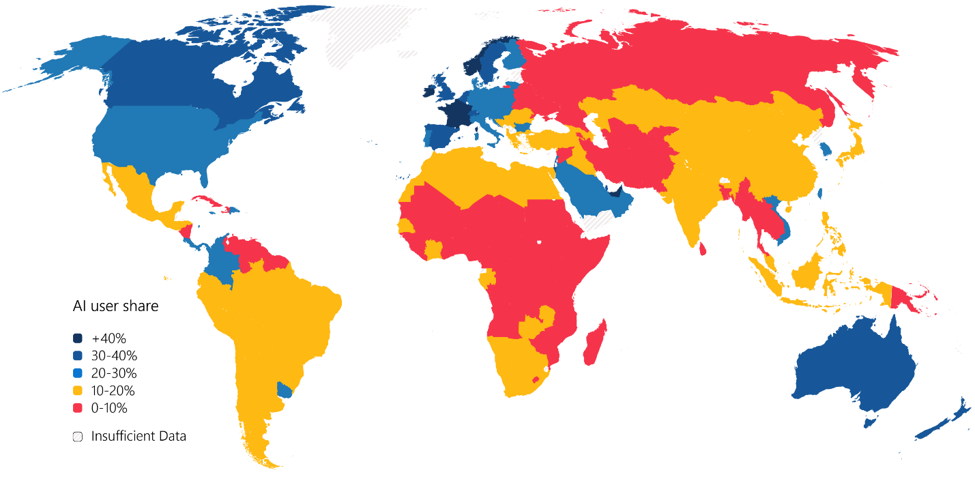
Figure 1 Global distribution of AI adoption rates by economy. Microsoft (2025)
A majority of countries with high adoption (20+%) are based in Europe and North America. Fellowship regions (Africa, Latin America and the Caribbean, South and Southeast Asia) see consistent rates between 0-20%. Many countries with low adoption rates by population show higher rates of adoption when considering the percentage of the population connected to internet (e.g. Tanzania goes from 6.37% user share to 22.62%).
Global Mobile Penetration
GSMA Mobile Connectivity Index, 2025
The United States maintains a high percentage of mobile connectivity (91.45%) at an average increase of 0.66% annually. Additionally, all fellowship countries show positive growth trends suggesting highly adaptive markets (e.g. the Dominican Republic has seen an average increase of 1.97% annually). Nine of the 13 countries represented in the fellowship have an average increase above 1%; the mean increase among countries sampled is 1.22% annually.


WhatsApp / Meta Platforms Penetration (as of 2025)
WhatsApp has between 3 billion to 3.3 billion monthly active users (MAU), with both Facebook and Instagram surpassing 3 billion; Messenger has 947 million. WhatsApp is highly valued across the Global South with five of the top six countries with the Most WhatsApp Users being based across the region. For example, in 2024, India had approximately 853.8 million users while the United States had 98 million users. Latin America is a leader in using WhatsApp commerce for retail, banking, healthcare, tourism, etc.
Tech Sovereignty
India Case Study
India has committed $1.25 billion (USD) to the IndiaAI Mission, which is structured around seven pillars: AI compute, foundation models, datasets, application development, AI safety, startup support, and skills development. To date, India had deployed approximately 34,000 GPUs by mid-2026, with plans to reach 100,000 publicly accessible GPUs by December 2026. IndiaAI has selected Indian firms, including Sarvam AI, to develop indigenous foundation-model capacity. Complementary public-language infrastructure, including Bhashini, supports AI services across multiple Indian languages.








Community Adaptation for a Water Festival Without Clean Water