
Editor’s Note: Stimson’s Myanmar Project seeks a variety of analytical perspectives on issues relating to Myanmar’s civil war, domestic politics, foreign relations, and other topics. Angshuman Choudhury is a doctoral candidate at the National University of Singapore and King’s College London. His expertise encompasses India-Myanmar relations, western Southeast Asian affairs, and the politics of Northeast India.
By Pamela Kennedy, Fellow and Deputy Director, China Program
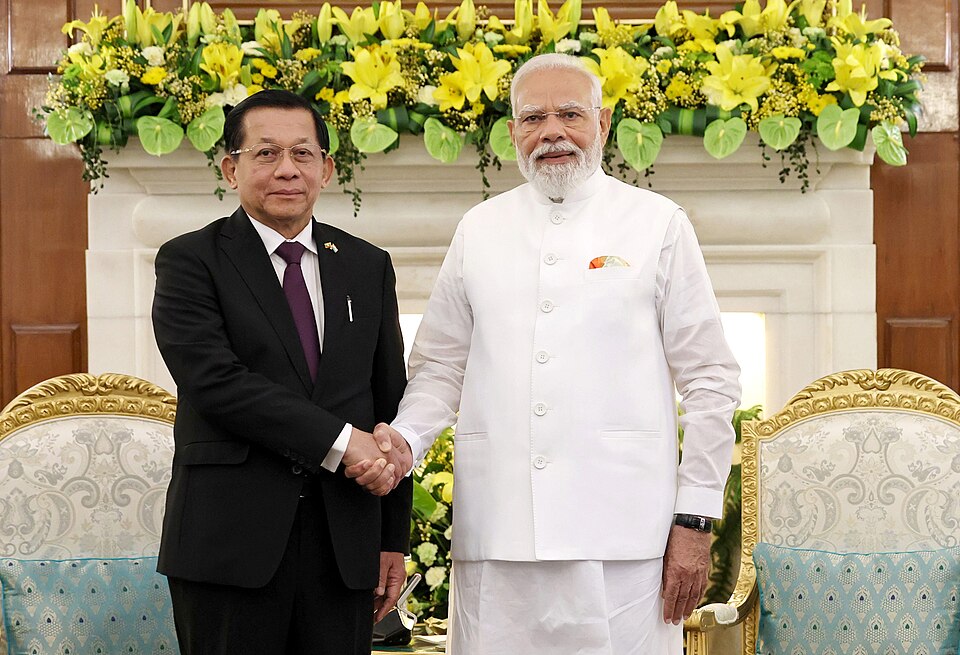
In 2024, three years after wresting power in a coup, Myanmar’s military leader, Min Aung Hlaing, made an unsurprising choice for his first foreign trip: China. But, two years on, he picked a different neighbor for his maiden foreign tour right after becoming the country’s president through a heavily stage-managed election: India. Extending only a “working visit,” rather than a full “state visit,” New Delhi welcomed him as part of a calibrated push to normalize ties with Naypyidaw, using the elections as a nominal marker of “democratic transition” while continuing to engage quietly with the resistance. In doing so, it seeks to reassert its position as a key geopolitical player in Myanmar.
This matters more than ever for India as China moves to consolidate its leverage over the new “government” through coercive conflict mediation and open political and economic support for the regime. India sees Beijing’s renewed outreach as a threat to its decades-long relationship with the military and ability to pursue four key objectives that are central to its relationship with Myanmar within the ambit of its “Act East Policy”: better securing the border, completing flagship connectivity projects, consolidating its strategic presence in the Bay of Bengal, and expanding bilateral trade and investments.
For his part, Min Aung Hlaing sought to use India’s image as the region’s largest federal democracy to legitimize his own regime, something that New Delhi was happy to offer in exchange for stronger strategic ties. On the other hand, India views the anti-junta resistance as divided and unable to consolidate power within a centralized state apparatus and thus sees little strategic gain in engaging publicly with it on democracy. Instead, it appears to be falling back to its risk-averse policy of pursuing stronger ties with Naypyidaw while soft-pedaling normative concerns.
This model of bilateral engagement makes India’s Myanmar strategy look very similar in intent to that of its primary competitor, China. In turn, it renders India into a mere substitute for, and not an alternative to, China. By leaning on the hugely unpopular regime for short-term strategic gains, New Delhi may end up jeopardizing its relations with other political stakeholders in Myanmar in the longer term, especially if resistance forces maintain control of the border or a broader political shift takes place next door (not unlike in Bangladesh). Because India lacks the leverage that China enjoys in Myanmar, without a differentiated strategy, it may struggle to find its footing in the country if and when this happens.
India, therefore, needs to hedge more broadly and deeply with diverse stakeholders in Myanmar with the aim of protecting its interests in a future with multiple possible scenarios.
Geopolitical Battle of Leverage
India understands that Min Aung Hlaing, despite the extraordinary strategic imperatives that he faces today, remains wary of Myanmar’s overdependence on China. This offers New Delhi an opportunity to demonstrate its influence in Naypyidaw, with the broader aim of expanding its geopolitical orbit in Southeast Asia and countervailing Beijing’s growing dominance in its immediate neighborhood. This is largely why India has continued to engage the Min Aung Hlaing regime as its front-facing diplomatic partner in Myanmar since the coup, even as it sought to build fresh ties with Ethnic Armed Organizations (EAO) and allied resistance forces, especially those along its border with western Myanmar, after Operation 1027 in October 2023.
The military-run phased election, although hugely unpopular among the people of Myanmar, has given New Delhi a normatively convenient (though disingenuous) political rationale to normalize relations, especially as the Chinese doubled down on their own support to the junta. This calibration is further aided by the renewed outreach that some ASEAN members, like Thailand, have made to the junta in recent months, allowing India to align its diplomatic posture with the wider region.
In spite of India’s appeasement of the Min Aung Hlaing regime, however, Chinese influence continues to grow. Beijing’s deft strategic maneuvering with the Three Brotherhood Alliance members in northern Myanmar, leading to multiple Chinese-mediated bilateral ceasefires, has reduced military pressure on the junta and consolidated Chinese leverage over Naypyidaw to an unprecedented degree. The Min Aung Hlaing regime, thus, finds itself compelled to demonstrate meaningful progress on Beijing’s geoeconomic endeavors, such as the high-stakes Kyaukphyu port-cum-SEZ project and other Belt and Road Initiative (BRI)-linked connectivity projects.
India, in comparison, has limited leverage or coercive power over the Naypyidaw regime to affect foreign policy behavior. It does have some strategic chips to play on certain fronts, however, and the regime knows that well. A set of powerful EAOs, People’s Defense Forces (PDF), and allied organizations continue to operate freely along and across the India-Myanmar border. Unlike Beijing, New Delhi has little influence over their strategic conduct, let alone an ability to broker ceasefires. But it can continue to look away or, in some cases, silently empower them by providing both direct and indirect non-military aid, such as allowing informal trade of essential items (including fuel) to resistance-controlled territories in Chin and Rakhine States through the Mizoram border. By doing so, India can indicate its strategic depth to Naypyidaw and, in turn, compel it to address India’s own border security concerns. However, for India, this is a delicate strategic bargain, as the regime, too, can use armed groups along the border to counter New Delhi’s tacit coercion.
India also continues to use subtle diplomatic maneuvers to indicate its discomfort with the military-backed regime, if not its support for the anti-junta opposition. For example, the Narendra Modi government welcomed Min Aung Hlaing but didn’t exactly lay out the red carpet. He got what is known as a “working visit,” one notch below a “state visit.” While a working visit is also a high-level official reception, designed for direct engagement on critical bilateral issues, it stops short of full sovereign recognition of the other side. Even in April, when Min Aung Hlaing officially anointed himself Myanmar’s President, India sent its Minister of State for External Affairs, rather than the more senior External Affairs Minister, to attend the inauguration.
In the diplomatic universe, these subtleties matter, as they reveal the finer contours of foreign policy practice. India’s graded responses to the Min Aung Hlaing regime speak to what is widely referred to as its “dual-track diplomacy” in Myanmar: maintaining ties with whoever is in control of Naypyidaw while keeping open channels of engagement with the opposition. More specifically, India may be trying to preserve some goodwill with the resistance that remains in control of large swathes of its geopolitically crucial northeastern border. This was also conspicuous in the remarks delivered virtually by the Indian ambassador to Myanmar, Abhay Thakur, at the recent junta-hosted 11th anniversary program of the Nationwide Ceasefire Agreement (NCA) in which he emphasized the need for “constructive engagement” with “all stakeholders”, including those “operating or present along the India–Myanmar border.” Beijing maintains a similar dual track, but through more direct (and coercive) relations with EAOs in northern Myanmar which depend on Chinese-linked or approved supply lines and underhand political backing to sustain themselves. This is why the Chinese could offer Min Aung Hlaing a full state visit without fretting about alienating the resistance, something that India would struggle to do.
The Security Pitch
While India’s careful balancing would not have been lost on him, Min Aung Hlaing tried to use the visit to tip the scales in his favor. By assuring India that his regime would not allow Myanmar’s territory “to be used against India’s security interests” – which, in this context, is a coded reference to Indian armed groups using Myanmar as a staging post – he sought to present himself as New Delhi’s primary border security guarantor. However, based on precedent, India has little reason to trust the Myanmar military on this issue. In fact, the latter has continued to offer shelter to Indian armed groups in Myanmar in exchange for their mercenary services against the pro-democracy resistance. Some of these groups, like the People’s Liberation Army (PLA) of Manipur and the United Liberation Front of Asom-Independent (ULFA-I) of Assam, have used their cross-border safe havens in western Sagaing Region to attack Indian security forces in the recent past.
While New Delhi sees Indian armed groups’ presence in Myanmar and the junta’s inaction as irritants, it does not appear to want to press Naypyidaw too hard. This is because India understands the Myanmar military’s strategic constraints, including its lack of territorial control over areas of northwestern Myanmar where the anti-India outfits are based. Therefore, New Delhi prefers to deal with them directly through cross-border kinetic action, such as using drones to occasionally attack these armed outfits.
In fact, by not pushing too many buttons in Naypyidaw on this issue, New Delhi wants to preserve its strategic privilege to strike across the border without provoking the regime next door. India’s desire to do so was also conspicuous in the India-Myanmar joint statement, which did not mention a specific reciprocal guarantee on border security from the Indian side, unlike those made by Beijing in the joint statement from the Myanmar leader’s visit to China from June 15-19. India only broadly agreed to “support” Myanmar’s “sovereignty and territorial integrity.”
What is clear is that India was successful in securing a public assurance on border security from Min Aung Hlaing without committing much in return, thus preserving its space to not only act against anti-India outfits inside Myanmar, but also quietly permit anti-junta groups to operate along and across the porous border.
It is possible, however, that the Myanmar side urged New Delhi to restrict anti-junta networks, such as Chin-led aid groups, from operating across the border or using Indian territory (Mizoram, specifically) to mobilize. The recent arrests by Indian authorities of seven foreign nationals, including one American, who were returning from an alleged drone-delivery assignment in Myanmar may be one indication of renewed collaboration between New Delhi and Naypyidaw on security and intelligence sharing. However, even in this specific instance, the Modi government, by not aggressively pursuing draconian anti-terror charges against the seven individuals, seems to be indicating that it will not always acquiesce to Naypyidaw’s requests, prioritizing its own strategic interests instead.
As part of these delicate negotiations, Min Aung Hlaing also promised to secure crucial cross-border trade routes for India. It is hardly a coincidence that just days after his visit, Naypyidaw’s forces moved in to recapture large parts of the highway between the border town of Tamu and the local trade hub of Kalay in western Sagaing, a key connectivity route that forms the first stretch of the ambitious, under-construction India-Myanmar-Thailand Trilateral Highway. New Delhi may see this as a meaningful return on its renewed bilateral outreach to the junta, but only if the regime is able to hold on to the route and create a secure corridor for India to resume road construction.
Even if patches of the highway remain contested in the near future, Naypyidaw may use its limited success to convince India that tides have begun to shift in its favor. The regime’s recent recapture of Falam in Chin State, which the resistance had seized in April 2025, could become part of yet another pitch for closer collaboration with New Delhi, which, like Beijing, seeks a stable borderland. In fact, the military could use Falam as a launchpad to reclaim large sections of the vital Mizoram-Chin State border, which is key to cross-border trade and the successful completion of the high-stakes, India-funded Kaladan Multi Modal Transit and Transport Project (KMMTTP).
If the regime demonstrates its ability to expand and retain strategic territory, India may revert to a more orthodox foreign policy of showing more commitment to backing the Naypyidaw regime in keeping with its time-tested relationship with the Myanmar military and overstated belief in it as the country’s only coherent institution. A recent defense cooperation meeting between both sides in Guwahati, Northeast India’s largest city, may indicate a new phase of military-to-military cooperation centered around the border regions. However, as long as the Arakan Army remains active in northern Rakhine and southern Chin States, Naypyidaw’s forces will find it nearly impossible to capture and dominate the KMMTTP route, most of which passes through territory controlled by the Rakhine EAO. A recent spate of airstrikes in southern Chin and Rakhine States demonstrates the regime’s desperation to make inroads here.
Ailing Economics
Because Min Aung Hlaing has little to offer to India in terms of real security-related gains on the ground, he led his salvo with economic ties, as his business-dominated diplomatic entourage and participation in the India-Myanmar Business Conclave in Mumbai showed. Even on this, however, the India-Myanmar relationship remains lopsided, with Indian imports from Myanmar far exceeding its exports. Regular bilateral trade has fallen from US $2.14 billion in FY2024-25 to $1.95 billion in FY2025-26, despite the formalization of the rupee-kyat trade settlement mechanism in 2024. Political strife continues to deter large-scale Indian private investments in the country. Border trade, unlike in the case of Thailand or China, remains a minuscule part of the India-Myanmar economic story and will remain so unless the political-security environment changes radically.
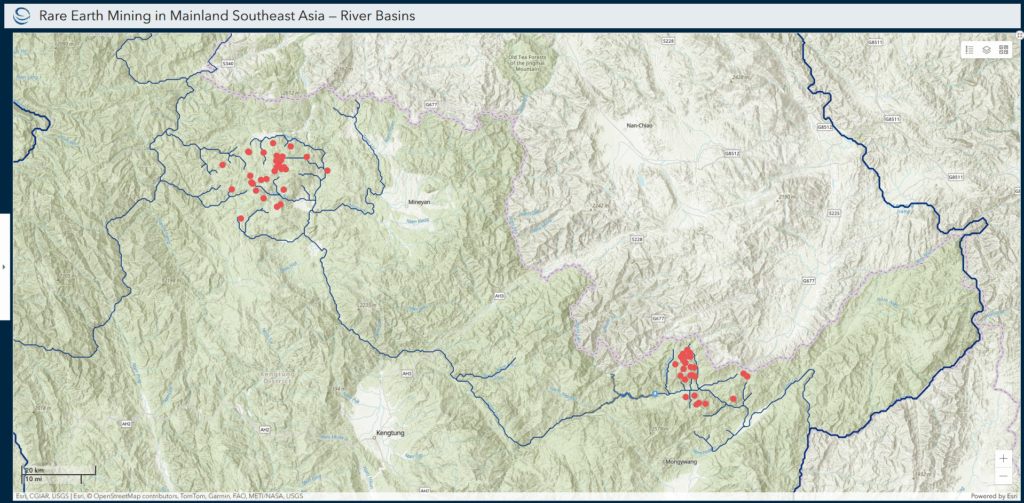
Min Aung Hlaing can potentially offer India exclusive access to rare earths (RE), something that New Delhi wants dearly, as shown by the Indian envoy’s comments at a recent mining forum in Mandalay. But most of Myanmar’s RE geography, spanning large parts of northern Kachin State and expanding in northern Shan State, remains outside of his regime’s control and under the dominance of the powerful Kachin Independence Army (KIA) and other EAOs. The one small RE-heavy section that the regime previously controlled along the Sino-Myanmar border in Pangwa (Chipwi Township) through a local militia also fell into the KIA’s hands in 2024.
Therefore, it is only by working directly with the KIA that New Delhi can hope to secure limited access to critical minerals. India may have already reached out to the KIA, although the Kachin EAO will tread carefully before parceling out RE blocks whose primary client is its northern neighbor, China. Beijing, after all, would balk at the prospect of sharing its de facto RE procurement and processing rights with India, one of its primary regional competitors. This is especially true following India’s recent inclusion in the US-led “Pax Silica” alliance, which, among other things, seeks to reduce import dependency on the Chinese RE supply chain through willing partners.
India’s Normative Edge
For India, there are no easy bargains with either the military or the resistance, and the rapidly shifting territorial landscape complicates matters further. Moreover, the political and security establishments in New Delhi continue to see the Myanmar military as a structurally resilient institution that may be unpopular and currently under attack, but as too big and powerful to collapse entirely. It is this orthodox, deeply entrenched belief that has discouraged successive Indian governments from abandoning the military and reallocating some of its chips to the democratic resistance.
India’s normative hesitation is even more pronounced today, with the Modi government’s sparse interest in upholding democratic ideals at home, let alone using it as a meaningful foreign policy tool. Yet, New Delhi should not lose sight of the normative foundations of India’s foreign policy, some of which the Indian prime minister has himself articulated at different forums, such as the Voice of the Global South Summit in 2023 and the Shanghai Cooperation Organisation (SCO) summit in 2024, using the language of universalism, peace, and humanity. Nor must it forget that the Min Aung Hlaing regime is only keen to use India’s democratic credentials to polish its own image and balance growing Chinese influence, rather than initiate genuine democratic reforms within Myanmar.
Therefore, India may need to adopt a different approach: one that looks beyond the current regime, while also seeking to work around its current strategic asymmetry with China. This would mean investing more assets at different levels of the diplomatic and security apparatuses to expand ties and build trust with ethnic stakeholders across Myanmar. Because ethnic forces continue to dominate large sections of the strategically pivotal India-Myanmar border, despite the Naypyidaw regime’s recent military victories, this would allow India to secure its security and economic interests more comprehensively.
Moreover, the New Delhi establishment should recognize that it has something unique to offer to Myanmar that China does not: a normative model for a federal democratic union, which is what many in the resistance seek to build today. Taking a bolder approach to the resistance would allow New Delhi to minimize risks and maximize benefits and potentially even outflank China in the event of a tectonic power shift in Myanmar in the future.




Community Adaptation for a Water Festival Without Clean Water