
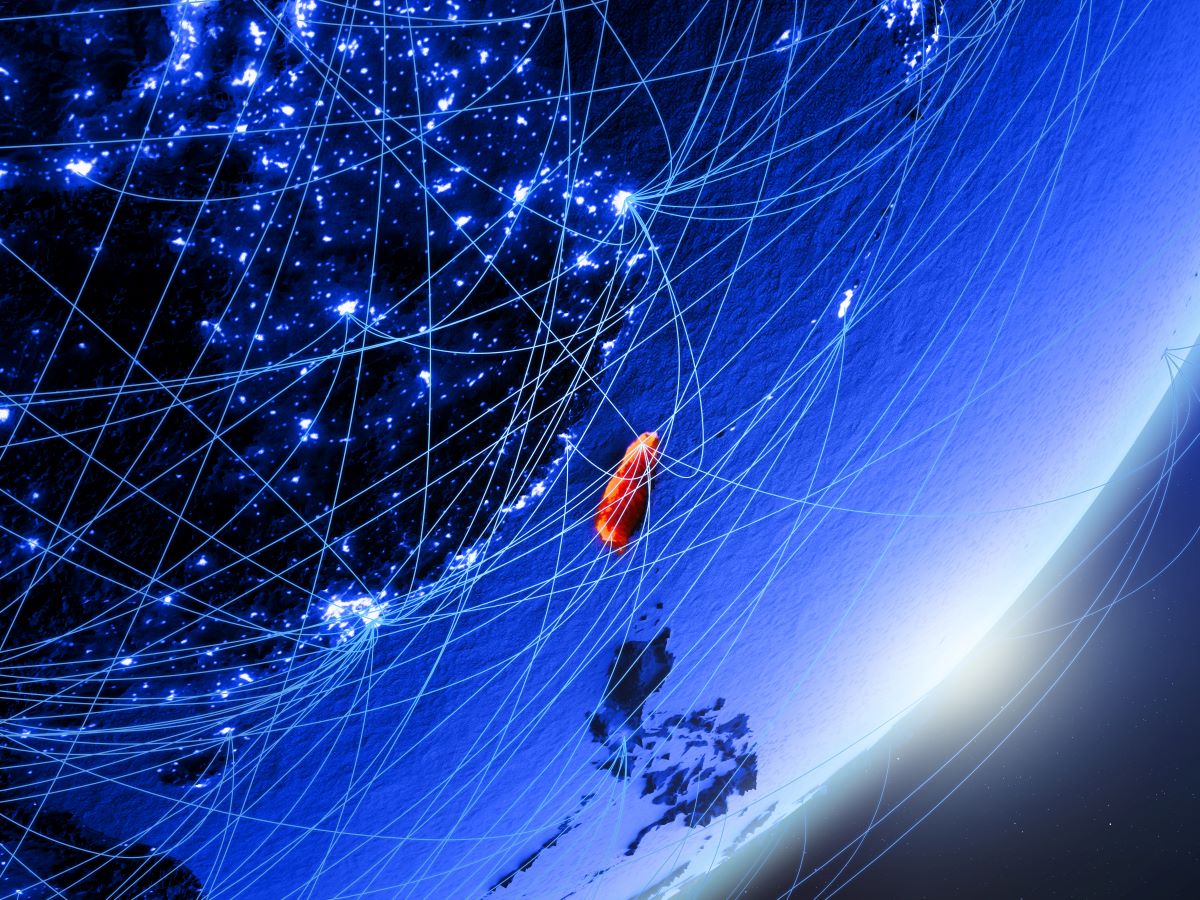
Taiwan’s unmatched capabilities in the advanced semiconductor industry give the United States a strong interest in the island’s security and the stability of the Taiwan Strait, providing Taiwan with its proverbial “silicon shield.” This interdependency between the United States and Taiwan will deepen with the US-led Pax Silica Declaration, formalized in January 2026 with Taiwan’s support,1The Pax Silica signatories as of April 2026 include the U.S., the UK, Greece, Australia, Singapore, Japan, South Korea, Israel, the Netherlands, Qatar, the United Arab Emirates, India, Sweden, and the Philippines. by elevating the semiconductor supply chain to a vital role in the AI race, because without these chips, there is no AI.
This new level of high-tech collaboration between the United States and Taiwan reflects the importance that both partners place on the potential for AI to transform the world and the need for a cooperative approach on the complex economies underlying the AI revolution. In their joint statement on the Pax Silica Declaration, the U.S. and Taiwan agreed to promote prosperity, economic security, and technological progress through their economic partnership in this new era of AI.2The Government of the United States of America, Department of State, “Joint Statement on the Pax Silica Declaration and U.S.-Taiwan Economic Security Cooperation,” January 27, 2026, https://www.state.gov/releases/under-secretary-for-economic-affairs/2026/01/joint-statement-on-the-pax-silica-declaration-and-u-s-taiwan-economic-security-cooperation/. Taiwan is not a signatory of Pax Silica, though U.S. officials have hinted that Taiwan may sign on in the future.3Keoni Everington, “Taiwan and US sign statement endorsing Pax Silica principles,” Taiwan News, January 28, 2026, https://www.taiwannews.com.tw/news/6291154. Yet Taiwan is perhaps the most indispensable partner for the United States in AI and semiconductors. The United States would not be able to secure the AI supply chain without Taiwan’s cooperation. And Taiwan needs AI partnership with the United States to strengthen the silicon shield.
The Symbiotic AI Chip Supply Chain
US-Taiwan AI cooperation builds upon a well-established supply chain for semiconductors. For several decades, as US-based chip manufacturing decreased with the rise of the fabless business model,4Karen M. Sutter, Emily G. Blevins, and Yong W. Kwon, “Semiconductors and the CHIPS Act: The Global Context,” Congressional Research Service, September 28, 2023, https://www.congress.gov/crs-product/R47558. U.S. tech companies have increasingly focused their efforts on designing the chips required for advanced technologies, while Taiwanese foundries have produced them and then sold them back to their largest customers in the United States. This has been a symbiotic relationship, with U.S. companies pouring investments into R&D for supercomputing hardware and software and Taiwanese companies likewise investing in new manufacturing technologies to create more powerful chips. The ability of Taiwanese fabs to consistently produce these chips at high yields — the number of usable chips per wafer — is critical to the success of the supply chain, as it both meets the enormous demand of U.S. customers for advanced chips and lowers the cost of the chips.
Taiwan’s advantage in chip-making extends beyond the fabrication part of the supply chain. The chip industry in Taiwan covers the entire chain of production, including chip design, masking and fabrication, and packaging and testing, spread across more than 300 companies.5Taiwan Semiconductor Industry Association, “Overview on Taiwan IC Industry: 2025 Edition,” July 8, 2025, 3, https://www.tsia.org.tw/EN/PublOverview?nodeID=60. This proximity has enabled Taiwanese companies to develop manufacturing techniques for the increasingly advanced chips required for supercomputing. Taiwan’s all-in-one ecosystem is central to the efficiency and expertise of chip production in Taiwan, and it is difficult to replicate elsewhere due to the complexity of the production processes, the specialized equipment and technologies required, and the need for a reliable pipeline of workers with specialized skills.6Stimson, “Why Taiwan Fears ‘America First’ Risks Eroding Its ‘Silicon Shield’,” Pamela Kennedy, October 10, 2025, https://www.stimson.org/2025/why-taiwan-fears-america-first-risks-eroding-its-silicon-shield/#elementor-toc__heading-anchor-1. This makes Taiwan the natural leader in producing chips for AI.
Could the Silicon Shield Become the AI Shield?
AI requires some of the most advanced logic chips available today, about 90% of which are physically made in Taiwan. But the Trump administration is working to onshore chip manufacturing with a goal of fulfilling 40% of U.S. demand for advanced chips with domestic production by the end of Trump’s term,7“Taiwan says 40% shift of chip capacity to US is ‘impossible’,” Reuters, February 8, 2026, https://www.reuters.com/world/china/taiwan-says-40-shift-chip-capacity-us-is-impossible-2026-02-09/. thus reducing U.S. reliance on the hyper-concentration of advanced chip-making in Taiwan. This move seems counterproductive to strengthening the US-Taiwan chip partnership, and indeed the Trump administration’s forceful approach to this onshoring effort has decreased Taiwanese people’s trust in the United States, leading to doubts in the strength of the silicon shield.8Stimson, “Why Taiwan Fears ‘America First’ Risks Eroding Its ‘Silicon Shield’,” Pamela Kennedy, October 10, 2025, https://www.stimson.org/2025/why-taiwan-fears-america-first-risks-eroding-its-silicon-shield/#elementor-toc__heading-anchor-1. Yet the fact of Taiwan’s dominance in advanced logic chip manufacturing may result in tying U.S. interests even more closely to Taiwan’s. Deeper relationships between U.S. and Taiwanese companies, as they collaborate on AI-capable chips, could reinforce the silicon shield with enormous investments in AI.
Through the US-Taiwan trade agreement signed in January 2026, Taiwanese companies committed to investing $250 billion in U.S. semiconductor and AI-related industries, and the Taiwanese government agreed to provide $250 billion in credit to these firms.9Government of the United States of America, Department of Commerce, “Fact Sheet: Restoring American Semiconductor Manufacturing Leadership Through an Agreement on Trade & Investment with Taiwan,” January 15, 2026, https://www.commerce.gov/news/fact-sheets/2026/01/fact-sheet-restoring-american-semiconductor-manufacturing-leadership. This joins investment by Taiwan’s leading chip maker, TSMC, which has expanded its plans in Arizona several times since 2020.10Dylan Butts and Emily Tan, “TSMC is set to expand its $165 billion U.S. investment — here’s what we know,” CNBC, January 15, 2026, https://www.cnbc.com/2026/01/16/tsmcs-arizona-chip-expansion-isnt-done-after-us-investment-cfo.html. So far, one fab out of six planned is operational and is reported to have high yields,11Craig Mellow, “TSMC in Arizona: the most transformative FDI project ever?” FDI Intelligence, January 21, 2026, https://www.fdiintelligence.com/content/f24e3fc7-5d62-4686-95ab-5b1ce6524737. but it will take time for output at the Arizona hub to fulfill a substantial portion of U.S. demand. Taiwan benefits from the AI race happening now, rapidly, which means the United States must continue to rely on chips produced in Taiwan for most of its supply.
The Taiwanese government is working to further cement Taiwan’s place in the AI supply chain by efforts to expand Taiwan’s expertise in AI beyond the hardware. This addresses another critical element of the Pax Silica vision: the growth of AI from a technology with the potential to exponentially expand economic growth to one that delivers on the massive investments made in the United States, Taiwan, and around the world over the past few years. The Lai administration’s “Ten AI Initiatives Promotion Plan,” announced in January 2026, is a development strategy to utilize AI effectively in Taiwan, as well as expand Taiwan’s AI talent pipeline and domestic compute capacity.12Republic of China (Taiwan), National Development Council, “Ten AI Initiatives Promotion Plan (2025-2028),” accessed April 13, 2026, https://www.ndc.gov.tw/en/Content_List.aspx?n=E738D6D7DD31163F. The plan points to Taiwan’s declining birthrate and labor shortages as motivations for using AI to strengthen the island’s national and economic security, though it will face significant challenges in supplying the energy and fresh water that an expanded AI infrastructure ecosystem will require. Partnership with the United States, which also faces the political problem of securing resources for AI while meeting existing consumer demands for energy and water, may help to develop solutions. Just as cultivating a robust pipeline of AI experts and testing applications of AI will make Taiwan a stronger partner in the AI race, working with the United States (which has far greater compute capacity with over 4,000 data centers and hundreds of billions of dollars of private and government investments in AI-related sectors13Board of Governors of the Federal Reserve System, “The State of AI Competition in Advanced Economies,” Alex Haag, October 6, 2025, https://www.federalreserve.gov/econres/notes/feds-notes/the-state-of-ai-competition-in-advanced-economies-20251006.html. ) could amplify Taiwan’s efforts and offset the resource demand.
Vulnerabilities in the Supply Chain
The United States and Taiwan cannot rest on the laurels of their successful chip supply chain partnership if they hope to run the AI race together. There are several vulnerabilities in the supply chain that could cut the AI race short. Taiwan’s semiconductor and other high-tech industries are downstream of other parts of the supply chain, which are located around the globe, leaving Taiwan’s companies exposed to supply chain disruptions. The chip manufacturers need, for example, extreme ultraviolet (EUV) lithography machines produced by Dutch company ASML to etch transistors invisible to the naked eye on the most advanced chips. They also need critical minerals, like the gallium and germanium semiconducting minerals, which are almost exclusively supplied by Chinese companies.14Center for Strategic and International Studies, “From Mine to Microchip,” Gracelin Baskaran and Meredith Schwartz, October 7, 2024, https://www.csis.org/analysis/mine-microchip. While the Netherlands is not likely to impose export controls restricting Taiwanese access to the lithography machines, China has experimented with export controls on these critical minerals as leverage in the trade and tech war with the United States over the past few years, which also saw Chinese exports of germanium to Taiwan zero out between 2022 and 2024.15Stimson, “China’s Germanium and Gallium Export Restrictions: Consequences for the United States,” Sarah Godek, March 19, 2025, https://www.stimson.org/2025/chinas-germanium-and-gallium-export-restrictions-consequences-for-the-united-states/. The near monopoly that China enjoys over the critical minerals processing industry leaves Taiwanese tech companies with few options for other sources, should China decide to reduce or ban exports of key minerals.
In an ongoing supply chain crunch, the supply of helium, which is necessary to create the inert environment required in fab cleanrooms, has been severely restricted by the war in Iran, as Qatar, which produces 34% of the global helium supply, has had to halt production.16Eduardo Baptista, “Helium shortage has started impacting tech supply chains, execs say,” Reuters, March
26, 2026, https://www.reuters.com/world/asia-pacific/helium-shortage-has-started-impacting-tech-supply-chains-execs-say-2026-03-26/. Kelvin Chan and The Associated Press, “Iran war cut off helium from Qatar, and shortages will start to bite in a few weeks, threatening chip supply chains that fuel the AI boom,” Fortune, March 21, 2026, https://fortune.com/2026/03/21/iran-war-helium-shortage-qatar-chip-supply-chains-ai-boom/. And potential instability in the Taiwan Strait could threaten Taiwan’s ability to export semiconductors to the United States — the fundamental geopolitical problem underlying the silicon shield idea.
Thus, the widely distributed geography of chip manufacturing inputs creates multiple points of vulnerability in the supply chain that may be impacted by numerous events — conflicts, natural disasters, pandemics, blockages of shipping lanes, increases in fuel prices, imposition of tariffs. Not all of these factors are within the control of the United States and Taiwan. But in order to maintain a secure, reliable supply chain, these potential chokepoints and weak links require the United States and Taiwan to try to mitigate or prevent adverse events and seek to address known supply chain weaknesses.
These parallel areas of cooperation might echo past cooperative efforts, such as the assistance with masks and vaccines that Taiwan and the United States provided each other during the COVID-19 pandemic, as well as include current efforts to deter China from making a move on Taiwan. Reducing the impact of chokepoints like critical minerals and helium supplies may require the development of alternative resources and new technologies. U.S. and Taiwanese industries are well-positioned for collaboration and share incentives to reroute or innovate new supply chains, though the timelines, especially for reducing critical mineral dependency on China, are long, as with Japan’s 15-year-long experience.17River Akira Davis and Kiuko Notoya, “How Japan Built a Rare-Earth Supply Chain Without China,” The New York Times, December 8, 2025, https://www.nytimes.com/2025/12/08/business/japan-rare-earths-lynas.html. The Trump administration could assess whether the tariffs on Taiwanese goods create friction in the supply chain, including Section 232 tariffs, which Taiwanese companies can only avoid if they invest in certain amounts of US-based production. Importantly, the United States will need to rebuild the trust with Taiwan that was damaged by the perception that Washington sought to weaken the silicon shield by onshoring the chip industry.
In keeping with the spirit and purpose of Pax Silica, the United States and Taiwan will also need to cultivate and support an international order that is conducive to strengthening the supply chain. Pax Silica’s growing membership is an important recognition of the need for consensus among a broader group of like-minded countries. But other efforts to create a stable international environment matter as well: reiterating the importance of peace and stability in the Taiwan Strait; reducing US-China tensions and maintaining dialogues; and reassuring and strengthening international groupings, including alliances like NATO and multilateral organizations like the UN. The Trump administration has the most work to do on this point, as the administration’s policies so far have been more disruptive than stabilizing, from the global economic fallout from the trade war to the war on Iran, and “America First” maneuvers like withdrawing the United States from 66 international organizations clearly signal a preference for unilateralism.18Government of the United States of America, The White House, “Fact Sheet: President Donald J. Trump Withdraws the United States from International Organizations that Are Contrary to the Interests of the United States,” January 7, 2026, https://www.whitehouse.gov/fact-sheets/2026/01/fact-sheet-president-donald-j-trump-withdraws-the-united-states-from-international-organizations-that-are-contrary-to-the-interests-of-the-united-states/. But if the administration is serious about Pax Silica, it must remember that the initiative will not bring about stability by default. Pax Silica, and the AI supply chain, will thrive best in a more stable global security environment.
Towards a Stronger AI Partnership
The United States and Taiwan are uniquely positioned as cornerstones of the AI supply chain. They possess complementary competitive advantages, and their industries have the benefit of long-standing relationships between companies. The Pax Silica Declaration poises them to deepen the partnership, which may serve to strengthen Taiwan’s silicon shield through shared stakes in realizing the potential of AI. The success of this partnership, however, will rest on whether the United States and Taiwan can manage or reduce the vulnerabilities in the supply chain, both internal frictions and external chokepoints, well enough to maintain their edge in the AI race. Having gone all-in on AI, Taiwan and the United States need each other to keep running the race.





Community Adaptation for a Water Festival Without Clean Water