


Editor’s Note: This brief was informed by expert presentations by Parfait M. Eloundou-Enyegue, PhD (Cornell University), Kathleen Mogelgaard (Population Institute), Andrew Selee, PhD (Migration Policy Institute), and Jennifer Sciubba, PhD (Population Reference Bureau), shared at an Environmental Security Program Congressional Masterclass on global demographic trends.
By Lauren Herzer Risi, Senior Fellow and Director, Environmental Security Program
Executive Summary
Population dynamics underpin many of today’s most urgent societal challenges, yet these factors are rarely mentioned in policy discussions. As Cornell University demographer Parfait Eloundou-Enyegue notes, “If there is any century in which we have to think carefully about population, it is this century.”1Parfait Eloundou-Enyegue, “Congressional Masterclass on Global Population Trends” (lecture presented at Congressional Masterclass hosted by the Stimson Center Environmental Security Program, Washington, D.C., April 24, 2026). The 21st century is defined by simultaneous demographic shifts as population:
- grows rapidly in some places while shrinking in others;
- ages at historic speed in some regions while others remain youthful; and
- redistributes from rural areas to cities.
Understanding how these dynamics impact U.S. priorities like healthcare, cost of living, fiscal policy, and national defense is essential for crafting policies and strategies that are effective and resilient in the face of demographic changes.
Youth bulges: Between 2000 and 2025, fertility rates declined in every UN region.2David E. Bloom et al., “The Debate over Falling Fertility,” International Monetary Fund F&D Magazine, June 2025. https://www.imf.org/en/publications/fandd/issues/2025/06/the-debate-over-falling-fertility-david-bloom. But populations in Sub-Saharan Africa and South Asia remain strikingly young, and by 2050, the number of working age people in these regions will grow by more than 1 billion.3Labor Mobility Partnerships, “Growing Youth Populations in Low-Income Countries Require Creative Jobs Solutions,” Rebekah Smith (October 2020). https://lampforum.org/2020/10/08/growing-youth-populations-in-low-income-countries-require-creative-jobs-solutions/#_edn1. Already, the number of workers —especially skilled and educated workers — in these regions has risen faster than the net supply of jobs. In India, young people account for 83% of the unemployed; in Indonesia, 16% of young people aged 15-24 are out of work.4Syed Munir Khasru, “Asia’s next economic crisis may come from youth unemployment,” The Institute for Policy, Advocacy, and Governance, April 3, 2026. https://www.ipag.org/asias-next-economic-crisis-may-come-from-youth-unemployment/.,5Aisyah Llewellyn, “Indonesia has 44 million youths. It’s struggling to get them jobs,” Al-Jazeera, July 18, 2025, https://www.aljazeera.com/economy/2025/7/18/indonesia-has-44-million-youths-its-struggling-to-get-them-jobs. Projected increases in the youth population represent an enormous potential economic asset for these regions, but only if their countries have the jobs, education systems, and institutions to support them.
Urbanization: Countries must grapple with shifting policy priorities as shifting demographic trajectories influence urbanization rates, rural-to-urban migration, distribution of urban growth (i.e., growth in medium versus large cities), the informal labor force, and informal settlement growth.6The World Bank, “Demographic Trends and Urbanization,” Sameh Naguib Wahba Tadros et al. (2021). https://documents.worldbank.org/en/publication/documents-reports/documentdetail/260581617988607640. Between 2000 and 2020, South and Southeast Asia and Sub-Saharan Africa saw the fastest urban growth compared to other regions, due to natural increase and rapid rural-to-urban migration by workers seeking economic opportunities.7Andrew Zimmer et al., “Global divergence in urban demographic change and migration patterns.” Nature Cities (2026). https://doi.org/10.1038/s44284-026-00447-7. Urbanization presents unique challenges and opportunities across the urban continuum, from rural areas to small and medium-sized cities to megacities.8Ibid.
Aging in the United States: The United States is aging. Between 2010 and 2060, the ratio of people who are not of working age (i.e., under 15 and over 64) relative to every 100 people of working age (15 to 64) is projected to nearly double from 21 to 41, compounding pressures on Social Security and Medicare funds, which depend directly on the ratio of working age contributors to older beneficiaries.9U.S. Census Bureau, “Demographic Turning Points for the United States: Population Projections for 2020 to 2060,” Jonathan Vespa, Lauren Medina, and David M. Armstrong, (Washington, D.C.: U.S. Census Bureau, 2020). https://www.census.gov/content/dam/Census/library/publications/2020/demo/p25-1144.pdf. ,10Congressional Budget Office, “The Demographic Outlook: 2025 to 2055,” Daniel Crown and Katherine Starkey (Washington, D.C.: CBO, 2025), https://www.cbo.gov/publication/61164. ,11Bipartisan Policy Center, “2026 Social Security Trustees Report, Explained,” Sanya Bahal and Emerson Sprick (June 2026). https://bipartisanpolicy.org/explainer/2026-social-security-trustees-report-explained/.At the same time, aging is increasing demand for elder care while the caregiver workforce shrinks. For instance, the United States has only 7,300 certified geriatricians—far below the estimated need of 30,000 by 2030.12Charles H. Jones and Mikael Dolston, “Healthcare on the brink: navigating the challenges of an aging society in the United States,” NPG Aging 10, no. 1 (April 2024): 22. doi: 10.1038/s41514-024-00148-2.
Declining population is particularly acute in rural communities of the United States. Between July 2024 and June 2025, roughly half of rural U.S. counties lost population, with declines in natural population growth (births minus deaths) driving depopulation in two-thirds of these counties.13Population Reference Bureau, “U.S. Population Growth Slowed Dramatically in 2025 as Immigration Dropped, New Data Shows,” Alicia Vanorman (January 2026) https://www.prb.org/news/new-data-shows-major-slowing-of-u-s-population-growth-in-2025/. As a result, rural communities are facing hospital closures, lower federal infrastructure investment, and labor shortages.
Aging in high-income countries: Population aging is not just a U.S. concern; it’s a challenge for almost all high-income countries, with significant implications for U.S. allies’ military capacity, economic growth, and global stability. Age-related spending pressures are projected to increase in the average OECD country by nearly 6.25% between 2024 and 2060.14OECD, “Aging populations, their fiscal implications and policy responses,” Vassiliki Koutsogeorgopoulou and Hermes Morgavi, (2025). https://www.oecd.org/en/publications/ageing-populations-their-fiscal-implications-and-policy-responses_6aec03b3-en.html. Countries that are simultaneously aging, fiscally constrained, and whose defense-eligible population is shrinking will face hard choices that affect their capacity to contribute resources to shared security and project stability in their regions.
Immigration: Immigration is key to offsetting the pressure of aging populations. As deaths rise and births remain low, net migration to the United States can help sustain the workforce and support economic competitiveness.15Alicia Vanorman, “U.S. Population Growth Slowed Dramatically in 2025.” Prior to the second Trump Administration’s enforcement measures, immigration was projected to become the primary driver of U.S. population growth by 2030.16U.S. Census Bureau, “Demographic Turning Points for the United States.” Between July 2024 and July 2025, however, immigration added just 1.3 million people to the total U.S. population, down from a peak of 2.7 million between 2023 and 2024.17Alicia Vanorman, “U.S. Population Growth Slowed Dramatically in 2025.” With natural population growth remaining steady, and a lower level of international immigration, the total U.S. population grew just 0.5% to 341.8 million in 2025—the slowest growth since 2021, during the COVID-19 pandemic.18Ibid.
Congress possesses the policy levers to shape how these demographic trends affect U.S. interests:
- Directing foreign assistance to drive education, health, and workforce development can help youthful countries build economic and political stability;
- Providing stable, predictable immigration pathways, especially in healthcare and caregiving, can help to curb labor shortages as the U.S. workforce ages; and
- Working today to update domestic entitlement programs and care infrastructure to meet the needs of an aging population can help to prevent future fiscal crises.
The effects of each of these demographic trends will play out for years after political terms end. But these trends present a critical policy opportunity, not a demographic inevitability. The choices made now will shape U.S. competitiveness and security for decades to come.
Figure 1: Workers per Social Security Beneficiary (1960-2100)
The Youth Bulge: Investing in Global Growth and Stability
Global population growth is slowing, and the global population is expected to peak at roughly 10.3 billion in the mid-2080s before beginning a gradual decline(Figure 2).19United Nations, Department of Economic and Social Affairs, Population Division, “World Population Prospects 2024: Summary of Results” (New York: United Nations, 2024), https://population.un.org/wpp/. But this aggregate trend masks enormous differences between countries. Population in close to half of the world’s countries and territories — including China, Russia, Brazil, and Iran — has already peaked or will peak in the next 20 years.20Ibid. The remaining 126 countries and areas will continue to grow, but how fast will depend heavily on how they adapt to these changes. Depending on immigration rates, the U.S. population is expected to reach a peak of nearly 370 million in 2080 before declining to 366 million by 2100.21Ibid.
Figure 2: UN Global Median Population Trajectory by Region (1950-2100)
In the next 25 years, the youth population (15-24 years) in low- and lower-middle income countries is projected to increase by 16%, with much of that growth in Sub-Saharan Africa.22United Nations, Department of Economic and Social Affairs, Population Division, “World Population Highlights 2026: Youth,” (New York: United Nations, 2026), https://www.un.org/development/desa/pd/sites/www.un.org.development.desa.pd/files/undesa_pd_2026_world_population_highlights-youth.pdf. At the same time, the number of youth in high- and upper-middle income countries is projected to fall by 24%. These differing paths, which will shape countries’ labor force, fiscal capacity, and economic development, reflect a given country’s stage within the demographic transition, a model that plots countries’ evolution from high mortality and high fertility rates, to low mortality and low fertility rates (see “Age Structure and the Demographic Transition”). Where countries are in this transition — and how quickly they are moving through its stages — has implications for U.S. foreign policy, development assistance, and global economic stability.
In a demographically diverse world, understanding which regions host large youth populations — and where young populations are expected to continue growing rapidly — can indicate where investments in education, employment, health, gender equity, and other sectors could secure the greatest gains and reduce the likelihood of political instability. Today, roughly 55% of the world’s youth aged 15-24 live in Asia and the Pacific.23UNESCO-UNEVOC, “Asia-Pacific, Key Facts & Overview | BILT Atlas of Emerging Trends,” Unesco.org, 2022, https://atlas.unevoc.unesco.org/asia-pacific. South Asia, in particular, is home to 30% of the world’s adolescents,24UNICEF, “Youth-Led Action in South Asia,” Unicef.org, 2024, https://www.unicef.org/youthledaction/south-asia. and half of the region’s population is under the age of 24.25Martin Raiser, “South Asia’s Human Capital Is the Resilience It Needs,” World Bank Blogs, 2023, https://blogs.worldbank.org/en/voices/south-asias-human-capital-resilience-it-needs. India, with more than 371 million young people between 15-29, has the largest youth population of any country.26UNICEF, “Economic Opportunities for Young People,” Unicef.org, 2024, https://www.unicef.org/india/economic-opportunities-young-people. However, South Asia’s growth is slowing; its fertility rate — the average number of children that are born to a woman over her lifetime — is 2.0,27 World Bank Group, “Fertility Rate, Total (Births per Woman) – South Asia | Data,” data.worldbank.org, (2024). https://data.worldbank.org/indicator/SP.DYN.TFRT.IN?locations=8S slightly below the replacement rate of 2.1 and the global average of 2.2 children per woman.28UN Department of Economic and Social Affairs Population Division, “World Fertility 2024,” 2024, https://www.un.org/development/desa/pd/sites/www.un.org.development.desa.pd/files/undesa_pd_2025_wfr_2024_final.pdf.
Age Structure and the Demographic Transition
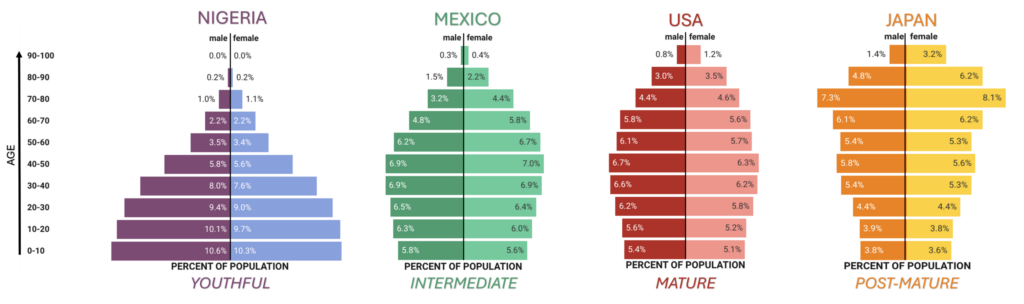
Demographers use population pyramids to illustrate a country’s age structure, which is the distribution of its population across age groups. The horizontal bars represent the proportion of the total population within each age bracket, starting with newborns at the base and moving up through older cohorts. This visual of a country’s age structure illustrates its stage in the demographic transition — a model describing how populations evolve from high mortality and high fertility rates, to low mortality and low fertility rates. As countries move through the demographic transition, their age structure pyramids are reshaped by declining fertility, shifting labor force demands, rising life expectancies, and migration patterns. The demographic transition has five stages:
- Stage 1: Countries experience high birth rates and high death rates, so the population size remains mostly constant. This stage applied to much of the world prior to the Industrial Revolution.29Ibid.
- Stage 2: Improvements in food security and public health reduce death rates, especially among children, while birth rates remain high, resulting in rapid population growth. Countries in this stage today are primarily least-developed countries, including Chad, Somalia, the DRC, the Central African Republic, and Niger.30World Population Review, “Stage 2 Demographic Transition Model (DTM) Countries 2026,” (2026). https://worldpopulationreview.com/country-rankings/stage-2-dtm-countries.,31ISS African Futures, “Demographics: Thematic Futures,” Jakkie Cilliers (June 2026). https://futures.issafrica.org/thematic/03-demographic-dividend/.
- Stage 3: Historically, countries move into this stage when birth rates gradually decrease as their economic status improves and women’s access to opportunity and contraception increases. Both Nigeria and Mexico, pictured above, are currently in Stage 3.32World Population Review, “Stage 3 Demographic Transition Model (DTM) Countries 2026,” (2026). https://worldpopulationreview.com/country-rankings/stage-3-dtm-countries.
- Stage 4: Low birth rates and low death rates slow population growth and increase a country’s median age. Research shows that when a country’s median age reaches between 26-40, it often enters a phase associated with higher economic productivity (upper-middle income status) and high levels of political stability.33Population Institute, “Beyond 8 Billion: What You Need to Know About Population Projections,” (April 2025). https://www.populationinstitute.org/wp-content/uploads/2025/04/PI-0325-8-billion-brief-2025_FINAL.pdf The United States, with a mature median population age (35.6-45.5) is in Stage 4, while Mexico is expected to enter Stage 4 in the coming decades.34World Population Review, “Stage 4 Demographic Transition Model (DTM) Countries 2026,” (2026). https://worldpopulationreview.com/country-rankings/stage-4-dtm-countries.
- Stage 5: Death rates exceed birth rates, causing an increase in the median population age to middle-aged or elderly.35Abby Watkins, “Stage 5 of the Demographic Transition Model,” Population Education, March 10, 2026. https://populationeducation.org/stage-5-of-the-demographic-transition-model-dtm/ However, the rate of population decline in Stage 5 countries can vary; while most countries in this stage experience population decline as they age, some countries continue to experience net population growth due to immigration. Japan, with a post-mature median population age (greater than or equal to 45.6), is in Stage 5.36World Population Review, “Stage 5 Demographic Transition Model (DTM) Countries 2026,” (2026). https://worldpopulationreview.com/country-rankings/stage-5-dtm-countries
Meanwhile, Africa has the world’s youngest and fastest-growing population. At least 60% of the continent’s population is below the age of 25.37United Nations Department of Economic and Social Affairs, “Africa’s Fast-Growing Population: Tackling Youth Unemployment | Division for Inclusive Social Development (DISD),” UN.org, 2025, https://social.desa.un.org/sdn/africas-fast-growing-population-tackling-youth-unemployment. Although fertility rates have been declining across much of sub-Saharan Africa, in most countries fertility remains far above replacement level — and is expected to remain high for decades.38United Nations (2025). World Fertility 2024. UN DESA/POP/2024/TR/NO.11. New York: United Nations. As a result, Sub-Saharan Africa is expected to remain youthful and its population will continue growing longer than any other region. In fact, Africa will soon become the epicenter of the world’s youth: By 2030, the continent will be home to 42% of young people aged 15-24, overtaking Asia.39Population Reference Bureau, African Union Commission, and Sydney Perlotto, “Africa’s Future: Youth and the Data Defining Their Lives,” (2019). https://www.prb.org/wp-content/uploads/2026/01/Status-of-African-Youth-SPEC.pdf.
These demographic projections for Africa have immense implications, not just for its countries but for the globe. When a youthful country has a sustained decline in birth rates and death rates, it produces a “youth bulge,” where 20% or more of a country’s population is between the ages of 15 and 24. Falling fertility rates and improved healthcare have led to a youth bulge in most Sub-Saharan African countries (Figure 3).40Mustapha Jobarteh, “Sub-Saharan Africa – ISS African Futures,” ISS Africa, May 28, 2026, https://futures.issafrica.org/geographic/regions/sub-saharan-africa/#demographics. As young people in these countries transition to early adulthood, the proportion of working age people to dependents will increase. That period (stages 2 and 3 of the demographic transition) offers a “demographic window of opportunity” to accelerate economic growth and harness powerful social benefits. More resources can be invested in the health and education of each child, leading to a more productive future workforce. Countries also benefit from a larger labor supply — which can boost production and consumption — and the potential for greater household savings. These assets are known as the demographic dividend (see “Dissecting the Demographic Dividend”).
Figure 3: Youth Population Structure and Global Weight (2024)
Africa’s concentration of youth will likely amplify its geopolitical and economic importance on the world stage. By 2025, the working age population across the African continent is expected to double, accounting for 85% of the total growth in the world’s population aged 15-64.41OECD, “More Investment in Skills Development Is Key to Africa’s Growth Potential,” OECD, 2024, https://www.oecd.org/en/about/news/press-releases/2024/07/Investing-more-in-skill-development-is-key-to-making-African-economies-more-productive-.html. In fact, by 2050, Sub-Saharan Africa will be the only region in the world where the number of working age people is still rising.42Michele Fornino and Andrew Tiffin, “Sub-Saharan Africa’s Growth Requires Quality Education for Growing Population,” IMF Blogs, April 25, 2024, https://www.imf.org/en/Blogs/Articles/2024/04/25/sub-saharan-africas-growth-requires-quality-education-for-growing-population. With much of the world facing — or soon facing — a declining working age population, Africa’s youth have the potential to shape the future of the global workforce and become a critical motor of global growth that can deliver enormous benefits for the global economy.43Jack Goldstone and John May, “Africa’s Youth Can Save the World,” October 13, 2023, https://www.wilsoncenter.org/publication/africas-youth-can-save-world.
Whether a country can capture potential economic and social gains depends in part on its level of inequality, unemployment, and the number of youth not in education, employment, or training. Investing in quality education, jobs, infrastructure, gender empowerment, and healthcare when a country is in a youth bulge phase is crucial to realizing the dividends of a large working age population.
Dissecting the Demographic Dividend
The demographic dividend is the potential boost in economic growth and human development that can happen when falling fertility rates lower the ratio of dependents to working age people.44David E Bloom et al., “Population Changes and Demographic Dividends,” Bulletin of the World Health Organization 104, no. 2 (Feb 2026): 134-136. doi: 10.2471/BLT.25.295004. Fertility declines for several reasons: better child survival, shifting norms favoring smaller families, a preference for more educated children, improved reproductive health, and/or deliberate policies like China’s one-child rule.45David E Bloom et al., “Fertility in high-income countries: trends, patterns, determinants, and consequences,” Annual Review Econ 16, no. 1 (2024): 159-184. https://doi.org/10.1146/annurev-economics-081523-013750. As fertility falls, resources once devoted to raising children can shift toward employment, stronger health and education systems, and new technology — helping countries to alleviate the potential burdens of high youth dependency.46David E Bloom et al., “Population Changes and Demographic Dividends.”
The demographic dividend is not automatic, however. Turning that potential into real gains requires complementary investments in robust health and education systems, sound governance, infrastructure, macroeconomic stability, and functioning labor and integrated markets.47Ibid. Dividends are strongest when development efforts are well-integrated — for instance, vaccination programs improve not just health but also school attendance and learning, while reproductive health programs let families invest more in fewer children and increase work and savings.
Research from low- and middle-income countries confirms the benefits of leveraging the demographic dividend with well-integrated programs as the ratio of dependents to working age people declines.48National Bureau of Economic Research, “Quantifying the Life-Cycle Benefits of a Phototypical Early Childhood Program,” Jorge Luis García et al., June 2017, https://heckmanequation.org/wp-content/uploads/2017/01/w23479.pdf. High-quality, birth-to-five childhood education and care programs for disadvantaged children, for instance, deliver a 13% annual return on investment. Every $1 invested is estimated to yield between $4 and $16 dollars in societal and economic benefits.49Ibid.
Education and skills training are key to success: Research shows that each additional year of education for a pupil in Africa can increase their future earnings by up to 11.4%.50OECD, “More Investment in Skills Development Is Key to Africa’s Growth Potential.” When it comes to girls’ education, the impact on earning power is even higher: In Sub-Saharan Africa, each additional year of schooling correlates with a 14.5% increase in earnings.51OASIS, “A Fulcrum for the Future: Leveraging Girls’ Education and Family Planning for Development and Security in the Sahel,” OASIS, March 11, 2021, https://oasissahel.org/resources/a-fulcrum-for-the-future. Meanwhile, expanding care services and extending social protections, like childcare programs and access to social systems for informal work, can strengthen women’s access to quality jobs and improve their overall economic outcomes by better encompassing labor that is frequently left unpaid and/or unregulated.52Vera Kum and Adeline Nembot, “Recognizing, Reducing, and Rewarding Unpaid Care Work in Central Africa,” Nkafu Policy Institute, February 23, 2026, https://nkafu.org/not-just-numbers-but-impact-transforming-womens-labour-force-participation-in-sub-saharan-africa-ssa/. Women’s employment, in turn, accelerates economic development.53Karima Ladhani and Michael Sinclair, “Achieving the Demographic Dividend – Harvard Ministerial Leadership Program,” Harvard Ministerial Leadership Program, 2025, https://ministerialleadership.harvard.edu/case-studies/achieving-the-demographic-dividend/.
Although programs that target adolescents yield the most immediate impacts, investments in a child’s first three to five years of life bring the greatest long-term returns. As a country that recently passed through its demographic window of opportunity,54Jesus Cañas et al, “Mexico’s productivity woes limit nearshoring, growth potential,” The Federal Reserve Bank of Dallas, April 16, 2024, https://www.dallasfed.org/research/swe/2024/swe2405. Mexico illustrates how early childhood investment can help convert that window into lasting human capital gains. Mexico’s 2002 preschool mandate — requiring three years of compulsory schooling for children ages 3–5 — significantly boosted primary school test scores, and these effects persisted into later grades.
55[1] The Ronald O.Perelman Center for Political Science and Economics, “Starting Strong: Medium-
andLonger-run Benefits of Mexico’s Universal Preschool Mandate,” Jere R.
Behrman et al. (Oct 2024),
https://economics.sas.upenn.edu/pier/working-paper/2024/starting-strong-medium-and-longer-run-benefits-mexicos-universal-preschool.
Nearly 20 years later, the reform increased the probability of finishing high school by 8.7% and of completing college by 11.1% — echoing similar long-term benefits, such as higher earnings and lower crime, that followed the introduction of preschool programs in high-income countries.
Without strong investments to ensure that youth have the education, skills, and opportunity to participate in the future labor market, both in Africa and elsewhere, the continent’s rapidly growing young population could heighten the risk of political and social instability.56Population Reference Bureau, “Youth Bulges, Urbanization, and Conflict – Population Reference Bureau,” Eric Zuehkle, (August 2009). https://www.prb.org/resource/youth-bulges-urbanization-and-conflict/. As of 2023, nearly 22% of youth in sub-Saharan Africa lacked access to education, employment, or training — and across the continent, women represent an outsized share (61%) of these youth.57World Data Lab, Development Policy Research Unit, and Mastercard Foundation, “Africa Youth Employment Outlook 2026” (Mastercard Foundation, February 10, 2026), https://cdn.buttercms.com/wGqoCWESByqlZVwlH1gR. The OECD also reports that African economies face a dearth of quality jobs and a workforce that lacks the skillsets for existing jobs, including those in agriculture, mining, and renewable energy.58OECD, “More Investment in Skills Development Is Key to Africa’s Growth Potential.”
High unemployment rates have contributed to a rising tide of youth discontent across the continent. A recent surge of youth-led protests has rocked several youth bulge countries, from Morocco to Kenya, driven by young Africans’ growing frustration with a lack of economic opportunities and poor access to healthcare.59PBS News, “Why Gen Z Protests Are Shaking Morocco and How the Government Has Responded,” PBS News, October 4, 2025, https://www.pbs.org/newshour/world/why-gen-z-protests-are-shaking-morocco-and-how-the-government-has-responded. In a recent pan-African survey conducted by Afrobarometer, almost half of Africans between 18 and 35 years old ranked job creation as the number one issue they would prioritize for additional government spending focused on young people,60Afrobarometer, “AD833: Keeping up with the People’s Agenda: Popular Priorities for Government Action, and How They Are Evolving,” Mohamed Nejib Ben Saad and Carolyn Logan, (2024). https://www.afrobarometer.org/publication/ad833-keeping-up-with-the-peoples-agenda-popular-priorities-for-government-action-and-how-they-are-evolving/. and more than a third ranked health as a top issue for the government to address.61Afrobarometer, “African Youth Concerned about Health and Unemployment, Casting Eyes Abroad to Find Better Work, Escape Poverty,” (2025). https://www.afrobarometer.org/wp-content/uploads/2025/09/News-release_African-youth-concerned-about-health-and-unemployment-Afrobarometer-3sep25.pdf. In the most extreme circumstances, youth bulges can fuel more severe forms of instability. Research on violent extremist organizations has found that young people are disproportionately represented among their ranks, driven by a combination of factors: frustration and anger at blocked opportunities and a search for belonging and relationships outside the family unit.62 J. Tochukwu Omenma et al., “al-Shabaab and Boko Haram: Recruitment Strategies,” Peace and Conflict Studies 27, no. 1 (May 2020). DOI: 10.46743/1082-7307/2020.1460. Analyses of terrorist fighters across Latin America, Asia, the Middle East, and Europe have found the average age of an urban terrorist to be in the early- to mid-20s.63 Countering Radicalisation and Violent Extremism Among Youth to Prevent Terrorism. Netherlands: IOS Press, 2014. Unemployment, in particular, drives recruitment, with some young and low-skilled workers viewing jihadist groups as a form of alternative employment.64Ibid. Despite the strength of these correlations, it’s important to note that youth bulges alone do not cause radicalization or violence; poverty, weak governance, and a lack of economic opportunity are consistent contributing factors, and investments in education, jobs, and civic inclusion remain among the most effective tools for reducing this risk.
Policy Implications: Expanding quality education, creating quality jobs, improving skills training, empowering women, and strengthening healthcare systems and infrastructure are all crucial steps for youthful African countries as they move into the demographic window of opportunity. Mobilizing foreign aid to support today’s youth bulge countries would not only increase economic development in those countries; it would also help address a growing tide of discontent and frustration among Africa’s young populations, and help build the economic engine that will power the future global economy.
Urbanization: Growth, Gaps, and the Urban Continuum
Since the end of the 20th century, the rise of large, youthful labor forces has aided in decreasing income inequality between countries as nations have harnessed their youth populations to transition from agrarian to industrial and service sector labor forces.65Arthur S.
Alderson and Roshan K. Panidian, “What is Really Happening with Global Inequality?” Sociology of Development 4, no. 3 (2018): 261-281. https://doi.org/10.1525/sod.2018.4.3.261
However, rapid unplanned urbanization can also increase inequality within developing countries by creating sharp divides in infrastructure, wages, and access to services. Under current employment rates and population projections, by 2050, an estimated 590 million of the 1.4 billion new working age (20-64) people will have limited access to employment opportunities in the world’s five most youthful regions (Sub-Saharan Africa, South Asia, Southeast Asia, Latin America, the Middle East) — regions that are also rapidly urbanizing.66Rebecca Smith, “Growing Youth Populations in Low-Income Countries Require Creative Jobs Solutions.” The global urban population — now roughly 55% — is projected to reach nearly 80% by 2100.67United Nations, “World Population Prospects 2024.”
Smaller cities – despite collectively outnumbering, and in some instances outgrowing – primary cities, are chronically under-invested in by national governments compared to larger urban centers, making their development central to projected development and labor force growth.68Andrew Zimmer et al., “Global divergence in urban demographic change and migration patterns.”
The enormous shift in the distribution of the global working age population has ripple effects across the urban continuum. Without coordinated urban and economic planning, these urban populations will face daunting challenges, including increases in the number of informal settlements exposed to natural hazards,69Kuffer et al., “Slums from Space—15 Years of Slum Mapping Using Remote Sensing,” remote sensing 8, no. 6 (2016): 455. https://doi.org/10.3390/rs8060455. a growing risk of social and political unrest due to youth discontent,70Jack Goldstone, “Population and Security: How Demographic Change Can Lead to Violent Conflict” Journal of International Affairs, 56, no. 1 (2002): 3-21. http://www.jstor.org/stable/24357881. and a lack of social and labor protections for informal work.71Marina Romanello et al., “The 2022 Report of the Lancet Countdown on Health and Climate Change: Health at the Mercy of Fossil Fuels,” The Lancet 400, no. 10363 (October 25, 2022), https://doi.org/10.1016/S0140-6736(22)01540-9.
Many young people in youth bulge nations facing high rates of urbanization have chosen to migrate to other countries and regions to seek better economic opportunities. For instance, the Persian Gulf states host an estimated 20 million to 25 million migrant workers from South and Southeast Asia, with foreign workers accounting for 92% of the workforce in the United Arab Emirates.72Khasru, “Asia’s next economic crisis may come from youth unemployment.” Remittances from younger relatives seeking better economic opportunities comprise an important dimension of per capita income and consumption for nations hosting large youth populations.73Khasru, “Asia’s next economic crisis may come from youth unemployment.” Over $120 billion is remitted to India, between $22 billion and $23 billion to Bangladesh, and approximately $30 billion to Pakistan — a large share of theses funds is sent by young workers in urban construction and services.
As working age populations are increasingly concentrated in urban economic centers, rural areas also face daunting challenges including shrinking workforces,74Lichter and Jognson, “Depopulation, Deaths, Diversity, and Deprivation: The 4Ds of Rural Population Change,” older and more dependent populations,75Ibid. eroding tax bases,76Ibid. and relative under-investment compared to mega-cities.77Andrew Zimmer et al., “Global divergence in urban demographic change and migration patterns.”,78Sameh Naguib Wahba Tadros et al., “Demographic Trends and Urbanization.” In aging regions, rural depopulation increases fiscal strains precisely where older residents are most dependent on public services and least able to relocate.
Policy implications: For countries navigating rapid urbanization, national-level demographic averages consistently understate the pressures building in the places experiencing the sharpest shifts — meaning effective planning requires targeted investment in secondary cities and peri-urban areas to prevent the growth of informal settlements, service gaps, and youth unemployment. For U.S. foreign policy, this pattern has direct implications for the stability of partner countries and drivers of migration. Calibrating development assistance and diplomatic engagement to national-level indicators risks missing localized data points — such as underinvestment in secondary cities or depopulation in rural regions — that are more predictive of unrest, informal labor exploitation, or outmigration pressure than aggregate GDP or youth bulge statistics alone. Given that remittance flows and labor migration already function as informal safety valves for youth unemployment, U.S. engagement with both origin and destination countries — on labor protections, urban planning capacity, and sub-national data systems — could help preempt the compounding risks of unplanned urbanization before they manifest as regional instability or migration crises.
Aging and Depopulation: Pressures at Home and Abroad
Although some countries will remain youthful for decades, many already have a large share of older adults. Some places are also contending with depopulation, or declining population, including many European countries and several Asian nations.79World Population Review, “Countries with Declining Population 2026,” World Population Review, 2026, https://worldpopulationreview.com/country-rankings/countries-with-declining-population.
The United States is older than it has ever been, with those 65 and over accounting for roughly 19% of today’s population and rising to 23% by 2050.80Population Reference Bureau, “Fact Sheet: Aging in the United States – Population Reference Bureau,” Mark Mather and Paola Scommegna, (2024). https://www.prb.org/resource/fact-sheet-aging-in-the-united-states/#footnote-1. Even though the United States as a whole still has about 500,000 more births than deaths each year, that surplus is now concentrated in a shrinking number of (mostly urban) counties — deaths already outnumber births in two-thirds of all counties.81Population Reference Bureau, “Fact Sheet: Aging in the United States – Population Reference Bureau,” Mark Mather and Paola Scommegna, (2024). https://www.prb.org/resource/fact-sheet-aging-in-the-united-states/#footnote-1.
In many parts of the country, population growth has been slowing for decades. But recently, overall U.S. population growth slowed significantly, largely driven by the drop in net international migration, which fell by roughly 45% from 2024 to 2025.82Ibid.,83US Census Bureau, “Slow Growth Impacts Nation’s Largest Counties Hardest,” Census.gov, March 26, 2026, https://www.census.gov/newsroom/press-releases/2026/2025-popest-metro-micro-counties.html. During that time, the population of about 40% of the country’s counties shrank;84Saraiva et al., “More US Counties See Population Drops Under Trump’s Immigration Crackdown,” Bloomberg, March 26, 2026, https://www.bloomberg.com/news/articles/2026-03-26/us-census-shows-more-counties-see-population-drops-in-immigration-crackdown?embedded-checkout=true. counties that were already shrinking lost population faster than they had before (Figure 4). And among those counties that had grown between 2023 and 2024, nearly 80% experienced either slower growth or depopulation between 2024 and 2025.85US Census Bureau, “Slow Growth Impacts Nation’s Largest Counties Hardest.”
Figure 4: Percent Change in U.S. Population by County (2024-2025)
Places with aging populations generate a lower tax base due to a shrinking labor force; they can also lose political representation.86Ellis Chen and Vanessa Williamson, “Taxation, Representation, and Climate Migration,” Brookings, January 21, 2025, https://www.brookings.edu/articles/taxation-representation-and-climate-migration/. Aging populations also lead to surging pension and healthcare costs as the worker-to-beneficiary ratio decreases. The Population Reference Bureau estimates that Social Security and Medicare spending will rise to 11.5% of GDP by 2035 — up from 9.1% in 2023.87Population Reference Bureau, “Fact Sheet: Aging in the United States – Population Reference Bureau,” Mark Mather and Paola Scommegna, (2024). https://www.prb.org/resource/fact-sheet-aging-in-the-united-states/#footnote-1. Projections released in June 2026 indicate that Social Security will be exhausted by 2032; once the fund is depleted, incoming revenue will only be able to sustain 78% of scheduled benefits.88“The 2026 OASDI Trustees Report,” SSA.gov, June 9, 2026, https://www.ssa.gov/oact/TR/2026/index.html This shortfall will be compounded as healthcare costs rise as the U.S. population ages and relies more heavily on health services. The shortage of healthcare providers, especially pronounced in rural areas of the U.S., is also expected to deepen as demand for elder care expands.89Jones and Dolsten, “Healthcare on the Brink,” 1-10.
The United States is not alone in facing an aging population. Nearly every country is growing older. Over the last 25 years, fertility rates declined in every UN region; two-thirds of people live in countries with below-replacement fertility rates.90International Monetary Fund, “The Debate over Falling Fertility,” Hadley Hooper, June 2 2025. https://www.imf.org/en/Publications/fandd/issues/2025/06/the-debate-over-falling-fertility-david-bloom. However, the pace at which countries are aging varies, as do the economic and political contexts of these aging societies. Places like India, Mexico, Iran, Thailand, Vietnam, and most of Latin America are transitioning to older populations at a greater speed than wealthier European countries did: It took 70 years for Germany’s 60+ population to double, and 89 years in the UK, but the 60+ population of “second-wave” aging countries, like Thailand and Mexico, doubled in only 20-35 years.91United Nations, Department of Economic and Social Affairs, Population Division, “World Population Prospects 2024.” Given Latin America’s strategic importance to the United States, it is especially worth noting the speed of transition in the region, where the proportion of people aged 65+ is expected to grow from 10% today to 25% by 2050.92Laurence Blair, “The Gray Tide: Latin America’s Demographic Transformation,” Americas Quarterly, April 21, 2026, https://www.americasquarterly.org/article/the-gray-tide-latin-americas-demographic-transformation/. In countries like Chile and Brazil, fertility rates have plummeted (Chile now has a lower birthrate than Japan), and rapid aging is straining already under-resourced health systems.93Danilo Farias de Morais, “Brazil’s Population Fragility Taxes National Health Systems | Think Global Health,” Think Global Health, September 29, 2025, https://www.thinkglobalhealth.org/article/brazils-population-fragility-taxes-national-health-systems. In Brazil, the 65+ population is expected to double from 11% to 22% between 2025 and 2040.94Ibid.
Widespread aging also has implications for the global workforce, as countries like India that have historically been home to large proportions of the world’s working age population now accelerate towards older age structures. By 2050, most of the world will live in places where the working age population is shrinking, even as Africa’s working age population surges.95Center For Global Development, “The Implications of a Declining Labor Force,” Charles Kenny and George Yang, April 23, 2024. https://www.cgdev.org/publication/implications-declining-labor-force.
Aging low- and middle-income countries face a distinct set of challenges. On the one hand, many of these countries do not have to grapple with the robust entitlement systems that are entrenched in wealthier countries like France.96Javier Giménez and Julián Saavedra, “European Nations Have No Choice but to Raise Retirement Ages – Our Case Study Shows Why,” The Conversation, November 7, 2025, https://doi.org/10.64628/aao.ecvryjm7e. Yet, because they often lack the institutional capacity to support their older populations, and are expected to face shortages of health workers, the costs of aging in these countries could fall largely on individuals.97Jones and Dolsten, “Healthcare on the Brink,” 1-10.
Today, many second-wave aging countries are at a critical juncture. Countries facing low fertility rates have largely been unsuccessful in increasing them over the long term. While family-friendly policies, such as subsidized daycare and paternal leave, support families and benefit children, it is not clear whether they have successfully prevented steeper fertility declines.98Stephanie Hegarty, “What One Country’s Experiment Says about Attempts to Boost Birth Rates,” BBC, June 15, 2026, https://www.bbc.com/news/articles/c5yzdr4ygdno. By and large, pro-natalist government interventions in countries like Singapore and Turkey have had limited impact on birth rates. Hungary spends 5% of its GDP on ambitious policies aimed at married, heterosexual couples and workers in the formal job market; these include extensive tax breaks, interest-free loans, and mortgage subsidies to incentivize young couples to have children.99Ibid. As of 2025, however, its fertility rate had declined from 1.6 in 2021 to just 1.31 children per woman — far below replacement rate.100Vanessa Brown Calder, “Hungary’s Fertility Outcomes Highlight Pro-Natal Policy Limitations,” American Enterprise Institute, November 21, 2025, https://www.aei.org/op-eds/hungarys-fertility-outcomes-highlight-pro-natal-policy-limitations/; Hegarty, “What One Country’s Experiment Says about Attempts to Boost Birth Rates.” Turkey’s ongoing campaign has also so far proven fruitless; its fertility rate reached an all-time low in 2024.101 Hubbard and Timur, “Erdogan Wants Turkey to Have More Babies. Few Parents Are Listening.”
Policy Implications: Policies that accommodate an aging population and increase immigration are more effective than attempting to boost birthrates. Such policies include strengthening health infrastructure and the care economy; expanding pathways for immigration, especially of workers; investing in technology to boost per-capita productivity; adjusting entitlement systems; and establishing services and infrastructure — like public transit and age-adapted housing — that contribute to the well-being of older populations.
Lessons from the world’s first super-aged society: Japan
Japan, the world’s fourth-largest economy and key U.S. ally in the Indo-Pacific, became the world’s first “super-aged” society in 2005, when 20% of its population reached the ages of 65 and over. Today, more than 30% of its population is aged 65+, and this share is projected to rise to 38% by 2050. Japan’s total population, which began to shrink in 2011, is expected to lose almost one million people each year over the next several decades.
Facing these extreme demographic challenges, Japan’s government, employers, and families employed new tactics to deliver economic growth, provide core services, and remain militarily strong, including:
- Better utilizing the existing population as both paid workers and volunteers;
- Extending mandatory retirement ages;
- Adapting workplace culture to be more welcoming to women and to older workers; and
- Increasing the number of immigrants and workers on multi-year training or employment visas (although the total number of foreign workers in Japan remains quite low compared to many Western democracies).
These innovative approaches have helped Japan grow economically and build a stronger military despite population shrinkage and rapid aging.
That said, Japan’s debt-to-GDP ratio of around 250% and difficulty hiring workers in critical industries (including defense) are two areas of concern. Moreover, like in many other aging countries, efforts to increase the fertility rate have been largely unsuccessful, generating concerns about the scale of future population shrinkage and debt overhang as the 85+ population continues to increase.
Dr. Andrew Oros, Japan Program Director, Stimson Center and author of Asia’s Aging Security (2025)
Immigration as a Demographic Policy Lever
As the U.S.-born population ages, immigration to the United States spurs growth in its population, workforce, and economic capacity. Unlike many other aging countries, the U.S. population has continued to grow, largely due to immigration.
During the last several decades, foreign-born workers were responsible for more than half of growth of the U.S. labor force. Between 2019 and 2024, immigrants accounted for 88% of U.S. labor force growth; and as of 2024, immigrant workers were predicted to be the only source of U.S. labor force growth by 2053.102National Foundation for American Policy, “New NFAP Policy Brief: Immigrants and America’s Labor Force Growth – NFAP,” National Foundation for American Policy, October 15, 2024, https://nfap.com/research/new-nfap-policy-brief-immigrants-and-americas-labor-force-growth/. Immigrants play an especially important role in the U.S. healthcare sector, accounting for 17% of total healthcare workers and 30% of direct care workers in long-term contexts (Figure 5).103Drishti Pillai and Samantha Artiga, “Monthly Changes in the Number of Immigrants in the Total U.S. Workforce,” Kaiser Family Foundation, June 18, 2026, https://www.kff.org/immigrant-health/the-role-of-immigrants-in-the-u-s-health-care-workforce/. They are also much more likely to start businesses compared to native-born Americans.104Azoulay et al., “Immigration and Entrepreneurship in the United States,” American Economic Review: Insights 4, no. 1 (March 2022): 71-88. doi: 10.1257/aeri.20200588.
Figure 5: First Generation Immigrant Occupation by Industry (2010-2024)
Last year, international migration to the United States decelerated significantly, falling from 2.7 million in 2024 to 1.3 million in 2025.105Vanorman, “U.S. Population Growth Slowed Dramatically in 2025 as Immigration Dropped, New Data Shows.” Ninety percent of U.S. counties experienced a decline in net international migration. If these declines continue, the impacts could have far-reaching consequences for an aging U.S. population.106US Census Bureau, “Slow Growth Impacts Nation’s Largest Counties Hardest.” Without new immigrant workers entering the workforce, the aging U.S.-born population could face growing labor shortages and reduced entrepreneurship, potentially leading to subpar services and higher prices for American consumers and slower or stagnant U.S. economic growth.107Stuart Anderson, “Immigrants Will Be America’s Only Source of Labor Force Growth,” Forbes, October 16, 2024, https://www.forbes.com/sites/stuartanderson/2024/10/16/immigrants-will-be-americas-only-source-of-labor-force-growth/.,108The Brookings Institute, “The impact of immigrants on the US economy,” Tara Watson (March 2026), https://www.brookings.edu/articles/the-impact-of-immigrants-on-the-us-economy/. It is estimated that the fall in immigration from 2024 to 2025 alone could cause U.S. GDP growth to drop by 0.19% to 0.26%.109Ibid. In the healthcare sector specifically, declining participation in healthcare occupations by immigrants could deepen existing care gaps, especially as the share of older Americans grows.
While immigration is a powerful tool, it cannot fully offset the demographic challenges of aging countries. A 2025 report by the Migration Policy Institute, which examined the efficacy of immigration in addressing demographic challenges from an aging population in Canada, found that immigration can help to curb population decline but does little to rebalance age structure. Addressing rising old-age dependency ratios will require other tools, as discussed in the previous section.110Migration Policy Institute, “Canada Case Study Explores the Limits of Immigration to Ease Demographic Decline,” MPI.org (Migration Policy Institute, February 27, 2025), https://www.migrationpolicy.org/news/canada-demographic-decline-immigration.
Policy Implications: As net international migration continues to decline, stabilizing and diversifying legal immigration pathways, particularly for healthcare, caregiving, and skilled trades, is essential to sustaining labor force growth. However, because immigration alone cannot fully balance an aging age structure, immigration-focused strategies should be paired with a diverse set of tools outlined throughout this brief, such as adapting entitlement systems, investing in productivity-enhancing technology, and building the care economy. Maintaining reliable and predictable immigration pathways in the United States also preserves one of the country’s demographic advantages over other aging economies — a pull factor that, if allowed to erode further, would compound the labor shortages and slower growth already emerging as migration falls.
The Evolving Landscape of U.S. Immigration
As immigration continues to shape the United States’ demographic trajectory, patterns of immigration may evolve (Figure 6). Latin American and Caribbean countries account for a high proportion of immigrants to the United States, as they have for decades. Since 1965, roughly half of immigrants to the United States have come from Latin America.111Abigail Geiger, “What the Data Says about Immigrants in the U.S.,” Pew Research Center, August 21, 2025, https://www.pewresearch.org/short-reads/2025/08/21/key-findings-about-us-immigrants/. In recent years, the share of new arrivals from South America has increased more than the share from other regions, up 13% in 2021-2023 compared to 2015-2019.112Abigail Geiger, “What the Data Says about Immigrants in the U.S.” Asia is also a major source of immigration; in 2023, 27% of immigrants in the United States were born in Asia.113Abigail Geiger, “What the Data Says about Immigrants in the U.S.”
While Africa’s share of new immigrants has fallen in recent years, immigration from Africa is still growing significantly in absolute terms, increasing 74% between 2010 and 2023. As working age populations begin to contract in many places, Africa could become an increasingly important source of U.S. immigration.114Jeanne Batalova, “Sub-Saharan African Immigrants in the United States,” migrationpolicy.org, October 3, 2018, https://www.migrationpolicy.org/article/sub-saharan-african-immigrants-united-states.
Figure 6: Immigrant Origin Country by Year, With and Without Mexico
U.S. Strategic Position in a Demographically Shifting World
Compared to other wealthy nations, the United States has entered this demographic century with several structural advantages:
Time: The U.S. fertility rate is declining more slowly than that of most other OECD nations.115OECD, “More Investment in Skills Development Is Key to Africa’s Growth Potential,” OECD, 2024, https://www.oecd.org/en/about/news/press-releases/2024/07/Investing-more-in-skill-development-is-key-to-making-African-economies-more-productive-.html. In 1977, 15% of the U.S. population was 60+. That percentage is expected to double to 30% around 2060 — an 83-year process. This slow decline buys more time to adapt the entitlement systems, like Social Security and Medicare, that were built during a period of population growth. While the country is beginning to feel the pressure of an aging population, it still has time to design and implement policies to manage them.
Demographic diversity: The United States is home to large, well-networked diaspora communities from virtually every region of the world. Few other countries can match the breadth and depth of these channels of economic integration, political influence, and global connectivity. When an immigrant arrives in the United States, they tap into a pre-existing network that accelerates their entry into the labor market and embeds them in the social fabric of their community. U.S. society is, however imperfectly, unusually capable of absorbing people from different backgrounds and integrating them into a shared national identity, which is a form of geopolitical strength.
Pull factor: Despite today’s heightened geopolitical tensions, the United States continues to be a destination for immigrants. Highly skilled workers are willing to wait 20 years or more for the chance to work in the United States, driving research and technological innovation.116Jeanne Batalova, “Frequently Requested Statistics on Immigrants and Immigration in the United States,” Migration Policy Institute, March 12, 2025, https://www.migrationpolicy.org/article/frequently-requested-statistics-immigrants-and-immigration-united-states. Other migrants cross the southern border, often at significant personal risk, in hopes of building a better future for their families in the United States. This magnetism is a strategic asset that compounds over generations; for example, nearly half of all Fortune 500 companies were founded by immigrants or their children.
Cultural influence: As the global distribution of the youth population shifts dramatically over this century, the countries and regions that shape youthful aspirations, consumption, and culture will wield outsized influence. There are three categories of countries that hold this global cultural impact: those that retain it through slower fertility decline and diverse, globally influential youth cultures, like the United States and Mexico; those that sustain it despite demographic decline through innovation and economic strength, like Japan and South Korea; and those in Africa whose influence will grow as their share of global youth expands if they invest in education, technology, and the enabling conditions young people need to thrive. The United States’ position is not simply a function of population size; it depends on the global reach of American culture, which is largely driven by the diversity of American youth.
While all of these advantages are real, they are not guaranteed. The United States must reckon with two global trends that could diminish them: the hardening of borders worldwide, and the dramatic retrenchment of U.S. foreign assistance, particularly in health and education.
Restrictions on migration: Across Europe, governments have tightened asylum procedures,117Amina Ismail, “EU overhaul to toughen migration rules takes effect, though doubts remain about impact,” Reuters, June 12, 2026, https://www.reuters.com/world/eu-overhaul-toughen-migration-rules-takes-effect-though-doubts-remain-about-2026-06-12/. expanded border enforcement agencies,118Dimitar Bechev, “Despite Schengen’s Expansion, Europe’s Borders Are Hardening,” The Carnegie Endowment for International Peace, January 14, 2025, https://carnegieendowment.org/europe/strategic-europe/2025/01/despite-schengens-expansion-europes-borders-are-hardening. and increasingly outsourced migration control to transit countries.119Migration Policy Institute, “Countries Are Pushing Borders Outward to Expand Deterrence and Protection Alike,” Natalia Banulescu et al. (June 2026), http://migrationpolicy.org/article/border-externalization-spread. North African governments, partly at the direction and funding of the European Union, have significantly hardened the corridor between Sub-Saharan and North Africa,120Anthony Faiola, et al., “With Europe’s support, North African nations push migrants to the desert,” The Washington Post, May 20, 2024, https://www.washingtonpost.com/world/interactive/2024/eu-migrant-north-africa-mediterranean/. leading to documented cases of migrants abandoned at desert border crossings. Burkina Faso, Mali, and Niger have introduced new ordinances tightening movement, and in major African destination countries like South Africa, anti-migrant rhetoric has become increasingly mainstream.121“Nigeria sees no sign that anti-immigrant violence is waning in South Africa,” Al-Jazeera, July 6, 2026, https://www.aljazeera.com/news/2026/7/6/nigeria-sees-no-sign-that-anti-immigrant-violence-is-waning-in-south-africa.
As these barriers rise, migration no longer serves as a pressure valve for youth bulge countries. Young people who might have migrated to find work instead remain in countries without jobs for them, compounding the risk of political instability. For the United States, this dynamic has a double edge: It reduces one source of demographic relief for fragile countries in strategic regions, while simultaneously testing whether U.S. immigration policy can continue to be an asset.
Declining foreign assistance from the United States and other major donor countries has introduced significant uncertainty about the future of the demographic century. Fertility rates, mortality trends, and the pace of the demographic transition in high-growth countries are all shaped by their health and education systems. By supporting programs that allowed people, especially women and girls, to make choices about their lives and futures, the United States has contributed to real demographic shifts across Sub-Saharan Africa, South Asia, and elsewhere. The current pivot away from providing foreign assistance to such programs endangers these improvements in child mortality, maternal health, contraceptive access, and girls’ school enrollment, which were not inevitable, and are not irreversible. The consequences of withdrawing that support have, in some cases, been immediate, but many will accumulate over the coming decades, directly affecting global stability and U.S. security interests in these regions and beyond.
Acknowledgments
The authors would like to thank Andrew Selee, Jennifer Sciubba, Parfait M. Eloundou-Enyegue, and Kathleen Mogelgaard for their participation in the Environmental Security Congressional Masterclass and for their thoughtful review of this brief. We are also grateful to Anwen Williams, Environmental Security intern, for her research support; to Meaghan Parker for her editorial guidance and review; and to Aaron Sampson of the Population Institute for his contributions. Finally, we thank the Population Institute for supporting this work.








Community Adaptation for a Water Festival Without Clean Water