
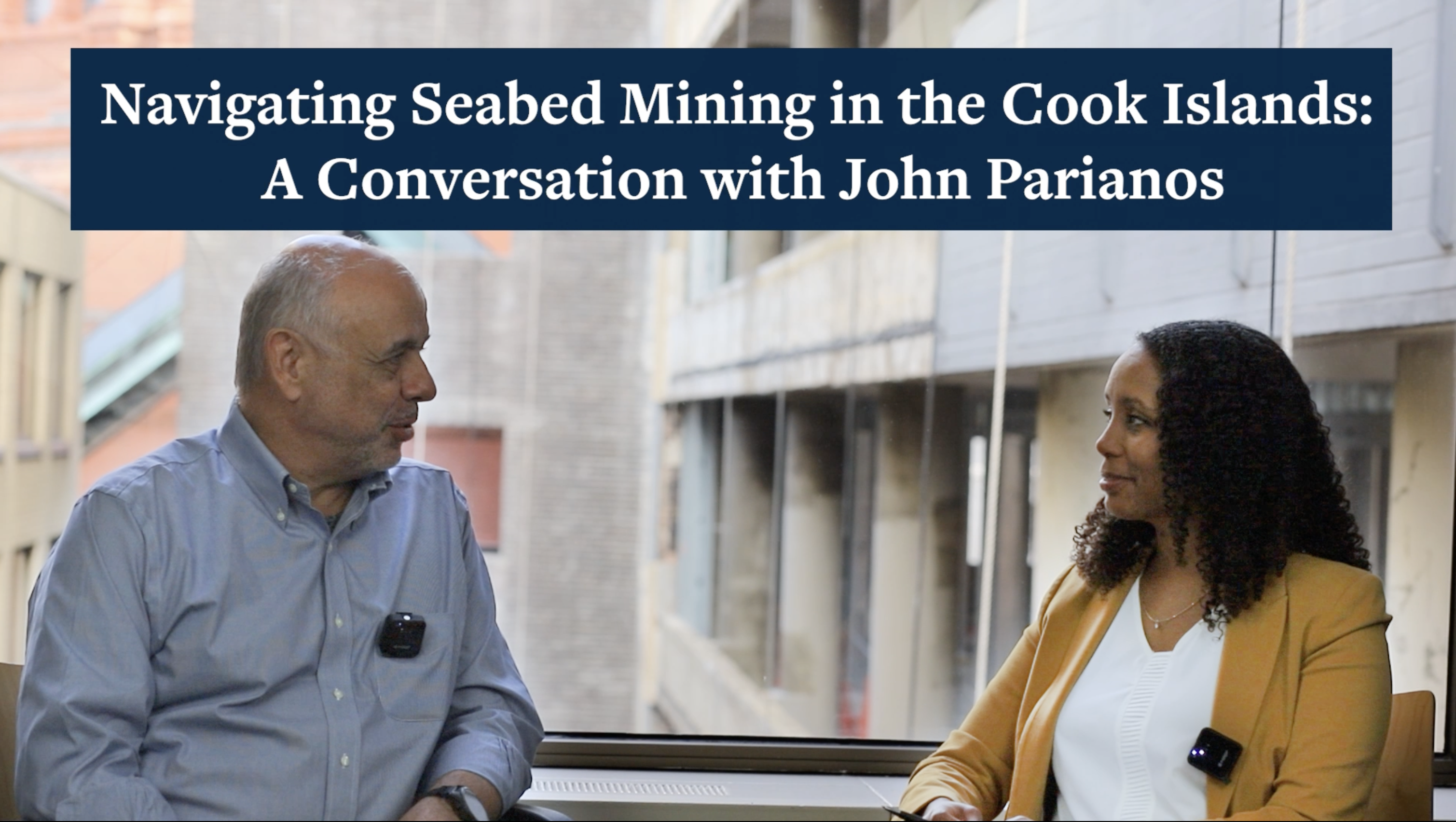
Full Interview Audio & Transcript
Mahlet Mesfin: Since they’ve been discovered, seabed minerals have been in active debate around who owns them, how they are harvested, and the impact of such activities. Some of these minerals can be found in international waters or areas beyond national jurisdiction, and the International Seabed Authority, or the ISA, was established to organize and control mineral resources in those areas.
For the last few years, countries have been working to agree on an international regulatory framework, or mining code, through the ISA that would help govern future exploitation activities in that area. But seabed minerals are not only found in areas beyond national jurisdiction — they’re also found in countries’ exclusive economic zones, or EEZs. And in those cases, governments must design their own domestic systems in order to pursue resource development.
The Cook Islands have long been known to have an abundance of marine minerals, and they’ve spent decades working through their regulatory and legislative systems to manage seabed mining. There are many strong opinions on this issue, but there is general agreement that protecting the marine environment and limiting potential harms will come from having robust regulatory frameworks in place. I’m grateful to be joined today by Dr. John Parianos from the Cook Islands Seabed Minerals Authority, to get some insights into the details of a system that one could argue sets a standard for open, transparent, and comprehensive regulatory approaches to seabed mineral resource development.
John, could you introduce yourself and your role related to seabed minerals in the Cook Islands, and provide a brief overview of the system you have in place?
Dr. John Parianos: I’m Dr. John Parianos, and I’m Director of Knowledge Management at the Cook Islands Seabed Minerals Authority. Our job is basically to collect and collate information so that stakeholders in the Cook Islands — and abroad — are as well-informed as possible about how to manage this opportunity going forward. As you mentioned, the green environment is important, and a reasonable return is also important. What my staff and I do is try to present as complete a picture as possible for our government, our people, and other stakeholders — to see where we are today in this journey, and where we might go.
The Cook Islands is blessed to have an exceptional deposit of polymetallic nodules on the seabed. But if it is going to be brought to account, we will not entertain any shortcuts. Things have got to be done properly. If you don’t do it properly, you’ll be held to account and could damage the very thing you’re hoping to nurture.
Mahlet Mesfin: A central challenge in these discussions is environmental risk and managing it. As seabed mining moves from exploration to potential commercial activity, governments really have to face decisions on how they’re regulating an industry that has never operated at scale in the deep ocean in these environments. How do you think about environmental assessment in those cases, when there’s no commercial-scale mining experience to draw from?
Dr. John Parianos: It is a little bit like taking a step into the unknown. However, it’s better to try and design the rules in advance than to make them up as you go. What we’ve done is taken the information we can find, pulled it together, and realized we actually know quite a lot.
The big gap — one of the big gaps, I should say — is really a large-scale demonstration of what would happen if you proceeded. But smaller-scale pilot testing has happened before, probably four or five times now, dating back to the 1970s when there were three trials. There was also disturbed-sediment testing done in the 1990s, and most recently, two more demonstrations in the last few years — in fact, a third one was completed last year as well.
So what you do is compile the information you have, and then make a structured, hopefully balanced risk assessment of the impacts. And very importantly, you qualify your level of confidence.
The Cook Islands has done that. We conducted a Strategic Environmental Assessment, and all of the assessments in that process were carried out by external consultants — specialists in environmental assessment with a great deal of experience. We provided and worked with them to compile the information, but we let them do the core assessment.
The other thing that’s really important is what you assess against. There’s a lot of discussion and negotiation at the International Seabed Authority, and sometimes it’s not really clear what they’re assessing things against — for example, what is “serious harm”? We don’t use that term in the Cook Islands the way the ISA does. We have our own nomenclature, derived from other standards. A lot of what we’ve done we took from an organization called NIWA, which is now part of Earth Sciences New Zealand. They developed a series of guidance documents on how to assess these things, and we took that. We’d like to think we improved it in a few critical ways — and that’s what things were assessed against. So we can have a much more structured and balanced discussion about it.
The answer, basically, is that there’s still more we need to learn — especially around some of the more severe impacts where equipment might directly interface with the seabed and affect ecosystems.
Mahlet Mesfin: The terminology of “serious harm” not being defined does seem somewhat problematic. Can you go into a little more detail about how you have defined it within the context of your regulatory framework?
Dr. John Parianos: The ISA is trying to negotiate these definitions, but certain key terms are not yet in place — and you can see people writing papers and getting them published to try and focus these definitions. In our own study and analysis, it boils down to what we call acceptability. The environmental impacts the marine environment will have to endure — are they acceptable in exchange for the ecosystem services you receive? There’s no simple answer to that. There’s no tick-box or crystal ball. In the end, the decision is going to be made by a particular body in the Cook Islands — not my authority, but our National Environment Service, which is completely separate for reasons of governance.
All we can try to do is present as complete a picture as possible of how severe the impacts are, how extensive they are, and how confident we are in those assessments — alongside a projection of what the benefits are going to look like. We can give quite a bit of guidance as to what’s likely to be acceptable or not, but ultimately they’ll have to make that judgment call. You can never fully engineer a judgment call out of a system — ultimately there’s always going to be one, and they’ll have to make it at the time.
Mahlet Mesfin: You spoke a little about the ISA. We’ve also talked about your domestic regulatory processes. The Cook Islands also has a contract with the ISA. How do you think about aligning your domestic processes with those being developed internationally?
Dr. John Parianos: It’s really straightforward to begin with. The Cook Islands has ratified UNCLOS, and under that there’s a provision that says our domestic systems have to be equally or more effective than international standards. What that means in practice is that whatever you do domestically has to meet or exceed what the ISA puts in place — not necessarily more prescriptive, but equally or more effective.
What we’ve done in the Cook Islands is start with that international node, then layer in our domestic node — what our own laws say. The exclusive economic zone of the Cook Islands is a multi-use park called Marae Moana. And within Marae Moana, everything in the marine environment either has to be protected or conserved. In terms of protected areas, we have marine protected areas around certain spots, focused primarily around our islands. In terms of conserved, we’ve taken that to mean that every habitat and unique ecosystem needs to be conserved to some extent, using the global biodiversity framework as a starting metric — including the well-known 30×30 target.
We’ve made sure that in all proposed development scenarios — and nothing has been approved yet — we’re managing the whole of the country’s marine environment so that we won’t approach that 30% limit for any habitat type. We don’t yet have enough information to make exact promises, as we haven’t yet received environmental impact statements from our license holders, but at least we have the principles in place.
Mahlet Mesfin: The Cook Islands recently announced a delay of up to five years before moving current exploration licenses into commercial extraction, highlighting some of the uncertainty that still exists in this space. What factors led to that, and what information will be needed to make the decision about whether and how to move forward?
Dr. John Parianos: There’s no delay, as such. What has actually happened is that exploration licenses in the Cook Islands run for five years — compared to 15 years at the ISA — and that was done deliberately so that we could make sure license holders were performing and not just sitting on their licenses. The license holders have now reached the end of their first five years and need more time.
So they’re going to have to apply for renewal, and we are going to have to assess that and get everything in place by February of next year, when the first five-year term expires. Under the law, they can apply for renewals more than once. But the principles have never changed.
They need an approved work plan that addresses the key issues required to progress beyond exploration — including an environmental management program that gives them enough information to produce a full environmental impact statement. They also need to provide the government with a pre-feasibility study. At the heart of this is sustainability. Before anything beyond exploration can be licensed, the onus is on the license holders to demonstrate to us — and not just the government, but the broader stakeholder base — that what they’re proposing is sustainable, both technically and financially. We know there will be some environmental impacts; the question is whether those impacts are likely to be acceptable given what the country and all other parties in the value chain stand to gain. They need more time to meet those particular goals, and when they do, they can confidently apply for a mining license.
Mahlet Mesfin: Seabed mining isn’t just about science and regulation — there’s a real public component to this. You’ve done extensive community consultations. How have you approached meaningful engagement, and what lessons might apply to others?
Dr. John Parianos: The Cook Islands is a little different from some other jurisdictions because we have what we call the three pillars: the traditional leaders of the Cook Islands, the church, and the government. Whenever we do a major consultation, we make sure all three pillars are represented. Under our act, the Seabed Minerals Authority is also required to have an advisory committee that includes those three pillars, meeting quarterly to give feedback on how we’ve been performing and to raise any community concerns.
A key principle for us is making sure our people come along on the journey. There’s a saying that there’s always room for everyone on the sailing ship. When you do consultations, you have to be patient and give it time — it’s often the smaller voices that come in at the end. People ask the most difficult questions just when you think it’s all done. Our consultations often run very late — sometimes starting at 6 p.m. and going until midnight — to give everyone time to ask questions. You try to build a non-threatening atmosphere where everyone can participate.
There have been well over 300 consultations across the Cook Islands. We started with the main island and expanded to the outer islands, which can be quite difficult to reach, but real effort has been made. And importantly, 90% of Cook Islanders don’t actually live in the Cook Islands — there are about 15,000 people in the country itself, but close to 100,000 in New Zealand and about 50,000 in Australia. So in the last couple of years, we’ve also conducted multi-city consultations in both Australia and New Zealand, with townhall-style meetings. The Prime Minister — who is also the Minister of Seabed Minerals — attended all of those, as did the other two pillars, to address questions from the diaspora.
Mahlet Mesfin: I’d like to take you through a thought experiment — imagining two different scenarios over the next five years. In one, seabed mining moves forward in the Cook Islands. In another, it doesn’t. What would be the key driving forces that determine which scenario comes to pass?
Dr. John Parianos: That’s an easy one in a way, because we’re already in the second scenario — there’s no seabed minerals extraction happening in the Cook Islands today, and there hasn’t been much interest in cycles before. In the 1970s there was a lot of interest, then it faded. It came back in the late 80s and 90s for a while, then only really picked up again about seven or eight years ago.
Cook Islanders often ask: what’s going to happen now? What’s different this time? And the honest answer is that the market fundamentals have changed fundamentally. Global demand for the metals concerned has gone through the roof. We’ve had to more than triple what we needed before — and that’s even accounting for recycling and substitution. Cobalt, for example, is used in a wide range of industries: battery cathodes, special steels, jet engines, medicine, and more. The International Energy Agency, which is the organization the Cook Islands government relies on for forecasting, shows that demand is going to keep growing.
What might stop it from going ahead? There are really two main things. First, it may not be economically viable, or alternative sources of the needed metals may emerge. Second, the environmental impacts may be deemed unacceptable. There are also growing questions about cultural heritage that we’ll need to listen carefully to.
On the environmental side, our Strategic Environmental Assessment provides some encouragement, but there’s still a lot more to learn. On the economic side, the value in the nodules is high — they’re quite valuable per tonne — but turning that into something financially and technically sustainable is up to the license holders to demonstrate. They’re investing, which suggests they feel they have a reasonable chance of making it work.
Mahlet Mesfin: Last question — this is a very complicated topic and we’ve covered a lot of ground. I just want to give you an opportunity to reflect on one thing you want the audience to understand about seabed mining and the debates today.
Dr. John Parianos: It’s very easy to hear polarized views from people in this sector — both those who are for and those who are against. In government, we feel we’re somewhere in the middle. My background is industry, so I do appreciate where the companies are coming from. But my shareholders, as you might call them, are the people of the Cook Islands. My loyalty is to them. I want to make sure they’re as well-informed as possible for when that judgment call comes.
As a scientist, I’d like to see a structured approach to these sorts of things. So whether you’re for, against, or neutral — and a lot of people really are neutral — the idea is to have a structured approach so that there’s cause and effect, so that impacts are put into perspective and benefits are put into perspective. If that can be a key part of the dialogue going forward, rather than complete polarization and people making purely emotive decisions, I think that would be a good thing.
Our Prime Minister puts it very well. He says, “We will not be guided by fear.” He wants to get the knowledge, make the journey, and then make a decision based on that. I agree with that.
Mahlet Mesfin: Thank you so much. We are definitely on a journey on this topic, internationally and here in the United States. We really appreciate your insights and depth of knowledge as we probe into the questions at the heart of these debates.
Dr. John Parianos: It’s a pleasure to be here. Thank you very much.





Community Adaptation for a Water Festival Without Clean Water