


As lawmakers negotiate a reconciled FY 2027 National Defense Authorization Act (NDAA), previously abandoned proposals to raise the monetary value threshold of congressional arms sales notifications may find new life during the closed-door conference process. If included in a final NDAA, proposals would effectively shrink the number of proposed arms sales subject to congressional review and reduce public visibility into U.S. defense trade decisions. With Congress already reeling from years of diminishing authority over U.S. arms sales, the change would represent a severe blow to what remains of U.S. arms trade safeguards.
What Are Arms Sales Notifications?
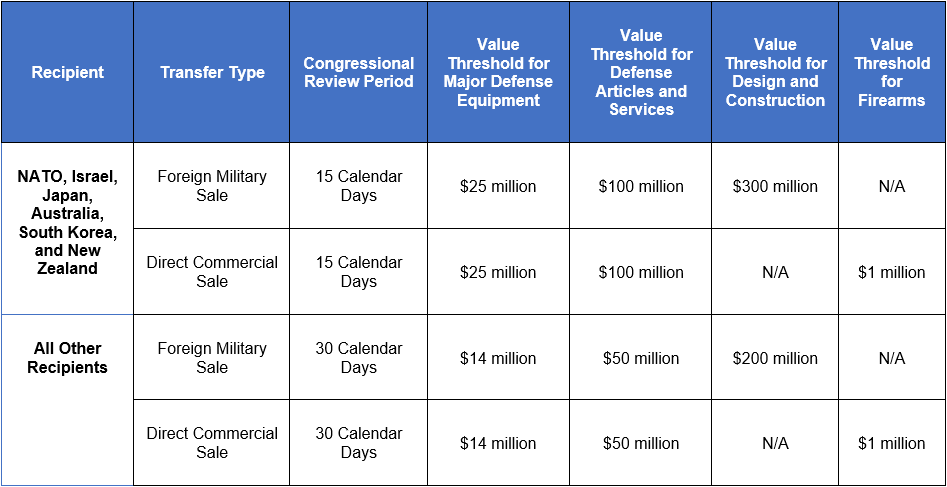
The Arms Export Control Act (AECA) — which provides the executive branch the delegated authority to engage in and regulate U.S. arms sales — requires that certain arms sales be submitted to Congress for review. Whether a proposed arms sale is subject to congressional review depends on the dollar value of the prospective deal as well as its intended recipient. For most recipient countries, both the House Foreign Affairs and Senate Foreign Relations committees must be notified of major defense equipment (MDE) valued at $14 million or more, defense articles and services valued at $50 million or more, and design and construction deals valued at $200 million or more, and are then afforded a 30-day review period before the sale can proceed. For NATO allies, Australia, Israel, Japan, New Zealand, and South Korea, the value thresholds are higher and the duration of the review period halved to just 15 days (see Table 1 for details).
Table 1: Review Periods and Notification Thresholds
The notification process is not just a bureaucratic box-checking exercise. It is a lynchpin in a narrow but critically important oversight ecosystem, and one of the only statutorily protected mechanisms expressly designed to facilitate lawmakers’ intervention in the arms transfer process. At the technical level, arms sales notifications trigger expedited AECA protocols that allow Congress to block a proposed sale through a joint resolution of disapproval (JRD). But given the limits of the JRD process — which has never successfully been used to block an arms sale — it is also important to understand how notifications underpin a wider dialogue between Congress, the executive branch, and the American public on arms sales.
By subjecting delicate foreign security partnerships to public scrutiny, notifications have incentivized the executive branch to seek congressional buy-in for potential arms transfers. Historically, this has taken the form of the “tiered review process,” a normative practice whereby the executive branch provides relevant congressional committee leaders with advance notice of proposed arms sales and refrains from formal notification without their approval. Though not required by law, the tiered review process allows legislators to raise concerns, request more information, or suggest adjustments to the terms of a proposed sale. On rare occasions, congressional leaders have placed “holds” on arms transfers of particular concern. Given the structural limits of the JRD process, these holds have represented the only practical tool at Congress’ disposal to effectively block an arms transfer.
Notifications also represent a de facto transparency instrument. Though direct commercial sales (sales between a private U.S. firm and a foreign recipient) remain obscured from public view, government-to-government sale notifications are posted on the State Department website at the time of their submission to Congress. The practice not only invites public scrutiny but also requires the U.S. government to defend, explain, and bear the political costs of decisions to arm predatory governments accused of human rights abuses or violations of international law. Similarly, as the American public has become more aware of arms sale issues, notifications have proven to be important catalysts for public pressure on elected leaders to take more principled positions against high-risk arms transfer decisions.
What Raising Notification Thresholds Means for Oversight
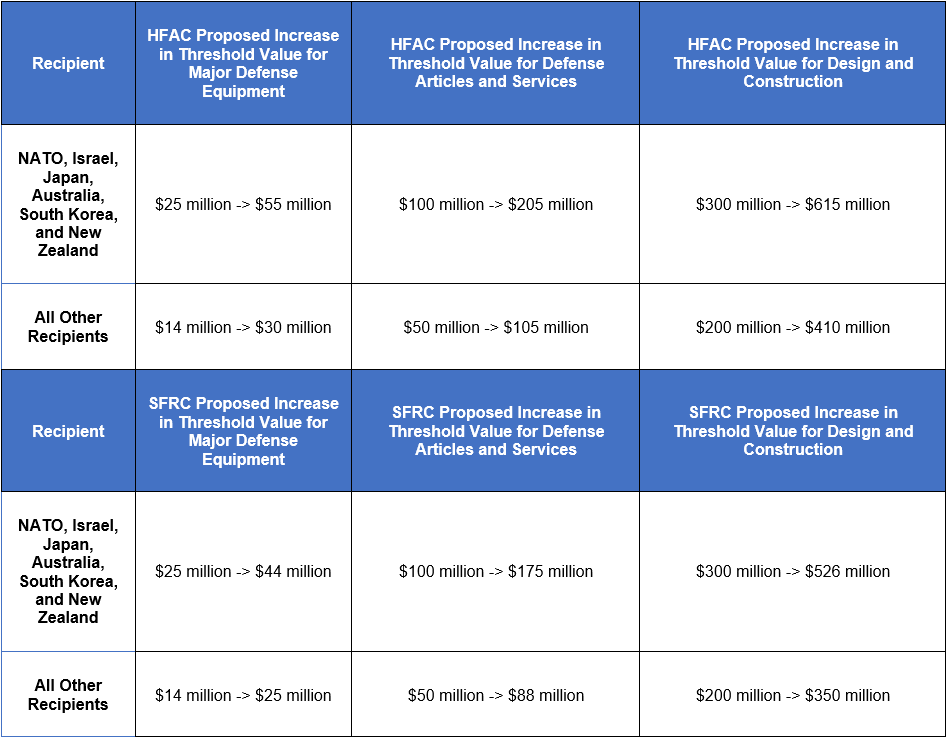
Raising the dollar value threshold for arms sales notifications would effectively shrink this oversight ecosystem. Higher notification values mean many more arms sales would fall below the threshold for congressional review and under the radar of legislative or public scrutiny. Information from proposed amendments from the House suggests that the values for most categories would be more than doubled. Senate proposals are less generous but still would raise the notification floors by tens or hundreds of millions of dollars.
Table 2: HFAC and SFRC Threshold Value Increase Proposals
The risks are not simply theoretical. Sub-threshold sales have long represented a practical gap in congressional oversight. Bipartisan congressional efforts to block arms sales to a Saudi-led coalition during its military campaign in Yemen are a striking illustration of this challenge. In 2019, notifications for emergency arms sales to members of Riyadh’s coalition proved a powerful catalyst for congressional action and public advocacy, including the rare passage of several JRDs (though they were vetoed by President Trump). Yet, a 2020 State Inspector General report found thousands of other sub-threshold sales worth over $11 billion to Saudi Arabia and the United Arab Emirates in the lead up to those JRDs were spared the same public scrutiny — including sales of the very types of arms that Congress had moved to block.
In applying the House-proposed thresholds to sales that took place in 2025, it is clear that many proposed sales would have been exempt from notification. Sales of air-to-ground missiles to South Korea, medium tactical vehicles to Lebanon, or medium-lift helicopters to Zambia are just a few examples of transfers that would have avoided congressional consideration. Additionally, higher thresholds could encourage the executive branch to break up larger sales into smaller packages to avoid congressional oversight, especially at a time when lawmakers have proven more eager to reclaim and impose their authority over transfers to divisive recipients.
Conclusion
Proponents of raising notification thresholds have often suggested the reforms would improve the efficiency of the U.S. arms transfer process, noting that the values have not kept pace with inflation. Raising thresholds has consistently featured among recommendations put forward by both executive branch proposals and congressional task forces aimed at speeding up U.S. arms transfers and is a central feature of the Streamlining Foreign Military Sales Act of 2025 introduced by Montana Republican Representative, Ryan Zinke.
But the backlog of U.S. arms transfers that has kept some U.S. partners waiting for years to receive their purchases seems hard to square with the time-bound brevity of the congressional notification and review process. Barring a rare congressional intervention, arms transfers are automatically permitted to proceed after 30 calendar days for most countries and just 15 for NATO+ partners. As for the tiered review process, holds placed on proposed sales are not bureaucratic delays but indications of substantive concerns that merit stronger executive branch consideration.
Long wait times for U.S. defense customers has much more to do with constraints in the defense industrial base than it does with regulation and oversight. Delays experienced by partners are a result of the same systemic production challenges that have plagued the U.S. government’s own struggle to replenish its stockpiles and meet readiness requirements. Within the broader regulatory ecosystem, there may be meaningful ways to improve efficiencies, but by the State Department’s own measures, 95% of foreign military sales are approved within 48 hours. And while the process for submitting notifications may add some administrative burdens, eliminating them would seem to offer a negligible improvement to systemic defense production challenges.
In other words, raising notification thresholds would represent an enormous sacrifice of already-diminished congressional oversight without much upside. And while there may be opportunities to consider where regulations could be streamlined, efficiency should not come at the expense of effective governance and accountability.








Community Adaptation for a Water Festival Without Clean Water