
Introduction
The latest announcement about the first tranche of South Korea’s strategic investment shows a strong lean towards energy infrastructure. Curiously missing from the discussion was any mention of the $150 billion for shipbuilding. This may seem puzzling since there was quite a bit of fanfare surrounding the Make American Shipbuilding Great Again (MASGA) initiative after the inauguration of President Lee Jae Myung in June of last year. A closer inspection of the South Korean October investment package provides some important clues as to why the shipbuilding component was not included in the initial package.
Lessons from North Star Power
There are three important lessons that we can draw from the South Korean October investment package (i.e., Project North, Project Star, and Project Power). The first lesson is that the South Korean government sees these projects as actual “investments” that will yield returns. In fact, the financing structure and mechanisms built into the package show that the investments have been carefully designed to provide safeguards for the South Korean government so that it can recover its principal with interest and, if successful, even make profit.
Careful inspection of the agreement, for instance, shows that the fund is a recoverable 20-year investment that would allow a 50-50 distributional split between the South Korean and U.S. governments until an aggregate amount equal to the Deemed Allocation has been recouped after which the distribution on the return from investment changes to 10% for South Korea and 90% for the U.S. If Korea is unable to recover the full Deemed Allocation within 20 years, the two governments can discuss adjustments to this distribution.
The second important lesson is that the South Korean government’s decision to deploy this capital hinges on the “commercial reasonableness” of the projects that are being proposed. According to the Enforcement Decree for the Special Act for Korea-U.S. Strategic Investment Management (the Special Act), this term is defined as “an investment that, consistent with the principle of good faith, is expected to generate sufficient cash flow over the life of the U.S.-bound investment to repay its principal and interest.” It is worth noting that “commercial reasonableness” was cited as the main reason as to why the South Korean government decided to delay its commitment to the Alaska LNG pipeline project.
There are two sets of factors that could impact the commercial reasonableness of any large projects. One has to do with the structural challenge of executing the project itself. With regards to the South Korean public financing behind the construction of eight new large reactors in the U.S., for instance, labor shortage and deficient supply chain have often been cited as two major hurdles. This, however, did not discourage the South Korean government from committing $120 billion.
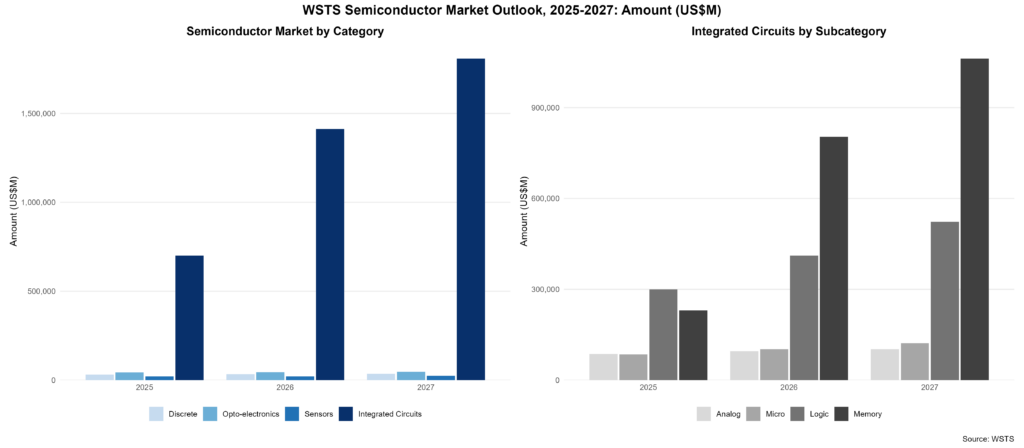
A more important consideration for Seoul may have been the demand outlook for nuclear energy, which looks strong. As the U.S. Energy Information Agency’s latest Annual Energy Outlook shows, U.S. electricity consumption increased by 2.1% over the past five years after 15 years of hardly any growth. The EIA’s estimate shows an average annual growth rate of approximately 0.9% to 1.6% through 2050 due to data center-related demand. Server electricity consumption between 2020 and 2050, in particular, is expected to increase by 16-fold. This confirms the data, which shows capital expenditure among leading hyperscalers increasing by four-fold between 2023 and 2025. Buttressing this trend is also an exponential increase in demand for semiconductors where demand growth and outlook have been and are expected to be significant for memory chips.
It is notable that all of this is happening while a sizable number of reactors in the U.S. are being decommissioned. In short, demand outlook for nuclear energy is strong.
The final lesson is that the projects that were approved for South Korean government funding were linked to a transformational change in the U.S. economy led by AI and an interlocking policy architecture which supports this trend. While the Alaskan liquefied natural gas (LNG) pipeline project has been pitched as a source of energy for data centers in Alaska, its core business proposition was always framed more as a reliable alternative energy source for the Asian market and less as part of the AI transformation story. The Trump administration’s May 2025 executive orders, on the other hand, explicitly link nuclear expansion to AI by directing the Department of Energy to designate government-linked data centers as critical defense facilities and nuclear reactors powering them as defense critical electric infrastructure. The subsequent $17.5 billion federal financing for 10 large reactors adds greater weight to the government’s support for this enterprise. Coupled with these moves, South Korea’s strategic investment becomes part of a greater public-private partnership effort with higher chance of success.
Applying Lessons to Shipbuilding
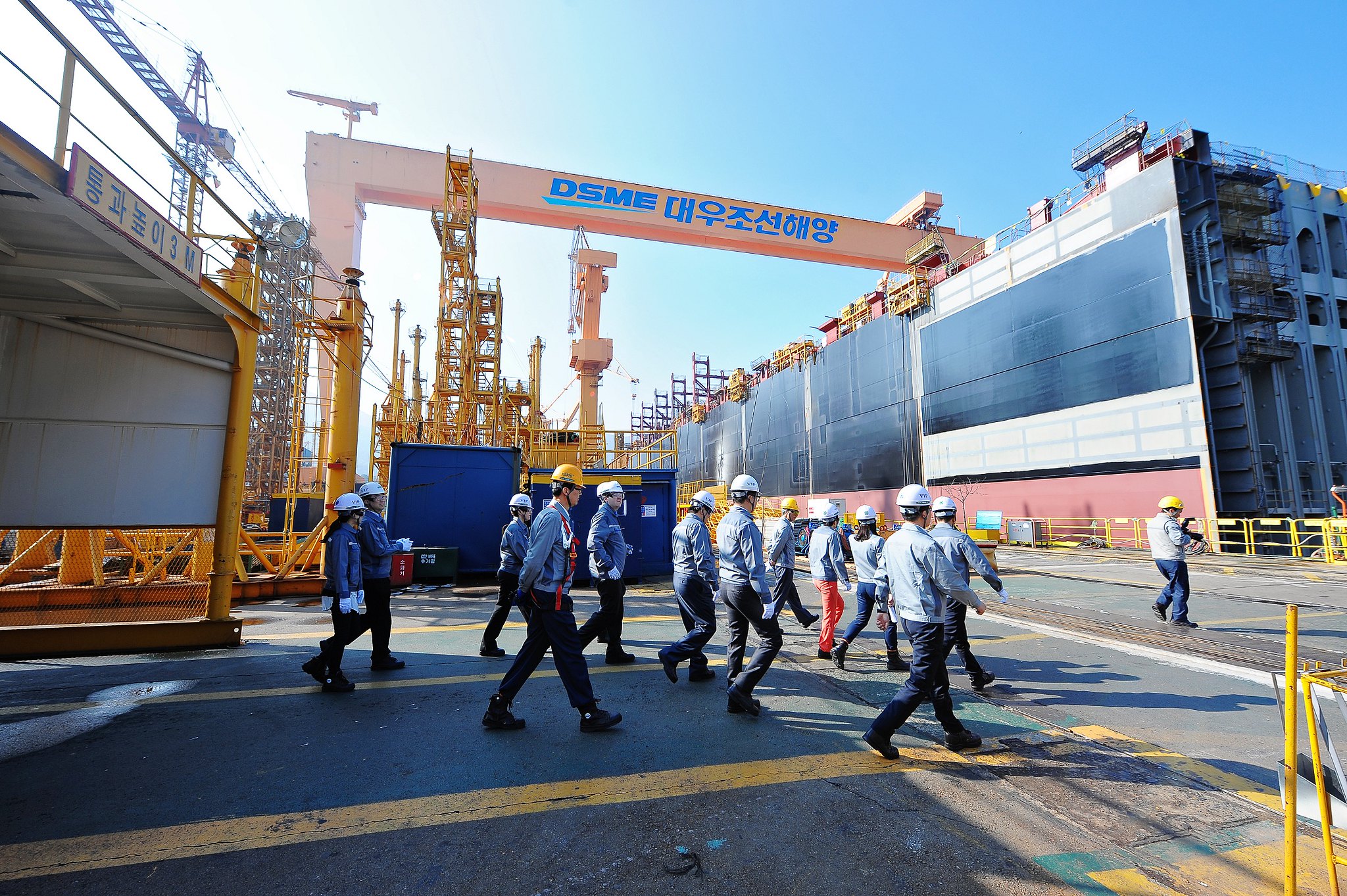
The above lessons provide some important insights and implications for the thinking behind South Korean public financing for U.S. shipbuilding. While a weak maritime industrial base (i.e. labor shortage and deficient supply chain) may weigh on the minds of South Korean policymakers and private actors, the South Korean government’s decision on its shipbuilding investment is more likely to be driven by the demand outlook for ships in the U.S. and whether the U.S. government has taken necessary steps to support that demand.
To that end, the 2026 BRS Annual Review shows that new vessel orders in 2025 totaled 176.5 million deadweight tonnage (Dwt), of which 72.3% went to Chinese yards, 19.4% to South Korean builders, and 6.4% to Japan. In contrast, there were only 12 new commercial orders in the U.S. (i.e., two LNG carriers and ten MR2 tankers) during the same period, which translates to less than 0.5% of the global Dwt total. It is worth noting that last year was the first time a new commercial vessel order was registered since 2022, and all of those new orders came from Hanwha Shipping for Hanwha Philly. With the SHIPS for America Act unable to pass in its original form and different parts of the original bill being broken up and included in the National Defense Authorization Act (NDAA), the demand outlook for commercial vessels looks, at best, uncertain.
The demand outlook for government contracts, on the other hand, looks different. The U.S. Navy’s latest FY2027 budget sets aside $65.8 billion for shipbuilding, which would support the procurement of 34 vessels, including both combatant (18) and auxiliary ships (16). This is a sizable increase from the 2025 and 2026 budgets, which were $39 billion and $47.4 billion, respectively. The FY2027 budget for the Coast Guard sets aside $578.3 million for vessel Procurement, Construction, and Improvements (PC&I). The Coast Guard budget shows FY 2025 and 2026 both maintaining PC&I for vessels at $833.3 million.
For these numbers to matter, South Korean shipbuilders or their subsidiaries must possess a yard that can build or service U.S. naval or coast guard vessels. In the case of Hanwha Philly, for instance, it must undergo necessary modification and certification of the existing commercial yard. Korean shipbuilders can bypass this process if they acquire yards that are already equipped to handle these types of vessels. Even if they are successful in acquiring a naval yard, South Korean shipbuilders will have to compete against other established defense primes for government contracts.
Given that the combined order values for the three largest South Korean builders were $35.4 billion in 2025, a sizable U.S. government order would be enough to allay some concerns about the commercial viability of operating a U.S. yard comparable to ones in East Asia. From the South Korean point of view, the question is whether such a project package can be envisioned and structured.
Thus far, the House, Senate, and White House have each proposed three paths to allow for limited foreign shipbuilding in allied yards, but these measures fall short of presenting a long-term demand proposition for the South Korean shipbuilders. For the size of investment that the South Korean government is contemplating (~$150 billion), a long-term procurement roadmap for the Navy and Coast Guard, coupled with expanded repeat orders for the same ship classes, would prove useful.
Although implementing the Finland Model or the bridge strategy could alleviate near-term needs for vessels as the initial investment for domestic yard development begins to take shape, a handful of vessel orders do not fully address the need for long-term capital investments to establish and maintain a skilled workforce, facilitate technology transfer, and develop a local supply chain ecosystem. They could be used as an illustrative case for demonstrating the performance of allied shipyards. Implementing the long-term vision for realizing the dream of a prosperous U.S. shipbuilding industry, however, will require more.
An important step in this direction may include establishing a standing high-level intergovernmental consultative channel that would set the agenda around applicable vessel classes for allied shipbuilding cooperation, formulate a procurement and investment schedule, and address the structural barriers to modernizing the domestic maritime industrial base. The two sides can use this mechanism to also discuss the scale and terms of policy financing and structure so that investment can be linked to actual milestones and specific performance indicators. Some examples of such indicators include vessels delivered as well as actual increases in U.S. employment and regional supply chain activity.
The undertaking required to modernize the U.S. shipyards to make them as productive as the ones in East Asia would require a sizable policy financing support comparable to the strategic investment package announced in early October. As noted in a recent report by the Government Accountability Office (GAO), the cost of updating the four public yards owned and managed by the U.S. Navy would require over $200 billion of investment over a period of 50 years. This is a good reference point in thinking about the magnitude of the challenge associated with the cost and time for modernizing privately owned yards in the U.S..
Finally, the selection process for partnerships with allied shipbuilding companies should be based on demonstrated performance, including ownership of U.S. shipbuilding facilities, hiring and training of U.S. workers, introduction of new technology, development of local supply chains, and delivery of U.S. government contracted vessels. Selecting proven performers who are already delivering or making a good faith effort to deliver on these fronts would be a logical choice.
Conclusion
There have been many notable accomplishments on bilateral shipbuilding cooperation between the U.S. and South Korea over the past two years starting with the establishment of a joint financing alliance in June as well as the launch of the Korea-U.S. Shipbuilding Cooperation Center (KUSPC) in July. The Trump administration issued the Executive Order titled “Restoring America’s Maritime Dominance” in April 2025, which directs the Commerce Secretary to include “all available incentives to help shipbuilders domiciled in allied nations partner to… help strengthen the shipbuilding capacity of the United States.” The administration’s Maritime Action Plan (MAP) also lays out “reducing dependence on unreliable suppliers through heightened cooperation with allies and partners” to rebuild domestic capacity. Finally, there is broad bipartisan consensus in Congress that allied shipbuilding cooperation is critical to American national and economic security.
However, for this cooperation to deepen and lead to meaningful outcomes, both sides must do more. The lessons from South Korea’s October strategic investment package show that the key test ultimately comes down to the “commercial viability” of the project itself, which largely rests on a strong demand outlook. If such a condition is met, it is incumbent on South Korea to execute and fulfill those contracts on time and at cost. Just as the U.S. need not revamp its maritime industry on its own, South Korea also needs the support of policymakers in Washington to map out and implement a joint vision for the future of the shipbuilding industry and market now more than ever.







Community Adaptation for a Water Festival Without Clean Water