

Presidential candidates aligned with Donald Trump have been on a winning streak in Latin America. Since his second inauguration, conservatives have prevailed in six straight presidential elections across the region. Now, Washington is eyeing the ultimate prize of Brazil, which accounts for half of South America’s GDP and population. Flávio Bolsonaro, a Trump ally and the son of former President Jair Bolsonaro, won the first round on Oct. 4 and is the frontrunner against incumbent President Luiz Inácio Lula da Silva ahead of the Oct. 25 runoff.
Mostly domestic factors — including frustration with the economy, a growing sense of insecurity, and yet another major corruption scandal — are opening the way for a return of the Bolsonaro family to power. Far-right parties made major gains in Congress and in gubernatorial elections, including in São Paulo and Rio de Janeiro. Jair Bolsonaro’s wife and two of his sons, Carlos and Jair Renan, won congressional seats. It was a remarkable turnaround for a former president under house arrest for attempting a coup d’état.
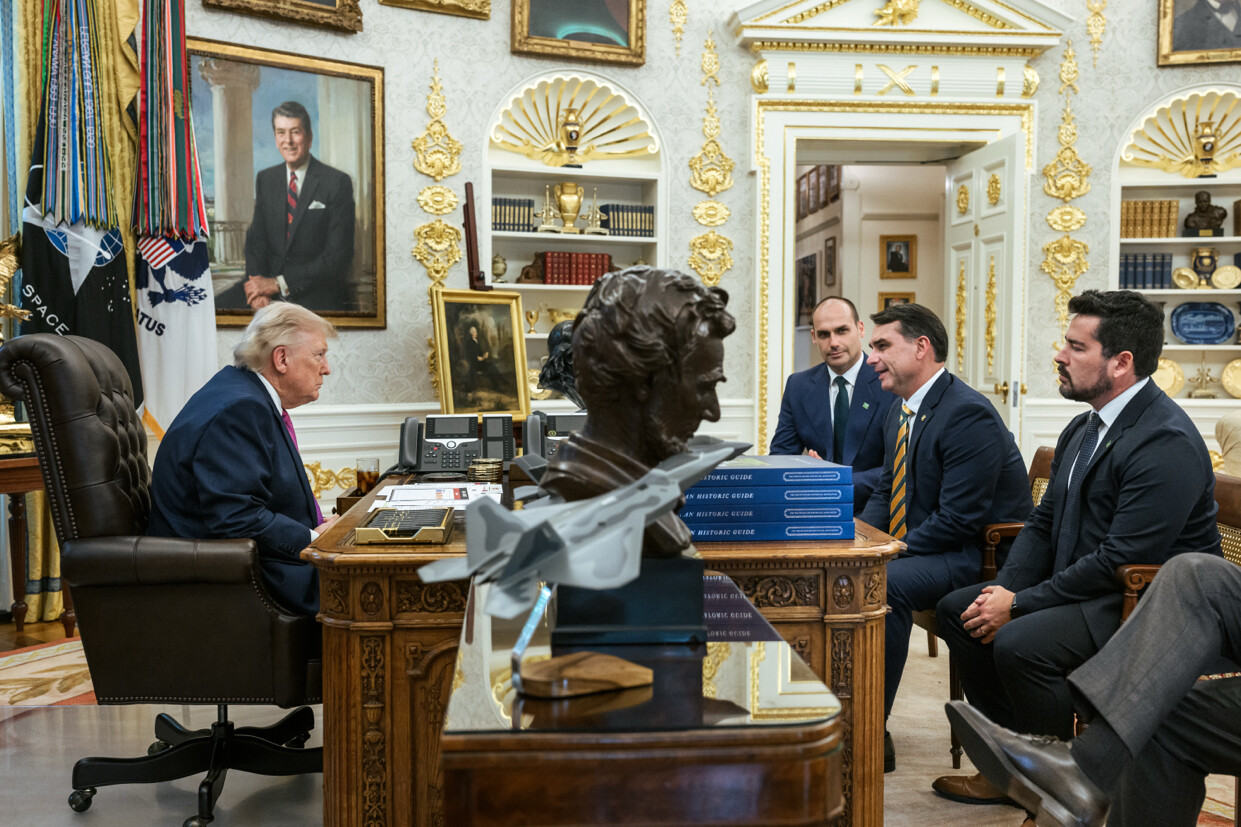
That is not to say that the United States did not attempt to influence the election. The Trump administration has been meddling in Brazilian politics for over a year. As the presidential campaign began, Trump hosted Flávio Bolsonaro in the Oval Office. A few days later, the State Department designated two Brazilian crime syndicates as Foreign Terrorist Organizations, over Lula’s repeated objections. Earlier, the State Department had suspended the visas of several government officials and sanctioned Supreme Court Justice Alexandre de Moraes — a nemesis of the Bolsonaro family — for alleged “warfare” against Jair Bolsonaro and U.S. technology companies, including Meta and X.
Washington’s interventions should not come as a surprise. The “Donroe Doctrine” rests on the notion that U.S. national security and economic interests in Latin America depend upon Washington’s “preeminence” in the Americas. In practice, that means not only competing against China, but also promoting candidates and parties seen as friendly to the U.S. president and his MAGA movement.
By contrast, Lula has pursued an independent foreign policy, at times openly defiant of Trump on issues ranging from trade to the Middle East. Brazil is a pillar of China’s Latin America strategy: It is Beijing’s top trading partner and largest investment destination in the region, and a fellow founding member of the BRICS. For the Trump administration, replacing Lula with a staunch ally would represent its greatest foreign policy success in the region since the January raid that removed Venezuela’s Nicolás Maduro.
In truth, whatever the result, the Brazilian election is exposing the limits of the “Donroe Doctrine.” A return of the Bolsonaros would without a doubt change many things in Brazil, including its security cooperation with Washington and its diplomatic alignment on culture war debates. Flávio Bolsonaro has promised to mirror the U.S. designation of Brazilian criminal organizations as terrorist groups and to join Trump’s “Shield of the Americas,” the security alliance he launched in March at his golf course in Florida. He would also disfavor international climate initiatives and build close relations with Israel, likely fulfilling his father’s promise to move the Brazilian Embassy to Jerusalem.
None of that, however, would meaningfully reverse China’s deepening economic influence in Brazil, or the belief among many Brazilian business executives and foreign policy elites that the best long-term strategy is to hedge against an increasingly unpredictable United States.
If Brasília becomes the next Latin American capital to shift rightward, the region would be ideologically aligned with the United States to a degree not seen since at least the early 1990s, following the end of the Cold War. Yet the U.S. unipolar moment is long gone, including in Latin America. No matter who is in power in the region, Trump’s revived Monroe Doctrine is destined to collide with the reality of growing dependence on Chinese trade, investment, and technology.
Beijing’s Gravitational Pull
Structural forces shape Brazil’s dependence on China and, in many ways, Trump’s foreign and economic policies are strengthening those bonds. For example, the U.S. war against Iran and the resulting Strait of Hormuz crisis prompted China to diversify its oil supplies. Far from the battleground, Brazil is benefiting handsomely. The volume of Brazilian oil exports to China more than doubled in the first quarter of the year compared to the same period a year ago, as energy prices soared. Amid expanding production, Brazil’s majority state-owned energy giant, Petrobras, reported a 96% rise in second-quarter net profits.
Trump’s trade policy has also brought Brazil and China closer together, with the United States taxing many imports from Brazil at a rate of 37.5%. As a result, from January to August, Brazilian exports to the United States dropped 10% from a year earlier while imports fell by 9%. Over the same period, Brazil’s exports to China rose 15%, and its imports from China grew by 9.5%. Over all, Brazil is now exporting three times as much to China as it does to the United States.
Flávio Bolsonaro hopes his friendship with Trump would reorient trade flows. But his promises to negotiate a free-trade agreement with the United States are far-fetched, given bipartisan skepticism in Washington and the reluctance of U.S. farmers to compete against Brazilian producers.
In the meantime, dependence on the Chinese market has far-reaching political implications in Brazil. China is by far the largest buyer of Brazilian agricultural exports, and those producers are a pillar of the Bolsonaro coalition. During his campaign in 2018, Jair Bolsonaro expressed hostility to China and made a provocative visit to Taiwan. Once in office, however, he quickly made a state visit to Beijing, as industry groups restrained his anti-China instincts and reined in the more ideological forces in his government. Trade with China increased, and despite Washington’s lobbying, he permitted Huawei to supply equipment for Brazil’s 5G networks. Far from abandoning the BRICS, he nominated a Brazilian to lead the New Development Bank, the bloc’s financing arm.
This time around, his son has been cautious about the subject from the start, directing his criticism chiefly at Lula, whom he accuses of “making Brazil a Chinese colony.”
Pro-Trump leaders walking back promises to take sides in the US-China competition have become a common story in Latin America. During his insurgent presidential campaign, Argentina’s Javier Milei pledged not to do business with China, describing its leaders as “assassins.” Nowadays, Milei calls China a “great trading partner,” and he recently renewed Argentina’s $19 billion currency swap line with the People’s Bank of China for another five years. El Salvador’s Nayib Bukele once considered restoring ties with Taiwan and accused China of “not playing by the rules.” Nowadays, the two governments are reportedly considering a free trade agreement.
For his part, Lula regards China’s emergence as key for checking U.S. power and building a multipolar world order. But even he has learned the hard way about the political sensitives of China’s commercial inroads in Brazil. In 2024, Lula sparked public outrage after promoting a 20% tax on certain products sold on popular Chinese e-commerce platforms, including Shein and AliExpress. Under fire, he soon reversed course.
Yuan Talks
In general, ideology has played a limited role in Brazil’s strategy for navigating US-China competition. In a March speech at the Conservative Political Action Conference in Texas, Flávio Bolsonaro argued that Brazil’s rare-earth reserves, the second largest in the world, should be the “solution” for U.S. dependence on Chinese supply. His remarks drew strong criticism from members of the Lula administration.
Under Lula, however, American companies — backed by generous U.S. government funding and guarantees — have been swiftly expanding their presence in Brazil’s rare-earths industry. In early 2026, the U.S. International Development Finance Corporation provided $565 million to refinance debt and expand Brazil’s Serra Verde mine, the only producer of all four critical magnetic rare-earth elements outside of Asia. In September, USA Rare Earth completed its acquisition of the company. Serra Verde also secured a 15-year agreement to send all its initial production to the United States, at guaranteed minimum prices.
Similarly, Brazilians seem fairly united in responding to Trump’s offensive against Pix, a widely popular digital payments system developed by Brazil’s central bank. Pix is the country’s most used cashless payment instrument, outpacing credit, debit, and prepaid cards, and allowed for the financial inclusion of millions of Brazilians. Washington claims that Brazil unfairly favors Pix over private U.S. competitors, such as Visa and Mastercard. Testifying before the Office of the U.S. Trade Representative, Flávio Bolsonaro rejected Trump’s discrimination argument, and in Brazil, he has vowed to defend Pix. However, he promised not to link it to “non-Western” payments systems.
Lula has repeatedly flirted with “de-dollarization,” promoting trade in local currencies, deeper integration with Chinese and other payment systems, and even a BRICS currency. That said, his “Global South” discourse has not meaningfully reduced Brazil’s use of the dollar, which accounts for most of the country’s trade and about 75% of its central bank’s currency reserves, compared with 6% for the renminbi. Lula’s proposal to develop a BRICS currency has gone nowhere. For his part, Flávio Bolsonaro would be unlikely to dismantle Brazil’s existing arrangements with China that facilitate bilateral trade in renminbi and the use by Brazilian banks of Chinese payment systems.
Similarly, Lula’s departure from the Palácio do Planalto would not radically change Brazil’s technology sector — another area that has raised tensions with Washington. Lula has pushed to diversify technology suppliers to reduce dependence on U.S. firms, increase competition, and foster local capabilities. Those are the principles behind his pet project, the “Brazilian Cloud,” a government-backed initiative to develop a national cloud computing service and retain data and sensitive infrastructure in Brazilian hands.
Flávio Bolsonaro would downplay those goals, and it is unclear if he would fully embrace the “Brazilian Cloud.” However, his pro-Trump foreign policy would do little to change the growing appeal of Chinese technology to Brazilians. From electric cars to open AI models, Chinese firms offer increasingly competitive products, often at lower prices than Western competitors. Their swift expansion in Brazil has far more to do with market forces than the political preferences in Brasília. Both the first Trump administration and the Biden administration, for example, failed to persuade Jair Bolsonaro to exclude Huawei from Brazil’s commercial telecommunications networks. His son would face similar incentives to prioritize affordable and sophisticated Chinese technology over U.S. security concerns.
To be sure, a Brazilian government that joins the Shield of the Americas and champions Washington’s foreign policy agenda would represent a substantial victory for Trump. Brazil is Latin America’s most influential actor on the global stage, a member of the G-20, and a leader in the Global South. Though Brazil’s political system is famously slow-moving and consensus-based, Brazilian presidents have almost total control over foreign policy. Flávio Bolsonaro, whose father is known as the “Trump of the Tropics,” would likely use alignment with Washington to mobilize his base and demonstrate a clear break with the Lula era.
None of that, however, would counter China’s growing economic clout, or the diplomatic leverage it provides. If anything, Brazil will become even more dependent on Chinese trade, investment, and technology, as Trump doubles down on his trade protectionism and reindustrialization agenda. Should Flávio Bolsonaro win the presidency, he would no doubt return to the Oval Office to celebrate the rapidly growing MAGA influence in South America. Afterward, expect him to start planning his next big trip — to Beijing.



Community Adaptation for a Water Festival Without Clean Water