

Editor’s Note: Stimson’s Myanmar Project seeks a variety of analytical perspectives on issues relating to Myanmar’s civil war, domestic politics, foreign relations, and other topics. The authors of this piece bring a range of expertise on politics, development, and peacebuilding in Myanmar. Tay Zar Myo Win is a PhD candidate at Deakin University, Australia, whose research focuses on political and social dynamics in Myanmar. Tint Zaw Hein is an academic administrator, researcher, and practitioner in sustainable development.
By Pamela Kennedy, Deputy Director, East Asia Program
Disclaimer: Stimson is not able to independently verify the survey’s sample collection. The survey data reflects the sentiment on the ground in Anyar, Myanmar’s upper Dry Zone, during the highly charged and sensitive period of the regime-led elections in December 2025–January 2026. Conditions on the ground continue to evolve.
Introduction
Many view the people of Myanmar as having parallel desires: on the one hand, a desire for peace and a cessation of intense suffering and brutal and indiscriminate military oppression, atrocities, and mass killings since the 2021 military coup, and on the other a desire for resistance groups to continue fighting the military. However, most assessments do not utilize reliable, on-the-ground evidence to truly understand public opinion. To illuminate people’s actual perceptions, particularly those from Anyar—the Dry Zone of central upper Myanmar—regarding the revolution, their suffering, and their expectations of the revolution and resistance forces, we conducted a survey among 287 people from Magway, Sagaing, and Mandalay. Our key finding is that most respondents want the resistance to keep fighting and want to see better collaboration, coordination, and unity between the National Unity Government (NUG) and Ethnic Revolutionary Organisations (EROs), as well as within multiple factions of local defence forces. Against this backdrop, new federal units and alliances are emerging, which might help consolidate the resistance. But new federal units also bring new challenges such as resource sharing, revenue generation, shifting territorial control, managing power dynamics, and maintaining effectiveness.1Tay Zar Myo Win, “Emerging Local Governance in Anyar amidst Massive Post-Coup Destruction,” In C. Medail, S. Hmung, & M. B. Pedersen (Eds.), “Myanmar rises: The Spring Revolution,” ISEAS – Yusof Ishak Institute, 2026, https://bookshop.iseas.edu.sg/publication/8018. These trends are all evident in Anyar.
Anyar is a socio-cultural term that literally refers to central upper Burma, including present-day Mandalay, Sagaing, and Magway regions. Beyond just geography, the term encompasses shared livelihoods, cultural practices, and political experiences, particularly among the Bamar majority rural communities in the central dry zone. Since the 2021 military coup, Anyar has become a resistance stronghold against military rule. Anyar theatre is now widely recognized as the epicentre of Myanmar’s post-coup civil war, with sustained clashes between resistance forces, the military, and paramilitary armed groups. In particular, Sagaing and Magway regions have experienced some of the highest levels of conflict intensity, mass displacement, village destruction, and civilian casualties nationwide. According to data from the International Institute for Strategic Studies (IISS), nearly one-third of conflict events in Myanmar (including clashes, air and drone strikes, and IED explosions) and over half of infrastructure damage from June 2021 to June 2026 occurred in the dry zone.2International Institute for Strategic Studies, “Myanmar Conflict Map,” 2026, https://myanmar.iiss.org/dashboard. Moreover, the Burmese military—which now controls only about one-third of the country—was unable to hold elections in many parts of the dry zone. For example, in Sagaing, 25 out of 37 townships held elections, and within those 25 townships, 70.91% of wards and village tracts were excluded.3Burma News International, “Ballots Without Choice: Electoral Dynamics in Ethnic Areas of Myanmar,” March 2026, https://www.bnionline.net/sites/bnionline.net/files/publication_docs/20260405-english-bni_report.pdf. This article focuses on three regions—Mandalay, Sagaing and Magway—as major parts of Anyar Region.
The survey was conducted between 12 November 2025 and 4 February 2026 across Sagaing, Magway, and Mandalay regions. A total of 287 voluntary respondents participated in the survey. No personally identifiable information was collected from respondents, and no incentives were offered for participation. Due to security constraints and access limitations, respondents were selected through purposive sampling, which ensured geographic diversity across resistance-controlled, military-controlled, and contested areas while minimizing overlap in participant recruitment. The sampling strategy for the survey also prioritized ordinary civilians rather than representatives of political bodies, civil society organizations, or armed groups. Of the respondents, 49% resided in resistance-controlled areas, 34% in military-controlled areas, and 17% in contested areas. The majority (61%) were aged between 18 and 35 years. The surveys were conducted face-to-face in the Myanmar language. Local enumerators were recruited based on their prior research experience and familiarity with the local context. Before field deployment, enumerators received training on the study objectives, the survey tool, informed consent procedures, and data collection protocols. Data were collected using KoboToolbox, but given limited internet access and security concerns, surveys were conducted offline and uploaded only after enumerators reached locations with stable internet connectivity. Following data collection, a debriefing session was conducted with enumerators to discuss findings, clarify responses, and provide contextual insights.
The People’s Expectations for the Resistance
Our survey findings show profoundly strong support for the resistance movement. When asked to rate their support for the resistance on a scale of 1 to 5, 75% of respondents selected the highest level (5), while 14% selected level 4. When asked about the most effective resistance tactic among three options—armed resistance, a combination of armed and non-violent movements, and non-violent movement—45% chose armed resistance, and 47% selected the combined approach. As a follow-up question on which approach should be strengthened, 74% identified armed resistance. 46% believed the actions of resistance forces reflect the will of the people, citing the primary reason as their continued fight against the military, while 39% responded that they did not want to answer that question and 15% perceived that the resistance forces did not listen to public opinion.
We also asked who respondents wanted to lead the revolution, providing as options all major EROs, the NUG, prominent political activists and leaders, and an ‘other’ option allowing participants to name an alternative. At the national leadership level, 34% of respondents indicated that they would like to see General Twan Mrat Naing, the leader of the Arakan Army (AA), lead the nationwide resistance movement—the highest number of responses—followed by 23% supporting the NUG. This suggests that people from Anyar may be inspired by the Arakan Army’s military victories over the military in Rakhine State. This finding also aligns with their preference for armed resistance as a revolutionary approach.
Unity among Myanmar’s diverse resistance forces is a long way off, and their different political interests and visions can lead to disagreements and tensions. Many ethnic resistance groups were reluctant to join the revolution or collaborate with the NUG, and some even continued engaging with the military to try to achieve their political goals. Despite the complexity of underlying challenges to resistance unity, even just in fighting together against the military, people are now increasingly pushing leaders and resistance forces to work together. The survey highlighted that the public in Anyar perceives unity between Bamar resistance groups and non-Bamar resistance groups as the most important factor to overcoming the current crisis, followed by the consolidation of PDF forces. But the question is whether the leaders are listening and, more importantly, whether they want to listen. As long as the resistance remains fragmented, the military will continue to exploit this divergence to its advantage.
Regarding resolution of the conflict, 90% of respondents indicated that the revolution should end only through armed victory over the military. By contrast, only 9% considered negotiation a plausible pathway toward ending the conflict. Consistent with this position, 93% of respondents expressed little confidence that the elections held by the military would resolve the ongoing crisis, as the elections were widely perceived as lacking public support, not free and fair, and not reflecting the people’s will, primarily because they were organized by the junta, who seized power by arbitrarily arresting elected leaders and brutally cracking down on political dissent.
At the same time, respondents indicated several expectations for the resistance. The most frequently selected expectation was greater unity between resistance groups and ethnic armed forces (83%). This was followed by calls for stronger coordination among PDF forces (66%), reform within the NUG (48%), and increased support from the international community (46%).
Emerging Federal Units and Increased Collaboration
Against this backdrop of ongoing massive humanitarian needs and public desire for a more consolidated approach, resistance forces have initiated multiple platforms to reorganize themselves and reflect the changing context. Mandalay, Sagaing, and Magwe regions all organized regional governance structures under the emblem “Emerging Federal Units” by early 2026. These governance structures are intended to be more responsive to local community needs by staying closer to people and taking local-level action, and they often state consolidating the diverse resistance groups as a priority. The Sagaing Federal Unit Hluttaw’s February 5, 2026 statement explicitly demonstrates that coordinating activities among resistance forces within the region and consolidating the dispersed political and military forces are among its six political roadmaps.4Sagaing Federal Unit Hluttaw, February 4, 2026, Facebook, https://www.facebook.com/sagaingfuh/posts/pfbid0YL9rjiNQUwUJHRKCLmKfTmzPjty73WADQPzvhpBNCafcomLLSvHosQCuWxM2jzagl. Similarly, the objectives of the Interim Constitution of the Magway Federal Unit include assisting coordination among resistance forces in achieving the revolution and resolving disputes among them in accordance with the law.5Magway Federal Unit Hluttaw, November 7, 2025, Facebook, https://www.facebook.com/photo?fbid=1288328596666072&set=pcb.1288334476665484. Since these statements, there have been several meetings between different federal units.
But governance structures, approaches, and policy priorities in these three regions differ, as well as the issues they face, and this creates challenges for external coordination. For example, while resistance groups could control more territory in Sagaing, this is less likely in Mandalay. Structural differences add further complexity: the Vice Chairperson of the Mandalay Interim Executive Council is the Defence Minister of Mandalay, while the Magway and Sagaing Federal Units have separate Defence Ministers under their respective interim arrangements.6Mandalay Interim Governing Council, November 28, 2025, Facebook, https://www.facebook.com/migc.mm/posts/pfbid0uhtRkVUgMKrZfSLWaiQTFpdzk2Rg5oMUKuDAUTjdhaSWyoAbEN558ZA8ScC4Uqwdl?rdid=juvfLT76S2eZiHXu. 7Interim Magway Federal Unit Government, April 13, 2026, Facebook, https://www.facebook.com/imfug.mm/posts/pfbid0TXzSPAfRXfKBwmstgUgFSXsdsuzjZZEyc8AEbXqcPBJ3qumajwTVdZzRRSmVwQLUl. 8Sagaing Federal Unit Interim Government, December 23, 2025, Facebook, https://www.facebook.com/SFUIGOffice/posts/pfbid02b4pXgeVbDx9sfqjuAEQmfz1xPasraWRK5MBXdSL9KkQ5UXpGWHZQvB3oggScGFaql. 9DVB, “Sagaing Federal Unit Hluttaw appoints 12 new officials to its interim administration,” December 25, 2025, https://english.dvb.no/sagaing-federal-unit-hluttaw-appoints-12-new-officials-to-its-interim-administration/.
Of Myanmar’s seven administrative regions, only those three have successfully initiated federal unit governance structures so far. On March 4, 2026, 42 Local People’s Defence Forces (LPDFs) released a statement calling on the Magway Federal Unit Government to consolidate LPDFs in Magway under the unit government and to invite more LPDFs to join.10Public Voice Television, May 4, 2026, https://www.facebook.com/photo?fbid=1329334199292476&set=a.567953695430534.
Though coordination challenges remain, these unit governments could provide fresh momentum to address fragmentation, consolidate resistance forces, and better meet local needs. These regional bodies were officially established just before our survey, but a majority of respondents (66%) were both aware of emerging federal unit governments in their respective regions and expected these entities to bring positive changes to their daily lives and the resistance movement. 63% of participants believed their security and socioeconomic situation would improve, 65% believed disputes caused by village and township administration would decrease, and 72% expected resistance activities to be more effective when the federal units are strengthened. In resistance stronghold Anyar a relatively ethnically homogenous Burmese population and the establishment of a functioning NUG administration may provide more favourable conditions for coordination.
Regarding reforms among resistance groups, the highest-ranked preference (32%) was for unity between ethnic revolutionary organisations and Burma resistance forces, followed by 30% emphasizing consolidation among People’s Defence Force (PDF) groups. This data demonstrates that grassroots actors are aware that fragmentation among resistance factions poses a serious barrier to achieving revolutionary victory, and they expect resistance leadership to prioritize unity in fighting the military. The recent formation of the Steering Council for the Emergence of a Federal Democratic Union (SCEF) in March 2026—which comprises the NUG, the CRPH, and four prominent EROs: the Kachin Independence Organization (KIO), the Karen National Union (KNU), the Chin National Front (CNF), and the Karenni National Progressive Party (KNPP)11Steering Council
for the Emergence of a Federal Democratic Union, “ဖက်ဒရယ်ဒီမိုကရေစီပြည်ထောင်စုပေါ်ထွန်းရေး ဦးဆောင်ကောင်စီ (Steering Council for the Emergence of a Federal Democratic Union – SCEF) ထုတ်ပြန်ကြေညာချက်” [Announcement by the Steering Council for the Emergence of a Federal Democratic Union (SCEF)], March 30, 2026, https://www.scefdu.org/statement/announcement-by-the-steering-council-for-the-emergence-of-a-federal-democratic-union-scef. —serves as a positive indication that resistance leaders are seemingly adapting to public demands, at least symbolically.12James Shwe, “Myanmar’s New Federal Steering Council: Why now, who is missing, and why ‘Reconciliation’ is an illusion,” April 2, 2026, https://eng.mizzima.com/2026/04/02/32773. However, several major EROs have not yet joined inter-group frameworks. Another development is the formation of the Spring Revolution Alliance (SRA) in December 2025 aimed at joint military operations in Anyar and beyond, comprising nineteen armed resistance groups.13The Irrawaddy, “Interview: What is the New Spring Revolution Alliance?” December 19, 2025, https://www.irrawaddy.com/in-person/interview/interview-what-is-the-new-spring-revolution-alliance.html. Currently, forces operating within this alliance remain concentrated in Sagaing, Magway, Bago, Chin, Mon, and Karen.
Foreseeable Challenges to Coordinated Resistance
Regardless of how various institutions are reorganized to make them fit for purpose, several challenges remain. One of the most contentious issues is the 3Ps—People’s Administrative Organisation (PAO), People’s Defence Organisation (PDO), and People’s Security Organisation (PSO)—which have increasingly become sources of frustration and dissatisfaction among local communities due to many reported issues of power abuses, mismanagement of resources, and conflicting roles between the 3Ps.14Tay Zar Myo Win, “Emerging Local Governance in Anyar,” ISEAS – Yusof Ishak Institute. For example, in August 2025, a PDF unit under the NUG arrested 13 members of the Kani Township Natural Resources Committee in Sagaing Region, including members of 3Ps, over allegations of tax revenue misuse.15BBC, “NUG ထိန်းချုပ်ဒေသတချို့မှာ အခွန်ငွေ အဂတိလိုက်စားမှုတွေ ဘယ်လိုဖြစ်ခဲ့လဲ” [How did tax-related corruption occur in some areas under NUG control?], November 5, 2025, https://www.bbc.com/burmese/articles/c98d557620mo.
Concurrently, local resistance groups have raised grievances over NUG efforts to monopolize political authority and revenue collection. Amid these unfolding tensions, the newly established federal unit governments could play an intermediary role by providing oversight of local authorities, including the 3 Ps, while negotiating with the NUG over the distribution of competencies and revenues. Such arrangements could help ensure a fair allocation of resources to local actors for the delivery of public services while maintaining resistance cohesion in line with the expectations of our survey respondents.
Our survey respondents considered nine major issues affecting daily life under resistance actors, and 22% of total responses highlighted misconduct in public budgeting as a primary concern, while 13% pointed to forced tax collection. Many expect that emerging federal unit governments will be able to address these issues, although these organizations are still discussing the division of competencies with the NUG. We anticipate that the 3Ps will be placed under the supervision of the unit governments, whereas they were previously accountable to NUG ministries. However, no concrete agreement has been reached as yet, though some unit federal constitutions allow for placing 2 Ps (PSO and PDO) under the unit governments.16Center for Ah Nyar Studies, “Understanding Federal Units in Central Myanmar: Briefing Paper on Federal Unit Politics of Central Burma (Part 1),” November 19, 2025, https://ah-nyarstudies.org/understanding-federal-units-in-central-burma-part-1/.
Resource sharing disputes and conflicts between local groups and NUG forces are prone to continue. People judge fairness not only in terms of federal–regional relations but also by comparing themselves with other regions. As one Anyar federal unit official put it in an interview with the authors, people in the region would see it as unfair if the NUG relied heavily on revenue from Anyar while being unable to collect comparable contributions from other regions for national-level resistance activities, which in turn could affect the NUG’s legitimacy. Revenue generation is essential during the revolutionary period—not only to fund military operations but also to provide public services and humanitarian support. According to the taxation and budget allocation arrangement announced by the NUG in 2022, People’s Administrative Organizations are allocated 30% of the total tax collected, and People’s Defence Organizations receive 40%, while the NUG retains the remaining 30%.17BBC, “How did tax-related corruption occur in some areas under NUG control?” But federal and regional authorities may not always agree on how resources should be used. Effective budgeting is critical, both for meeting military and administrative needs and for retaining legitimacy among local populations. As one Anyar official explained to the authors in an interview, their government prioritizes social spending, such as for healthcare and livelihood support, because local communities have endured prolonged hardship and continue to back the resistance.
Yet, the ability to enforce laws, deliver services, collect taxes, and extract resources depends on territorial control. In areas under military authority, civilians often have little choice but to rely on SAC-provided services, particularly for healthcare and education, regardless of their preferences. 18Han Thit & Htoo Aung, “The reluctant return of Myanmar’s students,” Myanmar Now, July 27, 2023, https://myanmar-now.org/en/news/the-reluctant-return-of-myanmars-students/. 19Human Rights Watch, “Myanmar: Junta Assault on Health Care Hinders Quake Response,” April 28, 2025, https://www.hrw.org/news/2025/04/29/myanmar-junta-assault-health-care-hinders-quake-response. This means armed confrontation and other forms of coercion will likely continue as competing authorities try to assert control over local governance. Civilian administrative actors will likely continue to be caught in between competing authorities and face risks such as arbitrary detention and threats to personal safety.20Su Mon, “Myanmar outlook: Fighting is set to intensify in the center of the country,” ACLED, August 6, 2026, https://acleddata.com/report/myanmar-outlook-fighting-set-intensify-center-country. Thus, the challenge for resistance forces, including both the NUG and emerging federal unit governments, in sustaining public support is not only to consolidate scattered resistance groups to fight the military but also to address humanitarian and livelihood needs.
Competition over resources is also likely to intensify in another direction: between resistance forces and the new regional administrations formed after the military-organized elections.21Su Mon, “Myanmar outlook: Fighting is set to intensify in the center of the country.” As expected, the USDP—led by former military personnel—claimed a sweeping victory and formed governments at both the union and regional levels. As these structures develop, they may be competing with burgeoning resistance-oriented governance structures. In addition, resource sharing among the resistance actors, particularly between the emerging regional entities and the NUG, has already become a flashpoint. Take, for example, recent tensions in Myaing and Pauk Townships in Magway Region. The NUG instructed local forces to transfer revenue-generating oil fields to its control, but local resistance groups (LPDFs) and 3Ps also rely on them to fund their operations, weapons, and soldiers.22BBC, “Tensions over oil fields in Pauk and Myaing,” [ပေါက်နဲ့ မြိုင်က ရေနံမြေလွန်ဆွဲပွဲ], April 8, 2026, https://www.bbc.com/burmese/articles/cvg48mz9354o. After several groups raised concerns, the issue was eventually resolved through coordination between the NUG and the Magway Federal Unit Interim Government, establishing a joint committee to manage such resources, thereby preventing further escalation. Though this matter was resolved through coordination, broader resource-sharing discussions between the NUG and the Interim Magway Federal Unit Government are still in progress,23BBC, “Tensions over oil fields in Pauk and Myaing.” and other flashpoints could arise in many areas.
Conclusion
Despite enduring severe suffering due to conflict and the military’s indiscriminate oppression aimed at intimidating local populations and resistance forces, Anyar residents still strongly support the revolution, and the level of support has not decreased over five years of conflict for all but 14% of survey respondents. However, such strong support for the revolution does not necessarily equate to backing for all resistance actors and activities. In fact, residents have witnessed misconduct and abuses of power by some resistance actors, and long-standing fragmentation among resistance leaders, particularly between Bamar and non-Bamar ethnic revolutionary groups, remains an issue. They also recognise that revolutionary victory cannot be achieved without unity and coordinated action.
On the other hand, a clear, shared vision among the resistance forces has still not yet emerged. Although many resistance actors explicitly claim federal democracy as a shared goal, several ethnic revolutionary groups have not joined the broader revolutionary movement. Even this stated goal remains unconvincing due to a lack of implementation, while several immediate practical challenges—such as resource sharing, power distribution, and the formation of a consolidated leadership body—still persist. This is a serious concern for the current revolution in Myanmar, both for its prospects of victory and for securing sustained support. Broader consequences include continued suffering and hardship for the people of Myanmar. Symbolic steps toward consolidation, such as the formation of the SCEF, have been taken, but substantive unity has not yet been achieved. Going forward, a priority for the resistance leadership will be to maintain revolutionary momentum by convincing not only international actors but also local populations that they can set a clear common goal and that all parties are willing to consolidate to achieve it.
Limitations
Conducting research in a conflict-affected setting inevitably influences both access to participants and the interpretation of the findings. While connections within local communities enabled broad participation, relying on these networks may have introduced selection bias. In addition, using purposive sampling and working under ongoing security risks means the results cannot be easily generalised. Despite these constraints, the results of this survey yield profound insights into the experiences of civilians in Anyarand offer a grounded understanding of the realities. The findings present a snapshot of the current situation and suggest areas for further research, although it cannot be claimed that the opinions represent the whole population of Anyar.
About the Authors
Tay Zar Myo Win is a PhD candidate at Deakin University, Australia, whose research focuses on political and social dynamics in Myanmar. He previously worked as a lecturer at the Faculty of Political Science, Ubon Ratchathani University, Thailand. His research interests include local governance, conflict, humanitarian assistance, federalism, and human rights, with a particular focus on Myanmar. He has extensive experience in civic education, democracy, and electoral support.
Tint Zaw Hein is an academic administrator, researcher, and practitioner in sustainable development. He serves as Chancellor of Let Pen Community College in the Magway Federal Unit, where he oversees institutional strategy, academic administration, and regional education initiatives. He is also the Founder and Researcher at Faw Hto Kaw Research Consultancy, leading field research and analytical studies across central Myanmar.
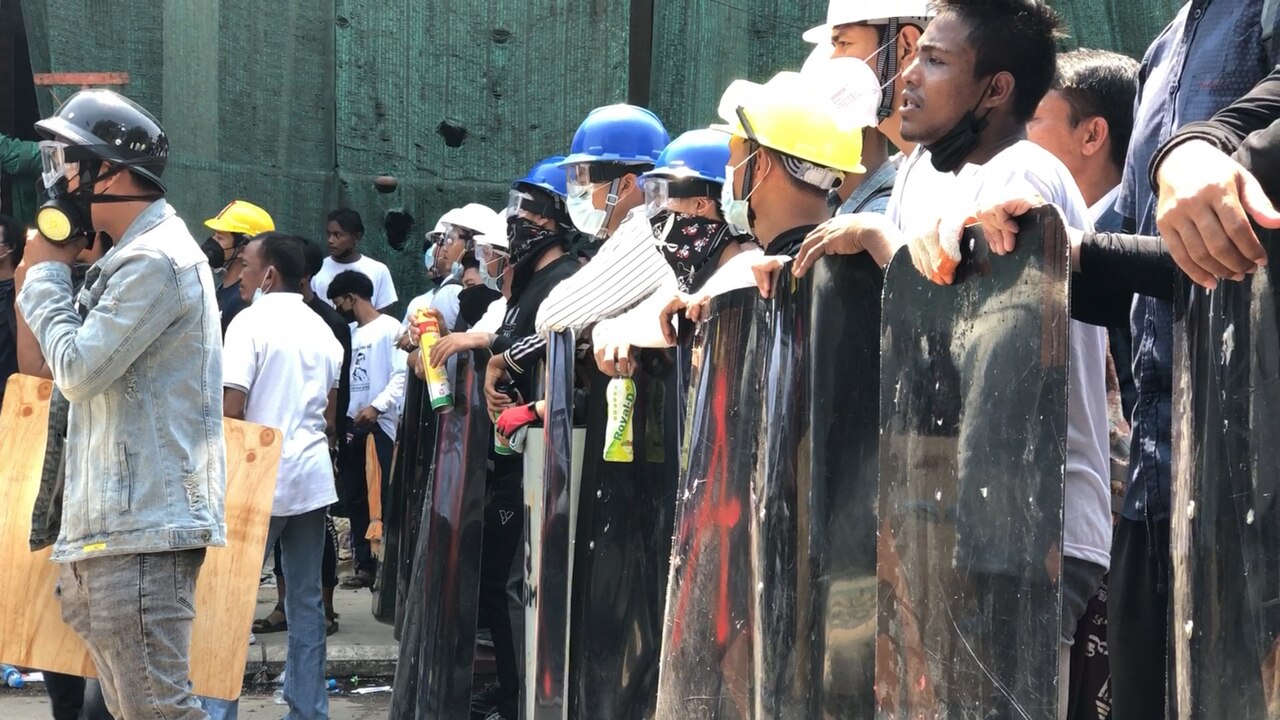
Header image: Protestors with shields chanting at the police at Bagaya Street Yangon. By Maung Sun





Community Adaptation for a Water Festival Without Clean Water