

Introduction
In early March 2026, Ecuadorian commandos conducted a series of raids allegedly targeting an armed group with ties to drug trafficking in the rural San Martín settlement along the country’s border with Colombia. Over six days, according to a comprehensive Human Rights Watch report, Ecuadorian troops tortured local farm workers, burned and destroyed property with no discernable connection to illicit activity, and bombed vacant land. While the events offer a stark example of the alleged abuses that have come to characterize Quito’s response to the country’s surge in armed violence, the operations were striking for another reason: U.S. forces were present, on the ground and in the air, in what U.S. officials proudly described as a partnered operation.
Far from an outlier, the events in San Martín offered a preview of a wider shift in the United States’ approach to hemispheric security, one which applies a blanket counterterrorism framework to the region’s law enforcement challenges, centers on military solutions, and bears unfortunate similarities to the U.S. Global War on Terrorism (GWOT). In particular, the expansion and intensification of military aid and “by, with, and through” (BWT) initiatives — in which the U.S. provides support to local partners to conduct operations, like the raids in San Martín — are especially concerning. The GWOT is littered with failed BWT campaigns and security assistance initiatives, offering cautionary lessons. Latin America, meanwhile, is an especially inauspicious setting for proxy warfare, another reason U.S. policymakers should think more critically about the new approach to security cooperation in the Western Hemisphere. The history of U.S. military interventions and human rights abuses by the region’s armed forces have created heightened sensitivities to U.S.-backed domestic military campaigns, which could quickly erode support for the new U.S. strategy.
Bringing Counterterrorism to Latin America
The Trump administration came to office with a clear intention of prioritizing U.S. foreign policy in Latin America, albeit with a narrow focus on immigration, transnational crime, and competition with China. In a departure from recent strategies that sought to address the persistence of Latin America’s illegal armed groups, criminal violence, and illicit trafficking through social, economic, governance, and law enforcement approaches, the Trump administration quickly adopted a counterterrorism paradigm and demanded the same from regional partners. Dispensing with traditional law enforcement framing, the administration recast regional insecurity as a transnational armed conflict that demanded military intervention, drawing direct, strained comparisons between the region’s non-state groups and more traditional terror organizations like Al Qaeda and ISIS. Within months, the administration had designated a host of gangs, criminal organizations, and armed groups from across the region as terrorist entities, begun a campaign of airstrikes targeting alleged drug boats, threatened unilateral strikes against organized crime targets in Mexico and Colombia, and militarily deposed the president of Venezuela in a nighttime raid.
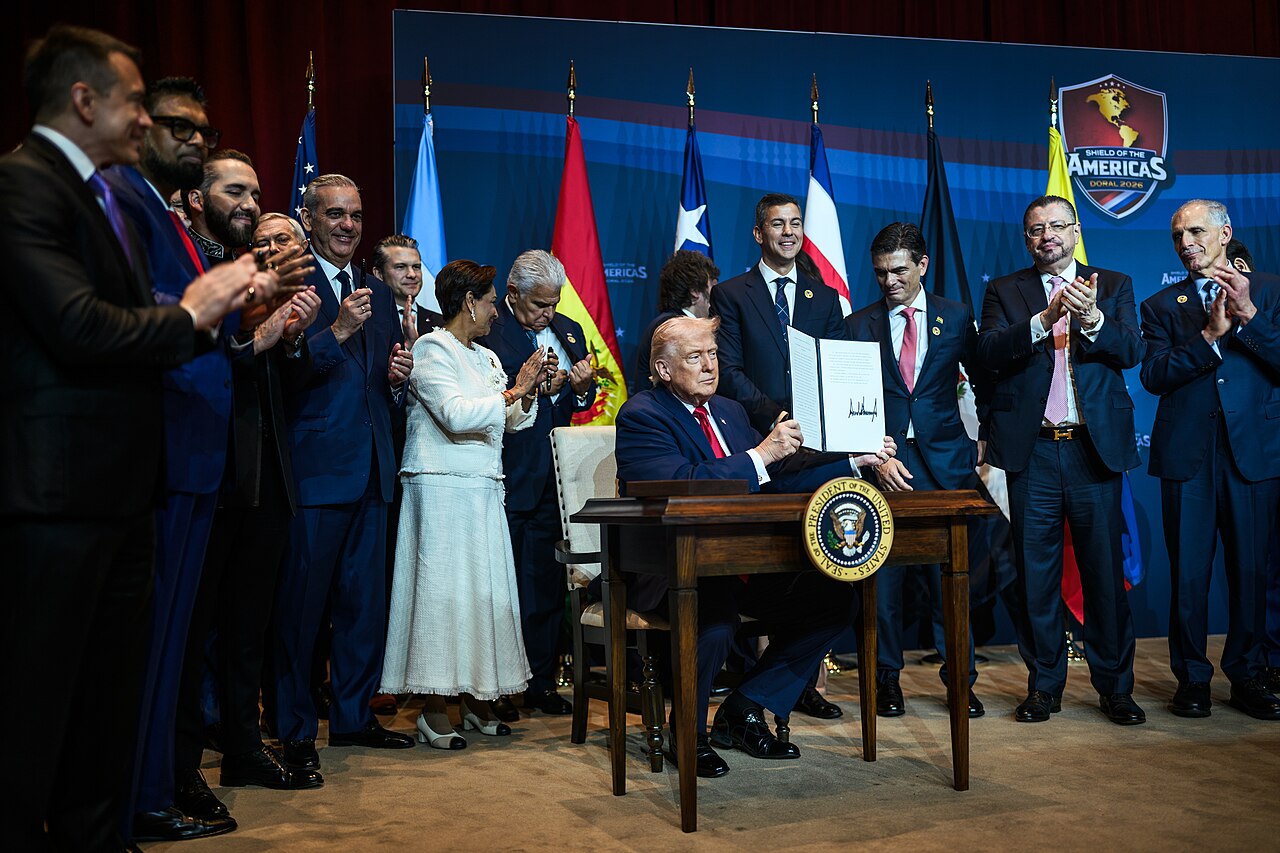
Beyond unilateral measures, the administration has also significantly expanded and deepened security cooperation activities with a number of governments in the region. Over the past year, the administration inked deals with both Ecuador and Guatemala reportedly allowing for joint military operations, signed a status of forces agreement with Paraguay to permit a U.S. security presence inside the country, and provided enabling operational, on-the-ground support for counternarcotic raids in Mexico, apparently without properly coordinating with the national authorities. In June, the U.S. military, in coordination with the Venezuelan government, assassinated Héctor Guerrero, the leader of the Venezuelan drug trafficking gang Tren de Aragua. In March, Trump presided over the most public display of the new approach, hosting the inaugural “Shield of the Americas” summit at a golf course in Florida. The alliance of largely conservative Latin American governments committed to working together to expand military pressure on cartels and other armed groups.
The expansion of these arrangements reflects not just U.S. imperatives and the threat of U.S. tariffs for noncooperation, but also a growing frustration among Latin American publics with the region’s rising insecurity. Latin America has long been the world’s most violent region, and the growing threat of organized crime has imposed increasing human and economic costs and undermined democratic institutions. Those frustrations have provided tailwinds to candidates who promise mano dura, or heavy-handed, approaches to combatting armed violence, including through closer military cooperation with Washington. Promises of hardline law enforcement, for example, helped elect the conservative presidents of Ecuador, Chile, Colombia, Costa Rica, and Peru. The president of tiny El Salvador has become a regional icon for a crackdown on criminal gangs that relies upon mass arrests under a multiyear state of emergency. In all, the dragnet has put nearly 2% of the population behind bars.
Under these circumstances, patron-proxy partnerships have become especially appealing across the Americas. Such relationships allow Washington to catalyze and claim credit for more aggressive, militarized operations against cartels, gangs, and other armed groups, while minimizing the political and physical risks of a conventional boots-on-the ground presence. As expressed by Elbridge Colby, the U.S. Undersecretary of Defense for Policy, in a speech in Peru, “We see partner-led, joint kinetic operations with partner nations as force multipliers, as the way to lasting and durable progress against these perils.” For governments in Latin America, especially those that came to power promising a more aggressive response to rising violence, direct cooperation with the United States provides a powerful symbol of a new approach, curries favor with Washington, and unlocks material assistance to enable their own military operations. In Ecuador, for example, the government has advocated for reopening a U.S. military base in the port city of Manta. Abelardo de la Espriella, Colombia’s new president, has offered the city of Medellín as the Shield of the Americas headquarters. The official U.S. delegation to his August 7 inauguration included the head of the Drug Enforcement Administration (DEA), and the United States soon afterward pledged $1 billion in security assistance. In Haiti, a US-supported international security force is battling gangs that control most of Port-au-Prince, and separately, a U.S. private security company is deploying armed drones against gang targets.
It was the same logic that helped drive the proliferation of BWT and security force assistance during the GWOT. BWT is a catchy moniker for a wider operational concept wherein the United States provides various kinds of training, materiel and equipment, technical assistance, on-the-ground advisement, and operational support to local security partners to act as a frontline fighting force. These programs are typically complemented by others forms of security cooperation, including capacity building and security force assistance. In some cases, it has meant operating jointly with partners, but with a “light footprint,” usually composed of special operations troops supporting local security actors who act as the main body for operations. In other cases, U.S. assistance was less operationally oriented, and instead focused on capacity building, acquisition of capabilities, or institutional developments. Whatever the modality, the appeal of security cooperation and assistance can include seeking plausible deniability, avoiding the political and human costs of large-scale foreign interventions, insulating overseas operations from escalation risks, leveraging local expertise, and lowering the costs of maintaining an expansive geographic presence, among many others.
Though it has been a longstanding fixture of U.S. foreign policy — including in Latin America — the GWOT saw an unprecedented surge of partner capacity-building authorities, security assistance spending, and BWT campaigns. From Mali and Tunisia to Afghanistan, the Philippines, and beyond, the United States spent billions of dollars supporting foreign security forces to pursue non-state armed groups under the umbrella of counterterrorism, often without sufficient consideration of the distinctions and nuances that distinguished threats across such disparate geographies and political contexts.
After more than a decade, mounting frustration with these initiatives catalyzed deeper reflections among U.S. legislators, experts, and policymakers about the inherent risks, tradeoffs, and failures of BWT and its associated security cooperation and assistance components. From that introspection came new legislation and oversight, new institutions dedicated specifically to the study and practice of security cooperation, and a wealth of academic literature and policy insights that promised a more evidence-based approach to security assistance. As many experts and academics found, while security assistance and BWT approaches can be effective, success is predicated on a range of important conditions and demands rigorously studied and applied policy and practice. Well applied, U.S. assistance can be a critical tool for improving military effectiveness of partners, advancing interoperability, improving security governance, and addressing shared security concerns. Yet, as the GWOT has given way to other grand-strategic imperatives, senior policymakers, including those spearheading the new approach to hemispheric security, appear willing to dispense with those lessons.
Looking Back: Lessons Learned from the GWOT
Operational Efficacy
U.S. security cooperation and assistance initiatives during the GWOT have a checkered operational and strategic track record. While there are discrete examples of successful partnered campaigns or capacity-building initiatives, the GWOT is awash with initiatives that floundered, failed to sustain or exploit operational gains, or even coincided with deteriorating security circumstances.
The large-scale collapse of major formations in the US-built Iraqi and Afghan militaries in 2014 and 2021, respectively, may be the most familiar examples, but there are many more. In the Sahel, a decade of military aid not only failed to turn the tide against Islamist militancy, but also lent support to local security actors that had a habit of overthrowing their civilian governments and inviting a Russian military presence to legitimize their newly founded juntas. In Somalia, nearly two decades of US “train, equip, advise, and assist” support for the Somali military and the African Union mission provided important, but ultimately inconclusive and often fleeting, success against the Al-Qaeda-linked Al-Shabaab, which continues to control large swaths of the country and has rolled back many of Mogadishu’s recent gains. In Yemen, the Ali Abdullah Saleh government, which received hundreds of millions of dollars in security assistance, habitually redirected U.S. military aid provided to fight Al Qaeda in the Arabian Peninsula (AQAP) towards regime preservation and to target political rivals. After Saleh was effectively forced from office in 2012, the legacy of that assistance remained visible in the civil war that followed, where US-trained units and weapons drifted between competing factions, while AQAP exploited the chaos to expand its operations and presence.
These cases were not outliers. Across the globe, the United States has struggled to improve the military effectiveness of its partners or deal lasting blows to non-state armed groups. In some cases, local forces were simply ill-prepared to absorb U.S. assistance or lacked the institutional capacity to translate American support into durable capacities. Even in cases where operational alignment was achieved, challenges of governance related to corruption, state capture, or the disruptive role of conflict economies undermined the utility of U.S. support.
In other cases, partners were eager to accept U.S. assistance, but not its interests or objectives. Accordingly, for the weak states that were often the subject of these efforts, a partner’s improved martial capacities did little to address Washington’s counterterror imperatives and instead provided the means for intensified civil conflict, regional competition, or the repression of domestic dissent.
More importantly, while these security assistance efforts followed a rudimentary “fight fire with fire” logic, many GWOT-related initiatives often masked deeper challenges and crowded out more contextually relevant counterterror strategies. Ultimately, even under the best of circumstances, security assistance and partnered operations did little to address the local drivers of insecurity that provided fertile ground for sub-state militancy. Indeed, in some cases, U.S. assistance inflamed insecurity by empowering predatory actors, disrupting civil-military relations, or creating perverse incentives for local elites to ensure continued access to U.S. patronage. Moreover, in focusing so squarely on kinetic solutions and conflating different forms of insecurity with terrorism, BWT campaigns and other military-centered assistance initiatives drew attention away from alternative or complementary approaches that may have been more effective at dealing with the causes of violence, including strategies that focus on good governance, intelligence, law enforcement, financial crimes, public corruption, economic development, or socio-political grievances.
Use of Force and Effective Oversight
Beyond a disappointing operational and strategic track record, the surge in U.S. budgetary and operational authorities intended to support an expanding portfolio of assistance efforts and BWT campaigns overwhelmed oversight mechanisms and guardrails intended to ensure accountability and strategic logic for the use of force and U.S. security cooperation.
In the first 15 years after the 9/11 attacks, the number of major U.S. security assistance and cooperation programs more than doubled, with most new authorities falling under the purview of the Department of Defense instead of their traditional home in the Department of State. One estimate found that the Department of Defense’s share of all U.S. security sector assistance funding rose from 17% in 2001 to 60% by 2015.
These budgetary authorities intermingled with the expansively interpreted Authorization for the Use of Military Force (AUMF) passed by Congress in 2001, which the executive branch used to justify a global military campaign against not just those responsible for 9/11, but also a disparate collection of militants, many with no actual connection to Al Qaeda. The result was a cocktail of authorities that underwrote a massive expansion of U.S. military presence far beyond the borders of Afghanistan and often in remote, poorly governed places where local or international oversight was minimal.
These new dynamics presented a number of challenges. First, shifting the center of gravity of U.S. security assistance from the Department of State to the Department of Defense created strategic dissonance between BWT campaigns and wider U.S. foreign policy imperatives. While the Department of Defense could draw on larger budgets, its mandates and competencies remained more narrowly focused on the military dimensions of confronting terrorism. The Department of State, with a wider purview and set of expertise, became disproportionately less influential in the development of security cooperation partnerships, even when statute required its concurrence on programing, eroding its ability to ensure these initiatives squared with higher-level strategic interests.
Additionally, the rapid expansion of budgetary authorities under the Department of Defense alongside a growing set of BWT initiatives complicated public and congressional oversight. Compared to State Department security assistance authorities, reporting on Defense Department programs is far more restrictive, shared with only a small set of congressional leaders, and often on a classified or “for-official-use-only basis.” Public reporting on these programs, including in budgetary documents, lacks basic details about where and how these programs are implemented.
Under these conditions, it became all too easy for an American operational presence to creep far beyond the scope envisioned or understood by lawmakers, the American public, or even some policymakers. In many cases, U.S. forces deployed to act as trainers and advisers were placed in situations where they were likely to engage in active combat, raising questions as to whether authorities were intentionally mixed and rules of engagement intentionally structured to create the conditions for U.S. combat operations in all but name.
Among the most salient and tragic examples was the Tongo Tongo incident, where four U.S. Army Special Forces soldiers reportedly deployed as part of a building partner capacity program were killed during a joint operation to assassinate or capture a senior member of the Islamic State in the Greater Sahara. Many lawmakers expressed frustration over feeling ill-informed about the scale and nature of the U.S. presence in Niger, especially in such a high-risk role. In the aftermath, the Department of Defense equivocated on what authority permitted the joint patrol, with clear confusion regarding the Pentagon’s legal authority for such a high-risk operational activity. Eventually, the Pentagon determined that troops operating as part of a budgetary authority to build partner capacity also had “the authority to conduct [counterterrorism] operations with partner Nigerien forces.”
Human Rights and Civilian Protection
The prevalence of human rights abuses and civilian harm were among the most vexing legacies of the GWOT and a hallmark of a number of U.S. security partnerships. Driven by the trauma of the 9/11 attacks, and with a particular focus on bringing U.S. military might to bear on terror groups, the United States showed a willingness to partner with even the most predatory governments, prioritizing tactical and operational exigencies over human rights concerns.
Beyond problematic partner selection, a number of additional factors exacerbated civilian harm risks. First, non-state armed groups were commonly operating in fragile states, where substate violence intersected with local grievances expressed along social, economic, ethno-linguistic, or confessional lines. In these contexts, local security forces were not purely operating in the national interest, but also as instruments of elite competition, which shaped their behavior with respect to combatants and civilian members of marginalized populations. Moreover, even in cases where U.S. and local interests and objectives were more closely aligned, underdeveloped partner forces struggled to exhibit the sort of restraint and civilian protection practices that even advanced militaries find challenging.
Similarly, partner governments in weak states proved eager to use American military assistance to pursue their own agendas, irrespective of their relevance to U.S. counterterror goals. For governments facing competition for legitimacy, it became easy to invoke counterterrorism while targeting rivals, suppressing dissent, or extracting concessions from restive populations.
The diffusion of responsibility between U.S. and partner forces also presented a challenge. Whereas operational decision-making wholly owned by either the United States or a partner force offered more clear lines of accountability, shared control blurred responsibility and facilitated mutual deniability for incidents of civilian harm. What’s more, even when U.S. forces played an operationally significant role during incidents of civilian harm, the presence of a partner force allowed Washington to shift the burden of responsibility onto local actors.
U.S. requirements for end-use monitoring of U.S.-supplied materiel and the Leahy Law’s obligatory vetting of foreign security partners provide important, albeit limited, safeguards. Nevertheless, research suggests that external patronage can undermine civilian protection imperatives. Access to external support has been shown to extend the duration and intensity of armed conflict, and foreign military aid can also diminish a proxy’s dependence on local political support. Absolved of the need to maintain legitimacy and popular approval, governments are less likely to exhibit restraint or minimize civilian harm.
Far from an unfortunate side effect of the GWOT, Washington’s enabling support to predatory governments and abusive security forces fueled the sorts of grievances upon which militancy thrives. Moreover, resentment over abusive behavior by partner forces did not only harm the reputations of host governments. Rather, U.S. support meant populations closely associated Washington with the abuses and excesses of its proxies, inviting blowback and providing the pretext for local militancy to take on an international dimension that only increased the risk to the United States.
Implications for Latin America and U.S. Policy
More than a decade after the 9/11 attacks, the United States had a decidedly disappointing record for its various security assistance, cooperation, and BWT efforts. While some defenders cited the absence of another mass casualty attack on the homeland as proof of success, global terrorism was surging, including in the very geographies where the United States had embarked on its most intensive military assistance initiatives. In the aftermath of so many ill-fated BWT and security assistance campaigns, political scientists, practitioners, and civil society experts endeavored to examine how the United States could achieve a better return on its security assistance investments while mitigating the risks presented by proxy-warfare.
Critical to these developments were efforts by lawmakers to impose oversight, professionalism, and accountability on security cooperation. The FY2017 and FY2019 National Defense Authorization Acts introduced a sweeping set of reforms, including consolidating the patchwork of partner capacity building authorities; mandating the development and implementation of assessment, monitoring, and evaluation frameworks; requiring stronger human rights and international humanitarian law safeguards; and establishing dedicated institutions and a commensurate workforce to bring professionalism and evidence-based policy to U.S. security cooperation.
In parallel and in response to reforms, a rich body of literature began to highlight key tradeoffs inherent to BWT projects and explored the conditions and practices that might encourage better outcomes. Some research centered on the fundamental principal-agent dilemmas that BWT encountered, as well as on the challenges of enforcing conditions on assistance, monitoring a proxy’s behavior, and ensuring assistance advances U.S. interests. Others addressed the importance of diligent partner selection, noting that security assistance could enhance the performance of partners that already possessed a degree of interest alignment, institutional capacity, cohesion, and legitimacy, but was unlikely to produce those outcomes where they were not already present. Others looked more granularly at the conditions necessary to enable effective partnerships, including interest alignment and the quality of a partner’s institutions. Many other studies explored the role and limits of security assistance in generating influence, shaping partner behavior, exacerbating civil-military tensions or civilian harm, and fueling armed violence.
Applying those lessons, scholarship, and policy insights to Latin America raises a number of red flags that should give the Trump administration pause about its newfound enthusiasm for security assistance and cooperation in the region. Operationally, Latin America presents many of the conditions that have plagued other military aid efforts and BWT campaigns. While the region has made progress improving aspects of public administration, such as central banking, a lack of state capacity and weak security institutions remain a persistent problem. Corruption, lack of absorptive capacity, weak oversight and accountability mechanisms, poor recruitment practices, fragile command and control regimes, and a lack of integration, or “jointness,” between various elements of the security sector are all likely to undermine the tactical efficacy of U.S. assistance. Civilian law enforcement institutions are notoriously ineffective and corrupt in many countries, including in Central America. Spending on the armed forces, meanwhile, is low, accounting for less than 1% of GDP in Argentina, Mexico, and Peru.
While Latin America’s third wave democratization achievements have been impressive, it was not so long ago that many of these countries, including Argentina, Brazil, and Chile, emerged from military dictatorships. Cuba, Nicaragua, and Venezuela are considered nondemocratic. In El Salvador, the president has eliminated term limits and governed under a state of emergency for four years. The legacy of military rule and contemporary democratic decline are especially troubling in light of the growing role of the region’s armed forces in public life. Mexico, for example, dissolved its national police in 2019 and replaced it with a national guard operated by the Secretariat of National Defense. Brazil’s last president appointed an unusual number of retired and active-duty military officers to his administration; several were accused of involvement in a plot to overturn the 2022 election. In this context, U.S. military assistance has the potential to empower security figures and political entrepreneurs who have an expansive view of the domestic functions of the military.
In the past, American support for the armed forces in the region harmed the U.S. image. During the Cold War, the United States maintained close ties to an Argentine military junta that murdered an estimated 30,000 civilians from 1976 to 1983, and with the infamous Augusto Pinochet regime that led Chile from 1973 to 1990. The United States has also faced persistent criticism for supporting the armed forces of El Salvador and Guatemala during decades-long civil wars that resulted in unspeakable brutality against civilians. The U.S. Army’s School of the Americas, founded in 1946 to train Latin American servicemembers and police, became so notorious for the abuses committed by some of its alumni — ranging from torture and extrajudicial killing to coup plotting — that it changed its name in 2001.
Despite that history, there is an increasing appetite in Latin America for U.S. security assistance, including the highly militarized approach favored by the Trump administration. Organized crime, a longtime but growing challenge in countries such as Colombia and Mexico, is destabilizing once-peaceful nations such as Ecuador and Costa Rica. Violent crime is now among the top voter concerns throughout the region. In addition to the Shield of the Americas launch, a related summit nearby at the U.S. Southern Command saw defense and security ministers from 17 nations jointly establish the Americas Counter Cartel Coalition. In August, the Southern Command established the Joint Task Force Western Hemisphere to coordinate regional missions under the Shield of the Americas.
That said, regional support for importing GWOT strategies and tactics to Latin America should not be overstated. Overall support for the United States has fallen sharply during the second Trump administration. The governments of Mexico and Brazil have expressed concern that U.S. designations of criminal groups as terrorists might provide a pretext for acts of war, such as unilateral strikes on their territories. In some capitals, acceptance of U.S. security assistance is likely defensive — to avoid tariffs or other coercive measures — or is regarded as better than nothing from an administration that has downplayed traditional capacity building. The last time the United States tried something similar, in Mexico, the results of its kingpin strategy and other militarized approaches to drug cartels were so underwhelming that Andrés Manuel López Obrador, the country’s president from 2018 to 2024, adopted a “Hugs, Not Bullets” crimefighting strategy. In Ecuador, the military’s new involvement in fighting criminal groups has produced a long list of alleged human rights abuses. Indeed, though some regional partners may have adopted the language of counterterrorism to gain access to U.S. patronage, the degree of interest alignment remains unclear. Whereas the Trump administration’s primary strategic objective relates to illicit drug trafficking and irregular migration, governments across the region have other interests, ranging from minimizing the local impacts of armed violence, extending state authority to ungoverned spaces, favoring one criminal group over others, or myriad other imperatives.
Additionally, the experience of the GWOT illustrates why an expansion of security assistance and BWT in Latin America presents serious oversight and accountability challenges. Across the region, armed groups, criminal organizations, and gangs often operate in the socio-political periphery, where state presence is minimal, where communities are often neglected and marginalized, and where critical mechanisms for accountability are absent. That inaccessibility is compounded for U.S. observers, who suffer from the inherent tyranny of distance, such as in rural areas of Colombia and Venezuela. Under these circumstances, a surge in U.S. military presence and assistance may outpace accountability and oversight mechanisms, adding to the risks that American engagement evolves beyond BWT and into more direct hostilities. This is not a new phenomenon in Washington’s interventions in Latin America, and there are already questions being raised about the role of U.S. forces in recent operations, such as the one in Ecuador. In April, for example, the Mexican government claimed that two CIA officers killed in a car accident as they returned from a joint counter-cartel mission with Mexican forces did not have authorization to participate in counternarcotics missions on Mexican territory.
These dynamics also exacerbate civilian harm and human rights risks, which are already a perennial challenge for security forces across the region. Washington’s encouragement of military responses to illicit activity will invariably invite heavy-handed tactics, including those that may not be suitable for effectively addressing local threats. Rarely are illicit armed actors wearing uniforms or encountered in organized security formations. Instead, they are embedded in communities, difficult to distinguish from non-combatants, and enjoy due process rights under local laws that do not typically permit summary executions. Moreover, in places where the state or other institutions are absent, the permeation of illicit activity into daily life means that individuals may defy easy black and white classifications, moving fluidly from minimal or inadvertent participation in illicit economies to perfectly innocent activities, and involve individuals coerced into joining criminal groups. These challenges are made even more stark by the growing recruitment of children by armed groups, who may be fooled, forced, or enticed to participate in illicit activities as a matter of survival. The United States itself is setting a troubling example. So far, the U.S. campaign to target alleged drug smugglers in speedboats in the Caribbean and Eastern Pacific — regularly featured in video clips on U.S. government social media accounts — has killed 223 civilians in 67 reported strikes. The United States has also shown a disregard for international law in its invasion of Venezuela and its oil embargo against Cuba.
Those precedents risk lowering the standards for security forces in the region that have already demonstrated limited restraint and respect for human rights, especially when operating in marginalized communities that already suffer from criminal violence. One of the most notorious cases involved the armed forces in Colombia, a Major Non-NATO Ally, where soldiers battling the FARC and ELN armed groups in the early 2000s murdered noncombatants and falsely registered them as guerrillas to inflate the body count, a controversy known as the “False Positives” scandal. Injecting U.S. military support and presence into these environments without proper safeguards and incentives can easily exacerbate these risks, empower irresponsible actors, and frustrate effective accountability. As recently as 2012, DEA agents who participated in an anti-drug raid in Honduras sparked a controversy about civilian deaths that led to congressional inquiries.
Moreover, as was the case during the GWOT, the militarization of U.S. engagements in the region risks crowding out other ways in which the United States could be a valuable partner in the fight against organized crime and armed violence. For good reason, the United States has historically favored cooperation with the region’s law enforcement institutions to solve law enforcement challenges, including assistance to control corruption, build anti-money laundering know-how, increase extraditions, and train police, prosecutors, and judges, such as by embedding experts in the region’s criminal justice institutions. The State Department’s Bureau of International Narcotics and Law Enforcement Affairs specializes in building law enforcement capacity, often in partnership with other U.S. agencies, such as the Justice Department’s Office of Overseas Prosecutorial Development, Assistance, and Training, the FBI, and various components of the Department of Homeland Security. These days, the Pentagon is happy to be in the lead, but previous defense secretaries have warned that the United States too often fails to strike the right balance between killing adversaries and building better governance, including by shoring up law enforcement institutions. Robert Gates, who served as defense secretary under Republican and Democratic presidents, has called for “a dramatic increase in spending on the civilian instruments of national security — diplomacy, strategic communications, foreign assistance, civic action, and economic reconstruction and development.”
Admittedly, these interventions have not solved the region’s organized crime challenge. But experts say the militarized strategy is an even less promising alternative. Data suggest that the U.S. boat strikes have had little impact on cocaine trafficking, for example. By contrast, the “Metástasis” and “Purga” investigations by Ecuadorian prosecutors, cases supported by the United States, helped unravel links between criminal groups and figures in Ecuadorian politics, law enforcement, and the courts. Not only is U.S. law enforcement support more effective, it is, in many cases, the only option, given the legal, constitutional, and political barriers to the military’s involvement in civilian law enforcement in many Latin America countries, as well as restrictions on the presence of foreign troops.
What’s Next
The severity of the region’s long-neglected security challenges deserves greater attention and investment from Washington. When applied discerningly, and as part of a broad strategy that also addresses the drivers of violent crime, U.S. security assistance can be a powerful tool for supporting regional partners as they confront illicit criminal groups, insurgencies, and other non-state actors. Indeed, many experts and policymakers point to Plan Colombia — a U.S. counternarcotics effort that provided over $10 billion in security assistance and cooperation support to Bogotá between FY2000 and FY2018 — as a paragon of what good security assistance can look like, notwithstanding the program’s uneven achievements and pitfalls. Unfortunately, the emerging U.S. approach to hemispheric security cooperation and assistance is too narrow, hyper-militarized, and misapplied to criminal groups that do not fit the traditional definition of terrorists. Overall, this approach fails to reflect the lessons from previous failed U.S. strategies. As a result, the new Monroe Doctrine primarily addresses the symptoms of criminality in Latin America, and by doing so, the United States risks repeating the errors of the not-so-distant past.







Community Adaptation for a Water Festival Without Clean Water