
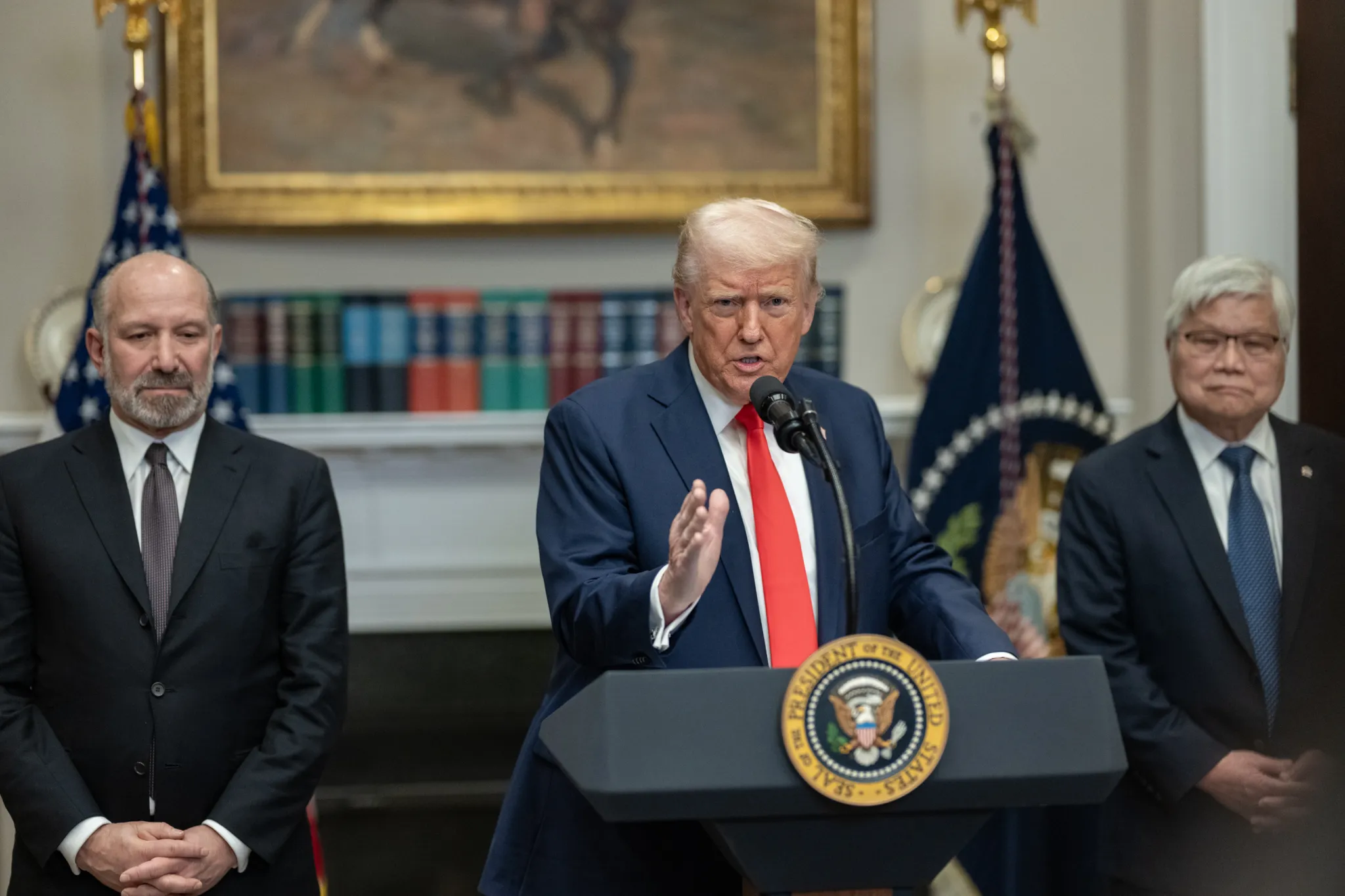
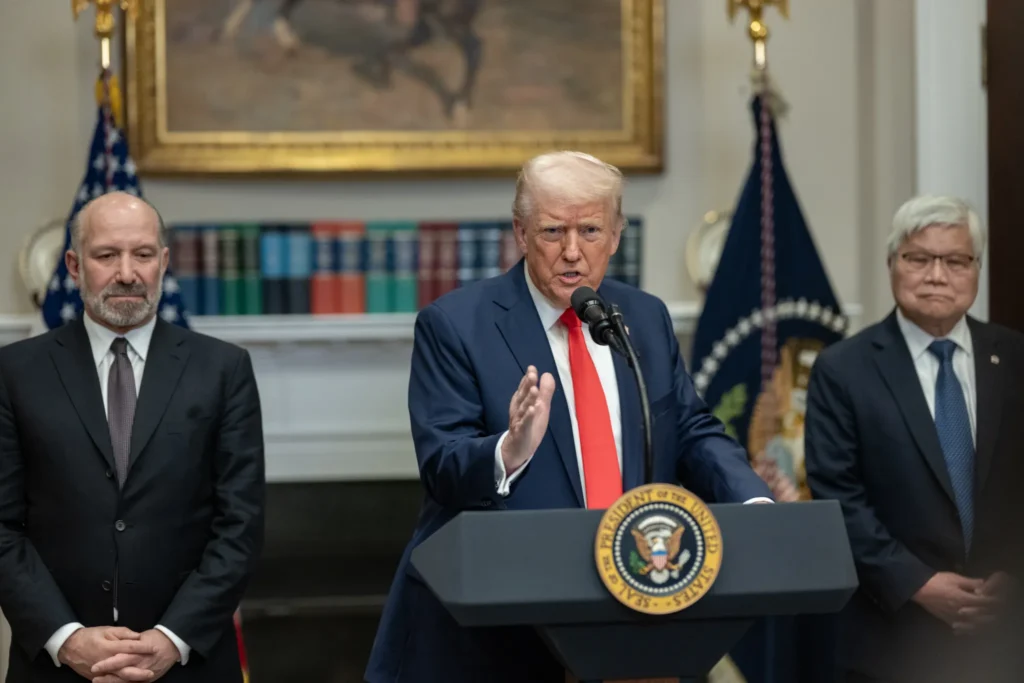
Since Donald Trump returned to the White House in 2025, there has been considerable concern over whether Washington’s longstanding support for Taiwan will survive his presidency. Many fear Trump views Taiwan largely as an irritant complicating US-China relations, and some of his rhetoric seems to justify this view. However, the president’s speech is famously inconsistent, making it impossible to obtain a clear picture of his administration’s policy based on his public comments alone.1Some scholars have even found that the statements of cabinet officials are far more aligned with the administration’s actions than those of Trump himself. See Kevin Maloney, “Trump’s Cabinet Dramatically Changed American Foreign Policy While the President Made Noise: A Scholar of Presidential Rhetoric Explains,” The Conversation, May 18, 2026, https://theconversation.com/trumps-cabinet-dramatically-changed-american-foreign-policy-while-the-president-made-noise-a-scholar-of-presidential-rhetoric-explains-281307.
Nor is the president the lone decisionmaker on Taiwan policy. While Trump has taken a more hands-on approach to hot-button foreign policy issues than his recent predecessors and has the authority to enact significant changes if he chooses to do so, day-to-day policy continues to be driven by administration officials and career bureaucrats who do not appear to share the skepticism that some of Trump’s words imply. The president’s ability to change course on Taiwan is also constrained by Congress, which continues to show overwhelming bipartisan support for the island.
This report will look beyond the narratives and speculation caused by Trump’s rhetoric and examine what his administration’s approach to Taiwan reveals about its commitment to the island. The report is not aimed at comprehensively dissecting the various elements of the Trump administration’s Taiwan policy, but rather at answering one fundamental question: What does the Trump administration’s track record so far say about its commitment to Taiwan? The answer is far more optimistic for Taipei than many popular narratives suggest.
Background
It is not hard to understand why many observers believe the Trump administration is less committed to Taiwan than its predecessors. Trump frequently accuses Taiwan of stealing America’s semiconductor industry and demands that the manufacturing of increasingly sophisticated chips relocate to the United States. He also has openly questioned Taiwan’s strategic importance to the U.S. and stated in unprecedentedly stark terms that he does not want to fight a war over the island.2 Fox News, “BREAKING: Trump Addresses Xi’s WARNING over Taiwan,” YouTube video, May 15, 2026, 5:45, https://www.youtube.com/watch?v=7ib2ab_kDLI. Additionally, though the Trump administration insists that Taiwan policy has not changed under its watch, parts of its approach to the island have been noticeably less assertive and more conciliatory toward Beijing than what was experienced under the last two administrations.3 In this report, “policy” and “approach” are distinct terms. “Policy” refers to the administration’s official policy, while “approach” is the style by which the administration implements the policy.
U.S. support for Taiwan became more overt under Trump’s first administration (2017-2021), which significantly expanded unofficial diplomacy with the island. This included, among other developments, President-elect Trump accepting a congratulatory phone call from then-Taiwan president Tsai Ing-wen in December 2016 and the president’s dispatch of Health and Human Services Secretary Alex Azar to Taiwan in 2020, making him the first Cabinet official to visit the island since 1979.4 Associated Press, “U.S. Sending Highest Official to Taiwan Since Ties Cut in 1979,” NBC News, August 5, 2020, https://www.nbcnews.com/news/world/u-s-sending-highest-official-taiwan-ties-cut-1979-n1235852. Trump also approved $18.3 billion in arms sales to Taiwan, far surpassing in four years the previous record of $15.6 billion approved during the eight years of the George W. Bush administration (2001-2009).5 U.S.-Taiwan Defense and Security Review, “Taiwan Arms Sales Notified to Congress 1990-2025,” December 17, 2025, https://www.ustaiwandefense.com/taiwan-arms-sales-notified-to-congress-1990-2025/.
The administration of Joe Biden (2021-2025) largely continued this approach. While Biden approved a much smaller volume of arms sales to Taiwan ($8.4 billion), his administration was, by many counts, even more overt in its support for the island.6 Ibid. The Biden administration routinely criticized Beijing’s military activities near Taiwan. It also continued the well-established practice of naval transits through the Taiwan Strait and actively called on allies to do more to support the island. Furthermore, Biden became the second president, after George W. Bush, to state unequivocally that he would use military force to defend Taiwan if the island were attacked.7 David Brunnstrom and Trevor Hunnicutt, “Biden Says U.S. Forces Would Defend Taiwan in the Event of a Chinese Invasion,” Reuters, September 19, 2022, https://www.reuters.com/world/biden-says-us-forces-would-defend-taiwan-event-chinese-invasion-2022-09-18/. Biden repeated this pledge four times, making it unlikely that he simply misspoke. While his administration clarified that these statements did not constitute a change of policy, they helped bolster confidence in Washington’s support for Taipei.
The beginning months of the second Trump administration appeared to indicate that this general trend would continue. Less than a month after the inauguration, the State Department removed the phrase “we do not support Taiwan independence” from its online factsheet on Taiwan.8 Ben Blanchard, “U.S. Drops Website Wording Not Supporting Taiwan Independence,” Reuters, February 16, 2025, https://www.reuters.com/world/us-drops-website-wording-not-supporting-taiwan-independence-2025-02-16/. It also added new content highlighting Taiwan’s technology cooperation with the Pentagon and U.S. support for Taiwan’s membership in some international organizations. While the factsheet’s continued opposition to “any unilateral changes to the status quo from either side” showed the official policy had not changed, these edits appeared to indicate the administration planned to retain Biden’s assertiveness on the Taiwan issue.9 Ibid.
The Pentagon conveyed even stronger messages about Taiwan. Whereas the Biden administration’s Defense Department identified China as its sole “pacing challenge,”10 U.S. Department of Defense, 2022 National Defense Strategy of the United States of America, Including the 2022 Nuclear Posture Review and 2022 Missile Defense Review (Washington, DC: Department of Defense, October 27, 2022), https://media.defense.gov/2022/Oct/27/2003103845/-1/-1/1/2022-NATIONAL-DEFENSE-STRATEGY-NPR-MDR.PDF. a classified document leaked from the Pentagon during Defense Secretary Pete Hegseth’s second month on the job specifically identified “denial of a Chinese fait accompli seizure of Taiwan” as “the department’s sole pacing scenario.”11 Helen Davidson, “Pete Hegseth Indicates Stronger US Backing for Taiwan in Speech Attacking China,” The Guardian, April 1, 2025, https://www.theguardian.com/world/2025/apr/02/pete-hegseth-indicates-us-backing-taiwan. In other words, the Pentagon under Hegseth was not just worried about competing with China; it explicitly worried about the threat of Chinese military action against Taiwan. Hegseth’s speech at the annual Shangri-la Dialogue in Singapore in May 2025 described the threat China poses to Taiwan and the U.S. commitment to deterring or winning a fight over the island in such clear terms that some accused him of abandoning strategic ambiguity, a longstanding U.S. policy of deterring both Beijing and Taipei from acting in ways likely to result in conflict by intentionally leaving both sides unsure how the U.S. would react.12 Graeme Dobell, “Hegseth: Asia Is the Priority and the US Will Fight for Taiwan,” The Strategist (Australian Strategic Policy Institute), June 2, 2025, https://www.aspistrategist.org.au/hegseth-asia-is-the-priority-and-the-us-will-fight-for-taiwan/.
This started to change as the White House adjusted its approach to Beijing following the latter’s successful navigation of Trump’s tariff war in 2025. China proved itself better prepared than the U.S. to withstand the disruptions in trade caused by the tariffs, which at one point reached 145%. China also unveiled its own set of leverage against Washington, such as its ability to weaponize its near-monopoly of rare earth minerals critical to the U.S. military and industrial base. This was an inflection point in the Trump administration’s China policy. As Trump and his top officials recognized that they had underestimated Beijing, they began treating it more like a peer. As a result, weeks after Treasury Secretary Scott Bessent boasted that Beijing was “playing with a pair of twos” — a reference to holding a losing hand in the game of poker — the administration began to seek a détente with its main geopolitical rival.13 Jeff Cox, “Treasury Secretary Bessent Says China’s Escalation Was a ‘Big Mistake’; Country Is ‘Playing With a Losing Hand,’” CNBC, April 8, 2025, https://www.cnbc.com/2025/04/08/treasury-secretary-bessent-says-chinas-escalation-was-big-mistake-country-playing-with-losing-hand.html.
One of the areas this détente has manifested is in the administration’s approach to Taiwan. The administration has not altered America’s fundamental policy toward Taiwan, and Trump’s decision to approve a record-breaking $11 billion arms sale to the island in December 2025 — shortly after the truce with China was formalized — runs counter to speculation that he might abandon commitments to Taiwan in order to appease Beijing. However, the administration has otherwise been more cautious about Taiwan, with senior Pentagon officials openly saying they have to be careful about discussing the island.14 Jake Chung, “US’ Taiwan Policy Unchanged: Official,” Taipei Times, July 25, 2026, https://www.taipeitimes.com/News/taiwan/archives/2026/07/25/2003861352.
The administration’s cautious turn on Taiwan, compounded by its continued assault on the international free trade regime, Trump’s open skepticism of key security alliances, and the migration of important military assets from the Western Pacific to the Middle East for use in the war against Iran, have strengthened pre-existing speculation that the administration might abandon America’s commitment to Taiwan or use the island as leverage in negotiations with Beijing.
These concerns are not unreasonable. Trump has shown himself more capable and willing than any president in recent history to enact fundamental changes to longstanding policy. He has withdrawn from international institutions, cut aid to Ukraine, and scaled back and canceled military drills with U.S. ally South Korea in order to not offend North Korea.15 Heejin Kim and Joyce Lee, “US Cancels Joint Marine Drills With South Korea Over Iran War-Related Force Constraints,” Reuters, August 24, 2026, https://www.reuters.com/world/asia-pacific/us-cancels-joint-marine-drills-with-south-korea-over-iran-war-related-force-2026-08-24/. Most concerning, after vowing not to expend U.S. military assets fighting “forever wars” in the Middle East, Trump launched a war against Iran that has depleted America’s munitions and left the world — including Taiwan — with surging energy costs. The war has also resulted in missile and drone attacks by Iran and its proxies on key U.S. security partners and widespread allegations that the U.S. is not doing enough to protect its partners from these attacks.16 Sam Magdy, Michelle L. Price, and Aamer Madhani, “Gulf Allies Disappointed U.S. Didn’t Notify About Iran Attacks and Ignored Their Warnings, Sources Say,” PBS News, March 6, 2026, https://www.pbs.org/newshour/world/gulf-allies-disappointed-u-s-didnt-notify-about-iran-attacks-and-ignored-their-warnings-sources-say. Indeed, Trump’s approach to other international commitments understandably raises questions about the credibility of his commitment to Taiwan.
Furthermore, Trump’s approval of the $11 billion arms package to Taiwan in December 2025 was quickly overshadowed by the president’s decision to delay an even bigger arms sale in 2026. Trump’s delay of this package amid his diplomatic efforts with Beijing and his characterization of the package as a “good negotiating chip” further amplified concerns that his administration is weakening America’s commitment to Taiwan.17 John Geddie, Tamiyuki Kihara, Yukiko Toyoda, and Ben Blanchard, “US Allies Fret Over How Trump Might Play His Taiwan Hand With Xi,” Reuters, September 17, 2026, https://www.reuters.com/world/china/us-allies-fret-over-how-trump-might-play-his-taiwan-hand-with-xi-2026-09-17/. Taiwan’s government and its supporters in the United States are justified in feeling unease over these developments.
Trump’s rhetoric further compounds these concerns. The president’s criticism of Taiwan’s semiconductor industry reveals a lack of understanding of or appreciation for the strategic nature of the US-Taiwan partnership.18 Michael Cunningham, “America’s Chip Future Still Runs Through Taiwan,” Stimson Center, June 30, 2026, https://www.stimson.org/2026/americas-chip-future-still-runs-through-taiwan/. Also concerning are demands by Trump and multiple administration officials that Taiwan spend an unrealistic 10% of its gross domestic product (GDP) on defense in order to justify U.S. support.19 Reuters, “Pentagon Nominee Backs Trump Call on 10% Taiwan Defense Spending,” Reuters, October 8, 2025, https://www.reuters.com/world/china/pentagon-nominee-backs-trump-call-10-taiwan-defense-spending-2025-10-07/. For a discussion of why the figures demanded by administration officials are unrealistic, see: Michael Cunningham, “The Myth of Taiwan’s Pro-China Defense Budget Blockade,” Nikkei Asia, March 10, 2026, https://asia.nikkei.com/opinion/the-myth-of-taiwan-s-pro-china-defense-budget-blockade. The public nature of this rhetoric amplifies US-skeptic narratives in Taiwan and sows doubt over Washington’s commitment to the island, risking a weakening of the credibility of U.S. deterrence. Data from public opinion polls in Taiwan show that the number of people who see the U.S. as “untrustworthy” rose to nearly 60% in 2025, an increase of ten percentage points over the previous year.20 Bonnie S. Glaser and Jennifer Lan, “Taiwan’s Growing Distrust of the United States,” German Marshall Fund of the United States, August 18, 2025, https://www.gmfus.org/news/taiwans-growing-distrust-united-states.
While these concerns are understandable, they do not show a complete picture of the Trump administration’s approach to Taiwan. In fact, while the risk of Trump unilaterally changing policy in ways detrimental to Taiwan’s security cannot be completely disregarded, a more thorough investigation into his administration’s stated policy and behavior toward the island shows that Washington’s commitment continues to deepen under this administration.
Policy Continuity
The clearest indication of a change in America’s commitment to Taiwan would be a shift in the administration’s official policy towards the island. The United States’ Taiwan policy has been largely consistent since 1979, when the U.S. severed formal diplomatic ties with the island and Congress stepped in to preserve unofficial relations through the Taiwan Relations Act (TRA).21 In addition to establishing the legal framework for the unofficial U.S.-Taiwan relationship, the TRA affirms that “any effort to determine the future of Taiwan by other than peaceful means, including by boycotts or embargoes is considered a threat to the peace and security of the Western Pacific area and of grave concern to the United States.” It also sets a legal requirement for the U.S. to “provide Taiwan with arms of a defensive character” and “maintain the capacity of the United States to resist any resort to force or other forms of coercion that would jeopardize the security, or social or economic system, of the people of Taiwan.” The full text and official summary of the TRA is available at: U.S. Congress, Taiwan Relations Act, Pub. L. No. 96-8, 93 Stat. 14 (1979), https://www.congress.gov/bill/96th-congress/house-bill/2479. The American Institute in Taiwan — the de-facto U.S. embassy — summarizes the official policy as follows:
The United States has a longstanding one China policy, which is guided by the Taiwan Relations Act, the three Joint Communiques,22 The Three Communiques are three joint statements between U.S. presidents and senior CCP officials in 1972, 1979, and 1982 that contributed to the establishment and development of U.S.-China relations and clarified U.S. official positions on Taiwan. The full text of all three communiques is available at: American Institute in Taiwan, “Three U.S.-China Joint Communiqués,” American Institute in Taiwan, accessed September 30, 2026, https://www.ait.org.tw/tag/three-communiques/. and the Six Assurances.23 The Six Assurances are six principles the administration of former U.S. president Ronald Reagan submitted to the U.S. Congress and to Taiwan to reassure both Taiwan and the U.S. Congress amid concerns about the third U.S.-China joint communique. Three versions of the assurances were submitted to different audiences, with similar but slightly different wording. A historical and contextual overview of the Six Assurances, along with the full wording of the three versions, is available at: Susan V. Lawrence, President Reagan’s Six Assurances to Taiwan (Washington, DC: Congressional Research Service, February 18, 2025), https://www.congress.gov/crs-product/IF11665. We continue to have an abiding interest in peace and stability across the Taiwan Strait. We oppose any unilateral changes to the status quo from either side. We expect cross-Strait differences to be resolved by peaceful means, free from coercion, in a manner acceptable to the people on both sides of the Strait. Consistent with the Taiwan Relations Act, the United States makes available defense articles and services as necessary to enable Taiwan to maintain a sufficient self-defense capability – and maintains the capacity to resist any resort to force or other forms of coercion that would jeopardize the security, or the social or economic system, of the people on Taiwan.24 American Institute in Taiwan, “U.S.-Taiwan Relations,” American Institute in Taiwan, accessed September 30, 2026, https://www.ait.org.tw/policy-history/u-s-taiwan-relations/.
To implement this policy, the U.S. has long sustained a posture of strategic ambiguity. Successive administrations have been purposely ambiguous regarding how they would respond to a mainland Chinese attack or other contingency over Taiwan. The purpose of this ambiguity is to create a condition of “dual deterrence” in which Beijing does not dare attack Taiwan for fear that the U.S. will intervene and Taipei does not act in ways likely to provoke an attack for fear that the U.S. will stay on the sidelines.25 Michael Cunningham, “Should the USA Maintain Its Policy of Strategic Ambiguity Towards Taiwan?,” The Heritage Foundation, June 24, 2024, https://www.heritage.org/china/commentary/should-the-usa-maintain-its-policy-strategic-ambiguity-towards-taiwan. Strategic ambiguity has long been credited for helping to preserve peace and stability in the Taiwan Strait.
Previous presidents have occasionally spoken in ways that appeared to indicate a possible change in policy, but their administrations always stepped in to clarify that the policy had not changed. This was most evident when former president George W. Bush and, later, Joe Biden told media they were prepared to use military force to defend Taiwan against an attack from mainland China. Their statements led some observers to conclude that the U.S. had abandoned strategic ambiguity or sought to amend its one China policy, a development that could have catastrophic consequences for cross-Strait stability. In both cases, however, administration officials clarified that the comments did not change the longstanding U.S. policy.
The Trump administration has also been consistently clear that the longstanding U.S. policy toward Taiwan has not changed, despite the president’s rhetoric. AIT’s enunciation of America’s Taiwan policy, as presented above, remains on its website as of October 2026, indicating that it is still the official policy of Trump’s State Department. In June 2026, amid the fallout caused by some of Trump’s comments to media following his summit with Chinese leader Xi Jinping in Beijing, Secretary of State Marco Rubio clarified, “We want to see the status quo preserved as-is. . . our policy on Taiwan is not changing.”26 Patricia Zengerle, Simon Lewis and Doina Chiacu, “Rubio: No Change in US Policy on Taiwan,” Reuters, June 2, 2026, https://www.reuters.com/world/china/rubio-no-change-us-policy-taiwan-2026-06-02/.
Similar affirmations of the longstanding policy have been provided by officials throughout Trump’s administration. Officials who are on record affirming that policy has not changed following Trump’s May 2026 summit with Xi include Defense Secretary Pete Hegseth,27 CBS News and Associated Press, “Hegseth Tones Down Warnings About China: ‘We Respect Their Ambitions,’ but ‘Position Hasn’t Changed on Taiwan,’” CBS News, May 30, 2026, https://www.cbsnews.com/news/hegseth-china-warnings-taiwan-singapore/. U.S. Trade Representative Jamieson Greer,28 Quinn Scanlan, “China Committed to Not ‘Provide Material Support to Iran,’ U.S. Trade Representative Says,” ABC News, May 17, 2026, https://abcnews.com/Politics/china-committed-provide-material-support-iran-us-trade/story?id=133046732. and the president himself.29 Fox News, “Trump Addresses Xi’s Warning Over Taiwan,” 5:34. Following a second 2026 Trump-Xi summit in Washington, U.S. Ambassador to China David Perdue further stated, “We’re not changing the language. We’re not changing our position [on Taiwan]. We want peace across the [Taiwan] Strait.”30 Carol Yang, “‘Right Now, It’s Fine’: Trump Brushes Off Questions About Summit Talk on Taiwan,” South China Morning Post, September 27, 2026, https://www.scmp.com/news/china/diplomacy/article/ 3368946/right-now-its-fine-trump-brushes-questions-about-summit-talk-taiwan.
The administration’s formal strategy documents also confirm that, at least on paper, its commitment to Taiwan remains robust. Particularly noteworthy are the 2025 National Security Strategy (NSS) and the 2026 National Defense Strategy (NDS). Both of these documents were released following the conciliatory shift in the administration’s approach toward China, when the administration’s incentive was to minimize areas of disagreement with Beijing.
A review of previous administrations’ National Security Strategies finds Trump’s 2025 NSS to be the most assertive on Taiwan. Its eight direct mentions of Taiwan are the most of any such document since 2000.31 Bill Clinton’s 2000 NSS mentioned Taiwan by name 10 times and expressed strong support for the island, albeit in more abstract terms than Trump’s 2025 document. For Clinton’s 2000 NSS, see: The White House, A National Security Strategy for a Global Age (Washington, DC: The White House, December 2000), https://history.defense.gov/Portals/70/Documents/nss/nss2000.pdf?ver=vuu1vGIkFVV1HusDPL21Aw%3d%3d. Compared with previous NSS documents, most of which contained one or two standard talking points about peace and stability in the Taiwan Strait, or Biden’s 2022 NSS, which largely cast the issue in terms of competition with China32 In Biden’s NSS, most references to Taiwan fall under a section heading entitled “Outcompeting China and Constraining China.” See: The White House, National Security Strategy (Washington, DC: The White House, October 2022), 24, https://bidenwhitehouse.archives.gov/wp-content/uploads/2022/10/Biden-Harris-Administrations-National-Security-Strategy-10.2022.pdf., the Trump NSS calls for supporting Taiwan as a strategic asset in its own right due to its semiconductor manufacturing and geographic position.33 The White House, 2025 National Security Strategy (Washington, DC: The White House, December 2025), 23, https://www.whitehouse.gov/wp-content/uploads/2025/12/2025-National-Security-Strategy.pdf. It also explicitly states that the U.S. strategy aims to “[reinforce] U.S. and allies’ capacity to deny any attempt to seize Taiwan or achieve a balance of forces so unfavorable to us as to make defending the island impossible.”34 The White House, 2025 National Security Strategy, 24. No previous NSS was so explicit about America’s dedication to preserving Taiwan’s security. The NSS also addresses concerns about possible policy changes, stating that the U.S. will “maintain our longstanding declaratory policy on Taiwan, meaning that the United States does not support any unilateral change to the status quo in the Taiwan Strait.”35 Ibid.
Trump’s 2026 NDS has been criticized for not mentioning Taiwan by name. This is a fair criticism — Biden’s 2022 NDS explicitly outlined the risks posed by Beijing’s coercive activities around Taiwan and the U.S. commitment to support the island’s “asymmetric self-defense commensurate with the evolving PRC threat and consistent with our one China policy.”36 U.S. Department of Defense, 2022 National Defense Strategy, 15. With that threat continuing to grow, it is little wonder that the lack of any direct mention of the island in the 2026 NDS worried many of Taiwan’s supporters in Washington. However, one of the top priorities outlined in Trump’s NDS is to “deter China in the Indo-Pacific” by creating a condition of “deterrence by denial” in the First Island Chain (FIC).37 U.S. Department of Defense, 2026 National Defense Strategy of the United States of America (Washington, DC: Department of Defense, January 23, 2026), 3-4, https://media.defense.gov/2026/Jan/23/2003864773/-1/-1/0/2026-NATIONAL-DEFENSE-STRATEGY.PDF. Taiwan constitutes a critical node in the FIC, a stretch of islands from the northern tip of Japan through the Philippines and into Southeast Asia. As such, references to the FIC’s defense, by extension, include the defense of Taiwan.
The concept of “deterrence by denial” or “denial defense,” as used interchangeably in this document, was popularized by a 2021 book by Elbridge Colby, the Pentagon’s current Undersecretary for Policy, who led the drafting of the NDS.38 Elbridge A. Colby, The Strategy of Denial: American Defense in an Age of Great Power Conflict (New Haven, CT: Yale University Press, 2021). Colby has consistently used the phrase in referring to the defense of Taiwan. During his confirmation hearing in 2025, Colby stated that “America must prioritize denial defense of Taiwan and focus its military assets and resources on that objective.”39 Sean Monaghan, “The Risks of Rushing to Denial in the Taiwan Strait,” Center for Strategic and International Studies, March 24, 2025, https://www.csis.org/analysis/risks-rushing-denial-taiwan-strait. This is precisely what the NDS calls for, except that it substitutes the word “Taiwan” for “the First Island Chain.”
Also noteworthy is how explicitly the NDS ties “denial defense” of the FIC to the objectives outlined in the NSS, which as shown above is particularly assertive on preserving Taiwan’s security. The NDS describes this priority as follows:
to prevent anyone, including China, from being able to dominate us or our allies—in essence, to set the military conditions required to achieve the NSS goal of a balance of power in the Indo-Pacific that allows all of us to enjoy a decent peace. To that end, as the NSS directs, we will erect a strong denial defense along the First Island Chain (FIC).40 U.S. Department of Defense, 2026 National Defense Strategy, 4 (emphasis added).
Thus, while the NDS’s failure to mention Taiwan by name injects some ambiguity into the Pentagon’s commitment to Taiwan, the context of the document indicates that Taiwan remains a key priority, just as it is in the NSS.
Deepening Support for Taiwan
U.S. commitment to Taiwan cannot be assessed solely based on official declared policy. It is also important to gauge the implementation of that policy. The administration’s détente with Beijing since the second half of 2025 has introduced mixed signals, but most indications of a weakened commitment are based on Trump’s personal statements or his activities related to other regions or policy issues. While these concerns should be taken seriously, the overall direction of the administration’s policy behavior regarding Taiwan continues to indicate a strong sense of commitment.
Brent Christensen, who served as director of the American Institute in Taiwan (AIT) between 2018 and 2021, observed in July 2026 that “measured by the depth and breadth of cooperation across multiple sectors, the [US-Taiwan] relationship is arguably stronger today than at any time since the United States changed diplomatic recognition from Taipei to Beijing in 1979.”41 Brent Christensen, “The US-Taiwan Relationship Is Stronger Than the Headlines Suggest,” Brookings Institution, July 23, 2026, https://www.brookings.edu/articles/the-us-taiwan-relationship-is-stronger-than-the-headlines-suggest/. Christensen explained how the relationship “evolved from one centered largely on unofficial relations and arms sales into a comprehensive partnership spanning security, trade, technology, global governance, education, and civil society.”42 Ibid.
The US-Taiwan partnership has been expanding for decades, and much of this growth predated Trump’s presidency. The most rapid expansion and deepening of U.S. engagement with Taiwan arguably occurred during Trump’s first term and that of his successor Biden. Yet, US-Taiwan ties have also continued to deepen during Trump’s second term.
Economically, Taiwan rose to become the United States’ fourth-largest trading partner in 2025.43 Keoni Everington, “Taiwan Passes Germany to Become US’ 4th Largest Trading Partner,” Taiwan News, February 4, 2026, https://www.taiwannews.com.tw/news/6295792. Taiwan has also become a significant investor in the U.S., with one investment alone — Taiwan Semiconductor Manufacturing Company’s (TSMC) manufacturing investment in Arizona — increasing by $200 billion since Trump assumed office, to reach a total of $265 billion. The TSMC investment is now the largest foreign greenfield investment in U.S. history.44 U.S. Department of Commerce, “Trump Administration Secures an Additional $100 Billion U.S. Semiconductor Manufacturing Investment for a Total of $265 Billion From TSMC,” July 16, 2026, https://www.commerce.gov/news/press-releases/2026/07/trump-administration-secures-additional-100-billion-us-semiconductor.
Some might argue that TSMC’s investment was purely a product of political pressure and reflects the Trump administration’s efforts to deprive Taiwan of its strategic importance. Indeed, many Taiwanese fear that TSMC’s rapidly growing operations in the U.S. will weaken the island’s “Silicon Shield” and the biggest driver of its otherwise stagnant economy.45 Pamela Kennedy, “Why Taiwan Fears ‘America First’ Risks Eroding Its ‘Silicon Shield,’” Stimson Center, October 10, 2025, https://www.stimson.org/2025/why-taiwan-fears-america-first-risks-eroding-its-silicon-shield/. However, both TSMC and the Taiwan government see this engagement as being in their strategic interest, indicating that it is not a one-sided extraction effort.46 William Yang, “Taiwan Lauds TSMC Investment as ‘Historic Moment’ for US Relations,” Voice of America, March 6, 2025, https://www.voanews.com/a/taiwan-lauds-tsmc-investment-as-historic-moment-for-relations-with-us/8001263.html. Furthermore, TSMC continues to expand in Taiwan, and estimates show the vast majority of advanced semiconductor manufacturing will remain on the island for the foreseeable future.47 Tung Chen-Yuan, “Anchored in Taiwan, Expanding Globally: TSMC’s Global Expansion Strategy,” Kaohsiung Times, January 25, 2026, https://www.kaohsiungtimes.com/anchored-in-taiwan-expanding-globally-tsmcs-global-expansion-strategy/. In addition, the investment in Arizona will not be completed before Trump leaves office in January 2029. If anything, the importance Trump places on this investment indicates a strong commitment to ensuring Taiwan’s security throughout his term in office.
The administration is also engaging Taiwan in its signature Pax Silica initiative to secure global supply chains and “build the AI ecosystem of tomorrow.”48 U.S. Department of State, “Pax Silica,” accessed September 30, 2026, https://www.state.gov/pax-silica/. In the words of U.S. Undersecretary of State for Economic Affairs Jacob Helberg, “We are deciding who we trust to build our chips, power our AI, and secure the technologies that will define the future.”49 Hollie Younger, “Taiwan to Attend Pax Silica Summit in Washington,” Taipei Times, June 24, 2026, https://www.taipeitimes.com/News/taiwan/archives/2026/06/24/2003859668. Though Taiwan is not a signatory of the Pax Silica Declaration — likely due to its ambiguous international status and the lack of formal diplomatic ties with Washington — it signed a joint statement with the U.S. and participates as the only “non-signatory [participant],” indicating the administration’s willingness to include it among trusted partners to engage in issues the administration sees as of the utmost strategic importance.50 U.S. Department of State, “Pax Silica.”
The administration is also deepening defense cooperation with Taipei and openly discussing engagements it previously sought to keep quiet. In April 2026, the American Chamber of Commerce in Taipei observed that Washington’s security support for Taiwan, which was historically limited to military sales, now spans “defense industry coordination, collaboration on supply chain resilience, military training, and integration of the two countries’ command-and-control systems.”51 Julia Bergström, “The New Context of U.S.-Taiwan Security Cooperation,” Taiwan Business TOPICS (American Chamber of Commerce in Taiwan), April 16, 2026, https://topics.amcham.com.tw/2026/04/the-new-context-of-u-s-taiwan-security-cooperation/.
For example, in October 2025, a Taiwan Marine Corps battalion was invited to Guam to engage in a month-long exercise with their American counterparts.52 Marc Julienne and Peter Chu, “The U.S. Policy Toward Taiwan Beyond Donald Trump: Mapping the American Stakeholders of U.S.-Taiwan Relations,” Institut Français des Relations Internationales (IFRI), February 17, 2026, 3, https://www.ifri.org/en/memos/us-policy-toward-taiwan-beyond-donald-trump-mapping-american-stakeholders-us-taiwan-relations. Then, in August 2026, AIT released photos showing a joint US-Taiwan Coast Guard operation and heralding “Taiwan’s partnership in maritime security and safety.”53 Joyu Wang, “Deep U.S. Ties With Taiwan Are Surviving Pressure From China and Trump,” Wall Street Journal, August 4, 2026, https://www.wsj.com/world/asia/taiwan-us-military-training-china-7795c2f3. While this was not the first time the U.S. and Taiwanese Coast Guards cooperated, such engagement used to be kept low-profile.
Perhaps the most sensitive area where the U.S. has become more open about defense engagement under Trump is the case of the so-called “American English teachers,” a euphemism for a small but critical cadre of U.S. military personnel based in Taiwan. It has long been an open secret that the U.S. stations a small number of military personnel on the island to assist with various tasks, such as training. During Trump’s second term, however, their presence has been increasingly acknowledged by representatives of both the U.S. and Taiwan governments. Furthermore, according to Taiwan’s Defense Minister Wellington Koo, their numbers are increasing.54 Ibid.
Little has been revealed about what exactly these military personnel do in Taiwan, but the island clearly sees it as valuable. A spokesman for Taiwan’s military, revealed that they “share a lot of real combat experience.”55 Ibid. Another Taiwanese military official told media, “If you want to know what we actually learned [from the American military personnel], you just have to look at how much our units have changed during. . . combat training.”56 Ibid.
Indeed, media reporting on the annual Han-Kuang Exercises held in August 2026 observed significantly more influence of U.S. training methods than in past years’ exercises.57 Simina Mistreanu, “Taiwan Kicks Off Annual Military Drills to Counter a Potential Chinese Attack,” Associated Press, August 13, 2026, https://apnews.com/article/taiwan-han-kuang-military-drills-china-283f26ae2757166fcd3542471f927f00. One reservist who was called back to participate in the drills praised the realistic training scenarios and hands-on experience operating advanced U.S. weaponry, which differed substantially from the previous years’ exercises he participated in.58 Private discussion in Taipei, August 20, 2026.
The most alarming aspect of the revelations around “American English teachers” is that Taiwanese officials now openly acknowledge their presence and that Washington has not attempted to deny it. It is unlikely that Taipei would speak of this issue publicly without permission from Washington. It can therefore be understood that the Trump administration either actively encouraged or did not oppose Taipei’s recent disclosures about these activities.
Even more shocking are October 2026 reports that senior personnel from the Pentagon will be embedded in Taiwan’s Ministry of National Defense (MND) to assist with policy coordination and combat readiness.59 Lawrence Chung, “US Defence Experts to Work Inside Taiwan Military HQ Under Reported Pact,” South China Morning Post, October 5, 2026, https://www.scmp.com/news/china/military/article/3369795/us-defence-experts-work-inside-taiwan-military-hq-under-reported-pact. If confirmed, this will be an even more overt and sensitive area of defense cooperation and a clear sign of the Trump administration’s support for Taiwan.
One of the greatest indications of the investment the Trump administration is making in Taiwan is the plan, announced in July 2026 by AIT Director Raymond Greene, to commence large-scale coproduction of military drones with Taiwan.60 Raymond Greene, “AIT Director Raymond Greene’s Remarks at the Taichung Drone Industry Opportunities Forum,” American Institute in Taiwan, July 2, 2026, https://www.ait.org.tw/ait-dir-greene-remarks-at-the-taichung-drone-industry-opportunities-forum/. Greene’s statement envisioned transforming Taiwan into a hub for drone manufacturing, a goal shared by the island’s government and each of its three major political parties.61 Michael Cunningham, “Building a Hornet’s Nest: The Promises and Challenges of US-Taiwan Drone Coproduction,” https://www.stimson.org/2026/building-a-hornets-nest-the-promises-and-challenges-of-us-taiwan-drone-coproduction/. While Beijing harshly criticized Greene’s remarks, he was not speaking of his own volition.62 Global Times, “Taiwan Affairs Office Spokesperson Criticizes Greene for Contradicting Trump’s Stated Position, Threatening Cross-Straits Stability,” Global Times, July 8, 2026, https://www.globaltimes.cn/page/202607/1365442.shtml. Greene represents the U.S. State Department, which responded to Beijing’s criticism by saying he “fully represents the U.S. government’s position.”63 Hsu Yung-ching, “US Rebuts China’s Criticism of AIT Head,” Taipei Times, July 11, 2026, https://www.taipeitimes.com/News/front/archives/2026/07/11/2003860563.
US-Taiwan drone cooperation is already underway, albeit at an early stage. Several leading U.S. drone companies are investing in the island, and conversations with interested parties in Taiwan indicate that both joint ventures and contract manufacturing arrangements, in which American drone companies place orders with Taiwanese manufacturers, are under discussion.64 Cunningham, “Building a Hornet’s Nest.” Taiwan has a long way to go before it has the capacity for such large-scale production, but its manufacturing of both complete drones and critical components is increasing exponentially, and contacts on the island say that, with the right amount of U.S. buy-in, largescale coproduction is a realistic scenario in the coming years. 65 Ryoo Jae-min, “Taiwan’s Drone Exports Surge into Saudi Market,” The Chosun Daily, July 24, 2026, https://www.chosun.com/english/industry-en/2026/07/24/4QRBIWQNVRDBLKU43LEHG4V2PI/. In August 2026, Taiwan’s legislature passed a bill aimed at developing the island’s drone industry and allocating funds to this endeavor.66 Sean Lin, “Legislature Passes Drone Procurement Bill with US$7.56bn Spending Cap,” Focus Taiwan, August 27, 2026, https://focustaiwan.tw/politics/202608270014.
It is not only drones that the U.S. and Taiwan seek to coproduce. Many in both places also want to see coproduction of missiles and other military equipment in order to overcome insufficient U.S. industrial capacity while also more effectively arming Taiwan. In September 2025, Taiwan unveiled a cruise missile it plans to jointly manufacture with the U.S., but the effort is still in its infancy.67 Yimou Lee and Fabian Hamacher, “Taiwan Shows Off First Missile to Be Jointly Manufactured with US Arms Maker,” Reuters, September 17, 2025, https://www.reuters.com/business/aerospace-defense/taiwan-shows-off-first-missile-be-jointly-manufactured-with-us-arms-maker-2025-09-17/. While coproduction faces strong headwinds, the progress that has been made since Trump assumed office shows that his administration continues to deepen collaboration with and invest in Taiwan. It would not engage with Taiwan on such strategically critical manufacturing if it planned to abandon the island to Beijing.
Concerning but Within Precedent
This report has shown that the Trump administration has, thus far, maintained the longstanding U.S. policy regarding Taiwan and engaged with Taipei in ways that show strong commitment to the island and its security. However, some of the president’s behavior and rhetoric appear inconsistent with this commitment. Any assessment of the administration’s approach to Taiwan would be incomplete without addressing these apparent contradictions.
With the exception of some of Trump’s rhetoric, which will be addressed in the next section, most of the behaviors frequently cited as indicating lax commitment on the part of Trump are well within the precedent set by previous presidents who remained committed to Taiwan’s security. This does not mean the behaviors should not be subject to criticism; previous presidents faced much of the same criticism now directed at Trump, and the threats Taiwan faces in 2026 are larger than those it had to grapple with during the administrations of George W. Bush or Barack Obama. Nevertheless, the historical record makes this behavior unpersuasive as evidence that Trump is going to abandon the U.S. commitment to Taiwan.
For example, Trump’s reluctance to make explicit commitments regarding Taiwan’s defense and his often evasive responses to questions about potential conflict scenarios are frequently cited as evidence that he does not view the island as a priority. When asked how the United States would respond to a conflict involving Taiwan, Trump frequently offers variations of statements such as, “I don’t comment because I don’t ever want to put myself in that position,” and “I can’t give away my secrets.”68 Ghulam Ali, “Trump’s Policy toward Taiwan: Compounding Strategic Ambiguity,” Global Taiwan Institute, January 28, 2026, https://globaltaiwan.org/2026/01/trumps-policy-toward-taiwan/.
This is difficult to reconcile with his administration’s otherwise strong record of commitment to Taiwan, but it is in line with the longstanding U.S. policy of strategic ambiguity. Indeed, Trump may adhere to this policy more closely than some of his recent predecessors. Among previous presidents, George W. Bush and Biden were alone in their public declarations that they would use military force to defend Taiwan. Other presidents generally responded more cautiously, sidestepping the question rather than actively foster doubt as Trump often does. A 2026 article published by the Global Taiwan Institute observed that Trump has “compounded [strategic] ambiguity through contradictory signaling—and, at other times, striking silence.”69 Ibid.
Trump’s rhetoric is less refined than that of his predecessors, and many of his off-the-cuff remarks cast more doubt than is usually present under traditional strategic ambiguity. Nevertheless, when reporters press Trump about his commitment to Taiwan, his answers tend to be more reassuring. During Trump’s widely criticized interview with Fox News following his summit with Xi in Beijing, the president told his host that “nothing’s changed” regarding the U.S. policy.70 Fox News, “Trump Addresses Xi’s Warning Over Taiwan,” 5:34. This is a consistent, though often overlooked, element of his public messaging. Likewise, when pressed about Taiwan’s status, Trump stated that he would “like to see it stay the way it is,” signaling support for the status-quo rather than a departure from existing policy.71 Fox News, “Trump Addresses Xi’s Warning Over Taiwan,” 4:48. While these messages were drowned out by seemingly contradictory rhetoric about not wanting to fight a war over Taiwan, those more negative comments were nonetheless consistent with the longstanding policy; it was the tone that differed from past presidents.
Even Trump’s criticism of Taiwan President Lai Ching-te, as unhelpful as it may be for US-Taiwan relations, has precedent. In 2003, George W. Bush, while meeting with then-Chinese Premier Wen Jiabao, publicly rebuked Taiwan’s then-president Chen Shui-bian, who had proposed a referendum that China viewed as a move in the direction of independence. While the rhetoric was more polished than Trump’s warning for Lai not to “go independent,” the message was similar: “The comments and actions made by the leader of Taiwan indicate that he may be willing to make decisions unilaterally to change the status quo, which we oppose.”72:AFP, “Bush Opposes Taiwan Referendum,” Al Jazeera, December 10, 2003, https://www.aljazeera.com/news/2003/12/10/bush-opposes-taiwan-referendum. Bush’s public rebuke of Chen is still viewed in Taiwan as a low point in the island’s relationship with the U.S., and Trump’s criticism of Lai rightfully raises concerns of a repeat of those tensions. So far, however, the administration continues to engage deeply with Taiwan, as shown above.
Trump also faces criticism for his decision to delay approval of a $14 billion arms package for Taiwan amid his administration’s diplomatic engagement efforts with Xi. However, this practice is also not unique to Trump. U.S. arms sales to Taiwan have long frustrated US-China relations, and administrations have often calibrated the timing of arms sale announcements to avoid unnecessarily disrupting diplomatic initiatives with Beijing. As a result, delaying arms sales has historically been a recurring feature of U.S. policy rather than evidence of a diminished commitment to Taiwan.
Presidents George H.W. Bush (1989-1993) and Bill Clinton (1993-2001) were both criticized for delaying arms packages amid diplomacy with China.73 John J. Tkacik Jr., “Will History Repeat with the Latest Taiwan Arms Deal?” The Heritage Foundation, October 9, 2010, https://www.heritage.org/defense/commentary/will-history-repeat-latest-taiwan-arms-deal; Robert Kagan, “Pressuring Taiwan, Appeasing Beijing,” Carnegie Endowment for International Peace, August 2, 1999, https://carnegieendowment.org/posts/1999/08/pressuring-taiwan-appeasing-beijing. George W. Bush delayed arms sales to Taiwan multiple times during his presidency (2001-2009) to avoid jeopardizing Beijing’s help with priorities such as the Global War on Terror and North Korean nuclear talks.74 Ashley J. Tellis, “Bush Should Keep His Word on Taiwan,” Carnegie Endowment for International Peace, July 19, 2008, https://carnegieendowment.org/posts/2008/07/bush-should-keep-his-word-on-taiwan. Bush also froze a sale for an extended period to register disapproval of then-Taiwan president Chen Shui-bian’s pro-independence activism, which complicated Bush’s engagement with Beijing and which he feared threatened peace and stability in the Taiwan Strait.75 U.S.-Taiwan Defense and Security Review, “Taiwan Arms Sales Notified to Congress 1990-2025.” The Bush era freezes, however, were brief compared to those under Barack Obama (2009-2017), who did not announce a single arms sale to Taiwan between September 2011 and December 2015 — a period of over four years.76 Ibid.
The fact that previous presidents engaged in similar behavior does not excuse Trump’s decision to delay a critical arms package. Nevertheless, it is difficult to interpret a practice that has been common across multiple administrations as evidence of diminished commitment in this case. Such an interpretation is especially unpersuasive when considered alongside the administration’s broader efforts to strengthen its strategic partnership with Taiwan, as detailed above.
Nor did Trump break precedent by discussing the arms sale with Beijing. His comment to media that the Six Assurances — widely interpreted as prohibiting consultation with Beijing over arms sales — were issued a long time ago and thus of questionable relevance did not help Taiwan’s cause, but the administration since clarified that the Assurances remain in force.77 Dewy Sim, “Trump Backs ‘Six Assurances’ to Taiwan but No Arms Sale Timeline, US Diplomat Says,” South China Morning Post, June 28, 2026, https://www.scmp.com/news/us/diplomacy/article/3358401/trump-supports-six-assurances-taiwan-no-timeline-arms-sale-us-diplomat-says More fundamentally, the Six Assurances do not prohibit the president from talking about arms sales with Beijing. They simply state that the U.S. “has not agreed to consult with [Beijing] on arms sales to Taiwan.”78 Three different versions of the Six Assurances were submitted to different audiences in 1982. While some of the wording varies, the message of all versions on arms sales is essentially the same. For the full wording of each version, see: Lawrence, President Reagan’s Six Assurances to Taiwan. Rush Doshi convincingly points out that, for over 40 years, the Six Assurances have been explained as a promise not to consult with Beijing over arms sales to Taiwan, giving this interpretation the force of policy.79 Rush Doshi (@RushDoshi), “Post on X,” X, May 15, 2025, https://x.com/RushDoshi/status/2023858810297749654. However, it is far from clear what kind of a discussion qualifies as a consultation. Chinese officials routinely raise the issue of arms sales during discussions with their American counterparts, making them an agenda item regardless of the U.S. side’s preference.
The history of the Six Assurances also indicates that the policy was not intended to prohibit all discussions of the matter with Beijing. The day former president Ronald Reagan released the Six Assurances, he signed a US-China joint communique that expressed willingness to reduce and eventually phase out arms sales to Taiwan.80 American Institute in Taiwan, “U.S.-PRC Joint Communique (1982),” August 17, 1982, reproduced by the American Institute in Taiwan, accessed October 1, 2026, https://www.ait.org.tw/u-s-prc-joint-communique-1982/; Lawrence, President Reagan’s Six Assurances to Taiwan. That same day, he also issued an internal memo that bridged the two documents, stating:
the U.S. willingness to reduce its arms sales to Taiwan is conditioned absolutely upon the continued commitment of China to the peaceful solution of the Taiwan-PRC differences. It should be clearly understood that the linkage between these two matters is a permanent imperative of U.S. foreign policy.81 American Institute in Taiwan, “U.S.-PRC Joint Communique (1982).”
In other words, the author of the Six Assurances viewed arms sales to Taiwan partly as instruments of leverage to moderate Beijing’s behavior.82 For an in-depth discussion of this concept, see Miles Maochun Yu, “Trump, Taiwan, and the Reagan Doctrine,” Hoover Institution, July 23, 2026, https://www.hoover.org/research/trump-taiwan-and-reagan-doctrine. Yu points out that “Arms sales have never been an end in themselves. They have been one of Washington’s most effective instruments for influencing Beijing’s behavior while strengthening Taiwan’s capacity for self-defense.”
One example that mirrored this approach occurred in 2001, when President George W. Bush considered an arms package for Taiwan that included Aegis-equipped destroyers, a capability Beijing viewed as particularly sensitive because of its missile-defense applications. Bates Gill of the Brookings Institution recommended a solution that he said was “being considered in many parts of Washington”: that the administration “contingently defer” a decision on the Aegis sale while making clear that the United States could approve the sale if China continued to amass missiles across from Taiwan.83 Bates Gill, “Arms Sales to Taiwan: The Annual Dilemma,” Brookings Institution, March 22, 2001, https://www.brookings.edu/articles/arms-sales-to-taiwan-the-annual-dilemma/. Bush ultimately excluded the Aegis destroyers from the 2001 arms package while authorizing a range of other major systems for Taiwan, a decision mainstream media lauded as a “diplomatic slam dunk” because it strengthened Taiwan’s defenses without provoking a confrontation with Beijing.84 Tony Karon, “Why Taiwan Arms Deal Is a Diplomatic Slam Dunk for Bush,” TIME, April 24, 2001,https://time.com/archive/6938970/why-taiwan-arms-deal-is-a-diplomatic-slam-dunk-for-bush/.
This example is not cited to suggest that Trump’s actions are motivated by the same considerations that shaped Bush’s approach or the advice he was given. Nor is it clear that such a strategy would have any chance of influencing Beijing’s behavior today, given that the balance of power across the Taiwan Strait is far more favorable to China than it was during the Bush administration. Rather, the example is cited to illustrate the extent to which discussion with Beijing has previously occurred in the context of U.S. arms sales to Taiwan. Unless credible evidence emerges clarifying Trump’s rationale for discussing the arms package with Xi, the only firm conclusion that can be drawn is that he is far from the first U.S. president to have discussed Taiwan arms sales with his Chinese counterpart.
Discussions of Trump’s delayed arms sale are also incomplete if they do not acknowledge the record-breaking package Trump approved in December 2025. Indeed, Trump, in his first year, approved nearly a 40% higher volume of arms sales to the island than Biden approved through the entire four years of his presidency.85 Rintaro Tobita, “Trump’s Second-Term Taiwan Arms Sales Top Biden-Era Total by Nearly 40%,” Nikkei Asia, June 5, 2026, https://asia.nikkei.com/politics/international-relations/trump-s-second-term-taiwan-arms-sales-top-biden-era-total-by-nearly-40. Administration officials told media in May 2025 that they expect to exceed the record-breaking $18.3 billion in arms sales to Taiwan that was approved during Trump’s first administration, and the December 2025 announcement indicates they are on their way to doing this.86 Michael Martina, Yimou Lee, and Ben Blanchard, “Trump Aims to Exceed First Term’s Weapons Sales to Taiwan, Officials Say,” Reuters, May 30, 2025, https://www.reuters.com/world/china/trump-aims-exceed-first-terms-weapons-sales-taiwan-officials-say-2025-05-30/. The 2026 delay understandably raises questions about the administration’s priorities and approach, but when viewed in the broader context of its overall record on arms sales, it is premature to treat the delay as evidence of a diminished commitment to Taiwan. A more balanced assessment must weigh the delay against the administration’s substantial and ongoing efforts to strengthen Taiwan’s defense capabilities.
Lingering Concerns
None of this is to say that Taipei and its supporters have nothing to worry about. As mentioned above, the Trump administration has changed longstanding U.S. policy on multiple issues, and continuity on other issues, such as Taiwan, cannot be taken for granted. The administration overturned decades of U.S. trade policy, imposing tariffs on friends and partners with little regard for their interests. Its neglect of close security partners in the Middle East, as mentioned above, naturally raises questions about how the administration would react if Taiwan suffered an armed attack. A 2026 Brookings Institution survey found that just 24% of Taiwan’s voters consider the U.S. a “trustworthy ally.”87 Lev Nachman and Wei-Ting Yen, “How Partisan Is Taiwan’s Security Debate?,” Brookings Institution, May 28, 2026, https://www.brookings.edu/articles/how-partisan-is-taiwans-security-debate/. Trump’s callous treatment of Ukrainian President Volodymyr Zelenskyy and his administration’s cutting of aid to Ukraine amid its conflict with Russia likely further strengthen this skepticism.88 James M. Lindsay, “Trump and Zelenskyy Clash in the Oval Office,” Council on Foreign Relations, February 28, 2025, https://www.cfr.org/articles/trump-and-zelenskyy-clash-oval-office.
Yet, Taipei and its supporters in Washington should also recognize the constraints Trump would encounter if he unilaterally decided to abandon longstanding support for Taiwan. Not only does the TRA mandate some forms of security assistance, but many of Trump’s top administration officials are longtime supporters of Taiwan, and while Trump may appear more likely than his recent predecessors to disregard the convictions and policy advice of his own cabinet members, a move toward abandoning Taiwan would likely spark significant internal opposition and be politically difficult.
Furthermore, while skepticism toward Taiwan is growing in some U.S. policy circles,89 See, for example, Jennifer Kavanaugh, “A Strategy for Staying Out: Recalibrating US Support to Taiwan,” Brookings Institution, March 20, 2026, https://www.brookings.edu/articles/a-strategy-for-staying-out-recalibrating-us-support-to-taiwan/. overall, Taipei enjoys strong bipartisan support, and nowhere is that support more concrete than in Congress.90 For an in-depth discussion of Taiwan’s support in Congress, particularly among Republicans, see: Ashley (Yi Hui) Lee, “In an ‘America First’ Era, Taiwan Gains Ground in Congress,” The Diplomat, September 23, 2025, https://thediplomat.com/2025/09/in-an-america-first-era-taiwan-gains-ground-in-congress/. In 1979, Congress passed the TRA to mitigate the impact of President Carter’s decision to sever diplomatic relations with Taiwan in favor of Beijing. In the past decade, the number of Taiwan-related bills introduced in Congress has skyrocketed, and several have been passed into law, providing a mix of symbolic and substantive support for Taipei.91 Billy Stampfl, “The U.S. Congress and Taiwan: Measuring American Support Quantitatively and Qualitatively,” Global Taiwan Institute, November 29, 2023, https://globaltaiwan.org/2023/11/the-us-congress-and-taiwan-measuring-american-support-quantitatively-and-qualitatively/. Despite the polarization that has handicapped Congress in recent years, much of this action received nearly unanimous support.92 For example, Trump signed the Taiwan Assurance Implementation Act in December 2025 after the act obtained unanimous approval in the Senate. See: U.S. Congress, House, Taiwan Assurance Implementation Act, H.R. 1512, 119th Cong. (2025), enacted as Public Law 119-45, December 2, 2025, https://www.congress.gov/bill/119th-congress/house-bill/1512. If Trump attempted to abandon America’s commitment to Taiwan, he would face stiff resistance from Congress, which has repeatedly shown itself willing and able to intervene on Taipei’s behalf.
Given these constraints and this report’s findings that the administration is deeply committed to Taiwan, Taipei and its supporters should worry less about speculation that Trump will end Washington’s commitment to Taipei. Instead, they should focus on mitigating the negative impacts some of Trump’s and his administration’s behavior have on Taiwan despite their strong commitment.
One place this paradox is manifested is in the rhetoric of Trump and members of his administration. While the president is on record advocating for the status-quo and threatening dire consequences if Beijing attempts to seize Taiwan, such statements are often obscured by his less supportive comments.93 Sean Lin, “Taiwan Rejects Trump’s Claim It ‘Stole’ U.S. Chip Industry,” Focus Taiwan, May 21, 2026, https://focustaiwan.tw/politics/202605210013; Josh Hoang-Wilkes, “Trump to Xi: If You Invade Taiwan, I Will Bomb Beijing,” Domino Theory, July 11, 2025, https://dominotheory.com/trump-to-xi-if-you-invade-taiwan-i-will-bomb-beijing/.Observers often caution that Trump’s off-the-cuff remarks should not be taken at face value, but this does not make them harmless.94 Maloney, “Trump’s Cabinet Dramatically Changed American Foreign Policy.”
For example, when Trump or administration officials openly question Taiwan’s commitment to its own security and pressure the island to allocate an unrealistic percentage of its GDP toward defense, these statements inflict concrete damage on Taiwan and on US-Taiwan relations. While the president’s supporters argue that pressure from Washington can help Taiwan’s government break through domestic opposition to defense spending hikes, the administration’s tendency to publicly accuse Taipei of neglecting its own defense harms morale in Taiwan and fuels narratives that directly threaten the island’s interests. In Taiwan, these narratives cast the island’s government as incompetent and the U.S. as an unreliable partner. In the U.S., the rhetoric spreads messages that Taiwan is unworthy of continued support and risks eroding public support for Taiwan just as the US-Taiwan relationship is more important than ever for both places.
There is another risk that Washington, in an effort to manage tension with Beijing, might fail to stand up for Taiwan despite the many other areas where strong commitment is manifested. Indeed, the Trump administration is visibly less assertive than previous administrations in responding to Chinese military activities around Taiwan. Beijing has significantly ramped up its air and sea incursions around Taiwan in 2026, including regular activities east of the island, which were historically rare and indicate strengthened capability for an attack or blockade.95 Ashley Lee, Shuren Koo, Kwangyin Liu, and Hazel Hsu, “Why China’s ‘Gray Zone’ Campaign Has Extended to Eastern Taiwan,” CommonWealth Magazine, August 5, 2026, https://english.cw.com.tw/article/article.action?id=4925. Yet, U.S. responses to these activities have been relatively muted, and the U.S. Navy’s transits through the Taiwan Strait have also decreased since Trump’s return to office.96 Allen Zhang and Charity Ihrman, “America Is Sailing Through the Taiwan Strait Less. Does It Matter?,” Breaking Defense, August 14, 2026, https://breakingdefense.com/2026/08/america-is-sailing-through-the-taiwan-strait-less-does-it-matter/. The Pentagon may well believe it is “[speaking] and [walking] softly while carrying a big stick” in keeping with its commitment to Taiwan.97 Pete Hegseth, “Remarks by Secretary of War Pete Hegseth at the 2026 Shangri-La Dialogue in Singapore (As Delivered),” U.S. Department of War, May 30, 2026, https://www.war.gov/News/Speeches/Speech/Article/4504755/remarks-by-secretary-of-war-pete-hegseth-at-the-2026-shangri-la-dialogue-in-sin/. It may even believe its hands-off approach is helping to keep temperatures low while it works behind the scenes to strengthen Taiwan’s military preparedness through training and other efforts presented earlier in this report. However, Beijing is unlikely to moderate its gray zone activities without meaningful pushback from Washington.
Taipei and its supporters should work with the administration to address these and other concerns. While they are unlikely to prevail upon Trump to change his style of speech, they may be able to achieve improvements on some other issues, such as Washington’s response to Beijing’s military activity around the island. Where they are the most likely to have success, however, is in continuing to take advantage of the U.S. commitment by further deepening strategic cooperation with Washington to ensure future administrations remain committed.




Community Adaptation for a Water Festival Without Clean Water