
Executive Summary
“Given the gravity of today’s most daunting challenges, we must together pursue the opportunities offered by the Pact for the Future … Both present and future generations need today’s leaders—across governments, the business community, civil society, and the multilateral system—to seize the moment with unrivaled courage, foresight, and a renewed commitment to act.”
—María Fernanda Espinosa Garcés, 73rd President of the United Nations General Assembly, former Foreign and Defense Minister of Ecuador, and Executive Director of GWL Voices
The world is presently witnessing the highest number of active conflicts since 1946, including the US-Israel war with Iran this year, and Russia’s now five-year-old war with Ukraine. All cause immense human suffering, including large-scale forced displacements, countless deaths and injuries, and wanton material destruction of infrastructure, livelihoods, and the environment. Meanwhile, the international community continues to transgress the Earth’s critical planetary boundaries, and emerging technologies both signal hope and generate shockwaves in economic, ecological, and security domains, nationally and globally.
Given these trends, the need for effective global action has never been greater. Yet resources and political support for international organizations, and for international law and global cooperation writ large, are fast declining. Official Development Assistance (ODA), for example, after steadily increasing over the past two decades, peaked in 2023 and then plunged 23.1% from 2024 to 2025. Fortunately, the commitments reached at the September 2024 Summit of the Future in New York—the Pact for the Future, Global Digital Compact, and Declaration on Future Generations—hold the promise of restoring confidence in the multilateral system, including renewed faith in international development assistance. When fully implemented, these innovations in global governance and cooperation could reverse present negative macrotrends and set humanity on a more peaceful, sustainable, and prosperous path.
Multilateralism Under Challenge and the Future of the Pact
Against the backdrop of destructive wars, environmental decay, curtailments of human rights and democracy, violations of international law, and technological fears, Global Governance Innovation Report 2026 (GGIR’26), “Advancing the Pact for the Future and a New Peace & Security Architecture,” offers refined tools for assessing and boosting implementation of the Pact for the Future, Global Digital Compact, and Declaration on Future Generations. With special emphasis on the United Nations’ extreme liquidity crisis and the Secretary-General’s response (the “UN80 Initiative”), the report also recommends concrete measures for overcoming obstacles to progress in the run-up to the official high-level Pact, Compact, and Declaration reviews due by September 2028.
GGIR’26 further analyzes and recommends steps toward a bolder and more inclusive peace and security architecture to better manage 21st century threats within and between states, focused on specific Actions in the Pact for the Future. In particular, Pact Chapter Two (“International peace and security”) adapts the “4P’s” (prevention, peacemaking, peacekeeping, and peacebuilding) to the changing character of war. Pact Chapter Five (“Transforming global governance”) calls for making the Security Council more representative and expanding the contributions of the General Assembly and the Peacebuilding Commission to sustaining peace. These efforts, together with the UN80 Initiative’s wider innovation agenda, aim not only to defend and reform multilateral institutions but also the international rules-based order.
Monitoring the Pact for the Future: The Pact Monitoring Toolkit in Year Two
GGIR’26 expands upon the Pact Monitoring Toolkit’s 2025 methodology by introducing two new features that enable an assessment to date of 452 Sub-Action indicators from 40 of the Pact’s 56 Actions: Most Recently Reported Data to compare to baseline data, and a Stoplight Dashboard to judge each Sub-Action indicator’s progress. GGIR’27 will cover all 56 Actions.
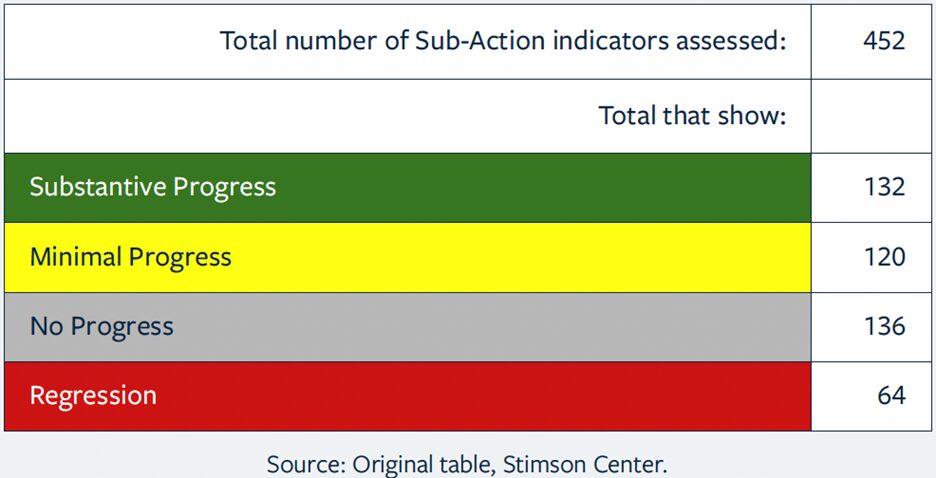
On the whole, our comprehensive review found that: i) more than half of assessed Sub-Action indicators showed some level of positive progress; ii) sharp reductions in foreign aid and funding for international organizations (driven by political roadblocks) are, nevertheless, undermining continued progress; and iii) the Pact for the Future demonstrates continued momentum and relevance of multilateral cooperation. On the latter point, the Pact responds to critics by showing that: first, broad international consensus can still be reached on urgent reforms to make the global governance system deliver for all humanity; and second, Summit of the Future implementation efforts are yielding tangible and, in some instances, significant results (as elaborated in section four of this report).
Rethinking the Peace and Security Architecture for a Changing World
To update and reimagine the collective security system, as well as the UN’s wider conflict management toolkit, to keep pace with the changing nature of warfare and security, GGIR’26 recommends:
Collective Security Institutional Architecture Upgrades: Achieving a “consolidated model” (Pact Action 40) to get to text-based negotiations toward a more representative Security Council requires agreement on the number of membership categories of a reformed Council and its voting thresholds, as well as potentially limiting the veto. Another innovation (though not requiring a UN Charter amendment) is permitting the General Assembly to recommend a set of defined consequences for a state found to have violated the UN Charter by committing an illegal use of force.
Future of Peacemaking and Peacekeeping: The UN needs to champion a peacemaker as its next leader, who fully leverages UN Charter Chapter VI mediation and other peaceful settlement tools. Moreover, to better optimize peacekeeping, peace operations should revert to their original fair witness and deterrent functions rather than to peace enforcement.
Reimagining Prevention and Peacebuilding: Climate risk early warning is needed to better respond to the new frontier prevention concern of climate change-induced conflicts. Furthermore, the UN should establish a Civilian Protection Support Mechanism to ensure that protection (and wider peacebuilding) efforts continue during peacekeeping transitions.
Accelerating Implementation through a Pact Innovation Plan
Advancing the Pact for the Future requires both political commitment and novel approaches to implementation. The Global Governance Innovation Network’s Pact Innovation Plan (PIP) responds to this need by offering a structured yet flexible platform for generating creative, research-backed solutions across the Pact’s 56 Actions. This year’s “PIP Edition Two” aims, in particular, to stimulate strategic thinking around the Pact’s most consequential Actions, creating space for diplomats, practitioners, and experts to consider a fundamental question:
When the international community looks back in 2028, what will be remembered among the most important achievements and legacy-building innovations flowing from the 2024 Summit of the Future?
In this spirit, GGIR’26 proposes ten potential big-ticket “flagship commitments” based on existing milestones, momentum, and political will ahead of 2028. The goal is to facilitate positive messaging across a clear track record of memorable, high-impact outcomes, to encourage greater momentum and high-level political support across the entire Pact, including: Action 3 (End Hunger); Action 4 (SDG Financing and related IFA reforms Actions 47-52); Action 16 (Peacemaking); Action 30 (STI for Human Rights, including the Scientific Panel and Global Dialogue on AI Governance); Action 36 (Youth Participation); Action 40 (Security Council Reform); Action 42 (General Assembly Revitalization); Action 46 (Human Rights for All); Action 53 (Beyond GDP); and Action 55 (Partnerships).
Despite heightened political divisions and mistrust among major powers, champion governments, motivated international civil servants, and dedicated civil society partners make slow yet steady headway on these and several other major Pact goals in defense of UN values. Increasingly, they look for a new kind of leadership in 2027 and beyond, with the vision, courage, and experience to transform the United Nations by realizing the Pact’s full potential.
Across the Pact for the Future, the UN80 Initiative, and broader efforts to renew peace and security governance, a common thread emerges: today’s interconnected crises can no longer be managed through fragmented, deadlocked, or reactive approaches. The years leading up to the 2028 Pact review, alongside preparations for the post-2030 development agenda and the transition to new UN leadership, represent a critical window for demonstrating that inclusive multilateralism can still serve as an effective instrument for prevention, resilience, collective problem-solving, and just outcomes. Ultimately, the success of these efforts will not be measured by the number of declarations adopted or new processes launched, but by whether the international community succeeds in renewing trust, reducing insecurity, and delivering a more peaceful, just, and sustainable future for current and future generations.








Community Adaptation for a Water Festival Without Clean Water