
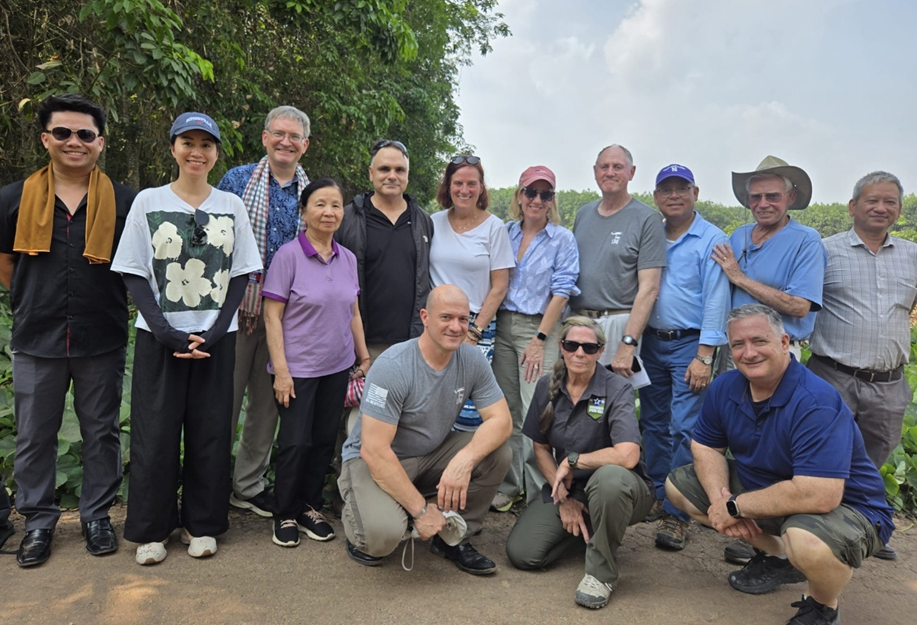
In April 2026, I traveled through Vietnam with a delegation of U.S. veterans and MIA family members who are part of the nonprofit organization, Mission: POW-MIA. We met Vietnamese partners and visited former battle sites under the auspices of the Vietnam Wartime Accounting Initiative (VWAI), the U.S. government-funded program to assist Vietnam in locating and identifying its own missing. Established in 2021 with bipartisan Congressional support, VWAI was re-authorized in FY 2026 and entered its second phase.
The scale of the challenge is immense. Vietnamese sources estimate that 175,000-200,000 remains are unrecovered from 20th century wars, and 300,000 unidentified remains are buried in cemeteries across the country. However, no detailed statistics are available, and the official designation of “martyrs” (liệt sĩ) refers only to soldiers on the revolutionary side, not to civilians or South Vietnamese (ARVN) losses.
Over the last 40 years, the Defense POW/MIA Accounting Agency (DPAA) has recovered over 1,000 remains of Americans killed in Vietnam, Laos, and Cambodia in partnership with regional governments, with more than 1,500 still unaccounted for. DPAA’s legal mandate extends only to American personnel; Vietnamese recovery efforts are less well resourced, without the laboratories and advanced equipment that the U.S. government provides.
As decades have passed, the condition of remains has become highly degraded. The physical appearance of grave locations is often dramatically different — from cleared land to forest plantations or industrial developments — and the memories of surviving witnesses may also shift over time. Yet advances in DNA identification, coupled with the ongoing declassification of archival records and aerial photography from the war, offer new opportunities for progress.
In 2024-25, based on information provided by U.S. veterans and independent Vietnamese researchers, provincial excavation teams uncovered over 150 sets of remains around the Lộc Ninh airfield, site of major battles in 1967 and 1972. According to local military officers we met in April 2026, 11 ARVN remains were also recovered and reburied in cemeteries. With ground-penetrating radar, magnetometry, and other technologies, additional mass and individual graves could be identified in the future. The VWAI archival research component, led by Texas Tech University’s Vietnam Center and Archive, is currently concentrating on records covering the Lộc Ninh area.
Such coordinated effort between the Vietnamese military, U.S. veterans, and researchers is the most promising pathway to returning physical remains and information to families who have been waiting for decades. Indeed, the next 5-10 years form a crucial time window in which living witnesses can still be located and new research approaches are explored. In December 2025, Vietnam’s deputy prime minister announced targets of recovering 7,000 fallen soldiers and conducting DNA analysis on 18,000 unidentified remains by July 27, 2027 (Vietnamese Veterans’ Day), plus higher targets of 10,000 recovered and 23,000 identified by 2030. The Ministry of National Defense subsequently launched a “500 days and nights campaign” (Chiến dịch 500 ngày đêm), lasting from March 15, 2026 through July 27, 2027 to “intensify the search, collection, and identification of the remains of fallen soldiers.” Several of the individual researchers involved in the Lộc Ninh case have been appointed to a national advisory committee for the campaign.
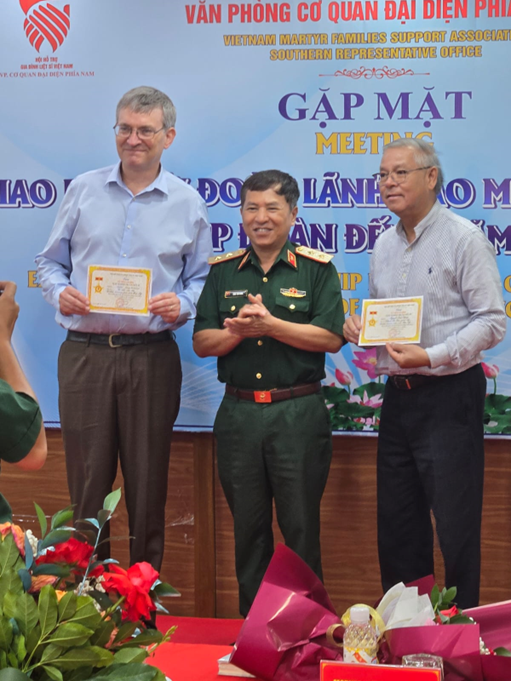
Members of the Mission: POW-MIA delegation received certificates from the Vietnam Martyr Families Support Association. Photo: To Thi Bay.
With support from VWAI partners and Vietnam’s own commitment, the “500 days and nights” targets are eminently achievable. Of course, it will never be possible to recover remains of all missing persons, or even a majority of them. But the effort will also uncover information and wartime artifacts that can help to bring healing and peace of mind to family members on all sides of the conflict. Exchanges like the visit by Mission: POW-MIA strengthen people-to-people connections among Americans and Vietnamese, which are a foundation for peace.
One of the U.S. delegation members, a retired Navy captain, had previously accompanied Gen. John W. Vessey to Vietnam in 1991, when the controversy over American MIAs was at its peak. “At that time,” the captain remarked, “we didn’t think that the Vietnamese put any great value on recovery of their missing. I now recognize that’s not the case.”
For Vietnamese families, obtaining physical remains — or at least personal belongings — of the deceased is central to traditions of ancestor veneration. The cultural value placed on recovering wartime remains in both Vietnam and the United States adds to its importance as a cornerstone of the bilateral Comprehensive Strategic Partnership.
Header image: Mission: POW-MIA and Texas Tech researchers visit a suspected MIA crash site with U.S. Consul General Melissa Brown, Ho Chi Minh City, April 2026. Photo: Kim Benner




Community Adaptation for a Water Festival Without Clean Water