
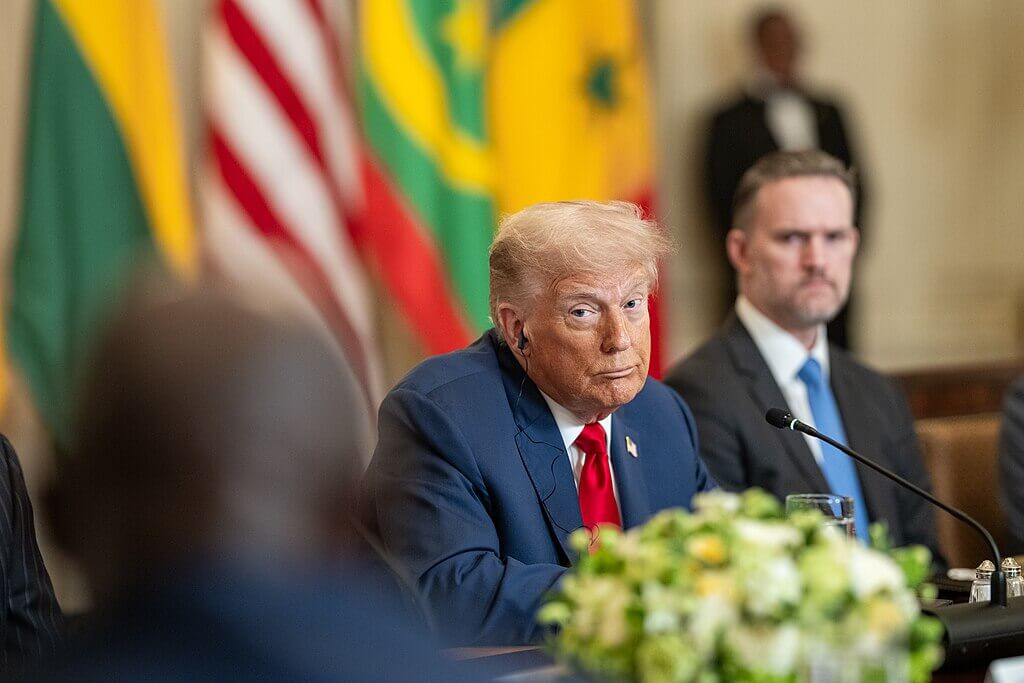
In raising tariffs and slashing humanitarian and developmental aid to Africa while focusing on critical minerals extraction, Trump is boosting China and Russia’s influence in Africa despite the slowdown in China’s investments and Russia’s recently troubled military footprint in the Sahel. In their favor is Beijing and Moscow’s wooing of Africa’s countries as part of an alternative multilateral order while the Trump Administration snubs them with a decreased diplomatic presence. With Europe also slashing developmental aid to Africa, the West is missing an opportunity to invest in Africa’s long-term potential beyond critical minerals.
Foreign Aid Cuts Hurting Africa
Africa is taking the brunt of the U.S.’s foreign aid cutbacks. The U.S. was the single largest donor, providing up to 26% of all aid going to Africa. More than half a million people with H.I.V. will die unnecessarily in South Africa alone, according to one estimate made by the South Africa’s HIV foundation. Almost eight million people in Congo stand to lose food aid, and 2.3 million children are facing deadly malnutrition, according to the United Nations. Jakkie Cilliers, founder of the Africa-focused Institute for Security Studies (ISS), has warned that 5.7 million more Africans will be pushed into extreme poverty next year and an additional 19 million by 2030. Trump has predicted that his own cuts will be “devastating” and called on other countries to help.
Climate assistance is being slashed not just by Trump but also European nations opting to focus on defense spending despite Africa’s growing vulnerability to climate change. According to the World Meteorological Organization, temperatures across Africa are rising at 0.3°C per decade. China has become a major partner on climate assistance and believes Africa could develop into a huge market for green energy. Xi promised 30 clean energy projects in addition to cooperation on the nuclear sector at last year’s China-Africa summit.
The combination of Trump administration tariffs of 10% or 15% for most African countries (and 30% for South Africa) and the failure of the U.S. Congress to extend the 25-year-old African Growth and Opportunity Act (AGOA) is a blow to Africa’s economic aspirations and U.S. ties with the continent. AGOA provided duty-free access for many products such as clothing, leather, and footwear, and the lack of its extension puts at risk approximately 1.3 million African jobs. Some of the biggest losers are South Africa, Madagascar, Kenya, and Lesotho. In contrast, last June, China extended tariff-free access to 53 African countries, triggering a 25% to 26% increase in Chinese exports last August. China’s trade surpassed the U.S.’s in 2009.
Critical Minerals
The businessman Massad Boulos, Trump’s Senior Advisor for Africa, defends Trump’s assistance cutbacks by saying Africans don’t need charity, just business deals. An area in which the U.S. needs Africa’s help, he says, is critical minerals. Yet, the humanitarian cuts will hurt many of the countries and the workers who Trump and Boulos are relying on to develop the critical minerals industry. Depending on child labor for cobalt mining, for example, is odious enough, but depriving these children of vaccines and food aid only adds to the injustice.
The U.S. is highly dependent on China for 70% of critical minerals needed for manufacturing. China has spent years making investments in mining and the processing of critical minerals including in Africa, which is estimated to hold 30% of the world’s supply. Trump and Boulos’ fixation is nothing new. In February 2023, the Biden Administration established a Mineral Security Partnership with eight mineral-rich African countries that already cooperate with China. Boulos’ negotiations of a ceasefire between Rwanda and DRC paved the way for Trump to announce a major U.S. minerals agreement with the two African nations in late June. Unfortunately for Trump’s peacemaking, the conflict in eastern Congo appears to be heating up. The IMF believes Africa’s possession of critical minerals could transform the region, but for that it will need to focus on processing, not just on mining.
Trump officials recently vowed to help with “refining,” not just mining, but the scope of what is needed would be immense. Mining cannot be successful without the infrastructure to haul the minerals to market. Traditionally, the U.S., unlike China, has not funded infrastructure. The partially completed Lobito Atlantic port corridor that Biden funded and Trump supports involves building 350 miles of new rail line in Zambia connecting its northwest region to the DRC as well as hundreds of miles of feeder roads along the corridor and renovating the 120-year-old Benguela railway. A BCG study stresses that no one [African] country “could master the entire mining-to-manufacturing continuum alone,” but “regional blocs such as the SADC, ECOWAS, and EAC offer immediate platforms for sharing infrastructure and coordinating investment.”
Decline in US Interest Predates Trump’s Second Term
Shortly after Trump’s 2024 electoral victory, Reuters interviewed eight current and former officials confirming what a review of U.S. government watchdog reports had evidenced: There had been “a dearth of staff and resources” at embassies in Africa, compromising ties under Biden. Reuters quoted Cameron Hudson, a former CIA analyst about how a lack of resources caused the U.S. to get sidelined, including losing a major spy base in Niger and being caught out when the Sudan civil war erupted in 2023.
The Trump Administration is compounding the weakening of the U.S. presence in Africa by not nominating ambassadors to major African posts. Except for conservative media critic Leo Brent Bozell III, yet to be confirmed for U.S. Ambassador to South Africa, there have so far been no nominees for other major embassies such as those in Nigeria, Kenya, and Ethiopia. Last April, a leaked memo, which Secretary of State Marco Rubio called “fake,” indicated a plan to radically cut back the U.S. diplomatic footprint in Africa. “Lesotho, Eritrea, the Central African Republic, the Republic of Congo, Gambia, and South Sudan will have embassies closed, along with consulates in Douala, Cameroon, and Durban in South Africa.” Despite the headwinds facing many African countries, the continent has made enormous strides toward regional unity with the African Union and economic and tech initiatives like the African Continental Free Trade Area (AfCFTA) and the landmark 2024 Continental Artificial Intelligence Strategy. In focusing solely on resources, Trump risks stirring neo-colonial resentment, underrating Africa’s economic potential in non-resource areas.
Chinese Influence on the African Continent
Through the Belt and Road Initiative (BRI), formed by President Xi Jinping in 2013, China has invested in numerous infrastructure and development projects throughout Africa, part of Beijing’s efforts to connect the PRC to Europe. China has also fostered close political ties with African leaders and countries through its regular summits.
China’s African projects involve significant debt or concessions from the recipient countries. Since BRI’s founding, China has invested over $700 billion with 49 African nations, the largest borrowers being Angola, Egypt, Kenya, Nigeria, and Ethiopia. The investments have resulted in “debt-traps” for some countries, allowing Beijing to leverage favorable treatment of Chinese firms and access to natural resources. Djibouti presents one case study: Loans from a Chinese state-owned firm and others financed the Port of Djibouti’s development, resulting in 56% of Djibouti’s external debt being owed to China. Consequently, in 2014, Djibouti agreed to allow the People’s Liberation Army (PLA) to make use of its port and construct the PLA’s first overseas naval facilities, which were completed in 2017.
Angola is another nation in serious debt to Chinese lenders. Since 2002, Angola has borrowed more than $45 billion from China, and as of 2024, 40% of the country’s external debt is owed to Chinese creditors, at a total amount of $17 billion. Despite 72% of Angola’s oil exports going to China, the country’s decreased production in recent years means Angola has struggled to keep up with its payments.
Nevertheless, the total external debt owned by China is a small fraction of Africa’s debt and, according to the IMF, has been significantly “scaled back” due to China’s growing risk aversion and domestic slowdown. China’s foreign investment strategy is shifting towards “green and digital infrastructure, involving more local collaboration in project selection,” which is a welcome change. The IMF sees China trimming back on oil and resource imports from Africa undermining economic growth among Africa’s energy-exporting nations.
China is the third largest arms supplier to African countries in addition to holding joint exercises and training. In 2024, Chinese and Tanzanian troops participated in the “Pace Unity 2024” joint exercise, consisting of both land- and sea-based operations. Between 2018 and 2022, China was responsible for almost 10% of all arms imported to Africa behind Russia and the U.S. As of 2024, 70% of African nations utilize Chinese armored vehicles in their militaries. China has especially benefited from Russia’s reduced military exports during the ongoing war in Ukraine, by stepping in to provide reliable and cheap products to African militaries.
Russia’s Military Influence
Much like China, Russia has been long interested in spreading influence across the African continent. Unable to leverage the same economic might as China, Russia has exploited a Western vacuum, providing military help to juntas in the Sahel and elsewhere in exchange for access to the continent’s vast reserves of natural resources. Russia also conducts disinformation campaigns, spreading anti-western narratives, and pro-Russian sentiment has helped Moscow forge close relationships with numerous African military leaders, diminishing American influence.
The Wagner Group, founded by the late Yevgeny Prigozhin and later reorganized into the Africa Corps, has been the primary force utilized by Moscow to further its agenda in the region. In 2017, Wagner deployed to Sudan to provide security and train Sudanese troops to help suppress protesters in exchange for gold mining concessions to its subsidiary, Meroe Gold. A similar story has played out in the Central African Republic (CAR), where Wagner has assisted the government of the CAR in training soldiers, suppressing protests, undertaking combat operations, and providing weapons and equipment in exchange for which it received mining rights.
However, in the Sahel, the Africa Corps has failed to find the same success. Recent efforts to combat insurgent groups in places such as Mali and Burkina Faso have been described as uncoordinated and ineffective. Indeed, many Sahel insurgent groups that the Africa Corps has battled are reviving. Particularly with the bulk of its forces fighting in Ukraine, the Africa Corps, and with it Russia, may have hit their limits in expanding their military role on the continent.
Still, Russia is likely to remain a large provider of arms. Between 2018 and 2022, 40% of African major arms imports came from Russia. During the same time frame, the U.S. and China accounted for 16% and around 10% of arms imports, respectively. While Russia’s number is sure to have decreased due to the ongoing conflict in Ukraine, the fact remains that Russian arms exports to African nations have forged strong political relationships and long-term military dependence on Moscow.
Moreover, Putin has cultivated political ties with many African nations. Following the first-ever ministerial conference of the Russia-Africa Partnership Forum in late 2024, Mali, Niger and Burkina Faso signed a deal for Russian help in satellite monitoring of their borders. With Moscow and Beijing pushing the BRICS expansion, two new African countries — Egypt and Ethiopia — have been inducted as full members, joining South Africa. Kenya and Zimbabwe have also expressed interest in joining. Algeria, Nigeria, and Uganda have been granted “partner country” status as of January 2025.
Risks and Challenges for the US
While Trump is admired for his strength in many African countries and has touted Africa’s economic potential, China has surpassed the United States since 2013 in overall influence, encompassing all relations from diplomatic links to foreign aid and economic and security ties, according to University of Denver’s Pardee Institute. The U.S.’s decreasing clout in Africa contrasts with the global pattern of influence the U.S. has been able to maintain in other regions. Europe’s post-colonial influence has also receded. The cutback in humanitarian and medical assistance is a blow to U.S. influence in an area where the U.S. once stood out. China’s humanitarian foreign aid is relatively small.
The World Bank has warned that poorer developing countries, many in Africa, will face a hard slog in the next couple decades, and it will take more than critical minerals mining deals to recover. Is it in the American and Western interest to see Africa decline further? Since 2020, Africa has seen more political unrest, violent extremism, and democratic reversals than any other region, and that could spill over with terrorism and rampant migration. By default, turning Africa over to China and, a lesser extent Russia, the U.S. and West are furthering the expansion of alternative governance institutions such as BRI and BRICS that Beijing and Moscow see as building blocks to a “non-” if not “anti-” Western world.






Community Adaptation for a Water Festival Without Clean Water