
Corporate Multi-Alignment
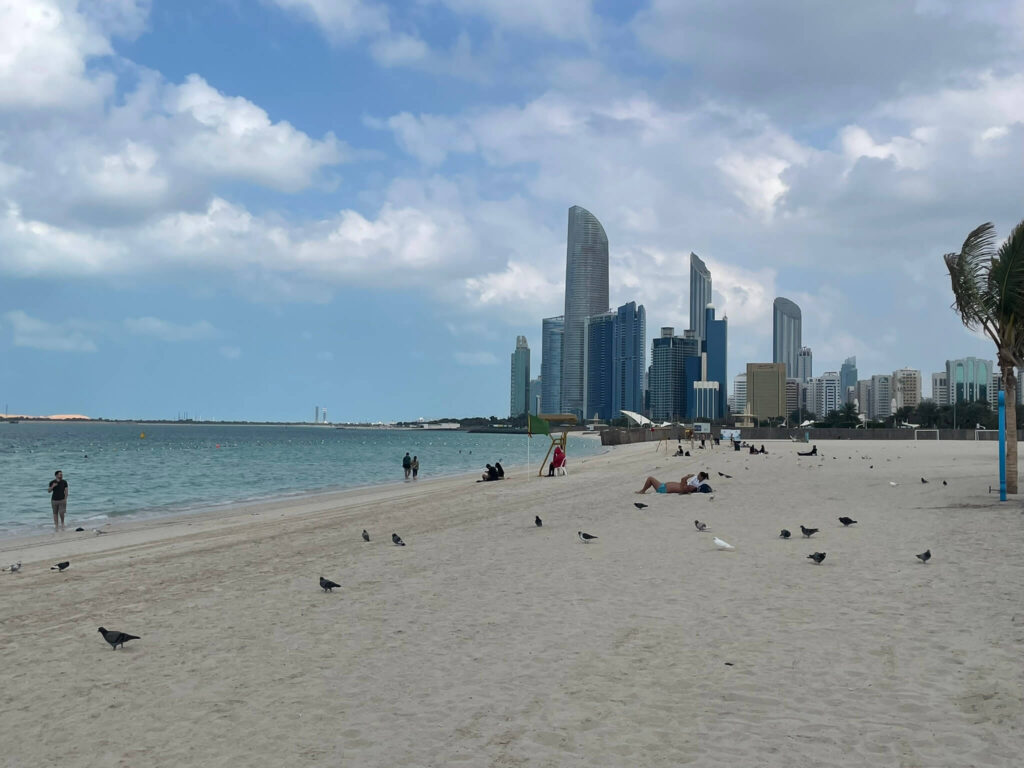
We landed very late in Abu Dhabi (via Doha) and were driven to our American hotel in a very swanky Chinese electric vehicle – the very type that neither of us can buy. Not because they’re expensive, but rather because we live in the United States.
Which is to say, from the moment we stepped off the plane, and over the course of many conversations with several regional experts and academics, one message rang clear: The UAE is open for business with everyone.
What the Emiratis’ version of this business-based “multi-alignment” looks like in practice is not obvious at first glance but becomes clearer when seen through the lens favored by the experts we talked to. These experts characterized the UAE as maturing, with one stating: “The UAE is not a teenager anymore.” Part of this maturation is creating a longer-term strategy, which the Emiratis are doing. As one interlocutor put it, “The UAE is obsessed with the future,” and that future, in their view, is defined by artificial intelligence (AI). Emirati elites see AI not only as a groundbreaking technology but also as the key to their long-term economic success. The world will eventually transition away from fossil fuels; the UAE isn’t waiting until that happens.
The UAE’s AI ambitions, however, have created a pressure point in the US-UAE relationship. The Biden administration was wary of exporting the most high-end, exquisite semiconductor chips to the UAE because of the UAE’s relationship with China. And this hesitation may have been warranted – the Emirates’ main AI firm, G42, has significant ties with Chinese firms. Some of G42’s work has obvious military applications, while still others are clearly dual-use (i.e. for both civilians and the military). Despite these connections, one Emirati expert maintained that “the UAE’s relationship with China has not harmed the United States.” Some might struggle with that claim, but, from the Emiratis’ perspective, the onus is on the skeptics to prove it.
The UAE sees itself as becoming a cosmopolitan business hub. Being “open for business with everyone” only works when the region is calm. Instability is poison to international investment. Even though the threats faced by the UAE have changed substantially over the past decade – from fears of coups to fears of non-state actors, regional disorder and the threat of societal collapse – Emiratis still view America as a valuable “balancing” actor and key to regional stability. Several experts pointed to U.S. strikes against the Houthis in Yemen as evidence of continued U.S. engagement in the region.
In other words, the UAE has changed substantially in the last 10 or 15 years, but the United States’ security role has stayed largely the same. Experts told us that, in practice, Washington still sees the Gulf as a set of regimes concerned with internal security and ideological alignment. Now, however, the UAE (and other Gulf states) are driven by technological aspirations, economic realities, and a new middle-power flexibility – none of which existed a decade ago.
This combination of factors helps explain why the UAE is hedging. While the almighty United States might be able to ensure free sea lanes, it cannot alone ensure long-term economic success. In other words, Emirati officials are acutely aware of how quickly stability — and a mostly-foreign-born workforce — can disappear. A couple of experts pointed to the cautionary tale of Beirut. This once-shining example of success in the early 1970s (much like Abu Dhabi or Dubai is today) was largely destroyed by the Lebanese civil war and has yet to fully recover.
Thus, Emiratis view their strategic environment through a “split lens.” They believe they can leverage connections with China and Chinese firms to attract investments, technology partnerships, and more trade, while also relying on the United States for deterrence, maritime security, and some higher-end technologies. Despite ongoing hedging, the Emiratis believe that the United States is still the only credible security guarantor, and that some American tech – namely, AI, cloud computing, and oil and gas extraction – is unparalleled. The United States is certainly not a perfect partner, but the Emiratis view China as unable and unwilling to project military power in any way comparable to the United States. Russia, meanwhile, is an erratic and unreliable partner, especially while it is fighting a grueling war in Ukraine.
Even still, despite the United States’ military prowess, experts emphasized the Emiratis’ continued hesitation of aligning too closely with the United States. According to one, the UAE sees a US-backed security guarantee as “double-edged”; it may provide stability, but can also make the UAE a target, much like Qatar was in June 2025. Moreover, the UAE wants to avoid getting caught in the middle of a strategic competition between Washington and Beijing. “The Emirates will not choose sides,” one expert explained. “No middle power will.”
And yet, although the United States and the UAE diverge in some areas, they still doshare some common interests. For example, despite everything that has transpired in the region after Hamas attacked Israel on October 7, 2023, experts told us that the Emiratis are committed to their role as a regional bridge to Israel. They still support their decision to join the Abraham Accords in 2020, and, more recently, Mohammed bin Zayed wholeheartedly embraced President Trump’s “Board of Peace”; the UAE was one of a handful of countries who participated in the signing ceremony held at last month’s World Economic Forum at Davos. However, as one expert said, “The UAE wonders if they can get the best of both worlds.” That is, the Emirates strive for a system in which they can benefit from American chips and cloud tech, Chinese manufacturing and compute, Indian human capital, Korean air defenses, Turkish drones, and European training — all at the same time. They view a strategy of multi-alignment as the only way they can further all of the UAE’s national interests simultaneously.
Only time will tell, however, as to whether the interests of the UAE and the United States will continue to align. Over the long term, the United States may well balk at the UAE’s insistence that it will continue to work with China and Chinese firms. And the Emiratis, meanwhile, have been equally firm in their determination not to “choose sides.”
Transactional Foreign Policy is Back
For now, however, the return of a transactional foreign policy, and a focus on short-term benefits, can obscure deeper points of difference. The Emiratis welcome this new transactionalism with open arms. In fact, explained one of our interlocutors, the Emiratis much prefer “dealing with the strongmen.”
For much of the rest of the world, the return of Donald Trump to the White House has been unsettling. Critics warn that his “personalist” brand of foreign policy can lead to chaos. But the Emiratis don’t necessarily see it that way. Experts characterized the last 10 years of US-UAE relations as defined by “mistrust,” “unpredictability,” and “confusion.” There was distance between the two countries during the Obama administration; Emiratis were frustrated by the JCPOA, disappointed by Obama’s failure to enforce his “red line” on Syria, and unsettled by the promised “Pivot to Asia.” This was followed by Donald Trump’s first term and a return to engagement with the region via the Abraham Accords. Then relations regressed again under the Biden administration. Many in the UAE saw the extensive export controls as unfair. The lowest point of the US-UAE relationship may have come in January 2022, after a Houthi drone attack struck Abu Dhabi. President Biden took a week before calling Emirati leaders to offer condolences. That was seen as too little, too late.
Thus, where other states (especially in Europe) tend to lament the transactional nature of the Trump administration, Emirati elites have found it easier to navigate – and even more predictable. Experts pointed to the financial benefits that have flowed to the Trump family and Trump loyalists following key foreign policy decisions and explained that Emiratis feel more comfortable dealing with this quasi-capitalist-clientelism. They look to Jared Kushner’s relationship with Saudi Arabia as a model, one that they can – and have – used to advance the UAE’s national interests, for example by investing in the Trump-family-linked crypto company, World Liberty Financial.
The Trump administration has benefited from this new transactional modus operandi – and the president has reaped both personal and policy rewards. We were warned, however, that, without a careful plan, “middle powers will milk you.” We understood this to mean that, unlike in the past, states are no longer reflexively aligning with the United States under the pretense of the Liberal International Order, or out of gratitude for American security guarantees. Experts explained that middle powers like the UAE always viewed the “liberal international order” construct as a fallacy. There is little preventing the UAE, however, from using their newfound leverage to extract concessions in the broader great power competition for global influence.
Partner vs. Partner?
This quest for leverage – and the risks for the United States – can be seen today through the lens of the UAE-Saudi relations. The United States has security agreements with both the UAE and Saudi Arabia, including military bases and arms sales, and it has coordinated with both countries in the past. Now, however, the Trump administration is stuck in a precarious position as the Emiratis and the Saudis quarrel over the future of their southern neighbor – Yemen. Last year, the UAE threw its support behind the Southern Transitional Council (STC), whereas the Saudis continue to support the Presidential Leadership Council (PLC). The PLC and the STC were once united in a coalition that was internationally recognized as the legitimate government of Yemen, and both continue to fight against the Houthis. However, the STC led a separate offensive in December to capture territory in Southern Yemen. Saudi Arabia viewed this a threat to its national security; the STC’s departure from the government makes that coalition weaker and threatens to prolong the civil war. For their part, the Emiratis believe that the coalitional government had clearly failed and were therefore open to exploring other alternatives (including support for the STC).
Some see a proxy war in Yemen, with two U.S. partners on opposite sides, as a product of the United States’ stated intention to step back from the region. Similar scenarios could play out elsewhere. The Emiratis characterized their involvement in Yemen as aimed at promoting development and stability, and they accused the Saudis of attempting to manage a threat, rather than solving it. (Although, should we have traveled to Saudi Arabia, we almost certainly would have heard a different story).
Decades of U.S. overextension in the region have now created a difficult situation. Just as some U.S. officials aim to make the UAE “choose” the United States over China, Emirati and Saudi leaders are trying to force a choice on the United States. As one expert warned, “Be careful not to be used.” It would be profoundly unwise to “do either side’s bidding.”
As we left Abu Dhabi for Istanbul, we couldn’t help but think about how much the UAE and this region have changed in the last 10 to 15 years. Soaring over new high-rises and data centers, one can only imagine what the coming decade will bring. Over the next few years, might the United States be more responsive to the ever-changing world, and flexible in how it employs its power? Time will tell. All in all, the visit reaffirmed our sense that managing security partners’ shifting and competing interests requires deft diplomacy, a deep understanding of their history and strategic culture, and a willingness to adapt to changing circumstances. The Emiratis have made such multi-aligned flexibility a mainstay in their strategic culture. Americans should take a page from their book.





Community Adaptation for a Water Festival Without Clean Water