


Executive Summary
In 2016, the Colombian government and the guerrilla insurgency group known as FARC-EP signed the Final Peace Agreement, bringing an end to decades of conflict and immense human suffering. In the years since, the United Nations Verification Mission in Colombia (herein referred to as the Verification Mission) has helped maintain momentum behind the peace agreement, building parties’ trust and confidence in the peace process. And although progress remains slow in implementing the agreement, the mission continues to inspire government and civil society efforts through its advice, advocacy, and assistance. More recently, the mission has also accompanied government efforts to engage in dialogue with other armed groups that target civilians and perpetuate insecurity across the country.
In assessing its impact on the safety and security of civilians, this report finds that the Verification Mission has meaningfully contributed to the protection of civilians in Colombia through its verification mandate and good offices. Importantly, the mission has developed an internal culture of placing people first, thanks to its “proactive verification” approach to its mandate. Specific factors that have enabled this include the mission’s widespread presence across the country, its facilitation of communication between the capital and regional and local levels, its advocacy for the protection of civilians, and its reinforcement of civil society’s capacity to advance their own protection needs.
The mission’s accomplishments in these areas have been enabled by the Colombian government’s ongoing efforts to fulfill its responsibility of protecting civilians, as well as by the fact that the mission operates within a largely permissive operating environment. Furthermore, protection is intrinsic to the peace agreement the mission is mandated to verify. Government officials and civil society experts interviewed for this study describe the mission as promoting a protective environment for former FARC-EP combatants and other vulnerable communities, with civilians often seeing the mission as a source of advice, a link to national entities, and a voice of the international community.
The Verification Mission’s impact on the protection of civilians faces clear limits, however, as protection is not explicitly referenced in its mandate, nor does it have the authority or capacity to use force to protect civilians. As a special political mission (SPM), the Verification Mission has no armed troops or police, although it does maintain unarmed international observers with military and police backgrounds. Additionally, at the level of the state, fragmented government approaches to implementing human security-related policies, as well as an absence of meaningful state presence and capacity across the territories, hinder protection outcomes in the country.
Overall, the Verification Mission’s experience provides useful examples of how peace operations without an explicit protection mandate can nonetheless help advance the safety and security of civilians. For its part, the Verification Mission could seek to strengthen its impact in Colombia by developing internal mission guidelines on the protection of civilians to optimize protection outcomes where it is deployed. Such an initiative would be greatly supported by the UN Secretariat’s development of guidance that outlines the possible scope and limitations of SPMs in contributing to the protection of civilians. Furthermore, the Verification Mission’s experience highlights the need for such protection guidance to address operating in urban conflict areas, for example where armed actors live and operate among civilian communities.
Introduction
A little less than 10 years on from the historic signing of the 2016 Final Peace Agreement between the government of Colombia and the guerilla group Fuerzas Armadas Revolucionarias de Colombia-Ejército del Pueblo(FARC-EP), there remains an ongoing push to implement the agreement in full. Yet progress remains slow. While the peace agreement enabled a phenomenal reduction in violence across the country, its incomplete implementation threatens to leave unaddressed societal inequalities and security threats facing former FARC-EP combatants and other vulnerable communities. Furthermore, in many regions, insecurity has risen as armed groups—characterized either as criminal or political—continue to proliferate and grow in force.1Luis Jaime Acosta, “Colombian Armed Groups Have Expanded during Petro’s Presidency, Report Finds,” Reuters, July 8, 2025, accessed September 9, 2025, https://www.reuters.com/world/americas/colombian-armed-groups-have-expanded-during-petros-presidency-report-finds-2025-07-08/. Civilian communities remain at direct risk, both from being caught in the middle of intensifying hostilities2The International Committee of the Red Cross (ICRC) in Colombia reported that in 2024 civilians experienced the worst levels of conflict since the signing of the 2016 peace agreement. (ICRC, “Humanitarian Challenges 2025: Colombia” (2025), 2, https://www.icrc.org/en/publication/humanitarian-report-2025-colombia; and ICRC, “Colombia: ‘Most Colombians Are Engulfed in the Conflict against Their Will,’” Patrick Hamilton, May 14, 2025, https://www.icrc.org/en/article/colombia-most-colombians-engulfed-conflict-against-will.) and from targeted violence, intimidation, and coercion.3For more on social control tactics used by armed groups, see International Crisis Group, “Trapped in Conflict: Reforming Military Strategy to Save Lives in Colombia,” Report no. 95 (2022), 6, https://www.crisisgroup.org/latin-america-caribbean/andes/colombia/95-trapped-conflict-reforming-military-strategy-save-lives; and International Crisis Group, “Colombia: Is ‘Total Peace’ Back on Track?,” October 4, 2023, accessed September 9, 2025, https://www.crisisgroup.org/latin-america-caribbean/andes/colombia/colombia-total-peace-back-track. It is within this challenging security environment that the United Nations Verification Mission in Colombia (herein referred to as the Verification Mission) operates.
Established in 2017, the Verification Mission is mandated to monitor and verify implementation of five key aspects of the 2016 agreement. Throughout its eight-year history, the Verification Mission has enjoyed strong host-state consent and cooperation, helping to build trust between the Colombian government and the FARC-EP and promote peace across the country. As such, the UN Security Council has provided steady backing to the mission, evidenced by its unanimous support for the mission’s mandate renewals each year. These dynamics are attributable in large part to a focused, concise mandate that directly responds to the host state’s expressed wishes for the mission.
Few studies, however, have explored the Verification Mission’s impact on the protection of civilians in Colombia.4The one known exception to the dearth of research on the protection impact of the Verification Mission is International Peace Institute’s “United Nations Special Political Missions and Protection: A Principled Approach for Research and Policymaking,” Dirk Druet (2021), 13-16, https://www.ipinst.org/2021/07/un-special-political-missions-and-protection-a-principled-approach-for-research-and-policymaking. Although the mission does not have an explicit mandate to protect civilians, its proactive verification of government efforts to protect former FARC-EP combatants and other at-risk civilian populations—in line with its mandate—points to the idea that the mission’s presence and operation in the country inherently promote civilian safety and security. This report thus investigates in what ways the Verification Mission, as a special political mission (SPM),5The term SPMs refers to a broad category of UN peace operations that are usually unarmed and funded by the UN’s regular budget. SPMs focus on conflict prevention, peacemaking, and post-conflict peacebuilding activities, with typologies ranging from field-based missions and regional offices to the offices of UN Special Envoys to groups of experts monitoring Security Council sanctions regimes. These missions tend to be smaller and less costly than peacekeeping missions. As of 2025, more than 20 SPMs are deployed around the world. (See UN Department of Political and Peacebuilding Affairs, “DPPA Around the World,” 2025, accessed September 9, 2025, https://dppa.un.org/en/dppa-around-world.) contributes to the protection of civilians in Colombia through implementation of its mandate, as well as how its unique operational environment affects its ability to support civilian security. This research aims to inform emerging dialogue about the possible roles for SPMs in advancing the protection of civilians where deployed.
Protection by UN Peace Operations
Research on the protection of civilians by peace operations has traditionally focused on UN peacekeeping missions that have explicit mandates to do so. Peacekeeping missions, composed of civilian staff, military, and police, implement a comprehensive, three-tiered approach to protection: 1) protection through dialogue and engagement, 2) physical protection, and 3) establishing a protective environment.6The operational concept of protection of civilians by UN peacekeeping missions is outlined in the UN Department of Peace Operations’ policy “The Protection of Civilians in United Nations Peacekeeping,” updated May 1, 2023, accessed September 30, 2025, 9-17, https://peacekeeping.un.org/sites/default/files/2023_protection_of_civilians_policy.pdf. Furthermore, uniformed components in peacekeeping operations can be armed and use force in self-defense or in defense of the mandate, such as to protect civilians.
In contrast, there is no collective understanding about how SPMs, typically comprised of unarmed personnel,7One exception to this is the UN Guard Unit in Somalia, a special defensive force deployed in 2014 and composed of UN troops to protect the compounds of the SPMs deployed in country. (UN News, “Somalia: UN Deploys New Special Force to Protect Staff in Mogadishu,” May 18, 2014, accessed September 23, 2025, https://news.un.org/en/story/2014/05/468562.) contribute to the protection of civilians, although the UN Agenda for Protection details that all UN entities should be working in favor of the protection of people and their human rights.8See United Nations Agenda for Protection: Strengthening the Ability of the United Nations System to Protect People through their Human Rights, February 2024, https://www.ohchr.org/sites/default/files/documents/issues/protection/Agenda-Protection-Pledge-Policy-Brief.pdf. Nonetheless, a few political missions have had mandates to monitor and report on civilian casualties or to support host authorities in implementing their plans on the protection of civilians (as in Afghanistan and Sudan, respectively). These peace operations provide further examples of how civilian missions, like the one in Colombia, can strive to advance the protection of civilians, as well as what limitations they may face in doing so.9For discussion of protection findings from other SPMs, see Stimson Center, “Civilian Protection in Sudan: Emerging Lessons from UNITAMS,” Julie Gregory (2024), https://www.stimson.org/2024/civilian-protection-in-sudan-emerging-lessons-from-unitams/; International Peace Institute, “United Nations Special Political Missions and Protection: A Principled Approach for Research and Policymaking”; and PAX, “Reflections on Protection of Civilians in UN Special Political Missions,” Daniele Rumolo (2023), https://protectionofcivilians.org/report/reflections-on-protection-of-civilians-in-un-special-political-missions/.
Within the Colombia context, discussion of the Verification Mission’s contributions to the protection of civilians does not seek to suggest that the mission has undertaken activities outside the bounds of its mandate. Rather, the aim of this report is to explore whether and how the mission’s strategic approach to its mandate and implementation of key activities have the effect of encouraging the protection of civilians.
In carrying out the research, the authors conducted 36 interviews with 75 stakeholders in Bogotá, Cali, and Buenaventura, as well as extensive desk research. Those who participated in the research include 46 UN personnel (42 from the Verification Mission and four from the UN Country Team); five Colombian government officials and three representatives from the armed forces; two former FARC-EP combatants; four Indigenous representatives; and 11 Colombian civil society experts and/or human rights defenders. Of these participants, 35 identified as women (of which 14 are Colombian nationals and five disclosed belonging to marginalized ethnic communities) and 40 identified as men (of which 17 are Colombian nationals and eight disclosed belonging to marginalized ethnic communities). All interview data has been anonymized to protect the privacy and safety of participants.
This report is limited in scope and focuses on the work of the Verification Mission. It does not examine the contributions of the UN Resident Coordinator or the 20-plus UN agencies that also seek to improve the lives and safety of Colombians through delivery of their specialized mandates. Furthermore, most of the interviews that were undertaken were facilitated by the mission, and therefore the authors attempted to verify claims made where possible. The authors also did not travel to areas where the mission is not present, thereby limiting their understanding of how the Verification Mission may be perceived in such areas. Some of these factors are likely to have influenced the findings emerging from this research.
The Verification Mission’s Establishment and Mandate
Following three years of peace talks, in January 2016, the Colombian government and the FARC-EP jointly requested the establishment of a UN political mission with unarmed international observers to verify the cease-fire, permanent cessation of hostilities, and disarmament process.10UN Security Council, Identical Letters Dated 19 January 2016 from the Permanent Representative of Colombia to the United Nations Addressed to the Secretary-General and the President of the Security Council, S/2016/53, 22 January 2016. During initial discussions about bringing an international mission to support the parties in implementing the peace agreement, the FARC-EP expressed interest in a Community of Latin American and Caribbean States (CELAC) mandate, while the Colombian army opposed the idea of UN peacekeepers on Colombian soil, seeing blue helmets as a sign of a failed state. However, it was Colombia’s High Commissioner for Peace Sergio Jaramillo who ultimately convinced the parties that a Security Council mandate would provide the parties with the security monitoring and verification assistance they desired. (United Nations University-Centre for Policy Research, “The UN Security Council and Transitional Justice: Colombia,” Rebecca Brubaker (2020), 57, https://collections.unu.edu/eserv/UNU:7965/UNU_TransitionalJustice_FINAL_WEB.pdf.) Within a week of the request, the Security Council authorized the creation of the UN Mission in Colombia.11See UN Security Council, Resolution 2261 (2016), S/RES/2261 (2016), 25 January 2016. To ensure the safety of UN personnel, the Colombian government pledged responsibility for their security.12UN Security Council, Identical Letters Dated 19 January 2016 from the Permanent Representative of Colombia to the United Nations, 2; and UN Security Council, Report of the Secretary-General to the Security Council on the United Nations Mission in Colombia, S/2016/729, 18 August 2016, para. 25. Once deployed, the UN Mission in Colombia reported a significant level of trust and coordination between Colombia’s armed forces and the FARC-EP, preventing incidents on the ground and supporting the integration of observers in the tripartite monitoring and verification mechanism.13UN Security Council, Report of the Secretary-General on the United Nations Mission in Colombia, S/2016/1095, 23 December 2016, paras. 21 and 22. Experts attribute the presence and work of the UN Mission in Colombia to strengthening the confidence of FARC-EP combatants in the disarmament process, decreasing distrust between the parties, and ensuring adherence to verification protocols.14Institute for Integrated Transitions, “DDR Innovations from the Colombian Peace Process with the FARC-EP,” Jasmina Brankovic, Gerson Iván Arias Ortiz, and Carlos Andrés Prieto Herrera (2020), https://ifit-transitions.org/publications/ddr-innovations-from-the-colombian-peace-process-with-the-farc-ep/.
As envisioned in the Final Peace Agreement of November 2016, the Colombian government and FARC-EP proposed a second, follow-on UN political mission to verify the reintegration and provision of protection measures for former FARC-EP combatants, following the completion of the UN Mission in Colombia’s mandate.15UN Security Council, Letter Dated 29 March 2017 from the Secretary-General Addressed to the President of the Security Council, S/2017/272, 21 April 2017, 6.3.3. In its conceptualization, this mission was inspired in part by the success of prior UN missions in the region that utilized international observers or verified agreements, such as in El Salvador and Guatemala, respectively. Furthermore, incorporating the protection of civilians as a mission mandated task did not enter into consideration for this second mission, as both parties exhibited strong commitment to a future peace by coming to accord on the final agreement and by cooperating with the first UN mission in the implementation of its mandate. Notably, the parties directly agreed to prohibit acts or threats of violence against civilians (including former FARC-EP combatants)—a commitment integrated into the cease-fire and cessation of hostilities protocols,16UN Security Council, Report of the Secretary-General to the Security Council on the United Nations Mission in Colombia, S/2016/729, paras. 3, 38, and 39. in addition to the contents of the Final Peace Agreement. And so, with the parties united on their vision for the second mission, the Security Council established the UN Verification Mission in Colombia in July 2017.17See UN Security Council, Resolution 2366 (2017), S/RES/2366 (2017), 10 July 2017. For the Verification Mission’s mandate, the Security Council approved the tasks laid out by the Secretary-General in UN Security Council, Report of the Secretary-General on the United Nations Verification Mission in Colombia, S/2017/745, 30 August 2017. The Verification Mission shortly thereafter began its activities following the completion of the UN Mission in Colombia’s mandate in September 2017.
Since its initial deployment, the Verification Mission’s mandate has been expanded four times at the request of the Colombian government.18In October 2017, the Security Council temporarily mandated the mission to verify the “temporary, bilateral, national ceasefire” with the Ejército de Liberación Nacional (ELN) for a little more than three months. (See UN Security Council, Resolution 2381 (2017), S/RES/2381 (2017), 5 October 2017.) In 2021, the Security Council expanded the Verification Mission’s mandate beyond the verification of reintegration and security guarantees to include the verification of restorative sentences issued by the Special Jurisdiction for Peace, a judicial body established by the 2016 peace agreement. (See UN Security Council, Resolution 2574 (2021), S/RES/2574, 11 May 2021.) And in January 2023, the Security Council added verification of the comprehensive rural reform and ethnic chapters to the Verification Mission’s mandate. (See UN Security Council, Resolution 2673 (2023), S/RES/2673, 11 January 2023.) Following from that, in August 2023 the Security Council expanded the Verification Mission’s mandate a fourth time to monitor and verify the temporary, nationwide cease-fire with the ELN, which has since lapsed. (See UN Security Council, Resolution 2694 (2023), S/RES/2694 (2023), 2 August 2023.) The mandate currently tasks the mission with verifying implementation of the 2016 Final Peace Agreement as relates to: comprehensive rural reform; reintegration of former FARC-EP combatants within political, economic, and social life; security guarantees for former FARC-EP combatants and other at-risk persons; restorative sentences issued by the Special Jurisdiction for Peace; and the ethnic chapter of the peace agreement. The mission was also previously tasked with verifying two temporary, bilateral, nationwide cease-fires between the Colombian government and the Ejército de Liberación Nacional (ELN) from October 2017-January 2018 and August 2023-August 2024.19UN Verification Mission in Colombia, “Mandate,” accessed September 9, 2025, https://colombia.unmissions.org/en/mandate. During mandate renewals, China and Russia have routinely emphasized the importance of upholding state sovereignty and avoiding an expansive mandate.20“Colombia: Vote on Verification Mission Mandate,” Security Council Report, October 30, 2024, accessed September 11, 2025, https://www.securitycouncilreport.org/whatsinblue/2024/10/colombia-vote-on-verification-mission-mandate-renewal-3.php.
The aspects of the Verification Mission’s mandate related to verifying the provision of security measures for former FARC-EP combatants and other vulnerable populations (e.g., conflict-affected communities, social leaders, and human rights defenders), as well as the reintegration of former FARC-EP combatants into society, directly support the protection of civilians. Additionally, cease-fire monitoring contributes to the aim of reducing violence. A focus on comprehensive land reform and addressing the rights of peasants and ethnic communities also supports a more protective environment by seeking to address long-standing conflict drivers in Colombia.
Challenges to Civilian Safety and Security in Colombia
Despite notable improvements in Colombia’s security environment in recent decades, numerous intersecting drivers of violence and the persistence of a number of non-international armed conflicts continue to present a serious challenge to civilian safety and protection.21According to the ICRC, there were eight non-international armed conflicts in Colombia as of 2025. (ICRC, “Classification of The Armed Conflicts in Colombia,” 2025,
accessed September 17, 2025, https://www.icrc.org/en/article/classification-armed-conflicts-colombia; Uppsala Conflict Data Program, “Battle-related deaths (number of people) – Colombia,” accessed via the World Bank Group, Data360 on October 1, 2025, https://data.worldbank.org/indicator/VC.BTL.DETH?locations=CO; and UN Office of Drugs and Crime, “International Homicide Statistics Database,” accessed via the World Bank Group, Data360 on October 1, 2025, https://data.worldbank.org/indicator/VC.IHR.PSRC.P5?locations=CO.) The proliferation of armed groups, the structural legacies of decades of armed conflict, and the draw of powerful illicit economies are contributing to a devastating surge in armed violence throughout a country with limited state capacity.22ICRC , “Colombia: “Most Colombians Are Engulfed in the Conflict against Their Will;” and Verification Mission personnel, interview by authors, Bogotá, Colombia, February 17, 2025.
While Colombia’s 2016 peace agreement marked a historic step in addressing one of the region’s longest-running conflicts, the government was unable to meaningfully extend its presence to the areas previously under FARC-EP control. Vast swaths of the country thus became theaters of competition for an array of groups looking to stake a claim in the illicit economies of Colombia’s rural and peripheral territories.23Verification Mission personnel, interviews by authors, Bogotá, February 17, 2025. The more fragmented security environment has invited an increasingly violent struggle among a mix of FARC-EP splinter groups, the ELN, powerful criminal groups and gangs, and formerly demobilized paramilitary organizations.24Verification Mission personnel, interviews by authors, Cali, Colombia, February 22, 2025; and International Crisis Group, “Trapped in Conflict: Reforming Military Strategy to Save Lives in Colombia,” 4-5.
As these groups vie for territorial or operational control over criminal enterprises—ranging from human trafficking and extortion rackets to illegal mining and coca cultivation—civilians have paid a heavy price, as evidenced by the map below. Not only are they subject to coercion, forced confinement25Forced confinement can take the form of severe movement restrictions on communities, use of land mines, or curfews imposed by armed groups. or displacement, and other forms of direct violence, but they are also increasingly targets for recruitment, both voluntary and forced.26ACLED, “Civilians in Colombia Face Less Deadly—But More Pervasive—Violence during Petro’s Presidency,” Tiziano Breda (2025), https://acleddata.com/2025/02/17/civilians-in-colombia-face-less-deadly-but-more-pervasive-violence-during-petros-presidency/. Moreover, in many parts of Colombia, armed groups operate around and within local communities, dominating the sociopolitical landscape through means such as levying coercive fees or requiring the use of local identification cards.27International Crisis Group, “Colombia: Is ‘Total Peace’ Back on Track?,” 4; and International Crisis Group, “Trapped in Conflict: Reforming Military Strategy to Save Lives in Colombia,” 6. Intimidation and social control lend an atmosphere of fear and insecurity to everyday life.28International Crisis Group, “Colombia: Is ‘Total Peace’ Back on Track?,” 4. For its part, the government of Colombia is struggling to evolve its approach to these new realities. Despite a 2023 Ministry of National Defense strategy espousing human security as foundational to national security, the armed forces have leaned on familiar military-centric strategies that are ill-suited for the current context, that insufficiently prioritize human security, and that reinforce the strained trust between affected communities and the state.29International Crisis Group, “Trapped in Conflict: Reforming Military Strategy to Save Lives in Colombia,” 14-15, 22-23, and 26. In March 2023, Colombia’s Ministry of National Defense presented its new strategy on security, defense, and citizen coexistence, which provided a foundation for security and defense planning while centering the protection of life and respect of international human rights conventions. (See Government of Colombia, Ministry of National Defense, “Security, Defense, and Citizen Coexistence: Guarantees for Life and Peace 2022-2026,” March 2023, accessed through the Colombian Platform for Human Rights, Democracy and Development on September 23, 2025, https://ddhhcolombia.org.co/2023/05/24/politica-de-seguridad-defensa-y-convivencia-ciudadana/.)
With respect to the Verification Mission, intensifying conflict between armed groups has direct implications for the mission’s mandate to monitor security guarantees for former FARC-EP combatants, social leaders, and conflict-affected communities. Former combatants experience unique vulnerabilities. Many face fragile socioeconomic conditions, are confronted by social stigmas, and are targeted both for their past involvement in the conflict and their current participation in the peace process.30Former FARC-EP combatant, interview by authors, Cali, Colombia, February 21, 2025; International Crisis Group, “A Fight by Other Means: Keeping the Peace with Colombia’s FARC,” Report no. 92 (2021) 12, https://www.crisisgroup.org/sites/default/files/092-a-fight-by-other-means%20%282%29.pdf. Moreover, past military experience makes former FARC-EP combatants appealing targets for recruitment by armed groups, including through coercion.31Former FARC-EP combatant, interview by authors, Cali, February 21, 2025; Colombian government representative, interview by authors, Bogotá, February 18, 2025. Since the 2016 peace agreement, at least 470 former FARC-EP combatants have been killed, with many more facing displacement or other personal security issues.32UN Security Council, Report of the Secretary-General to the Security Council on the United Nations Mission in Colombia, S/2025/419, 27 June 2025, para. 6.
Social leaders, including those from human rights organizations and representatives of Indigenous and ethnic groups, also face serious security threats. Their advocacy for peace, transitional justice, human rights, environmental protection, and socially conscious economic development represents a direct challenge to the violent social control strategies of armed groups and criminal organizations.33UN General Assembly,
Report of the United Nations High Commissioner for Human Rights on the Situation of Human Rights in Colombia, A/HRC/58/24, 22 January 2025, para. 11. Accordingly, social leaders and human rights defenders have become direct targets for violence, disproportionately impacting Indigenous peoples, Afro-Colombians, and peasant farmers.34Ibid., para. 12.
Critically, there is significant overlap among these communities, representing intersections of vulnerabilities that can compound risks and harms. For example, the unique and especially acute challenges faced by women and girls in Colombia are compounded by the risks they face as a result of other identity factors. Women who are former FARC-EP combatants, for instance, have faced additional challenges during the reintegration process, ranging from intimate partner violence to limited family care resources within dedicated territorial areas for training and reintegration.35International Crisis Group, “A Fight by Other Means: Keeping the Peace with Colombia’s FARC,” 9-10. Similarly, women and girls in marginalized communities face a layering of vulnerabilities that aggravate their already severe safety risks, including, for example, especially high rates of sexual and gender-based violence.36Conflict-affected persons, interviews by authors, Buenaventura, Colombia, February 25, 2025; and UN General Assembly, Report of the United Nations High Commissioner for Human Rights on the Situation of Human Rights in Colombia, paras. 20 and 27. The recruitment of children by armed groups presents an additional crosscutting challenge. In 2024, the UN Office for the High Commissioner of Human Rights (OHCHR) verified 216 cases of recruitment or use of minors by armed groups, of which a majority involved Indigenous or Afro-Colombian children.37UN General Assembly, Report of the United Nations High Commissioner for Human Rights on the Situation of Human Rights in Colombia, para. 18. These risks underscore the challenges faced by communities covered by the Verification Mission’s mandate, and the complex sociocultural landscape in which the mission is operating.
The Verification Mission’s Contributions to the Protection of Civilians
Our research shows that while the responsibility for the protection of civilians rests with the Colombian government, the vast majority of Verification Mission personnel perceive that their work advances the safety and security of civilians in Colombia. And although the mission had not previously analyzed its activities through a protection-of-civilians lens, the Verification Mission has put in place mechanisms that help mainstream protection considerations throughout much of its work in practice. For instance, the mission maintains a mission-wide focal-point system for women, youth, and marginalized ethnic communities, enabling the Verification Mission to monitor and advocate to government authorities and armed actors on challenges these populations face.38Verification Mission personnel, interviews by authors, Bogotá, February 17, 2025. The mission’s structure around regional, subregional, and local offices39United Nations Verification Mission in Colombia, pamphlet, July 25, 2024, 14, accessed September 9, 2025, https://colombia.unmissions.org/sites/default/files/folleto2024_ingles_25jul_1.pdf. further enables the mission to develop close relationships with local communities, and supports the reporting of early warnings or emergency situations to regional and national levels.40Verification Mission personnel, interview by authors, Bogotá, February 20, 2025.
Organizational Chart for the Verification Mission41Adapted from the Verification Mission’s “UN Verification Mission Organigramme (simple),” September 2025.
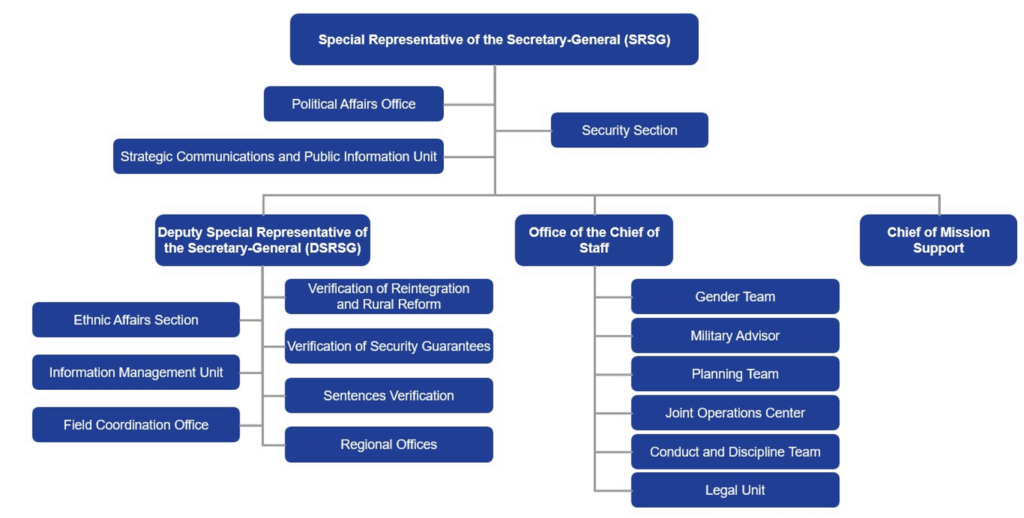
Protection efforts are also supported by the work of various units across the mission, such as the teams in charge of verifying security guarantees, monitoring reintegration of former FARC-EP combatants, and supporting cease-fire monitoring mechanism(s) at the request of the relevant parties. Additionally, as shown in the organigram above, the mission houses a Joint Operations Center that ensures that mission leadership receive timely, verified information on emerging developments across the country, including those that impact civilian safety and security. Furthermore, the mission’s nearly 160 nonuniformed international observers, who come from police or military backgrounds, are integrated at all levels of the mission and provide essential expertise by contributing to the mission’s liaison with national security forces, participating in cease-fire monitoring, and helping the mission assess threats in unstable or contested areas.42As of May 31, 2025, the Verification Mission had 157 unarmed, nonuniformed international observers deployed on the ground. (UN Department of Peace Operations, “Contribution of Uniformed Personnel to UN by Mission and Personnel Type,” 31 May 2025, accessed September 9, 2025, https://peacekeeping.un.org/sites/default/files/06_un_missions_summary_of_military_and_police_86_may_2025.pdf.) The range of functions performed by these observers is detailed in UN Security Council, Report of the Secretary-General on the United Nations Verification Mission in Colombia, S/2017/745, paras. 36-39.
Moreover, protection considerations implicitly shape the mission’s presence and allocation of resources within the parameters of the mandate, with priority given to geographic areas where violence and conflict are most severe.43According to a senior mission leader, the mission strategically allocates greater resources and personnel to regional offices and local teams located in areas where violence is higher. (Interview by authors, Bogotá, February 17, 2025.) To be sure, the mission faces constraints in capacity and resources, which will likely continue to increase with the budget cuts requested by the Secretary-General under the UN80 initiative. But overall, the Verification Mission’s efforts to improve civilian safety and security are most significant in four areas: contributing to protection through presence, protecting through communication and dialogue, advocating for the government’s protection of civilians, and helping build civil society’s capacity to advocate for their own protection.
Contributing to Protection through Presence
Contributing to protection through presence represents one of the most consistently cited aspects of the Verification Mission’s role in preventing civilian harm. Across the mission, from the headquarters in Bogotá to regional hubs to field offices, Verification Mission personnel described how their unique operational access across Colombia—including areas with little state presence, among marginalized communities, and in territories where armed groups are active—had the incidental benefit of promoting the protection of civilians.44Verification Mission personnel, interviews by authors, Bogotá, February 17, 2025 and February 19, 2025; Cali, February 21, 2025; and Buenaventura, February 23, 2025. While such a high degree of field presence makes the mission an exception among SPMs, it nevertheless remains a necessity for the mission to implement its verification mandate.
In functional terms, the mission, the Colombian government, and civil society stakeholders all found that the Verification Mission’s strong presence in contested areas encouraged more responsible conduct by contributing to the perception among all actors that their actions were being observed.45Ibid.; and Colombian government representative, interview by authors, Bogotá, February 18, 2025; religious representative, interview by authors, Bogotá, February 18, 2025; and NGO representative, interview by authors, Buenaventura, February 24, 2025. This behavioral effect speaks to the mission’s credibility with the Colombian government, nonstate actors, and civil society alike. As expressed in many interviews and recent surveys, the Verification Mission is seen across the political spectrum as a credible, trustworthy, and valuable custodian of the peace process.46Verification Mission personnel, interview by authors, Buenaventura, February 23, 2025; and religious representative, NGO representatives, and former FARC-EP combatant, interviews by authors, Bogotá, February 18, 2025. For survey information, see UN Office of Internal Oversight Services, Evaluation of the United Nations Verification Mission in Colombia, Rakib Hossain, Trung Dang, and Daniela Hernandez Salazar (2023), 8, 9, and 23. Without this legitimacy and the widespread respect that the UN “blue vests” have earned in Colombia over many years (including prior to the peace agreement), the mission’s widespread presence would be hard to sustain, especially in areas with little to no government presence, and would provide very little incentive for armed actors to abstain from abusive or predatory activities.47Verification Mission personnel, interviews by authors, Buenaventura, February 23, 2025.
The mission’s presence, reputation, and protection effects are mutually reinforcing. The mission leverages its unique territorial access to encourage and facilitate government engagement with actors in hard-to-reach areas. The mission has made notable investments in extending and sustaining its territorial presence, as shown in the map below. It operates in more than 300 municipalities, including in areas most affected by conflict.48As of mid-2025, the Verification Mission had nine regional offices, eight subregional offices, and more than 20 local offices. (UN Verification Mission in Colombia, “Where is the Mission?,” 2025; and “2025 Mission Factsheet,” August 2025).
Mission personnel regularly travel to engage with local communities in remote and contested areas; according to a mission official in the Cali regional office, staff typically spend one week based in the office, followed by a week traveling in the field. These field missions are not simple affairs. They require robust planning and coordination with the UN Department of Safety and Security (UNDSS) and are frequently conducted in conjunction with Colombian government institutions. They necessitate travel by car, boat, or on foot, and sometimes extended stays in portable campsites. These visits are aided by the Verification Mission’s relationships with local communities, who regularly alert the mission to potential security risks, informing risk assessments and decisions surrounding the time and location of trips.49Verification Mission personnel, interviews by authors, Bogotá, February 19, 2025, and Buenaventura, February 23, 2025; and NGO representative, interview by authors, Buenaventura, February 24, 2025.
Taken together, and as described by one mission personnel, “sometimes the bad guys behave a bit better when the white cars and blue vests show up.”50Verification Mission personnel, interview by authors, Bogotá, February 17, 2025. Predicated on its well-regarded status across stakeholder communities, the mission’s presence can have a dissuasive effect on armed actors.51Ibid.; and International Peace Institute, “United Nations Special Political Missions and Protection: A Principled Approach for Research and Policymaking,” 15-16.
Protecting through Communication and Dialogue
The Verification Mission’s presence also allows it to serve as a bridge between communities and public authorities. Mission personnel reported that civilians may not know how to access or engage with government officials at local levels, may mistrust the capacity of officials to act, or may avoid contact for fear of retaliation by armed groups.52Verification Mission personnel, interviews by authors, Buenaventura, February 23, 2025. The Verification Mission regularly seeks engagement with at-risk communities, and as a result social leaders, human rights defenders, and civil society organizations understand that they can reach out to the mission when they perceive a potential threat to the safety and well-being of their communities. According to mission personnel, civilians most often contact the mission by phone, text message, or in-person visits to the mission’s offices. Once the issue in question is verified, civilians rely on the mission to raise security and humanitarian concerns with state authorities and, when appropriate, the UN Security Council and wider diplomatic community in Bogotá. Going through the mission also protects the identities of those who speak out, lowering the risks to their personal safety53Mission personnel described effective channels of communication between the Verification Mission’s local and regional offices. If a situation cannot be resolved locally, the information is escalated internally and usually resolved with government authorities at the regional level. (Verification Mission personnel, interviews by authors, Bogotá, February 17, 2025; Cali, February 22, 2025; and Buenaventura, February 23, 2025.) while enabling them to benefit from a reliable referral pathway.54The mission’s role in helping connect victims or survivors of conflict to the appropriate Colombian authorities to ensure their access to safe assistance was most recently recognized in its 2024 mandate renewal. (See UN Security Council, Resolution 2574 (2021).)
Government officials similarly reported that they rely on the mission for conflict analysis and information on emerging developments in conflict-prone areas, particularly where there is insufficient state presence.55Colombian government representatives, interviews by authors, Bogotá, February 18, 2025, and February 20, 2025. However, fragmented government approaches (both at the national level and between the local, regional, and national levels) can create delays in enacting an efficient and effective response, including when Verification Mission officials signal an urgent threat to civilians. For instance, ahead of the surge in violence between the ELN and FARC-EP dissidents in Colombia’s northeastern Catatumbo region in early 2025, and in follow-up to the Office of the Ombudsperson’s early warnings, the Verification Mission shared information with high-level government officials that indicated conflict in the region was imminent and urged the government to deploy military forces and protect civilians. While the government was coordinating its response, the mission carried out crucial initiatives to help civilians within the parameters of its mandate in the 24 hours before national armed forces arrived, including the evacuation of former FARC-EP combatants and social leaders by helicopter.56Verification Mission personnel, interview by authors, Bogotá, February 17, 2025.
The Verification Mission’s recent role in facilitating a cease-fire monitoring mechanism (the government’s bilateral cease-fire with the ELN, August 2023-August 2024) and contributing to another (the government’s bilateral cease-fire with the Estado Mayor de los Bloques y Frentes, or EMBF, October 2023-April 2025) through its good offices function also helped to prevent confrontations between the state and the respective armed groups, as well as to reduce attacks on critical infrastructure.57The Verification Mission’s role in monitoring the 2023-2024 cease-fire between the Colombian state and the ELN was integrated into the mission’s mandate in August 2023. However, the mission’s activities in support of the state’s 2023-2025 cease-fire with the EMBF remained outside of the mission’s formal mandate, with the mission relying on its good offices function. Mission support to the cease-fire with the EMBF was conducted at the direct request of national authorities, with the mission’s engagement helping to build confidence between the parties. The EMBF cease-fire monitoring mechanism helped to prevent “armed contact” between the parties 63 times between July 2024 and February 2025, with at least five people taken hostage by EMBF also released. (UN Security Council, Report of the Secretary-General on the UN Verification Mission in Colombia, S/2025/188, 27 March 2025, para. 41.) The monitoring mechanisms allowed the parties to be in constant communication: flagging potential violations, coordinating efforts to verify violations, and problem-solving and de-escalating tensions. The aim of preventing civilian harm remained central to the mission’s cease-fire monitoring work, with the mechanisms also used to share and coordinate responses to humanitarian issues.58Verification Mission personnel, interviews by authors, Bogotá, February 17, 2025; and religious representative, interview by authors, Bogotá, February 18, 2025. Furthermore, the mission supported the government in developing protection protocols for communities that remained under threat from armed groups that had agreed to temporary bilateral cease-fires; even though implemented imperfectly, these protocols provided the Colombian armed forces with the operational guidance to act in favor of protecting civilians while seeking to avoid kinetic confrontations with armed groups.59Subject matter experts, interview by authors, Bogotá, February 18, 2025.
Furthermore, the Verification Mission’s accompaniment of select “Total Peace” dialogues, an initiative advanced by the Petro government, has supported efforts to reduce violence against civilians.60As of February 2025, the Verification Mission actively accompanied three “Total Peace” talks at the national level (with the ELN, the EMBF, and Coordinadora Nacional Ejército Bolivariano, or CNEB) and three socio-legal urban dialogues with criminal groups in Buenaventura, Medellín, and Quibdó. (Verification Mission personnel, interview by authors, Bogotá, February 17, 2025.) In the words of a senior mission official, the mission’s soft facilitation efforts and advisory support enabled it to propose “certain good practices and initiatives to benefit trust and progress, but also link to the protection of civilians, which is how communities are impacted.”61Verification Mission personnel, interview by authors, Bogotá, February 17, 2025. For example, in national-level talks, the mission raised awareness of the prohibition of the recruitment and use of children under 18,62International conventions prohibit the recruitment and use of children in armed conflict. and, in coordination with the Catholic Church, helped facilitate safe methods for conflict-impacted communities to raise their demands with the parties.63Verification Mission personnel, interview by authors, Bogotá, February 17, 2025; and religious representative, interview by authors, Bogotá, February 18, 2025.
At regional and local levels, the Verification Mission encourages the protection of civilians by accompanying communities seeking to engage in dialogue with armed groups on humanitarian issues. In the Valle del Cauca department, for instance, the mission has assisted Indigenous communities in communicating with armed groups about minimum humanitarian conditions needed for their safety and health. These conditions include preventing the use of Indigenous communities as human shields, avoiding the use of land mines on their territory, and halting the recruitment of children and the forced confinement of communities.64Verification Mission personnel, interview by authors, Cali, February 22, 2025; and conflict-affected persons, interviews by authors, Buenaventura, February 25, 2021. In the Bajo Calima and San Juan areas in the region, Indigenous communities have also raised the idea of humanitarian safety zones as a possible way to reduce risk to civilians, with the mission accompanying discussion of this topic with the government and other actors.65Verification Mission personnel, interview by authors, Cali, February 22, 2025. Humanitarian safety zones, however, come with inherent risks that would require careful management.66For discussion of the risks of safe zones, see Norwegian Refugee Council, “Explainer: Safe Zones” (2024), accessed September 9, 2025, https://www.nrc.no/globalassets/pdf/reports/protection-of-civilians-and-access/nrc-safe-zones-explainer.pdf.
Case Study of Buenaventura: Dialogue Accompaniment with Local Criminal Groups
In the contested port city of Buenaventura on the Pacific Coast, the Verification Mission accompanied the creation of a socio-legal urban dialogue process in late 2022 between the government and the two criminal gangs that exert de facto control over the city (the Shottas and the Espartanos). The mission’s role as an impartial observer on behalf of the international community, alongside the Catholic Church and the Organization of American States (OAS), granted the gangs the confidence they needed to come to the table, despite distrust of the government.67Verification Mission personnel, interview by authors, Cali, February 22, 2025; and religious representative, interview by authors, Buenaventura, February 24, 2025. In the words of one civil society member, “When the gangs see the UN is there, they know that it is a serious process.”68Religious representative, interview by authors, Buenaventura, February 24, 2025.
Buenaventura’s socio-legal dialogue focused on a progressive process of community violence reduction, with the ultimate goal of dismantling these criminal gangs through still undefined collective judicial plea-bargaining and restorative justice practices. Over the first three years of this dialogue, homicides dropped in what has historically been the most violent city in the country. While the city used to average 850 killings per year, 2024 ended with 21 homicides, the lowest level of violence the city had experienced in years, thanks to a bilateral cease-fire enacted by the two gangs.69Verification Mission personnel, interview by authors, Cali, February 22, 2025. Outside of observing the dialogue process, the Verification Mission contributed through its use of good offices, including engaging with the gangs on halting the recruitment of children, seeking a humanitarian solution when a child was abducted from one gang by another, and visiting gang representatives in jail who formed part of their group’s delegation to the socio-legal dialogue.70As it is illegal in Colombia to engage with criminal organizations, the Verification Mission’s ability to use its good offices to interact with criminal entities for humanitarian purposes is enabled by the privileges and immunities granted to UN personnel. This gives the mission a unique role in the process that is distinct from the Catholic Church and the OAS. To protect national mission staff, only international personnel from the Verification Mission engage in such good offices. (Verification Mission personnel, interview by authors, Cali, February 22, 2025.) According to an individual with knowledge of the process, “Once the UN is there, the criminals are more receptive.”71Religious representative, interview by authors, Buenaventura, February 24, 2025.
Through 2024, violence trends were on a downward trajectory, as reflected in the graph below. The gangs agreed to stop homicides, reduce extortion of poor citizens, and halt recruitment of children (which agreements the gangs partially implemented). Efforts to demobilize hundreds of children affiliated with the gangs, however, were stymied by the government’s lack of local capacity to rehabilitate and reintegrate them into society.72Verification Mission personnel, interview by authors, Cali, February 22, 2025.
In February 2025, the Shottas and Espartanos opted not to renew their bilateral cease-fire, as the Colombian government had issued an arrest warrant for the lead spokesperson for the Espartanos and had failed to create a legal framework for collective plea-bargaining and transitional justice for the dismantling of the gangs. In early April 2025, the two gangs voluntarily restored the bilateral cease-fire after a re-escalation of hostilities and urban violence.73Ibid.; and UN Security Council, Report of the Secretary-General to the Security Council on the United Nations Mission in Colombia, S/2025/419, para. 12. However, Buenaventura’s socio-legal dialogue process remains suspended,74Buenaventura’s socio-legal dialogue between the government and the two criminal gangs has remained suspended since March 2025. UN Security Council, Report of the Secretary-General to the Security Council on the United Nations Mission in Colombia, S/2025/419, para. 12. with little that the Verification Mission can do without government agreement on a framework for demobilizing local criminal groups.
Advocating for Physical Protection
Despite being an unarmed UN mission with no explicit protection mandate, the Verification Mission has undertaken activities to advocate, encourage, and, on exceptional occasions, contribute to the physical protection of civilians. These measures are varied and largely reflect activities envisaged in the mandate, enabled by the Verification Mission’s proactive approach.
Core to the mission’s mandate is its attention to territorial areas for training and reintegration (TATRs), dedicated demobilization camps across Colombia where former FARC-EP combatants and their families can receive government-administered protection, social services, assistance with productive projects, and reintegration support. The UN has been instrumental in the development of these sites; for instance, the first UN Mission in Colombia supervised the establishment of “transitory zones for normalization” where initial disarmament processes took place, and which would eventually form the core of the TATRs.75Laura Camila Barrios Sabogal, “From Cantonments to Settlements: Lessons for Reintegration of Former Combatants from the Colombian Peace Process,” International Peacekeeping 21, no. 4 (August 2024): 608, accessed August 2025, https://doi.org/10.1080/13533312.2024.2391765. In addition to promoting economic and social reintegration, these areas are intended to physically protect and prevent the recruitment of former FARC-EP combatants by outside armed actors, providing the government focused geographic areas around which to concentrate protection resources.
Today, the Verification Mission continues to provide assessments of government compliance with its obligations to those living in the TATRs, reporting on the ongoing needs and challenges faced by former FARC-EP combatants and acting as a liaison between TATR communities, government institutions, and civil society.76Verification Mission personnel, interview by authors, Bogotá, February 17, 2025; and UN Security Council, Report of the Secretary-General to the Security Council on the United Nations Mission in Colombia, S/2025/419, paras. 6, 24, 28, and 35. Critically, the mission has encouraged more robust and effective support for these areas, including in terms of advising on economic and livelihood projects, ensuring the perspectives of TATR residents are communicated to the state, and facilitating counter-stigmatization processes in areas surrounding the TATRs.77Former FARC-EP combatant, interview by authors, Cali, February 21, 2025. The mission’s efforts to improve the conditions and effectiveness of the TATRs have clear protection implications, with staff noting that relatively few former FARC-EP combatants have been killed in the reintegration areas.78Verification Mission personnel, interview by authors, Bogotá, February 17, 2025; and International Crisis Group, “The Hard Road for Colombia’s Wounded Former Combatants,” Glaeldys González Calanche, 2024, https://facesofconflict.crisisgroup.org/the-hard-road-for-colombias-wounded-former-combatants/. However, security threats from encroaching armed groups have led the government, with support from the UN, to relocate at least five TATRs in recent years, with smaller groups of former FARC-EP combatants also frequently relocated.79UN Verification Mission in Colombia, “The New Reintegration Landscape, Eight Years after the Final Peace Agreement Signature,” 2025, accessed October 1, 2025, https://colombia.unmissions.org/en/new-reintegration-landscape-eight-years-after-final-peace-agreement-signature. In early 2025, 16 out 24 TATRs faced difficulties in maintaining the preventive deployment of national security forces.80UN Security Council, Report of the Secretary-General on the United Nations Verification Mission in Colombia, S/2025/188, para. 58. The majority of former FARC-EP combatants now live outside the TATRs.81UN Verification Mission in Colombia, “The New Reintegration Landscape, Eight Years after the Final Peace Agreement Signature.”
Outside of the reintegration areas, former FARC-EP combatants can face significant threats. This is especially true for former FARC-EP combatants who also belong to marginalized ethnic communities, for whom the Colombia government has not yet developed tailored reintegration programming.82UN Security Council, Report of the Secretary-General on the United Nations Verification Mission in Colombia, S/2024/968, para. 68. With the aim of improving their safety and security, the Verification Mission monitors where former FARC-EP combatants move to if they decide to leave the TATRs, providing information and strategic analysis to the government for the purpose of preventing violence and protecting former FARC-EP combatants. The mission also actively engages the Colombian government on the issues of improving access to land and housing for former FARC-EP combatants.83Verification Mission personnel, interview by authors, Bogotá, February 20, 2025.
Furthermore, the Verification Mission regularly engages with Colombia’s National Protection Unit (NPU), a dedicated division within the Ministry of Interior tasked with providing security and protection services to at-risk individuals, including many of those covered by the 2016 peace agreement. The mission routinely provides conflict monitoring and technical advice to inform the individual and collective security measures adopted by the NPU for former FARC-EP combatants covered by the peace agreement, along with social leaders and human rights defenders. Headed by the mission’s security guarantees team, these advisory activities include providing data and technical support to government risk assessments and early warning mechanisms; referring or shepherding individual cases, complaints, and information to the appropriate government authorities; advising on internal government processes for responding to threats and providing security guarantees; and developing emergency procedures for imminent security threats.84Verification Mission personnel, interviews by authors, Bogotá, February 19, 2025, and Cali, February 22, 2025; and Colombian government representative, interview by authors, Bogotá, February 20, 2025. Critically, the mission has played an important role in evaluating the government’s performance in implementing these protection measures. Where the government has failed to adopt security guarantee measures spelled out in the 2016 agreement, the Verification Mission advocates for their implementation, including through direct engagement with the government.85Verification Mission personnel, interviews by authors, Bogotá, February 17, 2025, and Cali, February 22, 2025. The Colombian government has only partially implemented the security guarantee provisions laid out in the 2016 peace agreement. (UN Security Council, Report of the Secretary-General on the UN Verification Mission in Colombia, S/2025/188, para. 22).
Beyond the Verification Mission’s advisory and support capacities, on rare occasions the mission has also used its assets to relocate those covered by its mandate to safer areas. In cases where a threat of violence against civilians was assessed to be imminent, the mission has worked with government institutions to facilitate the emergency relocation of former FARC-EP combatants, social leaders, and human rights defenders, such as by transporting individuals to government-owned safe houses for temporary protection. Additionally, the mission has on specific and seldom occasions taken on a more direct role, in coordination with government authorities, when government responses are delayed. In early 2025, for example, while violence surged in the Catatumbo region and the government coordinated its response, the mission used its own helicopters to extract dozens of at-risk individuals, including former FARC-EP combatants and social leaders.86Verification Mission personnel, interviews by authors, Bogotá, February 17, 2025 and February 20, 2025, and Cali, February 22, 2025; and Colombian government representative, interview by authors, Bogotá, February 18, 2025.
Helping Build Civil Society’s Capacity to Advocate for Protection
Across its mandated thematic priorities, the Verification Mission works to provide a platform for marginalized groups at national, regional, and local levels. In this way, the mission helps diverse parts of Colombia’s vibrant civil society understand and access the country’s centralized institutional landscape, highlighting possible entry points for connection and advocating to government authorities for the inclusion of marginalized communities (e.g., women, peasants, former FARC-EP combatants, vulnerable ethnic communities) in policy discussion and peace processes.87Verification Mission personnel, interviews by authors, Bogotá, February 17, 2025 and February 20, 2025.
Similarly, the Verification Mission helps civil society organizations and conflict-affected communities better advocate for their own needs and protection. This approach is modeled by mission leadership such as former UN Special Representative of the Secretary-General Carlos Ruiz Massieu, who met every two or three months with national women’s organizations to share information on emerging developments and to discuss women’s leadership in the implementation of the 2016 peace agreement.88Verification Mission personnel, interview by authors, Bogotá, February 17, 2025; and UN Department of Political and Peacebuilding Affairs, “From Words to Actions: The Experience of the UN Special Political Missions in Colombia on Women, Peace and Security (2016-2020),” Marcie Mersky (2020), 21, accessed January 23, 2025, https://dppa.un.org/en/lessons-learned-study-words-to-actions-experience-of-un-special-political-missions-colombia-women. At the local level, the mission replicates these engagements with representatives of women’s organizations where possible.89Verification Mission personnel, interview by authors, Bogotá, February 17, 2025.
Although budgets are often tight, several mission personnel also referenced the utility of carrying out projects that support peacebuilding or enhance the capacities of civil society.90Verification Mission personnel, interviews by authors, Cali, February 21, 2025, and Buenaventura, February 23, 2025. For example, when discussing the mission’s impact on former FARC-EP combatants in Valle del Cauca, a former combatant praised the mission’s support of destigmatization campaigns, which have reportedly contributed to the development of more tolerant views toward former combatants by law enforcement, public servants, and local communities.91Former FARC-EP combatant, interview by authors, Cali, February 21, 2025. And in the area of Buenaventura, where ethnic female human rights defenders face high levels of discrimination and violence, a 2024 Verification Mission capacity-building workshop for these human rights defenders was cited by several participants as having a profound personal and community impact. 92Conflict-affected persons, interview by authors, Buenaventura, February 25, 2025.
Assessing the Verification Mission’s Impact on Civilian Safety and Security
The Verification Mission’s impact on the protection of vulnerable civilians has been positive, albeit limited. While the Verification Mission does not have a mandate to protect civilians, its presence, mandated activities, and frequent use of good offices have served to reassure civilians in conflict-affected areas that the international community cares about their safety and security. The mission has also helped increase the confidence of marginalized populations in their own security through capacity-building, providing technical advice, advocating for their inclusion in peace processes, and raising their concerns to government authorities at all levels.
Through the ethos of “proactive verification,”93A legacy of the first UN Mission in Colombia, the Verification Mission’s internal strategy centers on “proactive verification,” going beyond passive monitoring of implementation of the 2016 peace agreement to taking note of problems (e.g., through conflict or policy analysis) and trying to facilitate solutions. For further discussion of the Verification Mission’s verification approach, see UN Department of Political and Peacebuilding Affairs, “From Words to Actions: The Experience of the UN Special Political Missions in Colombia on Women, Peace and Security (2016-2020),” 25. the Verification Mission serves as an active support in advancing implementation of the peace agreement. This proactive, problem-solving mindset pervades the organization and empowers mission personnel to think flexibly and respond creatively to emerging risks that threaten the safety of former FARC-EP combatants and other at-risk communities. Similarly, it also enables the mission to contribute to initiatives that align with the aim of reducing violence against civilians.94For instance, in addition to the mission’s accompaniment of three “Total Peace” dialogues, the Verification Mission relied on its inherent good offices function to support monitoring of the state’s temporary bilateral cease-fire with the EMBF (October 2023-April 2025) at the request of national authorities. Similarly, thanks to its good offices, the mission helped set up and continues to support the conditions for socio-legal urban dialogues in Buenaventura, Medellín, and Quibdó, although the first and latter dialogues are currently suspended. As seen in Buenaventura, these urban dialogues have great potential for being able to reduce violence against civilians by providing a space for the Colombian state and local criminal groups to engage in open dialogue.
Enabling Factors in the Verification Mission’s Environment
While the Verification Mission deserves credit for its success in Colombia, it is important to recognize the unique factors that have contributed to an especially permissive operational environment. Whereas geopolitical polarization has frequently turned the Security Council into a diplomatic sparring arena, Colombia represents a rare case of consensus among Council members.95Verification Mission personnel, interviews by authors, Bogotá, February 17, 2025; and “Security Council Visiting Mission to Colombia,” Security Council Report, February 7, 2024, accessed September 14, 2025, https://www.securitycouncilreport.org/whatsinblue/2024/02/security-council-visiting-mission-to-colombia-3.php. The mission has enjoyed uncontested renewals of its mandate to date and has seen four unanimous resolutions expanding its remit, responding directly to requests from the national authorities. The mission is thus viewed by actors in Colombia as a genuine manifestation of the international community’s support for the peace process, underwriting the widely held perception of the mission as a trustworthy interlocutor.
The mission also maintains a strong working relationship with the Colombian government, enabled by the ongoing commitment of the signatories to the 2016 peace agreement. This is evidenced by positive partnerships between the mission and a spectrum of state entities, including the Office of the President, the armed forces, and relevant ministries and agencies tasked with implementing the peace agreement.96Colombian government representatives, interviews by authors, Bogotá, February 18, 2025 and February 20, 2025, and Cali, February 21, 2025; and UN Department of Political and Peacebuilding Affairs, “UN Verification Mission in Colombia,” accessed September 14, 2025, https://dppa.un.org/en/mission/un-verification-mission-colombia. The mission also is careful to ensure that its role is not seen as infringing on the Colombian government’s sovereignty or its responsibility to protect civilians,97Verification Mission personnel, interview by authors, Bogotá, February 19, 2025. though the mission’s presence across the country supports the extension of state authority in practice. Through implementation of its mandate, the mission has positioned itself as a valuable contributor to the government’s own efforts to enable peace and security.
Beyond the government, civil society leaders and organizations interviewed for this research expressed a clear understanding of the Verification Mission’s mandate. Awareness of the mission’s role, as well as what is functionally beyond its mandate, has helped manage public expectations, focus the Verification Mission’s engagement with civil society, and build trust between the mission and marginalized communities.98NGO representatives, interviews by authors, Bogotá, February 18, 2025, and Buenaventura, February 24, 2025; Verification Mission personnel, interviews by authors, Bogotá, February 19, 2025, and Buenaventura, February 23, 2025; and conflict-affected persons, interviews by authors, Buenaventura, February 25, 2025.
Strong public awareness of the Verification Mission is also a function of the UN’s wider and historic role in Colombia. The UN Country Team’s presence predates the Verification Mission and is composed of more than 20 specialized UN agencies working on issues ranging from humanitarian assistance to human rights to development.99Office of the UN Resident Coordinator representative, interview by authors, Bogotá, February 19, 2025. The Verification Mission has developed its presence in the context of these other UN entities, benefiting from the good will generated over their long tenures as well as the complementary activities in which they engage. For instance, Colombia hosts one of the largest OHCHR field offices in the world, with a presence that dates to 1997;100International Peace Institute, “United Nations Special Political Missions and Protection: A Principled Approach for Research and Policymaking,” 15. for this reason, the Verification Mission does not house a human rights section. Instead, the two entities seek to de-conflict and cooperate where possible, leveraging each other’s comparative strengths.101UN agency representative, virtual interview by authors, March 3, 2025.
Limitations Facing the Verification Mission
The environment in which the Verification Mission operates also presents inherent challenges to the mission’s ability to support the protection of civilians in Colombia. Notably, a disjointed government approach to implementing national policies and a lack of state presence or connective tissue with local authorities102Verification Mission personnel, interview by authors, Bogotá, February 17, 2025. mean that government action to protect civilians can be delayed or nonexistent—whether that arises in implementing the various aspects of the 2016 peace agreement or ensuring the deployment of security forces in at-risk areas. For instance, in the months leading up to the Catatumbo crisis, the Office of the Ombudsperson issued several early warnings that failed to catalyze the requisite proactive action from the interministerial task force.103Colombian government representative, interview by authors, Bogotá, February 20, 2025. Furthermore, while the Ministry of National Defense adopted a strategy in early 2023 that outlined the role of the armed forces in ensuring human security,104See Government of Colombia, Ministry of National Defense, “Security, Defense, and Citizen Coexistence: Guarantees for Life and Peace 2022-2026.” military action has tended to focus on confronting armed groups—a strategy that has yet to bear significant security dividends.105International Crisis Group, “Trapped in Conflict: Reforming Military Strategy to Save Lives in Colombia,” 14-16; and Elizabeth Dickinson, “How to Get Colombia’s Peace Process Back on Track,” Foreign Affairs, October 1, 2024, accessed September 9, 2025, https://www.foreignaffairs.com/colombia/how-get-colombias-peace-process-back-track. Such realities have underscored public distrust in government institutions,106Verification Mission personnel, interview by authors, Bogotá, Colombia, February 17, 2025; and religious representative, interview by authors, Buenaventura, Colombia, February 24, 2025. with several mission personnel expressing concern that popular frustration over the slow implementation of the 2016 peace agreement could rub off on the Verification Mission going forward.107Verification Mission personnel, interview by authors, Bogotá, February 20, 2025.
The Verification Mission’s limited budget, staff, and resources also require strong collaboration with the government and external funders. One illustrative example comes from Buenaventura, where rivers dominate and roads are scarce. In this area, the Verification Mission does not have a boat, necessitating each visit to at-risk communities be coordinated with the Office of the Ombudsperson for use of its vessels. Such a setup could restrict the mission’s movements, particularly if government officials were to oppose travel to a certain area, although mission personnel did not report this as a concern. Similarly, while the mission is unable to provide aid or services requested by the communities it visits, a few mission personnel reported flagging community needs and potential delivery organizations to prospective funders to promote humanitarian or development action.108Verification Mission personnel, interview by authors, Buenaventura, February 23, 2025.
The Verification Mission, in line with its mandate, maintains no armed capabilities, requiring that the mission liaise with civilian communities and state authorities, where present, to determine when it is safe for the Verification Mission’s unarmed staff to conduct field visits. Security conditions can shift quickly as a result of the positions and activities of armed groups, requiring that the mission engage in proactive planning with UNDSS, the entity responsible for issuing security determinations for field visits and ensuring the overall safety and security of UN personnel.109Ibid.
Furthermore, according to government policy, the Verification Mission is the only UN entity allowed to engage with armed groups, specifically in the context of accompanying political dialogues or for humanitarian purposes.110UN agency representative, virtual interview by authors, March 3, 2025; and UN agency representatives, interview by authors, Bogotá, February 19, 2025. This policy can impede UN agencies in carrying out their mandates in areas with armed groups, especially those that rely on humanitarian principles and must be impartial and neutral in their work. It also puts a greater onus on the mission to funnel information to relevant parts of the UN Country Team when an issue outside of the mission’s mandate arises in engaging with armed groups or affected communities. For instance, the UN Country Task Force on Monitoring and Reporting (CTFMR), which is co-chaired by UNICEF and monitors and reports on grave violations against children, remains unable to work with armed groups to develop action plans to halt violations such as the recruitment and use of children, a phenomenon of increasing concern across Colombia.111Given this gap in engagement and the mission’s travel to territories where UNICEF does not have a presence, UNICEF provided technical guidance to Verification Mission field offices in 2024 to ensure mission personnel understand the protocols of child disengagement from armed groups, as well as how the mission can support the government in preventing these grave violations. And though child protection remains outside of the Verification Mission’s mandate, the mission is an observer in the CTFMR so that it can remain apprised of relevant developments. (UN agency representatives, interviews by authors, Bogotá, February 19, 2025; and Alfie Pannell, “‘Never Touched a Gun’: Colombia Fighters Step Up Child Soldier Recruitment,” Al-Jazeera, July 9, 2025, accessed September 9, 2025, https://www.aljazeera.com/news/2025/7/9/never-touched-a-gun-colombia-fighters-step-up-child-soldier-recruitment.) Such a prohibition allegedly stems from the government’s desire to remain the lead interlocutor with armed groups.112UN agency representatives, interview by authors, Bogotá, February 19, 2025.
Coordinating with the UN Country Team on pressing issues facing civilian communities is all the more challenging as the Verification Missionis not an integrated mission. Though the Verification Mission and the UN Country Team developed an integrated strategic framework to guide cooperation, the framework has not been updated since 2018 to reflect evolving conflict dynamics or the expansion of the mission’s mandate.113UN Office of Internal Oversight Services, Evaluation of the United Nations Verification Mission in Colombia, para. 73. Collaboration thus tends to rely on independent initiatives and individual relationships between the mission and UN agencies, rather than on mainstreamed coordination structures. And while this could allow personnel to think more creatively and expansively when protection concerns arise, the ad hoc nature of these connections can create gaps, such as the reported need for a UN-only space where the mission and agencies can discuss humanitarian concerns.114UN Country Team representative, interview by authors, Bogotá, February 19, 2025. In the long term, both the Verification Mission and the UN Country Team could optimize their impact through a strategically coordinated approach.
Conclusion
The UN Verification Mission in Colombia has helped uphold the peace between the government and the former FARC-EP over the past decade, with the Final Peace Agreement leading to significant reductions in violence across the country. Through a proactive interpretation of its mandate, the mission has tirelessly supported progress toward the full implementation of the peace agreement, although much still remains to be done. The mission has also promoted the reduction of violence against civilians by armed groups through cease-fire monitoring and dialogue accompaniment.
In these ways, the mission contributes to the protection of civilians in country, albeit with clear limitations as it does not have a protection mandate nor armed capabilities. Importantly, the mission supports a safer and more secure environment for former FARC-EP combatants and other at-risk communities through its presence, facilitation of communication between national authorities and the territories, accompaniment of dialogues with armed groups, support of civil society advocacy, and direct engagement to remove people from harm’s way when necessary and as resources allow.
The Verification Mission’s experience provides compelling examples of how SPMs in other contexts can work to promote civilian safety and security, whether it be through dialogue, advocacy, or capacity-building. Missions may be most successful in this endeavor when host authorities demonstrate the political will and capacity to fulfill their core responsibility of protecting civilians; when there is good cooperation between host authorities and the mission; and when there is a clear understanding among the government and civilian population as to the mission’s mandate and limitations. Nonetheless, as in the Verification Mission’s case, these ideal circumstances should not be taken as an excuse for inaction when they do not occur in full.
Given the imperative that all UN entities support the safety and security of civilians, as laid out in the UN Agenda for Protection, the UN Secretariat should produce guidance that delineates the potential ways that SPMs, in all their diverse forms, can actively contribute to protection efforts, as well as what may be beyond their authority and capacity to do so. This would go a long way in prompting further consideration among mission leadership about the potential scope for acting in favor of the protection of civilians. Furthermore, such guidance should address operating in nontraditional conflict environments, as in Colombia, where both armed groups and criminal organizations perpetrate widespread violence and remain embedded within local communities.
Going forward, SPMs can better understand the impact of mandated activities by applying a protection lens to their work and mapping out how mission initiatives and mechanisms may support efforts to protect civilians and their human rights. In the case of the Verification Mission, the mission could further strengthen its impact by developing internal mission guidelines on the protection of civilians. This would enable mission leadership to plan strategically for how the mission can leverage its comparative advantages and existing resources to further advance protection outcomes. While the government of Colombia continues to demonstrate that it has the intent, political will, and capacities to fulfill its responsibility of protecting civilians, the Verification Mission’s experience nonetheless shows that it can play a meaningful role in contributing to protection efforts.
Abbreviations
CTFMR—UN Country Task Force on Monitoring and Reporting
ELN—Ejército de Liberación Nacional
EMBF—Estado Mayor de los Bloques y Frentes
FARC-EP—Fuerzas Armadas Revolucionarias de Colombia-Ejército del Pueblo
NPU—National Protection Unit
OAS—Organization of American States
OHCHR—UN Office for the High Commissioner of Human Rights
SPM—Special political mission
TATRs—Territorial areas for training and reintegration
UNDSS—UN Department of Safety and Security
Acknowledgements
The authors are grateful to all who generously offered their knowledge and experience to inform this study. Special thanks to those who participated in interviews, including personnel from the UN Verification Mission in Colombia and UN agencies in country, Colombian government officials, civil society representatives, and conflict-affected persons. The authors would further like to extend thanks to Alina Entelis, Steve Hege, Lisa Sharland, Rachel Stohl, and others for their insights and comments on earlier drafts.
All views reflected in this report remain the responsibility of the authors.
This report was made possible by generous support from Global Affairs Canada.

Cover photo: A view of the streets and river in Cali, Colombia. Photo by Julie Gregory.
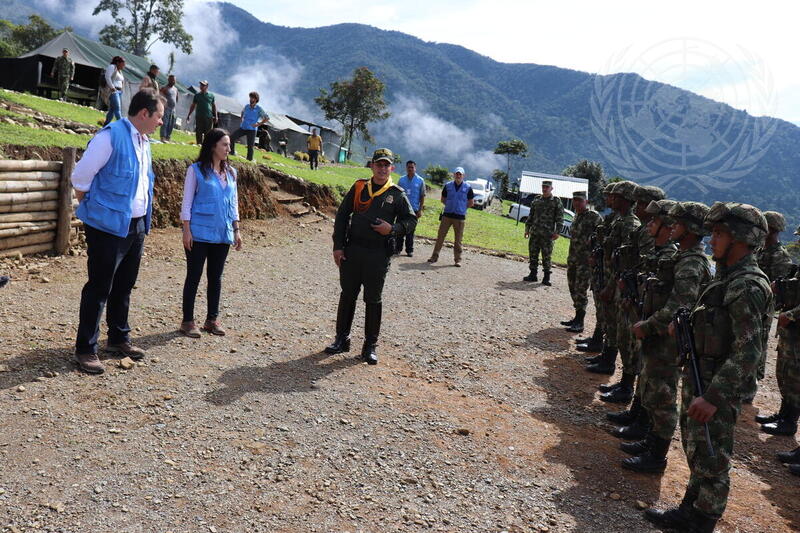






Community Adaptation for a Water Festival Without Clean Water