
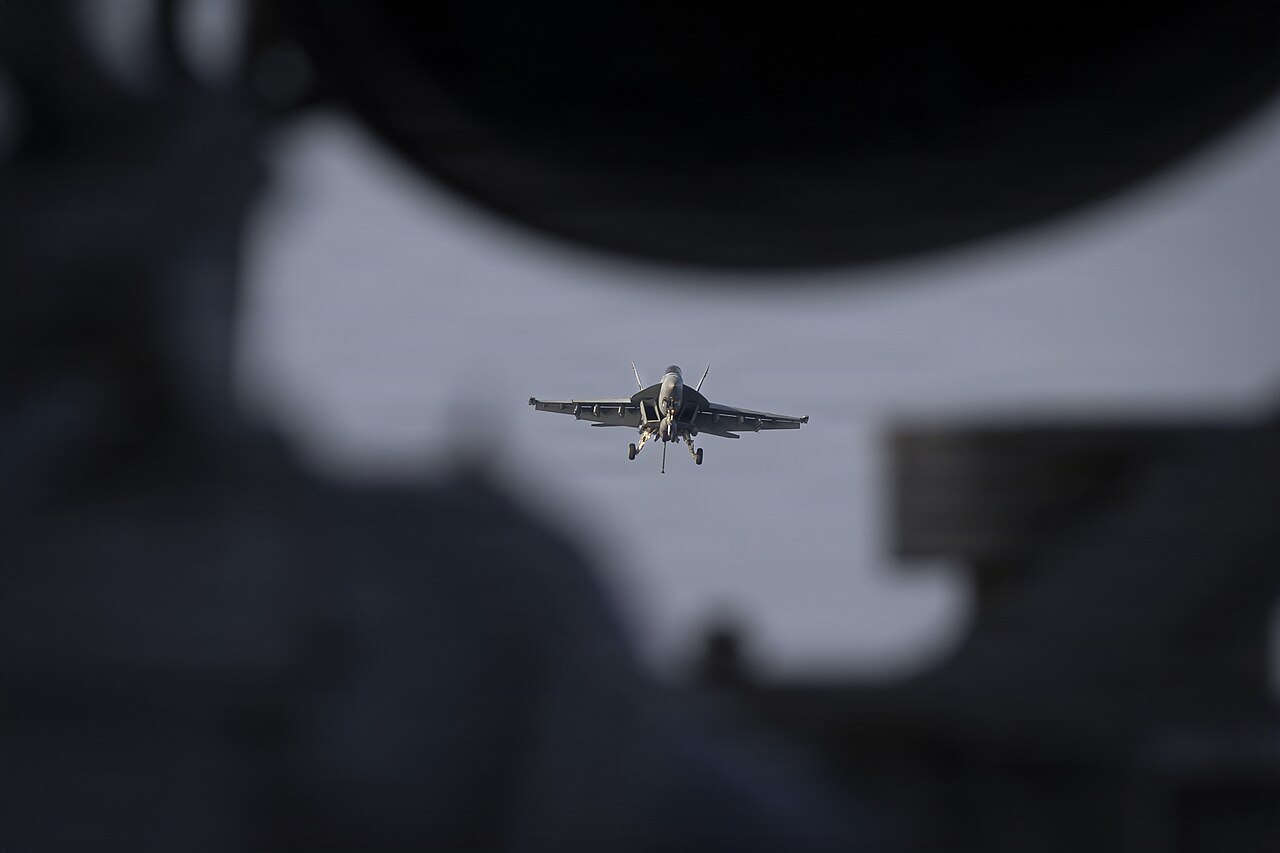

Executive Summary
Since the beginning of the Iran War in late February 2026, scholars, politicians, and the public have debated the role of allies in the war. On the surface, at least, the war could constitute a case of allied entanglement – in which a state becomes involved in a conflict that it would have otherwise avoided were it not for its alliance commitments. Critics of U.S. foreign policy often warn that U.S. alliance commitments increase the likelihood that the United States will be involved in wars. Others dispute that, claiming that a country as powerful as the United States has ample means of avoiding entanglement.
This paper tests the assumption that the Iran War is a case of alliance entanglement. It begins by reviewing the academic literature to describe how nations become entangled. It then determines whether U.S. core security interests alone motivated U.S. military action against Iran, finding that they did not. Finally, it analyzes whether allies decisively pulled the United States towards war and concludes that they did. The Iran War is a case of allied entanglement: allies, specifically Israel and Saudi Arabia, are a but-for cause of U.S. military action against Iran. The paper also finds that allies have attempted to lengthen and widen the war against U.S. interests, constituting a form of goal entanglement.
Before the war, leading strategists within the Trump administration highlighted their awareness of tradeoffs and stressed the need to prioritize. President Trump neglected these arguments in favor of his personal assessment of the merits of war. His decision was heavily affected by personal appeals from regional allies, and by recency bias, including the apparent success of the Venezuelan operation the month prior. The results so far have been disappointing. Pursuing foreign policy based on gut instincts, which can be easily influenced by individual persuasion and recent events, rather than a disciplined grand strategy risks entanglement in conflicts that are only tangentially tied to U.S. interests.
Introduction
The Iran War has brought discussions of alliance entanglement into the political mainstream. For decades beforehand, a lively scholarly debate has centered around the possibility of alliance entanglement — defined by most scholars as a situation in which a state becomes involved in a conflict it would have otherwise avoided were it not for its commitments — formal or understood — to allies or security partners.
Critics of U.S. foreign policy have argued that the United States’ extensive alliance network has embroiled it in foreign conflicts or will in the future. Defenders of U.S. primacy disagree, claiming that these commitments are easy to circumvent and pointing to an empirical record which purportedly shows the infrequency of entanglement. Notably, however, entanglement skeptics do not argue that it is impossible, only that it is rare. This paper will build on this debate, scrutinizing whether the Iran War is one of those cases.
Current opinion on this question is mixed. Some assume that the United States would not have gone to war with Iran in late February 2026 were it not for U.S. alliance commitments in the Persian Gulf and elsewhere in the Middle East region. Joe Kent, former director of the National Counterterrorism Center under President Trump, made this claim in his widely publicized resignation letter, stating explicitly that the United States was at war with Iran because of “pressure from Israel and its powerful American lobby.”1Joseph Kent, “Resignation Letter from National Counterterrorism Center Director,” The American Presidency Project, University of California, Santa Barbara, March 17, 2026, https://www.presidency.ucsb.edu/documents/resignation-letter-from-national-counterterrorism-center-director-joseph-kent. Similarly, Oman’s foreign minister, Badr Albusaidi, emphasized that “this is not America’s war” and argued that the United States had been drawn into the conflict despite key progress in negotiations with Iran in the weeks before the war.2Badr Abdusaidi, “America’s friends must help extricate it from an unlawful war.” The Economist March 18, 2026. https://www.economist.com/by-invitation/2026/03/18/americas-friends-must-help-extricate-it-from-an-unlawful-war.
Others dispute that, pointing to over 47 years of enmity between Iran and the United States. Some claim that the war serves U.S. interests, not merely or primarily those of U.S. allies. Mark Dubowitz of the Foundation for the Defense of Democracies argues that destroying Iran’s ballistic missile and nuclear programs is an “imperative” for U.S. national security.3Mark Dubowitz, “Israel Didn’t Drag the US into War with Iran — They Enabled Us to Fight It Smarter and Faster.” New York Post, March 8, 2026. https://nypost.com/2026/03/08/opinion/israel-didnt-drag-the-us-into-war-with-iran-they-enabled-us/. Others see the war as a strategic error but contend that Trump is solely to blame for that miscalculation. Daniel Kurtzer and Aaron David Miller of the Carnegie Endowment for International Peace attribute the decision to go to war to Trump’s flagrant disregard for the risks involved.4Daniel C. Kurtzer and Aaron David Miller, “The Problem With the Idea That Netanyahu Made Trump Attack Iran.” Carnegie Endowment for International Peace, March 23, 2026. https://carnegieendowment.org/emissary/2026/03/trump-netanyahu-iran-war-responsibility. Max Boot, in a Washington Post editorial, sounds a similar note, arguing that claims of Israeli control over U.S. decision making are conspiratorial.5Max Boot, “Don’t blame Trump’s stupid war on Israel.” The Washington Post, March 23, 2026. https://www.washingtonpost.com/opinions/2026/03/23/dont-blame-trumps-stupid-war-israel/.
Broader public opinion is mixed but suggests that the entanglement narrative has become politically mainstream, if not universally accepted. In polling by the Institute for Global Affairs, 24% of respondents believed that Israel is the country most responsible for the Iran War, as opposed to 30% who believed the United States is most responsible and 28% who mostly faulted Iran. Among Democrats, the figure believing Israel is primarily responsible climbs to 33%, while for Republicans, it is 13%.6Eloise Cassier, Jonathan Guyer, Lucas Robinson, Ransom Miller, “Shifting Views of Israel.” Institute for Global Affairs, May 19, 2026. https://instituteforglobalaffairs.org/2026/05/war-president-israel/.
The war remains deeply unpopular, further challenging the claim that it serves core U.S. interests.
Still, understanding whether and how a nation chooses to go to war is essential to determining whether entanglement has occurred; fighting a war alongside, or in support of, an ally is not, in and of itself, entanglement. This paper therefore proceeds in three steps: first by describing the hypothetical mechanisms which might result in alliance entanglement; second, by assessing whether other motives, unrelated to U.S. alliance commitments, were sufficient to have caused U.S. military action against Iran on their own; and finally, by discerning whether the mechanisms of entanglement were at play in the case of the Iran War. We conclude with an assessment of the broader risks of entanglement, and recommendations for avoiding them.
It is important to distinguish alliance entanglement from claims that any given state somehow controls U.S. foreign policy, supposedly allowing it to draw the United States into a war against its will. While the latter would be a form of entanglement, such cases are extraordinarily rare. States are guided by their own national interests, and not easily convinced to engage in behavior that harms these interests. But alliances can entangle states by influencing their thinking about what threats matter and how they should be addressed. Issues that would otherwise be of minimal salience can become far more important because they threaten an ally, or because an ally has sought to amplify those concerns. This process of entanglement does not require nefarious, covert control by foreign actors over U.S. policy. Indeed, foregrounding the party that ultimately chose to go to war misses the essential point of entanglement, which is about how alliances reshape states’ thinking about the wisdom of going to war, or prompts other risky behavior that increases the risk of being drawn into a conflict that does not advance a given state’s core interests. Of course, the Trump administration ultimately chose to go to war; it could have chosen not to. The relevant question is whether alliances decisively influenced that choice.
Put differently, the assumption being tested in this paper is that the United States would not have entered war with Iran were it not for the United States’ alliance commitments in the region; it is not that allies forced the United States into war with Iran. This distinction is not merely a matter of semantics. There are other plausible factors — including overconfidence after the successful abduction of Nicolas Maduro from Venezuela, anger over Iran’s murder of thousands of protesters in January 2026, a longstanding distrust of the Iranian regime, and Trump’s hostility for the Obama-brokered JCPOA — that all could have contributed to Trump ordering U.S. forces to strike Iran, factors which have nothing to do with alliance dynamics. Ignoring these alternative explanations risks painting an inaccurate picture of the war itself, and the process of entanglement more generally.
To the extent that this paper concludes that the Iran War was, in fact, a case of alliance entanglement, this does not imply that all alliances are intrinsically dangerous, or prone to involving the United States in foreign wars that it should avoid. U.S. foreign policy must be disciplined — whether the country has 50 allies or none. But alliances exist to advance the common security interests of the parties to them. They are sustained so long as those interests remain in alignment. Alliances do not create interests, however; leaders must demonstrate firmness and self-control to ensure that U.S. grand strategy remains focused on core U.S. interests. Put differently, grand strategy should establish clear priorities. And, from that foundation, U.S. officials should assess allies’ requests to become involved in potentially complex and risky military operations with appropriate scrutiny and caution.
Theories of Entanglement
Alliance entanglement or entrapment has long been a concern for international security scholars, though with different terminology. Michael Mandelbaum first described it as a fundamental risk of alliances: Each state fears that “he will be entrapped in a war he does not wish to fight.”7Michael Mandelbaum, The Nuclear Revolution: International Politics before and after Hiroshima (Cambridge University Press, 1981). Glenn Snyder popularized and formalized the concept: “Entrapment means being dragged into a conflict over an ally’s interests that one does not share, or shares only partially.” Snyder claimed that it “occurs when one values the preservation of the alliance more than the cost of fighting for the ally’s interests.”8Glenn Snyder, “The Security Dilemma in Alliance Politics,” World Politics 36, no. 4 (July 1986): 467. In these early works, the possibility of fighting a conflict on behalf of an ally was to be taken seriously as one of the chief risks of alliances, along with abandonment on the opposite extreme: measures to mitigate one risk would amplify the other.
A more recent wave of scholarship has called for narrowing the meaning of entanglement. Tongfi Kim, for example, posited that entrapment, as a term, is best used to describe a narrow subset of the broader phenomenon of entanglement, which he defined as “the process whereby a state is compelled to aid an ally in a costly and unprofitable enterprise because of the alliance.” Entrapment, according to Kim, is “a form of undesirable entanglement in which the entangling state adopts a risky or offensive policy not specified in the alliance agreement.”9Tongfi Kim, “Why Alliances Entangle But Seldom Entrap States.” Security Studies 2011 20 (3): 350–77. doi:10.1080/09636412.2011.599201. Entanglement is a necessary risk of alliances: If states never fought wars on behalf of their allies except when it served their own interests, there would be no security benefit to the alliance.
Michael Beckley expanded the entanglement debate, including by identifying the possible pathways through which alliances can entangle states.10Michael Beckley, “The Myth of Entangling Alliances: Reassessing the Security Risks of U.S. Defense Pacts.” International Security 2015; 39 (4): 7–48. doi: https://doi.org/10.1162/ISEC_a_00197. According to Beckley, states can be entangled because of reputational costs, since failing to follow through on a commitment to one ally might be seen as undermining the credibility of commitments to others; provocation, because an alliance might frighten an adversary into a military response; emboldenment, in which an alliance inspires states to engage in risky behavior that they otherwise would avoid if not protected by an ally; and, lastly, socialization, since alliances often entail routine society-to-society and military-to-military engagements, these interactions might lead states to redefine their sense of self interest as more aligned with that of an ally.
The last mechanism is worth considering at greater length. Beckley’s socialization pathway implies that a state can become entangled, even though it believes the war it is fighting serves its own interests. Put another way, alliances do not just shape the decision to go to war; they also affect how states evaluate the importance of their allies’ security concerns. Socialization also implies that, even if states retain their agency to avoid being entangled, they may come to believe that a given dispute is central to their own interests, subconsciously ignoring or minimizing the role that an alliance has played in shaping that determination. Thus, simply evaluating whether states believe their entry into a war is in their own interests, as Beckley does, risks leaving out cases of entanglement.
Two criticisms of Beckley’s approach merit further discussion before turning to the specific case of the Iran War. First, Joshua Shifrinson and David Edelstein charge Beckley with defining entanglement too narrowly.11Joshua R. Itzkowitz Shifrinson and David M. Edelstein, “It’s a trap! Security commitments and the risks of entrapment.” In US Grand Strategy in the 21st Century: The Case for Restraint, edited by A. Trevor Thrall and Benjamin H. Friedman, 19-39. (Routledge, 2018). They posit that entanglement is not just about whether a state chooses to fight a war or not; those situations are bound to be rare, because most states are intrinsically reticent to wage wars. Rather, Shifrinson and Edelstein explain, entanglement can also involve timing (i.e. when the state fights the war), the objectives the state seeks to achieve by joining it, and the forces the state commits to waging it. Even if a state isn’t entangled, per se, into a conflict, it can be compelled to fight at an inopportune time (e.g. by an ally that initiates an attack), to pursue goals that it would not otherwise, or to commit more forces than are justified by its core security interests. In other words, to only evaluate instances in which a state’s leaders explicitly say they are going to war not to advance their own country’s interests, but rather on account of an entangling ally — which is sure to be very uncommon indeed if those same officials expect to rally support from their own constituents or subjects — is to miss a complete picture of how alliances can lead states into more belligerent postures or behavior.
Second, several scholars have argued that Beckley’s finding that entanglement is rare is at least partly due to the structure of the international system throughout most of the years in his dataset. Beckley considers the cases of entanglement from 1948 to 2010, a period that was mostly spent under bipolarity between the United States and the USSR. However, Edelstein and Shifrinson, as well as Jennifer Lind, claim that bipolar systems are unlikely to produce entanglement.12Jennifer Lind, “Article Review 52 on “The Myth of Entangling Alliances.” International Security 39:4″. H-Diplo | ISSF Article Review 52, April 13, 2016. https://issforum.org/articlereviews/52-entangling-alliances Allies are less important to great powers under bipolarity; great powers focus more on internal balancing than external balancing, and miscalculation is less likely when there is one well-defined adversary. Unipolarity, on the other hand, presents greater risks of entanglement. The great power — especially if its power is waning relative to others in the international system — may allow itself to become entangled by an ally to forestall the rise of other powers. Shifrinson and Edelstein also point out that the dominant power in a unipolar world is highly valued for its military capabilities, increasing the incentive for allies of the hegemon to attempt to entangle it.13Shifrinson and
Edelstein, “It’s a trap! Security commitments and the risks of entrapment.”
This paper will not wade into the debate about the frequency of entanglement in the historical record. Regardless of whether entanglement is common or rare, scholars agree on its essential elements: a state fighting a war that is not otherwise in its interests, or fighting that war differently than its core interests would otherwise have warranted, because of an alliance. With that in mind, we turn to explaining why the Iran War was not fought primarily because of U.S. security interests, and therefore appears to be a case of allied entanglement.
The Iran War and US Security Interests
Core U.S. security interests were not at stake in Operation Epic Fury. The White House’s four most clearly stated objectives for the war were to “obliterate Iran’s ballistic missile arsenal and production capability, annihilate its navy, sever its support for terrorist proxies, and ensure [it] never acquires a nuclear weapon.”14The White House, “President Trump’s Clear and Unchanging Objective Drive Decisive Success Against Iranian Regime,” April 1, 2026, https://www.whitehouse.gov/releases/2026/04/president-trumps-clear-and-unchanging-objectives-drive-decisive-success-against-iranian-regime/. Upon close inspection, these objectives — especially when weighed against foreseeable costs and available alternatives to war — reveal that the Iran War did not advance U.S. security or other vital interests.
In a Stimson commentary published in May 2026, Michael Cohen and Will Smith explain the failure of Operation Epic Fury along each of these parameters.15Michael Cohen and Will A. Smith, “Is the Iran War Worth It?”, Stimson Center, May 29, 2026, https://www.stimson.org/2026/is-the-iran-war-worth-it/. The least plausible justifications are harming Iran’s proxies and destroying its navy. Iran’s proxies had been severely weakened by the Israeli campaign against Hezbollah and Hamas, and, before that, the U.S. assassination of Iranian Major General Qasem Soleimani of Iran’s Islamic Revolutionary Guard Corps (IRGC) in 2020. These proxies posed no significant threat to the United States, especially as the United States drew down forces from Iraq and Syria. As Cohen and Smith point out, many of the nefarious actions attributed to Iranian proxies, including the employment of improvised explosive devices (IEDs) that killed and injured thousands of U.S. servicemembers, date back a decade or more; IEDs are practically irrelevant given the absence of active U.S. combat troops on the ground. Iran’s navy, similarly, posed no threat to Americans; and the worst thing Iran could do — close the Strait of Hormuz — is something it had never attempted before the war, but which it managed to accomplish even after its navy was effectively destroyed.
Despite the administration’s claims, Smith and Cohen conclude that the bombing campaign against Iran’s missile program did not accomplish its objectives. Iran retains about 70% of its missile stockpile and 90% of its underground missile storage facilities even after months of bombing, and their production infrastructure could be reconstituted in a matter of months. And, in any case, it’s hard to see how Iran’s missile program poses a severe threat to the United States.
This leaves nuclear weapons. U.S. intelligence assessments concluded before the war that this threat was not imminent. U.S. aerial bombardment cannot eliminate Iran’s remaining uranium stockpile, which is deep underground. But, more to the point, war was not necessary to achieve progress on the Iranian nuclear program. Several diplomats involved in the February negotiations (before the start of the war) have reported that Iran seemed willing to make substantive concessions.16Patrick Wintour and Julian Borger, “UK security adviser ‘attended’ US-Iran talks and judged deal was within reach,” The Guardian, March 17, 2026. https://www.theguardian.com/world/2026/mar/17/uk-security-adviser-attended-us-iran-talks-and-judged-deal-was-within-reach; Badr Abdusaidi, “America’s friends must help extricate it from an unlawful war,” The Economist March 18, 2026. https://www.economist.com/by-invitation/2026/03/18/americas-friends-must-help-extricate-it-from-an-unlawful-war. Tehran is less likely to do so now. If anything, the war has empowered hardline factions within Iran who are less willing to compromise and who may believe obtaining a nuclear weapon is a necessity to stop future attacks.
Moreover, there is clear evidence that the administration itself did not consider nuclear weapons to be an imminent threat. Trump repeatedly insisted that Operation Midnight Hammer had “obliterated” the Iranian nuclear program in June 2025, and the administration did not deviate from this assessment even after the start of the Iran War. In testimony before Congress, then-Director of National Intelligence Tulsi Gabbard refused to say that Iran’s nuclear program posed an imminent threat to the United States; her written remarks stated that Iran’s nuclear capabilities had been largely destroyed in Midnight Hammer.17Robert Jimison, “U.S. Intelligence Saw No Change In Iran’s Missile Capabilities Before War”, The New York Times, March 18, 2026, https://www.nytimes.com/2026/03/18/world/middleeast/tulsi-gabbard-senate-testimony-iran-war.html; Tulsi Gabbard, “Opening Statement of Director of National Intelligence Tulsi Gabbard.” Presented before the Senate Select Committee on Intelligence, Washington, DC, March 18, 2026. https://www.intelligence.senate.gov/wp-content/uploads/2026/03/os-gabbard-031826.pdf. According to Gabbard, Iran had made no efforts after those attacks to rebuild the program. She also claimed that Iran could theoretically begin to develop an ICBM before 2035, hardly a timeline that could constitute an immediate threat. And just before the war began, Press Secretary Karoline Leavitt stuck to the story that Midnight Hammer had destroyed Iran’s nuclear program.18Andrew Roth, “Trump advisers scramble to justify possible US intervention in Iran,” The Guardian, February 27, 2026. https://www.theguardian.com/us-news/2026/feb/27/trump-iran-war-evidence.
The meager security benefits of the war should also be weighed against its considerable costs, including a massive expenditure of critical missile interceptors and long-range strike weapons, which are limited in number and essential to U.S. military readiness in key strategic regions.19Chris Park, “Last Rounds? Status of Key Munitions at the Iran War Ceasefire.” Center for Strategic and International Studies, April 21, 2026. https://www.csis.org/analysis/last-rounds-status-key-munitions-iran-war-ceasefire; John Hudson, Tara Copp, and Dan Lamothe, “U.S. Bears Brunt of Israel’s Missile Defense, Pentagon Assessments Show.” The Washington Post, May 21, 2026. https://www.washingtonpost.com/national-security/2026/05/21/us-bears-brunt-israels-missile-defense-pentagon-assessments-show/. Indeed, even if, for the sake of argument, the United States did have a compelling security interest in the weakening of the Iranian regime, that interest must be weighed against the costs to U.S. security elsewhere. And the Trump administration understands the importance of such tradeoffs: Just a year ago in 2025, the Pentagon was reluctant to send interceptor systems to Ukraine out of concerns that the dwindling inventory of such missiles was making the United States vulnerable in the eventuality of a confrontation with China. Clearly, the administration is aware of the opportunity costs of allocating expensive weaponry to low-priority regions.
Nothing in the Middle East’s security situation changed that could upend this strategic calculus; indeed, in January 2026, the National Defense Strategy confirmed American priorities of “securing the homeland” and deterring China through strength in the Western Pacific, urged U.S. policymakers to prioritize key regions (the Western Hemisphere and Indo-Pacific), and emphasized burden shifting to allies in Europe and the Middle East. And yet, the administration initiated an Iran War all the same.
These facts are not dispositive, alone, of entanglement. But they do prove that it is impossible to explain Operation Epic Fury merely by reference to U.S. security interests. This fulfills the second condition of Snyder’s definition: “being dragged into a conflict over an ally’s interests that one does not share, or shares only partially.” We now turn to the first condition and consider whether alliances pushed the United States towards war in Iran.
Did US regional alliances tip the scales towards war with Iran?
Unfortunately for security scholars, detecting entanglement requires more than U.S. Supreme Court Justice Potter Stewart’s famous test for obscenity: “I know it when I see it.” And the task in the case of the Iran War is made no easier by the endless confusion surrounding the Trump administration’s stated objectives and shifting rationales for waging it.20Cohen and Smith, “Is the Iran War Worth It?” Regardless, public reporting and administration statements do provide strong evidence for entanglement, largely through socialization; that is, allies used their frequent interactions with the United States to persuade U.S. decision-makers that a war against Iran served American security interests. There is also evidence that the United States was entangled by the possibility of a unilateral Israeli strike, which almost certainly would have drawn the United States into the conflict, even if the Trump administration was determined to stay out of it.
According to several credible reports, the planning for Operation Epic Fury started when Israel sought American backing for a strike on Iranian leadership and against its nuclear and ballistic missile sites.21Jonathan Swan and Maggie Haberman, “How Trump Took the U.S. to War with Iran.” New York Times, April 7, 2026. https://www.nytimes.com/2026/04/07/us/politics/trump-iran-war.html; Erin Banco, Gram Slattery and Maayan Lubell, “Trump Approved Iran Operation After Netanyahu Argued for Joint Killing of Khamenei, Sources Say.” Reuters, March 23, 2026. https://www.reuters.com/world/middle-east/trump-approved-iran-operation-after-netanyahu-argued-joint-killing-khamenei-2026-03-23/. Israel was not the only ally seeking to persuade the United States of the wisdom of launching a war against Iran: Reporting indicates that Mohammed Bin Salman (MBS), Saudi Arabia’s Crown Prince, also personally lobbied Trump to strike Iran in several February phone calls, even while publicly expressing support for peace.22Michael Birnbaum, John Hudson, Karen DeYoung, Natalie Allison, Souad Mekhennet; “Push from Saudis, Israel helped move Trump to strike Iran”, The Washington Post, February 28, 2026. https://www.washingtonpost.com/politics/2026/02/28/trump-iran-decision-saudi-arabia-israel/. If these states were not U.S. allies, it is implausible to think that their leaders would be given so much latitude to make their case to U.S. policymakers, or that U.S. policymakers would seriously consider these appeals.
It is not true that Iran posed no threat to U.S. interests. For the most part, however, past U.S. presidents had concluded that the danger did not warrant direct strikes on Iranian leadership targets, nor were they serious enough to risk starting a wider war.23Operation Epic Fury was far from the first time that Israel had sought American backing for an attack on Iran. There is evidence that Israel wanted to strike Iran during the Biden, Obama, and Bush administrations, and lobbied each leader accordingly, but held off due to a lack of American support each time. See Nahal Toosi and Jonathan Lemire, “Biden Tells Netanyahu U.S. Won’t Join Counter-Strike on Iran.” Politico, April 14, 2024. https://www.politico.com/news/2024/04/14/biden-netanyahu-u-s-wont-join-counter-strike-iran-00152130; Dennis Ross, “How America Can Slow Israel’s March to War.” The Washington Institute for Near East Policy, August 17, 2012. https://www.washingtoninstitute.org/policy-analysis/how-america-can-slow-israels-march-war;
Jonathan Steele; “Israel asked US for green light to bomb nuclear sites in Iran” The Guardian, September 25, 2008. https://www.theguardian.com/world/2008/sep/25/iran.israelandthepalestinians1. President Trump departed from this pattern briefly, in his first term with the assassination of Qasem Soleimani in January 2020, and then with the 12-day air campaign (Operation Midnight Hammer) against Iranian nuclear facilities in June 2025. In both cases, however, Trump avoided steps that risked escalation. And in the months leading up to Epic Fury, the Trump administration gave no indication that it had changed its assessment that the Iranian threat was manageable without a war.
Taken together, these are the necessary components of entanglement: a state fighting a war that it would not otherwise have fought because of one or more allies. Having sketched the basic picture, the paper will examine how allies entangled the United States.
There is considerable evidence to suggest that the United States’ involvement in the Iran War was driven by the security concerns of regional allies, and specifically, that both socialization and provocation played a role. The most detailed reporting so far describing the decision to go to war, by the New York Times’ Jonathan Swan and Maggie Haberman, concludes that Israeli Prime Minister Benjamin Netanyahu directly presented the case for war to Trump and a small group of Cabinet officials on February 11, 2026. According to Swan and Haberman, Netanyahu “made a hard sell, suggesting that Iran was ripe for regime change and expressing the belief that a joint US-Israeli mission could finally bring an end to the Islamic Republic.”24Swan and Haberman, “How Trump Took the U.S. to War With Iran.”
This followed several months of concerted lobbying, including a December meeting at Mar-a-Lago between the two leaders.25Ibid. Netanyahu was joined in this effort by Saudi leaders: Despite publicly advocating for negotiations, MBS made several phone calls to Trump in the months before Operation Epic Fury urging the U.S. to strike, and Saudi defense minister Khalid bin Salman convened a January meeting with Trump administration officials warning of the risks if the United States did not take action.26Michael Birnbaum, John Hudson, Karen DeYoung, Natalie Allison, Souad Mekhennet, “Push from Saudis, Israel helped move Trump to strike Iran,” The Washington Post, February 28, 2026. https://www.washingtonpost.com/politics/2026/02/28/trump-iran-decision-saudi-arabia-israel/. Both Israel and Saudi Arabia painted a picture of a nuclear-armed Iran shielded by a ballistic missile program that would pose an existential threat to the region if the United States did not take military action.
Both allies believed a strike against Iran would advance their own security interests. Israel has consistently sought military action against Iran, but previous attempts to organize a joint operation were turned aside by past U.S. presidents, including President Trump during his first term.27Kurtzer and Miller, “The Problem With the Idea That Netanyahu Made Trump Attack Iran.” In those earlier instances, officials in Washington concluded that U.S. interests would not be helped, and might be harmed, by a war. Despite a nominal reconciliation in 2023, Saudi Arabia and Iran have been bitter geopolitical rivals for years and have fought a brutal proxy war throughout the Middle East, most recently in Yemen.
These facts strongly imply a dynamic of socialization — specifically, that Israeli and Saudi leadership sought to persuade Trump, as well as past American presidents, that a strike against Iran would be advantageous to U.S. interests. Socialization in this case occurred through the consistent engagement between leaders and the use of these engagements by allies to persuade the United States of a shared interest (in this case, about the threat of the Iranian regime) that required military action. The familiarity with U.S. leaders, and the strength and durability of their security relationships with the United States, gave Netanyahu and MBS a unique platform from which they could increase the salience of the Iranian threat to U.S. policymakers and make the case that war served U.S. national interests.
Two further facts point to the importance of this concerted campaign in Trump’s decision to launch Operation Epic Fury. Firstly, the start of Operation Epic Fury was not tied to changes in Iran’s behavior or capabilities. Rather, a meeting of U.S. and Israeli leaders was the catalyzing event. While it is true that Iranian nuclearization could be a threat to the United States, the urgency of said threat and the need for military action, as opposed to negotiation, to address it are both open questions that both Netanyahu and MBS sought to influence. Indeed, Netanyahu’s assessments of the severity of the threat have consistently been out of step with the view of international monitoring groups and U.S. intelligence for decades. He has been warning U.S. policymakers about Iran’s nuclear ambitions in some form or another since 1995.28“Imminent Iran Nuclear Threat? A Timeline of Warnings Since 1979.” The Christian Science Monitor, November 8, 2011. https://www.csmonitor.com/World/Middle-East/2011/1108/Imminent-Iran-nuclear-threat-A-timeline-of-warnings-since-1979/US-joins-the-warnings-1992-97. While Trump bears the ultimate responsibility for having been persuaded by these appeals, it is implausible to suggest that they had no effect given that Trump’s renewed focus on Iranian nuclearization did not track any actual increase in the Iranian nuclear threat (and, as noted before, the administration did not consider this threat to be especially high at the time the war was launched).
This is different from past Trump administration military actions against Iran. Operation Midnight Hammer in June 2025 followed extensive Israeli operations against Iranian nuclear facilities, which were themselves prompted by Iran’s decision to proceed with nuclear enrichment as well as negotiations with the United States.29On June 12, 2025, the IAEA passed a resolution declaring that Iran was no longer in compliance with its obligations under the NPT, the first such resolution since 2005. See “Atomic Watchdog Says Iran Not Complying with Nuclear Safeguards.” UN News, June 12, 2025. https://news.un.org/en/story/2025/06/1164291. Earlier, in January 2020, the U.S. strike that assassinated Qasem Soleimani followed several attacks on American embassies and bases by Iranian-backed groups in the month prior.
Second, Trump’s concern about Iranian ballistic missiles is suggestive of the importance of socialization. While the United States would certainly not look favorably upon missile exchanges in the Middle East, such acts, by themselves, would not constitute a significant threat to U.S. security. During Trump’s first term, in September 2019, drones attacked Saudi oil facilities at Abqaiq and Khurais. The attacks, which originated from Yemen, were attributed to Iran’s allies the Houthis, and ultimately to Iran itself. Notably, however, Trump chose not to launch military operations in retaliation for these strikes. He explained at the time that he wanted to avoid a war. But that was not true for Israel and Saudi Arabia who, unsurprisingly, could not look at the prospect of continued Iranian strikes with such equanimity.
Trump had a different perspective on war with Iran in early 2026. U.S. credibility and reputation may have played a role. When making the ultimate decision for war, Trump stated that the United States “had to ensure that Iran could not just shoot missiles at Israel or throughout the region.”30Swan and Haberman, “How Trump Took the U.S. to War With Iran.” Nevertheless, that a president whose political brand is a laser focus on how foreign policy should benefit the United States specifically — and who has generally denigrated the idea that the United States should be responsible for the protection of its allies — would cite another country’s security concerns in deciding to send the United States to war, and to do so mere days after extensive discussion with that country’s leader, suggests that Trump’s conception of U.S. interests was broadened by socialization. And this idea was not isolated to an Oval Office statement from Trump. The State Department’s legal justifications for Operation Epic Fury argue that “the United States is engaged in this conflict at the request of and in the collective self-defense of its Israeli ally, as well as in the exercise of the United States’ own inherent right of self-defense.”31Reed D. Rubinstein, “Operation Epic Fury and International Law.” Office of the Legal Adviser, U.S. Department of State, April 21, 2026. https://www.state.gov/releases/office-of-the-legal-adviser/2026/04/operation-epic-fury-and-international-law.
Did the threat of imminent Israeli strikes on Iran entangle the United States?
The second pathway through which entanglement may have occurred in Operation Epic Fury is through the possibility that an Israeli operation would invite Iranian retaliation that would, in turn, draw the United States into the conflict. Reports suggest that Israel had been planning an attack on Iran since December, regardless of whether the United States chose to participate.32Erin Banco, Gram Slattery and Maayan Lubell, “Trump Approved Iran Operation after Netanyahu Argued for Joint Killing of Khamenei, Sources Say.” Reuters, March 23, 2026. https://www.reuters.com/world/middle-east/trump-approved-iran-operation-after-netanyahu-argued-joint-killing-khamenei-2026-03-23/. Several administration officials and senior U.S. political leaders, most notably Secretary of State Marco Rubio and Speaker of the House Mike Johnson, claimed that an Israeli unilateral strike would have led to an Iranian response that targeted U.S. bases. Rubio and Johnson claimed, therefore, that the administration chose to join in strikes as a defensive operation.33Lisa Mascaro, “Trump Officials Say Israel’s Plans Helped Lead the US into Iran War,” Associated Press, March 2, 2026, https://apnews.com/article/congress-war-powers-trump-iran-68d78b2215cc6c021937859ce852e1f2. If true, this constitutes allied entanglement. The United States fought a war because an ally, in this case Israel, made it a target of attacks that it otherwise would not have been subjected to.
There is, however, a plausible alternative explanation for these public statements. The legal authority for presidents to wage military operations is often contested. The Constitution vests the power to declare war with the Congress. One of the ways that presidents have circumvented this constraint is by invoking the danger of an imminent threat to Americans. Presidents are understood to have the power to repel sudden attacks and are not required to await congressional authorization to do so. Iranian retaliation against U.S. bases after a unilateral Israeli attack would have constituted such an imminent threat.
To be sure, public justifications do not always faithfully represent the true motivations for any given policy. In the case of the 2003 Iraq War, for example, Deputy Secretary of Defense Paul Wolfowitz, long an advocate for regime-change in Iraq, allowed that the Bush administration “settled on one issue, weapons of mass destruction, because it was the one reason everyone could agree on.” A subsequent Senate investigation, published in 2008, concluded that Bush administration officials elevated intelligence assessments that supported the case for war, while ignoring those that did not. And, to this day, the debate over why the United States actually went to war with Iraq in March 2003 remains hotly contested.34Glenn Kessler, “The Iraq War and WMDs: An Intelligence Failure or White House Spin?” The Washington Post, March 22, 2019. https://www.washingtonpost.com/politics/2019/03/22/iraq-war-wmds-an-intelligence-failure-or-white-house-spin/.; see also Jane K. Cramer and A. Trevor Thrall, eds, Why Did the United States Invade Iraq? (Routledge, 2011); and Joseph Stieb, The Regime Change Consensus (Cambridge University Press, 2021).
In short, it is possible that some Trump administration officials cited the fear of an Israeli attack, followed by Iranian retaliation, as the reason for starting the war because that was more politically viable than the true motivations for Operation Epic Fury. Indeed, reporting now shows that the United States and Israel had been coordinating on how to carry out strikes for weeks before they actually happened; the claim that the United States was forced to join at the last minute to preempt an Iranian attack is unconvincing.
That said, focusing only on this narrow version of the entanglement story, involving an imminent threat to U.S. soldiers, risks missing the forest for the trees. Regardless of the veracity of the administration’s public justifications, it is true that a unilateral Israeli operation against Iran was in the works, and it could have forced the United States into conflict in several ways. Firstly, it almost certainly would have resulted in Iranian missile retaliation against Israel (as has occurred in the past). While the United States does not have a formal treaty that obligates it to come to Israel’s defense in the event of an attack, it is certainly plausible that their position as the United States’ preeminent regional ally, with significant political support on both sides of the aisle, could have created significant pressure for the United States to intervene on Israel’s behalf.
Secondly, as Rubio and Johnson alluded to, it is possible that Iran would have replied to an Israeli attack with strikes on U.S. bases in the region. Even if the United States was not involved in the initial strike, there are plausible reasons why Iran could choose to retaliate against U.S. bases anyway: for example, to destroy U.S. infrastructure and prevent a follow-on U.S. attack (as occurred in Operation Midnight Hammer, where the U.S. followed a unilateral Israeli operation with its own strikes).
It is impossible to say exactly which of these concerns weighed on the White House in its eventual decision to join Israel in Operation Epic Fury. The Trump administration was clearly aware that Israel was likely to hit Iran regardless of what it chose to do. That fact may well have influenced the cost-benefit calculus of a preemptive U.S. strike by making many of its downsides seem inevitable.
Other Explanations for the Iran War
What of some of the alternative explanations for the Iran War that are unrelated to allied concerns? For example, some have cited the Iranian government’s slaughter of protesters in January 2026, but that does not explain Operation Epic Fury.35See, for example, “Policy Alert: U.S. Launches Operation Epic Fury to Eliminate Iran’s Nuclear and Missile Threats,” FDD Action, February 28, 2026, https://www.fddaction.org/policy-alerts/2026/02/28/policy-alert-u-s-launches-operation-epic-fury-to-eliminate-irans-nuclear-and-missile-threats/; Kurtzer and Miller, “The Problem With the Idea That Netanyahu Made Trump Attack Iran.” For one thing, the strikes were launched a month after the Iranian regime’s brutal crackdown. If the intent was to help the protests to succeed, or at least to curtail the regime’s ability to commit widespread violence against its own people, the United States would have undertaken military operations sooner. It is true that an expansive campaign before the military buildup in the region would have been difficult, but a narrower response — for example, a limited punitive strike — would have been well within U.S. capabilities. Retribution for Iran’s human rights violations may have made the military option seem more attractive to Trump but makes very little sense in the context of Trump’s past statements and behavior. After all, the Trump administration has shown little interest in human rights abroad. And Trump himself has been quite critical of his predecessors’ willingness to risk American lives and treasure for ends that he sees as unrelated to the ultimate security and wellbeing of the American people.36Henry J. Gomez, Allan Smith, Tara Prindiville, “Trump, who campaigned against ‘endless wars’, enters Iran war with no end date’,” NBC News, March 2, 2026. https://www.nbcnews.com/politics/donald-trump/trump-campaign-endless-wars-iran-no-end-date-rcna261323. But, even before Trump, the United States has not, historically speaking, been willing to risk the lives of its own troops, and spend tens or hundreds of billions of dollars, to avenge the killing of foreign protesters.
Notwithstanding Trump’s previous opposition to so-called humanitarian interventions, Daniel Kurtzer and Aaron David Miller claim that Trump was going to go to war regardless of Netanyahu’s lobbying, and they attribute Trump’s motivations to a combination of revulsion over the crackdown on the protesters and U.S. negotiators Steve Witkoff and Jared Kushner’s assessments that talks with Iran were likely to fail.37Kurtzer and Miller, “The Problem With the Idea That Netanyahu Made Trump Attack Iran.” Kurtzer and Miller are right to assign primary responsibility for the war to Trump. But this does not exclude the possibility that his choice to do so was shaped by U.S alliances. In other words, their article only proves that the United States was not forced into war by its allies — but no serious analyst suggests that that is the case. The United States retains the upper hand, and U.S. presidents have agency. Kurtzer and Miller’s argument has also been undercut by more recent reporting, which reveals that Trump had come to the decision to join with Israel in striking Iran weeks before Witkoff and Kushner’s supposed failed negotiations. Furthermore, Witkoff and Kushner did not deem failure to be inevitable; rather, Trump’s trusted advisers had merely assessed that reaching an agreement could take some time.38Swan and Haberman, “How Trump Took the U.S. to War With Iran.”
More generally, any argument that the war against Iran is being fought for reasons external to their nuclear and ballistic missile programs must then reckon with what the administration has sought from the war. The key sticking points in negotiations and the United States’ hardest demands have nothing to do with regime accountability for violence against protesters, with Chinese influence in the region, or with Tehran’s funding for proxy groups: From the president on down, the administration has consistently pointed to the nuclear issue. And this matches the most detailed reporting from the rooms where the decision to go to war was made, which, again, suggests the centrality of nuclear weapons and ballistic missiles. While it is true that the administration’s initial war justifications were confusing and often contradictory, resorting to elaborate theories about the motivation for Operation Epic Fury, when all the evidence now points in the same direction, is no longer credible.
Goal Entanglement During the Iran War
Let us assume, though, that the arguments above are incorrect and the United States would have pursued a military operation against the Iranian regime, on the basis that such a war furthered of its own security interests, and that it would have done so regardless of its alliances. There is strong evidence that Israel (and, to a lesser extent, Saudi Arabia) attempted, with varying degrees of success, to expand the scope and lengthen the duration of the Iran War beyond what the United States would have otherwise preferred. This effort included a broadening of initial war goals beyond what U.S. policymakers considered to be realistic interests, and repeated attempts to scuttle U.S. negotiations with Iran.
Notwithstanding Trump administration rhetoric, the scale and breadth of Operation Epic Fury certainly seemed aimed at a lofty goal of potential regime change that was neither achievable nor in the United States’ security interests. In the Situation Room meeting where Netanyahu made the case for war, U.S. officials predicted that regime change was unlikely. CIA Director John Radcliffe reportedly described the Israeli plan to obtain it as “farcical,” and Secretary of State Marco Rubio referred to it as “bullsh-t.” Even Trump agreed that regime change would not be a U.S. objective, saying that it should be “their problem.”39Ibid. American intelligence assessments consistently agreed that the most likely outcome of attempted regime change would be a further consolidation of power by hardline elements of the current government.40Mark Mazzetti, Julian Barnes, Edward Wong, and Ronen Bergman, “Israel Thought It Could Spur Rebellion Inside Iran. That Hasn’t Happened,” The New York Times, March 22, 2026, https://www.nytimes.com/2026/03/22/us/politics/iran-israel-trump-netanyahu-mossad.html.
Yet, in the end, the United States did work with Israel in a botched attempt to bring about regime change in Iran. The United States provided essential intelligence for the strike that killed Supreme Leader Ali Khamenei, as well as a number of other high-ranking Iranian security personnel.41Jason Burke, “How Israeli Sleight and US Might Led to the Assassination of Ali Khamenei.” The Guardian, March 1, 2026, https://www.theguardian.com/world/2026/mar/01/how-israeli-sleight-and-us-might-led-to-the-assassination-of-ali-khamenei. The United States and Israel also apparently collaborated on a plan to free former Iranian President Mahmoud Ahmadinejad, whom they saw as a possible leader for postwar Iran, but was under effective house arrest due to political disputes with the ruling regime in Tehran.42Mark Mazzetti, Julian E. Barnes, Farnaz Fassihi, and Ronen Bergman, “Early War Goal Was to Install Hard-Line Former President as Iran’s Leader,” The New York Times, May 19, 2026, https://www.nytimes.com/2026/05/19/us/politics/iran-israel-us-leader-ahmadinejad.html. The plan backfired when he was injured by the strikes meant to free him from captivity. Ahmadinejad subsequently backed out of any possible collaboration with the powers that had nearly killed him. Subsequent reporting has found a yearslong effort to cultivate Ahmadinejad as an intelligence asset, but this ultimately came to naught.43Mark Mazzetti, Julian E. Barnes, Farnaz Fassihi, and Ronen Bergman, “Inside Israel’s Secret Operation to Cultivate Ahmadinejad,” The New York Times, July 13, 2026, https://www.nytimes.com/2026/07/13/us/politics/israel-mahmoud-ahmadinejad-iran.html.
Ahmadinejad was not the only figure tapped for a possible successor regime. In public statements immediately following the first strikes, Trump encouraged the Iranian people to rise up and overthrow the government: “Now is the time to seize control of your destiny,” he said in a recorded message from Mar-a-Lago. “This is the moment for action.” For the most part, that did not happen. The Iranian people seemed mostly focused on avoiding the fate of their compatriots who had been struck by U.S. bombs and missiles. But, more to the point, any desire on the part of Trump or others in his administration to seek regime change, unlikely as that might have been, suggests goal entanglement.
But there were obviously limits to how far the Trump administration was prepared to go. There is evidence, for example, that Israel would have pursued even more impractical schemes to bring about regime change: In the early days of the war, Israel bombed military installations in northwestern Iran to attempt to clear the way for Iranian Kurdish militias, which Israel hoped would sweep into the country and overthrow the government.44Mazzetti, et al., “Israel Thought It Could Spur Rebellion Inside Iran.” Turkish officials warned the United States against supporting any such plan; Ankara opposes support for Kurdish militias due to its own war against the PKK, but Kurdish leaders themselves decided against the intervention. Notwithstanding those objections, it is clear that Israel attempted to broaden the conflict beyond what the United States would have preferred, a nearly textbook example of goal entanglement, as Shifrinson and Edelstein describe it.
Saudi Arabia also pushed the United States to pursue regime change in Tehran. MBS reportedly emphasized the necessity of eliminating the Iranian government in calls with Trump a month after the war started and urged him to push forward with toppling the government, including with strikes on Iranian energy infrastructure. That the United States did not ultimately pursue that drastic (and likely illegal) course of action reveals the limits of allied persuasion.45Julian E. Barnes, Tyler Pager, and Eric Schmitt, “Saudi Leader Is Said to Push Trump to Continue Iran War in Recent Calls.” The New York Times, March 24, 2026. https://www.nytimes.com/2026/03/24/us/politics/saudi-prince-iran-trump.html.
Still, the broadening of war objectives beyond merely setting back the Iranian nuclear program, or degrading other Iranian conventional capabilities, has actively undermined U.S. interests. The strategy of assassinating Iranian leaders in an attempt to bring about eventual regime change also killed off more pragmatic leaders like Ali Larijani, who pushed for a more moderate Supreme Leader and was reportedly far more open to negotiation with the United States than the hardliners who have consolidated power following Larijani’s killing on March 17th. In other words, strikes on Iranian leaders could end up having the effect of creating a more determined adversary.46Trita Parsi, “Larijani’s Killing Will Destroy Iran War Off-Ramps for Trump.” Responsible Statecraft, March 17, 2026. https://responsiblestatecraft.org/ali-larijani-iran/. Whether the assassination of Iranian leaders intentionally and actively eliminated U.S. off ramps, or simply failed to bring about regime change, it made the resolution of the Iran War on the United States’ terms less likely.
Moreover, Israel has attempted to keep the United States in the Iran War by undermining American negotiations with Iran, another aspect of goal entanglement. Shifrinson and Edelstein point out that a state may become entangled by its ally’s “refusal to end a conflict when [it] desires” because of that ally’s more expansive war objectives. This is precisely what has transpired in the Iran War. Recent reports have revealed that the United States was so concerned about Israeli attempts to assassinate Iranian negotiators who were inclined to sign a ceasefire that it warned these individuals about Israel’s plans.47John Hudson and Ellen Nakashima, “US warned Iran about Israel’s aims to assassinate leaders,” The Washington Post, July 2, 2026. https://www.washingtonpost.com/national-security/2026/07/02/us-warned-iran-about-israels-aims-assassinate-leaders/. Meanwhile, continued Israeli operations in Lebanon delayed negotiations as Tehran insisted that any peace deal would require a cessation to Israeli military activity in southern Lebanon and Beirut.48Yuliya Talmazan, Keir Simmons, Gabe Gutierrez, and Dan De Luce, “Israel and Hezbollah agree to a ceasefire after intensified fighting threatens Iran talks,” NBC News, June 26, 2026. https://www.nbcnews.com/world/iran/us-iran-talks-postponed-vance-cancels-trip-israel-strikes-lebanon-rcna350830.
In short, there are three major points that suggest that Operation Epic Fury would not have been pursued, at least not in its current form, but for U.S. alliances.
First, war with Iran does not appreciably advance essential U.S. security interests. The objectives of Operation Epic Fury are either unimportant to U.S. security, self-defeating, or insufficient to justify a war; the very minimal threat Iran poses to the United States had decreased well before the start of the conflict.
Second, even if war with Iran did serve a U.S. security interest, it contradicts the grand strategic vision of the Trump administration, which has argued that American military resources are needed elsewhere — particularly in the Western Hemisphere and the Indo-Pacific. Neither conditions on the ground in the Middle East and Persian Gulf, nor the administration’s general view of national priorities, could explain the sudden reversal represented by Operation Epic Fury. The absence of other changes in either the security situation or American grand strategy suggests that the war would not have occurred were it not for the repeated requests from Netanyahu and MBS, a campaign that culminated in the Israeli leader’s presentation in the White House Situation Room on February 11, 2026.
Third, even if the United States would have pursued a military operation against Iran, regardless of such lobbying, it would not have undertaken an operation with the goal of regime change, nor would it have experienced such difficulty in reaching an accord with Iran, without Israeli military ambitions. While the United States’ pursuit of regime change has been half-hearted or shambolic at times, the assassination of Iranian leaders, advocacy for popular uprisings, and attempts to manipulate and replace the current government, failed to install a new regime in Tehran. None of these objectives are consistent with Trump’s stated commitment to putting America First. But pursuing such maximalist goals ensured that those in Iran who survived understood the stakes, and were prepared to take extraordinary measures, including especially the closure of the Strait of Hormuz, which prolonged the war and imposed enormous costs on Americans.
Conclusion
Any assessment of whether allied entanglement has occurred in a given case is intrinsically speculative for two reasons. Firstly, determining entanglement requires the evaluation of a counterfactual, namely, whether the war would have occurred had there been no alliance. This can never be known with absolute certainty. Secondly, wars are never fought for just one cause, and the process by which states decide to go to war is opaque and often involves misrepresentations. The question to ask in assessing this paper’s central claim is simple: Would the United States have launched Operation Epic Fury if not for its security relationships, especially with Israel and Saudi Arabia? Answering this question in the affirmative does not exclude the possibility that many other factors, like the apparent success of the operation in Venezuela and Trump’s personal animosity toward Iran, were important in the decision to go to war. It merely posits that those other factors were not sufficient to produce a war were it not for the U.S. alliances in the region.
In the final accounting, the prevailing assumption that the Iran War is a case of alliance entanglement is likely true. There is more than enough evidence to suggest that the steady process of persuasion by Netanyahu and MBS (and, possibly, the prospect of being dragged into conflict by a unilateral Israeli attack) was an essential ingredient in Trump’s decision to launch Operation Epic Fury. Israeli and Saudi desires for regime change in Tehran at least partially broadened the United States’ goals in the conflict.
The assertion that U.S. alliances had no effect on the decision to go to war is strongly at odds with most of the reporting on the subject, which describe the importance of Netanyahu and MBS’s personal lobbying campaign. It also contradicts the administration’s public statements, which emphasized the need to defend Israel and to protect U.S. personnel in the event of a unilateral Israeli attack.
What’s more, the claim that allied entanglement did not occur is hard to square with the administration’s articulated grand strategy, which downplays the importance of the Middle East in American military planning. Meanwhile, showing that Trump believed war with Iran was in the United States’ interests when he launched Operation Epic Fury is not sufficient to disprove this paper’s core argument, because the process by which entanglement occurred in this case was through the United States redefining its own self-interest as a result of the alliance.
It is essential to distinguish the arguments of this paper from other claims about Israeli influence over American foreign policy. Positions along the lines of “Israel decides U.S. foreign policy” are wrong. Throughout the process leading up to war, the Trump administration retained the ability to reject Netanyahu (and MBS’s) requests — indeed, key figures within the administration advocated for Trump to do so. Many of Israel’s attempts to broaden the scope of the operation were rejected by the United States. And, eventually, Trump sought to terminate the war, a decision that many in Israel, including his past supporters, find frustrating, a betrayal, and a “colossal mistake.”49Isaac Chotiner, “The Israeli Ultra-Hawks Who Feel Betrayed by Trump’s Iran Deal.” The New Yorker, June 17, 2026. https://www.newyorker.com/news/q-and-a/the-israeli-ultra-hawks-who-feel-betrayed-by-trumps-iran-deal. Ignoring these facts and insisting on a narrative of Israeli control risks veering into dangerous antisemitic tropes.
Along those lines, while the Iran War was a case of entanglement, it does not imply that all alliances are dangerous, but rather that the United States must be careful in assessing allies’ requests for assistance. Specifically, U.S. policymakers must scrutinize whether an ally’s interest in a given course of action is an interest shared by the United States, and, if so, whether that interest is more important than others that would be undermined by taking that action. The United States’ alliance structure should not turn into an imperial court where allies come in to plead their case in the hope of assistance, nor should alliances create interests where they previously did not exist. It is rational for smaller allies to attempt to raise the salience of their security concerns to the United States, but U.S. policymakers must be careful about how they evaluate these claims.
The Iran War also has implications for the academic literature on entanglement more broadly. It suggests that attempting to evaluate entanglement by looking for instances in which leaders explicitly state that a war has been launched on another country’s behalf risks leaving out cases of entanglement by socialization. It should not be surprising that great powers are rarely forced into war, but this does not mean that they do not fight more wars because of their alliances. Even if Beckley is correct that great powers have considerable leverage to avoid being pulled into conflicts, they will not use that leverage if they come to believe the conflict is in their own interests — which is what socialization does. This is reflected in the Iran War. Considering how alliances reshape great powers’ conception of their own interests might be more challenging than just evaluating their formal commitments, but it is necessary to capture the full scope of how a nation’s alliance network affects its propensity to go to war.
Above all, Operation Epic Fury is a demonstration of the risks of foreign policy that fails to follow a grand strategy. One can object to the grand strategy of the Trump administration on many grounds, but it showed both internal consistency and an awareness of tradeoffs and the need to prioritize. At a crucial juncture, President Trump neglected its arguments in favor of his personal assessment, and it should not then be surprising that individual persuasion and recent events had such outsized bearing on his decision. Grand strategy is like a roughly sketched map of untraveled land. It does not offer detailed instructions at every turn, and occasionally, the destination can be undesirable — states have adopted counterproductive grand strategies before, and sometimes even wise policies, in isolation, are incompatible with a given grand strategy.50On this see, especially, Joshua Rovner, Strategy and Grand Strategy (Routledge, 2025). But policy aligned with, and informed by, a nation’s grand strategy is far preferable to the alternative of zigzagging erratically based on gut instincts. Even if you might, at times, go in the right direction, you are just as likely to be led astray. That is what happened in the case of the Iran War of 2026.








Community Adaptation for a Water Festival Without Clean Water