
Editor’s Note: This Policy Brief was produced with the support of Global Negotiation Support Fellows Aparna Trichur and Kelvin Muli (https://www.global-negotiation.org/gns). The author is also grateful to the Article 109 Coalition Secretariat for their availability in sharing views and resources. The responsibility of the content lies solely with the author.
By Richard Ponzio, Senior Fellow and Director, Global Governance, Justice & Security Program
Abstract
At a critical juncture for the United Nations and multilateralism, this policy brief suggests concrete ways to overcome challenges on the path toward an Article 109 Conference to review the UN Charter. It argues that three main traps can be avoided: i) the “doomed narrative” trap with geopolitics and conflicts invoked to justify that it has become challenging or impossible to forge common ground; ii) the “past failure” trap where unsuccessful attempts to convene a Conference due in 1955 to review the UN Charter are recalled to cast a negative mindset on future efforts; iii) and the “established practice” trap when justifying that diplomats cannot be expected to engage differently in multilateral processes and negotiations. The policy brief contends that early and sound investment in the potentials of negotiation and process-design provides concrete avenues to overcome these and other challenges. Both during the mobilization and formalization phases, concrete steps can showcase the ability to innovate in multilateral process(es) leading up to an Article 109 Conference, which in itself would be a success and would provide a higher chance to deliver a UN Charter review both ambitious and agreeable to all. Such focus on process would also allow moving away from a “win-lose” approach to negotiation and foster a “win-win” approach, with a third win, the win of the collective: “people and planet.”
Unleashing the Potentials of Negotiation and Process-Design
At the Summit of the Future in September 2024, heads of state and government pledged in the Pact for the Future to a “new beginning in multilateralism.” The actions in the Pact aimed to “ensure that the United Nations and other key multilateral institutions can deliver a better future for people and planet, enabling us to fulfill our existing commitments while rising to new and emerging challenges and opportunities.” They further reaffirmed their “unwavering commitment to international law, including the Charter, to address global challenges, some of which could overwhelm and threaten all of humanity.” 1United Nations. Pact for the Future, Global Digital Compact and Declaration on Future Generations. September 2024, para. 7 and 8.
Several months before the adoption of the Pact, civil society organizations met in Nairobi to create engagement and inspire action on governance reform initiatives. The Article 109 Coalition emerged from this, formally launching in 2025, with a view of delivering on the promise made when the UN Charter was finalized in 1945 at the San Francisco Conference through Article 109 (see box 1): holding a “General Conference of the Members of the United Nations for the purpose of reviewing the present Charter.” The Conference was meant to be held before the tenth annual General Assembly, namely in 1955, and has remained an unaccomplished objective ever since.
Box 1: Article 109 from the UN Charter
1. A General Conference of the Members of the United Nations for the purpose of reviewing the present Charter may be held at a date and place to be fixed by a two-thirds vote of the members of the General Assembly and by a vote of any nine members of the Security Council. Each Member of the United Nations shall have one vote in the conference.
2. Any alteration of the present Charter recommended by a two-thirds vote of the conference shall take effect when ratified in accordance with their respective constitutional processes by two-thirds of the Members of the United Nations, including all the permanent members of the Security Council.
3. If such a conference has not been held before the tenth annual session of the General Assembly following the coming into force of the present Charter, the proposal to call such a conference shall be placed on the agenda of that session of the General Assembly, and the conference shall be held if so decided by a majority vote of the members of the General Assembly and by a vote of any seven members of the Security Council.
Source: United Nations. UN Charter. 1945.
With a focus strictly on process, this policy brief does not take a position on whether a UN Charter review would contribute to a “new beginning in multilateralism” and even less on the content of such a review.2Popovski, Vesselin. Revising the United Nations Charter. Global Governance Innovation Network. April 2024. The policy brief argues that focus on process could in itself contribute to addressing a number of challenges, notably:
- being trapped in the prevailing narrative that the time of multilateralism and the United Nations is over, and replaced by “might is right” dynamics, which often feeds an erroneous idealization of the past 80 years since the San Francisco Conference;
- being locked in the past failure to convene, in line with Article 109, a General Conference in 1955 and the subsequent years when process-related issues may have contributed to the failed outcome;
- being constrained by the established practice of multilateral negotiations that often fail to deliver on the spirit and letter of multilateralism and to adapt to the United Nations made up today of not 51 but 193 States, with a wide range of stakeholders striving to have a seat at (or close to) the table.
The policy brief offers recommendations developed to leverage proven negotiation tools and techniques, and test new approaches to multilateral negotiations, both in the phase of mobilization to garner support for an Article 109 Conference and the subsequent more formal steps toward the convening of such a Conference. Success in the implementation of Article 109 of the UN Charter could already manifest itself with a process-design allowing to bring (back) to the table the spirit of multilateralism: as recalled on a UN website, multilateralism “implies that actors have a shared realization that it is in their interests to work together to resolve problems that are bigger than their individual efforts could tackle.”3United Nations. “Multilateral System.” Accessed February 3, 2026.
The “shared realization” may be implied; often, it ought to be fostered. Beyond the imagination of what each state or stakeholder could currently foresee, sound process-design could unleash the power of negotiation to deliver on outcomes meeting the interests and needs of all. Such a focus on process would allow movement away from a “win-lose” approach to negotiation and foster a “win-win” approach, a third win, the win of the collective “people and planet.”
Challenges Ahead: Avoiding Three Traps
Without looking into the substance of a possible Charter review, a process-design approach starts with a sound identification of the challenges likely to impact the steps toward convening of a General Conference. Such an assessment can help designing a process, or rather a set of processes, which can be supported by all states irrespective of their current position on a UN Charter review.
The “Doomed Narrative” Trap: Geopolitics Undermine Multilateralism
Geopolitics and conflicts are invoked to explain that it has become challenging, and at times impossible, to forge common ground in the United Nations, a system itself under threat, questioning the very possibility to move forward with an Article 109 UN Charter Review.
Feeding in a “doomed narrative,” much attention is currently being given to measures taken by the U.S.: financial pressure on the UN to reform; pulling out from international organizations; disengagement from negotiation processes and/or negotiated outcomes; disregard for international law; and the launch of a Board of Peace perceived by some as an alternative to the United Nations.4The White House. Fact Sheet: President Donald J. Trump Withdraws the United States from International Organizations that Are Contrary to the Interests of the United States. January 7, 2026; The White House. “President Trump Ratifies Board of Peace in Historic Ceremony, Opening Path to Hope and Dignity for Gazans.” January 22, 2026.
Yet, such a focus on one state seems to dismiss other signals much more supportive of the United Nations and multilateralism — notably, China’s promotion of a win-win cooperation and its “Global Governance Initiative,”5Xinhua. “Full Text of Xi Jinping’s Speech at the ‘Shanghai Cooperation Organization Plus’ Meeting.” September 1, 2025. as well as the potential for more assertive roles for “middle powers.” For its Presidency of the UN Security Council in May 2026, China convened a high-level open debate under the theme “Upholding the Purposes and Principles of the UN Charter and Strengthening the UN-Centered International System” with the aim to “encourage all countries to revisit the original mission of the Charter, safeguard the victorious outcomes of World War II, and revitalize the UN’s central role in the international system.”6Security Council Report. “Upholding the UN Charter.” Accessed May 1, 2026.
The prevailing “doomed” narrative is also often coupled with an idealization of the genesis of the United Nations and the subsequent decades. “As World War II was about to end in 1945, nations were in ruins, and the world wanted peace,” reads the first sentence of the official webpage “History of the United Nations.”7United Nations. “History of the United Nations.” Accessed April 15, 2026. Yet, the organization was not born out of the free will of all nations, but rather of three hegemonic powers, the U.S., the USSR, and the UK, agreeing on a plan sealed as their leaders, Roosevelt, Stalin and Churchill met in Yalta in February 1945 in the midst of World War II — following on several other initiatives such as the “Declaration by United Nations” in 1942 and the Dumbarton Oaks conversations in 1944.
According to a section devoted to a “World organization” of Yalta Conference proceedings, the three leaders decided to summon a “United Nations conference on the proposed world organization” in the United States in April 1945. With all expenses covered by the U.S., the San Francisco Conference brought together a selected few invited countries while the vast majority of the world was still under colonial rule. The “enemies” from the war were not at the negotiation table.8Sharei, Mahmoud (Shahryar). Reconstructing Article 109(3) of the UN Charter: Towards Constitutionalisation of the United Nations and International Law. University of Kent. 2016, 320-21.
Portrayed as a milestone for a rules-based international order, the foundation of the United Nations came also in a climax of “might is right,” with the U.S. ratifying the UN Charter just after dropping the first nuclear bomb on Hiroshima and just before the second one on Nagasaki, with a devastating toll for civilians. While such a demonstration of power brought a final blow to Japan, shortly after nazi Germany and fascist Italy were defeated, scholars such as Mahmoud Sharei considered it a warning to the San Francisco participating States that they speedily ratify the UN Charter, which they did in a record time.9Sharei, Mahmoud (Shahryar). Reconstructing Article 109(3) of the UN Charter: Towards Constitutionalisation of the United Nations and International Law. University of Kent. 2016, 320-21.
Rather than idealizing the past, it is thus important to consider how multilateralism has historically developed. In one of his publications before he became a Special Representative of UN Secretary-General Kofi Annan, John Ruggie invited an approach to multilateralism that contrasted other international arrangements, such as bilateralism and imperialism, and distinguished different facets within it: limited versus universal; nominal versus qualitative, with the central concept of “diffuse reciprocity.”10Ruggie, John Gerard. “Multilateralism: The Anatomy of an Institution.” International Organization 46, no. 3 (Summer 1992): 571. John Ruggie recalled how President Roosevelt moved toward a collective security organization which “stripped away the Wilsonian aspiration that collective security somehow be substituted for “balance-of-power politics.” Rather, the “collective security mechanism would have a basis in the balance of power but also mute the more deleterious effects of balance-of-power politics.” The United Nations was born with “at its core, an enforcement mechanism ‘with teeth,’ but subject to great power veto.”11Ibid, 87.
The “Past Failure” Trap: Unsuccessful Attempts Determine Future Failures
Article 109 of the UN Charter, situated in Chapter 18 on amendments, was inserted at the San Francisco Conference as a compromise. Visibly to accommodate a “veto” for the UK, the U.S., and the USSR in the UN Security Council – with France being visibly co-opted to become the fourth permanent member and China making it the famous “P5” – the promise was made to all countries concerned by the veto that the UN Charter would be reviewed within 10 years.
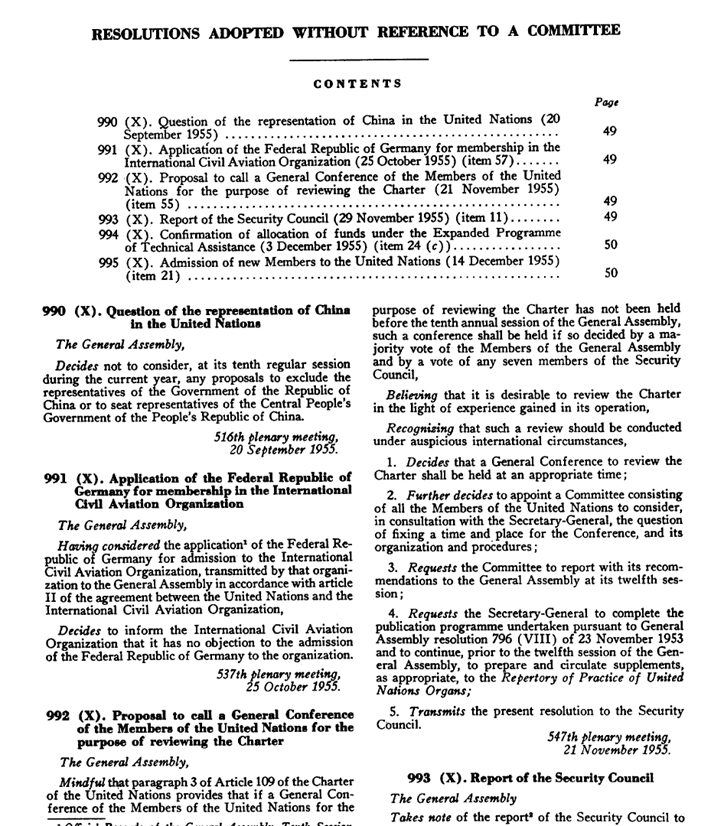
In 1955, after much preparatory discussion, the UN General Assembly (UNGA), in its Resolution 992(X),12United Nations. General Assembly. Resolution 992 (X), Proposal to Call a General Conference of the Members of the United Nations for the Purpose of Reviewing the Charter. Adopted November 21, 1955. proposed to call a General Conference, “believing it desirable to review the Charter in the light of experience gained in its operation.” Shortly after, the Security Council adopted a resolution concurring with the UNGA resolution’s wording that a conference to review the Charter be held “at an appropriate time.”13United Nations. Security Council. Resolution 110 (1955), Question of Reviewing the Charter of the United Nations. Adopted December 16, 1955. This was a diplomatic way to reflect the lack of agreement to proceed.
The UNGA resolution appointed a Committee to consider the question of “fixing a time and place” for the Conference and its organization and procedures, while agreeing that the Conference should be held under “auspicious international circumstances” (see box 2).14United Nations. Security Council. Resolution 110 (1955), Question of Reviewing the Charter of the United Nations. Adopted December 16, 1955. Following each recommendation by the Committee on Arrangements for a conference for the purpose of reviewing the Charter, the UN General Assembly voted that it was still not the appropriate time to hold the conference until the Committee stopped meeting in the late 1960s.
Box 2: UNGA resolution 992(X) of 1955 “Proposal to call a General Conference of the Members of the United Nations for the purpose of reviewing the Charter”
Source: United Nations. General Assembly. Resolution 992 (X), Proposal to Call a General Conference of the Members of the United Nations for the Purpose of Reviewing the Charter. Adopted November 21, 1955.
While a process-design needs to be informed by the past, it is important to avoid being locked in past developments or at least the way it could be seen through present lenses. From analysis of dynamics unfolding in the 1950s and 1960s, one could draw the lesson that too much emphasis on substance (the “veto” issue) and the context (Cold War) undermined the possibility to convene the conference.
Fast forward to the present day, too much emphasis on the substance and on the context could undermine progress toward a Conference. Process-design could usefully mitigate two risks. First, states may fear being locked in dynamics similar to the separate and difficult negotiations on Security Council reform. Secondly, states may anticipate that an Article 109 Conference could necessarily fall hostage to the current prevailing geopolitics framed with polarization, conflicts, and “might is right.”
The “Established Practice” Trap: Negotiators Can’t Do Differently
With notable exceptions, it is as if “process” in multilateral negotiations has become a set of mechanical steps, without integrating ex-ante basic elements of sound process-design and even less of the specific requirements for process-management. The mechanics can be summed up as follows:
- Resolution/decision triggering an intergovernmental negotiation: Usually the resolution/decision itself negotiated according to established practice in a given forum (e.g. UNGA, subsidiary bodies) sets a process in motion toward an outcome,15Outcomes vary from the negotiation of a (political) declaration for a Conference or a Summit to the elaboration of a legally binding/non-binding instrument, or the setting up of a new time-bound/open-ended process/entity – Global Dialogue; Panel; Working Group. sometimes with a timeline — not necessary for process efficiency but for other reasons such as budget allocation.
- Appointment/election of a Chair/Facilitator: Often, Chairs/Facilitators are appointed or elected after nominations by regional groups without necessarily much screening on required experience and skills; increasingly, these are shared roles between co-Chairs/co-Facilitators not for process-management efficiency but to satisfy a political/geographic balance — currently framed as “Global South” and “Global North”; sometimes a “Group of Friends” is established in support.
- Elaboration of a roadmap with key milestones: Not a requirement, but a practice not necessarily informed by process-design but merely a schedule for states — and observers — to mark in their busy calendar, often with little on exact working modalities.
- Convening consultations and negotiations: With some variations, states are invited by (co)-Chairs/(co)-Facilitators to provide written inputs, sometimes in reaction to “elements,” before being called to participate in negotiation rounds from a “Zero Draft” until agreement is ideally reached.
- When Rules of Procedures need to be discussed: The approach is often very mechanical with protracted negotiations and often deadlocks impacting the substantive negotiations e.g. on adoption modalities with the controversy “consensus” versus “voting.”
When it is not fully complemented by sound process-design and process-management, such established practice can undermine the likelihood and ambition of an agreed outcome. As one such illustration, dynamics at the opening of the Summit of the Future showed how the process was invoked to challenge the adoption of the Pact for the Future. An amendment tabled from the floor by the Russian Federation, pushed back by a “no action motion” by the African Group, which was put to a vote by the President of the General Assembly, allowing him finally to gavel on the Pact.16Bellion-Jourdan, Jérôme. “The United Nations’ Pact for the Future: From Negotiation to Action?” SWI swissinfo.ch. October 9, 2024.
Seen from a process view point, it raises questions on whether all Member States were comfortable with the way the Pact was elaborated with separate processes for its Annexes, the Global Digital Compact and the Declaration on Future Generations. In its intervention tabling the amendment, the Russian Federation expressed concern on the process: “The truth is that there were essentially no intergovernmental negotiations on the Pact. There was not a single meeting at which delegations gathered at one table and negotiated the text of the draft resolution by section and paragraph.”17United Nations. General Assembly. Strengthening of the United Nations System: Amendment to Draft Resolution A/79/L.2 “The Pact for the Future.” A/79/L.2/Add.1. 2024. The Russian Federation’s dissociation from consensus paved the way for challenges in subsequent negotiations on whether the Pact should be referred to.
More generally, across processes, states hold diverging views on working methods, though all locked in established practice: while some favor a “line-by-line” negotiation, others find it too lengthy and prefer to give leeway to the (co-)Chairs or (co-)Facilitators to consolidate each iteration of a text. Yet, in the negotiation rooms or their adjacent corridors, it has become increasingly common to dismiss these process-related concerns with Parties blaming others for using process as a delay tactic. For Chairs and Facilitators, it has become increasingly difficult to manage such dynamics when they are not blamed themselves for failing to get the process (back) on track.
Such situations often arise from a lack of full and proactive investment in negotiation process-design which subsequently impacts process-management and the ability to forge an agreement. Ignoring the concerns or diverging expectations on working methods often leads to a lack of confidence by the Parties in the process; it can fuel mistrust among Parties and in the relationship between the Parties and the Chair or Facilitator.
Recommendations: Process-Design to Unleash Article 109 Potentials
Under the section “Concerns about reviewing the UN Charter” of its website, the Article 109 Coalition suggests that “done well, an inclusive, guided and transparent process could itself reduce polarization and improve the geo-political mood.”18Article 109. “Concerns About Reviewing the UN Charter.” Accessed April 15, 2026. The “done well” is indeed an imperative for result and this policy brief attempts to set out some direction of travel on process-design.
At a minimum, the objective is to minimize the risks that travelers, Member States, and observers stumble upon in the journey to a UN Charter review, trapped in the prevailing doomed narrative, the heritage of past failure and the habit of established practice. As an ambition, sound process-design and process-management could demonstrate that innovative working methods can give a new life to the spirit and letter of multilateralism.
This policy brief is a first attempt to offer some recommendations and the Global Negotiation Support initiative stands ready to elaborate and advise on these or other options as appropriate.19Institute for Global Negotiation. “Global Negotiation Support.” Accessed April 24, 2026. Rather than precipitating the consideration of process-design and process management for the General Conference itself, the recommendations focus on the mobilization phase, and some more formal preparatory stages.
Mobilization Phase: Building Confidence in the Process
Building confidence in the process is essential from the start in the mobilization phase toward an Article 109 General Conference. Parallel and interrelated tracks could usefully be pursued to overcome perception bias, foster process-design co-creation, and bring innovative methods into the process.
Track One: Overcoming Perception Bias
Avoiding perception bias should come early, even before a formal process is launched. The mobilization phase can impact positively or negatively the subsequent phases. For instance, the Article 109 Coalition should be mindful to avoid a perceived divide between those who are “in” and others that are “out,” which would risk fueling perceptions of a polarization pro vs against the United Nations or “supporters” vs “detractors” of multilateralism. It is thus important that the Coalition clearly values diverse contributions as it does on its website: “We should not be afraid to have a conversation that surfaces different visions of the UN. That is what true multilateralism is all about.”20Article 109. “Concerns About Reviewing the UN Charter.” Accessed April 15, 2026.
From a negotiation expertise view point, sound process-design could help early on and throughout overcoming misperceptions and mitigating the risks that perceptions impact the dynamics negatively. Process-design could make space to avoid that perceptions lock in Parties in roles making it difficult for them to act or be perceived as acting differently, or fueling divides running counter to the spirit of multilateralism. It would also address perceptions entertaining a limited understanding of “power,” preventing creative ways to act on the real or perceived power asymmetry.
As corridor talks and side meetings already feed into perceptions that some Member States would support a UN Charter review, while others may be skeptical or oppose it, Member States could be engaged in formats that allow them to apply proven negotiation techniques and realize that, beyond their current positions, they can meet their interests and needs in different ways. Similarly, the fear by some Member States that the outcome of a UN Charter review could be worse than the status quo could be overcome with formats allowing all Member States to unpack and listen actively to their respective fears and expectations.
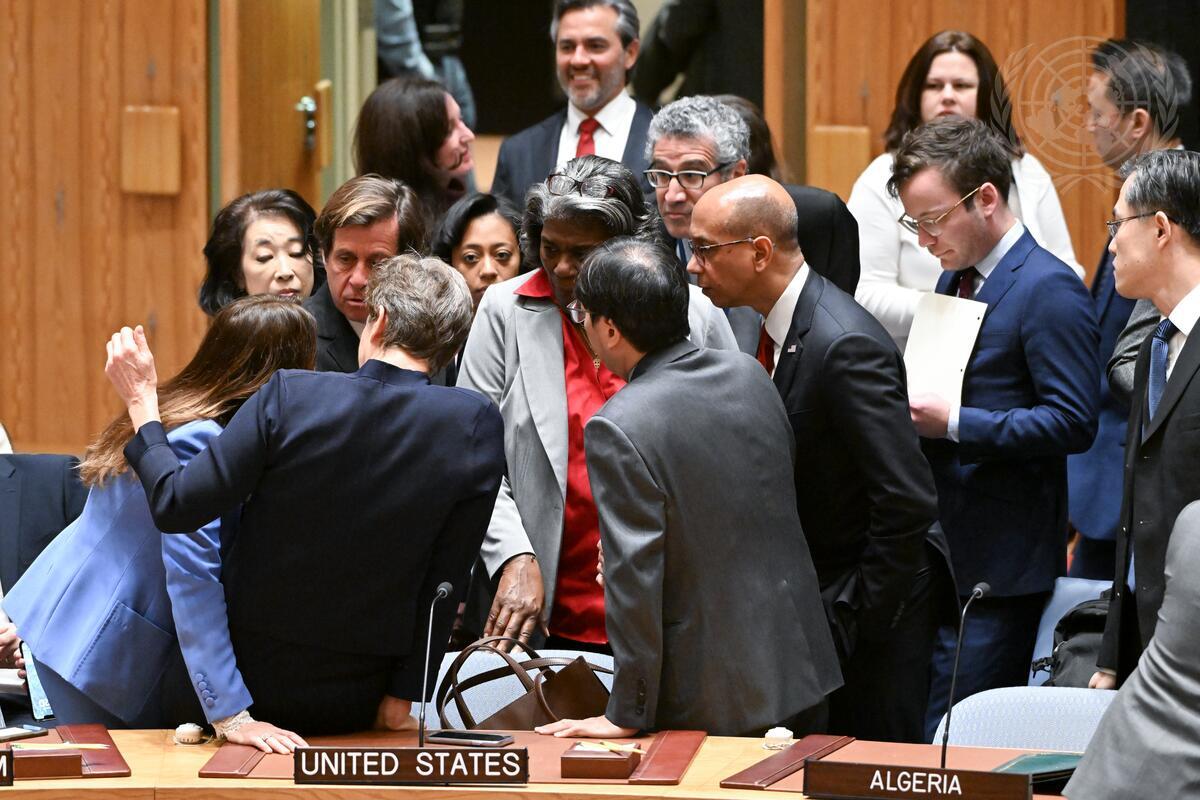
It is possible to move beyond established practice where “informal” or even “informal informal” formats of negotiation remain quite formal if only as Member States or Groups of States continue to speak behind their nameplates. As Chair, the author has tested formats whereby diplomats are invited to leave aside their nameplates and engage in a truly confidential format which allows them to better understand their respective interests and needs, and to explore and test options. Designing such formats would require a balancing act between principles often seen as conflicting, such as confidentiality versus transparency or State-driven versus inclusivity.
Track Two: Fostering Process-Design Co-Creation
For “inclusiveness” to be more than a buzz word, it may be wise to involve all UN Member States early on in a two-way communication exercise in a spirit of co-creation to trigger interest and confidence in the process:
- A formal communication to UN Member States with a number of assurances: There is no pre-defined expected outcome on the content of a UN Charter review; involving all is paramount for the universality of the UN Charter; agreement on working methods is essential for confidence in the process and trust among Parties.
- An active listening of UN Member States: With a view to collect information on the needs and expectations regarding the process itself, leaving aside any consideration on the substantive outcome – methods such as “Design thinking” developed in other fields could be adapted and tailored to such a multilateral process.21Hasso Plattner Institute of Design. An Introduction to Design Thinking: Process Guide. Stanford University. 2010.
In this period of transition for the top UN job, candidates for the role of UN Secretary-General could usefully integrate in their vision to commit to a leadership role in this two-way communication already during their campaign and/or as soon as they take office. Candidates could see it as a pillar in their proposed to bring (back) negotiation at the center of their working methods The vision and the courage to foster ambition as high as the UN Charter review would come with clear signals that the UN Secretary-General would act in an equidistant manner with and listen to all Member States irrespective of their real or perceived power base.
For process-design to be successful, it would also require genuine engagement with other stakeholders. It would foster trust to seek their views on the most appropriate process for an effective outcome, and ways to reconcile their expectation to be fully involved while respecting that confidentiality of formats may at times be necessary for Member State-driven processes to deliver.
Track Three: Bringing in Innovative Methods to the Process
Without prejudging the outcome of the two-way communication on the desired process, formats for the negotiation of a UN General Assembly resolution calling on a General Conference, and/or later preparatory stages, can make space for creativity with modalities that can be accepted by all Member States.22Interestingly, some efforts have been made in the intergovernmental negotiations on the question of equitable representation on an increase in the membership of the Security Council and other matters related to the Council in accordance with General Assembly decision 62/557 of 15 September 2008. For instance, States and groups of States have been invited to put forward various models as an outlook for a future reformed UN Security Council. Among others, the following could be considered on their own or in an integrated manner:
- Facilitating exercises of strategic foresight for a collective projection of different futures, with UN Charter review as one among other parameters: While all Member States would be involved, groups for strategic foresight could be kept relatively small and randomly selected to foster exchange beyond usual regional and other groupings; other methodologies could be applied with a similar purpose such as “Future Search” allowing for structure intervention with a focus on the future and common ground.23Weisbord, Marvin, and Sandra Janoff. “Three Perspectives on Future Search.” Future Search Network. 2010; also the related website: https://futuresearch.net/.
- Developing one or several serious games in multiple languages around UN Charter review: To avoid being bogged down in the usual discussions on the modalities for the period leading up to the Conference or for the Conference itself, participants, Member States and stakeholders alike, could be engaged in a serious game featuring the convening of the General Conference.
- Mobilizing tools to “transform conflicts”: To use the expression of top negotiator William Ury, inviting to transform conflict “from destructive fighting into creative, constructive, collaborative negotiation”24Ury, William. “3 Ways to Make Conflict Less Destructive.” New York: Harper Business. February 17, 2024, 368. rather than letting them impact negatively the negotiating rooms, whether they are conflicts among Member States or perceived conflicting worldviews.25Among others, some experiments could be mobilized such as the Institute for Global Negotiation’s “Beyond Division” project: https://www.global-negotiation.org/beyond-division. See also: Kugler, Kira G., and Peter T. Coleman. “Get Complicated: The Effects of Complexity on Conversations over Potentially Intractable Moral Conflicts.” Negotiation and Conflict Management Research 13, no. 3 (2020): 211–230.
Formalization Phase: Procedures Serving an Objective-Oriented Process
Negotiation process-design is essential for the mobilization phase and equally important in all formal steps leading up to a General Conference. Preparation should in fact be seen as an iterative exercise needed at each stage and considering all options to formalize the implementation of Article 109, which should be an integral part of the process-design to ensure the widest possible support. Conversely, it would be advisable to avoid the perception that a group of Member States are attempting to leverage procedural steps to impose an Article 109 UN Charter review process on others.
Option 1 – Reactivating the Arrangements Committee
Process-design could make space for considering whether it would be useful to reactivate the Arrangements Committee, which was tasked, when established by the UN General Assembly in 1955, with the preparations for a Conference. The process should, however, mitigate the risks that it becomes a complicating matter which would ultimately make all Member States lose sight of the overall objective: A General Conference for a UN Charter review.
While some may see it useful to seek an Advisory Opinion of the International Court of Justice (ICJ) to bring legal clarity to reactivate the Arrangements Committee, such avenue would come with many risks: delay until ICJ rules on the matter; no guarantee that the ICJ’s Advisory Opinion would be favorable to the proponents. Further, such an avenue risks legalizing a matter, i.e., convening the Conference, which is highly political.
While pros and cons of resorting to the ICJ need to be carefully weighed, there are other ways of reactivating the Arrangements Committee. During the last Committee’s meeting in September 1967, Chairman Abdul Rahman Pazhwak (Afghanistan) stated:26The word “chaiman” was routinely used in the first decades of the UN dominated by male leaders and diplomats. Currently, Chair or Chairperson are commonly used. “Every Member State was entitled to request the convening of the Committee and that such a request should be made to the Secretary-General who, on the basis of established procedure, would consult the Members and would convene the Committee if it was found desirable to do so.”27United Nations. General Assembly. Report of the Committee of Arrangements for a Conference for the Purpose of Reviewing the Charter. A/6865. October 18, 1967. In its subsequent resolutions, the UN General Assembly decided “to keep in being the Committee on arrangements for a conference for the purpose of reviewing the Charter.”28United Nations. General Assembly. Resolution 2285 (XXII), Report of the Committee on Arrangements for a Conference for the Purpose of Reviewing the Charter. Adopted December 5, 1967.
Building on the two-way communication with Member States, the incoming UN Secretary-General could be well placed to initiate the reactivation of the Arrangements Committee in case there is a broad understanding, and ideally a consensus, among Member States. Process-design for the Committee should be carefully crafted to avoid that Member States see themselves locked in a format marked by past failure and replicating established practice which they experience in most UN meeting rooms.
Option 2 – Sui Generis Process Triggered by UN General Assembly
In addition to or as alternative for the reactivation of the Arrangements Committee, the UN General Assembly would probably have to be seized through a resolution, in line with Article 109, to call for a General Conference and the modalities to prepare for and hold such a Conference. While Article 109 provides for “a two-thirds vote of the members of the General Assembly and by a vote of any nine members of the Security Council,” the abovementioned preparation stages could strive for a more ambitious threshold: Consensus both in the UN General Assembly and the UN Security Council.
The consideration of modalities for the preparation of the General Conference itself could build on the innovative formats and methods used in the exploratory stages. At that juncture, specific attention should be given to the set-up, a key element of process management. Rather than a mechanical selection process, it would be essential to ensure that the Chair and Bureau respond to the highest level of qualifications not for any multilateral process, but for a General Conference which could potentially determine the very future of the United Nations.
As per usual practice, Chairs and Bureau Members are selected among Member States, often at ambassadorial level. For the specific endeavor to lead the preparatory work and the holding of the General Conference itself, Member States may agree to entrust the UN Secretary-General and/or the President of the UN General Assembly as long as they meet the required skills and specifications, while being open to process and negotiation advice from Global Negotiation Support or others. There could also be innovation in the composition and mandate of the Bureau so that it can fully support efforts to achieve consensus at the General Conference.
Paths Forward: Turning the Impossible into Possible
On the path for an Article 109 UN Charter Review, defeatist voices are likely to be numerous, as they contribute to the doomed narrative, they invoke past failures or prefer the comfort zone of established practice. In the drafting of this policy brief, the author could already anticipate similar voices he heard when he was a diplomat: “don’t rock the boat” or “it’s not going to work.” Yet, two mottos applied as Chair or as leading negotiator can be a useful antidote: turning the impossible into possible; and the responsibility to test all options. As Nelson Mandela famously put it: “It always looks impossible until it’s done.”
Investing in process-design can make all Member States realize that they can turn the impossible task of a UN Charter review into a possible outcome. With this invitation to try all possible options, it is key to mitigate the risks that Article 109 becomes just a process which loses sight of its objective: The UN Charter review should not be an end in itself but a means toward delivering on a new vision for the United Nations.
In the corridors of New York, Geneva or other multilateral hubs, some seem to already hang on to an Article 109 process as a timely alternative to take over from the 2030 Agenda. The risk needs to be avoided that the UN Charter review becomes just another game in town to fill a vacuum or conveniently avoid critical questions on the inability to deliver on the 2030 Agenda ambition with only limited progress on the 17 SDGs.29United Nations. Secretary-General. “Secretary-General’s remarks to the General Assembly – on Priorities for 2026.” January 15, 2026.
Process-design is a way to allow navigating within the real or perceived power dynamics, and unpack the various forms of power and the evolving landscape of influential actors from states to the range of non-state actors. Process-design should also factor in a number of other parameters such as the interplay between states’ diplomacy and domestic politics, informed, among others, by what Robert D. Putnam called the “logic of two-level games.”30Putnam, Robert D. “Diplomacy and Domestic Politics: The Logic of Two-Level Games.” International Organization 42, no. 3 (Summer 1988): 427–460.
Process-design would also integrate the multiple voices amplified from the local to the global levels from worlds as diverse as the ones represented by the UN Major Groups, and other actors increasingly active in multilateral fora such as cities and mayors. Technology can be leveraged to allow for the direct participation of citizens in deliberations and negotiation processes.
Process-design is also about anticipation of the States’ BATNA, i.e., the “Best Alternative to a Negotiated Agreement” or the use of other channels for more limited UN reform. The current UN80 initiative is one such option.31United Nations. “UN80 Initiative.” Accessed March 5, 2026. Some may invoke Article 108 of the UN Charter which was used to expand the membership of the UN Security Council and of ECOSOC in light of the growing number of Member States and as it was not possible to hold a General Conference.32United Nations. General Assembly. Report of the Committee on Arrangements for a Conference for the Purpose of Reviewing the Charter. A/5487. September 4, 1963. Membership of the Security Council and the Economic and Social Council was expanded in 1963 and again in 1971.
Ultimately, process-design would come with a necessary reflection on leadership. On the path toward an Article 109 UN Charter Review and more generally, candidates for the role of Secretary-General could strive to overcome the current paradox: The UN needs a visionary and courageous leader, yet (many) Member States distrust delegating leadership for fear that it can undermine their sovereign prerogatives — framed in terms of “national interest” and often reflecting internal power struggles.
The current transition period gives an opportunity to shift away from the past (real or perceived) modus operandi. Moving forward, the next Secretary-General could contribute to re-build trust as a two-way relationship: trust by all Member States in an independent UN Secretary-General, acting in an equidistant manner with all, and trust by the UN Secretary-General in Member States, with also the necessary trust in the UN system itself. Building trust can be fostered by sound process-design for an Article 109 UN Charter Review process, and across multilateral processes and negotiations.





Community Adaptation for a Water Festival Without Clean Water