
Editor’s Note: Dr. Sandra Tombe is Executive Director of the Academic Council on the United Nations System and Assistant Professor of the Practice at Georgetown University. Her research interests focus on AI governance, migration and displacement, and transnational conflict and politics.
Naomi Kilungu is a PhD student and lecturer in conflict and peace at Daystar University. She founded AI for Peace Africa to promote ethical AI for peacebuilding and Safer Communities Alliance to reduce youth recidivism through technology. Her work focuses on peace technology, AI governance, Africa’s security architecture, and conflict economics.
By Richard Ponzio, Senior Fellow & Director, Global Governance, Justice, and Security Program
Abstract
The United Nations’ Pact for the Future and Global Digital Compact recognize artificial intelligence (AI) as a fast-evolving technology with vast implications for peace and security. Rightly, therefore, it is an important challenge and opportunity that warrants serious deliberations on its global governance. Governing AI is particularly important given the significant variation in the distribution of the risks and benefits of this consequential technology. While AI innovations emerge from all regions, Africa continues to be the recipient of greater AI risks than rewards. Accounting for 2% of data centers, Africa is particularly vulnerable to AI-related risks like technological dependencies, harmful data extraction practices, and exploitative work conditions. Given that AI’s harms and risks are experienced locally within specific contexts, this policy brief advances that while global AI governance is critical, it is not sufficient. From an African perspective, the brief highlights the value of AI global governance, particularly for knowledge exchange and transfer and for regulating lethal autonomous weapons, then examines the cost of weak institutions in Kenya and Ethiopia as case studies emblematic of continent-wide patterns. Looking at the African state independently and in the context of multilateral and regional organizations, the brief puts forward three recommendations: the integration of South-South AI cooperation in national AI strategies, the participation of the African Union in United Nations multilateral discussions on lethal weapons, and the development of national AI oversight mechanisms.
Introduction
At the launch of the Roadmap for Digital Cooperation report in 2020, United Nations (UN) Secretary-General Antonio Guterres noted that “digital technology is shaping history [while giving] the sense that it is running with us. Where will it take us?” he asked. “Will our dignity and rights be enhanced or diminished? Will our societies become more equal or less equal? Will we become more, or less, secure and safe?”1Guterres, Antonio. 2020. Secretary-General’s Roadmap for Digital Cooperation. New York, NY; United Nations. Of late, hypothetical yet serious questions surrounding a future with super intelligence and humanist super intelligence — technology that centers and serves humans rather than replacing them, followed by calls to pause AI experiments and training of powerful AI systems continue to heighten the existential dimension of this technological advancement.2Mustafa, Suleyman. December 2025. “The Mishal Husain Show: Mustafa Suleyman.” Bloomberg; Future of Life Institute. 2023. “Pause Giant AI Experiments: An Open Letter.” Accessed April 7, 2026. The far-reaching implications of AI for these questions and for war, peace, and development rightly point to the need for global governance of this increasingly consequential technology.
The UN has taken its recognition of the implications of technology for peace and security seriously. Its 2019 UN High-Level Panel on Digital Cooperation report first anchored technological cooperation in inclusion, respect, international law, human-centeredness, human rights, transparency and sustainability. These principles were later reinforced in the UN Secretary-General’s Our Common Agenda, which introduced the idea of a Global Digital Compact (GDC) that explicitly expressed the need for the global governance of AI.3Guterres, António. 2023. Our Common Agenda Policy Brief 5: A Global Digital Compact: An Open, Free, and Secure Digital Future for All. New York, NY; United Nations. The Pact for the Future and the annexed GDC, which were adopted by the UN General Assembly in its 2024 Summit, stand as the latest and most comprehensive multilateral framework seeking to articulate a vision for a common global position on governing AI.4United Nations General Assembly. 2024. Pact for the Future.
The Pact for the future clearly states the commitment of Member States to science, technology, innovation, and digital cooperation.5United Nations General Assembly. 2024. Pact for the Future. It holds this commitment in recognition of the challenges and opportunities emerging technologies present for (1) warfare and military applications, (2) facilitating the 2030 Agenda for Sustainable Development, (3) strengthening the response to the climate crisis, and (4) bridging the development and representation gap between the Global North and the Global South. Complementary on its part, the GDC anchors (1) bridging the digital divide, (2) inclusive digital economies, (3) human rights through open and safe digital spaces, (4) responsible and equitable data governance frameworks, (5) and an enhanced AI governance for the good of humanity.6United Nations General Assembly. 2024. Pact for the Future.
Certainly, these objectives are but a technological take on ideals the UN has long held close. They, however, are also indicative of the significant variation across the globe of where and how AI is affecting societies and lived experiences. With AI compute power residing in the Global North, the Global South, by far, is the context where AI risks (rather than value) generally tend to center — raising the potential for further inequality within and across regions.7Kaur, Anjali. 2025. “From Divide to Delivery: How AI can Serve the Global South.” Center for Strategic and International Studies. Africa, which accounts for 2% of data centers, is particularly vulnerable to AI-related risks like technological dependencies, harmful data extraction practices, and exploitative work conditions.8Nsubuga, R. 2025. “Critical Gaps in Artificial Intelligence in the East and Horn of Africa: A Call to Action to Safeguard Human Rights.” Human Rights Research Center.
Given the risks AI poses for Africa, this policy brief argues that while the global governance of AI through the UN and other multilateral bodies is necessary to actualize the objectives laid out in the Pact for the Future and GDC, global governance alone is not sufficient. National level commitments to governance through an AI strategy or other accountability mechanisms, coupled with regional frameworks like the African Union’s (AU) Continental Artificial Intelligence Strategy and backstopped by strong state institutions, are important for the uptake and implementation of these commitments. One of the earliest regional organizations to develop an AI roadmap, the AU provides the continent an important starting point on which to build.
We focus on knowledge sharing, the regulation of lethal autonomous weapons, and strong state institutions at the nexus of AI as key priority areas because of their potential to serve as an inflection point for development, peace and security, and human rights in Africa.9Action 27 of the Pact refers to LAWS. The Pact and the GDC speak to cooperation and knowledge exchange in various sections, prominently in Action 29 of the Pact and Objectives 1 and 5 of the GDC. Despite Africa’s growing AI deployment across various sectors, the compute power imbalance reflects tangible technical and practical limitations that keep the continent at a disadvantage. Knowledge sharing and transfer, as called for in the Pact for the Future and the GDC, can help bridge the AI divide Africa faces. On the other hand, the deployment of lethal autonomous weapons and the prevalence of advanced weapons in the hands of non-state actors in conflict-affected contexts are a prominent quiet concern. With the automated weapons market growing to $1 billion in imports, African policymakers are seized by the challenge of autonomous weapons, but they largely debate their concerns behind closed doors.10Kilungu, Naomi. 2026. “African Military Spending, War Investments, and PeaceTech Analysis.”
Linking ongoing concerns about AI-enabled weapons in Africa with multilateral debates on LAWS regulation and governance offers opportunities for greater reflection of African perspectives and needs in global autonomous weapons deliberations. At the national level, we focus on the state because it is simultaneously a critical player in addressing AI harm to African populations as well as in inflicting such harm by undermining democratic processes and human rights.11Objective 3 of the GDC. Given that AI harms are always locally felt and experienced, a strong state and strong institutions are critical for the enforcement of AI governance and accountability.
The remainder of this policy brief is divided into four sections. It first outlines the value-add of global AI governance with respect to knowledge sharing and the regulation of lethal autonomous weapons systems (LAWS). Then, it draws on cases from East Africa, particularly Kenya and Ethiopia, to demonstrate how weak states manipulate AI for their benefit. Noting the important role regional organizations often play in influencing norms and frameworks and bridging the national and international, the third part of the brief zooms out to the AU to examine how regional frameworks can help strengthen national frameworks and institutions. The fourth part concludes with concrete recommendations for African states without, within, and in partnership with multilateral organizations.
Global Governance of AI for Knowledge and Autonomous Weapon Regulation
Global frameworks for knowledge exchange and transfer and the regulation of autonomous weapons are significantly important for Africa. Not only does knowledge exchange and transfer ensure the inclusion of African voices in shaping global debates on AI, it also has the potential to catapult innovation on the continent across all sectors by bridging the technological divide. Governing autonomous lethal weapons, on the other hand, can ensure that weapons are not used to exacerbate violence and conflict in Africa.
Knowledge Exchange and Technology Transfer
Global governance mechanisms execute indispensable functions in facilitating knowledge exchange and technology transfer across regions with vastly disparate AI capacities. As called for in the GDC, the UN recently established the 40-member UN Scientific Panel on AI (eight of whom are African) and launched the Global Dialogue on AI Governance.12United Nations General Assembly. 2024. Pact for the Future. The Panel aims to further the scientific understanding of AI’s risks, impact, and opportunities to advance the evidence base and bridge research and policy in deliberations about AI governance.13United Nations General Assembly. 2024. Pact for the Future. Similarly, the Global Dialogue on AI seeks to actualize the technical insights from the Panel to build “trustworthy AI systems” in alignment with international law, human rights, and oversight mechanisms, among others.14United Nations. 2025. “Global Dialogue on Artificial Intelligence Offers Platform to Build Safe Systems, Secretary-General Says at Launch.” Press Release. For both tools, the UN has explicitly called for the inclusion of governments and experts from developing countries to ensure that these bodies are representative and reflective of the concerns and priorities of all.15United Nations. 2025. Terms of Reference and Modalities for the Establishment and Functioning of the Independent International Scientific Panel on Artificial Intelligence and the Global Dialogue on Artificial Intelligence Governance. New York A/RES/79/325. They show how multilateral platforms can bridge knowledge asymmetries between AI-intensive nations and countries with limited or no AI infrastructure.
The Pact for the Future and GDC recognize that knowledge exchange and technology transfer need to reflect North-South and South-South collaboration. The Pact for the Future calls for the sharing of technical knowledge with developing countries to improve capacities in science, technology, and innovation, while the GDC encourages “international partnerships” on AI research, capacity building for education and training, AI model training, access to open AI systems and models, and open training data, among others.16United Nations General Assembly. 2024. Pact for the Future. Furthermore, the GDC calls for collaboration between and among the Global North and the Global South in developing representative AI datasets, digital public infrastructure, affordable compute resources, and linguistically and culturally local AI solutions.17United Nations General Assembly. 2024. Pact for the Future.
The UN has not taken steps to develop mechanisms to institutionalize its vision for collaboration on these priorities. Certainly, the language of the GDC suggests that these efforts would need to be state-driven, potentially through non-UN mechanisms. International avenues like the Global Partnership for Artificial Intelligence (GPAI), a growing hub for AI research and technical collaboration which includes 44 of 178 UN member states, offers an example of the kinds of collaborative spaces that exist outside the UN.18Organisation for Economic Co-operation and Development. 2024. “Global Partnership on Artificial Intelligence.” Accessed April 7, 2026. The private sector, however, is actively supporting various innovations and capacity building efforts. Google, for example, is funding the Masahkane African Languages AI Hub to expand AI access to over 40 African languages.19Matias, Yossi, and Aisha Walcott-Bryant. 2025. “Supporting the Future of AI Research in Africa and Globally.” Google. As AI innovation increases in Africa, it can only be catapulted forward through partnerships such as these which have the potential to improve baseline outcomes like literacy skills as well as technical skills like machine learning.
Lethal Autonomous Weapons Systems Regulation
Between the use of drones in the Sahel and the Horn of Africa, the regulation of LAWS constitutes perhaps the most compelling case for well-grounded global governance of AI. AI agents were relatively distant at the Pact’s adoption, reflecting today the pace of this technological advancement. Autonomous weapons systems possess the capacity to “activate themselves, select their target, and take a human life,” posing fundamental ethical and juridical questions that transcend national borders.20United Nations. 2023. “First Committee Approves New Resolution on Lethal Autonomous Weapons, as Speaker Warns ‘An Algorithm Must not be in Full Control Decisions Involving Killing’.” Press Release. The Pact for the Future further emphasizes the implications of LAWS for peace, security, and international law in committing the UN to speed up discussions on these weapons through the Group of Governmental Experts on Emerging Technologies in the Area of Lethal Autonomous Weapons Systems under the auspices of the High Contracting Parties to the Convention on Certain Conventional Weapons (CCW).21United Nations. 2025. “Convention on Certain Conventional Weapons-Group of Governmental Experts on Lethal Autonomous Weapons.”
Furthermore, adopted with overwhelming support, the 2024 UN General Assembly resolution on LAWS22Perrin, Benjamin. 2025. “Lethal Autonomous Weapons Systems and International Law: Growing Momentum Towards a New International Treaty.” American Society of International Law, 29(2). underscores a growing international consensus concerning the necessity for a tailored two-tiered approach: prohibiting certain autonomous weapon systems and placing others under the purview of international humanitarian law.23Kmentt, Alexander. 2025. “Geopolitics and the Regulation of Autonomous Weapons Systems.” Arms Control Association. UN Secretary-General Guterres and others have advocated for a new international treaty by 2026 that would establish explicit prohibitions on the autonomous targeting of individuals without human involvement and institute restrictions regarding where, when, and for what duration LAWS may be employed.24Perrin, Benjamin. 2025. “Lethal Autonomous Weapons Systems and International Law: Growing Momentum Towards a New International Treaty.” American Society of International Law, 29(2).
For Africa, there is an urgency for serious deliberation and action on LAWS given the ongoing use of these advanced weapons across some of the continent’s most volatile settings. One of the first documented uses of lethal autonomous weapons in Africa was in 2020 in Libya, where forces affiliated with the Governmental National Accord deployed STM Karagu-2, a fully autonomous drone, to neutralize the Haftar Affiliated Forces.25United Nations Security Council. 2021. “Letter Dated 8 March 2021 from the Panel of Experts on Libya Established Pursuant to Resolution 1973 (2011) Addressed to President of the Security Council.” Granted, currently the more commonly used systems in Africa are semi-autonomous weapons like the Turkish Bayraktar TB2 — deployed by Ethiopia against the rebel groups in Tigray in 2020 and by Mali against separatists in Kidal 2024.26Yeni Safak. 2024. “Mali: L’Impact des Drones turcs TB2 dans la Reconquête de Kidal.” Yeni Şafak. Currently in Sudan, one of the continent’s most urgent crises, the Sudan Armed Forces and the Rapid Support Forces are actively deploying drones against one another and against civilians.27United Nations. 2025. “Sudan: UN Expert Alarmed by Escalating Drone Attacks, Urges Protection of Civilians and Civilian Infrastructure.” Press Release.
However, as LAWS and advanced weapons continue to rise in use through international and African manufacturers,28African Defense Forum. 2025. “Ethiopia and Nigeria Collaborate on African-Made Drones.” coupled with technological diffusion, the risk of these weapons becoming available and potentially reusable by state and nonstate actors also increases.29Ratcliffe, Rebecca. 2025. “Myanmar Military Junta using European Technology for Drone attacks.” The Guardian. In addition to upholding human dignity, limiting harm to civilians, and raising the threshold for conflict, the global governance of LAWS would be critical to ensuring responsible development and deployment, particularly within conflict affected states.
State Institutions and the Leverage of AI in Kenya and Ethiopia
Strong institutions that can safeguard rights and freedoms are critical for AI governance to work for all. Most importantly, it requires states that can not only reinforce laws and regulations that exist, but ones that can follow such rules and regulations themselves. Drawing on the case of Kenya’s 2024 Finance Bill and Ethiopia’s Grand Ethiopian Renaissance Dam (GERD), we highlight how the state’s abuse of AI to stifle freedom of speech and violate citizens’ rights reflects some of the costs of weak institutions.30Bradshaw, Samantha, and Phillip Howard. 2019. The Global Disinformation Disorder: 2019 Global Inventory of Organised Social Media Manipulation. Oxford Project on Computational Propaganda.
Kenya’s June 2024 Protest Over the Finance Bill
The 2024 Finance Bill, which aimed to increase taxes on everyday necessities, was the cause of one of the largest demonstrations in Kenya. Led primarily by Gen Z and millennial activists, the demonstrations were a “digital insurrection” in which AI technologies fulfilled both empowering and alarming purposes.31Maundu, Cecilia. 2025. “How Kenyans are Using AI during Protests.” Global Voices. Activists used AI creatively to answer tax-related queries and provide contact information of members of Parliament for direct constituent feedback. Developers created a “Finance Bill GPT” chatbot on Telegram and X that parsed the 300-page legislation clause by clause.32Maundu, Cecilia. 2025. “How Kenyans are Using AI during Protests.” Global Voices. While only 2.8% of the 25 million protest-related social media posts were original X posts, nearly 90% were re-posts, showing how coordinated digital mobilization amplified messages at scale. To ensure accessibility for a variety of audiences, including rural and low-literate communities, activists used AI-powered translation technologies to spread information across Kenya’s 68 recognized languages, including sign-language interpretation films sent over WhatsApp and Telegram.33Nendo. 2024. “The #Reject Revolution: When Tweets Take to the Streets.”
However, there were some alarming applications of AI-generated content by the state. Politicians’ use of disinformation by hire to control political narratives and sway political opinions has long been a concern in Kenya.34African Digital Diplomacy Observatory. 2023. “How Kenyan Influencers are Hired to Run Disinfo Campaigns.” Organized networks of accounts, many of which were formed expressly in June and July 2024, amplified pro-government hashtags using duplicate text and AI-generated imagery posted within minutes of one another.35Chenrose, Ali. 2024. “AI Tools Used in Kenya to Discredit Protestors and Allege Russian Connections.” Digital Forensic Research Lab. A number of these accounts used publicly accessible AI-generated photos of young Africans as profile photographs, along with AI-generated images of demonstrators flying Russian and Kenyan flags to imply foreign meddling.
No doubt, the public also engages in the manipulation of AI. A deepfake film in which President Ruto states he has “failed to rule this country” went viral during and after the demonstrations.36Africa News. 2024. “AI Videos Falsely Show Kenyan President Resigning following Deadly Protests.” While accountability and responsibility for AI-powered misinformation is a charge for the public and the state, they are a greater charge for the latter given its power and authority to reinforce rules. In addition to its own recruitment of AI to promote its position on the Bill, the Kenyan government directed an internet shutdown, undermining democratic principles and the right to free speech.37Pratt, Constance. 2025. “Internet Shutdowns Threat to Democracy.” International Commission of Jurists, Kenya. Furthermore, the government has been accused of disappearing online dissidents and detaining activists.38DW. “To fight dissent, Kenya clamps down on social media, AI.” Times of Oman. Since June 2024, the Kenya National Commission on Human Rights has recorded 82 detention instances, and as of early 2025, at least 29 people are still unaccounted for.
Ethiopia’s 2025 Catapulted Visual Propaganda
Ethiopia provides another example of AI manipulation by the state to carry out propaganda campaigns to accelerate territorial ambitions. AI-generated content exploded after the GERD was inaugurated in September 2025, praising the accomplishment of the Ethiopian state. Former State Minister Birhanu M. Lenjiso posted a widely shared AI-generated video celebrating the dam’s completion and urging Ethiopia to acquire Eritrea’s Port of Assab.39Tesfaye, Amanuel, and Matti Pohjonen. 2025. “AI and Visual Propaganda are being Used to Stoke Tensions as Ethiopia Eyes Eritrea’s Red Sea Port.” Global Voices.
Large signs that bore “ASSAB,” ultra-modern ports next to vast blue seas, and an excessive number of Ethiopian naval warships were all depicted in these synthetic videos featuring embellished Ethiopian national colors. AI-generated patriotic songs with lyrics like “Assab, my bride, the gateway and passage of my being” were displayed alongside military visuals depicting Ethiopian forces “taking over” Assab.40Tesfaye, Amanuel, and Pohjonen, Matti. “AI and Visual Propaganda.” Ethiopian fact-checkers find that speeches by public leaders and information on border disagreements, internal conflicts, or the diplomatic unease between neighbors in the region are often altered using AI.41Tesfaye, Amanuel, and Pohjonen, Matti. “AI and Visual Propaganda.”
Certainly, AI is heightening tensions that already exist. In his 2025 speech to Parliament, Prime Minister Abiy Ahmed stated that Ethiopia could no longer remain in a “geographic prison,” underscoring the extent to which access to the Red Sea is an existential concern for what is now a landlocked country.42Seid, Mohammed. 2025. “Navigating Autonomy: Ethiopia’s Quest for Naval Power in the Red Sea.” Institute of Foreign Affairs. Statements like this and others were interpreted by neighboring countries, particularly Eritrea, as potentially endangering its sovereignty and territorial integrity. That AI-generated content can be orchestrated to potentially mobilize nationalist sentiments and amplify regional tensions is a serious concern for an already destabilized region.
The African Union’s Approach to AI
Some of the challenges that African states face with regards to AI governance can be mitigated by regional multilateral support. The AU can play a critical role in strengthening and harmonizing national frameworks around AI and ensure the continent can mitigate its risks and harms while capitalizing on its benefits and positive contributions together. In July 2024, the regional body approved its Continental Artificial Intelligence Strategy, putting forward a “people-centric, development-oriented, and inclusive” approach to AI.43African Union. 2024. Continental Artificial Intelligence Strategy: Harnessing AI for Africa’s Development and Prosperity. It clearly positions AI governance as paramount for Africa,44Akana, Chuma, and Mercy King’ori. 2024. “The African Union’s Continental AI Strategy: Data Protection and Governance Laws Set to Play a Key Role in AI Regulation.” Future of Privacy Forum. demonstrating the continent’s agency in shaping AI governance rather than passively adopting foreign frameworks.
In line with one of its core principles of an AI that is “local first,” the strategy charges the AU with supporting Member States in, among other objectives, developing aligned national AI strategies, establishing independent oversight institutions that can enforce compliance and manage violations, and fostering regional and international cooperation for advancing AI capabilities.45African Union. 2024. Continental Artificial Intelligence Strategy. In emphasizing that “national AI strategies and policies are important starting points for governing AI,” the strategy places accountability for biased systems, human rights violations, and violations around data security at the local and national level.
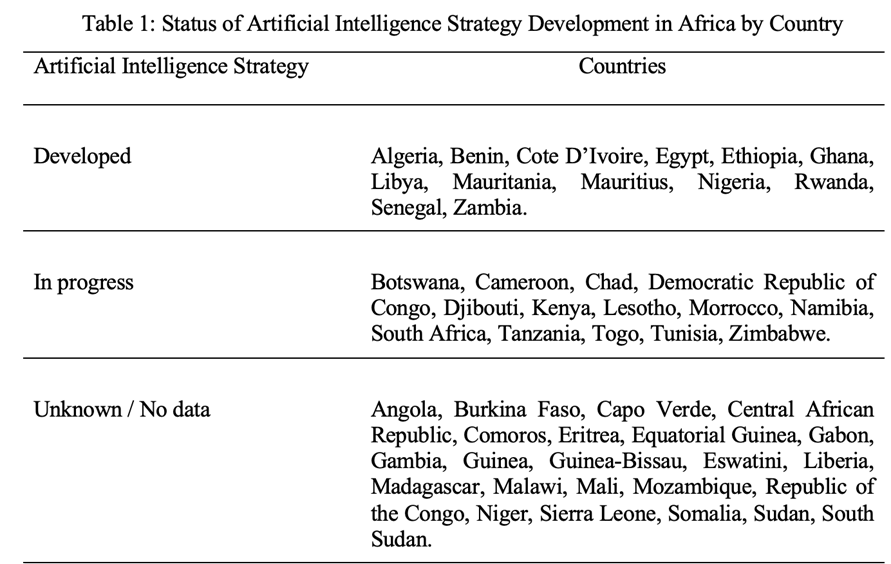
Source: Tombe, Sandra. “Why Conflict Affected Countries Need a National Artificial Intelligence Strategy.” 2026.
There is quite a variation across the continent on the development of AI strategies and policies and on the development of oversight institutions (see Table 1). Some of the countries with published AI strategies are Rwanda and Nigeria, while the other significant powerhouses of AI innovation and rapid adoption like Kenya and South Africa continue to develop their drafts. On the other end of the spectrum are the continent’s most conflict-affected countries — ones that are at a low state of AI readiness or preparedness and thus stand to lose the most without national AI strategies.46Tombe, Sandra. 2026. “Why Conflict Affected Countries Need a National Artificial Intelligence Strategy.” In progress.
On the other hand, independent oversight institutions as called for by the strategy do not yet exist. Some of these countries provide AI-related oversight through mechanisms like the AI task force in Kenya, the AI working group in Mauritius, and the AI national council in Zambia or Egypt, but these bodies are government bodies with limited oversight mandates. Furthermore, while cyber security and data protection laws that exist across the continent do provide relevant oversight, independent bodies would ensure that accountability can be pursued in instances where the state is the violator of rights.
Recommendations at the Global, Regional, and National Level
Global governance is important for managing such a consequential technological advancement like AI. Given that AI’s impact is always grounded in a local context, however, African states must be equipped to curb its harms and amplify its good locally. When states are constrained, regional organizations can provide support that goes beyond funding. In the following, we put forward practical recommendations for African states that call for greater partnership and engagement with the multilateral system as well as for explicit national action to strengthen state institutions
Partnerships on Knowledge Sharing and Technology Transfer
To further knowledge exchange on AI governance and technology transfer, African states must leverage the commitments to partnership outlined in the Pact for the Future and actualize them for their benefit. The important work of international private sector partnerships notwithstanding, African states should leverage the UN Office for South-South Cooperation to push for “next-generation” platforms and partnerships that facilitate harnessing the power of AI through knowledge sharing, capacity development, youth workforce development, and research with similar countries at a reduced financial cost.47United Nations. 2025. Bridging the Horizons and Continents: Forging Transformative Pathways in South-South and Triangular Cooperation. States that are currently developing their AI national strategies and those yet to begin are well positioned to articulate an approach built on South-South cooperation on AI. While fora like the GPAI offer an international platform for Global North and South outside the UN system, its membership costs, among other barriers, have thus far excluded African states. The AU can also play a key facilitating role on knowledge sharing and technology transfer, leveraging its convening power in support of members with the lowest AI adoption and readiness scores. It can also work with the Group of 77 to advance efforts on adapting AI frameworks that reflect the needs of the Global South.
Global African Engagement on LAWS
To mitigate risks posed by LAWS and contribute to norm-building, African states must articulate their positions and play an active role in shaping debates at the highest multilateral level. States may do so by agreeing to the CCW. Twenty-five African states make up the CCW’s membership, leaving half of the continent removed from influencing deliberations on technology and weapons.48United Nations. 2025. “Convention on Certain Conventional Weapons-Group of Governmental Experts on Lethal Autonomous Weapons.” In 2024, the CCW organized the ETALAWS conference and convened its members twice, 17 of which were African countries. Relatedly, the AU must participate in future meetings of the ETALAWS as they are organized. Non-State Member participants included the European Union, research institutions, and civil society organizations from Africa, so the AU’s absence stands out.49United Nations. 2025. “Convention on Prohibitions or Restrictions on the Use of Certain Conventional Weapons which may be Deemed too Excessively Injurious or to Have Indiscriminate Effects.” The AU’s participation would help position the regional body to bridge the gap for its non-CCW participating members and to contribute to norm and standard setting globally.
Independent AI Oversight Institutions
To bolster AI accountability, African states must take seriously the responsibility to govern and safeguard the rights of their people. Countries should take seriously the Continental Strategy’s call for establishing independent oversight institutions to oversee AI-relevant violations, harms, and abuse. The case of Kenya and Ethiopia are demonstrative and emblematic of a relatively wide-spread pattern of state oppression of rights when and as convenient on the continent. Not only do independent mechanisms offer the best chance for protecting individual rights, they also ensure that the state is held accountable for its violations and that the state can distance itself from allegations of meddling or political influence on state systems and institutions. Kenya, increasingly seen as a technology hub on the continent, is well positioned to lead on ushering such a mechanism.
Taking into consideration financing and implementation challenges, however, some states may consider empowering existing institutions to be independent of the state to carry out this oversight function. The key at this juncture where countries are developing AI strategies is to not lose sight of independent oversight for successful AI governance at the national level.
Conclusion
While knowledge sharing and transfer, regulation of autonomous weapons, and strong institutions at the intersection of AI are certainly not unique to Africa, it is in Africa that their nexus has the potential to significantly catapult the continent. The need to govern AI internationally, regionally, and nationally is therefore critical. The UN has been explicit in calling for an inclusive process to decide how to govern AI, and in supporting African states to leverage emerging technologies to boost development outcomes. However, African states have the ultimate responsibility to foster strong systems and institutions that can mitigate AI harms, safeguard human rights, and ensure access to innovation. The AU, for its part, can leverage its position to harmonize the development of frameworks and systems that can facilitate economic development and protect the rights of people.









Community Adaptation for a Water Festival Without Clean Water