


Editor’s Note: Thomas Kent is a specialist on propaganda, journalism, and the world information war. He had a long international career at The Associated Press, including as Moscow bureau chief, chief correspondent in Tehran during the 1979 Islamic revolution, and head of AP’s international service. Until 2018, he was president of Radio Free Europe/Radio Liberty, based in Prague. He now teaches at Columbia University and consults for governments, NGOs, and corporations on information operations and Russian affairs. His latest book, “The Propaganda Manual of the Ukraine War,” was published in August by the American Foreign Policy Council, where he is the senior fellow for strategic communications. He is also a senior fellow at GLOBSEC in Slovakia.
By North Africa, Mediterranean, and the Sahel Program Team
Russia is famous for its skill in propaganda. Its messaging routinely attempts to defy gravity: to replace the reality of a situation with an idealized picture that serves Russian interests. The strategy is “fake it till you make it” – to make a situation at home or abroad look as Russia would like it to be, in hopes that reality can eventually be engineered to make that portrayal true.[1]
Moscow’s propaganda operations are also highly parasitic, seeking to twist to Russia’s advantage whatever worries and grievances already exist in a target population. A leaked document from a Russian propaganda contractor emphasized “identifying hotbeds of conflict” in a target country and then executing “an artificial shift in the rhetoric of the conflict” to introduce themes beneficial to Russia.
Russian communication is also heavily emotional, harnessing the power of anger, disgust, hope, and humor to reinforce its claims. It leverages the phenomenon of emotional truth: Even if an argument is factually weak, its emotional power can make it convincing enough to have the desired effect.
In North Africa and the Sahel, Russia makes use of all these tactics to glorify regimes and movements favorable to its agenda; turn local grievances into narratives that favor Kremlin positions; and to supercharge its messages with emotional triggers.
Viewed in isolation, Russian propaganda is an enormously powerful machine. It combines the power of Russian state media; covert messaging, often run by intelligence agencies; and skilled private contractors, hired by the Kremlin or Russian business interests. Broadcasting, online operations, cultural centers, and billboards bring Russian communications directly to local populations.
However, Russian messaging does not exist in isolation. Multiple nations, including European states, the United States, China, Arab countries, and Türkiye, all seek visibility and advantage in the region. Often, they bulk just as large as Russia in the minds of the region’s population. This puts a premium on Russia’s ability to break through the information din with narratives that will stand out compared to those of others.
To this end, the Kremlin has infused its messaging with a utopian, millennialist spirit in an effort to create true geopolitical excitement in the region. Rather than just make economic promises or promote specific political points, Moscow preaches that the current moment is extraordinarily auspicious for an entirely new era: a total victory of the “world majority” over Western diktat and local corruption, ushering in a new era of universal prosperity under Russian and Chinese leadership.
The victory it promises recalls the “Proletarians of all countries, unite!” ambitions of the Soviet era, in which the oppressed people of all countries would overthrow their rulers and establish universal prosperity and peace under communism.
The question remains, however, whether even the most expert and utopian propaganda can eternally defy the facts on the ground. Ultimately, Russia’s influence in the region will depend more on political and economic reality than on its ability to sloganeer.
In Libya, Russia’s fortunes are heavily linked to the outcome of the standoff between its ally, Khalifa Haftar and his Libyan National Army in the east, and Abdelhamid Dbeibah’s UN-recognized Government of National Unity in Tripoli. The stakes are high for Moscow, which uses bases in eastern Libya to project power throughout the Sahel and extending to Sudan.
The United States has been working to unify the two Libyan sides through economic incentives and cooperation between their militaries, a process that threatens Russia’s position in the region. Especially worrying for Moscow are indications the Tripoli government has allowed Ukrainian forces to strike Russian shipping from its territory.
In the Sahel, much depends on the success of Russian forces against jihadists. Russia’s involvement in this fight is perhaps the biggest benefit the Sahel juntas derive from their close relations with Moscow. While the Western-backed overthrow of Moammar Qaddafi greatly strengthened jihadist and other anti-government forces, Russia is the external actor that has to deal with it now. The Kremlin must calculate whether the economic benefits from mining and other activities in the region, and the geopolitical gain from the West’s loss of influence there, justify the blood and treasure it has invested.
In Sudan, Russia’s long-held goal of a Red Sea naval base has led it to pivot from support of Muhammad Hamdan Dagalo’s Rapid Support Forces, backed for years by Wagner Group mercenaries, to the nation’s struggling government, defended by General Abdel Fattah al-Burhan’s Sudanese Armed Forces. The government reportedly has offered the base for the most pragmatic of reasons: to obtain Russian weaponry to fight the Rapid Support Forces. If Russia gets the facility, it will be even more enmeshed in protecting the government.
Further complicating Russia’s task across North Africa and the Sahel is Africa’s new multipolarity. In Cold War times, nearly every country in Africa was firmly fixed in either the Western or Soviet column. For decades, Russia encouraged multipolarity and Pan-Africanism as devices to pull countries away from the West and more toward the communist world. However, multipolarity today means Russia competes for influence with the EU, the U.S., Canada, China, Saudi Arabia, the United Arab Emirates, Morocco, Egypt, Türkiye, Japan, South Korea, and other nations. Many of them are able to make investments equal to or bigger to those than Moscow can, and some share the Kremlin’s willingness to deal with authoritarian regimes.
Beyond all this, Moscow’s increasingly difficult war against Ukraine weighs heavily on the money and manpower it can spare for Africa. Ukraine’s increasingly effective missile and drone strikes on Russia offer a daily spectacle of Moscow’s vulnerability. A failure in the war in Ukraine, or an even more expensive effort to make up for such a loss through a military adventure elsewhere, could lead to Russia drastically scaling back its ventures in Africa. This has happened before: Boris Yeltsin, under financial pressure and seeking accommodation with the West, sharply reduced Russia’s activities and visibility across the continent in the 1990s.
Given the variety of challenges it faces, Russia has responded by increasing still further its propaganda operations. Russia must project itself as a long-term ally of North Africa and the Sahel, an unbeatable military power despite its struggles against jihadists and in Ukraine, and the leader of a prospering bloc of “world majority” nations. Information operations are one of the rare areas in which Russia’s abilities are unsurpassed. Given the challenges Russia faces, it is no surprise that propaganda has been a major part of its regional strategy.
The Apparatus of Russian Propaganda
Russia began building up its international propaganda capabilities in 2005 with the creation of RT television, a worldwide network in English. In 2007, the year Putin made clear Russia’s definitive break with the West at the Munich Security Conference, Moscow began rapidly creating new influence institutions, many of them aimed at the Global South.
These included the creation that year of an RT service in Arabic, which aggressively promotes itself in the region. (In one of its recent campaigns, it sponsored billboards in Algeria, Tunisia, Morocco, and Libya reading, “They try to silence our voice. You seek out the truth. We meet at RT Arabic.”)
In 2008, Moscow created Rossotrudnichestvo (“Russian Cooperation”), which runs “Russia House” centers abroad and arranges trips to Russia for foreigners. Sometimes it works with another group, the Public Diplomacy Foundation.
The two organizations’ actions range from charitable endeavors to activities with a strong political overlay. They have distributed backpacks of school supplies to children in Mali, supported football tournaments in Niger, shown a film in Chad about Russian wedding traditions, and organized a Russian opera singing contest in Algeria. A project this year involved tree-planting in Libya and Mauritania in honor of Russian heroes in World War II – a war Russia likens to its current battle against what it calls a fascist regime in Ukraine.
Russia has further extended its reach into Africa through the Sputnik news agency, established in 2014 and operating in more than 30 languages including Swahili and Amharic; an RT service in French; and TV BRICS, an effort to promote the BRICS alliance across 30 countries. The organization lists the Tunisian news agency as partner.
Following its full-scale invasion of Ukraine in 2022 and isolation by the West, Russia indicated it was centering its diplomatic activities ever more on the Global South. A reported 2023 Foreign Ministry document stated that “the main possibilities for constructive international cooperation at the current historical stage are beyond the scope of the Euro-Atlantic, where the majority of partners and sympathizers with Russia are located.”
Among the signs of this re-centering was the opening in 2023 of African Initiative. Nominally a news agency in Arabic, French and Spanish aimed at Africa, it also functions as an NGO spreading Russian influence, especially in the Sahel. The United States says the agency, with offices in Burkina Faso and Mali, receives “material support and guidance” from Russian intelligence agencies. Also in 2023, Russia created RusAfro Media, ostensibly run by Moscow State University and operating in English, French, Portuguese, Arabic, and Afrikaans. The agency offers content for African outlets to republish for free.
All these institutions of Russian influence are public. There are covert elements as well, however. France’s counter-propaganda agency has assessed that African Initiative, in addition to its public activities, was the likely controller of a covert propaganda network consisting of four pseudo-news sites targeting West Africa in French and the UK in English. European and U.S. investigators have identified a series of other ostensibly African networks and news brands that are actually run by Russian operators.
Other pro-Russian voices are supposedly independent of Kremlin authorities, even if their content closely follows Moscow’s line. Cameroon-based Afrique Média, which often gave Wagner mercenaries positive coverage, features articles especially tagged for Mali, Burkina Faso, Niger, and Chad. An Afrique Média profile of Justin Tagouh, its director, described him as “refusing bribes, resisting political co-optation, and rejecting all forms of editorial interference.” However, Tagouh was sanctioned by the EU in 2025 on the grounds that his media group had “direct links with the Russian authorities, and spreads Russian narrative and anti-western narrative in African countries.”
Russia also benefits from social influencers. Kemi Seba, Nathalie Yamb, and Egountchi Behanzin have won more than 800,000 followers in West Africa for their anti-Western, Russia-friendly videos in French on YouTube.
Russia has worked as well to penetrate African journalism and fact-checking, once an exclusive province of U.S. and European trainers and advisors. RT and Sputnik now run training programs for African journalists. Their journalistic interest, according to an RT Academy promotional video, focuses on day-to-day African news and Russia’s activity in the region, compared to what it called Western outlets’ “same narrative” of climate change, sanctions against Russia, and LGBT.
An RT training session for journalists in Mali, according to a Russian account, “used fresh examples to show how famous news agencies like CNN, the BBC, and Deutsche Welle use fake news and spread this information worldwide, deceiving millions of people and giving them a false understanding of events in other countries.”
One of the greatest assets of Russia’s propaganda apparatus is Vladimir Putin himself. Russia presents him as a “big man” who gets things done, compared to fast-changing, colorless Western leaders and corrupt African rulers. Putin has turned increasingly to rhetoric aimed at Global South citizens. His references to colonialism in statements and speeches jumped from fewer than 10 in 2021 to nearly 70 in 2023. In Mali, billboards have appeared wishing Putin a happy birthday; in Burkina Faso, a large image titled “Support for the transition” showed Putin shaking hands with President Ibrahim Traoré.
Russia’s Propaganda Messages
For years, Russian propaganda in Africa portrayed Moscow as the world’s bulwark against colonialism. All the continent’s problems, in Russia’s telling, were the fault of European and U.S. imperialism.
Such messages fit well with African attitudes. These included positive attitudes toward Russia, the result of past Soviet support for national liberation movements, Russian training of military officers (including from North Africa and the Sahel), and even its efficient hosting of the 2018 World Cup. Russia is also appreciated for welcoming African students – though not as many as study in Western countries – and holding frequent “friendship festivals” with large Global South participation.
Given Russia’s anti-colonial brand, its full-scale invasion of Ukraine in February 2022 came as a shock to Africa, where respect for borders is a revered principle. The vast majority of U.N. members voted to condemn Russia’s action. These included 28 African states, among them Mauritania, Libya, Chad, Tunisia and Niger. (Mali, Algeria, and Sudan abstained, and Morocco and Burkina Faso did not vote.)
To meet this challenge, Moscow flipped the script, working to portray its invasion as an anti-colonialist act. It argued that West Europe and the United States, which exploited Africa for decades, were now seeking to colonize resource-rich Ukraine. Russia, in Moscow’s telling, was therefore waging an anti-imperialist fight to protect a brother country. The nature of the Ukrainian regime, Russian outlets said, was clear from Ukrainians’ racist treatment of African students trying to flee the country after the invasion.
Russia also pointed out that the West, which condemned Russia for violating international law in Ukraine, had repeatedly ignored national sovereignty in countries in Libya, Afghanistan, Iraq, and elsewhere.
Russia claimed the Ukraine war had led the West to violate African nations’ sovereignty anew by pushing them to restrict relations with Russia. Nigerien Prime Minister Ali Mahaman Lamine Zeine said a U.S. delegation demanded limits on Niger’s relationship with Russia and Iran, and that he had replied, “First, you have come here to threaten us in our country. That is unacceptable. And you have come here to tell us with whom we can have relationships, which is also unacceptable.”
Russia also leveraged the Ukraine war to argue that the West was on its last legs, unable to defend Ukraine and about to collapse at home from economic and social crises. Precisely because of this, it said, the moment had arrived for the final downfall of the West.
Putin’s Russia, however, has never advanced a clear roadmap as to how the collapse of the West would bring prosperity to Africa. Soviet propaganda held out socialism as the elixir that would elevate the economic fortunes of all countries; Russia’s current oligarchic capitalist system offers little for other countries to copy. In fact, Kremlin propaganda pays little attention at all to Russia’s internal conditions; it focuses almost entirely on what it describes as the evils of the West and the success of its clients and allies.
Other key goals of Russian propaganda include:
● Maintaining an advantage for Russia in Libya. According to leaked documents from a Russian influence network, Moscow seeks to “create chaos in the military and political situation in western Libya,” undermine U.S. and Turkish influence, and disrupt Libyan energy supplies to Europe.
● Promoting local allies. Russia has worked to be the best friend of new nationalist figures such as Ibrahim Traoré, who led the military coup in Burkina Faso in September 2022. Russian outlets have promoted a cult of personality around Traoré that has spread across the Global South. A 2025 Sputnik report quoted a Burkinabé demonstrator as saying, “We are not afraid. If you die because of Captain Ibrahim Traoré, you will be entitled to paradise.”
● Casting Russia as a model of morality. Russia compares its traditionalist Orthodox heritage to what it calls Western moral licentiousness. Russian hostility toward LGBT rights aligns with laws and public opinion in much of North Africa and the Sahel. The Russian Orthodox Church is expanding rapidly in Africa, including with parishes in Morocco, Tunisia, and Burkina Faso. Beyond its religious mission, the church’s tasks also reportedly include recruiting Africans to fight in Ukraine.
● Undermining Western health programs. Russia has long cultivated fears about Western health programs and medical research. African Initiative said the U.S. was suspected of seeking “a new, ideal pathogen to start another pandemic” that would “distract local governments from attempts to gain independence and expel military bases of the United States and its allies.” The U.S. State Department exposed a Russian campaign, begun in Burkina Faso, that claimed U.S. scientists were drawing blood to develop a virus to kill Africans.
Russian campaigns have turned away few people from Western-organized inoculations against malaria, a disease that Africans know well and fear, according to an international health official. But the official said Russian campaigning reduced the number of people willing to be inoculated recently against human papillomavirus (HPV) by amplifying fears that the serum would make women sterile.
● Encouraging migration to the West. Multiple reports have spoken of Russian operatives encouraging people to migrate to Western Europe, their way smoothed by routes through Russia and Belarus. Increasing numbers of migrants adds to stress on European societies, fueling the continuing rise of populist parties there that Moscow considers friendly to its long-term interests.
● Emotional manipulation. Russia often evokes a narrative arc of a prosperous African past, the catastrophe of colonialism, and a happy ending to come. Yevgeny Prigozhin’s media empire produced gory feature films aimed at Global South audiences to portray Western countries as dystopian and Wagner mercenaries as heroes. Wagner forces weaponized fear by producing videos as horrifying as those of ISIS. Aimed at intimidating Wagner’s opponents, the videos showed beheadings, castrations, cannibalism, and mutilation of corpses. Such videos have reportedly continued since the Africa Corps, an official part of the Russian Ministry of Defence, replaced Wagner.
● Economic solidarity. Russia presents itself as a reliable trading partner, while Western sanctions on Russia disrupt grain and fertilizer supplies to Africa. (Russia’s bombing of Ukrainian grain shipments is not highlighted.) Russia also seeks to build solidarity with African nations that, like Moscow, have suffered from Western sanctions. Russia’s last summit with African leaders, in 2023, drew only a small turnout in the wake of its invasion in Ukraine; a new summit this October will indicate how much Russia has repaired its reputation.[2]
Facts on the ground, however, continue to threaten Russia’s positions. Russian media have met the Trump administration’s outreach to Sahel nations with alarm or denial. Responding to a trip to the region this year by State Department official Nick Checker, Sputnik refused to accept that Trump’s approach to Africa could be any different from Joe Biden’s.
The “essence” of U.S. policy remains the same, it insisted: “beads instead of real development, mirrors instead of sovereignty, and firewater in exchange for strategic subjugation.” (Sputnik’s language might well come across to Africans as offensive, implying they can easily be seduced by trinkets and alcohol.)
Russian propaganda also continues to put the best possible light on Russian activities in the region. It continues, for example, to describe Russian troops as fighting heroically in Mali. During the offensive this year by anti-government forces, RT’s French Service said Russian forces had saved the government from overthrow by “terrorists.”
It acknowledged that the outnumbered Africa Corps forces had retreated from the key city of Kidal, saying Malian authorities had ordered the pullback. It said those attacking the city had benefited from “the participation of mercenary Ukrainian and European instructors.”
Messaging by Western Nations
Western responses to Russian propaganda have largely been inconsistent and episodic. The greatest obstacle faced by Europe and the United States is the lack of a convincing story to tell. For more than six decades since the end of widespread colonial rule in Africa, Western nations have insisted that incremental steps toward economic and political development, abetted by massive aid and loans, are certain to eventually yield strong, prosperous societies.
When this process yielded little, and nations turned to Russian and Chinese alternatives, the West argued that Africans were trading liberal democracy and rule of law for temporary economic and security gains. The problem with this approach was that in North Africa, the Sahel, and elsewhere, many Africans feel the fruits of democracy, at least as practiced in their nations, have been minimal. Many also believe that authoritarian leaders are the most likely to establish security.
Opinion surveys in Mali, Tunisia, Niger, and Burkina Faso in 2021-23 found that solid majorities of citizens supported military intervention in politics “if elected leaders abuse power for their own ends.” Traoré said in April that “people need to forget about the issue of democracy. Democracy is not for us.”
Such views have posed a significant challenge for Western governments that put democracy and liberal social values at the core of their messaging. Despite its arrogant treatment of many Africans, the Trump administration’s transactional approach, based less on values and more on mutual advantage, may pose a greater challenge to Russian and Chinese influence in the region than have previous U.S. administrations and the values-oriented European Union.
Burkina Faso expressed interest in April in reviving relations with Washington, and Mali said in July that it might consider allowing U.S. troops to rejoin its campaign against jihadists.
Western nations have tended to leave most of their communication to the region to their international broadcasters, such as the Voice of America, the BBC, Deutsche Welle, and France’s radio and television services.
These outlets have had strong followings. A Voice of America social media account in Africa saw its number of video views jump from a usual 125,000 to 17 million after Russia’s full-scale invasion of Ukraine. A State Department survey of 1,365 local digital news outlets in every African nation, completed in 2024, found that 344 used Kremlin-sourced material, 395 used Chinese content, and 626 used content from U.S. and other Western sources.
Pro-Russian content was most prevalent in West Africa, especially the Sahel, and in West Central Africa. And much of the Western material came from the Voice of America, whose African services were largely dismantled by the Trump administration in 2025.
Yet the broadcasters, although their perspectives are clearly Western, are not generally viewed as propaganda tools by their home countries. All have the legal status of independent journalistic organizations, and their staff do not see themselves as taking orders from their governments.
This complicates their serving as the “tip of the spear” of a propaganda effort. By contrast, the chief editor of RT states openly that “all RT employees, and its chief editor personally, follow orders only from the Kremlin.”
Most Western nations have traditionally been reluctant to use propaganda tactics consistently and at scale. Although they have deployed such tactics on occasion, policymakers and think tanks frequently recoil at “taking a page from Russia’s book.” One reason is that they believe assertive messaging must inevitably descend to outright lying and disinformation, which would further destroy the information environment.
So far, France has been the most assertive Western communicator to the Sahel, by covert as well as overt means.
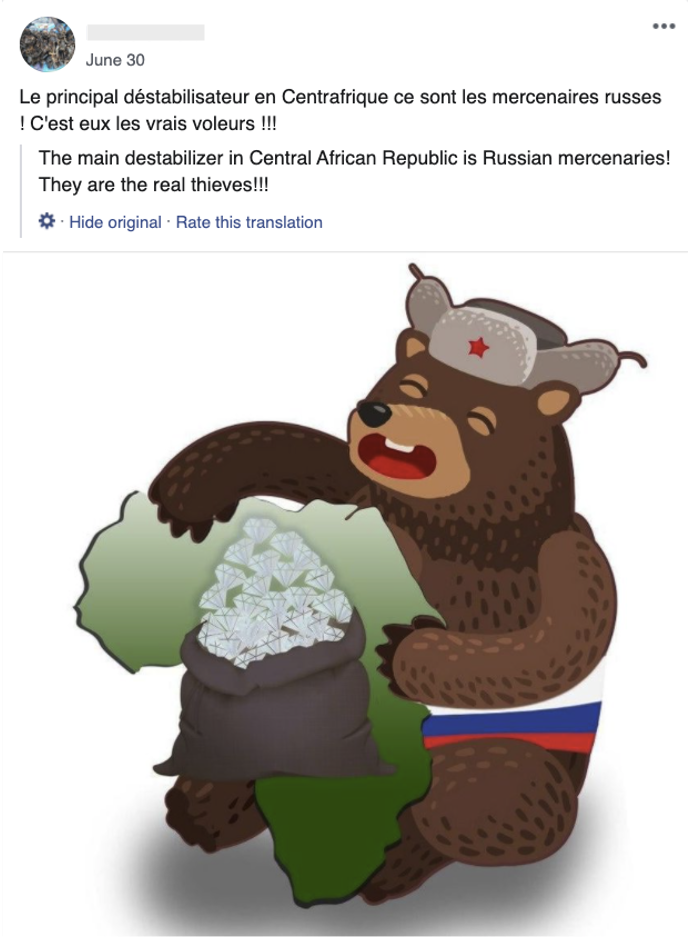
In 2020, Meta removed nearly 100 French-based Facebook and Instagram accounts attacking Russian activities in the region. A typical post was a cartoon showing a bear with a Russian hat scooping up diamonds. The accompanying text said, “The main destabilizers of central Africa are Russian mercenaries! They are the real thieves.”
In April 2022, a “Mali patriot” posted on social media images of a mass grave near a base that had just been deserted by French forces in the town of Gossi. Wagner mercenaries had supposedly just discovered the grave, full of people killed by the French. In response, France released drone images that caught the mercenaries half-burying corpses and then photographing them to make it look like they had just found them. French officials differed as to the drone images’ likely effect – whether they would have no impact, because many Malians believed France could well have committed mass murder, or would be convincing at least to citizens with open minds.
As Russian forces fell back last year against jihadists in Mali, the French foreign ministry’s “French Response” social account juxtaposed a 2021 Russian video promising to save Mali from French imperialism with video of a Russian official asserting in 2025 that Moscow “is not responsible for the internal situation of that country.” French Response said, “It was clear from the beginning that the Russians would not protect the Malians. Today, reality proves it.”
In late 2025, a mysterious string of new websites and social pages appeared, filled with text and images that denounced the governments of the Alliance of Sahel States and spoke positively of Western countries, including France. The actors behind the sites were unknown. The French foreign ministry declined comment.
The net effect of Russia’s propaganda efforts is unclear — particularly whether they will be able to endlessly defy gravity as Russia faces new obstacles in the region. Russia is also not the only information actor. Its messaging must break through social posts and influencers promoting the interests of multiple nations seeking influence in the region.
Proving effects on the ground are often the Achilles’ heel of information operations.
Propaganda can have clear tactical effects, such as Wagner videos reportedly sowing panic among many of Mali’s Fulani tribespeople.
But in terms of long-term political effect, the impact of propaganda is difficult to measure. This is particularly true in North Africa and the Sahel, where there are few public opinion polls or opportunities for citizens to express their views through voting or advocacy. Many citizens are concerned above all with their own security rather than ideology or geopolitics. They would welcome any geopolitical actor that might keep them safe.
[1] This strategy dates all the way back to the socialist realist art of the early Soviet period of the 1920s, which portrayed a glorious, industrialized future that looked nothing like the poverty-stricken reality of Russian peasant life.
[2] The 2023 summit was postponed from its original date of October 2022, presumably to allow more time for anti-Kremlin feeling over the invasion to dissipate. Still, only 17 heads of state participated, compared to 43 at the previous summit in 2019.



Community Adaptation for a Water Festival Without Clean Water