
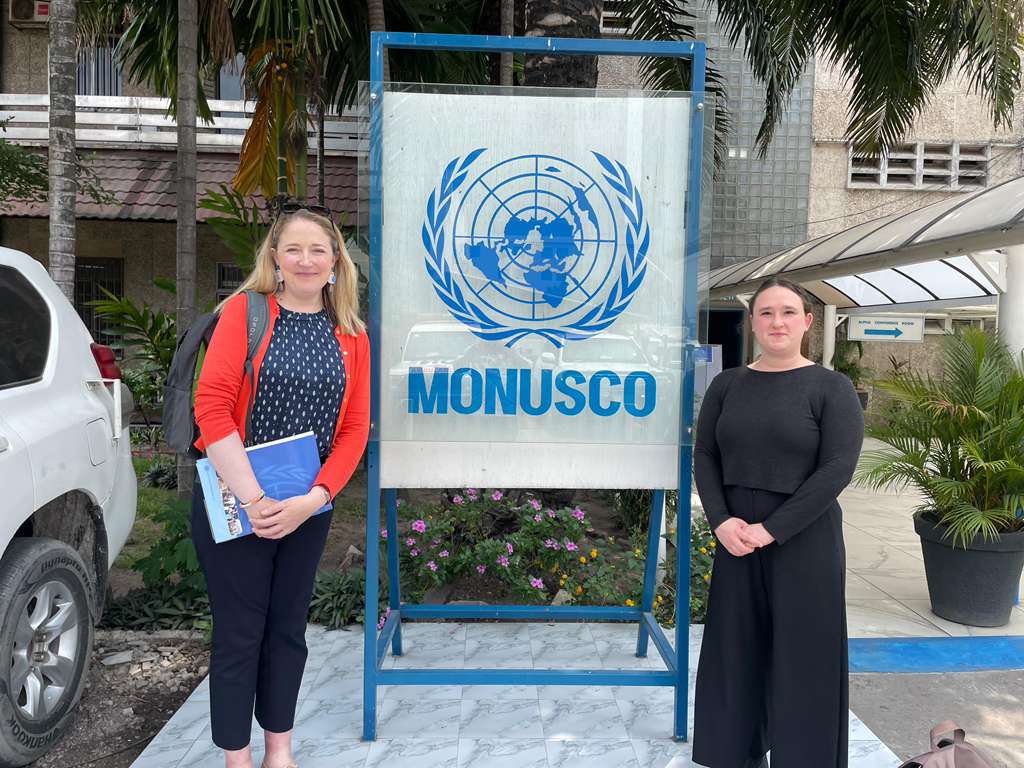
The following text was written by Lisa Sharland, Senior Fellow and Director of the Protecting Civilians and Human Security program, as she reflects on two trips to the DRC a decade apart.
Amid debates about the future of the United Nations and the impact of funding cuts, UN peacekeepers continue their vital work to protect civilians in a range of contexts across the globe. The Protecting Civilians and Human Security program observed this first-hand in October 2025 when we undertook a visit to Kinshasa and Beni in the Democratic Republic of the Congo (DRC). Over a two-week period, we engaged with military, police and civilian components of the mission, as well as civil society organizations, to understand how the UN peacekeeping mission (MONUSCO) is implementing its mandate, particularly the priority task to protect civilians. Our research was focused on two projects underway in the program: strengthening information integrity as part of protection of civilians, and framing gender-responsive leadership as part of the mission’s women, peace and security mandate.
Our experiences of Kinshasa and Beni were full of contrasts. Kinshasa, the capital of DRC, is a city of an estimated 18 million people. We were warned on numerous occasions before our arrival to leave time for the traffic to get across town, as it can often descend into gridlock across the sprawling city. The UN headquarters is located in Gombe, one of 24 communes in Kinshasa and home to most diplomatic missions, hotels, and NGOs. The UN personnel are split between two primary locations, meaning considerable time is spent commuting between the two. Notably, most UN vehicles lack the visible “UN” lettering on their vehicles moving about the city, with many removing the iconic lettering after the escalation of attacks against UN vehicles in 2022, spurred in part by misinformation about the activities of the mission.
While Kinshasa can be accessed by commercial flights, reaching Beni is far more challenging, with mission personnel, humanitarian organizations, and civilians reliant on MONUSCO and the UN Humanitarian Air Service to get to eastern DRC from Kinshasa. There are no commercial flights in operation, and accessing eastern DRC from bordering countries has become increasingly difficult with the takeover by M23/AFC in North and South Kivu, as well as the operation of armed groups including the ADF and CODECO in Ituri province. Even road movements around Beni remain limited due to the risk of attacks on civilians and personnel to the north and the south, which has only escalated in recent months. The UN presence in Beni remains split between the Mavivi Base, which is situated near the airport and has historically included the Force Intervention Brigade (FIB). It now also includes the Force Headquarters for the military component in the mission, which relocated from Goma in 2025.
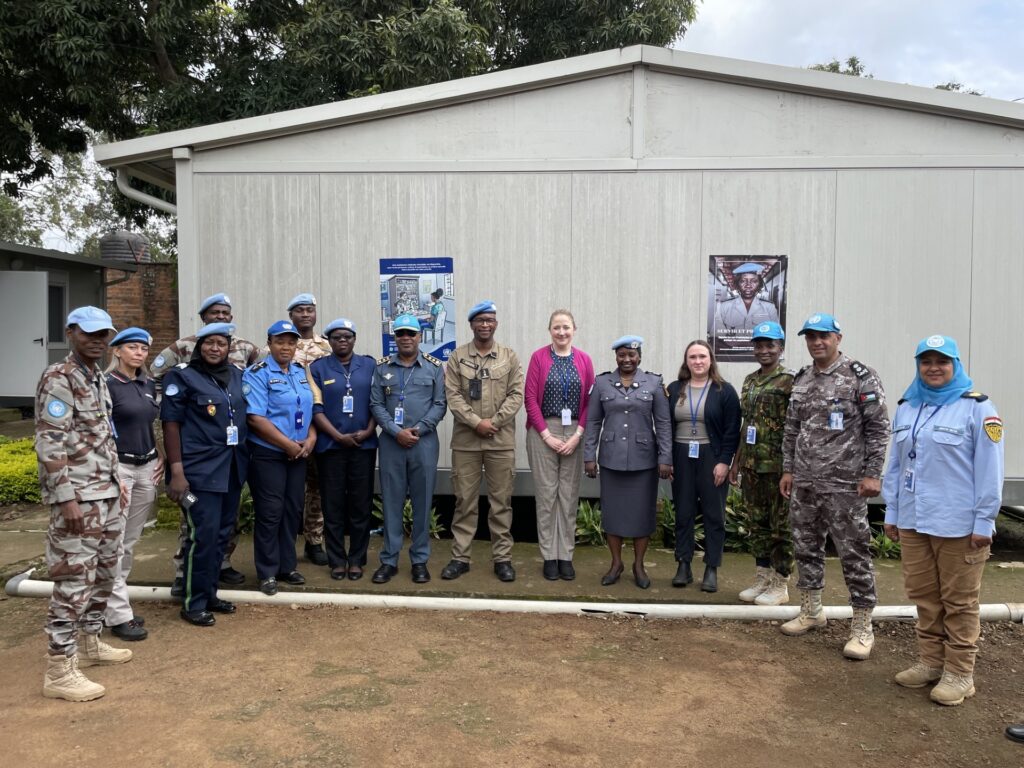
Stimson researchers Lisa Sharland and Juliet Weis stand with members of MONUSCO’s police component in Beni, Democratic Republic of the Congo in October 2025
Our visit took place at a critical juncture for MONUSCO. News had started to circulate about the contingency planning measures to reduce expenditure of the approved budget by 15%, driven largely by the U.S. withholding of payments to UN peacekeeping. While the mission has sought to mitigate the impact and provide a degree of reversibility, the cuts were anticipated to result in the repatriation of more than 1,500 troops, hundreds of staff officers, and formed police units, as well as the cessation of 347 civilian staff contracts. These cuts are already having an impact on the capacity of the mission to deliver on its mandate, particularly requirements to protect civilians.
Throughout our visit, the mission was also in consultation with visiting Security Council delegations, who were seeking input as part of the upcoming mandate renewal process in December. The January 2025 takeover of Goma, and concurrent Doha and Washington peace processes between the DRC and M23, and Rwanda respectively, were prompting debate about the future of the mission mandate operating in an environment where an armed group (the M23) was the de facto authority in Goma, restricting freedom of movement to the force, and prompting consideration about whether the mission should return to South Kivu (where civilians continue to face ongoing threats and attacks). The Security Council has since renewed the mission mandate in December 2025, retaining the mission’s priority of protection of civilians, while also authorizing the mission to take on tasks related to ceasefire monitoring as required in South Kivu. The mission mandate has also retained the role of the Force Intervention Brigade to neutralize armed groups in the east, although the capacity to do so remains under question with the implementation of contingency planning cuts and its impact on staff morale.
The situation was a stark contrast to my first visit to eastern Congo over a decade ago. It was a fleeting visit while I was working as a Defence Policy Advisor at the Australian Permanent Mission to the United Nations — part of a diplomatic tour by the Military and Police Advisor (MPAC) community in New York, with meetings in Kinshasa and Goma with personnel from MONUSCO. When we were in Goma in 2013, we met the first rotation of members of the Force Intervention Brigade, which had had just started to deploy. The FIB had been authorized by the Security Council in response to the recent takeover by the M23 of Goma in late 2012. That exceptional authorization has remained in place in MONUSCO’s mandate for the last 12 years. However, even with the FIB, the mission was unable to push back the M23 in January earlier this year.
These developments, like many others faced by MONUSCO in recent years, have contributed to a contested information environment that has threatened peacekeeper safety and security, and put civilians at risk. There is fair and legitimate criticism about the mission, and as many of those we met with noted, that is to be expected with a mission that has been present in the country for 25 years. However, false narratives about the mission supporting armed groups and benefiting from illegal mining have continued to circulate, with minimal pushback from government officials. Similarly, the conflict in the east has raised suspicions about the affiliation of ethnic groups and their support for M23 or certain armed groups, putting human rights defenders, many of whom are women, at risk. This contested information environment is undermining efforts to address the more recent Ebola crisis that has spread throughout the region as of June 2026.
One of the things that struck me on my first visit a decade ago and again more recently was the juxtaposition between the striking beauty of eastern Congo with the violent and protracted conflict that has gripped the region for decades. While the conflict has evolved, the expectations for protection and peace among civilians remain. Our recent visit reinforced the importance of MONUSCO continuing to adapt as it has over the past decade, but it will need to do so in a more resource-constrained and hostile environment.
The Stimson team is grateful to the individuals interviewed for their time and engagement on this project. Stimson’s research in the Democratic Republic of the Congo as part of these projects is supported by Global Affairs Canada. The findings from this trip will be featured in forthcoming Stimson Center papers. All views reflected in this piece are the responsibility of the author.


Community Adaptation for a Water Festival Without Clean Water