
“From barbarism to civilization requires a century; from civilization to barbarism needs but a day.” – Historian Will Durant.
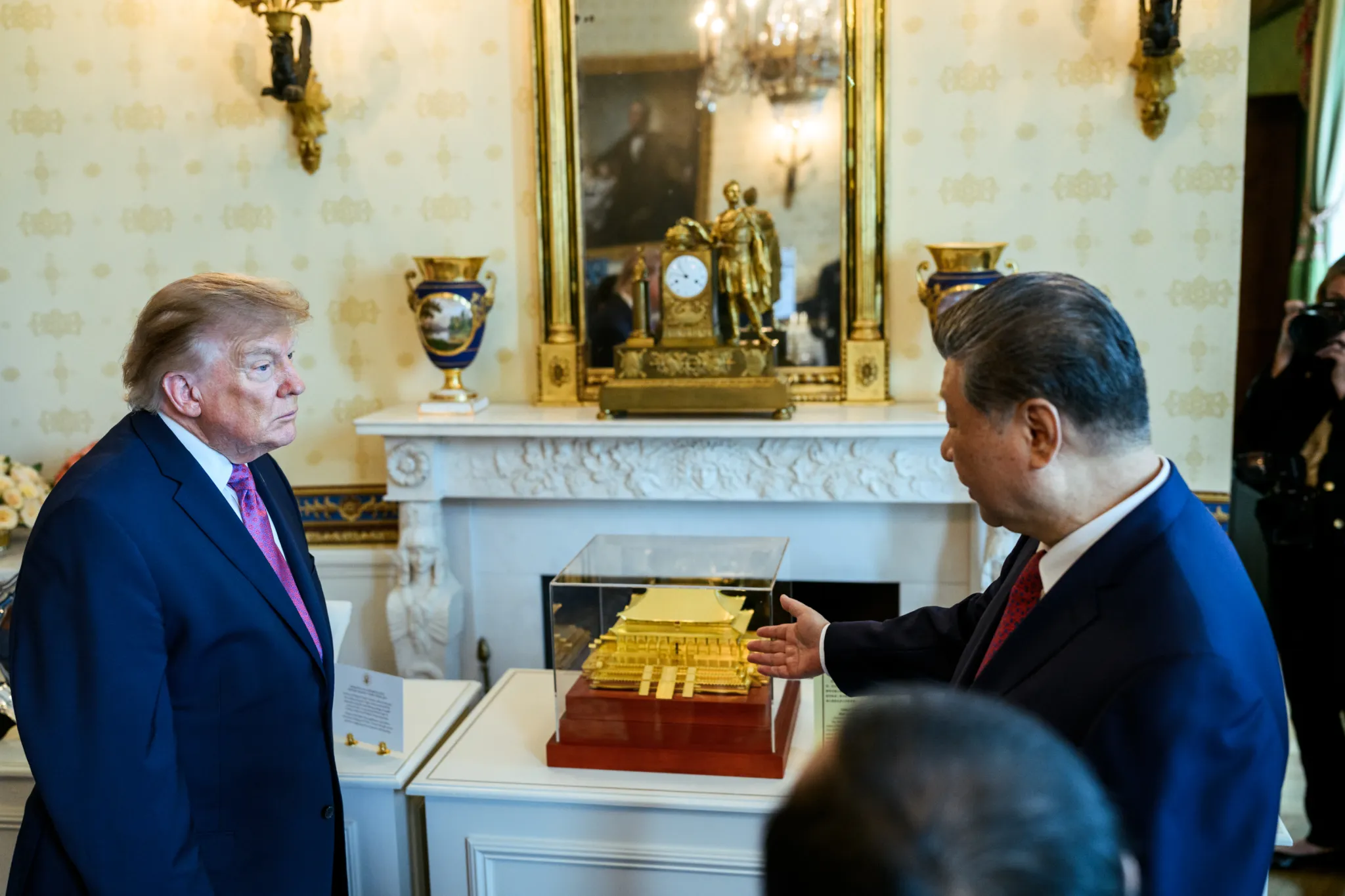
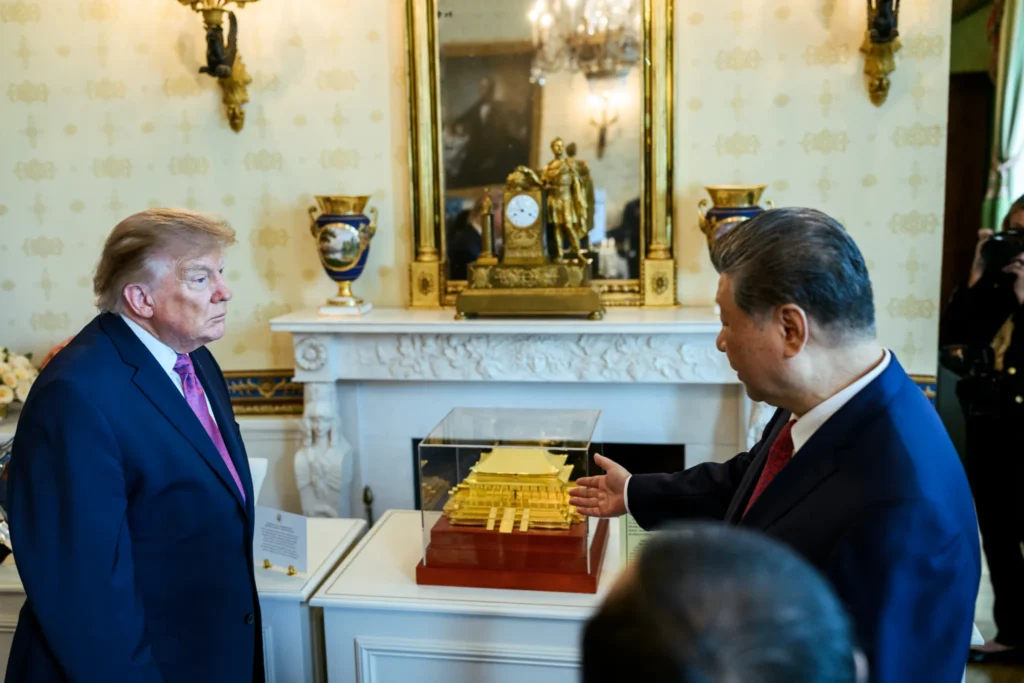
Few would dispute that our age is one of a volatile, crisis-riven world adrift. But during the recent summit between Presidents Trump and Xi, wars in Ukraine and the Middle East, climate change, and nuclear risks were, by most accounts, not much more than items of passing conversation for both leaders. Yet, few seemed to notice the absence of urgency or even obligation on the part of these two great powers. Some G2, eh?
The recent summit highlighted a distinct feature of our times: a stark deficit of stewardship to protect against existential risks to the planet. A U.S. retreat from global leadership amid a shifting balance of economic and geopolitical power is accelerating the dissolution of the premises and pillars of the post-World War 2 order into a confusing disorder with few rules guiding international politics other than raw power. It couldn’t happen at a more dangerous moment in history.
How did we go from FDR, Churchill, and Stalin at Yalta and Potsdam deciding war and peace to casually outsourcing diplomacy to end a U.S. war to Oman and Pakistan; from Bretton Woods creating a post-war order to a world of three myopic, predatory powers unraveling 80 years of norms and institutions to replace them only with raw power? If the proposed US-China-Russia Trilateral Summit concerning the war in Ukraine occurs in November, it will likely be more photo op than Yalta, with just vague promises. The major powers have gone from stewards of world order to predators feasting on its unraveling.
Perhaps most glaringly, the Russian invasion of Ukraine undid the most foundational principles of the post-World War 2 order: state sovereignty and no changing borders by force. Today, with wars raging in both the heart of Europe and the Middle East — with both theaters witnessing attacks against civilians in disregard of established rules of war — and 65 state-based and intra-state conflicts ongoing globally (the most since World War 2), scholars debate whether World War 3 has already begun. Where is the adult supervision?
What has shriveled the stature, sense of responsibility, and recognition of common interests — or at least of mutual vulnerability — of the major powers even as existential threats to the planet, ranging from wars, plague, climate change, and an unprecedented technology revolution that may supersede humans, all continue to mount? Arguably, a confluence of several factors can explain this dynamic — the success, relative peace, and prosperity of the post-World War 2 order, the unintended consequences of globalization, and two ill-advised wars.
A History of Order
Historically, world orders have tended to be based on a stable balance of power and a rough consensus of expected behavior among the major powers. Those conditions for a stable order typically occurred after major conflicts: the 1815 Congress of Vienna after the Napoleonic wars; the Treaty of Versailles after World War 1; the Bretton Woods system after World War 2. Major powers guaranteeing the peace was the logic behind the creation of five permanent seats on the UN Security Council.
Unlike such previous eras that ended by upheavals, after the turmoil of the Soviet Union’s demise and the Cold War, the U.S., the superpower hegemon, did not so much consider revising the post-World War 2 order, as decide on a triumphalist expansion of it. The Clinton administration called its strategy “enlargement” of the free-market, democracy-based neoliberal order, and the U.S. rode the dynamic of digital age globalization. Washington first fumbled efforts to integrate Russia, then pursued integration of the rest of the former Soviet Warsaw Pact nations into the US-led order, instead of Russia, gradually alienating Moscow and complicating its transition. (The counterargument is that Russia would, in any case, have reverted to its centuries-long traditional pattern of an Orthodox, authoritarian, continent-sized power tending to expand its influence. In any case, the result was fertile soil for an increasingly vengeful, anti-Western Putin regime.)
These strategic choices unfolded against the backdrop of no less momentous shifts, including the self-induced erosion of U.S. power in the two decades after 9/11 from two failed wars of choice in Iraq and Afghanistan, which took a heavy toll on nearly 2.5 million U.S. troops and drained the U.S. Treasury of $8 trillion. Add in the 2008 financial crisis and collapsing neoliberal assumptions and U.S. prestige, and the weight of the protracted folly becomes obvious.
During this period of globalization from the mid-1980s to 2008, peak globalization resulted in a diffusion of wealth and power from West to East and North to South. The percent of global GDP of the G7 nations went from some 70% when the Berlin Wall came down in 1989 to 44% in 2025. Still more consequential is the remarkable, globalization-fueled re-emergence of China, which is now the world’s second largest economy, with a GDP of $19 trillion. Beijing has been steadily narrowing the economic and military gap with the U.S., with tension, zero-sum trade, and tech wars increasing proportionately.
The death blows to the neo-liberal order were the “China shock” that hollowed out U.S. industry and the 2008 global financial crisis triggered by U.S. mortgage derivatives. The result has been the weaponization of interdependence, the rise of protectionism, economic nationalism, the receding of democracy, and, not least, resurgent zero-sum great-power competition. Thus, the current major powers — the U.S., China, and Russia — are all self-absorbed gerontocracies, all led by highly personalized authoritarian regimes, and all unsatisfied and immersed in the pathologies of their respective national myths with nostalgic dreams of the future (think: Make America Great Again; national rejuvenation of the Middle Kingdom, and neo-Tsarist Orthodox empire).
Current Disintegration
But at present, the world is in an odd, anomalous predicament, one of diffused wealth and power that has neither a stable balance nor consensus on rules and norms governing international politics. Currently, we have neither. Rather, we confront a terrible interregnum between an exhausted neoliberal order and an uncertain future. The mystery is where this trajectory leads.
The social scientist and historian Peter Turchin has developed a massive database of societies and empires back to past millennia. In his 2024 book End Times, he assesses interacting pressures — demographics, environmental limits, inequality, socio-economic stagnation — which, he argues, create 100-150 year cycles of integration and disintegration that can produce turmoil, revolution, civilizational collapse, and elites and counter-elites fighting for power. Turchin follows a long line of historians with cyclical views of civilizations, from Thucydides to Arnold Toynbee, but Turchin supplies a thick, multi-disciplinary database. It is no surprise that he sees the world now in a cycle of disintegration. It is difficult to envision the current dynamic of zero-sum economic, strategic, and technological competition and of the weaponization of interdependence and every technological and geographic chokepoint ending well.
One symptom is widespread disorder and a global governance deficit, a result of a waning of the major powers (arguably Europe as well) — each in their own way, in distinct areas, and at different paces and degrees. It’s a bit like Tolstoy’s line in Anna Karenina that “Happy families are all alike; every unhappy family is unhappy in its own way.”
Indicators of Russian malaise, from demographic decline, a self-destructive war leaving more than one million dead and wounded, brain drain of talented young Russians, and ranking 60th on the World Intellectual Property Organization’s Innovation Index, are demonstrable metrics of a dubious future. But the predicaments of both the U.S. and China, both countries arguably peaking now, are more of a paradox.
While both the U.S. and China lead the world in tech innovation, driving an increasingly knowledge-based 21st century economy and together accounting for about 42% of global GDP, both have K-shaped, two-tier economies, domestic stagnation, and deepening inequality. Both also have huge amounts of debt — the U.S., 120% of its GDP, and China’s non-financial debt, 300% of its GDP — and have made huge bets on the future. The U.S. has bet on massive investment in artificial intelligence (AI), which is driving and distorting its economy and stock markets, yet AI is an unproven transformational technology that has created financial risks, similar to previous bubbles such as the 2000 dot.com boom and 2008 financial crisis. Both the U.S. and China are plagued by a sense of malaise as social mobility stagnates and the burdens of aging populations take their tolls, as both countries pursue competing national ambitions.
This may help explain their narrow definitions of self-interest, respectively, in contrast to the enlightened self-interest, of say, the creators of the Congress of Vienna or the post-World War 2 Bretton Woods and international security systems. A fading of living memories of the horrors and follies of the 20th century may also help explain neo-fascist Holocaust deniers and young fans of socialism in the generation coming of age.
Regardless, this has left much of the rest of the world, from middle powers like Canada, Turkey, and Brazil to least developed economies in the Global South, scrambling and pursuing poly-aligned hedging to derisk from both the U.S. and China. These countries are seeking coping mechanisms to increase their agency in navigating this ecosystem, avoid being forced to choose between the U.S. and China, and minimize the economic and security damage. This has resulted in a surge in new trade arrangements excluding the U.S. since 2024 and new security arrangements, from burgeoning intra-Asian defense cooperation over the past decade cushioning against China, and, of late, the Mecca Defense pact between Saudi Arabia, Pakistan, and Turkey that was rooted in fears of U.S. unreliability. Middle powers are forming networks of cooperation in the hope of preserving rules-based politics among nations in the post-Trump era.
What Comes Next
The great uncertainty of our times, a sense of all the balls being in the air, has spawned a cottage industry of conjectures for what comes next in a post-Trump, if not post-American, world. These range from the outbreak of World War 3, or that we are sleepwalking into such a conflict, to a US-China bipolar world, to a post-Trump concert of Western-led alliances animated by fears of China, or one among major powers.
Other optimistic designs are for parlaying middle power and regional cooperation into a structured network of networks as the “new order” or, perhaps more modestly, cobbled-together, ad hoc bits of order. Structural trends suggest a more region-centric world taking shape. Finally, there is the pessimistic case that current trends are just a continued downward spiral of chaos — T.S. Eliot’s Wasteland realized. What seems abundantly clear is that the clock cannot be turned back.
There are other variations on these themes, but one thread connecting many of these imagined scenarios is a tendency of mostly straight-line projection of current trajectories. But if past is prologue, unbounded zero-sum competition leads to war and unexpected discontinuities. Such possibilities can move beyond this “time of monsters,” as one intellectual described an analogous period in the 1930’s and ’40s.
A plausible list of (not mutually exclusive, but likely cascading) shocks that may trigger breaks with the present — if not a doom loop — begins with the consequences of a sudden passing of Xi Jinping or Putin, or a post-Trump U.S. More structural shocks, ranging from a financial crisis of equal or greater magnitude to that of 2008 triggered by: a bursting AI bubble market crash; a rogue recursively self-improved (RSI) hacking banks, enabling a bio-attack, or hacking U.S. electric or communications infrastructure; or AI autonomous weapons starting a war. Another candidate is the impact of rapidly more severe climate change — e.g. extreme heat, droughts, floods, and wildfires –which will make cities and rural areas unlivable for hundreds of millions and lead to a surge of South-North refugee flows. The rising sea levels associated with climate change also pose serious questions: What happens when New York, Miami, Karachi, and Mumbai are underwater? It is worth recalling that from the 1200 BCE Bronze age collapse to that of Mayan civilization some 1200 years ago, environmental pressures have often toppled civilizations.
Some combination of the above-mentioned catastrophic scenarios and political instability due to leadership shifts, dysfunctional political systems, and a deficit of global cooperation are not difficult to imagine. The opposite is more difficult to imagine: a concerted effort to use foresight and international cooperation to assess and ameliorate clearly discernible common threats. Maybe they just don’t make great powers like they used to.





Community Adaptation for a Water Festival Without Clean Water