
Executive Summary
Civilians in armed conflict situations face rising threats to their safety, as warring parties increasingly disregard international humanitarian law and the UN Security Council in turn fails to take meaningful action to protect civilians in polarized contexts like Myanmar, Ukraine, and Sudan. In this contentious geopolitical environment, the full range of UN peace operations must be assessed for their potential to safeguard civilian lives. This paper focuses on an under-examined instrument within the UN’s peace and security toolbox: UN Special Envoys of the Secretary-General and their offices. Although these envoys have never been explicitly mandated to promote the protection of civilians, their high-level engagement with conflict parties positions them well to make contributions to protection outcomes.
Special Envoys, however, face significant obstacles in advancing the protection of civilians. Conflict parties may resist discussing protection or human rights issues, for fear that doing so may disadvantage their position by bringing to light violations. The internationalization of conflicts — where external actors supply arms and funding regardless of civilian harm — further diminishes an Envoy’s leverage. The risk of appearing partial when raising protection issues adds another layer of complexity. Special Envoys also have limited resources and political capital, requiring strong backing from influential member states to influence the parties to progress towards peace.
Despite these challenges, Special Envoys and their offices can and do contribute to protection. Within the UN system, Envoys can raise awareness among UN member states of threats facing civilians, coordinate public messaging across UN entities on the necessity of civilian protection, and inform UN regional strategies focused on addressing conflict drivers. In their engagement with conflict parties, Envoys can also conduct high-level advocacy regarding the protection of civilians and incorporate the topic into bilateral and multilateral talks. Additionally, connecting with conflict-affected communities can allow Envoys to elevate civilian perspectives in the political process and ensure their strategy is informed by needs on the ground.
Exploratory research on the topic, however, reflects that the protection of civilians is a lens infrequently used by those engaging in this type of work, with many examples appearing to have an incidental benefit in engendering a positive protection outcome. Looking towards the future, UN Special Envoys and their offices should proactively integrate protection considerations into their political strategies — if not already the case — and center protection within their work as much as possible. By embedding a focus on protection into their activities from the start, Envoys may optimize opportunities to prevent civilian harm and provide another avenue for the parties to communicate and demonstrate their good faith. Nonetheless, Envoys do not operate in a vacuum: Member states often hold the greatest leverage over conflict parties and should actively amplify the messaging and work of Envoys, as well as halt counter-productive actions that may escalate the conflict, while the UN Secretariat must provide consistent, high-level political backing. Without these conditions, Special Envoys and their offices will likely struggle to bridge the gap between dialogue and civilian protection.
Introduction
The future of UN peace operations1The term “UN peace operations” is defined in the Pact for the Future as comprising UN peacekeeping operations and special political missions. This paper thus adopts the same definition and usage of the term. See UN General Assembly, Resolution adopted by the General Assembly on 22 September 2024, A/RES/79/1, 22 September 2024, para. 42. has taken on greater urgency in the face of the deteriorating global peace and security landscape, especially as trends around civilian harm in conflict continue to worsen.2For further discussion of civilian harm trends, see UN Security Council, Protection of civilians in armed conflict: Report of the Secretary-General, S/2025/271, 15 May 2025. For more than 25 years, UN peacekeeping has been utilized by the Security Council to support peace processes and protect civilians in conflict situations, deploying thousands of uniformed personnel and saving millions of lives in the process.3UN News, “Does UN Peacekeeping work? Here’s what the data says,” December 10, 2022, accessed March 23, 2026, https://news.un.org/en/story/2022/12/1131552. The Security Council, however, has not authorized a new peacekeeping mission since 2014, bringing the total number of current UN peacekeeping operations with a protection of civilians mandate to five.4UN peacekeeping missions with a protection of civilians mandate are currently deployed in the Abyei Area (between Sudan and South Sudan); Central African Republic; Democratic Republic of the Congo; Lebanon (through the end of 2026); and South Sudan. During this time, the Council has become increasingly deadlocked in advancing political action that can lead to long-term inclusive peace in conflict-affected countries like Myanmar, Sudan, Ukraine, and Yemen, where civilians remain under threat.
The UN Agenda for Protection, released by Secretary-General António Guterres in early 2024, however, makes clear that it is the responsibility of all UN entities to utilize their comparative advantages to protect civilians and their human rights, in alignment with the UN Charter and international law.5See United Nations Agenda for Protection: Strengthening the ability of the United Nations System to protect people through their human rights, Internal Policy Brief, February 2024. One type of peace operation that remains under-explored when it comes to civilian protection is UN Special Envoys of the Secretary-General and their offices.
Ever since the UN’s first appointment of a high-level envoy in 1948,6The first UN Special Envoy was called for by the General Assembly to serve as ‘Mediator in Palestine,’ alongside the UN Truce Supervision Organization (UNTSO), in 1948. Count Folke Bernadotte was appointed to this role. UN General Assembly, Overall policy matters pertaining to special political missions: Report of the Secretary-General, A/68/223, 29 July 2013, para. 9. UN Secretaries-General have regularly relied on UN Special and Personal Envoys and their offices — unique forms of special political missions backstopped by the UN Department of Political and Peacebuilding Affairs (DPPA)7UN special political missions are usually deployed for the purpose of conflict prevention, peacemaking, or peacebuilding. They are typically comprised of civilian personnel, though some personnel may have police or military backgrounds. These types of missions may be established by the Security Council, General Assembly, or through an exchange of letters at the initiative of the Secretary-General. They do not have the authority to use force, except in self-defense. — to address political challenges that threaten international peace and security through the use of diplomacy, mediation, and good offices. More specifically, these envoys have been called upon to support peace talks and assist parties in establishing a ceasefire or addressing constitutional dilemmas, electoral crises, border issues, and regional conflicts, among other matters.8UN General Assembly, Overall policy matters pertaining to special political missions: Report of the Secretary-General, A/68/223, para. 19; UN Department of Political Affairs, “United Nations Conflict Prevention and Preventive Diplomacy In Action” (2006), accessed March 23, 2026, https://dppa.un.org/sites/default/files/booklet_200618_fin_scrn.pdf, 4.
UN Special and Personal Envoys can help hold conflict parties to account and promote peace process outcomes that include civilian protection and humanitarian safeguards. A focus on protection issues may also support the political strategy of an Envoy and their office, such as by incrementally shifting the actions of conflict stakeholders or providing new opportunities to catalyze progress. This report thus explores how UN Special Envoys and their offices can and do contribute to the protection of civilians. In doing so, it views protection through the lens of the Security Council’s “protection of civilians in armed conflict” agenda, which frames the protection of civilians as a matter of international peace and security.
Research on the role and effectiveness of UN Special Envoys as a distinct category of the UN’s peace and security architecture remains fairly limited to date,9For further research on UN Special Envoys as a collective, see Francesco Morini, “Adapting Dynamically to Change in Diplomacy: A Comparative Look at Special Envoys in the International Arena,” The Hague Journal of Diplomacy 13, 4 (November 2018): 559-562, accessed March 23, 2026, https://doi.org/10.1163/1871191X-13041002; New York University Center on International Cooperation, “Lessons from Multilateral Envoys” (2015), accessed March 23, 2026, https://cic.nyu.edu/wp-content/uploads/2022/11/envoys_publication_2015.pdf; and Carnegie Corporation of New York, “Pathfinders for Peace: A Report to the UN Secretary-General on the role of Special Representatives and Personal Envoys,” Cyrus R. Vance and David A. Hamburg (1997), accessed March 23, 2026, https://www.carnegie.org/publications/pathfinders-for-peace-a-report-to-the-un-secretary-general-on-the-role-of-special-representatives-and-personal-envoys/. due in part to the private, high-level nature of their work, limited presence in the contexts they work on, and infrequent public reporting requirements to UN bodies. Even so, existing bodies of literature on preventive diplomacy, conflict management, peace processes, good offices, and mediation in the multilateral space frequently feature the historical or ongoing work of UN Special Envoys.10For further reading on peace processes, good offices, and mediation as relates to UN Special Envoys, see Sara Hellmüller and Bilal Salaymeh, “Transactional peacemaking: Warmakers as peacemakers in the political marketplace of peace processes,” Contemporary Security Policy 46, no. 2 (January 2025), accessed March 23, 2026, https://doi.org/10.1080/13523260.2024.2448908; Jamal Benomar, “What Happened to the UN’s Mediation Abilities?” PassBlue, August 30, 2023, accessed March 23, 2026, https://passblue.com/2023/08/30/what-happened-to-the-uns-mediation-abilities/; Centre for Humanitarian Dialogue, “UN Envoys as conductors, not soloists,” Jeffrey Feltman (June 2019), accessed March 23, 2026, https://hdcentre.org/wp-content/uploads/2019/06/UN-Envoys-as-conductors.not-soloists.pdf; Adam Day, “Politics in the Driving Seat: Good Offices, UN Peace Operations, and Modern Conflict,” in United Nations Peace Operations in a Changing Global Order, eds. Cedric de Coning and Mateja Peter (Palgrave Macmillan, 2019), accessed March 23, 2026, https://doi.org/10.1007/978-3-319-99106-1_4; UN University Centre for Policy Research, “Diplomacy and Good Offices in the Prevention of Conflict,” Adam Day and Alexandra Pichler Fong (August 2017), accessed March 23, 2026, https://collections.unu.edu/eserv/UNU:6433/DiplomacyGoodOfficesinPreventionofConflictWeb.pdf; German Institute for International and Security Affairs, “Mission Impossible? UN Mediation in Libya, Syria, and Yemen,” Muriel Asseburg, Wolfram Lacher, and Mareike Transfeld (October 2018), accessed March 23, 2026, https://www.swp-berlin.org/publications/products/research_papers/2018RP08_Ass_EtAl.pdf; and International Peace Institute, “Lost in Transition: UN Mediation in Libya, Syria, and Yemen,” Francesco Mancini and Jose Vericat (November 2016), accessed March 23, 2016, https://www.ipinst.org/2016/11/lost-in-transition-un-mediation-in-libya-syria-and-yemen. Context-specific analyses of the UN’s engagement in countries where UN Special Envoys remain deployed also often speak to the perceived successes and failures of their strategies and practices.11For further reading on the work of UN Special Envoys in specific contexts, see, on Myanmar: International Peace Institute, “A Good Office? Twenty Years of UN Mediation in Myanmar,” Anna Magnusson and Morten B. Pedersen (2012), accessed March 23, 2026, https://www.ipinst.org/images/pdfs/ipi_ebook_good_offices.pdf; International Peace Institute, “The UN Is Still Failing Its Response to the Crisis in Myanmar: Interview with Chris Sidoti,” Albert Trihart and Chris Sidoti (October 2024), accessed March 23, 2026, https://theglobalobservatory.org/2024/10/the-un-is-still-failing-its-response-to-the-crisis-in-myanmar-interview-with-chris-sidoti; David Scott Mathieson, “Bishop’s Opening for a New UN Approach to Myanmar?” The
Irrawaddy, April 17, 2024, accessed March 23, 2026, https://www.irrawaddy.com/opinion/guest-column/bishops-opening-for-a-new-un-approach-to-myanmar.html; and Center for Strategic and International Studies, “The United Nations Needs to Stop Appointing Myanmar Envoys,” Erin L. Murphy (June 2023), accessed March
23, 2026, https://www.csis.org/analysis/united-nations-needs-stop-appointing-myanmar-envoys. On Syria: Clingendael Netherlands Institute of International Relations, “Time to change track: Assessing the UN’s conflict mediation strategy for Syria from 2019 to 2023,” Malik al-Abdeh and Lars Hauch (July 2023), accessed March 23,
2026, https://www.clingendael.org/sites/default/files/2023-07/Report_Assessing_the_UNs_conflict_mediation_strategy_for_Syria_from_2019_to_2023.pdf; Marie-Joëlle Zahar, “Seeking Inclusion, Breeding Exclusion? The UN’s WPS Agenda and the Syrian Peace Talks,” International Negotiation 28, 2 (May 2023), accessed March 23, 2026, https://doi.org/10.1163/15718069-bja10090;
International Centre for Dialogue Initiatives, “The Unbearable Lightness of UN Mediation in Syria,” Hasmik Egian and Mouin Rabbani (August 2023), accessed March 23, 2026, https://dialogueinitiatives.org/the-unbearable-lightness-of-un-mediation-in-syria/; Sara Hellmüller, “Peacemaking in a shifting world order: A macro-level analysis of UN mediation in Syria,” Review of International Studies 48, 3 (April 2022), accessed March 23, 2026, https://doi.org/10.1017/S026021052200016X; International Peace Institute, “Office of the Special Envoy of the
Secretary-General for Syria” in “United Nations Special Political Missions and Protection: A Principled Approach for Research and Policymaking,” Dirk Druet (July 2021), accessed March 23, 2026, https://www.ipinst.org/wp-content/uploads/2021/07/UN-Special-Political-Missions.pdf; and International Peace Institute, “Against the Odds: Civil Society in the Intra-Syrian Talks,” Sara Hellmüller and Marie-Joëlle Zahar (March 2018), accessed March 23, 2026, https://www.ipinst.org/wp-content/uploads/2018/03/1803_Against-the-Odds.pdf. On Yemen: UN Office of the Special Envoy of the Secretary-General for Yemen, “Special Envoy Hans Grunberg’s interview with South24,” August 19, 2025, accessed March 23, 2026, https://osesgy.unmissions.org/en/news/special-envoy-hans-grunbergs-interview-south24; Center for Strategic and International Studies, “Hans Grundberg: Mediation in
Yemen,” Jon Alterman and Hans Grundberg, April 30, 2024, accessed March 23, 2026, https://www.csis.org/analysis/hans-grundberg-mediation-yemen; International Centre for Dialogue Initiatives, “It’s Time for the UN to Regain Some Credibility in Yemen,” Arwa Mokdad (August 2023), accessed March 23, 2026, https://dialogueinitiatives.org/its-time-for-the-un-to-regain-some-credibility-in-yemen/;
Washington Center for Yemeni Studies, “UN Special Envoys and the Crisis in Yemen 2011-2021,” Adel Dashela (March 2022), accessed March 23, 2026, https://wcys.org/wp-content/uploads/2022/03/UN-Special-Envoys-and-the-Crisis-in-Yemen-PDF.pdf; and Sana’a Center for Strategic Studies, “Five Years of the UN Security Council
Toeing the Saudi Line,” Waleed Alhariri (April 2020), accessed March 23, 2026, https://sanaacenter.org/publications/analysis/9603. However, in examining the scope and role of UN Envoys as peacemakers, the research and policy communities have yet to consider how UN Special Envoys may be able to leverage their unique position to influence or contribute to the protection of civilians.12Special Envoys and their offices may derive inspiration for integrating the protection of civilians into their work from the guidance contained within: UN Department of Political and Peacebuilding Affairs and the UN Office of the High Commissioner for Human Rights, “Enhancing the quality and effectiveness of mediation efforts through human rights: DPPA-OHCHR Practice Note” (October 2024), accessed March 23, 2026, https://peacemaker.un.org/sites/default/files/document/files/2024/10/dppa-ohchr-joint-practice-note-english.pdf; and UN Department of Political and Peacebuilding Affairs, “2.2.6 Addressing
issues related to the safety and protection of civilians” in “Guidance on Mediation of Ceasefires” (September 2022): 25, accessed March 23, 2026, https://peacemaker.un.org/sites/default/files/document/files/2022/11/ceasefire-guidance-2022-0.pdf.
The few analytical or research pieces that speak to the impact of UN Special Envoys on protection include: Stimson Center, “A Role for UN Envoys on Civilian Protection?” Julie Gregory (November 2024), accessed March 23, 2026, https://www.stimson.org/2024/a-role-for-un-envoys-on-civilian-protection/; The
Global Observatory, “One Year Ago, War Broke Out in Sudan. What Can Be Done to Prioritize Protection of Civilians?” Julie Gregory (April 2024), accessed March 23, 2026, https://theglobalobservatory.org/2024/04/war-sudan-protection-of-civilians/; and International Peace Institute, “United Nations Special Political Missions and Protection: A Principled Approach for Research and Policymaking.” This report seeks to address this gap.
To inform this paper, research included a comprehensive review of scholarly research and analysis, reports of the UN Secretary-General, press releases issued by the offices of UN Special Envoys, and recent public speeches and statements made by UN Special Envoys. Furthermore, 10 virtual interviews were conducted between October 2024 and February 2025 with nine current and former UN personnel from the offices of UN Special Envoys in the Great Lakes Region, Myanmar, and Yemen, as well as with two country-specific experts. Over half of those interviewed were women. Given the high-level and confidential nature of the work of UN Special Envoys and their offices, civil society actors in these contexts usually have little visibility of Envoy activities or impact; for this reason, priority was placed on engaging those within the UN system with first-hand insight.
This paper is limited in scope as it focuses solely on the work of context-specific UN Special Envoys and their offices. Thus, it does not comprehensively cover the work of UN Personal Envoys of the Secretary-General13At present, there are three context-specific Personal Envoys of the Secretary-General; they are for Cyprus, Western Sahara, and Sudan. UN, “About the Leadership Team,” accessed March 23, 2026, https://www.un.org/sg/en/leadership-team. who serve a similar function as Special Envoys, albeit with minimal staff support (for instance, the Personal Envoy of the Secretary-General for Western Sahara has one staff member, while the Personal Envoy for Sudan has six support staff).14UN General Assembly, Resolution adopted by the General Assembly on 30 December 2025: Special subjects relating to the proposed programme budget for 2026, A/RES/80/243, 31 December 2025. Other types of representatives not covered by this paper include UN Special Envoys covering a thematic issue, who the Secretary-General often relies on to progress action around a global theme; Special Representatives of the Secretary-General and other senior-level positions in peacekeeping or special political missions; and Special Advisers appointed to provide advice and expertise to the Secretary-General on thematic or country-specific issues.
Understanding the Role of UN Special Envoys
Within the UN’s peace and security toolbox, Special and Personal Envoys consist of a subset of the Secretary-General’s representatives designated to address country-specific, regional, or thematic issues.15For descriptions of senior UN leadership posts, see UN Global Call, “Terminology of Senior Leadership Posts,” accessed March 23, 2026, https://www.un.org/globalcall/content/resources. While Special or Personal Envoys can be utilized at any stage of a conflict, these envoys are mostly engaged today in efforts to resolve high-intensity conflict (as seen in Myanmar and Sudan) or intractable conflict (as seen in Cyprus, Western Sahara, and Yemen). Research on multilateral envoys demonstrates that envoys from the UN, regional, and alliance organizations tend to be appointed when the magnitude of a conflict and its degree of internationalization remain high.16New York University Center on International Cooperation, “Lessons from Multilateral Envoys”, 35. Furthermore, UN Envoys may be selected as the peace and security tool of choice should conflict stakeholders oppose the deployment of other forms of peace operations17Ibid., 25. or should the Security Council be unable to come to accord on another way forward. In such cases, the appointment of a Special or Personal Envoy may help to strengthen or maintain relations with important actors, build trust and confidence between the parties, and even help to create space for the future deployment of other types of peace operations.
Establishment of a Special Envoy position is typically requested by either the Security Council or General Assembly and relates to matters of which they are seized, though it can also be created at the initiative of the Secretary-General. In comparison, Personal Envoy posts tend to be established at the behest of the Secretary-General alone, though political considerations may lead a UN body to elaborate thereafter on their mandate, as was the case for the Secretary-General’s Personal Envoy for Sudan.18Through Resolution 2724 (2024), the Security Council mandated the Personal Envoy for Sudan to “use his good offices with the parties and the neighbouring States, complementing and coordinating regional peace efforts;”. UN Security Council, Resolution 2724 (2024), S/RES/2724 (2024), 8 March 2024, para. 3. The creation of a support office for Special or Personal Envoys may occur alongside the establishment of an Envoy’s position or later on, as political necessities require.
The scope of a Special Envoy’s mandate may be defined in an exchange of letters between the Secretary-General and the president of the relevant UN body, or through a resolution issued by the Security Council or General Assembly. The mandates of most context-specific Special Envoys today have their origin in the Council. An exception to this is the Special Envoy for Myanmar, a post created and maintained following the General Assembly’s ongoing requests for the Secretary-General to use good offices in support of national reconciliation and political issues confronting Myanmar in response to the Rohingya crisis from the mid-1990s to the mid-2010s and again starting in 2017.19UN personnel, virtual interview by author, October 24, 2024; UN University Centre for Policy Research, “Assembly for peace: a digital handbook on the UN General Assembly’s past practice on peace and security,” Erica Gaston and Adam Day (August 2024): 120, accessed March 23, 2026, https://unu.edu/cpr/report/assembly-peace-digital-handbook-un-general-assemblys-past-practice-peace-and-security. Similarly, the General Assembly originally called for the Secretary-General to appoint a Special Envoy for Syria in early 2012 to support the efforts of the League of Arab States to resolve the Syrian crisis, after the Security Council failed to reach consensus on a forward path.20 UN University Centre for Policy Research, “The General Assembly’s past practice and engagement on peace operations,” Erica Gaston (June 2025): 8-9, accessed March 23, 2026, https://unu.edu/sites/default/files/2025-06/Summary%20of%20handbook%20findings%20on%20peace%20operations.pdf.
Whether or not explicitly referred to in the mandate, Special Envoys can also utilize the authority of the Secretary-General to provide “good offices.” Good offices can consist of “almost anything” where assistance is offered to parties in support of finding a solution to conflict or discord; this can range from a simple phone call, to conducting exploratory discussions or providing technical expertise, through to supporting a mediation effort or larger peace process.21Teresa Whitfield,
“Political Missions, Mediation and Good Offices,” in Review of Political 2010 Missions, ed. Richard Gowan (New York University Center on International Cooperation, 2010): 28, https://cic.nyu.edu/wp-content/uploads/2022/11/2010_rpm_whitfield_politicalmissions.pdf; and Jim Della-Giacoma and Tamrat Samuel, “Interview: Good Offices Means Taking Risks,” Center on International Cooperation, November 19, 2025, accessed March 23, 2026, https://cic.nyu.edu/resources/tamrat-samuel-good-offices-means-taking-risks/.
Special and Personal Envoys may also be deployed for a number of years, allowing for sustained political engagement over time. UN Envoys and their offices usually have a small budget, few staff, no armed capacities or authorization to use force, and limited to no presence in the countries they focus on. Given their diplomatic focus, Special and Personal Envoys have never been directly mandated to support the protection of civilians. The annex contains further details about the appointment, mandate, and peace processes where UN Special Envoys and their offices are presently assigned to cover a country or region.
Special Envoys are most effective when they have strong political backing from the Security Council or influential member states. However, as Envoys may be turned to when member states cannot agree on modalities for peace, such backing cannot be taken for granted. Envoys thus seek to work closely with actors who can exercise influence over the conflict parties, to gain leverage22United Nations University Centre for Policy Research, “Diplomacy and Good Offices in the Prevention of Conflict,” 7. and direct political momentum towards initiatives with the greatest viability. In addition to a strong diplomatic skillset, an Envoy’s background can also be instrumental in creating initial buy-in with conflict stakeholders; for instance, an Envoy’s political clout may support relationship-building with the parties, as long as it reinforces their credibility, impartiality, and trustworthiness. Furthermore, the internationalization of conflicts requires that Envoys be adept at coordinating and facilitating multi-level dialogue at global, regional, national, and local levels among diverse stakeholders who are either affected by the conflict or can influence its trajectory.23Centre for Humanitarian Dialogue, “UN Envoys as conductors, not soloists,” 4; Center for Strategic and International Studies, “Hans Grundberg: Mediation in Yemen.”
Challenges Facing Envoys in Influencing Civilian Protection
In considering the scope for UN Special Envoys in influencing the protection of civilians, one of the greatest challenges can be compelling host authorities to act upon their primary responsibility to protect civilians. In contexts like Myanmar or in Ansar Allah-controlled areas of Yemen, the de facto authorities pose the greatest threat to the safety of civilians. For instance, ever since the 2021 coup in Myanmar, the military junta has been using “airpower, bombings, and artillery as part of civilian cleansing campaigns” and to scare and displace those suspected of supporting resistance groups, in the words of one expert.24Academic expert, virtual interview by author, February 11, 2025. And in Yemen, “civic space is almost depleted” in Ansar Allah-controlled areas,25UN personnel, virtual interview by author, January 23, 2025. with dozens of UN personnel illegally held in detention26UN, “Yemen: Serious Concerns about Detained UN Staff – Special Envoy’s Briefing,” Hans Grundberg, February 13, 2026, accessed March 23, 2026, https://www.youtube.com/watch?v=WurjgcSxpWQ&t=424s. and domestic and online violence reducing the space for women in public life, including in the political realm.27UN personnel, virtual interviews by author, November 5, 2024 and January 30, 2025. In the face of these challenges, Special Envoys and their offices may have few incentives that they can use on their own to persuade host authorities to prioritize the protection of civilians.
Conflict parties may also want to avoid discussing protection or human rights issues, particularly if they do not perceive it as benefiting their interests.28According to a UN personnel with knowledge of the situation in Yemen, Ansar Allah sends the agenda for future meetings through ahead of time, with discussion of gender, human rights, or protection of civilians kept off the table. UN personnel, virtual interview by author, November 5, 2024. Alternatively, they may give lip service to these issues without the political will or capacity to follow through on commitments made, or create a narrative for international interlocutors that appears to rationalize and excuse their actions. Among some parties, the usage of terms like “human rights” and “protection of civilians” may cause mistrust towards Special Envoys or their offices, leading to perceptions of bias or fear that unsavory facts may be brought to light. As a result, several UN personnel within the offices of Special Envoys reported that they may not use such language depending on the actor, instead using humanitarian or security angles to address the same issues.29UN personnel, virtual interviews by author, January 21, 2025 and January 23, 2025. Furthermore, building up expectations around the engagement of a Special Envoy or their office on protection may give a false impression to affected civilian populations that envoys can move the needle more than is realistic.
The internationalization of contemporary conflicts can further embolden conflict parties to deprioritize civilian protection measures or, worse, to feel that they can operate with impunity when civilians are targeted or indiscriminately harmed. They are disincentivized from adhering to international humanitarian and human rights laws when they continue to receive arms, funds, or other material support regardless of their actions against civilians, as is the case in the Democratic Republic of the Congo (DRC), Sudan, and Yemen for instance. In such situations, there may be little a Special or Personal Envoy can do to directly impact the behavior of conflict parties if enabling member states or other external actors do not see a benefit in conditionalizing their support upon the protection of civilians.
When conflict parties insist on pursuing a military solution, Special Envoys are put in a difficult position of trying to find entry points for progress, knowing that the main parties do not want to come to accord, even though civilians are needlessly suffering. Envoys are thus faced with a delicate tightrope act of building and maintaining trust with all stakeholders. When a baseline of trust is achieved, strategically speaking out against illegal or inappropriate actions by conflict parties can have a large impact. However, the challenge of knowing when and how to do so can be made all the more difficult by the threat of cooperation being withdrawn; being prevented from accessing key stakeholders or the country itself; and inadvertent repercussions on the work and lives of UN personnel in country.
Special Envoys and their offices must therefore evaluate the benefits and risks of publicly addressing protection issues at each specific point in time. Depending on the fragility of the political situation, doing so could undermine an Envoy’s perceived impartiality should an actor or group of actors feel singled out or disadvantaged by such a focus. This could be a particular risk if some conflict parties are causing significant civilian harm while others are not. Envoys should thus seek to be consistent in approach, highlighting violations of international humanitarian and human rights law when they occur while acknowledging what actors across the conflict spectrum can do to address or prevent harm.30The even-handed public human rights reporting of the UN Assistance Mission in Afghanistan (UNAMA) on the protection of civilians and conflict-related detainees is frequently referenced as an example of how a consistent approach can increase perceptions of the UN’s credibility and impartiality with conflict actors. UN Department of Political and Peacebuilding Affairs and the UN Office of the High Commissioner for Human Rights, “Enhancing the quality and effectiveness of mediation efforts
through human rights: DPPA-OHCHR Practice Note”, 11.
Another entry point for UN Special Envoys is engaging civilians in conflict contexts, particularly those under active threat. While this can go a long way in informing the work of Special Envoys, doing so can also increase risk of harm to such individuals, their families, and communities. Special Envoys and their offices therefore must carefully weigh the benefits of engaging civilians on protection issues while also seeking to do no harm. As one person in the Office of the Special Envoy for Yemen reflected, “I would rather not put people at risk by engaging them, if I know I would not be able to save them.”31UN personnel, virtual interview by author, January 23, 2025. On the other hand, another colleague from the same office advanced that as long as informed consent is present, the UN should be careful not to undermine civilian agency by taking opportunities for engagement off the table, noting that civilians should be free to take the risks they are comfortable with.32UN personnel, virtual interview by author, January 30, 2025. One solution may be for Special Envoys and their offices to provide opportunities for direct contact through secure online platforms. Virtual exchange through encrypted technology, for example, may enable Special Envoys and their offices to benefit from a wider range of civilian perspectives and lived experiences while reducing interaction risks, as is done with the specialized working groups in the Office of the Special Envoy for Syria’s Civil Society Support Room.33UN Syrian Civil Society Support Room, “Thematic Working Groups,” accessed March 23, 2026, https://cssrweb.org/twgs/. Additionally, tapping into the diaspora may provide further insight into the challenges affecting civilian safety and security in country, though the diaspora may maintain different interests and can often afford to take more maximalist political positions than civilians in context.
Within the UN system, Special Envoys and their offices also face limitations that may hinder their ability to have an impact on the protection of civilians. A Special Envoy’s political capital is finite and can suffer without the proactive backing and engagement of UN member states. For better or worse, member states have the greatest likelihood of influencing the behavior of conflict parties and peace spoilers when it comes to the protection of civilians. Incentives,34Incentives can come in myriad forms, such as enabling political or economic inclusion, providing security support, facilitating financial or technical assistance, and reducing or removing penalties. The risk with incentives is that conflict parties will only maintain the desired behavior as long as they continue to benefit from the arrangement. For further discussion, see Aaron Griffiths and Catherine Barnes, “Incentives and sanctions in peace processes,” in Powers of persuasion: Incentives, sanctions and conditionality in peacemaking, eds. Aaron Griffiths and Catherine Barnes (Conciliation Resources, 2008): 13, https://www.c-r.org/accord/incentives-sanctions-and-conditionality/incentives-and-sanctions-peace-processes. for instance, can be used by member states to reward implementation of agreed protection measures, recognize the agreement to and maintenance of a ceasefire, or encourage acceptance of a multilateral monitoring mechanism or peace operation. Conversely, if parties to the conflict know that influential member states will step in with coercive or punitive measures if they do not operate in good faith or respect international humanitarian law,35Coercive and punitive measures can include formal sanctions (e.g., trade or arms embargoes, targeted financial or diplomatic sanctions), other forms of pressure (e.g., calling out actions in multilateral fora, reducing financial assistance or military aid, suspending diplomatic relations, pursuing judicial punishment through international courts), and at the farthest extreme, military action. Ibid. Non-targeted coercive measures, however, carry the risk of negatively impacting civilians in the concerned context, thus requiring careful evaluation and application in order not to further perpetuate or exacerbate civilian harm. Special Envoys can operate from a position of greater strength and leverage. In the absence of this, Envoys must rely on persuasive tactics; building up trust and relationships; and suggesting ways to help until the parties find it within their self-interest to pursue a path towards peace.36Academic expert, virtual interview by author, February 11, 2025. The latter, however, can take years, particularly if the conflict parties are supported politically, economically, or militarily by other actors; in contrast, strategic action by influential countries can quickly change the parties’ cost-benefit calculus of committing or tolerating violence against civilians.
Furthermore, a Special Envoy and their office may be perceived as weak or ineffective if there is an absence of active support from within the Secretariat. This is particularly imperative as it relates to the role of the Secretary-General in publicly and privately reinforcing the work and messaging of their envoys. A Special Envoy must be able to depend on the Secretary-General as head of the UN to intervene in support of the Envoy when and as may be required, such as through private back-channeling, intervening at strategic moments, or issuing strong public statements. Throughout Secretary-General António Guterres’ two terms, experts have described his approach to crisis diplomacy as cautious,37International Crisis Group, “Explaining the UN Secretary-General’s Cautious Crisis Diplomacy,” Richard Gowan (May 2021), accessed March 23, 2026, https://www.crisisgroup.org/cmt/global/explaining-un-secretary-generals-cautious-crisis-diplomacy; and International Crisis Group, “Ten Challenges for the UN in 2025-2026,” (September 2025): 11, accessed March 23, 2026, https://www.crisisgroup.org/sbr/global/sb13-ten-challenges-un-2025-2026. providing rhetorical support for Special and Personal Envoys while failing to engage in difficult, high-risk mediation initiatives. UN personnel involved in longer-term peace processes have cited Guterres as being “wary of risking political capital,” resulting in a lack of guidance and inconsistent support in practice.38International Crisis Group, “Explaining the UN Secretary-General’s Cautious Crisis Diplomacy,” https://www.crisisgroup.org/cmt/global/explaining-un-secretary-generals-cautious-crisis-diplomacy; and UN personnel, virtual interviews by author, January 20, 2025 and January 23, 2025.
Limited support from the Secretariat can also negatively impact the morale of UN personnel supporting Special Envoys. In one context for which a Special Envoy remains appointed, a staff member relayed, “It feels that [this context] is a forgotten conflict. It’s not a priority with headquarters in New York, including with the Secretary-General. We don’t get proper visits from headquarters. They are not supporting staff here or promoting [this context’s] case.”39UN personnel, virtual interview by author, January 23, 2025. Without such backing, a Special Envoy and their office will likely face an uphill battle in impacting the actions of conflict parties who do not already see it in their interest to prevent harm against civilians.
Furthermore, Special Envoys and their offices do not operate within a vacuum and can be impacted by challenges facing UN Country Teams or individual UN agencies in country. For example, the UN Country Team in Myanmar has adopted a cautious approach to engaging in country, particularly from 2021 to 2025 when it lacked a dedicated Resident and Humanitarian Coordinator, with some experts highlighting that this approach prioritized maintaining presence over effectiveness.40Former UN personnel, virtual interview by author, January 20, 2025; academic expert, virtual interview by author, February 13, 2025; and International Peace Institute, “The UN Is Still Failing Its Response to the Crisis in Myanmar: Interview with Chris Sidoti.” In this way, the strategy of a UN Country Team or of individual agencies can either create or limit options for an Envoy and their office to influence protection outcomes on the ground.
Special Envoys and their offices may also need to adjust their strategy due to risks facing other UN personnel in country. In Yemen, for instance, Ansar Allah has illegally detained UN personnel since 2021,41UN Office of the High Commissioner for Human Rights, “Detained UN staff in Yemen,” September 3, 2024, accessed March 23, 2026, https://www.ohchr.org/en/press-briefing-notes/2024/09/detained-un-staff-yemen. with a total of 73 UN personnel detained as of February 2026, in addition to numerous former UN staff, humanitarians, diplomatic personnel, and civil society representatives.42Many UN personnel are being held incommunicado, with some subjected to trials without due process. UN, “Yemen: Serious Concerns about Detained UN Staff – Special Envoy’s Briefing.” While addressing such violations requires a carefully calibrated approach to avoid exacerbating the situation for those detained or their families, it also increases the imperative that the protection of civilians is frontloaded as a key issue.
Another challenge raised by UN personnel across the offices of the Special Envoys for the Great Lakes, Myanmar, and Yemen is being unable to engage substantively on human rights issues — with the exception being human rights matters that directly influence the political process — due to limitations around territorial access; mandate, staffing, and resourcing constraints; and the need to preserve working relationships with conflict parties.43UN personnel, virtual interviews, January 21, 2025, January 23, 2025, November 5, 2024, and October 24, 2024. As one UN staff member stated, “The Special Envoy needs to have a human rights component separate from their office and mandate, so that they can serve as a mediator between parties.”44UN personnel, virtual interview, January 23, 2025. This challenge reinforces the essential role that OHCHR and Special Procedures Mandate Holders play in monitoring, reporting, and advocating against human rights violations in each context, especially when political dynamics minimize an Envoy’s space for addressing human rights issues in public fora. An Envoy and their office can thus leverage the reporting of these other actors to raise protection and human rights through their diplomatic channels, lowering the risk of backlash by the parties.
More generally, Special Envoys and their offices have limited resources, funding, and staff; several current and former UN personnel within the offices of Special Envoys reported that small budget and staffing levels meant they did not have the capacity to address protection issues in meaningful ways.45UN personnel, virtual interviews by author, November 5, 2024 and November 21, 2024; and former UN personnel, virtual interview by author, January 20, 2025. Given the UN liquidity crisis, this capacity may be at risk of shrinking further in the near future. Nonetheless, some offices dedicated to supporting a Special Envoy may have more capacity or territorial presence than others in terms of staff, budget, and number of office locations, which can impact engagement inside and outside the conflict context. At the lower end, the Office for the Special Envoy for Myanmar has a team of five46The number of staff in the Office of the Special Envoy for Myanmar includes the Special Envoy. with a 2026 budget of $957,200 and no permanent presence in country; in contrast, the largest office of a Special Envoy is the one for Yemen, with 81 personnel, a budget of about $14.2 million for 2026, and office locations in Sana’a and Aden, Yemen, as well as in Amman, Jordan.47UN General Assembly, Resolution adopted by the General Assembly on 30 December 2025: Special subjects relating to the proposed programme budget for 2026, A/RES/80/243. The number of staff in the Office of the Special Envoy for Yemen includes the Special Envoy.
Envoys Contributing to Protection of Civilians
Most UN personnel and experts interviewed described Special Envoys and their offices as having limited scope for influencing the protection of civilians. Nonetheless, most shared examples where Envoys were able to use their access and connections with conflict parties and influential member states to promote civilian protection. This underscores the reality that those engaged in diplomatic efforts may not be used to considering the role that dialogue or diplomatic engagement can play in contributing to protection efforts.
Importantly, centering the protection of civilians within the work of a Special Envoy and their office goes beyond a feel-good purpose. It can support an Envoy’s pursuit of a long-term political solution, for instance by improving the environment for dialogue, providing new opportunities for communication, promoting trust-building (both between the parties and with civilian populations), working to prevent the build-up of further civilian grievances, and helping lay the foundation for an inclusive political process.
UN Special Envoys and their offices can specifically engage diplomatically to advance protection in two distinct ways: 1) influencing the conflict parties and 2) influencing member states or key actors within the UN system. However, whenever engagement with conflict parties does not result in behavior modifications that align with international humanitarian and human rights laws, UN Envoys likely have the greatest chance of progressing the protection of civilians through other actors with more direct leverage. This includes member states who convene peace talks or can influence arms and trade flows in the context; those on the Security Council, such as those who hold the pen on a file or who can explore diverse avenues of influence; interested regional actors, such as neighbors and economic partners; and regional organizations.
Furthermore, while not strictly defined as civilian protection, UN Special Envoys and their offices can contribute to the protection of civilians through strategic work on issues like civilian harm, humanitarian aid access, conflict-related detainees, disarmament and repatriation of foreign fighters, impact of climate and natural resources on conflict drivers, and Women, Peace and Security. As relates to civilian harm, past and current Special Envoys have regularly highlighted imminent or ongoing violence against civilians, other egregious human rights violations, and risks to civic space in their interactions with UN member states.
Special Envoys and their offices can also utilize their high-level diplomatic engagement and good offices to complement the work of other UN or non-UN entities that may be better placed to address the protection of civilians in a specific context. This can include sensitizing stakeholders to the relevant work of other peace operations, regional organizations, UN Country Teams, country-specific Protection Clusters, and civilian-led protection initiatives. Other activities can include supporting strategy development, coordinating messaging, informing application of persuasive or coercive tools, and even pursuing joint action when appropriate (for example, in the form of a joint statement) in favor of the protection of civilians.
Working Within the UN System
Within the UN system, Special Envoys and their offices can work in support of the protection of civilians by raising awareness among UN member states about the nature and severity of threats facing civilians in the contexts they cover — such as during private consultations or in briefings to the General Assembly or Security Council — with the aim of informing member state action. As concerns Myanmar, Special Envoy Julie Bishop came into her role in April 2024 adopting a “quiet diplomacy” approach,48UN personnel, virtual interviews by author, October 24, 2024 and February 13, 2025; and academic expert, virtual interview by author, February 13, 2025. veering away from the more outspoken and public-facing approach taken by her predecessor Noeleen Heyzer. Nonetheless, Bishop has highlighted the brutal toll of the war in Myanmar on civilians through formal briefings to the General Assembly and the Security Council, as well as in the course of her official engagements with member states since her appointment, including regarding the devastating impact of the military’s airstrikes on civilian infrastructure.49For example, see Bishop’s September 2025 speech to the General Assembly on the situation of Rohingya Muslims and other minorities in Myanmar. UN Department of Political and Peacebuilding Affairs, “Remarks by Special Envoy of the Secretary-General on Myanmar Julie Bishop – United Nations General Assembly High-level Conference on the Situation of Rohingya Muslims and other Minorities in Myanmar (New York, 30 September 2025),” September 30, 2025, accessed March 23, 2026, https://reliefweb.int/report/myanmar/remarks-special-envoy-secretary-general-myanmar-julie-bishop-united-nations-general-assembly-high-level-conference-situation-rohingya-muslims-and-other-minorities-myanmar-new-york-30-september-2025.
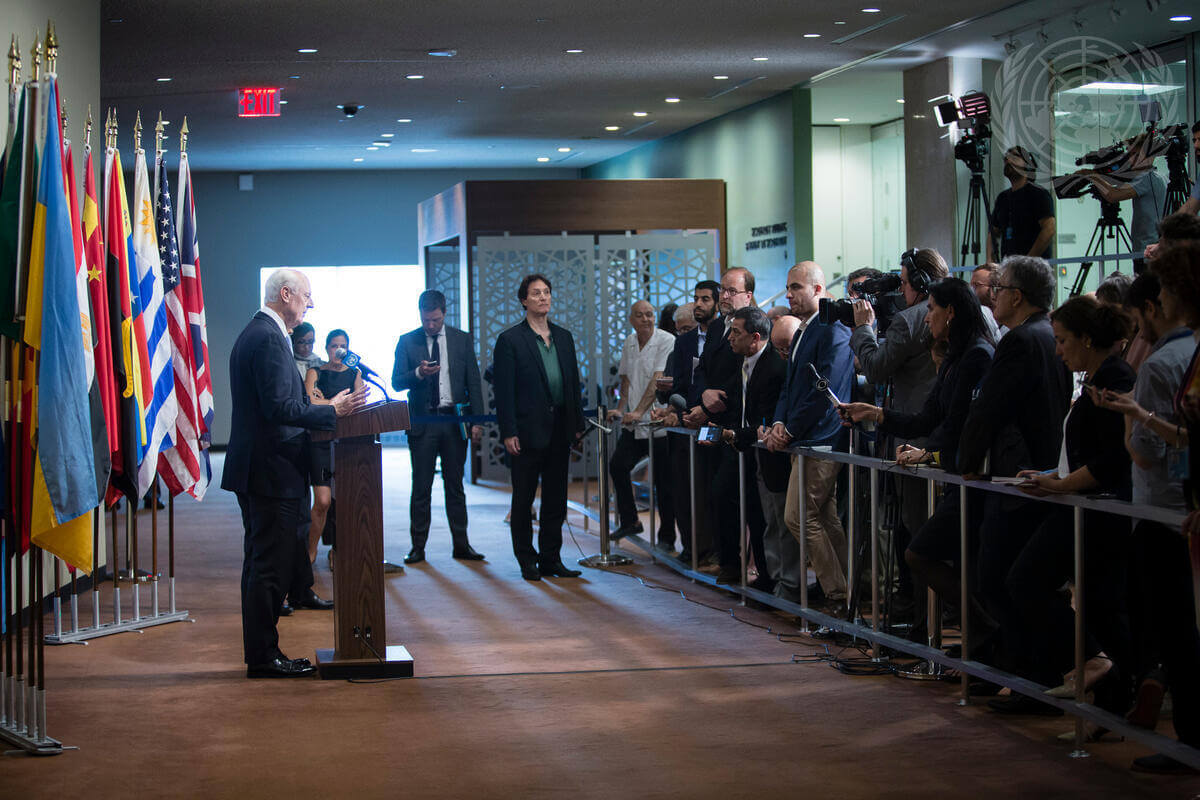
Another strategy used by the former Special Envoy for Syria, Staffan de Mistura, was facilitating a humanitarian task force that brought together member state representatives, UN personnel, and humanitarian organizations to discuss ceasefire violations and humanitarian access denials. This taskforce, last utilized in late 2024,50UN Office of the Special Envoy of the Secretary-General for Syria, “Statement Attributable to the United Nations Deputy Special Envoy for Syria Ms. Najat Rochdi following the Humanitarian Task Force,” October 7, 2024, accessed March 23, 2026, https://specialenvoysyria.unmissions.org/en/press-releases/statement-attributable-united-nations-deputy-special-envoy-syria-ms-najat-1. enabled collective brainstorming about how member states may be able to use their political capital to promote humanitarian access by the conflict parties and served to escalate humanitarian issues to the level of the UN Special Envoy and UN Emergency Relief Coordinator.51International Peace Institute, “United Nations Special Political Missions and Protection: A Principled Approach for Research and Policymaking,” 11-12.
Special Envoys can also play a coordinating role across the UN system regarding developments that may threaten the protection of civilians. In cases where it may be disadvantageous to an Envoy or their office to speak out on a given issue, a Special Envoy can use their role to encourage others within the UN system to shine a light on protection threats, facilitating who owns the messaging — be it the UN Country Team, a senior leader of a UN peacekeeping mission, individual UN agencies like OCHA, OHCHR, UNHCR, or UNICEF (including at regional or headquarters level), the Secretary-General’s spokesperson, or the Secretary-General. The Envoy can then more easily reiterate the messaging of others, lessening the risk of negative repercussions.52UN personnel, virtual interviews by author, October 24, 2024 and January 21, 2025.
Special Envoys, Resident Coordinators, and heads of regional offices or other peace operations may also be able to collectively manage their interactions with conflict parties to maximize their respective impacts. For instance, following the resurgence of South Sudan’s civil war in 2016 and the erosion of the relationship between the host authorities and the UN Mission in South Sudan (UNMISS), the former UN Special Envoy for Sudan and South Sudan, Nicholas Haysom, and then Head of UNMISS, David Shearer, strategically took different tones in messaging to the government on the protection of civilians. The nonresident Special Envoy’s forthright approach allowed the Head of UNMISS to take a lighter tone, preserving relationships on the ground and maintaining host-state consent for the peacekeeping mission.53International Peace Institute, “United Nations Special Political Missions and Protection: A Principled Approach for Research and Policymaking,” 21-22.
Special Envoys and their offices can also advise on, develop, and help inform the UN’s approach to addressing regional causes or exacerbators of conflict. This can be done by providing expert technical advice and building consensus among UN actors and member states in the region on thematic issues that impact the protection of civilians. The Office of the Special Envoy for the Horn of Africa, for example, coordinated the review and ongoing implementation of the UN’s conflict prevention strategy for the region; designed a climate, peace and security hub in coordination with the Intergovernmental Authority on Development (IGAD) to implement projects across the most climate-vulnerable parts of the Horn of Africa; and launched the UN’s regional strategy for tackling hate speech in late 2023.54UN General Assembly, Overall policy matters pertaining to special political missions: Report of the Secretary-General, A/79/303, 8 August 2024, para. 7 and 50.
Interacting With Conflict Parties and Affected Populations
When engaging conflict parties, the protection of civilians should remain centered within the Special Envoy’s political strategy for bringing about an end to conflict. It is imperative that Envoys and their offices continue to reiterate privately and publicly the primary responsibility of host authorities in protecting civilians, reinforcing the obligations of all conflict parties under international law. As such, Envoys can use their access to conflict parties or influential member states to advocate at the highest levels for measures that can better protect civilians. For instance, several UN personnel shared that the Special Envoy for Myanmar, Julie Bishop, has played a constructive role in “reminding countries [in the region] of their responsibilities and positions,” including on non-refoulement. In one situation, the Special Envoy’s bilateral advocacy helped prevent the transfer of several members of the National Unity Government present in Thailand back to Myanmar.55UN personnel, virtual interviews by author, October 24, 2024 and February 13, 2025.
Furthermore, Special Envoys can integrate discussion about the protection of civilians into bilateral and multilateral talks with conflict parties. A prime example of this is the work of the Special Envoys for Yemen on conflict-related detainees over the years, which has led to approximately 2,400-2,600 people being released from detention since the parties reached agreement on this matter in 2018.56UN personnel, virtual interview by author, January 23, 2025. The Office of the Special Envoy for Yemen engaged in significant shuttle diplomacy between the parties aimed at addressing their mutual interests before achieving an agreement between the parties on conflict-related detainees. The parties were only brought together to sign the agreement on paper once achieved. Total numbers of conflict-related detainees still held by the parties remain unknown, as there is no UN entity mandated to monitor or report on this issue in Yemen. UN personnel, virtual interview by author, January 23, 2025. And in the context of Sudan, the former Personal Envoy of the Secretary-General, Ramtane Lamamra, held proximity talks with the conflict parties on distribution of humanitarian aid and civilian protection issues in July 2024, amidst pervasive targeting of civilians and widespread war crimes and crimes against humanity by both parties. During these talks, the Rapid Support Forces (RSF) reportedly made commitments to allow the delivery of humanitarian aid into areas within its control, facilitate the safe movement of civilians, and strengthen protection of civilians efforts57UN, “Statement of the Personal Envoy of the Secretary-General for Sudan, Ramtane Lamamra, after the conclusion of the Geneva Proximity Talks,” July 19, 2024, accessed March 23, 2026, https://www.ungeneva.org/en/news-media/press-release/2024/07/statement-personal-envoy-secretary-general-sudan-ramtane-lamamra; and Security Council Report, “Sudan: Closed Consultations*,” July 28, 2024, accessed March 23, 2026, https://www.securitycouncilreport.org/whatsinblue/2024/07/sudan-closed-consultations-3.php. — essential steps to protect civilians, which, however, ultimately failed due to the RSF’s lack of implementation and insufficient external accountability.
Special Envoys can also connect with conflict-affected communities about protection and humanitarian issues and elevate their lived experiences, concerns, and recommendations. For instance, the Office of the Special Envoy for Syria, under the former leadership of Staffan de Mistura, initiated the Civil Society Support Room in January 2016, a forum hosted in Switzerland where Syrian civil society experts inform and advise the Special Envoy on pressing issues facing civilian communities. This mechanism, which continues today, serves as “an important driver of the Office of the Special Envoy’s engagement in humanitarian diplomacy,” granting the Office enhanced credibility and access to critical information about threats facing civilians, particularly as concerns insecure or hard-to-reach areas.58International Peace Institute, “United Nations Special Political Missions and Protection: A Principled Approach for Research and Policymaking,” 13. For discussion of the challenges this mechanism has faced, including as regards representation and ongoing relevance, see International Centre for Dialogue Initiatives, “Who Negotiates Peace? The Challenge of Inclusion in Syria,” Marie-Joëlle Zahar (August 2023), accessed March 23, 2026, https://dialogueinitiatives.org/who-negotiates-peace-the-challenge-of-inclusion-in-syria/; and International Peace Institute, “Against the Odds: Civil Society in the Intra-Syrian Talks.” The Office of the Special Envoy for Yemen also regularly conducts civilian consultations in country and across the diaspora, seeking to advance a “bottom-up vision for inclusive peace.” The Office, for instance, organized a 2024-2025 dialogue series with Yemeni civil society representatives to gather and leverage their insights, with civilians highlighting the need to establish mechanisms for the reintegration of armed groups, address rising humanitarian needs, and rebuild trust between local authorities and civilian communities.59UN Office of the Special Envoy of the Secretary-General for Yemen, “Third Public Report on the Political Dialogue series held in Aden from January 14 to 22, 2025 to advance Yemen’s peace process,” March 9, 2025, accessed April 7, 2026, https://osesgy.unmissions.org/en/news/third-public-report-political-dialogue-series-held-aden-january-14-22-2025-advance.
Additionally, Special Envoys can positively impact the protection of civilians by working to de-escalate political tensions and address underlying conflict drivers, such as through trust- and consensus-building, dialogue facilitation, mediation, and other good offices. In the case of Yemen, the Special Envoy’s engagement with the conflict parties led to a 2022 temporary truce that has remained in de facto effect ever since, despite intensifying regional tensions. Importantly, the maintenance of the truce led to the dissolution of all frontlines, causing violence between the internationally recognized government in the south and Ansar Allah in the northwest to decrease significantly and reducing civilian casualties in the process. 60UN personnel, virtual interviews, January 23, 2025 and November 5, 2024. And in the Great Lakes Region, the Office of the Special Envoy supported a field mission by the regional Contact and Coordination Group on the disarmament and reintegration of foreign armed combatants that successfully disarmed and worked to repatriate over a hundred foreign fighters in South Kivu, DRC in 2024.61UN personnel, virtual interview, November 21, 2024; and UN Security Council, 9742nd meeting, S/PV.9742, 8 October 2024, 3.
Conclusion
Civilian casualties in conflict around the world continue to climb; yet in several conflict settings, UN Special Envoys and their offices remain the only type of peace operation member states can agree to for the purpose of advancing peace. Though their material resources and presence on the ground may be limited, Special Envoys and their offices can seek to influence behavioral changes by conflict parties and those that enable them through dialogue and diplomatic engagement, which can lead to reduced civilian harm and help bring an end to conflict over time. Furthermore, a focus on the protection of civilians can support the political strategy of Special Envoys and their offices by improving the climate for talks, introducing new ideas or channels of communication, supporting confidence-building measures between the parties and with civilian populations, and creating space for a more inclusive peace process. Consistent engagement on the safety and protection of civilians can also increase awareness of human rights violations among the parties and UN member states without calling into question the impartiality of an Envoy and their office. And even if there is little scope for conflict resolution, the protection of civilians remains an essential component of conflict management — an inherent part of the role of a UN Special Envoy.
Although this paper highlights examples of UN Special Envoys and their offices demonstrating a positive impact on the protection of civilians, either intended or incidental in nature, the impact remains narrow in most cases. The protection of civilians also appears to be a lens not often used by Envoys and their offices at present, given the diplomatic framing of their work. Special Envoys and their offices should thus not be seen as a substitute for UN peacekeeping missions and the resources that they can bring to bear in directly protecting civilians. Nonetheless, Special Envoys may be able to increase their protection impact by integrating protection framing and considerations into their political strategy. Such an approach would also support Envoys in strengthening their preventive impact, as well as lessen risks to their relationships with conflict parties by centering threats to civilian safety and security from the start.
The protection of civilians, however, is fully dependent upon the political will of conflict parties and what they perceive to gain from implementing related measures. Given increasing trends around civilian harm in conflict and limits to their own political capital, it may be most likely that UN Special Envoys can promote changes in behavior by leveraging the influence of powerful member states, especially those with strong diplomatic, economic, or military ties with conflict parties. UN member states therefore have a critical role to play in coordinating with and amplifying the messaging of Special Envoys, as well as taking action to address or prevent further protection and humanitarian calamities. Furthermore, member state actions that internationalize and escalate conflict tensions, such as by providing military equipment, training, or funds to conflict parties, must be halted. Diplomatic engagement — including on the protection of civilians — will do little good if armed parties continue to benefit from waging war.
Looking towards the future, the UN’s role in reinforcing international peace and security must be safeguarded, with the protection of civilians central to this aim. The UN’s leadership and its member states should thus carefully consider how the full spectrum of peace operations can be utilized to advance protection where civilians remain under threat. In the case of Special Envoys and their offices, reliable political backing, private reinforcement, and provision of strategic guidance by the Secretary-General and influential member states are paramount to this objective. Even if capacity remains limited, prioritizing protection is essential. Doing so will help ensure the UN remains relevant — to the world’s governments and its peoples.
Acknowledgements
The author is deeply appreciative to all who offered their expertise and experience to this study. The author extends a special thanks to those who participated in interviews, including personnel from the UN Offices of the Special Envoys for the Great Lakes Region, Myanmar, and Yemen. Further thanks go out to Alischa Kugel, Steve Ross, Lisa Sharland, Teresa Whitfield, and Marie-Joëlle Zahar, as well as personnel within the UN Department of Political and Peacebuilding Affairs, for their insights and comments on earlier drafts.
All views reflected herein remain the responsibility of the author.
This paper was made possible by generous support from Global Affairs Canada.

Annex
Background on UN Special Envoys and Their Offices62The table omits discussion of the UN Special Envoy for implementation of Security Council Resolution 1559 (2004), as this post has been vacant since July 2016. UN General Assembly, Proposed programme budget and revised estimates for 2026, A/80/7/Add.11, para. 41.
| Appointment Process | Mandate | Office Budget and Personnel1For all figures, see UN General Assembly, Resolution adopted by the General Assembly on 30 December 2025: Special subjects relating to the proposed programme budget for 2026, A/RES/80/243. Number of personnel in each office includes the respective Special Envoy. | Political Process and Other UN Tools | |
|---|---|---|---|---|
| Great Lakes Region | The UN Special Envoy for the Great Lakes Region was appointed in March 2013 by UN Secretary-General Ban Ki-moon, which the Security Council welcomed through Resolution 2098 (2013). The idea of designating a special envoy to address the causes of the conflict in eastern DRC was raised by the Council in November 2012 (Resolution 2076). Current Envoy: Mr. Huang Xia (China, appointed in January 2019)2For Huang Xia’s bio, see UN, “Huang Xia,” accessed April 7, 2026, https://www.un.org/sg/en/appointments/sesg-gl/huang-xia-0. | The Special Envoy’s mandate is to coordinate, support, and assess member state implementation of the 2013 Peace, Security and Cooperation (PSC) Framework for the DRC and the Region, and to lead an inclusive political process aimed at addressing the root causes of the conflict.3See UN Security Council, Resolution 2098 (2013), S/RES/2098 (2013), 28 March 2013, para. 4. | Office Budget for 2026: $4,780,100 Number of Personnel for 2026: 24 The Office of the Special Envoy for the Great Lakes has staff based in Nairobi, Kenya, as well as a small liaison team to the African Union in Addis Ababa, Ethiopia. | Political Process: The Special Envoy’s engagement with member states in the region remains ongoing in support of the PSC Framework, as well as in implementing the 2020 UN Strategy for Peace Consolidation, Conflict Prevention and Conflict Resolution in the Great Lakes Region and subsequent action plans.4UN Department of Political and Peacebuilding Affairs, “Factsheet: Special Envoy for the Great Lakes Region,” accessed April 7, 2026, https://dppa.un.org/en/factsheet/special-envoy-great-lakes-region. The Envoy has also been engaged in the various peace talks aimed at ending the conflict in eastern DRC.5UN personnel, virtual interviews, November 21, 2024 and January 21, 2025. Other Peace Operations: The UN Organization Stabilization Mission in the DRC (MONUSCO) remains present, with a mandate to protect civilians. The UN Regional Office for Central Africa, based in Gabon, also covers many countries included in the work of the Special Envoy for the Great Lakes, such as the DRC; it does not have civilian protection language in its mandate. Human Rights Council mechanisms: Independent Commission of Inquiry on the Human Rights Situation in the South and North Kivu Provinces of the DRC, and the Special Rapporteur on the human rights situation in Burundi. |
| Horn of Africa | The UN Special Envoy for the Horn of Africa was first appointed in October 2018 by Secretary-General António Guterres, thereby expanding the prior post of the Special Envoy for the Sudan and South Sudan. This change resulted due to changes in bilateral relations between countries in the region.6UN Department of Political and Peacebuilding Affairs, “Factsheet: Special Envoy for the Horn of Africa,” accessed April 7, 2026, https://dppa.un.org/en/special-envoy-horn-africa. Current Envoy: Mr. Guang Cong (China, appointed in July 2025)7For Guang Cong’s bio, see UN, “Guang Cong,” accessed April 7, 2026, https://www.un.org/sg/en/appointments/2025-07-17/guang-cong. | The Special Envoy’s mandate is to assist IGAD and other regional entities in reinforcing peace and security gains, in conducting good offices and improving capacities for conflict prevention and mediation, and in addressing cross-cutting issues (such as concerns women, youth, and the climate).8The mandate for the Special Envoy for the Horn of Africa comes from an exchange of letters between the Secretary-General and the President of the Security Council. See UN Security Council, Letter dated 24 October 2018 from the Secretary-General addressed to the President of the Security Council, S/2018/955 and UN Security Council, Letter dated 31 October 2018 from the President of the Security Council addressed to the Secretary-General, 1 November 2018, S/2018/979. | Office Budget for 2026: $1,619,600 Number of Personnel for 2026: 9 The Office of the Special Envoy for the Horn of Africa has its staff based in Addis Ababa, Ethiopia. | Political Process: The Special Envoy and their office continue to support the related efforts of IGAD, in accordance with the mandate. The Envoy’s engagement has also focused on implementing the 2019-2024 UN Comprehensive Regional Prevention Strategy for the Horn of Africa, which sought to coordinate and optimize UN efforts to prevent conflict and sustain peace in the region.9UN Department of Political and Peacebuilding Affairs, “Factsheet: Special Envoy for the Horn of Africa.” Other Peace Operations: The UN Mission in South Sudan (UNMISS) remains present, with a mandate to protect civilians. The UN Transitional Assistance Mission in Somalia (UNTMIS) is also present; however, it does not have a mandate to protect civilians. Additionally, the UN Personal Envoy for Sudan conducts high-level diplomacy in the region, focused on ending the war in Sudan; however, the Envoy and their office do not have civilian protection language in their mandate. Human Rights Council mechanisms: Independent International Fact-Finding Mission for the Sudan, Commission on Human Rights in South Sudan, and the Special Rapporteur on the situation of human rights in Eritrea. |
| Myanmar | The General Assembly requested that the Secretary-General establish the post of the Special Envoy for Myanmar in 2017 through the adoption of Resolution 72/248, following a halt in requests for the use of the Secretary-General’s good offices in 2016.10Prior to this cleavage, there had been three prior UN Special Envoys for Myanmar, spanning the years 1995-2009, and a Special Adviser on Myanmar from 2012-2016 (although Vijay Nambiar, who served in the latter role, informally commenced his work on the file in 2010 while serving as Chief of Staff under Secretary-General Ban Ki-moon). Current Envoy: Ms. Julie Bishop (Australia, appointed in April 2024)11For Julie Bishop’s bio, see UN, “Julie Bishop,” accessed April 7, 2026, https://www.un.org/sg/en/appointments/sesg-myr/julie-bishop. | Under the heading of the “situation of human rights of Rohingya Muslims and other minorities in Myanmar,” the Special Envoy’s mandate is to facilitate “engagement and inclusive dialogue with all relevant stakeholders, including civil society, and affected populations.” The Envoy is also mandated to report to General Assembly every six months or as called for by the situation on the ground.12UN General Assembly, Resolution adopted by the General Assembly on 16 December 2021, A/RES/76/180, 2 and para. 22. | Office Budget for 2026: $957,200 Number of Personnel for 2026: 5 The Office of the Special Envoy for Myanmar has no staff based in country. | Political Process: The Special Envoy is engaging all stakeholders in assessing opportunities to re-invigorate a political peace process, in coordination with the Association of Southeast Asian Nations (ASEAN). There is no UN peace operation on the ground in Myanmar. Human Rights Council mechanisms: Independent Investigative Mechanism for Myanmar and the Special Rapporteur on the situation of human rights in Myanmar. |
| Syria | The General Assembly first requested that the Secretary-General appoint a Special Envoy for Syria in February 2012 through Resolution 66/253, to support the efforts of the League of Arab States in resolving the Syrian crisis. Current Envoy: Post is vacant as of early 2026. Mr. Geir O. Pedersen (Norwegian, appointed in October 2018) stepped down as Special Envoy near the end of 2025.13UN Office of the Special Envoy of the Secretary-General for Syria, “Statement Attributable to United Nations Special Envoy for Syria Mr. Geir O. Pedersen,” September 18, 2025, accessed April 7, 2026, https://specialenvoysyria.unmissions.org/en/press-releases/statement-attributable-united-nations-special-envoy-syria-mr-geir-o-13. | The Special Envoy is tasked with leading the UN’s efforts to implement Security Council Resolution 2254 (2015), which calls for a “Syrian-led and Syrian-owned political transition” based on the 2012 Geneva Communiqué and demands that all parties take appropriate steps to protect civilians.14UN Security Council, Resolution 2254 (2015), S/RES/2254 (2015), 18 December 2015, para. 1. The Envoy is specifically responsible for bringing together “representatives of the Syrian government and the opposition to engage in formal negotiations on a political transition process…”, as well as advancing options to establish a nationwide ceasefire.15Ibid., paras. 2 and 6. Given the collapse of Bashar al-Assad’s regime in December 2024, the Security Council is in the process of evaluating the UN’s future role and presence in country. The Secretariat prepared an integrated strategic assessment on this topic in mid-2025.16Security Council Report, “Syria: March 2026 Monthly Forecast,” March 2, 2026, accessed April 7, 2026, https://www.securitycouncilreport.org/monthly-forecast/2026-03/syria-89.php. | Office Budget for 2026: $12,742,000 Number of Personnel for 2026: 66 The Office of the Special Envoy for Syria has staff based in Damascus, as well as in Geneva, Switzerland, where its main office is currently located. Efforts are ongoing to move the Special Envoy’s office to Damascus.17Security Council Report, “Syria: April 2026 Monthly Forecast,” April 1, 2026, accessed April 7, 2026, https://www.securitycouncilreport.org/monthly-forecast/2026-04/syria-90.php. | Political Process: The Office of the Special Envoy remains heavily engaged in supporting Syria’s ongoing political transition under the principles of Security Council Resolution 2254 (2015). Other Peace Operations: Located in the Golan Heights, the UN Disengagement Observer Force (UNDOF) is mandated to oversee the implementation of the armistice agreement between Israel and Syria. It does not have a mandate to protect civilians. Human Rights Council mechanism: Independent International Commission of Inquiry on the Syrian Arab Republic. |
| Yemen | Secretary-General Ban Ki-moon appointed Jamal Benomar to the post of Special Adviser to the Secretary-General on Yemen in April 2011, to provide good offices in support of a political transition in Yemen.18UN, “Jamal Benomar Appointed Special Adviser to Secretary-General on Yemen,” August 1, 2012, accessed April 7, 2026, https://press.un.org/en/2012/sga1365.doc.htm. Through Resolution 2051 (2012), the Security Council requested that the Special Adviser continue providing good offices on behalf of the Secretary-General and advanced the idea of establishing a UN presence in Yemen to support this effort.19UN Security Council, Resolution 2051 (2012), S/RES/2051 (2012), 12 June 2012, para. 16. The Office of the Special Adviser to the Secretary-General on Yemen was created following an exchange of letters between the Secretary-General and president of the Security Council. See UN Security Council, Letter dated 18 June 2012 from the Secretary-General addressed to the President of the Security Council, S/2012/469, 2 and UN Security Council, Letter dated 21 June 2012 from the President of the Security Council addressed to the Secretary-General, S/2012/470, 1. Although Benomar served under the title of Special Adviser until he stepped down in April 2015, the functionalities of the post align with those of a Special Envoy. For this reason, Benomar is often referred to as the first Special Envoy for Yemen. Subsequent appointees carried the latter title. Current Envoy: Mr. Hans Grundberg (Sweden, appointed in August 2021)20For Hans Grundberg’s bio, see UN, “Hans Grundberg,” accessed April 7, 2026, https://www.un.org/sg/en/appointments/osesgy/hans-grundberg. | Through Resolution 2216 (2015), the Security Council called for the Secretary-General to strengthen his good offices role in Yemen. The Special Envoy is thus mandated to exercise good offices in support of “a peaceful, inclusive, orderly and Yemeni-led political transition process that meets the legitimate demands and aspirations of the Yemeni people, including women, for peaceful change and meaningful political, economic and social reform, ….”21UN Security Council, Resolution 2216 (2015), S/RES/2216 (2015), 14 April 2025, para. 13. Following this resolution, the UN Office of the Special Adviser on Yemen transitioned into the UN Office of the Special Envoy for Yemen. | Office Budget for 2026: $14,159,100 Number of Personnel for 2026: 81 The Office of the Special Envoy for Yemen has staff based in country, including in Aden and Sana’a, as well as in Amman, Jordan. | Political Process: The Special Envoy is actively engaged in efforts to establish a roadmap for a viable political process, with three tracks dedicated to economic, security, and political issues respectively.22UN personnel, virtual interview by author, November 5, 2024. Other Peace Operations: With the Security Council’s decision to end the mandate for the UN Mission to Support the Hudaydah Agreement (UNMHA) in March 2026,23UN Security Council, Resolution 2813 (2026), S/RES/2813 (2026), 27 January 2026, para. 1. there are no other UN peace operations present in Yemen. UNMHA’s mandate did not contain language on protection. There are no current Human Rights Council mechanisms that focus on Yemen. |
Header Image: Staffan de Mistura, then UN Special Envoy for Syria, briefs journalists following a Security Council meeting on the situation in Syria in 2017. UN Photo/Rick Bajornas.




Community Adaptation for a Water Festival Without Clean Water