
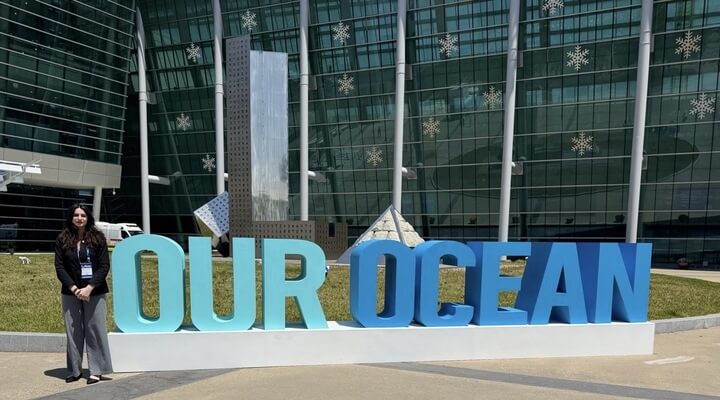
This year’s Our Ocean Conference held from April 28 to 30 in Busan, Republic of Korea, marked a decade of mobilizing governments, civil society organizations, academics, and industry representatives to discuss innovative and concrete actions to meet the threats facing the world’s oceans and coastal communities—and a critical opportunity to reflect on 10 years of ocean commitments and ocean action. The OOC 10 Year Progress Report, launched on day one of the conference, assesses ten years of turning conference commitments into action and solutions. Since its inception in 2014, the conference has generated 2,618 commitments to ocean action totaling US$160 billion in pledged funds. As of January 2025, 38 percent are in progress and 43 percent have been completed by a mix of governmental institutions, non-governmental organizations, intergovernmental institutions, the private sector, philanthropic organizations, and academia.
2025 has been dubbed “The Year of the Ocean.” This year is packed full of milestone ocean action events beginning with the 10th Our Ocean Conference leading up to the UN Ocean Conference taking place in Nice, France from June 9 to 13, COP30 in Belem, Brazil from November 10 to November 21, and numerous other high-profile events occurring on the margins of these international conferences.
These milestone conferences come at a time when our oceans are facing unprecedented and multidimensional challenges: last year the ocean was warmer than any time in the past 65 years of recorded observation, 14 million tons of plastic end up in the ocean every year, and ecological health beyond national jurisdiction is under threat from deep seabed mining and distant water fishing fleets. Sustainable Development Goal 14, Life Below Water, is the lowest funded of all SDGs with funding commitments lagging far below the estimated funding needs of US$174.52 billion per year.
Ambition is high to take on these threats. Globally, governments and civil society are rallying support for the ratification of the High Seas Treaty and the World Trade Organization Agreement on Fisheries Subsidies in the lead up to the UN Ocean Conference. Simultaneously, negotiations continue amongst governments to establish a Global Plastics Treaty and at the International Seabed Authority to establish regulations on deep-sea mining beyond national jurisdiction.
The excitement was palpable at this year’s Our Ocean Conference. The Stimson Environmental Security Program was on the ground for a week of events, receptions, and meetings at the center of the action.
Dialogue to Drive Ocean Innovation and Ocean Action
Engagements at the 10th Our Ocean Conference underscored the importance of convening a broad spectrum of stakeholders in the policymaking process to forge innovative and multi-sectoral collaboration.
Digital Oceans: Highlighting the Adaptability of the CORVI Methodology
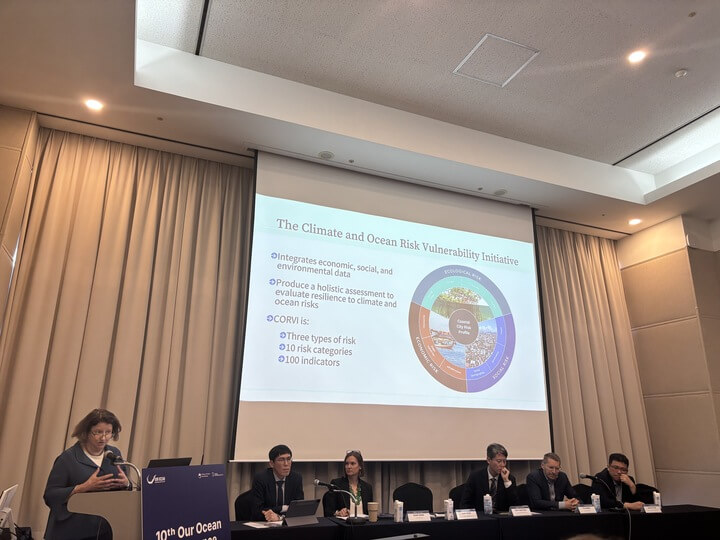
“Digital Oceans” took center stage at this year’s conference, with a focus on harnessing technology to advance ocean sustainability. During a panel hosted by the Korean Ministry of Oceans and Fisheries and Busan Metropolitan City, Stimson’s Environmental Security Program Director Sally Yozell showcased the Climate and Ocean Risk Vulnerability Initiative (CORVI)—a powerful tool bridging critical data gaps in vulnerable coastal regions.
Policymakers often struggle to prioritize climate adaptation efforts due to fragmented or incomplete data, particularly at the local level. CORVI addresses this challenge by integrating environmental, economic, and governance risk factors, combining existing data sources with surveys and interviews with local experts to provide a comprehensive picture of a coastal community’s climate risks. This multidimensional approach provides decision-makers with a clearer, localized picture of climate threats—a stark contrast to broader national or regional assessments.
Currently active in 16 coastal communities worldwide, CORVI has become an indispensable resource for building resilience. Each assessment refines the methodology, ensuring findings are more actionable and effectively communicated to policymakers. Its adaptability was recently demonstrated in Southeast Asia, where CORVI was tailored to assess risks from illegal, unreported, and unregulated (IUU) fishing—proving its value in a multitude of data-scarce environments.
Convening Counter-IUU Fishing Stakeholders
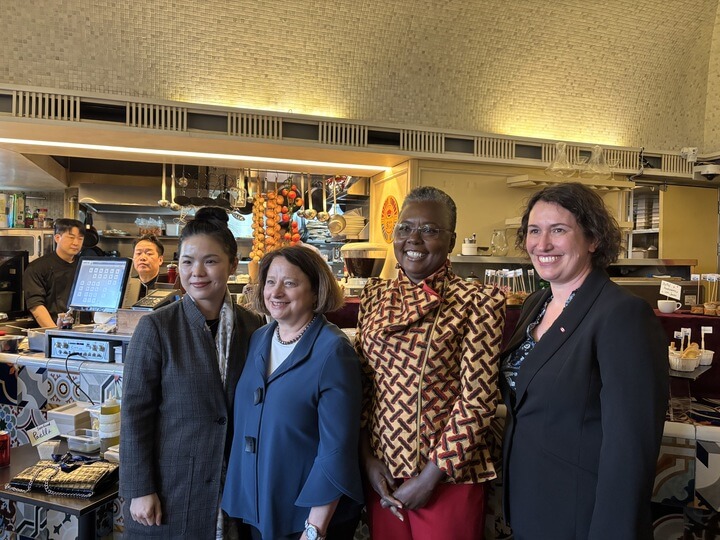
As Secretariat of the Illegal, Unreported, and Unregulated (IUU) Fishing Action Alliance (IUU-AA), the Stimson Center brought together key stakeholders for a high-level reception during the conference. The gathering underscored the Alliance’s growing role as the only global coalition solely dedicated to combating IUU fishing—an issue that Korea’s Minister of Oceans and Fisheries, Kang Do-Hyung, emphasized in his opening remarks: “As the only Asian member of the IUU Fishing Action Alliance, Korea recognizes the vital importance of international cooperation in vessel monitoring, fishing activity transparency, and seafood traceability.”
Launched at the 2022 UN Ocean Conference by the UK, U.S., and Canada, the IUU-AA has since expanded to 12 Member States and 12 Supporter organizations, uniting governments and private actors under a shared commitment to safeguard fisheries and maritime governance. The IUU-AA enables members to speak with one voice in global forums, amplifying efforts to curb IUU fishing’s devastating impacts on ocean ecosystems, coastal communities, and the rule of law.
The reception fostered dynamic exchanges among IUU-AA members, civil society groups, and regional coalitions, including the U.S. IUU Fishing and Labor Rights Coalition, the EU IUU Fishing Coalition, and the Japan IUU Forum, and other key members of the counter-IUU fishing community. Darcy DeMarsico, Deputy General of Fisheries and Oceans Canada, representing Canada as Chair of the alliance, remarked on key priorities for the IUU-AA under Canada’s Chairmanship and in the lead-up to the 2025 UN Ocean Conference, while Ghana’s Minister of Fisheries and Aquaculture, the Honorable Emilia Arthur, reaffirmed her country’s commitment to the cause. Riley Parks of South Korea’s Foreign Ministry highlighted national efforts to counter IUU fishing, setting the stage for an evening of strategic dialogue and new partnerships. It was a great event filled with stimulating discussions on new and emerging work, new partnerships, and the convening of new and old friends.
Redefining Maritime Security in the 21st Century
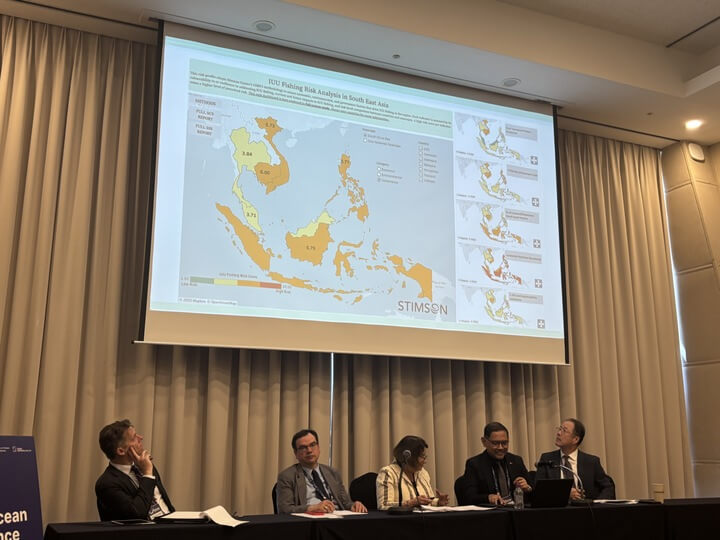
On the conference’s third and final day, the Center for Strategic and International Studies and the Stimson Center co-hosted a forward-looking panel examining how modern maritime security challenges are reshaping traditional concepts of ocean governance. The discussion brought together diverse perspectives on managing competing interests in an increasingly complex maritime domain.
Former U.S. Secretary of the Navy Carlos Del Toro set the stage with opening remarks, emphasizing how governments must adapt to evolving multidimensional threats at sea. The conversation then turned to specific regional challenges, with the Philippines’ Assistant Secretary for Maritime and Ocean Affairs highlighting how diplomacy remains crucial for pursuing national interests in the contested South China Sea. Stimson’s Environmental Security Director Sally Yozell contributed critical insights from the Center’s work on IUU fishing in Southeast Asia, presenting key findings from their risk analysis of illegal fishing activities in the South China Sea. The discussion broadened as Alex L.J. Shyy of Taiwan’s International Cooperation and Development Fund demonstrated how development finance and sustainability initiatives can foster stability in coastal communities. Former Assistant Secretary Steve Brock rounded out the conversation by addressing the U.S. perspective on expanding traditional definitions of maritime security to address emerging challenges. The panel collectively underscored how climate change, natural resource extraction, illegal fishing, and geopolitical tensions are transforming our understanding of ocean security in this century.
Building Resilience and Sustainable Blue Economies in Island States
Of the 20 most vulnerable countries to the impacts of climate change, 14 are found in the Indo-Pacific. Sea level rise, coupled with winds and storm surge, is, as one Pacific Island leader described, “literally washing us away.” Against this urgent backdrop, the Stimson Center and Sasakawa Peace Foundation convened policymakers, experts, and funders on Day Three to chart solutions for climate-resilient blue economies. Moderated by Stimson’s Sally Yozell, the panel drew on lessons from the Climate and Ocean Risk Vulnerability Initiative to spotlight actionable strategies.
Dr. Noralene Uy, Assistant Secretary of the Philippines’ Department of Environment and Natural Resources, showcased how community-driven data from citizen science and ecological mapping to climate risk assessments has unlocked financing and grounded resilience policies in local realities. She pointed to Stimson’s Dagupan CORVI as a model for integrating community perspectives into policy planning. Cook Islands’ Minister of Foreign Affairs Tingika Elikana amplified the voice of small island states, discussing the unique challenges face by small island states, the need for financial support from funding institutions, and stressing the delicate balance when building resilience between preserving traditional knowledge and adopting new technologies to build capacity for their domestic workforce. Financing mechanisms took center stage as ADB’s Toru Kubo detailed efforts to quantify climate risks and attract private investment, while Sasakawa Peace Foundation’s Masanori Kobayashi highlighted grants that empower communities to blend nature-based solutions with cutting-edge monitoring tools. Together, the discussion underscored a unifying theme: resilience demands innovation, but also inclusivity—bridging global expertise with the needs of those on the frontlines.
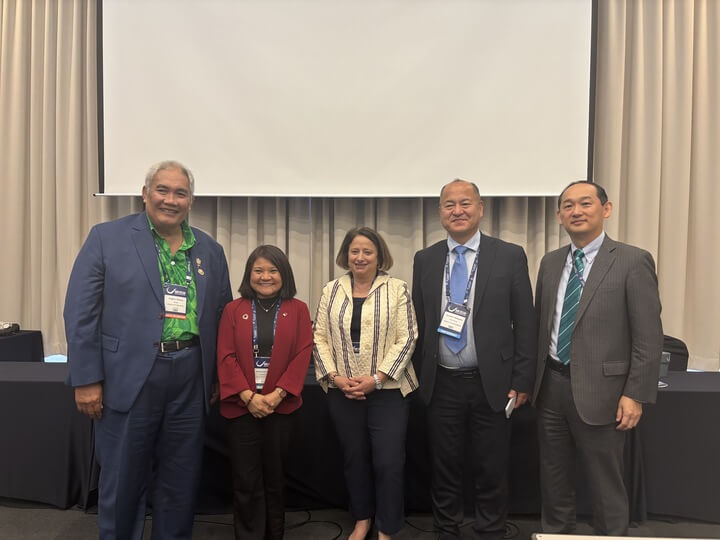
From left to right: Minister Tingika Elikana, Assistant Secretary Dr. Noralene Uy, Sally Yozell, Masanori Kobayashi of the Sasakawa Peace Foundation, and Toru Kubo of the Asian Development Bank.
What’s Next in the Year of the Ocean?
As the 10th Our Ocean Conference demonstrated, the past decade has seen significant commitments and progress in safeguarding our oceans, but the road ahead remains steep. With the UN Ocean Conference, COP30, and other pivotal events on the horizon, 2025 must be a turning point. The challenges are immense: rising ocean temperatures, rampant marine pollution, unsustainable fishing practices, and the urgent need to secure and implement global agreements like the High Seas Treaty and the Plastics Treaty.
The Stimson Center’s work at OOC—from advancing digital solutions like CORVI to fostering alliances against IUU fishing and redefining maritime security—highlights the power of collaboration, innovation, and data-driven policymaking. The Year of the Ocean demands more than pledges—it requires accountability, scalable solutions, and inclusive partnerships that center the voices of vulnerable coastal communities. In November, Brazilian President Luiz Inácio Lula da Silva and French President Emmanuel Macron unveiled the “Road from Nice to Belém” initiative – a strategic effort to create continuity between the 2025 UN Ocean Conference in Nice and COP30 in Belém. This critical linkage underscores how ocean health and climate action are fundamentally interconnected, establishing a policy pipeline to ensure UNOC commitments are not only maintained but amplified at the crucial climate summit. As we move toward Nice and beyond, governments, civil society, and the private sector must seize the opportunity to keep building momentum and act with urgency, transparency, and shared purpose.


Community Adaptation for a Water Festival Without Clean Water