
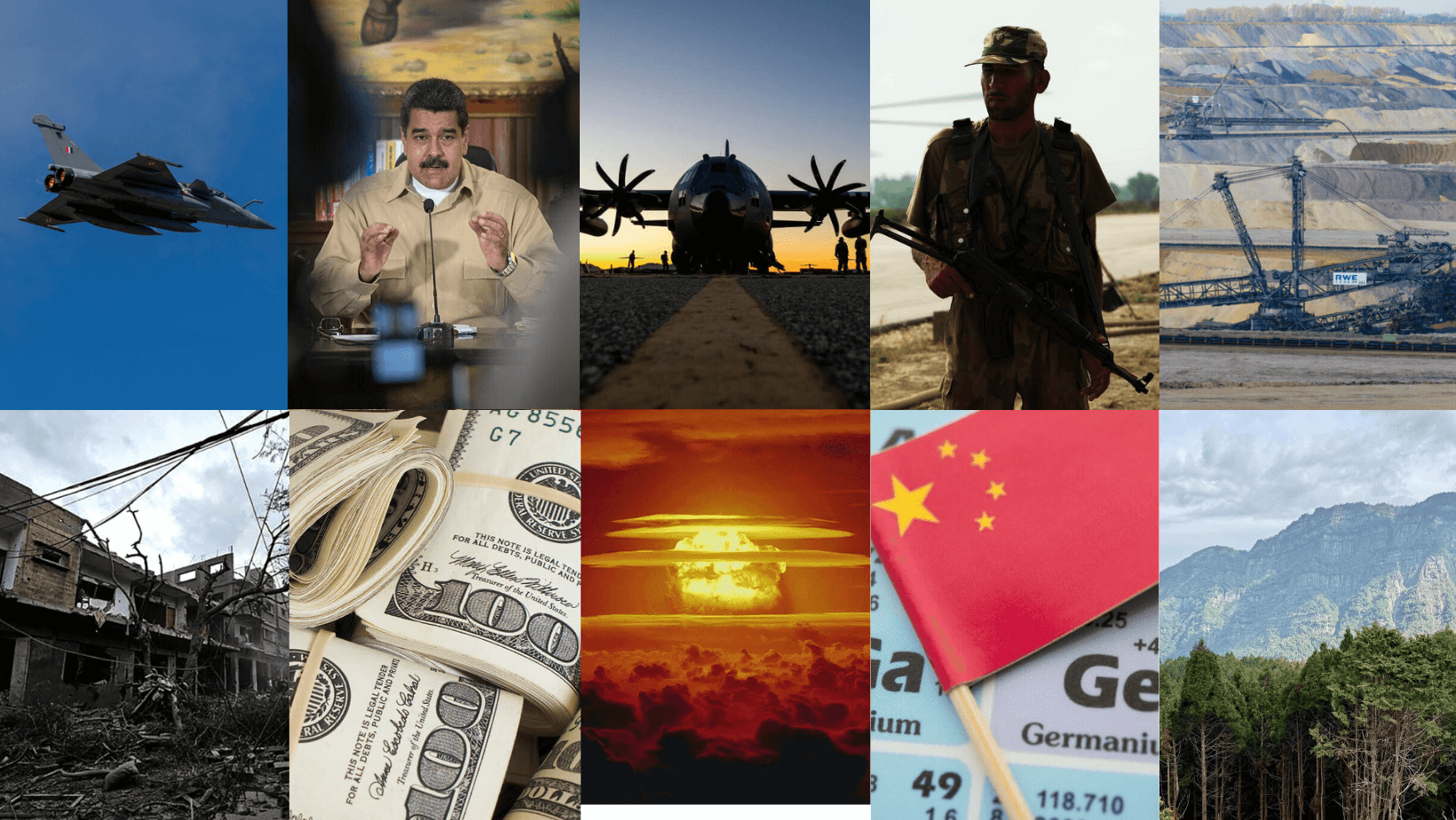
#10. Competing for Africa’s Resources: How the US and China Invest in Critical Minerals
Critical minerals remained a vital topic in 2025, closely following tech development trends between the U.S. and China. Our China Program monitored both countries’ overall presence on the African continent and its implications for continued great power competition through the year.
#9. Gambling on Armageddon: How US Nuclear Policies Are Undercutting Deterrence and Lowering the Threshold for Nuclear War
Ahead of changes to U.S. nuclear modernization policy in the second Trump administration this year, experts Geoff Wilson, Christopher Preble, and Lucas Ruiz took the lead on outlining a more responsible strategy of nuclear deterrence in a destabilized world.
#8. China’s Germanium and Gallium Export Restrictions: Consequences for the United States
In this issue brief from mid-March, Research Associate Sarah Godek explains how the U.S. could take advantage of loopholes within Chinese export control policy to bring germanium and gallium exports into the country following China’s latest trade restrictions.
#7. The Strategic Costs of US Strikes Against Venezuela
In early October, Evan Cooper and Alessandro Perri reacted to the U.S. strikes on civilian ships in the Caribbean and the implications for military intervention and regime change in Venezuela and broader conflict in the region.
#6. Top Ten Global Risks for 2025
In early January, experts Mathew Burrows and Robert Manning presented their annual forecasting projections on the probable global risks and scenarios ahead, and the new layers of conflict affecting international stability in 2025.
#5. Cratering Effects: Chinese Missile Threats to US Air Bases in the Indo-Pacific
In late December of 2024, experts Kelly A. Grieco, Hunter Slingbaum, and Lt. Col. Jonathan M. Walker revealed the critical gaps in U.S. airpower projection and capacity, especially for U.S. extended deterrence commitments in the Indo-Pacific.
#4. Keys to Developing a More Efficient, Effective Defense at Lower Cost
As the Department of Government Efficiency (DOGE) began taking action against government spending in late January, Stimson Research Analyst Julia Gledhill, along with William D. Hartung and Gabe Murphy, laid out the potential pathways to tackle wasteful Pentagon inefficiency.
#3. Rethinking the Threat: Why China is Unlikely to Invade Taiwan
Following on-the-ground fieldwork in the summer, experts Dan Grazier, James Siebens, and MacKenna Rawlins demystified the commonly held assumptions about Taiwan invasion scenarios and illustrated the geostrategic and political realities that would complicate such an operation.
#2. Five Key Concepts to Understand the India-Pakistan Crisis
Our South Asia Program took the initiative in mid-May to explain the strategic concepts and technologies at play during the India-Pakistan Crisis, and offered fresh analysis and expert opinions on the conflict.
#1. Four Days in May: The India-Pakistan Crisis of 2025
Just weeks after the India-Pakistan crisis broke out, Nonresident Fellow Christopher Clary provided one of the earliest assessments of the conflict, drawing on deep regional expertise and real-time analysis. This working paper became the most-read publication in Stimson’s history.




Community Adaptation for a Water Festival Without Clean Water