
Introduction
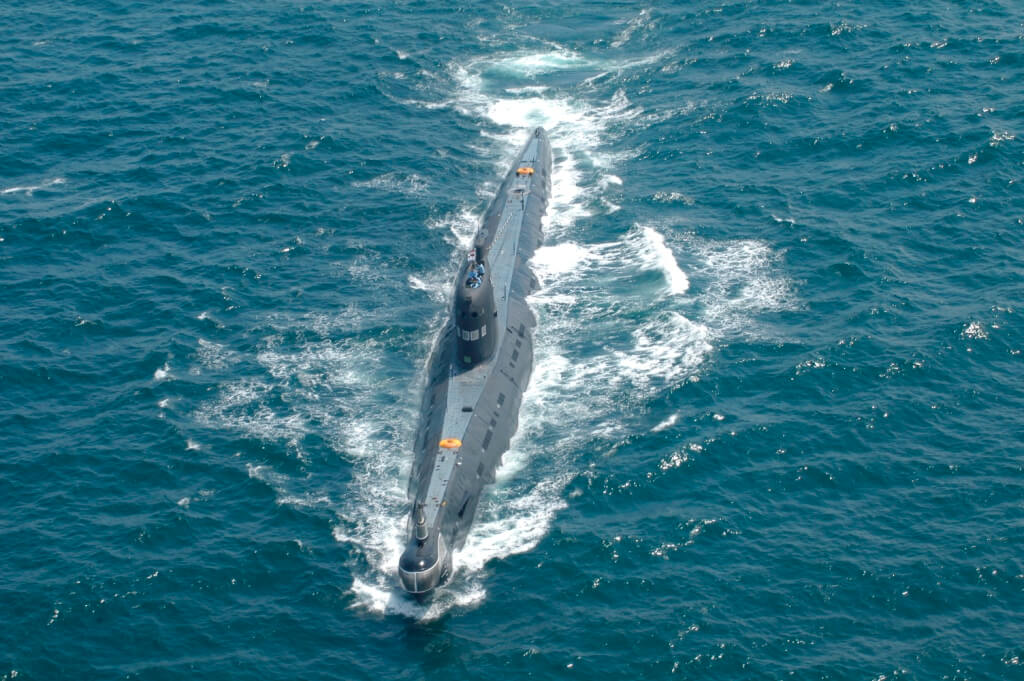
On August 29, 2024, the Indian Navy officially commissioned1Shivani Sharma, “INS Arighat, India’s second nuclear-submarine, commissioned into Navy,” India Today, August 29, 2024https://www.indiatoday.in/india/story/ins-arighat-second-nuclear-submarine-commissioned-navy-visakhapatnam-2590097-2024-08-29 the INS2INS stands for Indian Naval Ship. Arighaat — India’s second nuclear-powered and nuclear-armed submarine (SSBN).3SSBN stands for ship, submersible, ballistic, nuclear, implying that the submarine is nuclear propelled and capable of firing ballistic missiles. An SSN is a nuclear-powered general attack submarine that does not have ballistic missile capabilities. Although another SSBN, the INS Arihant, had already demonstrated4Amit Saksena, “INS Arihant: A Giant Stride for India?” Institute of Peace and Security Studies, June 16, 2014, https://www.ipcs.org/comm_select.php?articleNo=4519 India’s technological capabilities in 2016, the INS Arighaat represents a more significant advancement of India’s sea-based deterrent.5The Indian Ministry of Defence deems the Arighaat to be more advanced than the Arihant, especially because it has more indigenous components in its design and build and has the capability of firing the newer, longer-range K-4 ballistic missile. However, since the Arighaat is part of the Arihant-class of submarines, its length, displacement, propulsion, and speed are the same as that of its predecessor. It also reflects the Indian Navy’s growing profile in the Indian Ocean Region (IOR), especially against its South Asian rival, the Pakistani Navy. In addition, the increase6Amrita Dutta, “Uptick in Chinese vessels’ presence in Indian Ocean region: Official,” Indian Express, March 28, 2024, https://indianexpress.com/article/india/chinese-vessels-presence-in-indian-ocean-region-9237134/ in the net number of People’s Liberation Army Navy (PLAN) surface and sub-surface vessels in the Indian Ocean at any given time has expanded the Indian Navy’s threat matrix to include PLAN-Pakistan Navy cooperation as a subset of the overall perceived threats from both Pakistan and China.
Presently, India’s SSBNs are the principal nuclear-armed vessels patrolling the Indian Ocean within the China-India-Pakistan strategic complex. This situation is likely to change over time, however, as Chinese nuclear-powered and conventionally armed submarines (SSNs) make increasing forays into the Indian Ocean and Pakistan’s sea-based deterrent progresses. Indeed, India’s and Pakistan’s navies have both committed to extensive expansion and modernization programs, even as their bilateral relationship has gone from unstable (2016-2021) to relative stasis (2021-present). Set against security challenges in the IOR, including Somali piracy and Houthi missile, drone, and hijacking threats, intensifying maritime competition between India and Pakistan requires that policymakers and analysts devote attention to the conventional and nuclear risks associated with increasing competition.
This memo examines the Indian and Pakistani Navies’ trajectories of modernization through their doctrinal outlooks, fleet character, and external engagements. It also analyzes the development of both countries’ naval nuclear deterrents and outlines the new space for contestation and cooperation for both forces. With a specific focus on the novelty of the South Asian naval nuclear theater, the memo outlines the need for a fresh Incidents at Sea Agreement (INCSEA), better crisis communication between both navies, and broader bilateral and multilateral interactions to address new risks in the maritime domain.
Directions of Modernization
The level of a navy’s modernization can be determined by assessing at least three factors. The first and most intuitive is to analyze a navy’s doctrines, which dictate the service’s strategic outlook and means to achieve its goals. The second is to not only determine the type of vessels a navy is acquiring but to also analyze its “fleet character” (a term created for this memo, explained below). The third approach is to explore a navy’s interactions with its counterparts in the open seas, which allows policymakers and analysts to see doctrines in action and prioritize any changes.
Doctrinal Outlooks
In 2009, the Indian Navy categorized the Red Sea as an area of “secondary interest” in its maritime doctrine. By 2015, the Indian Navy had elevated the Red Sea to become a “primary interest,” also adding the Gulf of Oman; the Gulf of Aden and their littoral regions; the Southwest Indian Ocean, including IOR island nations therein; and the East Coast of Africa littoral regions to the category.7Ministry of Defence (Navy), Government of India, “Indian Maritime Doctrine, Indian Navy,” Naval Strategic Publication 1.1: 68. See also: Darshana Baruah, “India’s Evolving Maritime Strategy,” Diplomat, December 3, 2015, https://thediplomat.com/2015/12/indias-evolving-maritime-strategy/ Notably, between 2010 and 2015, an uptick in Somali piracy intensified the perceived maritime threat close to the Red Sea, leading regional navies — including India — to prepare a coordinated response.
In 2018, the Pakistani Navy’s doctrine declared the northern Arabian Sea to be its primary area of interest, with the broader western Indian Ocean falling within its extended area of interest.8Pakistan Navy War College, “Maritime Doctrine of Pakistan: Preserving Freedom of Seas,” 2018: 57. The common areas of operations for both navies have increased (at least doctrinally, notwithstanding historic operations by both in these zones).
Essentially, the Indian Navy’s focus9Rahul Bedi, “Why India needs a third aircraft carrier,” Hindu, June 11, 2024, https://www.thehindu.com/opinion/op-ed/why-india-needs-a-third-aircraft-carrier/article68273426.ece on developing a blue-water navy with sea-control aspirations contrasts with the Pakistan Navy’s anti-access/area denial focus.
Fleet Character
Presently, at 150 and 31 ships each, the Indian and Pakistani Navies aim to expand to more than 170 and more than 50, respectively, between 2027 and 2030.10The International Institute for Strategic Studies, “The Military Balance, 2024,” 267-269 (Indian Navy), 302-303 (Pakistan Navy). However, while the Indian Navy is steadily moving toward more Western platforms and equipment and diversifying its historically significant dependence on Russia, the Pakistani Navy fleet is set to be dominated by Chinese and Turkish platforms, gradually decommissioning its older Western platforms. This memo defines these moves as changes in the navies’ “fleet character” based on the countries of origin of new acquisitions. This characterization is useful because it captures the extent to which the origin of new acquisitions can affect a navy’s operations, training, and maintenance experience. Changing the source countries for platforms and equipment necessitates greater contact with the supplying state and learning its methods of operations for these platforms. While the Indian Navy still depends on Russia and the Pakistani Navy maintains strong contact with the U.S. and other Western navies, the two countries’ trajectories for sources of new, advanced platforms are geopolitically opposed.
Impact of New Naval Acquisitions
Despite its heavy reliance on Russian equipment, the Indian Navy’s prospective acquisitions for advanced platforms are mainly from Western states. These include, for example, the Rafale Marine fighter aircraft and additional Scorpene submarines from France, anti-submarine warfare aircraft from the United States (the P8-I Poseidon for instance), and potential new Air Independent Propulsion (AIP)-enabled submarines from Germany or/and Spain. Several factors have driven this evolution, including Russia’s inability to meet key requirements of the Indian Navy, such as a proven AIP system for a new class of conventional submarines, and supply chain issues arising from the Russia-Ukraine War, which have led to inordinate delays on delivering platforms, such as stealth frigates, to the Indian Navy.11Sudhi Ranjan Sen, “Russia-made warships set to join India Navy, despite sanctions,” Economic Times, April 5, 2024. , https://economictimes.indiatimes.com/news/defence/russia-made-warships-set-to-join-india-navy-despite-sanctions/articleshow/109065833.cms?from=mdr These issues have accelerated India’s inclination to look West for newer, advanced platforms as part of both a growing geopolitical re-alignment as well as a desire to diversify India’s platform sources away from Russian systems.
The Pakistani Navy, on the other hand, has gradually transitioned from British- and French-origin platforms to Chinese and Turkish vessels. Although U.S. sanctions on Pakistan in the 1960s drove early defense cooperation with China, Pakistan’s dependence on China grew only gradually over the decades.12Conrad Waters, Seaforth World Naval Review 2012, (Barnsley, South Yorkshire, England: Pen & Sword Books[Annapolis, Maryland: Naval Institute Press] (October 30, 2011). In the 1990s, the Pakistani Navy still primarily operated British and American surface combatant platforms, including the Tariq–class destroyers (six ships of the Royal Navy’s Type- 21 Amazon class) and the U.S. Gearing class. The Pakistanis scrapped the Gearing-class vessels early, but all the Tariq-class vessels were not decommissioned until 2023. Presently, apart from a few non-combatant Western-sourced platforms, the Pakistani Navy’s principal surface combatants are the Tughril-class (Chinese Type-54) vessels, Zulfiquar-class vessels (jointly constructed by China and Pakistan based on the Chinese Type-053H3), and the Jinnah-class vessels (presently being jointly manufactured by Pakistan and Turkey under the latter’s MILGEM program). Moreover, even as the submarine arm of the Pakistani Navy relies on the French Agosta vessels, Pakistan is turning to Turkey to upgrade them while buying new conventional submarines from China.
A key turning point occurred in 2005, when Pakistan and China struck a deal for the Zulfiquar-class frigates — the first new-build principal surface combatants for the Pakistani Navy since its establishment in 1947.13Staff Report, “Zulfiquar Class (F-22P) Frigate,” Quwa, June 6, 2020, https://quwa.org/daily-news/pakistan-navy-ships-zulfiquar-class-f-22p-frigate/ A 2016 deal14Amber Wang, “China launches first of 8 advanced stealth submarines for Pakistan Navy,” South China Morning Post, April 29, 2024https://www.scmp.com/news/china/military/article/3260820/china-launches-first-8-advanced-stealth-submarines-pakistan-navy for eight new Yuan-class (commissioned as the Hangor class) submarines from China further catalyzed this evolution in fleet character, with the first boat delivered in May 2024.15Gabriel Honrada, “China in middle of India-Pakistan naval arms race,” Asia Times, May 3, 2024. https://asiatimes.com/2024/05/china-in-middle-of-india-pakistan-naval-arms-race/ The Yuan class bearing the AIP system is of particular concern to India because an AIP system allows a diesel-electric submarine to stay submerged for significantly longer periods by reducing the need to recharge its batteries at the surface. The Pakistani Navy has long been the only South Asian navy to operate such submarines. Although this has triggered debates16Pradip Sagar, “Is Indian Navy’s submarine development losing edge over Pakistan?” India Today, December 21, 2022, https://www.indiatoday.in/india-today-insight/story/is-indian-navys-submarine-development-losing-edge-over-pakistan-2311980-2022-12-21 in Indian strategic circles on Pakistan’s potential ability to reduce the qualitative imbalance in submarine strength between the two forces, a larger debate17Harshit Prajapati, “The Threats India’s New Aircraft Carrier Will Face,” Diplomat, October 1, 2022, https://thediplomat.com/2022/09/the-threats-indias-new-aircraft-carrier-will-face/ over the usefulness of a third aircraft carrier18Ben Wan Beng Ho,”‘The Aircraft Carrier in Indian Naval Doctrine,” Naval War College Review, vol. 71, no. 1 (Winter), https://digital-commons.usnwc.edu/cgi/viewcontent.cgi?article=1005&context=nwc-review as opposed to more submarines is still under way in India. Growing Chinese and Pakistani submarine capabilities in the Indian Ocean have fueled this debate further.19Abhijit Singh, “The Indian Navy’s aircraft carrier dilemma,” Interpreter, March 13, 2023, https://www.lowyinstitute.org/the-interpreter/indian-navy-s-aircraft-carrier-dilemma In sum, although India increasingly looks West for new platforms while preserving its ties with Russia, Pakistan looks East (to China and Turkey).
External Engagements
Parallel to the opposing trajectories of their fleets’ evolution, the Indian and Pakistani Navies’ external engagements also reflect a similar divergence. The Indian Navy conducts 17 multilateral and 20 bilateral exercises annually, mainly with key Western partners like the U.S. Navy.20Dinakar Peri, “Navy gets ready for its biggest naval exercise amid ocean engagements,” Hindu, December 1, 2023, https://www.thehindu.com/news/national/navy-gears-up-for-its-largest-multilateral-exercise-amid-high-tempo-of-engagements-in-ior/article67591954.ece Exercise Malabar, an annual event that began as India-US naval drills, has now expanded to include all the Quad states (Australia, India, Japan, and the United States). The Indian Navy and the U.S. Navy likewise broadened exercises.21United States Navy Press Release, “United States Indo-Pacific Command,” March 21, 2024, https://www.pacom.mil/Media/News/News-Article-View/Article/3714876/us-india-launch-exercise-tiger-triumph-2024/ In 2019, the tri-service level will be covered by Exercise Tiger Triumph, a bilateral exercise focusing on humanitarian assistance and disaster relief.22Prior to this, India’s only tri-service exercises were with Russia.
Although the Pakistani Navy regularly exercises with Western navies through international fleet reviews, such as the AMAN23Pakistani Navy Press Release, “Directorate General Public Relations,” February 10, 2023, https://www.paknavy.gov.pk/PR100223.pdf Multilateral Exercise and bilateral exercises with the U.S. Navy, such as Inspired Union,24United States Navy Press Release, “US Naval Forces Central Command (US 5th Fleet),” May 2, 2024, https://www.cusnc.navy.mil/Media/News/Display/Article/3762670/us-pakistan-forces-complete-exercise-inspired-union-2024/ its most extensive naval drills are with China.25Note that both India (which conducts its own larger and older fleet reviews off Vishakhapatnam) and Pakistan keep each other out of their respective fleet review exercises. In August 2023, China and Pakistan conducted their largest-ever bilateral drills in the Arabian Sea, Sea Guardian 3 (SG3). The exercise was the third iteration of Exercise Sea Guardian, which followed earlier iterations in 2020 and 2022 (the latter in the East China Sea). This expanded exercise represented a deepening engagement between the Pakistani Navy and the PLAN, supplementing26DAWN Staff Report, “Deep sea phase of Pak-China naval exercise concludes,” DAWN, January 13, 2016, https://www.dawn.com/news/1232676 older bilateral exercises that both navies have conducted since 2014. The SG3 featured27Shantanu Roy-Chaudhury, “The Importance of China and Pakistan’s Joint Naval Exercises,” Diplomat, https://thediplomat.com/2024/01/the-importance-of-china-and-pakistans-joint-naval-exercises/ advanced PLAN assets.28These include the Type-952DL “Zibo” destroyer (which the Pakistani Navy hosted for the first time) along with the Yuan-class submarine and the Type-054A frigate (both of which the Pakistani Navy has acquired).
Although the principal consequence of these engagements is increased mutual trust between either navy and their exercising partners, what do these exercises mean for Indian Navy-Pakistani Navy engagement? For Pakistan, the Indian Navy’s increasing closeness to Western states is not necessarily a threat. It does not directly challenge or disable the Pakistani Navy’s ability to operate in its areas of responsibility. Nonetheless, it presents an area of increased competition, especially because Pakistan seeks to retain the security29Bantirani Patro, “The Centrality of Security in the Pakistan-US Relationship,” Diplomat, January 29, 2024, https://thediplomat.com/2024/01/the-centrality-of-security-in-the-pakistan-us-relationship/ focus of its own partnership with the United States. On the other hand, the “2022-2026 National Security Policy of Pakistan” implicitly asserts30Government of Pakistan, National Security Division, “National Security Policy of Pakistan 2022-2026,” January 14, 2022, https://static.theprint.in/wp-content/uploads/2022/01/NSP.pdf that India’s “self-professed role…as a so-called net-security provider in the wider Indian Ocean would affect the region’s security and economic interests negatively.” On the other hand, Pakistan’s closeness to the PLAN elevates it in India’s maritime threat matrix.
Although the question of Pakistan Navy-PLAN warships potentially docking in Gwadar, Pakistan, has long lingered31IANS Report, “China could project military power from Pakistan’s Gwadar port,” Economic Times, March 28, 2023, https://economictimes.indiatimes.com/news/defence/china-could-project-military-power-from-pakistans-gwadar-port/articleshow/99055468.cms?from=mdr in India’s analytical scholarship,32Imtiaz Ahmad, “China plans to build offshore naval base in Pakistan’s Gwadar Port, says report,” Hindustan Times, 9 January 9, 2018, https://www.hindustantimes.com/world-news/china-plans-to-build-offshore-naval-base-in-pakistan-s-gwadar-port-says-report/story-zcC2K12j5negjrekKUyPdI.html the increase in joint Pakistan Navy-PLAN activity in the northern Indian Ocean has become a pointed concern for New Delhi. For instance, in a briefing33Dinakar Peri, “House panel apprised of collusive threat from China and Pakistan,” Hindu, April 8, 2023, https://www.thehindu.com/news/national/house-panel-apprised-of-collusive-threat-from-china-and-pakistan/article66710973.ece to the parliamentary standing committee on defense in April 2023, India’s Chief of Defense Staff and Indian Navy representatives rationalized the need for Indian naval expansion by presenting Pakistan Navy-PLAN collaboration as a key threat and made the case for expanding the Indian Navy: “From now to 2030, the Pakistani Navy is projected to expand by 50% with China playing the biggest role in the expansion. Hence, it is absolutely imperative that Indian Navy expand its capability.” With Pakistani commanders portraying34Dinakar Peri, “China, Pakistan navies to hold first joint maritime patrol,” Hindu, 14 November, 2023, https://www.thehindu.com/news/international/china-and-pakistan-navies-hold-drills-in-arabian-sea-to-conduct-first-maritime-patrols/article67528374.ece SG3 as the “first joint maritime patrol” between China and Pakistan, Indian observers read35Abhijit Singh, “Deciphering China-Pakistan naval exercises in the Indian Ocean,” Observer Research Foundation, November 20, 2023, https://www.orfonline.org/expert-speak/deciphering-china-pakistan-naval-exercises-in-the-indian-ocean it as adverse Chinese signaling immediately after an India-US 2+2 dialogue where India confirmed its full membership in the U.S. Navy-led Combined Maritime Forces (CMF),36United States Navy Media Note, “US Naval Forces Central Command (US 5th Fleet)”, https://www.cusnc.navy.mil/Combined-Maritime-Forces/ which is a multilateral naval partnership among 46 navies. Notably, Pakistan is also a member of the CMF.
Emergent Naval Nuclear Forces
The effects of the key divergences highlighted above — especially those in fleet character and increasing closeness with geopolitically opposed third-states — are enhanced by the naval nuclear element in the India-Pakistan dynamic. Both India and Pakistan are nascent naval nuclear powers. India’s INS Arihant’s first “deterrence patrol” took place in 2018 (for 20 days),37Sandeep Unnithan, “INS Arihant returned yesterday from 20-day deterrent patrol,”, India Today, November 5, 2018, https://www.indiatoday.in/india/story/ins-arihant-returned-yesterday-from-20-day-deterrent-patrol-1383188-2018-11-05 with even prominent Indian analysts claiming38Manoj Joshi, “INS Arihant’s deterrence patrol: More hype than necessary,” Observer Research Foundation, November 6, 2018, https://www.orfonline.org/expert-speak/ins-arrogant-deterrence-patricks-more-hype-than-necessary-45427 that calling it the first patrol was an exaggeration for political benefit.39The patrol’s completion was announced through a rare public pronouncement on such issues by the Prime Minister of India. While India’s sea-based deterrent with two operational SSBNs is at a significantly more advanced stage relative to Pakistan’s, Indian analysts (including former navy chiefs) hold that India needs four40Rajeswari Pillai Rajagopalan, “India Launches 3rd Arihant Submarine,” Observer Research Foundation, January 7, 2022, https://www.orfonline.org/research/india-launches-3rd-arihant-submarine SSBNs for constant-at-sea deterrence (CASD). Indian naval experts, however, anticipate41Arun Prakash, “The significance of Arihant,” Indian Express, November 7, 2018, https://indianexpress.com/article/opinion/columns/the-significance-of-ins-arihant-nuclear-submarine-navy-5436432/ that it will take at least 50-60 years for Indian SSBNs to be able to go out for long-range patrol. These would ideally (but not necessarily) require protection by a fleet of nuclear-powered attack submarines potentially procured under the Indian Navy’s Project 75 Alpha (SSNs). Although the Indian Navy has not expressly formulated a CASD objective, one Indian interviewee confirmed to the author of this memo that CASD is the default assumption for India like any other naval nuclear power.42Interview conducted on September 27, 2024. Despite extensive project delays, India is trying to kickstart Project 75A for a fleet of SSNs, with France having indicated special interest in collaborating. The submarine-launched ballistic missiles (SLBMs) that India operates are the K-15 Sagarika (750kms) and K-4 Kalam (3,500kms).
In contrast, Pakistan’s naval nuclear deterrent is ambiguous, at least in terms of present capabilities. While some Pakistani analysts have asserted43Khuram Iqbal and Muneeb Salman, “Advocating by Doctrine: The Pakistan Navy’s Experience,” CIMSEC, https://cimsec.org/advocating-by-doctrine-the-pakistan-navys-experience/ that this ambiguity is commensurate with Islamabad’s undeclared nuclear doctrine at large, Islamabad’s intentions to develop a sea-based deterrent have long been evident, especially with the establishment of the Naval Strategic Forces Command, which was institutionalized in 2012. Moreover, the Pakistani Navy’s 2018 doctrine links the need for “robust sea-based strategic deterrence” with “growing asymmetry in conventional force levels” and adds that the “completion of nuclear triad would enable Pakistan Navy to reinforce strategic deterrence in the region” (emphasis author’s).44“Maritime Doctrine of Pakistan, 2018,” 148. Pakistan was unsuccessful at prohibiting naval nuclear weapons in the Indian Ocean at the United Nations in 2016 despite its lobbying efforts.45https://thediplomat.com/2016/05/the-indian-ocean-wont-be-a-nuclear-free-zone-anytime-soon/ Consequently, the Pakistan Navy has continued developing the Babur-III Submarine Launched Cruise Missile (SLCM) with tests in 2017 and 2018 — and the Inter-Services Public Relations office has re-asserted Pakistan’s sea-based deterrent capabilities in both instances. With a 450-km range46Shervin
Taheran, “Pakistan Advances Sea Leg of Triad,” Arms Control Association, March 29, 2018, https://www.armscontrol.org/act/2018-06/news-briefs/pakistan-advances-sea-leg-triad and reported ability to be launched47Ankit Panda, “Pakistan Conducts Second Test of Babur-3 Nuclear-Capable Submarine-Launched Cruise Missile,” Diplomat, April 1, 2018, https://thediplomat.com/2018/04/pakistan-conducts-second-test-of-babur-3-nuclear-capable-submarine-launched-cruise-missile/#:~:text=Last%20week%2C%20Pakistan%20announced%20the,target%20at%20an%20undisclosed%20location. from a torpedo tube, the missile has evidently not been tested off Pakistan’s existing AIP-enabled Agosta 90-Bs, thus far.
Notwithstanding the lack of actual trials, the nuclear-armed submarine as a platform for deterrence rather than warfighting applies more to India than to Pakistan because of New Delhi’s nuclear doctrine. The Indian doctrine48Office of the Indian Prime Minister, Press Note, January 4, 2003, https://archive.pib.gov.in/release02/lyr2003/rjan2003/04012003/r040120033.html ascribes a deterring role to India’s nuclear weapons through a policy of No First Use and “massive retaliation” to cause “unacceptable damage” through counter-value targeting in case of an attack on Indian territory or Indian military forces by using weapons of mass destruction.
For Pakistan, which attributes both a deterring and warfighting role to its nuclear arsenal (through a policy of “full-spectrum deterrence”), a conventionally powered nuclear-armed submarine (SSGK, for the purposes of this article) cannot be ruled out.49Technically, the term SSGK would imply submarine, submersible, guided, attack — meaning that a conventionally powered (diesel-electric) attack submarine also possesses capabilities to fire guided missiles which, in this case, can be nuclear-tipped. Such a configuration is rare (arguably possessed only by North Korea) because missile submarines are usually nuclear-powered to ensure longer endurance and hence better survivability.
While a nuclear-powered vessel is normally viewed as the most survivable due to its endurance, a new AIP-enabled submarine (such as the Yuan class) would work as a cost-effective compromise.50Pakistan’s Agosta 90Bs were procured at least 23 years before the test of its first SLCM — making the Yuan-class a better contender for SLCM trials, even while the Pakistani military has not announced such capabilities for the new vessels. Given the nascence of India’s deterrent and the ambiguity in Pakistan’s, both navies are in uncharted waters.
Nature of Contestation
Although India and Pakistan have engaged in a series of crises (2001/02, 2008, 2016, 2019) and a short “half-war” in Kargil in 1999, the Indian and Pakistani Navies have not witnessed direct military engagement since their last conventional war in 1971. Nonetheless, during peacetime, both navies were involved in several adverse incidents. In 2011, the Indian Navy and Pakistani Navy traded barbs as the PNS51PNS stands for Pakistan Naval Ship. Babur brushed52Staff Report, “India, Pakistan in war of words as warships collide,”, Economic Times, June 19, 2011, https://economictimes.indiatimes.com/news/politics-and-nation/india-pakistan-in-war-of-words-as-warships-collide/articleshow/8909179.cms?from=mdr against the INS Godavari when both navies were conducting anti-piracy operations in the Indian Ocean. The ships were escorting the MV Suez, a cargo vessel with 22 crew members, including six Indians and four Pakistanis). In 2016, on its return from the United Arab Emirates, India’s stealth frigate INS Tarkash crept up53Jayanta Gupta, “Indian warship makes contact with Pakistani vessels near western coast,” Times of India, May 28, 2016, https://timesofindia.indiatimes.com/india/indian-warship-makes-contact-with-pakistani-naval-vessels-near-western-coast/articleshow/52483243.cms on a fleet of Pakistani warships in international waters, with the latter asking it to “back off.” Just two hours later, the Pakistani warships tailed the Tarkash close to Indian territorial waters, leading two Indian warships to scramble and chase off the Pakistani warships prowling close to Indian waters. More recently, in 2019, Pakistani naval officials said54Franz-Stefan Gady, “Pakistan’s Navy Spotted, Warned Indian Submarine in Arabian Sea,” Diplomat, March 5, 2019, https://thediplomat.com/2019/03/pakistans-navy-spotted-warned-indian-submarine-in-arabian-sea/ that the Pakistani Navy had warded off an Indian submarine from entering Pakistani territorial waters on March 4, 2019. The Indian Navy dismissed this statement — including a video55Pakistan Navy, Statement by Director General Public Relations, March 5, 2019, https://www.facebook.com/watch/?v=2950969591583426 that the Pakistan Navy had released about the alleged incident — as false propaganda.
Although these incidents reflect the risk of direct skirmishes between both maritime forces, their frequency has been low, with no such incident reported since the resurgence of concerted anti-piracy and rescue operations by global naval forces since early 2024. The indirect threat of conflict, on the other hand, has remained latent in the India-Pakistan context owing to the two countries’ sustained hostility and territorial and maritime proximity, as well as Indian perceptions of the negative effects of deepening China-Pakistan cooperation. Instead, the new nuclear dimension of South Asian naval forces necessitates a fresh focus on the associated risks.
In the nuclear realm, however, the contest is more complex. The February 2019 crisis between the two states showed that even in peacetime, a risk-laden mutual interest exists in submarine-hunting. During the crisis, the Indian Navy’s surface and subsurface assets (including the SSN, INS Chakra) conducted56Asian News International Report, “Post Balakot strike, Indian Navy hunted for Pakistani submarine for 21 days,” India Today, June 23, 2019, https://www.indiatoday.in/india/story/post-balakot-indian-navy-hunted-pakistani-submarine-for-21-days-1554601-2019-06-23 a sweep to search for all significant Pakistani naval assets, including Pakistan’s Agosta 90B submarines, regardless of their conventional or nuclear missions. The Indian Navy’s concerted focus on building its anti-submarine capabilities — both through its exercises as well as acquisitions of Western platforms, such as the P8-I Poseidon — increases the larger risk of inadvertent escalation, especially if Pakistan is tempted to mount nuclear ordnance on its conventional submarines. This risk increases substantially with the injection of uncrewed underwater platforms used for anti-submarine operations. Notably, the Indian Defence Ministry cleared57ANI Report, “Defence Ministry clears Navy’s Rs 2,500 crore plan for unmanned vessels with capabilities to attack submarines,” Economic Times, September 11, 2024, https://m.economictimes.com/news/defence/defence-ministry-clears-navys-rs-2500-crore-plan-for-unmanned-vessels-with-capabilities-to-attack-submarines/amp_articleshow/113266858.cms around $250 million for 100-ton anti-submarine unmanned underwater vehicles as recently as September 11, 2024.
However, the novelty of the naval nuclear characteristic in South Asia raises more questions for Indian and Pakistani navies’ contestation. In the Indian case, there are lingering questions over the degree to which Indian decision-makers are comfortable with pre-mated SLBMs. While former Indian Navy Chiefs and other experts assert that Indian SSBNs carry pre-mated missiles with strong civilian control over launch authority, others argue58Yogesh Joshi, “Angles and Dangles: Arihant and the Dilemma of India’s Undersea Nuclear Weapons,” War on the Rocks, January 14, 2019, https://warontherocks.com/2019/01/angles-and-dangles-arihant-and-the-dilemma-of-indias-undersea-nuclear-weapons/ that even the mating of warheads with SLBMs occurs through the same three-stage process59Yogesh Joshi, “Samudra: India’s convoluted path to undersea nuclear weapons,” Nonproliferation Review, March 26, 2020, https://www.tandfonline.com/doi/abs/10.1080/10736700.2020.1720243 as that for land-based missiles, forcing60Sidharth Raimedhi, “India is turning Bay of Bengal into SSBN bastion. China can overreact,” Print, September 4, 2024, https://theprint.in/opinion/india-is-turning-bay-of-bengal-into-ssbn-bastion-china-can-overreact/2251196/ India’s SSBNs to adopt a “Sovietesque” bastion strategy and operate close to shore.
Although this might tempt the Pakistanis to conduct a conventional strike on Indian SSBNs with Pakistan’s SLCMs in the event of an escalated crisis, the broader risk of Pakistan potentially61Ashley Tellis, “Striking Asymmetries: Nuclear Transitions in Southern Asia,” Carnegie Endowment for International Peace, 2022, https://carnegie-production-assets.s3.amazonaws.com/static/files/202207-Tellis_Striking_Asymmetries-final.pdf pre-delegating nuclear use authority to a submarine commander62For a discussion of what Clary and Panda argue, see: https://www.tandfonline.com/doi/abs/10.1080/0163660X.2017.1370344 exacerbates the chances of an inadvertent nuclear escalation. This risk would increase if an Indian submarine mistook a Pakistani submarine carrying nuclear weapons to be conventionally armed. Not only would there not be the traditional distinction in acoustic signatures of SSBNs and SSKs63Conventionally powered attack submarines (usually diesel-electric). (that might help an adversary in approximate identification at varying ranges), but also that the Yuan class itself is the quietest submarine even in the Chinese PLAN fleet.
Moreover, Pakistan may proactively avoid a bastion strategy, given the limited 450-km range of the Babur-III.64This implies that Pakistani navy vessels have to leave their well-protected “bastions” and venture closer to their Indian targets due to the short range of their missiles – leaving them open to detection and interception. Especially with their new/expanded nuclear capabilities, the Indian and Pakistani Navies present a novel case of adjacent naval nuclear forces hostile to each other with no dedicated institutional measures to prevent inadvertent escalation. If anything, the high degree of ambiguity in platforms and the nature of their armament only increases the risk of escalation compared to their ground and air counterparts, who do not directly interact with each other in peacetime.
The nearest historical equivalent is the U.S. Navy’s hunting of the former Union of Soviet Socialist Republic’s (USSR’s) SSBNs in the Barents Sea and the GIUK gap65The GIUK gap stands for the Greenland-Iceland-United Kingdom gap — a set of chokepoints ideal for U.S. sensing and tracking of Soviet SSBNs during the Cold War. during the Cold War, which generated66Barry Posen, “Inadvertent Nuclear War?: Escalation and NATO’s Northern Flank,” International Security, vol. 7, no. 2 (Fall, 1982): 28-54. immense risks of inadvertent escalation. Nonetheless, the U.S. Navy operated in these waters, far from the US mainland, by choice. For India and Pakistan, their physical adjacency is unavoidable, especially with both navies expanding their geographic aspirations, sizes, and sophistication. Moreover, Pakistan has a historic strategic concern about a potential Indian naval blockade of Karachi during wartime — a memory of 1971 — that has led the Pakistan Navy to base some of its submarines out of Ormara, a city on the Makran coast between Gwadar and Karachi, instead of Karachi. Such a naval blockade is arguably the only conceivable manner in which India could breach one of Pakistan’s unofficial thresholds for nuclear use: economic strangulation.
With the Indian SSBN fleet set to grow quantitatively and qualitatively (since the Arihant class uses a small, Soviet-designed 83-MW reactor) and the Pakistan Navy inching closer to operating conventionally powered nuclear-armed submarines, the necessity for institutional arrangements to prevent or manage inadvertent naval incidents is progressively increasing.
Scope for Cooperation
Despite the inherently antagonistic posture of the Indian and Pakistani Navies, underwritten by the hostility in the more extensive bilateral relationship, both forces also find themselves dealing with the same nontraditional threats in the Indian Ocean. Humanitarian Assistance and Disaster Relief (HADR) operations by both forces have consistently featured a unique element: routine rescues of Indian and Pakistani citizens from conflict zones by the forces of the other side. The most recent such instance was in 2024 with the Pakistan Navy rescuing67Islam Uddin, “Pakistani Navy rescues 9 Indians stranded on boat in Arabian Sea,” Anadolu Agency, February 6, 2024, https://www.aa.com.tr/en/asia-pacific/pakistani-navy-rescues-9-indians-stranded-on-boat-in-arabian-sea/3128853 four Indians, and the Indian Navy rescuing68Staff Report, “Indian Navy rescues 23 Pakistani crew from hijacked Iranian ship in Arabian Sea,” Economic Times, March 30, 2024, https://economictimes.indiatimes.com/news/defence/indian-navy-rescues-23-pakistani-crew-from-hijacked-iranian-ship-in-arabian-sea/videoshow/108892304.cms?from=mdr 23 Pakistanis — both from distressed ships in the Arabian Sea.
Moreover, India’s full membership of the Bahrain-based Combined Maritime Forces since December 2023 is a crucial indicator of greater comfort with joint operations, under the command of other navies. For example, the Indian Navy carried out69Staff Report, “Indian Navy carries out maiden operation as CMF member, seizes 940 kg drugs in Arabian Sea,”, Print, April 16, 2024, https://theprint.in/defence/indian-navy-carries-out-maiden-operation-as-cmf-member-seizes-940-kg-drugs-in-arabian-sea/2043900/ its first drug-busting operation with the CTF-150 under the command of the Royal Canadian Navy in April 2024. This is a significant achievement for a navy that has long preferred operating alone, coordinating with other forces but not under a joint command. While India became a full member of the Combined Maritime Forces only recently, the Pakistani Navy has long been a full member of the forces, commanding the CTF-150 at least 12 times (command rotates among members every four months).70India has been an “associate partner” since 2022 with the term “associate” not being defined. Moreover, CMF participation is voluntary for each contributing nation. At least two interviewees cautioned, however, that these operations are voluntary, meaning that it would be at India’s discretion whether or not to participate in any operation.71Interviews conducted with former Indian naval officers at the Captain and Admiral levels on the 1st of July, 2024 and the 2nd of July, 2024 respectively.
The Distinctness of the Naval Domain
India and Pakistan presently share a “minimal” relationship, without full-scale diplomatic and economic ties.72Happymon Jacob, “The Age of Minimalism in India-Pakistan ties”, The Hindu, November 8, 2022,
https://www.thehindu.com/opinion/lead/the-age-of-minimalism-in-india-pakistan-ties/article66108192.ece Interestingly, this arrangement has also meant a lack of hostile military engagement, especially at the historically volatile Line of Control. The 2021 joint statement73Government of India, Ministry of Defence, Joint Statement, February 25, 2021, https://pib.gov.in/PressReleasePage.aspx?PRID=1700682#:~:text=In%20the%20interest%20of%20achieving,peace%20and%20lead%20to%20violence. by the Indian and Pakistani directors general of military operations (DGMOs) testifies to this new reality. Although the statement re-committed both militaries to the 2003 ceasefire, the fact that both sides agreed to discuss “core issues which have propensity to disturb peace” demonstrated that tactical military disengagement could be achieved even in the absence of dispute resolution. This has meant that (without prejudice to either side’s interpretation of “core issues”) India and Pakistan are both willing to engage at the military level to preserve the ceasefire, even as the larger bilateral freeze continues. Indeed, the ceasefire has endured since February 2021, with violations dropping to mere dozens per year, compared to thousands before 2021. While this shows that military stability can be maintained despite frozen political ties, additional factors specific to the naval domain both necessitate and enable positive engagement:
- Necessity: The space for either naval force to encounter the other is much higher in the maritime arena than elsewhere, given common areas of responsibility as well as increasing threats to maritime shipping, which requires multiple naval forces to protect the Internationally Recommended Transit Corridor. Given that the Indian and Pakistani Armies and Air Forces do not interact with each other (or come close to each other) in peacetime, the need for agreements between the naval forces is much higher than for their sister services, especially with both countries increasing their nuclear capabilities.
- Enabler: The naval arena is relatively out of the public eye, further reducing the political sensitivities associated with any new agreements. Despite the severe reduction in people-to-people contact because of minimal ties between the two states, Pakistani ships are regularly in Indian ports, a feature of the multinational nature of maritime commerce.74In March, 2024, Indian security agencies stopped a Pakistan-bound ship from China on the suspicion of the ship containing a dual-use consignment, in Mumbai’s Nhava Sheva port. While media attention focused on the brief exchange of hostile rhetoric and allegations, it counterintuitively proved that Pakistan-bound ships containing ordinary commercial consignments do pass through Indian ports.
Although the general risk of unplanned encounters exists, the naval nuclear risk in South Asia is highest in the sub-surface domain (on the surface, India quietly stripped75Matt Korda, “Hot-Launch Yoga: Cobra Pose Reveals Nuke Repose,” Federation of American Scientists, September 13, 2024, https://fas.org/publication/hot-launch-yoga-cobra-pose-reveals-nuke-repose/ its off-shore patrol vessels of any nuclear capabilities in recent years). This, however, presents a paradox, where the need to avoid miscommunication is highest, but the possibility (and plausibility) of an agreement pertaining to submarines is lowest. Consequently, it is easier for the Indian and Pakistani Navies to pursue agreements at a broader level that generate better behavior downstream. Having highlighted the risks and opportunities presented by the rapidly changing maritime context, supplemented by the relative adjacency of maritime spaces, this memo makes the following policy recommendations.
Policy Recommendations
Even as geopolitical competition in South Asia has become more trilateral owing to India’s increasing focus on the threats presented from China, confidence-building measures (CBMs) between India and Pakistan help to reduce the net amount of strategic risk on the subcontinent. A distinct feature of the India-Pakistan relationship during the last five years has been a lack of bilateral engagement, which directly dilutes any opportunities for fresh CBMs or bilateral agreements in any domain. For example, even after an unprecedented cruise missile misfire in 2022 that could have risked escalation, neither side demonstrated76Bashir Ali Abbas, “Political Incentives Will Determine the Next India-Pakistan Missile Agreement,” South Asian Voices, March 26, 2024, https://southasianvoices.org/nuc-m-in-r-brahmos-incident-03-26-2024/ an interest in new agreements. Essentially, CBMs are attractive77Aman Nair and Arindrajit Basu, “Confidence-Building Measures and Norm Diffusion in South Asia,” Observer Research Foundation, July 2, 2021, https://www.orfonline.org/research/confidence-building-measures-and-norm-diffusion-in-south-asia to states only if the expected returns are greater78United Nations Office for Disarmament Affairs, Media Note, “Military Confidence-Building Measures,” https://disarmament.unoda.org/convarms/military-cbms/ than the political cost. Agreements in the maritime domain, then, need to be viewed by both governments first as ends in themselves and second as confidence builders that generate mutual trust. Like the 2021 DGMO-led ceasefire, maritime agreements meant to preempt and prevent hostile naval interactions will allow both states to avoid being drawn into crises triggered at local levels in a domain where interactions are inevitable. Arguably, this even fits within India’s contemporary preference for political disengagement (because New Delhi is the party focused on political “de-hyphenation” with Pakistan), by reducing military triggers for crisis; any future thaw in the bilateral freeze will only enhance the effectiveness of military-led measures.
Incidents at Sea (INCSEA)
Among the oldest maritime CBMs recommended79K. R. Menon, “Maritime Confidence Building in South Asia,” Stimson Center, 1996, https://www.jstor.org/stable/pdf/resrep10946.9.pdf by both Stimson experts80Jill R. Junola, “Maritime Confidence Building in Regions of Tension,” Stimson Center, May 1996, https://www.files.ethz.ch/isn/93671/Report21.pdf and other81Hasan Ansari and Ravi Vohra, “Confidence Building Measures at Sea: Opportunities for India and Pakistan,” Sandia National Laboratories, January 2, 2004, https://www.govinfo.gov/content/pkg/GOVPUB-E-PURL-gpo86719/pdf/GOVPUB-E-PURL-gpo86719.pdf South Asian analysts is an Incidents at Sea Agreement between India and Pakistan, similar to the 1972 INCSEA82Ibid., 76. between the U.S. and the former USSR. That the Indian and Pakistani governments are not immune to its necessity was evident83Bashir Ali Abbas, “Looking Back at the 1999 India-Pakistan Lahore Declaration,” Diplomat, May 21, 2022, https://thediplomat.com/2022/05/looking-back-at-the-1999-india-pakistan-lahore-declaration/ immediately after nuclearization in the 1999 Lahore Declaration (and Memorandum of Understanding), which stated that “the two sides shall agree on prevention of incidents at sea in order to ensure safety of navigation by naval vessels, and aircraft belonging to the two sides.” While several variations of an INCSEA have already been proposed, this memo principally underlines the enhanced need for one because of new nuclear risks. This is especially important because new naval nuclear states such as India and Pakistan might be wary of arrangements that limit their operational room, even if there was political incentive. An INCSEA can then merely serve as a lighthouse for better crisis behavior at sea for commanders of platforms with both nuclear and nonnuclear missions. For instance, even the provisions of the US-USSR INCSEA did not compromise either state’s options to use its subsurface assets. Instead, in Article III(7),84U.S. Department of State Archives, “Agreement Between the Government of The United States of America and the Government of The Union of Soviet Socialist Republics on the Prevention of Incidents On and Over the High Seas,” May 25, 1972, https://2009-2017.state.gov/t/isn/4791.htm the agreement merely obliged both parties to inform the other force when exercising with submerged submarines, with the rest of the agreement largely focusing on efficient information sharing in case of collisions and accidents.
Moreover, India and Pakistan already have an older 1991 agreement85United Nations Treaty Repository, “Agreement on advance notice on military exercises, manoeuvres and troop movements,” April 6, 1991, https://treaties.un.org/doc/publication/unts/volume%201843/volume-1843-i-31420-english.pdf on “advance notice on military exercises, maneuvers and troop movements.” Clauses 10 and 12 in this agreement state:
10. The Naval ships and submarines belonging to the other country are not to close less than three Nautical Miles (NMs) from each other so as to avoid any accident while operating in international waters.
12. Aircraft of either country will refrain from buzzing surface units and platforms of the other country in international waters.
Nonetheless, the incidents that have occurred during the last decade show the 1991 agreement’s fragility, with at least one interviewee calling its provisions “dated” (especially the three-nautical-mile distance between forces envisaged by the agreement). In addition, the development of UUVs and the concerted modernization of naval forces — nuclear and conventional — with advanced warship tracking/submarine-hunting capabilities increase the net risk of unplanned encounters at sea. Yet, the 1991 agreement remains important for both navies; while a former foreign secretary affirmed86Aizaz Ahmad Chaudhury, “Indo-Pak CBMs,” DAWN, July 14, 2024, https://www.dawn.com/news/1845729/indo-pak-cbms this on Pakistan’s part, one Indian interviewee asserted that India also still adheres to the agreement and sends notices to Pakistan of any perceived violations.87Interview conducted on September 27, 2024.
Crisis Communication
Although a codified INCSEA is the ideal risk-reduction measure between the Indian and Pakistani Navies, both militaries have shown a propensity to practice mutually agreed-upon norms and rules, without codification; the 2003 ceasefire that the DGMOs renewed in 2021 was not a written agreement. Moreover, local commanders at the Line of Control have long followed88Happymon Jacob, ‘Line on Fire: Ceasefire Violations and India–Pakistan Escalation Dynamics’, Oxford University Press, 24 December, 2018, https://books.google.co.in/books/about/Line_on_Fire.html?id=bMKKDwAAQBAJ&source=kp_book_description&redir_esc=y noninstitutionalized, unwritten standard operating procedures, including “flag-meetings” among unit commanders on both sides to seek clarifications on perceived violations.
Rather than constrict the possibility of an INCSEA, such a custom arguably makes it easier for naval forces to follow such mutually agreed-upon regulations, even without a codified agreement. A reliable communication mechanism between both navies, similar to the DGMO hotline, could facilitate this. Although the latter has not been used for crisis management in recent years, its utility was proven for the renewed ceasefire. Owing to the possibility of unplanned encounters at sea and the need to negotiate terms to prevent them, a similar hotline is necessary at the level of both navies. Such a hotline is most plausible at the level of the director general naval operations (DGNO) in India and the equivalent level position in Pakistan. Although the Western naval commanders of both states should ideally interact to enhance bilateral trust, a hotline is more useful at the DGNO or its equivalent level. In India at least, the DGNO is at the ultimate end of the tight chain of communication upwards from the command level, in case of an unplanned encounter at sea — as one interviewee highlighted.89Interview conducted on September 27, 2024.
Bilateral Naval Interactions
Over the long term, with or without political engagement, India and Pakistan should invest in greater interactions between both naval forces based on, among other things, a recognition of mutual nuclear risk through the introduction of naval nuclear forces in a preexisting naval territorial competition. In any case, the Coast Guards of both states have a history of engaging in dialogue (between 2003 and 2018) and have an operational hotline. While tabletop exercises through Track II interactions can allow for more discreet technical engagement, the broader institutional framework at the Track-I level already exists in the form of the Indian Ocean Naval Symposium — a voluntary grouping90Indian Ocean Naval Symposium, https://www.ions.global/ions-working-groups of 25 Indian Ocean littoral states that meets biennially. Although the India-Pakistan rivalry has shown some ability to play out even within the Indian Ocean Naval Symposium (IONS), both have regularly participated91Government of India, Ministry of Defence, “Conclave of Chiefs, Bangkok, Thailand,” December 19, 2023, https://www.pib.gov.in/PressReleasePage.aspx?PRID=1988673#:~:text=The%208th%20edition%20of%20Indian,Naval%20delegation%20for%20the%20Conclave. in biennial meetings. With India serving as the next chair (2025-27), New Delhi has an opportunity to set up broader discussions for cooperation to prevent incidents at sea and cooperative standard operating procedures in case of accidents, which can implicitly address the nuclear risk.
Such discussions within a preexisting multilateral naval forum are not contingent on any reorientation in the India-Pakistan bilateral relationship. Rather, the continuously evolving maritime space in an increasingly contested Indian Ocean necessitates such conversations. Note that the mirror grouping for the Pacific — the Western Pacific Naval Symposium concluded92Western Pacific Naval Symposium, “Code for Unplanned Encounters at Sea,” 2014, https://maritimesafetyinnovationlab.org/wp-content/uploads/2016/12/cues_2014.pdf a nonbinding “Code for Unplanned Encounters at Sea” in 2014, even as great power competition between the United States and China (both Western Pacific Naval Symposium member states) was beginning to play out more assertively. Moreover, while the nuclear naval risk is relatively new, such engagement can enable India and Pakistan to better understand the impact of even newer emerging capabilities such as UUVs, on stability.
The broader mistrust in the India-Pakistan bilateral relationship and its downstream impact on strategic stability on the subcontinent should prod both states to seek better bilateral contact, especially in those tactical aspects that do not affect the political relationship. The policy recommendations in this memo are neither novel nor ingenious. Nonetheless, the general increase in sources of nuclear risk in the subcontinent’s maritime domain necessitates a reiteration of the particular recommendations highlighted here.







Current Geopolitics Shift Deep-Sea Mining Debates