


Online scams are a rapidly growing scourge globally. In the United States, data from the Federal Bureau of Investigation shows reported losses jumping 33% from 2023 to 2024 as part of a skyrocketing trend. In many countries, scams or fraud have become the most reported crime. Scams and financial fraud can originate from anywhere, but a major driver in recent years has been the emergence of professionalized online scam operations run by transnational criminal organizations (TCOs) based in Southeast Asia. The United Nations Office on Drugs and Crime (UNODC) estimates there are hundreds of industrial-style scam centers across the region. Online scams are a low-risk and high-reward criminal activity, and as a result, scams have become a primary revenue source over traditional illicit activities such as drug trafficking.
TCOs establish scam centers in areas with limited governance capacity or where local or national elites can be coopted to protect them, such as areas along Myanmar’s border with Thailand, and where they can utilize the internet to reach victims globally. And TCOs are adaptive: When local authorities crack down, they adjust by changing their approach or shifting location. Earlier in 2025, evidence emerged that online scam compounds operating out of Myanmar were beginning to utilize Starlink to access the Internet even as local crackdowns cut off hard line and mobile internet connections from Thailand.
The Spread of Satellite Internet in Southeast Asia
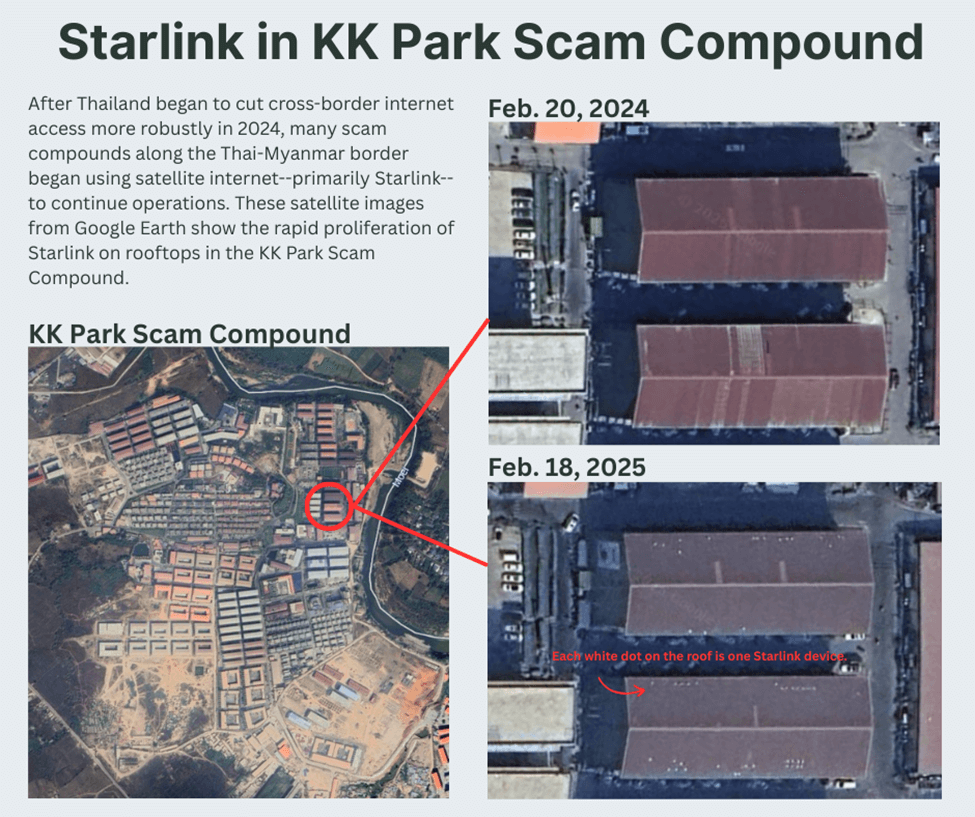
Starlink usage is a typical example of how criminal actors bypass efforts to shut down their operations. Given the infrastructural challenges in Myanmar, it’s been known for years that scam centers located along the Thai-Myanmar border were hooking into services provided by Thailand through mobile data, cross-border electricity connections, and cross-border internet connections. Thailand began cracking down on this as public attention to scam centers rose: In May 2024, Thailand’s National Broadcasting Telecommunications Commission began reviewing mobile towers along the border in an attempt to ensure they were readjusted to avoid providing services across the national border. In February 2025, in response to public concerns about scam centers utilizing Thai power and internet access to run criminal operations, Thailand cut cross-border internet access to five key zones hosting scam centers. Thai investigations occasionally identify surges in internet use that have been tied to illegal cross-border cables to areas with scam compounds, prompting further action and ongoing policing efforts. While the use of alternative satellite internet predates these cutoffs — an investigative deep-dive published just after Thai actions indicated that Starlink was already widely observed in these compounds by February — interviews indicated that their expanded use coincided with loss of access to internet through traditional means.
Since this trend was uncovered in early 2025, Starlink has expanded to become a major player in internet provision in Myanmar. While deep analysis is complicated due to the market complexity in Myanmar and lack of high-quality, validated data on internet use, the Asia Pacific Network Information Centre shows that Starlink was a major service provider between July and October 2025. International Justice Mission (IJM) pointed to a marked growth in Starlink’s use based on not only satellite imagery but also mobile phone data. IJM’s data from eight major compounds in Myawaddy and surrounding areas showed 2,492 Starlink connections in April 2025, which is more than double of what was in place in April 2024, and shows a clear growth trajectory following Thailand’s actions to block physical connections.
Clamping Down on Misuse
Increased attention to this issue has led to a series of shifts in how countries affected by scams, especially the United States, where SpaceX is registered, are responding. In the U.S., the Trump administration has indicated that addressing malign activities by overseas scam networks is a priority, announcing in November the creation of a Scam Center Strike Force to coordinate law enforcement and interagency efforts against Southeast Asia-based fraud and scams. While this effort is broad and reflects growing attention to scams from the United States alongside initiatives like an anti-scam caucus in Congress, there are a series of Starlink specific discussions that have paralleled this broader effort. U.S. Senator Maggie Hassan wrote a letter to Starlink in July urging Elon Musk and SpaceX to crack down on use of its services by malign actors in scam compounds in Southeast Asia. In October 2025, the United States Senate’s Joint Economic Committee (JEC) began to investigate Starlink for the use of its services to scam Americans, and in December, more broadly explored the role of U.S. tech companies implicated in the cyber scam life cycle. In November, the Department of Justice issued seizure warrants for Starlink satellite terminals used in scam compounds, highlighting their use in a series of locations and indicating that SpaceX should disable services to the specific devices.
Starlink has responded minimally to these pressures, even before the DOJ warrants. On October 21, SpaceX’s Vice President of Business Operations indicated that Starlink had identified and disabled more than 2,500 Starlink kits in Myanmar after 30 sets of Starlink “receivers and accessories” were found during a raid on one scam compound in Myanmar. Some reports indicate that despite the company’s efforts, Starlink missed some units operating in the KK Park and Deko Park scam compounds in Myanmar. Blocking these terminals or removing equipment was an important first step, but one which can be significantly expanded if Starlink cooperates more directly and in an ongoing manner with law enforcement or other organizations working to track and counter scams.
One complicating factor is that satellite internet can be a valuable resource in remote or underserved areas that lack other means of digital connection, or where repressive governments and rulers deliberately constrain internet access. The Myanmar Internet Project indicates that 80 out of 330 cities in Myanmar lack traditional internet access, which forces millions of citizens to rely on satellite internet such as Starlink to access the internet for basic economic services. As current events in Iran demonstrate, satellite internet — including Starlink — can be a lifeline during Internet shutdowns. Humanitarian workers, doctors, journalists, and other actors depend on satellite internet to deliver aid and maintain connectivity in Myanmar and other areas, so responding in ways that are proportionate and appropriately targeted is crucial to ensure the technology’s positive contributions remain uninterrupted. It would be a tragedy if the misuse of satellite internet led to a blanket block of the technology’s positive applications.
More broadly, the use of satellite internet technologies for illicit activities raises unique questions for jurisdiction, regulation, and sovereignty: Unlike physical cables and information infrastructure, which are managed by national utilities or private companies subject to the laws of host countries, satellites are not terrestrial. Current international space law was developed prior to the widespread development and placement of commercial satellites in the low Earth Orbit, and where relevant treaty provisions exist, their interpretation and implementation vary. The tension between satellite internet companies that operate globally and national governments that regulate territorially generates a fundamental mismatch in authority and accountability, and this grey space allows criminal actors to take advantage.
Demanding Answers, Pushing for Accountability
Within that context, we put forward the following suggestions for Space-X/Starlink, other satellite internet providers, and national governments committed to stopping scams:
- Starlink can be more proactive and collaborative in identifying and halting services to units that are identified in known scam compounds. Starlink’s decision to disable units operating in scam compounds on October 21, 2025 shows that it is possible to halt services in specific locations. The company should invest in internal capacity to monitor this situation, and in partnerships with groups such ASPI, IJM, the UNODC, or law enforcement units to regularly identify when Starlink kits are operating from scam compound locations or ID accounts tied to units that are operating fraudulently. Doing so would allow Starlink to reduce illegal activity through routinely disabling kits operating from known scam compound locations without more broadly impacting services for legitimate actors.
- Satellite internet services providers should establish industry best practices and safeguards to prevent illegal use of internet services. While Starlink is by far the most popular internet service provider, it is not the only one. Other internet service companies already operational in Asia include Eutelsat OneWeb (France) and Inmarset (owned by ViaSat, USA), while GuoWang (China), Qianfen (China), GalaxySpace (China), and Amazon Leo (USA) have all indicated goals to compete with Starlink and provide internet in global and regional markets. Scammers have historically shown adaptiveness: If companies do not adopt similar safeguards or best practices to avoid providing services to criminal actors, what is to prevent scammers from jumping between services? In the absence of an industry regulating body, satellite internet companies themselves should establish clear policies on the use of their services for fraud or other illicit activities and adopt safeguards or best practices such as know-your-customer protocols and anomaly detection services that enable them to identify and block criminal actors and online scam operations. This should also include public reporting on actions being taken in response to product abuse for the purposes of online fraud and scams.
- Starlink and other companies should prevent the diversion of terminals and equipment to illicit or criminal actors and stymie the growing black market. Given limited internet access in many parts of the globe, there is a booming market for Starlink units even in countries where Starlink is not officially operating or licensed. Often this is for legitimate use, but there is a growing black market to sell Starlink equipment and services to localities where Starlink isn’t licensed.
- Governments and relevant technical bodies should work to close legal gaps concerning satellite services. The proliferation of privately owned satellite constellations providing internet connectivity highlights legal and regulatory gaps. For example, the Outer Space Treaty establishes that states bear international responsibility for national space activities, including those of private entities, but current frameworks lack mechanisms to ensure satellite operators maintain adequate safeguards against criminal misuse of their services. Relevant bodies like the International Telecommunications Union (ITU) could advance collective development of technical standards for satellite service accountability to complement existing space law, while states should strengthen licensing requirements for satellite internet providers.
- Governments should speak out against the misuse of satellite internet and constructively engage with providers to find solutions. The example of U.S. efforts producing a tangible response from SpaceX last year are commendable, but this one-time interruption to Starlink’s use on the ground needs to be built upon through longer-term partnerships and ongoing efforts, not least to counter the inevitability of scam operations moving to new physical locations or smuggling in new terminals. In taking action, governments are encouraged to adopt nuanced policies and approaches that also account for the positive uses of satellite internet and avoid disrupting humanitarian response or access to information.
Responses to cyber-enabled crime and online scams are not a one-time effort, as malign actors and criminal organizations are reactive and adaptive and will continue to jump across national borders, technologies, and platforms when policies or laws target an individual company or locality. An effective response requires continued coordination across sectors, safeguards coordinated across companies and industry, and iterative review and responses to the latest developments. By proactively implementing safeguards, industry actors like Starlink can ensure their business is legitimate, avoid punitive risks, and maintain trust in their brand and the digital space more broadly. Acting will not only safeguard brand reputations but also shore up trust in the infrastructure and platforms that underscore digital economic growth.








Community Adaptation for a Water Festival Without Clean Water