


Editor’s Note: In November 2025, three Global Perspectives Responsible AI Fellows attended the inaugural Global AI Summit in Abu Dhabi, which convened key leaders in AI development and deployment to discuss how the international “AI race” is playing out in the Global South. At the summit, speakers highlighted three core themes for AI’s role and deployment around the world: Technology, Trust, and Talent. In this piece, Fellows Branka Panic, Jibu Elias, and Cristina Martinez Pinto share their reflections on each theme for consideration ahead of the 2026 AI Impact Summit in India.
By Giulia Neaher, Managing Editor for RAI Case Studies
Introduction
In 2025, AI’s potential for economic growth and productivity around the world continued to be a topic of heated debate; whether it will bring about positive transformation or amount to a bubble is yet to be seen. Regardless, any benefits from AI are likely to be unevenly distributed around the world, particularly along the divide between the Global South and Global North. While AI could act as an equalizer, helping to spur growth in the Global South, it’s also possible that models designed to serve the Global North will not function properly — or even cause harm — elsewhere in the world.
Policymakers, developers, and industry leaders are ramping up their work to address this disparity. In February 2026, India will host the AI Impact Summit, which promises to set a cohesive policy agenda for the future of AI development and deployment in the Global South. And at the inaugural convening of the Abu Dhabi Global AI Summit in November 2025, stakeholders began to lay the groundwork for these discussions, identifying three core themes for AI in the Global South: Technology, Talent, and Trust.
Technology depends on hardware and infrastructure that may not be present in the Global South; talent must be cultivated through the deployment of educational and professional resources that weather AI-driven workforce changes; and trust in AI is undergirded by inclusivity, access, and civic participation.
Below, RAI Fellows Branka Panic, Jibu Elias, and Cristina Martinez Pinto address some takeaways from Abu Dhabi regarding each of these themes. Ahead of the Impact Summit in February, they reflect on the opportunities and challenges that will be particular to the Global South in developing and deploying AI, both in 2026 and beyond.
Technology
The Infrastructure of AI
By Branka Panic
The geography of AI power tells a revealing story. In 2024, U.S. private AI investment surged to USD $109.1 billion, 12 times China’s $9.3 billion, while the entire African continent captured less than 1% of all global funding. A single Taiwanese company produces over 90% of the world’s most advanced semiconductors. Only 32 nations possess the data centers required for AI computing, and China alone controls over 80% of rare earth mineral processing essential for hardware manufacturing. These disparities reveal how the AI promise collides with reality: a technology that could level the global playing field increasingly depends on infrastructure, energy, and resources concentrated in the hands of the few.
DeepSeek’s breakthrough sparked some optimism across the Global South by proving that algorithmic efficiency could achieve frontier AI performance with dramatically reduced computational requirements. Many developers in the Global South saw this as a potential entry point into the AI race, but the Abu Dhabi AI Summit pivoted from celebrating such advances to confronting infrastructure realities. Even “efficient” models require computational resources, energy systems, and data centers that remain beyond reach for most nations. The numbers are stark: The U.S. and China together host 86% of global data center capacity while 150 countries lack any AI infrastructure. Africa and South America have almost no AI computing hubs; India has only five. The massive energy demand for data centers, equivalent to tens of thousands of households, strains local power grids and inflates electricity prices. This infrastructure gap compounds existing digital divides, as pointed out by Brad Smith of Microsoft, with 730 million people lacking electricity, 2.6 billion with no internet access, and 3.9 billion people without access to digital skills. As Amandeep Singh Gill, UN Special Envoy for Digital and Emerging Technologies, noted at the Summit, “there will be winners and losers” in this transition, warning that the international community’s capacity to support potential losers remains limited while power shifts accelerate, requiring unprecedented levels of wise governance, trust-building, and multilateral dialogue to prevent AI from becoming another vector of global inequality rather than a tool for shared prosperity.
For Global South policymakers, the infrastructure gap threatens a new form of technological dependency where even strategic AI capabilities must run on foreign clouds, subject to foreign terms. Yet the Summit revealed an AI optimism gap, a paradox where those with the least access have the most hope. Kenya’s Philip Thigo highlighted how Africa leapfrogged landlines to mobile phones and is now deploying ChatGPT for digital public services while pioneering green energy solutions, emphasizing Kenya’s commitment to long-term AI development by comparing the country’s approach to their famous marathon runners. India’s S. Krishnan similarly demonstrated that the AI race can be won through practical applications using low-cost infrastructure.
Individual Global South countries cannot navigate this transition alone, requiring not just bilateral partnerships but minilateral coalitions and new institutional architectures. Collective action will determine whether AI becomes a bridge or barrier for the Global South.
Talent
The Human Infrastructure of AI
By Jibu Elias
Talent represents the human capacity required to meaningfully participate in the AI-driven economy. Across the Summit, it became clear that talent is not simply a workforce issue but a determinant of national competitiveness and preparedness. Yet discussions also revealed a fundamental tension: While governments and industry agree that talent is essential, the exact contours of “AI-ready skills” remain difficult to codify.
Omar Sultan Al Olama, UAE Minister of State for Artificial Intelligence, emphasized that national talent strategies must focus first on quality of life, arguing that productivity will naturally follow when citizens are empowered with the right tools and competencies. This framing reflects a broader shift toward a more holistic understanding of human capability in the AI age.
Brad Smith, Vice Chair and President of Microsoft, distinguished the AI skills landscape from earlier technological transitions. During the PC era, digital skilling largely involved teaching people to use applications and operating systems. The AI era, however, demands a multilayered talent architecture:
- AI Fluency, the ability to critically interpret, integrate, and evaluate AI outputs;
- AI Engineering, a technical domain spanning semiconductor, computational infrastructure, applied model development, and sector-specific integration;
- Organizational Leadership, which includes managing cultural change, redesigning workflows, and governing responsible use of AI across institutions.
Multiple speakers highlighted the learning system constraints governments now face. Ahmed Al Shamsi, CEO of Emirates Foundation, noted that formal curricula cannot keep pace with technological advancements. Natasha Crampton, Microsoft’s Chief Responsible AI Officer, reinforced that “learning by doing” is becoming the foundational approach.
These concerns were supported by labor-market insights from Naria Santa Lucia, General Manager at Microsoft Elevate, citing LinkedIn estimates indicating that 70 percent of job competencies are expected to change because of AI. This level of turnover suggests that workers will need continuous, adaptive learning pathways rather than one-time training interventions.
The challenge, however, is not only the pace of change but the proliferation of unstructured skilling content. Several leaders noted that the global market is now oversaturated with AI courses, certifications, and microcredentials. Justina Nixon-Saintil, Chief Impact Officer at IBM, cautioned that many individuals still understand AI primarily through the lens of chatbots. Moving beyond interface-level familiarity toward capability-level integration remains a central talent challenge.
From an industry perspective, Ali Dalloul, Senior AI Executive at G42, described what he termed a “broken ladder” for young people: They accumulate certificates but lack structured pathways into meaningful careers. Mohammed Al Hosani, CEO of Emirates Foundation, similarly noted that providing tools and role models can accelerate talent development at the community level.
A significant conceptual contribution came from Peng Xiao, Group CEO of G42, who challenged the common assumption that the trajectory of AI is determined solely by its creators. He argued that societies themselves influence how AI evolves, creating feedback loops that shape future iterations of the technology. Xiao described the UAE’s integrated approach, highlighting initiatives at the Mohamed bin Zayed University of Artificial Intelligence (MBZUAI), where national skilling programs serve learners “from age 7 to 70.” Across sectors, the UAE is deploying millions of AI systems to augment human capability rather than replace it.
Together, these perspectives come to a critical conclusion: Talent is the foundational infrastructure of the AI era. Unlike compute or data, which can be imported or purchased, talent must be cultivated systematically and locally. Nations that succeed will be those that build flexible, adaptive learning ecosystems, create clear pathways from education to employment, and empower individuals not merely to use AI but to shape its trajectory.
For the Global South, talent development will determine whether AI becomes a catalyst for shared prosperity or a new vector of inequality.
Trust
The Social Infrastructure of AI
By Cristina Martínez Pinto
The third “T” highlighted repeatedly by speakers at the Summit was Trust, not as a soft value but as a non-negotiable requirement for the future of AI governance. If the Global South is to harness AI for development rather than become further dependent on foreign infrastructure, trust must be built intentionally and systematically. Trust is not a single element but an ecosystemic outcome, something that emerges only when AI development and deployment are multilateral, multiactoral, multilevel, and multidisciplinary.
At its core, trust begins with adoption, and adoption depends on inclusion. The “AI Pyramid” presented during the Summit underscored this reality: Out of 8.1 billion people, only 1.2 billion are active AI users, and many do not yet have access to AI in their own language. Beneath those layers lie even more fundamental gaps: digital skills, internet connectivity, and electricity access. This means that trust in AI is inseparable from trust in the basic digital systems that enable AI. Without addressing these foundational inequities, calls for “AI for all” will continue to collide with the lived experience of the majority of the world’s population.
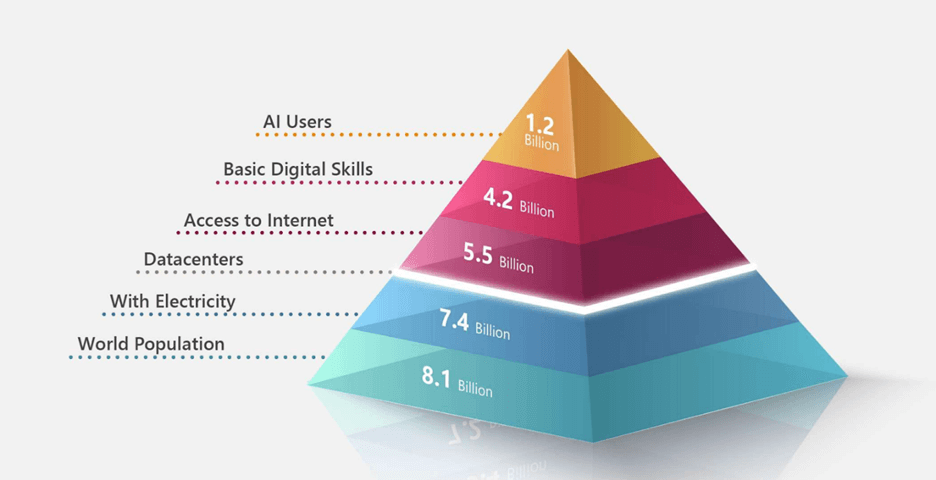
Source: Microsoft AI Diffusion Report (2025)
Trust does not emerge from access alone. It also depends on the institutional strength behind AI systems. Countries need public institutions capable of auditing, overseeing, and enforcing standards for AI, capacities that, as several policymakers emphasized, remain uneven across regions. Trust requires norms and laws that protect rights, anchor public expectations, and prevent AI from becoming another driver of discrimination or exclusion. These include data protection frameworks, algorithmic accountability regulations, and safeguards for transparency across AI life cycles.
Beyond formal regulation, governance mechanisms, from redress systems to algorithmic impact assessments and community-led AI audits, ensure that trust is not only promised, but practiced. People trust what they help create; therefore, co-creation with communities, civil society, academia, and marginalized groups is essential. Participation should not be merely symbolic: It is a source of legitimacy and ownership, ensuring that AI systems reflect social values rather than imposing external ones.
Trust depends on accountability and the assurance that actors with power over AI systems can be held responsible for all outcomes. Together, these elements form the social infrastructure of AI. If the first two pillars, technology and talent, represent what AI is, trust defines what AI becomes. Without trust, the promise of AI for the Global South risks turning into yet another missed opportunity.






Community Adaptation for a Water Festival Without Clean Water