
Introduction
For over two decades, UN peacekeeping has served as an essential tool in advancing the protection of children in contexts where they are deployed. Violence against children, however, continues to escalate to previously unreached levels, with 2024 witness to a 25% increase in grave violations and more than one in five children living in conflict zones.12024 also experienced a 35% rise in cases of sexual violence against children, including a dramatic increase in the number of cases of gang rape, underlining the systematic use of sexual violence as a deliberate tactic of warfare. UN General Assembly and Security Council, Report of the Secretary-General: Children and armed conflict, A/79/878-S/2025/247, 17 June 2025, paras. 5 and 9.; Gudrun Østby and Siri Aas Rustad, “Record high: One in five children in conflict zones,” Peace Research Institute Oslo, November 4, 2025, https://www.prio.org/comments/1829. UN peacekeeping missions are currently deployed in several contexts where children suffer grave violations, including the Central African Republic, the Democratic Republic of the Congo, and South Sudan. However, global reductions in funding and drawdown of UN peace operations have already reduced the UN’s capacity to monitor and verify these violations,2UN General Assembly and Security Council, Report of the Secretary-General: Children and armed conflict, A/79/878-S/2025/247, 17 June 2025, para. 11. as well as hampered mission capacity to engage systematically in prevention and advocacy with parties to conflict. In December 2024, the Security Council affirmed the importance of sustainable child protection capacity in peace operation contexts, including during mission withdrawals or transitions.3UN Security Council, Resolution 2764, S/RES/2764, 20 December 2024. However, implementing these commitments will require political support and sustainable funding, requiring the UN and its member states to continue to explore how peacekeeping can best maximize and sustain its impact on child protection over time.
Utilizing the eighth anniversary of the Vancouver Principles on Peacekeeping and the Prevention of the Recruitment and Use of Child Soldiers,4Government of Canada, “The Vancouver Principles,” accessed December 5, 2025, https://www.international.gc.ca/world-monde/issues_development-enjeux_developpement/human_rights-droits_homme/principles-vancouver-principes.aspx?lang=eng. this event examined how peacekeeping operations contribute to sustainable child protection frameworks, drawing on experiences and lessons from former and current UN peacekeeping missions. The workshop featured emerging research from the Stimson Center, Center for Civilians in Conflict, and Save the Children on the impact of peacekeeping on child protection, including as relates to the Democratic Republic of the Congo (DRC), Liberia, Mali, Somalia, and South Sudan.
Sustainable Approaches to Child Protection
Since 1999, the Security Council has deployed UN peacekeeping missions with explicit mandates to protect children. Through the course of the discussion, speakers highlighted the positive impacts of UN peacekeeping on children across a range of mission settings. For instance, the former UN Mission in Liberia (UNMIL), active from 2003 to 2018, left an enduring legacy on child protection through its support to the national government in establishing the institutions, mechanisms, and legislation that now underpin Liberia’s child protection framework, along with the mission’s broader work of raising public awareness of human rights. Similarly, the former UN Multidimensional Integrated Stabilization Mission in Mali (MINUSMA), deployed from 2013 to 2023, contributed to the creation of a protective environment by enabling protection actors’ access to hard-to-reach zones, supporting the reintegration of children recruited and used by conflict parties, and conducting technical capacity building of child protection actors at national and local levels. However, with MINUSMA’s unplanned exit from the country in 2023, Mali’s “child protection ecosystem lost its core scaffolding,” as one speaker noted, underlining the mutual importance of UN peacekeeping and host authorities investing in institutions, expertise, and mechanisms that can protect children long after a mission has departed.
Participants also emphasized the necessity of integrating child protection considerations from the early stages of mission assessment and planning through to mandate design, start-up and deployment, and the eventual withdrawal and transition of the UN mission. For example, one speaker noted that the UN Organization Stabilization Mission in the Democratic Republic of the Congo (MONUSCO) worked to mitigate the impact on children of its withdrawal from South Kivu in 2024 through joint planning with national authorities and the UN country team, ensuring continuity of the Monitoring and Reporting Mechanism (MRM), and building up the capacity of relevant civil society organizations and community-based protection mechanisms. Such efforts, however, are not linear, as partners have had to adapt to the resurgence of conflict in South Kivu throughout 2025. Participants further stressed the need for sustained political and financial support on child protection throughout the full duration of a mission’s deployment, including by the peacekeeping mission, relevant UN agencies, and the host government.
Furthermore, strong collaboration between peacekeeping missions, UN country teams, national authorities, and other child protection actors on the ground remains essential to long-term effectiveness. While child protection actors should seek to coordinate and deconflict immediate work, collective efforts can be maximized by developing a common vision of change that includes medium and long-term child protection objectives. In support of such efforts, peacekeeping missions can work with other UN actors present to outline a complementary division of labor, develop modalities for cooperation, and set progressive benchmarks.
In discussing the recruitment and use of children in conflict, several speakers highlighted the long-term utility of evaluating risk factors that lead to children becoming associated with conflict parties, thereby helping missions maximize their impact by addressing key drivers. In the case of Liberia, for instance, UNMIL primarily countered the cross-border recruitment of Liberian children through border-patrol operations, which had limited effectiveness and did not address root causes. One speaker noted the value of collecting disaggregated data to tailor child protection activities to the diverse risks faced by boys and girls, with the inclusion of related language in peacekeeping mandates having had a positive impact in Somalia and South Sudan for instance. Another highlighted the need to consider risk factors of recruitment through a regional lens; while many peacekeeping mandates are country-specific, child protection challenges are often unconstrained by borders.
Participants also emphasized the importance of engaging communities in child protection efforts. Though peacekeeping missions can contribute to an enabling environment through the provision of training, political leverage, and accountability, the durability of child protection can be enhanced by ensuring communities feel seen, heard, and empowered. Good practices include engaging with and resourcing local protection networks that have credibility and trust; strengthening survivor-centered referral mechanisms within communities, such as by building up the capacity of local peacebuilding organizations; and investing in child protection mechanisms that connect communities with local and national government. For instance, Somalia’s Joint National Action Plan on the Vancouver Principles — developed in collaboration between government ministries, women’s rights organizations, youth groups, and other civil society actors — was finalized in 2025, serving as a powerful example of how communities can be treated as co-architects of national or local child protection frameworks. Participants further noted the lasting influence of mission-led children’s rights campaigns in promoting proactive protection through community awareness-raising, encouraging child self-advocacy, and equipping civil society with the language and tools for the promotion of human rights.
And as peacekeeping missions are meant to be deployed for a finite amount of time, the long-term sustainability of child protection gains depends on whether host authorities are prepared and committed to assuming responsibility for the protection of children. With the sudden withdrawal of host state consent for MINUSMA in 2023, the mission’s unexpected exit resulted in a protection vacuum as host authorities were unable to step into the resulting security gap in a timely manner. In Mali, this led to a weakened MRM due to the heightened challenge of safely collecting data, reduced access and security guarantees for child protection actors on the ground, and shrinking technical and financial capacity at national and local levels. In preparing national authorities to serve as the main child protection actor on the ground, participants highlighted the utility of peacekeeping missions seconding staff to national institutions to train and develop national capacity, conducting joint field visits with host authorities to map protection needs across the country, incorporating child protection as a core priority in joint transition plans, and transitioning child protection specialists in peacekeeping missions over to the UN country team as a mission withdraws. In this way, peacekeeping missions can encourage the retention of child protection expertise in-country and the UN’s continued engagement with national counterparts on child protection issues beyond its time in country.
Conclusion
Ultimately, investing in child protection reinforces the overall effectiveness and impact of UN peacekeeping. As one speaker noted, “sustainable peace is impossible without sustainable child protection.” In pursuit of this goal, the discussion highlighted several key takeaways for peacekeeping missions, including: (1) ensuring child protection remains a core focus throughout a mission’s start-up and deployment, through to drawdown and transitions; (2) adopting a collaborative and coordinated approach with other child protection actors in situ; (3) evaluating the risk factors for grave violations within a given context through a regional lens and on an ongoing basis, while also pursuing or supporting initiatives that address root causes; (4) advocating for strong political commitment and investment of the host government in its ability to protect children; and (5) engaging communities in the promotion and protection of child rights. Given current funding shortfalls affecting UN peacekeeping and evolving discussions around the future of peace operations, the risk of diminished attention to child protection in peacekeeping contexts remains high. UN member states should not only advocate for child protection provisions and capacity in peacekeeping missions going forward, but also explore how they can advance implementation of the Vancouver Principles to support more sustainable child protection.
This event summary was drafted by Natalie Bramlett and Julie Gregory.
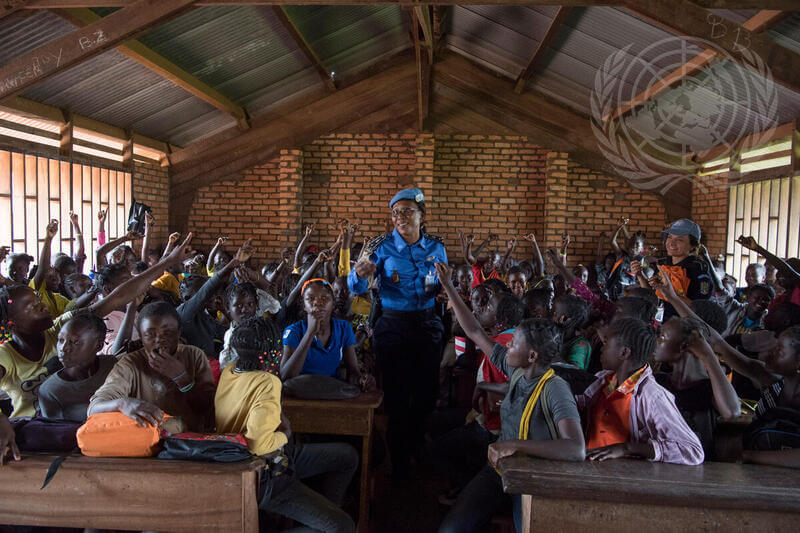
Header photo: UN police officer serving with the UN Multidimensional Integrated Stabilization Mission in the Central African Republic (MINUSCA) teaches a class on gender-based violence at a school in Bangui in 2017. UN Photo/Eskinder Debebe.






Community Adaptation for a Water Festival Without Clean Water