

Editor’s Note: Alessandro Perri, who holds a BA in Political Science and an MA in International Relations from the University of Chicago, is currently interning with the Reimagining U.S. Grand Strategy Program at the Stimson Center.
By Evan Cooper, Research Analyst, Reimagining U.S. Grand Strategy Program
Introduction
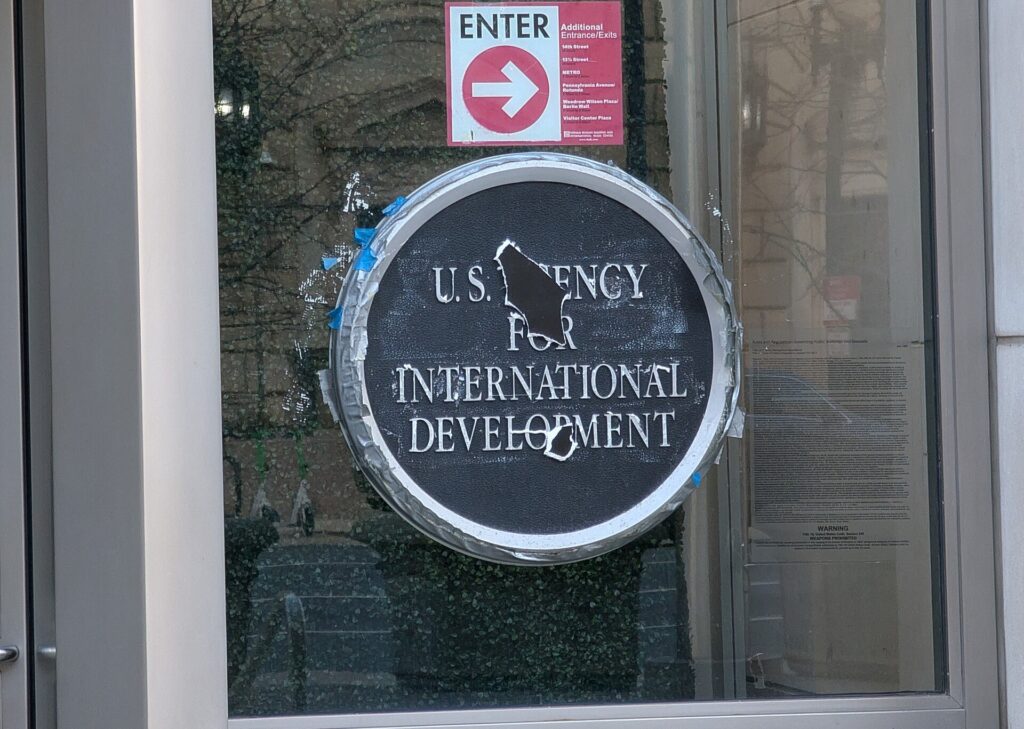
President Donald Trump’s unprecedented cuts to USAID — initially cancelling 83% of its programs, then shutting down the agency and rolling what operations remain into the State Department — have raised alarm bells as academics and policymakers warn about the potentially devastating humanitarian impact of a reduction in lifesaving U.S. overseas assistance. Beyond the toll of lives lost, Trump’s cuts to USAID are also likely to affect the United States’ standing in the world, as humanitarian and development assistance has been a critical source of goodwill for the United States — especially in the Global South. With the United States and Europe both reducing their role in foreign aid, the global humanitarian and development environment is more uncertain than ever. The question of whether that void gets filled, and by whom, will have drastic humanitarian and strategic implications.
This paper aims to answer the question: what are plausible scenarios that describe the United States’ position in the global aid environment 10 years from now? It considers both development (meant for long-run growth and social outcomes) and humanitarian (meant for short-term, lifesaving relief) aid in four potential scenarios, recognizing that the mechanisms for implementation and political popularity of both can differ. It is not an attempt to predict the future, nor does it prescribe a particular viewpoint. Rather, it attempts to elucidate the critical factors for policymakers in determining what the United States’ possible approaches to development and humanitarian assistance will look like in 2035, along with their implications for America’s diplomatic relations. The four scenarios are intended to serve as a tool for policymakers to think through the possibilities for aid in a time of upheaval and clarify the policy levers available to influence future outcomes.
Prospects for United States Aid and Development Assistance
The closure of USAID led to immediate consequences for the people and places where its programming took place. A study in the Lancet journal found that USAID’s programming had prevented millions of premature deaths and its elimination would lead to more if not quickly reversed: “Forecasting models predicted that the current steep funding cuts could result in more than 14,051,750 additional all-age deaths, including 4,537,157 in children younger than age 5 years, by 2030.” The past months have featured reports of food, contraceptives, and medicine being destroyed because USAID programs have been halted. Given that the United States is the largest provider of aid in the world, the decision by the Trump administration to pause, and ultimately cut, most U.S. aid has led to concerns that famines, displacement, instability, and environmental destruction will all increase as a result.
There were also immediate concerns for how USAID’s closure would change the standing of the United States in the world. The primary worry is that the United States will be replaced by China, leading to a world in which the United States has fewer partners and China has more. Several high-profile figures have claimed that China will benefit from USAID’s destruction. The head of the agency during the Biden administration, Samantha Power, wrote in the New York Times that the actions of the Trump administration are “paving the way for Beijing to become the partner of choice around the world.” Democratic Senator Chris Coons said that the closure of USAID would be “a gift to China … a gift to our adversaries around the world.” Francisco Bencosme, USAID’s China policy lead in the Biden administration, told Politico, “[China] will fill in the void in places like Cambodia and Nepal, and those are just the places we know about.” Bencosme’s remarks referred to China’s provision of $4.4 million to fund land mine removal in Cambodia and reports that Chinese officials were anonymously pledging assistance to Nepal if the country found itself in need of humanitarian assistance due to U.S. funding being withdrawn.
Since its launch in 2013, China has spent upwards of a trillion dollars as part of its Belt and Road Initiative (BRI), providing assistance, mostly in the form of infrastructure loans, to countries around the world. This development model has been attractive to many countries that see it as a way to gain access to the financial resources and expertise needed to rapidly build roads, bridges, ports, dams, and other large infrastructure projects. The results of BRI investments have been mixed for both recipient countries and China itself, but it has been the primary focus of Chinese foreign assistance over the past 12 years.
The BRI model contrasts substantially with the USAID model, which focused on smaller scale projects and the provision of humanitarian aid, mostly through grants administered by contractors. USAID’s efforts to distribute vaccines and medical treatment (particularly through the PEPFAR program), support conservation efforts, and assist people displaced by conflict are seen as successes of the U.S model of aid. That programming does not resemble the elements of the BRI that have been hailed as a success, such as the Chinese-financed Jakarta-Bandung High-Speed Railway, the first high-speed railway built in Southeast Asia. There has not been an indication of China taking over at a large scale the aid programs that the United States has stepped away from.
While some key programs abandoned by the United States have been adopted by other countries, there has not been a power capable of, or interested in, broadly taking over the United States’ role in international aid. The lack of a clear replacement to the United States, while demand for aid and financing remains high, means that there is still an opportunity for the United States to shape the future of development. Whether it engages in doing so, and how it approaches the many ways in which humanitarian aid and development assistance can be provisioned, is far from clear.
Factors for the Future of US Aid
While any list of factors used to determine how the complex, interconnected aid world will look in 10 years will inevitably be incomplete, it is nonetheless useful to think about what variables might affect the state of U.S. humanitarian and development assistance in 2035, along with how other nations might respond. Broadly, this paper will separate factors into two buckets — those internal to the United States, and those that are primarily dictated by exogenous global dynamics.
Domestic Factors
| America Returns | China Leads | Aid Adrift | Nationalism Unbound | |
|---|---|---|---|---|
| Salience of Trumpian nationalism in foreign policy | Rejection of Trumpian nationalism in foreign policy facilitates recommitment to assistance. | China dominating the aid world is possible with both a nationalist and non-nationalist United States. | Right wing nationalism is mostly rejected, but foreign engagement is not a priority. | Trump’s brand of foreign policy is the primary approach of American policymakers. |
| Bandwidth to focus on foreign policy | Politicians have a mandate to pursue foreign policy agendas to rebuild from Trump, and aid is a point of focus. | Foreign policy is placed on the backburner, allowing China to dominate the aid and development space. | Domestic politics dominate. Enough goodwill exists for a weak return to aid, but not to previous levels. | Assistance is a justifiable tool to advance narrow priorities, but U.S. aid contributions stay vanishingly low. |
| Salience of Chinese competition | Chinese competition is a major driver of U.S. foreign policy, leading America to recommit to aid strategically. | Chinese leadership in the Global South is seen as unimportant and does not prompt an American return to aid. | China’s relative weakness and U.S. domestic challenges reduce China’s salience to American policymakers. | China matters to the right-wing administration, but the chosen means of competition is security, not aid. |
External Factors
| America Returns | China Leads | Aid Adrift | Nationalism Unbound | |
|---|---|---|---|---|
| China’s choice to fill the gap | There is no gap to fill, since the U.S. returns to the aid space quickly and in full force. | China sustains its development assistance and sees opportunity to expand into the humanitarian space as well. | China does not expand its foreign assistance programs — its focus is largely domestic. | While it does not expand its aid, China maintains strategic partnerships to compete with the United States. |
| South-South cooperation | The impetus for South-South cooperation is weak, since Global South countries are given a larger role in a new development paradigm. | Some South-South cooperation accompanies China’s dominance as part of a broader BRICS aid architecture. | Without a natural leader in the aid space, South-South cooperation is the logical response, though there are inherent constraints. | South-South cooperation is attempted but faces more headwinds from unchecked climate change and a meddling United States. |
| Demand signals from aid recipients | There is sustained demand from the Global South for financing and a greater role in the international aid system. | China is willing to address increased demand, parlaying requests of assistance into security partnerships. | Aid demand is sustained or increases, but there are insufficient viable actors to supply the world’s need. | Select countries align policies to receive U.S. aid in some instances, but most focus on insulating from U.S. threats. |
The most obvious determinant of the U.S. foreign aid position in 10 years is whether the U.S. remains committed to Trumpian nationalism in the foreign policy arena. In simplest terms, Trump’s view is that all U.S. policies must be closely tied to a national security or economic goal of the United States (or, as the State Department puts it, must make America safer, stronger, or more prosperous), with considerably less weight placed on relationships and alliances. The political future is notoriously difficult to forecast — the eventual state of the U.S. economy under tariffs, the long-run popularity of Trump’s immigration policy, and the ability of the Democratic Party to unify around a candidate, among many other considerations, will influence whether Trump’s political brand continues to prevail. But to maintain some parsimony, this paper will bracket those considerations and focus more narrowly on the outcome variable; that is, will Trumpism be the dominant foreign policy political ideology in 2035?
A more subtle question is what bandwidth future U.S. officials will have to focus on foreign policy. If the United States is plagued by domestic economic troubles or exceptional political gridlock, it may be impossible for political leaders to implement reforms to U.S. assistance even if they wish to. That is both because their agenda may simply be filled by more immediately salient issues and because focus on foreign aid — when the United States is dealing with internal turmoil — is a losing proposition politically.
Additionally, the extent to which competition with China dictates U.S. foreign policy by 2035 will also be important in determining how committed the United States will be to aid. If policymakers believe that contesting China at every turn is a necessary endeavor, they may be more willing to shoulder the cost of aid, especially aid that is deployed to strategic or contested areas. If competition with China is no longer a salient factor in U.S. policy formation, national security justifications for aid are likely to become considerably weaker. That said, there is nuance to this point — the United States could determine that fighting China is not a game of soft power, but purely of hard power. In other words, the mode of competition with China matters, not just the extent.
One of the biggest questions as it pertains to international development is whether another actor will fill the void left by the United States. There are three possible alternatives to the United States — Europe, China, and South-South cooperation. European recommitment to aid is not a credible possibility. The most important European donors have already implemented significant cuts to their aid budgets in the past year. Europe’s issues are structural and unlikely to be resolved in 10 years; weak growth prospects, aging populations, increased defense burdens as a result of pressure from the United States, and strong, politically resilient right wing populist movements all serve as constraints on Europe’s ability to significantly ramp up its involvement in aid.
China is the more interesting possibility. It recently pledged $51 billion over the next three years in development assistance to Africa. This amount was less than China pledged to Africa during the heyday of the BRI in the mid-2010s, but an increase from the nadir in funding during the COVID-19 pandemic. Traditionally, China has been much more focused on economic projects than on humanitarian aid, and Chinese policymakers may be reticent to embark on an expanded aid program — especially considering the macroeconomic headwinds the country has faced. On the other hand, the United States’ absence may be a difficult opportunity to pass up for Chinese leaders, who would have the chance to draw a stark contrast between Chinese generosity and American selfishness if they ramped up humanitarian involvement.
Finally, South-South cooperation has frequently been discussed as a possibility, often taking the form of aid from Brazil, India, and other rising powers. That said, these countries are fiscally constrained compared to the West or China, and their aid infrastructure is nascent. It remains to be seen whether they can play a more significant role, especially considering that they have their own struggles with poverty and economic underdevelopment to address.
The demand side of aid also merits attention. It is implausible that aid-dependent countries can successfully reform their domestic institutions quickly enough to no longer rely on aid by 2035. Even putting aside the inefficiency, corruption, and political instability that have plagued many Global South nations, these governments simply do not have the access to capital to make up for the absence of the United States. For example, Nigeria, one of the wealthier nations in Sub-Saharan Africa, responded to USAID cuts with an extraordinary budget increase of $200 million for its healthcare system, but this influx covered less than half of the lost funding from the United States. Unfortunately, a more likely possibility is that demand from Global South countries for aid increases because of climate change, which is likely to drive more refugee flows, droughts, and other humanitarian crises by 2035.
Having surveyed the political landscape of cuts to U.S. assistance, this report now presents four potential scenarios for international aid in 2035. These scenarios are meant to consider how the various factors intersect, in addition to the major directions that international aid could move towards, depending on the choices made by policymakers over the next decade.
2035 Scenarios
America Returns
American voters decisively reject Trump-style nationalism at the ballot box, leading to a significant backlash against the administration’s legacy and a reversal of its most unpopular decisions. The foreign policy arena is not exempt from this re-evaluation, as Americans decide that the United States’s flouting of soft power, and insistence on driving tough bargains rather than attempting to cooperate, was a destructive, self-defeating grand strategy. As a consequence, American policymakers decide that concerted investment into soft power tools like USAID is the best way to mend tattered bilateral and multilateral relationships.
Aid becomes particularly urgent for U.S. policymakers for two primary reasons. The first is growing geopolitical competition with China, which seized the opportunity given to it by the U.S. absence and built stronger relationships throughout the Global South with development assistance. Importantly, though, the game is not lost for the United States, since China’s ability to ramp up international economic assistance is limited by its domestic concerns — opening the door for the United States to swoop back in and successfully compete. Secondly, increased migration flows and humanitarian catastrophes because of climate change drive up the demand for assistance.
There is a significant domestic constituency for this recommitment to U.S. aid. Even more hawkish or politically conservative groups that are less compelled by the moral argument for U.S. humanitarian assistance see the strategic value of USAID in a geopolitical context of competition. They also see giving aid in response to catastrophe as a recommitment to American internationalist values, which holds greater political benefit after public views towards the Trump administration’s approach sours.
With the blank slate given to them by Trump’s gutting of the agency, policymakers set to work on a reformed U.S. foreign assistance program with modernized procurement and accountability processes. In particular, officials worried that inefficiency and excess spending would open the door to future cuts move towards measuring aid by impact rather than quantity of distribution, and using bilateral aid relationships rather than relying on multinational organizations. Congress proves willing to fund increases to foreign assistance, seeing it as a cost-effective way to improve American global standing. The model of the Millennium Challenge Corporation, which has rigorous scrutiny and country-specific goals determined by recipient nations, is particularly salient in policymakers’ minds.
American officials solicit significant feedback and engagement from recipient nations in the Global South on what reforms to aid policies would be most welcome. Their attempts to fix the soft power damage incurred by USAID cuts avoid the “lecturing” tone that has led so many developing countries to roll the dice with China rather than continuing to engage with the United States and its Western allies. In part, this means greater localization, allowing organizations on the ground in recipient countries to have more say on how aid should be distributed and for what ends. This also means more focus on resilience and protection from climate change, reducing long-run exposure.
No other actor has stepped in to fully fill the void during the period of American absence. China’s macroeconomic difficulties persist, with Beijing following a path much like that of Japan in the 1990s, so that despite its increased engagement, it is unable to fully occupy the position the United States vacated in 2025. As a result, the United States returns to the preeminent role in the global aid space quickly — albeit with significant cost to human lives in the interim.
China Leads
No American leader decides to undertake the politically costly process of recommitting to foreign aid as domestic conditions remain of top concern to the American public. US-funded projects remain limited in scope, with only popular, marquee projects like PEPFAR or targeted assistance with transparently transactional political and economic motives (such as access to minerals) remaining.
In America’s absence, China sees an opportunity: While traditionally it has been more focused on development support and financing than emergency aid, its newfound ability to produce effective mRNA vaccines for a wide variety of diseases and viruses, coupled with the potential for improved partnerships with the Global South, leads Beijing to embark on more ambitious humanitarian projects, along with sustained international financing and infrastructure projects. China’s new leadership in humanitarian assistance fosters greater international coordination on aid, harnessing resources and expertise from BRICS allies.
The loss of American expertise is significant, and China’s aid program is hampered by opacity and vacillating political goals, but it becomes recognized as the leader in the humanitarian world with its new model of assistance. Countries suffering from natural disasters are quick to lobby China for support and are willing to make attractive offers of market access for Chinese firms to ensure they can tap China’s financing and development capabilities. While China does not obtain outsized diplomatic influence from its distribution of aid, it does develop greater sway in international organizations as the United States fades. This becomes something of a self-fulfilling prophecy, as American policymakers accept that China is far ahead in its relationships with the Global South, reinforcing the decision to focus on Americans’ domestic priorities.
The U.S. aid system remains under the direction of the State Department’s regional bureaus, which provide ad hoc support for countries with lasting ties or acute political value. The United States is able to respond to disasters in its immediate neighborhood, but its capabilities for providing humanitarian aid have severely atrophied, and disaster-afflicted countries know U.S. support is likely to be minimal. With the elimination of FEMA and USAID, the U.S. military becomes the sole provider of humanitarian assistance and disaster relief (HADR). With its focus on deterring China and ongoing involvement in conflicts around the world, its ability to be relied on to provide HADR is diminished, leading to major disasters where the United States is absent. This causes a degradation of U.S. diplomatic ties with large parts of the Global South as the U.S. footprint of aid workers never rebounds. The remnants of the aid industry seek funding from China and Gulf states, creating a brain drain in the area of development and humanitarian aid. Private US-based foundations support some development work abroad, but their capacity to do so contracts as their programs receive diminishing public attention and almost no government funding. While the United States is not shut out from international institutions, it becomes increasingly marginalized as China shapes the international system to align with its priorities.
Aid Adrift
After Trump, American policymakers are so focused on attempting to mend an increasingly complex domestic political situation that they are unable to deal much with foreign policy. The United States faces economic difficulties as a result of the tariff economy and the rise of AI displacing workers, and domestic polarization has reached a fever pitch, with regular disputes over the rule of law, democratic institutions, and other foundational, first-principles issues. As a result, politicians opt for a half-hearted return to something like the status quo ante while being careful to avoid projects that could get them into political trouble in an exceptionally hostile and vigilant social media environment. With international politics generally on the backburner, aid — never the biggest focus even within the foreign policy world — becomes politically minimized.
While funding levels increase somewhat compared to their nadir during the Trump administration, they are still low, and the human capital and soft power costs are never recouped as capacity has atrophied during USAID’s many years of disuse. There is little pressure to increase U.S. developmental assistance and humanitarian aid, both because internal issues dominate the media and because even more liberal-minded American leaders can point to European cuts as proving the fiscal necessity of a smaller aid budget. While some progressives still argue for a greater U.S. role in humanitarian assistance, their position is not politically viable.
As a result, the United States’ role in emergency aid is outsized compared to the rest of the world, but reduced relative to pre-2025, while its role in development or social justice aid becomes far more limited, since these are the projects more likely to be considered wasteful at best, and politically toxic at worst. Global South demands and views are almost totally excluded from the conversation, as recouping American soft power among countries that are not considered strategically essential to the United States is a low priority. The bilateral relationships between the United States and recipient countries do not see a significant improvement, with criticism directed at the United States for its past mistreatment of the Global South, its unwillingness to commit to real reform, and its unprecedented capriciousness.
However, other major global players do not fill the void left by the United States. Europe is constrained by sluggish growth and high defense spending requirements, having neither appetite nor capacity to spend money abroad. European spending on foreign aid does not significantly rebound from 2025 cuts.
China starts to face fiscal headwinds because of population issues that derive from the One Child Policy and the aftermath of the real estate sector’s collapse. As a result, Chinese leaders can no longer afford to maintain their largesse in the Global South as they did in the pre-Covid era. Paradoxically, this also minimizes the extent of U.S. recommitment, since the security rationale of competition with China is weakened by Beijing’s reduced involvement — if China isn’t trying to court these countries, the reasoning goes, the United States doesn’t need to either. Moreover, China’s historic preference for development projects rather than humanitarian aid continues, leaving the basic needs of millions unfulfilled.
Attempts at South-South cooperation led by a combination of governments and philanthropists become more frequent, though they are hamstrung by weak fiscal capacity (especially after the hit to developing economies from Trump’s tariffs and the damaging effects of climate change), corruption, and infighting. As a result, the United States remains a major player, but in a far smaller space and obtains few soft power benefits from its feeble recommitment.
Nationalism Unbound
Nationalism becomes the dominant political force in the United States, with the political movement built by Trump having sustained force and the Democratic Party broadly adopting a policy of economic nationalism. Increasingly chauvinist and racist politicians successfully argue that any form of assistance to the “Third World” is an abdication of responsibility to the American people — instead, they say, the United States should focus on bolstering its domestic security, particularly given intense geopolitical competition with China. As a result, U.S. aid functionally ceases altogether, with the exception of large, ostentatious projects meant to signal U.S. support for particular partner countries but not connected to human needs. The United States remains willing to fund some basic development projects that it can stamp its flag on, and which are seen as transactional necessities by partner nations, but shoddy execution limits their effectiveness.
The United States does not just abdicate its role — it also bullies others in the global aid space, impeding the work of NGOs and foreign governments with the pretext that their behavior spreads “anti-American” or “woke” agendas. Humanitarian organizations face persistent threat of U.S. sanctions, their staff in countries with a U.S. military presence finds U.S. troops to be uncooperative, and U.S. forces increasingly actively impede operations by denying access to aid workers. The United States withdraws all funding from the United Nations and the aid contracting space almost entirely dries up. This contributes to growing deglobalization and the fracturing of international institutions.
China, facing its own macroeconomic headwinds, proves to be unable to fund projects across the Global South like it did in the 2010s and opts instead to focus on narrow development partnerships with a select few countries. It occasionally clashes with the United States by offering up its capabilities as an alternative to the poorly managed aid disbursed by the United States. This becomes a point of contention, with the United States unwilling to rebuild its aid capabilities but frustrated by sustained competition with China. While China makes some efforts to provide humanitarian relief to partner countries facing severe disasters, its capability and will limit its ability to conduct sustained humanitarian operations.
Because of the hostility of the United States towards international aid groups, China’s narrow focus, and Europe seeking to avoid the wrath of the United States, the Global South attempts to collaborate internally on development efforts. It develops new South-South financing models, but the amount of capital available for projects is a fraction of the peak era of development banks in the early 2020s. While continued tariffs weaken the U.S. dollar and drive some investment towards developing countries, this financing is not tantamount to development assistance and still leaves enormous need unmet. Worse, the United States opposes any kind of global climate action. As a result, the Global South is plagued by increasing climate disasters, conflict, and displacement, with fewer tools and support to manage these challenges. This leads to resentment and animosity towards the Global North and contributes to a fractured international system.
Implications for Policymakers
The greatly diminished role of U.S. development aid and humanitarian assistance further fuels an already rapid shift in global affairs. U.S. policymakers face a fundamental choice of whether to pull back from the world and pursue deglobalization or form new structures and modes for engagement. Ultimately, assistance will be one of the arenas in which this choice is made. While Europe and China may engage in selective additional programs of assistance, they will not replace the role that the United States has held, nor will they support the large and capable independent assistance industry.
For U.S. policymakers, the choice of whether to engage in assistance efforts may be largely determined by domestic politics. There are economic constraints, but it is ultimately a question of will — the United States can still lead on international assistance if it chooses to do so. As public views have soured on whether U.S. assistance serves their interests, American politicians will face a choice: play to public views that spending on assistance is a wasteful endeavor or make the case for new forms of assistance that improve the standing of the United States. Pursuit of the status quo ante appears unlikely to yield much benefit.
Based on the chosen American grand strategy, policymakers will need to consider how to structure the organizations that engage in assistance. Decisions on what role the private sector and nonprofit organizations should play, the function of the State Department and United Nations, and what modalities to invest in will be increasingly pertinent questions as the consequences from U.S. disengagement in foreign aid begin to appear.
The old world of development assistance is definitively ending, but the future is still murky. Domestic politics, international security, and macroeconomic trends will all play a role in determining how politicians and bureaucrats approach humanitarian assistance in the coming years. What is clear, however, is that the United States’ decisions in this arena will shape an industry that — beyond its important geopolitical and economic implications — indelibly impacts the lives of hundreds of millions around the world every year. It is imperative that these choices be made with strategic clarity and purpose.







Community Adaptation for a Water Festival Without Clean Water