


Designing a solution is easy. It is implementing the solution, which takes great effort to succeed. Similarly, multilateral framework solutions are only as effective as the strength of the partnerships and implementation efforts to sustain them.
This case study examines what governance mechanisms and capacity-building initiatives are functioning well in outer space and proceeds to make the case for how these measures might be applied toward promoting accountability in cyberspace. Could there be an outer space ‘skeleton key’ for ‘unlocking’ accountability in cyberspace?
In exploring this question, the main areas examined in this case study are: (1) the Artemis Accords principles and program; and (2) capacity-building mechanisms for the long-term sustainability of space activities. Global capacity-building activities are beneficial because they help foster conditions for states to cooperate on shared goals and can strengthen forming a rules-based international order.
Outer Space Governance
First, it is important to introduce relevant legal framework to better appreciate the origin story of the Artemis Accords principles. The 1967 UN Treaty on Principles Governing the Activities of States in the Exploration and Use of Outer Space (OST) is the seminal document for outer space law. The OST is a leading document that prohibits national claims of sovereignty, the establishment of military bases and weapons, or the placement of weapons of mass destruction (WMD) in orbit or on celestial bodies. Another significant treaty is the 1972 Liability Convention, which is an agreement for states to take full responsibility for any damages caused by their space objects. This 1972 treaty is currently being tested however, by the rapid rate of technological advancements of the civil space sector. Traditionally, the law is slower in evolving to respond to technological developments, however, identifying the legal gaps and barriers is a necessary exercise to cultivating a robust accountability ecosystem. Together, these legislative instruments signify that accountability of states is a concrete reality in space and not just broad political principles. Through both the OST and the Liability Convention, states bear legal and financial responsibilities for public and private national space activities. Overall, the OST, combined with the United Nations (UN) Charter and other relevant international laws, represent “the essential framework for the peaceful exploration and use of outer space for the benefit of all nations.”1 European Union, “EU Joint Contribution on the Works of the Open-Ended Working Group on Reducing Space Threats through Norms, Rules and Principles of Responsible Behaviours: Fourth Part: Recommendations on Possible Norms, Rules and Principles of Responsible Behaviour Relating to Threats by States to Space Systems,” UNODA, June 15, 2023, https://docs-library.unoda.org/Open-Ended_Working_Group_on_Reducing_Space_Threats_-_(2022)/EU_joint_contribution_to_OEWG_works_on_norms_of_responsible_behaviours.pdf.
Case Study 1: The Artemis Accords’ Principles and Lunar Program
This section focuses on the Artemis Accords principles. It proceeds to draw connections between how certain aspects of the Artemis lunar exploration program could be applied to promote accountability in cyberspace among states.
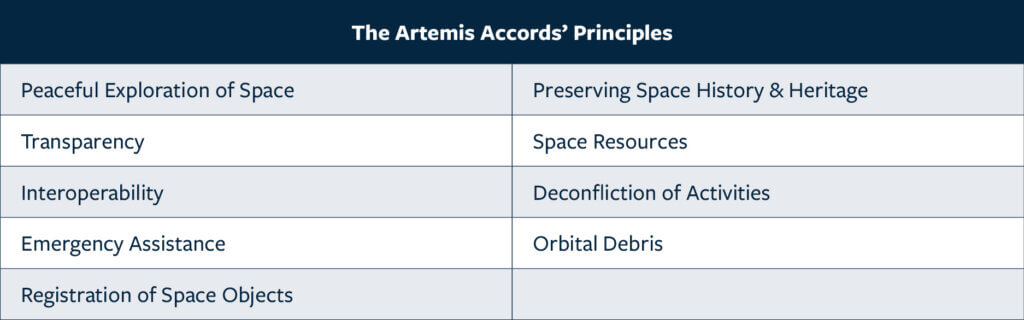
The Artemis Accords are composed of nine nonbinding principles that are drawn from the OST and other international laws. The Accords champion the peaceful exploration and scientific research of outer space, as well as advance the safety and sustainability of space activities. These principles of state cooperation for the peaceful uses of space are displayed in the table below.
Applying Artemis to Accountability in Cyberspace
At the time of writing, there are 39 state signatories to the Artemis Accords.2 Roxana Bardan, “NASA Welcomes Angola as Newest Artemis Accords Signatory,” NASA (blog), December 1, 2023, https://www.nasa.gov/general/nasa-welcomes-angola-as-newest-artemis-accords-signatory/. The most recent signatory is Slovenia on April 19, 2024.3 U.S. Department of State, “NASA Welcomes Slovenia as Newest Artemis Accords Signatory,” April 22, 2024, https://www.state.gov/united-states-welcomes-slovenias-signing-of-the-artemis-accords/. The other signatories include Angola, Argentina, Australia, Bahrain, Belgium, Brazil, Bulgaria, Canada, Colombia, the Czech Republic, Ecuador, France, Germany, Greece, Iceland, India, Israel, Italy, Japan, Luxembourg, Mexico, the Netherlands, New Zealand, Nigeria, Poland, the Republic of Korea, Romania, Rwanda, Saudi Arabia, Singapore, Spain, Sweden, Switzerland, Ukraine, the United Arab Emirates (UAE), the United Kingdom (U.K.), the United States (U.S.), and Uruguay.4 Ibid.
Apart from the Accords principles for advancing responsible state behavior, the Artemis lunar exploration program is also a capacity-building measure. Simply put, it operates as a mechanism to build partnerships and foster cooperation for lunar and deep space exploration with spacefaring nations. The Artemis program was established in October 2020 by coalition partners from Australia, Canada, Italy, Japan, Luxembourg, the UAE, the U.K., and the U.S.5 Ibid.
The Artemis Accords Coalition (i.e., the 39 state signatories) is also interested in exploring beyond the moon and showcasing global partnerships in promoting the safe and sustainable uses of outer space for future generations.6 U.S. Department of State, “A Strategic Framework for Space Diplomacy,” May 2, 2023, https://www.state.gov/wp-content/uploads/2023/05/Space-Framework-Clean-2-May-2023-Final-Updated-Accessible-5.25.2023.pdf. With 39 state signatories, the Artemis Accords enjoys generally positive global reception. For example, the president of the Polish Space Agency (POLSA) praised the Accords for promoting space collaboration and transparency, observing that POLSA was “very proud that we have members from all continents now.”7 Andrew Jones, “Artemis Accords Signatories Seek to Boost Transparency and Safety in Lunar Exploration,” SpaceNews, October 3, 2023, https://spacenews.com/artemis-accords-signatories-seek-to-boost-transparency-and-safety-in-lunar-exploration/.
Support for the Artemis Accords, however, is not without its challenges, particularly stemming from the provision about the deconfliction of space activities through the establishment of “safety zones.”8 Andrew Jones, “Artemis Accords Signatories Seek to Boost Transparency and Safety in Lunar Exploration,” SpaceNews, October 3, 2023, https://spacenews.com/artemis-accords-signatories-seek-to-boost-transparency-and-safety-in-lunar-exploration/. Some scholars have critiqued this aspect of Artemis as “an attempt by the Americans to walk softly to legitimize their deviation from the Outer Space Treaty.”9 Alexander Stirn, “Do NASA’s Lunar Exploration Rules Violate Space Law?” Scientific American, November 12, 2020, https://www.scientificamerican.com/article/do-nasas-lunar-exploration-rules-violate-space-law/. At the same time, these principles, such as emergency assistance, registration of space objects, and preserving space history, are not radically different from what is already enshrined in the OST, as well as several core supporting agreements, such as the Rescue Agreement, the Liability Convention, and the Registration Convention.10 U.S. Department of State, “Artemis Accords,” January 2024, https://www.state.gov/artemis-accords/. (See Appendix I).
Several of the Artemis principles are relevant for accountability, including in cyberspace. For instance, the principle of transparency—widely viewed as integral to accountability—recites that signatory states should conduct their activities in a peaceful and transparent way. To build transparency, the principle recommends that “Artemis Accords signatories commit to the public release of scientific information, allowing the whole world to join us on the Artemis journey.” This recommendation manifests in a variety of ways. One example is that during the formal ceremonies where states accede to the Artemis Accords, the incoming state publicly pledges to uphold a rules-based approach for the scientific exploration of space and to share information and resources toward a unifying space exploration goal.
Focusing on information sharing, the Artemis Coalition partners have convened two informal working group sessions as of this writing. The president of the Japan Aerospace Exploration Agency (JAXA) who also served as one of the co-chairs of the Coalition’s Working Group One in 2022 described the goals of these sessions as establishing partnerships for information sharing for near-term civil lunar mission plans and transparency to reduce mission deconfliction in lunar surface activities.11 Jones, “Artemis Accords Signatories Seek to Boost Transparency and Safety in Lunar Exploration.”
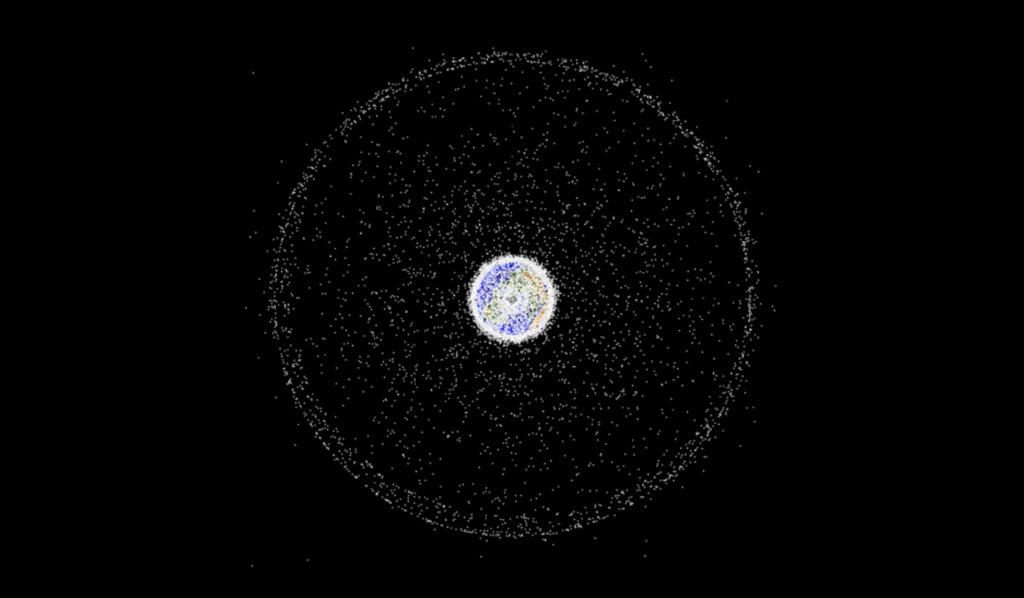
The U.S. Combined Space Operations Center’s Space Surveillance Network tracks manmade space objects currently orbiting the Earth. Orbital debris poses a challenge to space sustainability, and therefore, space governance. Illustration by NASA Orbital Debris Program Office.
The group’s first session was informally convened in 2022 to discuss how the Artemis Coalition could promote a multilateral dialogue on mission deconfliction and transparency in space activities. Under the aegis of the Artemis Accords framework, several Artemis parties met as a working group again in Baku, Azerbaijan, in 2023. This was the second working group meeting of the Artemis Accords signatories and coincided with the 74th International Astronautical Congress held in Baku.12 Ibid. At this working session, the parties discussed how to promote transparency, ensure safety in civil lunar surface operations, and reduce the risk of misunderstanding.13 Ibid. At the time of writing, it has not yet been announced if a third informal working group session will be convened at the forthcoming 75th International Astronautical Congress in Milan, Italy, in October 2024.
One benefit of these Artemis-led informal working group sessions is that they have the potential to be a means to publicly acknowledge and praise states for their transparency in space activities. For example, during the session in 2023, the NASA Deputy Administrator praised India for leading by example by exhibiting the Artemis Accords principle of transparency with its Chandrayaan-3 lunar landing mission. “They showed everything. They let the world join them online to watch the progress of this event….And in so doing, they upheld the highest principles of the Accords,” said Melroy.14 Ibid. As this report highlights, positive reinforcement is an incentive for states to comply with norms of responsible state behavior in outer space. To comply with the peaceful use of space, a positive reinforcement mechanism could be informal Artemis working group sessions at the International Astronautical Congress. A working group session may be a good model for positive encouragement with respect to the transparency and operationalization of the UN Framework for Responsible State Behavior, in particular the eleven nonbinding norms.
In support of transparency, the UN also maintains the world’s largest online and publicly available Register of Objects Launched into Outer Space. While it is not a panacea, this open registry system helps promote transparency because this type of information sharing builds trust among nations and enables better communication for the secure operation of space missions and traffic management.
The notion of deconflicting activities in a shared space or “global commons” could also be relevant for cyber-related activities of states. Deconfliction of space activities is also one of the nine Artemis principles. These types of activities include, but are not limited to, information sharing on mission length and the expected launch and lunar landing dates. Another governance aspect is the obligation to report the registration and launch of space objects. This principle is a requirement set forth in the 1976 Registration Convention. Under the convention, states are required to provide timely data to the UN on all objects launched into space. The relationship between this principle and the Convention demonstrates the mutually reinforcing relationship between laws and norms in outer space governance. A parallel initiative could be explored to encourage information sharing as it pertains to bolstering national, regional, and global Computer Emergency Response Teams (CERTs) to respond quickly to malicious cyber activity, such as a ransomware attack against another nation’s bank or hospital.
The origin story of the Artemis Accords principles may also be relevant and instructive for cyber accountability, because it demonstrates how unilateral positions and actions can bring states together. In turn, these opportunities for collaboration at times develop into coalitions of like-minded governments rallying together around specific threats or challenges. This collaboration advances accountability because states can form coalitions to discuss actions in line with existing international law, when it might otherwise be challenging to do so within other forums. For instance, the efforts of the U.S. to lead a ban on direct-ascent anti-satellite tests (ASAT) are another example from outer space governance of how pledging to refrain from a certain type of behavior could help encourage other states to follow suit in making a similar commitment. Further, the subsequent UN General Assembly (UNGA) resolution adopted in support of the ASAT ban may not have legal weight but does show how customary norms are formed and how nonlegal mechanisms can be used to reinforce what is regarded as unacceptable behavior.
Given the low likelihood of a comprehensive cyber security treaty being adopted soon, initiatives like these may be a more viable option to move the needle of progress higher for accountability.
APPLYING ARTEMIS ACCORDS PRINCIPLES TO QUANTUM COMPUTING CONCERNS?
To encourage states to develop an agreed normative framework for quantum-based technology, the government of Switzerland and the Geneva Science and Diplomacy Anticipator is unveiling the Open Quantum Institute in Geneva, at the European Organization for Nuclear Research (CERN). Quantum computers are advanced computational machines that use information storage units called quantum bits—qubits—and can solve complex mathematical problems exponentially faster than digital computers.15 https://www.technologyreview.com/2023/05/25/1073606/ibm-wants-to-build-a-100000-qubit-quantum-computer/.
The Artemis Principles could provide a useful basis for discussions between the Open Quantum Institute and global stakeholders, as initiated in March 2024.16 GESDA, “Who We Are: Geneva Science and Diplomacy Anticipator,” 2020, https://gesda.global/who-we-are/ ; GESDA, “Solution Idea: The Open Quantum Institute,” 2022, https://gesda.global/solutions/open-quantum-institute/. This three-year initiative will formally become part of CERN’s global outreach program with the Quantum Technology Initiative (QTI). Combining resources, the Open Quantum Institute will be CERN’s de facto “societal arm” to convene a global diplomatic dialogue on quantum computing and support the UN Sustainable Development Goals (SDGs).17 Antonella Del Rosso, “Bringing Quantum Computing to Society,” CERN, October 16, 2023, https://home.cern/news/news/computing/bringing-quantum-computing-society. Multilateral governance frameworks for quantum computers could act as a means for states to protect their sovereign authority18 Geoff Gordon, “Digital Sovereignty, Digital Infrastructures, and Quantum Horizons,” Springer Link, September 13, 2023, https://doi.org/10.1007/s00146-023-01729-7. authority18 in building accountability in the peaceful use and exploration of quantum computing. Sovereign authority in technological environments that transcend physical boundaries is generally referred to as “digital sovereignty.”19 Edoardo Celeste, “Digital Sovereignty in the EU: Challenges and Future Perspectives,” (Bloomsbury Publishing, 2021), https://doras.dcu.ie/25498/1/Celeste_DigitalSovereigntyintheEU.pdf.
Increasingly, states and international organizations like the UN and the North Atlantic Treaty Organization (NATO) are concerned about the potential security risks posed by quantum computers.20 https://www.nato.int/cps/en/natohq/official_texts_221777.htm; https://www.gao.gov/assets/d24106284.pdf. The UN Secretary-General cautioned the UNGA in 2022 that quantum computers could potentially “destroy cybersecurity and increase the risk of malfunctions to complex systems. We don’t have the beginnings of a global architecture to deal with any of this.”21 Antonio Guterres, “‘Our World Is in Big Trouble’, Secretary-General Warns General Assembly, Urging Member States to Work as One United Nations,” UN Press, September 20, 2022, https://press.un.org/en/2022/sgsm21466.doc.htm. Although the Open Quantum Institute is in its incubation phase, its leadership is already coordinating with 130 partners to explore governance approaches for the responsible use of quantum technology, noting that there is an equally “strong need for international cooperation in order to preserve human agency, accelerate our progress towards the SDGs, and ensure that the whole world contributes to and benefits from quantum computing.”22 Martial Trezzini, “Open Quantum Institute to Start in Geneva in March,” SWI, October 13, 2023, https://www.swissinfo.ch/eng/sci-tech/open-quantum-institute-to-open-in-geneva-in-march/48887914. This situation is an opportunity for the policy and scientific global community to come together to discuss how to advance accountability mechanisms for the observance of agreed cyber norms for quantum-based technology.

“A GPS satellite is launched from a SpaceX Falcon 9 rocket. Image by U.S. Air Force Senior Airman Thomas Sjoberg.”
Case Study 2: Promoting Accountability Via Capacity-Building
Cyber capacity-building activities help foster the conditions to engage the international community in upholding and strengthening a rules-based order in cyberspace.23 EU CyberNet, project of the Service for Foreign Policy Instruments, “Operational Guidance: Guide to the EU’s International Cooperation on Cyber Capacity-building,” European Commission, 2023, https://www.eucybernet.eu/operational-guidance/. Capacity-building has been underscored as crucial for accountability, notably positive accountability.24 Debra Decker, Kathryn Rauhut, and Allison Pytlak, “Fostering Accountability in Cyberspace,” Stimson Center, July 3, 2023, https://www.stimson.org/2023/fostering-accountability-in-cyberspace/.
Capacity-building activities to support long-term sustainability in space are generally understood in reference to enhancing the ability to operate in space in the future. Within international fora, it is defined as operating “in a manner that realizes the objectives of equitable access to the benefits of the exploration and use of outer space for peaceful purposes.” This definition is based on the 2019 Guidelines for the Long-Term Sustainability (LTS Guidelines) of Outer Space of the United Nations Committee for the Peaceful Uses of Outer Space (UN COPUOS). Surprisingly, the LTS Guidelines do not mention cybersecurity, which is an essential component for supporting the engineering life cycle of developing sustainable, secure, and resilient space systems. As a mechanism to generate accountability, this oversight could be an opportunity to promote global cooperation for identifying best practices and standards for safeguarding space assets and their supporting infrastructure from cyber threats. While the international LTS Guidelines are voluntary, international cooperation by states and global organizations to comply with the LTS Guidelines aligns with furthering another global framework—the SDGs—as it relates to the climate and the sustainability of space operations for future generations.25 United Nations, “THE 17 GOALS,” SDGS, n.d., https://sdgs.un.org/goals.
Finally, space offers other good models of capacity-building initiatives that could have relevance for cyber and accountability more broadly because of how they bolster transparency and information sharing. Specific examples include but are not limited to:
- Space Situational Awareness (SSA) mechanisms like the United Nations Office for Outer Space Affairs’ UN-Spider Portal, which is a common repository of technical capabilities (software) necessary to interpret space data. By sharing capabilities to monitor space activities, actors can verify compliance and hold disrupters accountable.
- The Space Track platform, which is a unilateral initiative to offer a freely accessible service to monitor activity in Earth’s orbits.
- Direct investments in connectivity and space infrastructure to promote cybersecurity, increase resilience, and reduce the risk of redundancy in architectural design.
Other Considerations
It cannot go overlooked that there is a deepening relationship between outer space and cyberspace, which may require that cyberspace has its own governance and accountability mechanisms or better integration and application of existing outer space norms and laws. Events at the outbreak of the Russia-Ukraine war underscore well the need for further review of the relationship between cyber- and outer space. There has also been a growing use of cyber and electronic “counter space weapons.”
Cyber counter space weapons can take a variety of forms and consist of activities including intercepting and monitoring data, corrupting data with malware, or even wresting control of the space system from the space operator. These weapons can disrupt and degrade the functionality of systems and, in extreme cases, destroy them. The Ukraine war demonstrates how malicious cyber actors can manipulate several points of entry to exploit ground-based, as well as orbiting, systems.26 Note: In February 2022, actors from the Russian state launched a malicious cyber operation against Viasat Inc.’s KA-SAT commercial satellites, disrupting thousands of modems across Ukraine and Europe. The attack also produced indiscriminate harm by disrupting wind turbines and internet services to private citizens across Europe. There is evidence of the Russian Federation persistently interfering with commercial space satellites supporting Ukraine and, by some accounts, evidence that the Ukrainian Armed Forces air defense units are targeting Russian electronic-warfare units using unmanned aerial vehicles (UAVs) interfering with Ukraine’s satellite communications; specifically, taking down Russian UAVs Horizon Air S-100 and Orlan-10 using Stingers. Electronic counter space weapons disrupt the transmission of radio frequency signals by jamming and spoofing communication relays and interfering with positioning, navigation, and timing (PNT) signals like GPS. On May 10 2022, SpaceX Founder Elon Musk tweeted that the Starlink terminals deployed in Ukraine had successfully “resisted Russian cyberwar jamming & hacking attempts so far, but they’re ramping up their efforts.”
During the UNGA First Committee session in October 2022, a Russian foreign ministry official declared the U.S. use of commercial satellites in the Ukraine war to be “provocative” and questionable under international space law. He warned that “quasi-civil infrastructure may be a legitimate target for a retaliation strike.”27 Konstantin Vorontsov, “STATEMENT by Mr. Konstantin VORONTSOV, Deputy Head of the Delegation of the Russian Federation, Deputy Director of the Department for Non-Proliferation and Arms Control of the Ministry of Foreign Affairs of the Russian Federation, at the Thematic Discussion on Outer Space (Disarmament Aspects) in the First Committee of the 77th Session of the UN General Assembly,” UN Journal, October 26, 2022, https://estatements.unmeetings.org/estatements/11.0010/20221026/5yPwCsESxyBr/N5pGP22K6MRm_en.pdf. Despite this announcement, there is no bright-line rule under international law for targeting dual-use satellites. In fact, targeting commercial space satellites that support both military and civilian populations implicates an array of legal commitments alongside informal ones, such as international telecommunications law, international space law (such as the OST), and even nonbinding guidelines regarding space debris mitigation.
At a meeting of the 2023 UN Open-Ended Working Group (OEWG) on Reducing Space Threats Through Norms, Rules and Principles of Responsible Behavior meeting, the U.S. representative explained that the dual-use nature of an increasing number of space systems presents a challenge to devising a durable definition for what constitutes a “weapon” in space.28 Ibid. The U.S. representative also expressed concern that some actors might claim civilian satellites are “weapons” as a subterfuge for targeting them on political grounds.29 Ibid. Just as the Woomera Manual30 Cassandra Steer, “The Woomera Manual: Legitimising or Limiting Space Warfare?” Military Space Ethics, eds. Nikki Coleman and Stephen Coleman, March 1, 2021 (Howgate Publishing, 2021 Forthcoming), ANU College of Law Research Paper no. 21.5, available at SSRN: https://ssrn.com/abstract=3802195. is envisioned to support a rules-based order for military space activities during periods of tension and armed conflict, global policymakers must be prepared to address the complex issues that traverse cyber and space in order to advance accountability.
Key Takeaways and Recommendations
Designing Governance Mechanisms that Span Cyber and Outer Space
Global policymakers must be prepared to address the complex issues arising from the convergence of space and cyberspace threats; particularly as the use of cyber and electronic counterspace weapons increases. There is a need to better integrate cyber-related threats and concerns within outer space mechanisms and frameworks, and vice-versa. International cooperation will become “even more important as both the opportunities in space evolve and the threats, in and to space, evolve as well.”31 NASA, “V.P. Kamala Harris Chairs National Space Council Meeting in Washington (Official NASA Stream),” December 20, 2023, https://www.youtube.com/watch?v=r1yr1G5nm44. Given the cross-domain connections between cyberspace and outer space, it is reasonable to examine what strong mutual priorities are functioning well in space and see if they might be similarly suited for building consensus around observing global cyber norms.
For example, the LTS Guidelines described earlier do not mention cybersecurity. This is an essential component for supporting the engineering lifecycle of developing sustainable, secure, and resilient space systems. As a mechanism to generate accountability, this support could be an opportunity to promote global cooperation for identifying best practices and standards for safeguarding space assets and their supporting infrastructure from cyber threats. While the guidelines are voluntary, international cooperation by states and global organizations to follow these guidelines is in alignment with realizing several of the goals articulated in the SDGs as it relates to protecting the climate and ensuring the sustainability of space operations for future generations.
Pledges to refrain from certain actions can help signal cooperation and build trust amongst States to advance joint coordinated action
Collectively, the Artemis Program, the Accords, and the ASAT ban can be relevant to cyber, because these examples demonstrate how coalitions of like-minded governments can advance action to respond to specific threats or challenges in line with existing international law. This approach is particularly relevant when the case might be challenging within established fora or institutions. Starting within a like-minded coalition is often a first step to signaling what is, and what is not, responsible state behavior. Such coalitions can also be more open to the active involvement of nongovernmental stakeholders because of their flexibility and relatively informal status. To some extent this is already happening in cyber through the recently launched Pall Mall Process on commercially available cyber intrusion capabilities or efforts within the Paris Peace Forum and Paris Call for Stability in Cyberspace. A cyber corollary for enabling accountability in the responsible use of cyberspace could be a similar pledge to refrain from other forms of harmful activity in cyberspace, like industrial economic espionage. Overall, accountability can be bolstered when states pledge to refrain from certain forms of conduct and meaningfully take action to signal that commitment to other states.







Community Adaptation for a Water Festival Without Clean Water