

The world responded in a unique and singular way to a problem discovered in 1985 that threatened the global commons: a hole in the ozone layer caused by ozone-depleting substances (ODS) with potentially severe consequences to human health and the environment. The Montreal Protocol is one of the most successful mechanisms addressing international risks. Its achievement underscores the importance of developing common goals, incentivizing compliance, and measuring outcomes to ensure accountability.
Important lessons for cyberspace can be taken from studying the development and implementation of global efforts to reduce the risks from stratospheric ozone.
An Evolving Framework
In 1985 the Vienna Convention for the Protection of the Ozone Layer (Vienna Convention) was adopted as a “framework convention”—a stepping stone toward addressing the depletion of ozone in the atmosphere but without requiring direct action. However, the Vienna Convention did obligate states to cooperate in developing “agreed measures, procedures and standards” to reduce ODS emissions with the development of future protocols and annexes to the Convention as science/technology advanced and negotiations continued toward appropriate actions.1 “The Vienna Convention for the Protection of the Ozone Layer,” Vienna, March 22, 1985, United Nations Treaty Series, vol. 2, no. 27, 6, available from https://treaties.un.org/doc/Treaties/1988/09/19880922%2003-14%20AM/Ch_XXVII_02p.pdf. Two years later, the Montreal Protocol on Substances that Deplete the Ozone Layer (Montreal Protocol) was adopted.2 “Montreal Protocol on Substances that Deplete the Ozone Layer,” Montreal, September 16, 1987, United Nations Treaty Series, vol. 2, no. 27, available from https://treaties.un.org/doc/Treaties/1988/09/19880922%2003-14%20AM/Ch_XXVII_02p. pdf.
According to the UN Environment Program (UNEP), “The Montreal Protocol phases down the consumption and production of the different ODS [ozone-depleting substances] in a stepwise manner, with different timetables for developed and developing countries” (with developing countries referred to as “Article 5 countries”). All parties have specific responsibilities related to the phaseout of the different groups of ODS. “Developing and developed countries have equal but differentiated responsibilities, but most importantly, both groups of countries have binding, time-targeted, and measurable commitments.”3 Ibid. The Protocol took a phased approach to implementing requirements, which were determined based on their feasibility and with procedures that had been determined at the Convention.
The Montreal Protocol cites controls for groups of substances weighted by ODS potential, with its parties calculating their production, consumption, and trade in those substances. Trade of ODS with states not party to the convention is restricted, with controls based on each state’s national circumstances.
The Protocol defines the phaseout/controls process, with mechanisms for determining and treating noncompliance decided at subsequent meetings. State parties review the controls at least every four years. Before the review, panels of experts in scientific, environmental, technical, and economic information are convened to assess and report on control measures. State parties are required to report annual ODS data, called Article 7 data, to check on compliance with the control measures.4 “Data Reporting and Surveys,” UN Environment Programme OzonAction, accessed May 24, 2024, https://www.unep.org/ ozonaction/what-we-do/data-reporting-and-surveys#.
The Protocol has been amended five times to reflect new science and concerns, with the most recent being the 2016 Kigali Amendment.5 “Amendment to the Montreal Protocol on Substances that Deplete the Ozone Layer,” Kigali, October 15, 2016, United Nations Treaty Series, vol. 2.f, no. 27, available from https://treaties.un.org/doc/Treaties/2016/10/20161015%2003-23%20 PM/Ch_XXVII-2.f-English%20and%20French.pdf; see also https://ozone.unep.org/ozone-timeline; and https://enb.iisd.org/ events/montreal-protocol-mop-28/summary-report-10-14-october-2016. Researchers recognized the inadvertent impact on global warming that some of the Protocol’s earlier steps were causing, specifically the substitution of hydrofluorocarbons (HFCs) for hydrochlorofluorocarbons (HCFCs) and chlorofluorocarbons (CFCs), which are widely used in refrigeration and air conditioning and are powerful greenhouse gases with global warming potential (GWP) thousands of times higher than that of CO2. The Kigali Amendment phases down global production and consumption of all key HFCs, with exemptions available for critical and/or essential uses.6 Note that various exemptions existed earlier. “Amendment to the Montreal Protocol on Substances that Deplete the Ozone Layer,” Kigali, 15 October 2016, United Nations Treaty Series, vol. 2.f, no. 27, available from https://treaties.un.org/ doc/Treaties/2016/10/20161015%2003-23%20PM/Ch_XXVII-2.f-English%20and%20French.pdf; For history, see: https:// ozone.unep.org/sites/default/files/2020-06/Briefing_note_on_exemptions.pdf; “OzonAction Fact Sheet,” UN Environment Programme OzonAction, accessed May 24, 2024, HYPERLINK «https://multimedia.3m.com/mws/media/1365924O/unep-fact-sheet-kigali-amendment-to-mp.pdf»https://multimedia.3m.com/mws/media/1365924O/unep-fact-sheet-kigali- amendment-to-mp.pdf and “Parties Amend Montreal Protocol to Address HFCs.” IISD, last modified October 17, 2016, accessed May 24, 2024, https://sdg.iisd.org/news/parties-amend-montreal-protocol-to-address-hfcs/. It also divides Article 5 countries into two further groups recognizing different baselines reflecting parties’ current levels of dependence on the named substances and allowing different phasedown schedules.7 “Montreal Protocol on Substances that Deplete the Ozone Layer,” Montreal, September 16, 1987, United Nations Treaty Series, vol. 2, no. 27, available from https://treaties.un.org/doc/Treaties/1988/09/19880922%2003-14%20AM/Ch_XXVII_02p. pdf.
From the framework established by the Vienna Convention to the Montreal Protocol and its attendant processes, the world has witnessed a slow but meaningful march toward accountability for healing the ozone hole and mitigating climate change, as all ODSs are also greenhouse gases.
Overseeing and Incentivizing Compliance
It took several years of negotiation to develop a noncompliance mechanism for the Montreal Protocol, which was subsequently revised.8 David Victor, “The Early Operation and Effectiveness of the Montreal Protocol’s Non-Compliance Procedure,” International Institute for Applied Systems Analysis (Modling, Austria: St. Gabriel, May 1996), https://pure.iiasa.ac.at/id/eprint/4863/1/ER- 96-002.pdf and https://diglib.uibk.ac.at/download/pdf/8396149.pdf. The mechanism is comprised of an Implementation Committee of 10 State Parties, representing various regions, which is supported by the UN Secretariat.9 Ibid. Compliance activities overseen by the Committee include annual reporting of data, phasing out of consumption and production of ODS, and implementing a licensing process including restricting trade with nonstate parties. The naming of State parties that are not in compliance and expressions of concern are what encourage countries to comply.10 “List of Implementation Committee Recommendations,” UN Environment Programme OzonAction, accessed May 24, 2024, https://ozone.unep.org/list-of-implementation-committee-recommendations.
The Implementation Committee assists countries to meet their implementation targets. This provides positive incentives. Countries self-report their own noncompliance and can seek grace periods and assistance.11 See below (as in another citation?) for information on the Multilateral Fund. Verification of data and timeliness of reports have been issues, but the implementing agencies involved—including the UN Development Programme, the UN Industrial Development Organization, and the World Bank—provide some confirmation of data. 12For recent compliance data, see https://ozone.unep.org/system/files/documents/MOP-35-12-Add-1E.pdf. For information on monitoring, see Duncan Brack, “Monitoring the Montreal Protocol”, Verification Yearbook 2003, (2003): 210-225, https://www.vertic.org/media/Archived_Publications/Yearbooks/2003/VY03_Brack.pdf»https://www.vertic.org/media/ Archived_Publications/Yearbooks/2003/VY03_Brack.pdf. The Protocol promotes sharing of technological approaches and best practices and evaluates the costs and benefits of different strategies for compliance. Advisory groups on technical options and economic assessments assist State parties. State parties are asked to report every two years on their collaboration efforts and on efforts to educate the public on effects of ozone depletion (Article 9); however, compliance with this request is not monitored by the Implementation Committee so only some countries appear to report, even when they do comply.13 See, for example, Australia’s “Additional Reported Information” from 2019, on the UN Environmental Programme’s OzonAction profile at: https://ozone.unep.org/countries/profile/aus, whereas the U.S. does not appear to report on outreach but does do this, https://www.epa.gov/ozone-layer-protection/voluntary-educational-and-outreach-programs- related-ozone-layer-protection. See also other observations on Article IX reporting regarding countries’ research and collaboration on pp. 8-9 of the EIA’s briefing to the 34th Meeting of the Parties to the Montreal Protocol (MoP34), “Chemical Nightmare,” October 2022, https://eia-international.org/wp-content/uploads/Chemical-Nightmare-SPREADS.pdf.
An important aspect of the success of the Montreal Protocol is its unique financial mechanism, the Multilateral Fund (MLF) for the Implementation of the Montreal Protocol, which provides technology transfer, institutional strengthening, and financial assistance in both manufacturing and servicing sectors to developing countries.14 Article X calls for best available technology transfers. Montreal Protocol on Substances that Deplete the Ozone Layer, art. 10, https://treaties.un.org/doc/Treaties/1988/09/19880922%2003-14%20AM/Ch_XXVII_02p.pdf. This financial assistance enables these countries to achieve compliance. At first, developed countries were responsible for most of the world’s ODS production and consumption; however, some developing countries, in particular China and India, are now major ODS and HFC producers.15 The evolving divergence among developing countries in their interest in compliance with the protocol and the Kigali Amendment is investigated in Shiming Yang, “Growing Apart: China and India at the Kigali Amendment to the Montreal Protocol,” Global Environmental Politics 23, no. 2 (2023), 74–101, https://doi.org/10.1162/glep_a_00698.
As of November 2023, contributions to the Fund totaled $5 billion.16 With nearly $1 billion budgeted for the three years (2024-26), see UN Multilateral Fund, http://www.multilateralfund.org/default. aspx. The MLF Executive Committee receives project proposals, oversees disbursements, and evaluates the effectiveness of the fund in phasing out ODS.17 The Executive Committee is responsible for overseeing the operation of the Multilateral Fund for the implementation of the Montreal Protocol. The Committee is selected from two groups, comprised of seven members from Article 5 and seven from non-Article 5 parties. They are elected each year by the Meeting of the Parties. Committee decisions are reached by a two-thirds majority vote representing individual majorities of each group—ensuring that neither donors nor recipients dominate the operations of the fund. The chair is chosen from one group, and the vice chair is chosen from the other. Each year they alternate. Causes of project success/failure are assessed for reporting on lessons learned. Implementing agencies report against outcomes. For example, OzonAction, a branch of UNEP, measures progress against nine outcomes (see visual below):
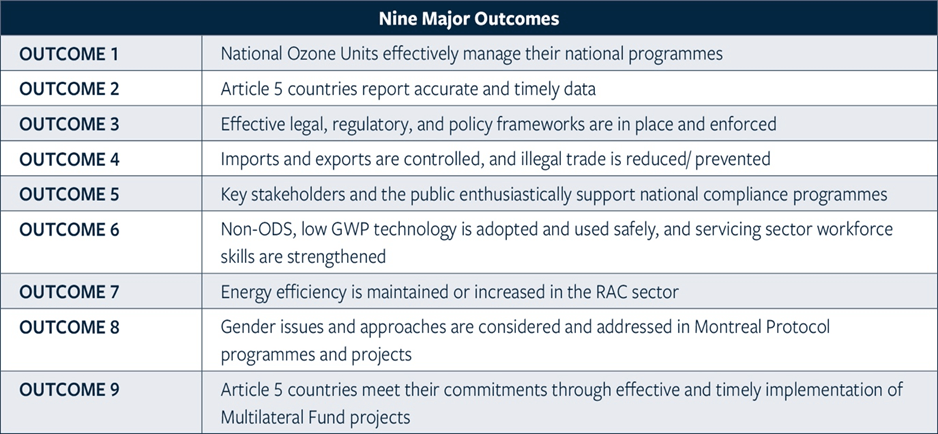
Illustration from https://www.unep.org/ozonaction/who-we-are.
Incentives for compliance are working. Every four years, a scientific assessment of the treaty’s effects is presented. The most recent one in 2022 found, “Actions taken under the Montreal Protocol continue to contribute to ozone recovery.” Over 200 scientists from 30 countries were involved in the assessment. Although the assessment warned that the Protocol faces many policy and scientific challenges to protecting the ozone layer, the ozone layer is expected to recover by the middle of the 21st century.
The Montreal Protocol regime of agreements and procedures, now in its fourth decade, is adapting to meet new challenges. In 2018, a group of scientists reported increased emissions of CFC-11, which was unexpected given the substance had been banned since 2010. The Environmental Investigation Agency (EIA), a British nongovernmental organization (NGO), released related findings at the 2022 State parties meeting tracing the emissions to the illegal production and use of CFC-11 in China. Given the revelations, China took some early targeted actions to reduce violations, but EIA noted that more oversight was needed worldwide. As some researchers have noted, “…the Montreal Protocol has achieved remarkable success through its flexibility and adaptive responses to scientific and technological advances… It is time for it to adapt again if it is to be a twenty-first century success story.”
Key Factors in the Development of the Agreement and Its Mechanisms
CFCs were invented in 1928 to replace some other hazardous materials used in homes for refrigeration; by the middle of the 20th century, CFCs were in wide use as a part of air conditioners, plastic manufacturing, and aerosols including hair spray.18 Stephen Andersen and K Madhava Sarma, Protecting the Ozone Layer: The United Nations History (1st ed.), (London: Routledge, 2002), 4, https://doi.org/10.4324/9781849772266. In the early 1970s, industry and scientists began to suspect the impact of these ODS and their long-lasting impact on stratospheric ozone19. Andersen and Sarma, Protecting the Ozone Layer, 10 & 197. Without that layer of ozone filtering out harmful Ultraviolet-B radiation, humans have more eye cataracts compromising vision, more skin cancers and some compromised immune responses; additional adverse effects on plants and marine life have more recently been noted.20 “Ultraviolet Radiation: How it Affects Life on Earth,” NASA Earth Observatory, September 6, 2001, https:// earthobservatory.nasa.gov/features/UVB/uvb_radiation2.php. The United States (U.S.) was responsible for about one-third of the global consumption and production of CFCs, and industry pushed back against possible controls.21 Andersen and Sarma, Protecting the Ozone Layer, 44-45.
In 1977, UNEP convened an international meeting that agreed to establish a World Plan of Action on the Ozone Layer. In 1981, the UNEP Governing Council asked the UNEP Executive Director to establish a group to start work on a framework convention to respond to environmental concerns about ozone depletion. These actions are what led to the Vienna Convention in 1985,22 The Vienna Convention for the Protection of the Ozone Layer, Vienna, 22 March 1985, United Nations Treaty Series, vol. 2, No. 27, p. 6, available from https://treaties.un.org/doc/Treaties/1988/09/19880922%2003-14%20AM/Ch_XXVII_02p.pdf. when there was an announcement of the discovery of a hole in the ozone shield over Antarctica and further validated earlier scientific findings.23 Steve Colwell, Jonathan Shanklin, “The Ozone Hole,” British Antarctic Survey, June 30, 2022, https://www.bas.ac.uk/data/ our-data/publication/the-ozone-layer/. Industry opposition diminished once they recognized the inevitability of controls. Companies changed strategy and researched alternatives—another route to technological and commercial success. 24Andersen and Sarma, Protecting the Ozone Layer, 200-201.
Certain individuals and countries helped drive agreement.
In 1980, Norway hosted a meeting of like-minded countries—Canada, Denmark, Germany, the Netherlands, Norway, Sweden, U.S.—and the European Commission that decided to push for negotiations for a convention. A proposal from Sweden led to the establishment of an Ad Hoc Working Group of Technical and Legal Experts by the Governing Council. This working group began work in January 1982 toward a draft convention. Unable to agree on substance, they proposed a framework treaty, the Vienna Convention.
A group of individuals from Canada, Denmark, Finland, Norway, Sweden, and the U.S. became known as the “the Toronto Group.” The group proposed a resolution to be approved at the same time as the Vienna framework treaty that called for negotiating a follow-on protocol.
UNEP’s executive director facilitated agreements via informal, closed-door discussions. Negotiations were also preceded by informal workshops, including industry representatives for the first time as more than observers. The director asserted that a protocol would be signed in the fall of 1987 and put forth his own proposals based on his confidential discussions with difficult delegates.25 Andersen and Sarma, Protecting the Ozone Layer, 39; 88-91. He is credited with “orchestrating” agreement on a process with clear outcomes.26 Andersen and Sarma, Protecting the Ozone Layer, 442. Personal relationships and innovative late-night ideas helped delegates reach agreement.27 Danny Hobrock, “The Ozone Hole,” CUDOS Science, December 10, 2022, https://www.cudos.science/ozone-hole.
Professional panels were established for independent scientific, technological, economic, and environmental assessments.
Panel chairs were unconstrained in how they developed committees of experts to contribute to the proceedings. Experts contributed their knowledge; they did not advise on policy but presented options and did not represent governments or industries. The goal was to strive for international representation and information from peer-reviewed journals, and a technology panel sought experts from industry given that new technological assessments were not yet included in peer-reviewed publications. These independent advisers worked collaboratively with experts from developing and developed countries to provide varied approaches to problems to gain international support.28 Andersen and Sarma, Protecting the Ozone Layer, 438-442. Obtaining and assessing data were key. New/better approaches are continually sought, such as initiatives to certify refrigerant technicians/ drivers and to move toward the use of natural low and/or very low refrigerants.29 Environmental Investigation Agency, “Ambition of newly revised EU F-gas Regulation heralds a new era of climate innovation!”, October 2023, https://eia-international.org/news/ambition-of-newly-revised-eu-f-gas-regulation-heralds-a-new- era-of-climate-innovation/. The use of natural refrigerants may be getting some pushback from existing businesses.
Funding schemes, technical support, and flexibility in phaseout schedules attracted countries that were initially opposed.
The London Amendment to the Protocol entered into force in 1992 and required the expeditious transfer of the best available and environmentally safe substitutes and technologies and committed State parties to meeting the agreed incremental costs in order to enable compliance by developing countries.30 Amendment to the Montreal Protocol on Substances that Deplete the Ozone Layer, London, June 29, 1990, United Nations Treaty Series, vol. 2.b, no. 27, available from https://treaties.un.org/doc/Treaties/1992/08/19920810%2003-51%20 AM/Ch_XXVII_02_bp.pdf; https://ozone.unep.org/treaties/montreal-protocol/amendments/london-amendment-1990- amendment-montreal-protocol-agreed. This was a critical factor in getting more States to sign on. Some like India worried about technological dependence on the developed states, who in turn had concerns about intellectual property protections of technology transfers. The ability to have a fund to help finance technological change also attracted countries like China to sign on to the amended protocol.31 Andrew Pfluger, “Why the Montreal Protocol is not a Template for Multilateral Environmental Agreements: An Examination of Why India, China Ratified,” Middle States Geographer, 43, 2010, 96-103, https://msaag.aag.org/wp-content/ uploads/2013/04/11-MSG-2010-Pfluger.pdf.
The public, media, and NGOs played a prominent role in driving agreement.
As one observer mentioned, simplifying the issue and having a dramatic name, “the ozone hole,” captured public attention.32 Andersen and Sarma, Protecting the Ozone Layer, 67. Media coverage internationally was uneven, but some significant publications helped inspire change.33 Paul Brodeur, “In the Face of Doubt,” The New Yorker, June 1, 1986, https://www.newyorker.com/magazine/1986/06/09/in- the-face-of-doubt. State parties, as required by the amendment, the UN, and some groups helped raise public awareness, including targeting new audiences such as children. NGOs such as the Natural Resources Defense Council and Greenpeace used legal remedies to advance reduction of ODS.
Reluctant states and industry got onboard.
The potential restrictions on ODS-related trade for those not signing the treaty or falling out of compliance proved to be a significant incentive—in the form of a stick, rather than a carrot—for participation and compliance. In the initial concerns about the ozone hole, the number of actual ODS manufacturers were small, only 15 according to one source. They would have to stop exports to nonstate parties of ODS and items made using these.34 Andersen and Sarma, Protecting the Ozone Layer, 351. The adaptive measures allowed—and supported by funding—encouraged states and their commercial sectors to see the benefits of joining and complying with the treaty. In addition to regulatory approaches to controls, some governments imposed taxes/fees on production and/or use of ODS. Some imposed quotas and/or bidding systems for licenses. Product labeling requirements were also introduced in some countries to allow consumer/user pressure on businesses, not just pricing, to help drive change.35 Andersen and Sarma, Protecting the Ozone Layer, 252-258. In addition, and to some extent, government contracts were modified to restrict ODS use/ purchases thus leveraging governments’ purchasing power.36 More extensive research is needed to document the extent and effectiveness of this; however, see some U.S. information here, United States Executive Order 12843—Procurement Requirements and Policies for Federal Agencies for Ozone-Depleting Substances, 1993, https://www.govinfo.gov/content/pkg/WCPD-1993-04-26/pdf/WCPD-1993-04-26-Pg638.pdf; United States Environmental Protection Agency, “EPA Collaborations with Stakeholders to Protect the Ozone Layer,” last modified July 20, 2023, accessed May 24, 2024, https://www.epa.gov/ozone-layer-protection/ epa-collaborations-stakeholders-protect-ozone-layer; and increased U.S. emphasis on the issue here “Fact Sheet: Biden Administration Combats Super Pollutants and Bolsters Domestic Manufacturers with New Programs and Historic Commitments,” September 23, 2021, White House Briefing Room, https://www.whitehouse.gov/briefing-room/statements- releases/2021/09/23/fact-sheet-biden-administration-combats-super-pollutants-and-bolsters-domestic-manufacturing-with- new-programs-and-historic-commitments/.
Women’s role in driving change becomes recognized.
The role of women in promoting compliance has been recently recognized with the MLF supporting efforts to better recognize gender in programs and assessments and to promote women’s training and participation.37 “OzonAction and Gender Mainstreaming,” UN Environment Programme OzonAction, accessed May 24, 2024, https://www. unep.org/ozonaction/ozonaction-and-gender-mainstreaming. Special efforts at capacity-building also target women, for example, providing training and support for women in West Africa to work in refrigeration repair.38 The Green Cooling Initiative, “Ozone and Climate Friendly Cooling in West and Central Africa (ROCA),”https://www.green- cooling-initiative.org/about-us/our-projects/roca/2023/07/03/trust-female-competence-oewg-side-event; https://www.green- cooling-initiative.org/news-media/publications/publication-detail/2023/06/13/video-series-women-in-refrigeration. Implementation of the Protocol can be linked to many of the UN’s Sustainable Development Goals (SDG), including SDG 5 on achieving gender equality and empowering all women and girls.39 “OzonAction and Gender Mainstreaming,” UN Environment Programme OzonAction, accessed May 24, 2024, https://ozone. unep.org/sdg.
Relevance to Cyber
The upper atmosphere and cyberspace are both areas where collective action is needed to address cascading effects, the transboundary nature of threats, and the potential harm to the global commons. The long-persistent effects of ODS on the ozone layer made that issue clearly urgent, whereas the harmful scenarios in cyberspace are not universally accepted or always seen as urgent. Although conditions in the world have changed from when the Vienna Convention discussions began, today’s fractured state relations need not stymie progress on cooperation. Even in 1991 when it was a time of difficult transition for the former Eastern Bloc, the former Soviet Union, and the United States, they found they could cooperate to monitor the ozone layer.40 Robert Cowen, “USSR To Help Keep an Eye on Ozone Layer,” Christian Science Monitor, January 16, 1991, https://www.csmonitor.com/1991/0116/dozone.html.
Who can have, and who can afford safer and more secure technologies? The global South and many others at first expressed their basic need for affordable refrigeration and were reluctant to address issues related to ODS. Some, even in developed states, doubted the true effects of ODS and viewed the short-term effects on the economy of disrupting existing industrial practices as too costly. Likewise in cyberspace, the global South and even some in the industrialized North value low-cost, less secure information communications technologies (ICTs) as potentially worth the gains that are possible through quicker, cheaper digitization. Scientists, technologists, and industry experts are critical players in developing solutions to issues in both areas. For ODSs, those discussions and the latitude for compliance are still evolving, even after many decades, given the advances in science and technology—including in monitoring. In cyberspace, that process is still nascent.
Key Takeaways and Recommendations
Consider Developing New Technological/Control Approaches
The depletion of stratospheric ozone is a singular well-defined risk that has required new technologies and approaches to be developed and updated as new risks and threats are discovered. Science and investments in research and development supported the transition from agreeing to a framework treaty and protocol to implementation of those instruments. Society, including the private sector, benefited as has the environment.
Unlike ozone, cyberspace presents a multiplicity of problems that largely stem from the underlying risks posed by anonymity. While benefits abound—free, fast information flows with protections for privacy and free speech—cyber anonymity facilitates dis/misinformation and allows shielding of malicious and criminal conduct. As cyber threats have increased with the advent of artificial intelligence (AI) and malware as a service, the risks and threats have multiplied. Artificial intelligence can be applied to help protect individuals, businesses, and governments but that level of sophistication is not widely available.
Recommendation: New approaches for cybersecurity are needed and should continue to be explored, particularly as cyberspace evolves and new technologies generate new threats.
If the digital world could be reinvented today, what would we want it to look like in terms of technologies, access, and controls to better manage cyberspace issues? Could/should new technological approaches and regulations better strike the balance between allowing the benefits of anonymity while finding more ways to ensure accountability as needed?
Define the Problem and its Relative Risks
Although the issue of ozone depletion was clear, it was valued differently among stakeholders engaged in the Montreal Protocol process. Negotiation and incentives were needed to reach agreement on common valuations and approaches. The work of international panels of scientists, technologists, and economists informed discussions. Obtaining and measuring data and outcomes from initiatives were all key.
Recommendation: The value placed on privacy versus wrongful use of ICTs differs among and within states and is changing. Reaching agreement on threats and overall risks is challenging. Although discussions at the United Nations (UN) on a broad cybercrime treaty have stalled,41 Alexis Steffaro, “Detour or Deadlock? Decoding the Suspended UN Cybercrime Treaty Negotiations,” Center for Cyber Security Policy and Law, March 4, 2024, https://www.centerforcybersecuritypolicy.org/insights-and-research/detour-or- deadlock-decoding-the-suspended-un-cybercrime-treaty-negotiations. important UN discussions on norms and laws for state behaviors continue to help build agreement.42 UN General Assembly resolution 75/240, Developments in the field of information and telecommunications in the context of international security, A/RES/75/240, December 31, 2020, established the open-ended working group on ICT, available from https://meetings.unoda.org/open-ended-working-group-on-information-and-communication-technologies-2021. Independent panels could perform a more structured analysis of cyber threats and risks, as was done by the expert panels of the Montreal Protocol, to develop a deeper common understanding and definition of incidents and categories of harms. For example, this effort could include estimating the broader societal harms stemming from a state’s actions and inactions in relation to ICT use, such as the potential cascading effects from attacks occurring in their and other countries. Obtaining data and establishing metrics in a consistent fashion are critical. Threat and risk assessments would evolve as information on threats and risks increases and as science, technology, and values change. Policymakers could then weigh conditional risks and their different valuations of harms and trade-offs, then consider collaborative approaches to managing specific risks.
Develop Agreed Approaches to Monitoring and Managing Cyber Risks
UNEP was the original hub for assessing and managing ODS risks and systematically involved other organizations in measuring and reporting on the ODS risks—from how the environment was changing to what actions could and might be taken to mitigate risk. Monitoring actions and capacity-building were integral parts of the framework, with an approach that was supportive rather than confrontational. The organizational responsibilities and relationships were complex but clear and mapped out, with supportive accountability mechanisms for managing risks.43 See Appendix.
Recommendation: In a 2023 policy brief published as part of the process leading to the Summit of the Future to be held later in 2024, the UN Secretary-General called for the establishment of “an independent multilateral accountability mechanism for malicious use of cyberspace by States to reduce incentives for such conduct.”44 United Nations Secretariat, A New Agenda for Peace, 26-27.
Such a mechanism could not only support accountability and call out malicious uses of cyberspace, but it could also assess and develop recommendations for managing cyber threats as well as monitor implementation and adherence to agreed commitments, including international law and the behavioral norms that comprise the UN Framework for Responsible State Behavior in Cyberspace.45 Some headway on this has already been made in limited areas. UN-affiliated and standards development organizations like the International Telecommunications Union and IEEE develop standards especially related to vulnerability management and risk. International Telecommunications Union, “Global Cybersecurity Index,” https://www.itu.int/en/ITU-D/ Cybersecurity/Pages/global-cybersecurity-index.aspx. It could help develop a structured and consistent approach to collecting data and assessing approaches. This mechanism could also support capacity-building (without duplicating existing efforts) and collectively and systematically evaluate outcomes as is done for ODS projects.46 Many different organizations have developed to a large extent organically to fulfill the many needs of cyberspace, such as the Cybil Portal mapping of capacity-building projects and the Geneva Dialogue on Responsible Behavior in Cyberspace coordinating efforts in reducing digital product vulnerabilities in digital products. Government of Switzerland, Federal Department of Foreign Affairs, “Geneva Dialogue on Responsible Behaviour in Cyberspace.” https://genevadialogue.ch/. The proposed UN Programme of Action (UN PoA) on state use of ICTs could help carry such efforts forward, making current efforts more efficient and effective. The possible harms that pose local, as well as systemic and international risks, could be assessed and should be prioritized to be addressed through capacity-building, regulations, and other approaches. Incentives for compliance are key, especially positive ones with assistance in developing the ability to comply.
Support Multilateral Leadership in Developing Agreements With Defined Roles and Responsibilities
The beginnings of agreement on ODS came from like-minded states banding together to take leadership— the Toronto Group. Some usual allies of these states were hesitant to support efforts at first, but with strong leadership from individuals in this group and others, as well as pressures from NGOs, scientists, and eventually the public, more states and businesses came onboard. Informal consultations and workshops outside formal meetings were key to forging relationships and agreements. Clear reporting structures, with separations between governance and implementation, were established among existing and new institutions.47 See Appendix. Regional networks were established to facilitate greater sharing of expertise and reporting.48 “Networks,” UN Environment Programme. OzonAction, Accessed May 24 2024. https://www.unep.org/ozonaction/networks. 49Developing countries have Ozone Contact Units that manage the local program and interface with MLF and others. https:// www.unep.org/ozonaction/networks/national-ozone-unit-contacts.
Recommendation: In addressing malicious cyber activity, some states have required leadership to address particular challenges through like-minded coalitions, such as the U.S. initiative on ransomware. Required coordination and leadership goes beyond states however, with cybersecurity firms and others partnering to advance security efforts.50 See for example, MITRE Engenuity: https://mitre-engenuity.org/ and the Cyber Tech Accord, https://cybertechaccord.org/. However, states and the UN could help focus the efforts of technology firms and others on what they collectively determine to be high-priority needs. Such efforts could lead to developing advisory panels similar in focus to the ODS Technology and Economic Assessment Panel with regional representation. A cyber mechanism could more precisely define what actions demonstrate compliance with agreed norms and international laws. Civil society could help with support as it has in monitoring ozone and other areas.51 On nuclear security: The Nuclear Threat Index, https://www.ntiindex.org/. On international rule of law: World Justice Project, ”Rule of Law Index,” https://worldjusticeproject.org/rule-of-law-index/. On women, peace and security: Georgetown Institute for Women, Peace and Security and Peace Research Institute Oslo. 2021. Women, Peace, and Security Index 2021/22: Tracking sustainable peace through inclusion, justice, and security for women. Washington, DC: GIWPS and PRIO.
Recognize the Need for Adaptability and Flexibility
The Montreal Protocol demonstrated the importance of adaptability and flexibility in responding to new scientific advancements and emerging challenges—with new solutions and approaches developed. Its negotiation process also recognized that countries with lower socioeconomic development would not be able to adapt as quickly as developed countries. Schedules were modified for those countries and programs were instituted to build their capabilities and positive incentives for compliance—with potential trade restrictions being the penalty for noncompliance.
Recommendation: The development and strengthening of cybersecurity norms will likewise require an adaptive process in which all stakeholders will have to continue to be flexible to keep pace with rapid technological advances such as AI and quantum computing. Any new mechanism to address cyber accountability needs to acknowledge this reality.







Community Adaptation for a Water Festival Without Clean Water