


During WWII, the US met the existential challenge from fascism that was threatening the survival of democracies by using our nation’s best scientists, and the best scientists from other nations seeking our refuge, to restructure our armies, gather information, and conduct forward-looking strategic planning on a global scale. The post-war policy of containment, which relied on specialized knowledge of various areas of the world where democracy and communism might compete for national dominance, ultimately proved effective in beating back the threat from belligerent communist expansion. But we are now in a new age of global ferment that is generating conflicts both transnational and substate, and for which novel and rigorous methods of gathering evidence, and ways of generalizing across contexts, are required to understand and manage the international conditions necessary for the security of our nation.
Similar to the multitude of problems that emerged from the collapse of the Soviet Union, the United States now faces mounting threats resulting from the fragmentation of societies and the nation-state order. States are weakening in the Middle East, across Africa, and in Southeast Asia, while consensus in the West has been eroding for the belief that the American and European Alliance, and its democratic institutions, are essential to political life and worth fighting for so that they may endure (World Values Survey 2005-2014, International IDEA 2023). Part of the problem is that as the velocity and volume of information increase, social cohesion tends to fracture, making the potential for violent conflict more likely. Russia, for example, with their disinformation campaigns seeks to create division along these social fault lines within nation-states (e.g., United States elections, European elections, the Catalonian independence movement, Brexit interventions, fake cables in Wikileaks indicating that the US government bugged the German Chancellor’s Office causing German support for the US to fall more than 30 percent the day it was reported, influence operations in the Sahel and in support of the partitioning of Ukraine, etc.). Social cohesion within nation-states, as well as alliances between them such as the European Union, the Association of Southeast Asian Nations (ASEAN), and even the Organization of American States (OAS) are threatened by more than just Russia. For example: the malign influence operations of China and Iran, increasingly in collusion with Russia; the revival of militant ethno-nationalism in Europe; the persistence of ISIS in sustaining a global archipelago of jihad; and separatist movements often fueled by outsiders seeking to divide communities through assaults on the “gray zone.”1The use of Gray Zone refers to the fault lines within societies that can be pushed to their breaking point by malign actors
From the 1950s through the 1980s, the United States Government (USG) partnered with universities to develop Area Specialists that could help the nation understand threats of Communist expansion, the Soviet Union, China, and nuclear weapons. After 9/11 there was a call to build capacity to understand terrorism. Generally, the US has a grand history of adapting to threats posed by foreign adversaries. The challenge today is that the adversary is not necessarily a country or an armed group where traditional powers of statecraft and military are paramount. The emerging threat stems from the fragmentation of societies within nation-states, whether friend or foe. The problem is not easily handled by the traditional national security structure of State or Regional Desks in Departments and Agencies that are tethered to geographic boundaries. A critical objective is to prevent the need for our military to spend lives and treasure fighting when an “ounce of prevention” could lead to a stronger outcome for the nation.
Accomplishing this objective requires a better understanding of information and its context, especially in fluid theaters of conflict, to facilitate effective, evidence-based decisions that optimize outcomes; and it entails collective responsibility with allies to stabilize international security in an age of increasingly rapid mobilization of information and peoples into conflict zones that risk U.S. interests and engagement. Success also may turn on unleashing the potential of young people to become researchers and scientists, and sending them to troubled regions across the globe, so as to build an intellectually powerful and empirically solid ethos from which future policy strengths grow. For it is the young – informed to be sure by lessons from mature experience — who are most apt to form active communities and networks open to creative ideas and novel ways to implement them before careers and concepts become mired in academic hierarchies and government bureaucracies. This opening necessitates a new culture of adoption that significantly lessens the time and red tape for administrative tasking that slows and shackles innovation.
DoD’s traditional focus on youth overwhelmingly concerns recruitment for active military service, rather than ideas; and the ideas that are encouraged mostly pertain to technological advancement rather than to better formulating and forecasting human decisions and outcomes, including those that can disorient and disarm an adversary regardless of technological prowess. Although the White House (2024) recently endorsed A Blueprint for the Use of Social and Behavioral Science to Advance Evidence-Based Policymaking as “integral to the missions of departments and agencies across the federal government” (National Science and Technology Office 2024, p.8), support for social science to inform national security is projected to remain meager into the near future. 2At present, DoD’s Minerva Research Initiative, which “supports social science research aimed at improving basic understanding of security, broadly defined,” is the primary program at least in part addressing related issues of how ideas and information move people toward or away from conflict. It punches above its weight in terms of developing innovative ideas for DoD and the nation as a whole, but its annual budgets is relatively small: in the neighborhood of $20 million annually, or about one one-thousandth of DoD’s annual Science and Technology budget and less than one-fifth the cost of a single F-35 fighter plane. Equally telling in scope of investment is social science, however, is that the SMART Scholarship Program, which is a scholarship-for-service program offering “scholarships for undergraduate, master’s, and doctoral students currently pursuing a degree in one of the 24 STEM disciplines,” does not include any social science disciplines under its remit (https://dodstem.us/participate/smart/). This indicates the DoD research environment does not prioritize social science in developing the future scientific workforce of the Department.
Yet even with relatively limited resources, artfully deployed, a National Center or national-level consortium for evidence-based statecraft could harness innovative social and behavioral science to benefit the nation while reducing threats of conflict and war. As an example of how this might be achieved on a more limited scale, below we describe an integrated approach to security-related research that we and our colleagues pursue at Artis International to provide ideas that may be useful for decision-makers. This is one of many possible approaches, but we discuss it here as a private-sector example of a scientific research institution that works with university researchers to address government and industry needs in understanding human behavior. Any full-blown U.S. government-sponsored national-level social science center would want to include social science practitioners from academia, consultancies, think tanks, and elsewhere to advance evidence-based insights for policy needs.
Artis International: A Sense of What Can Be Done Differently
Artis (from the Latin word for method, way · science, knowledge · skill/craft/art) is a U.S.-based scientific research organization that deploys multidisciplinary, multinational teams of academics, policymakers, former military, playwrights, musicians and poets (for their cultural insights and communications skills) to explore why people refuse political compromise, go to war, attempt revolution, resort to terrorism, and more generally, how and why groups of people violently oppose one another in word and deed. One novel theoretical approach centers on the concept of “the devoted actor,” which we systematically compare and contrast with rational-actor (utilitarian and consequentialist) approaches to human decision-making and behavior that are more standard in the social sciences (sociology, psychology, political science, international relations, economics).
In the field, we use surveys structured with experimental designs to test hypotheses (rather than gauge opinion), and we develop measures in both static (paper-and-pencil) and dynamic (for tablets and smartphones) form. These measures employ simple-to-use images that can be cross-culturally validated to assess notions such as attachment to non-negotiable sacred values versus fungible mundane and material values, degree of identity fusion with a group or idea, perceptions of ingroup and outgroup spiritual versus physical strength, personal and group resilience, group cohesion, trust, and so forth. We initially treat these notions as independent variables that affect our preferred dependent outcome variable; namely, willingness to sacrifice, including to fight and die. This outcome focuses attention on which ideas and values are truly important to people, what most powerfully and enduringly motivates people to take costly actions, and what it is most difficult to change in people’s beliefs and behaviors. We next attempt to model the causal, path-dependent relations between these variables, and to test for generality via online surveys and experiments with much larger and representative target populations.
A difficult problem in social science research is connecting what people in studies say they will do to what they really will do. To overcome this problem, we attempt to evaluate behavioral outcomes in the field, such as actual sacrifices (e.g., counting casualties and deaths). For our wider surveys, or where field verification is not possible, we seek to rule out posturing by performing brain-imaging experiments designed to reveal distinct neural processing signatures that conform to results from our surveys and experiments. Finally, we use results from these surveys and experiments to inform our machine-learning algorithms for tracking (“reading”) viral and enduring messaging in social media and the information space, and for creating cognitively and culturally informed Artificial Intelligence (“writing”) that can impede foreign-supported malign information operations by introducing truthful and persuasive messaging to promote actions that benefit national security and reduce the likelihood of violent conflict.
In what follows we outline contributions from Artis to a potentially effective, but hitherto underplayed, social science approach to two major challenges to US national security and the post-WWII international order built on US leadership: I. Transnational terrorism stemming from both Islamic revivalism and ethno-nationalist resurgence, and II. Foreign-backed malign influence operations, particularly those engineered by Russia. We present these examples as emblematic of the type of work that new investments and changes in institutional priorities could provide. Upscaling this sort of approach to a national effort could produce more broadly applicable, cost-effective bases for evidence-based policymaking that enhance national security while reducing conflict.
Islamist Terrorism and Ethno-Nationalist Supremacism: A Tacit Transnational Alliance
The aim and effect of transnational terrorism today – stemming from both Islamic revivalism and ethno-nationalist resurgence – is to fragment social and political consensus by forcing people into opposing camps, with no room for innocents. Governments and peoples wrestle with why this is happening and what to do. The question here: Can social science help?
The world’s general trend toward greater tolerance and less violence relative to decades and centuries past (Pinker 2018) – including the global spread of liberal democracies (Roser 2019) – risks reversing (Mishra 2017), spurred by transnational terrorism (U.S. Dept. Homeland Security 2019) and the opposing countercultural forces of Islamist revivalism and ethno-nationalist resurgence that it mostly represents (Moghaddam, 2018; START 2020). These seemingly opposed movements in fact tacitly collaborate to undermine free and open societies today much like fascists and Stalinists did back in the 1920s and 30s (Gelfand 2018). Understanding the social and psychological factors firing this collaboration and feeding extreme conflict is critical to attenuation without necessary recourse to arms.
Whether religious or secular, from the political right or left, extreme ideologies share similar polarized and exclusionary worldviews, despite differences in grievances (Kruglanski et al. 2019, van Prooijen & Kuijper 2020). The most extreme, including Islamist jihadism and racial supremacism, allow no place for people in the “Gray Zone” between the antipodes, which includes most of humankind (Atran 2019). Experimental and historical studies indicate that extreme and seemingly intractable group conflicts often involve opposing values (van Prooijen & Krouwel 2019, Ruggiero 2020) that represent convergent moral attitudes in a population (Mooijman et al. 2019), which can coalesce into inviolable social identities whose ritualized expressions distance them from other populations (Atran & Ginges 2012). When such values and identities clash with those of other groups, intense and sustained violence may erupt (Atran 2021a). Examining will to fight and die for such values is the focus of this challenge.
Devoted Actors versus Rational Actors
Perhaps the greatest impediment to progress in coping with transnational terrorism and extreme political conflict resides in the conceptual framework that our academic and political culture privileges for interpreting human behavior and formulating social policy. Policymakers, pundits, and the public tend to see extremist events as either rational acts of crass material self-interest or mental abnormality. Academic theories often parallel such views, for example, by defining suicide terrorists as quite rational (Pape 2003, Kacou 2013) or irrational (Harris 2005, Lankford 2013).3Terrorist leaders, distinct from the would-be martyrs themselves (Hoffman & McCormick 2004), also use suicide attacks as a rationally calculated tactic for material and psychological effect (Merari 2010) and for increasing political market share.
The framework for such notions in social science is based on the presumption that humans are rational decision-makers whose goal is to maximize the (cost-benefit) utility of their decisions to behave in certain ways rather than others. This paradigm gained dominance during the Cold War as a means of formulating and evaluating domestic and foreign policy (Amadae 2003).4Although the rational actor framework became a scientific paradigm during the Cold War, it has been dominant in British (then American) economic and political philosophy at least since Hobbes, as well as in the war planning and policy making of Western societies more generally since the Napoleonic Wars (von Clausewitz 1832). The US National Security Council, which has set security and foreign policy since 1947, still only has regular input from military, intelligence, and economic policy attendees—not health, education, or social welfare ones. Some influential psychologists, economists, and political scientists note the frequent failure to meet rational expectations because of limitations on cognitive processing (Simon 1997), unfamiliarity with cultural norms (Schelling 1960), resources that cannot be readily divided or disbursed (Fearon 1995), or other motivational biases (Kunda 1990) and ecological constraints (Kahneman 2011). Still, a tacit assumption seems to be that people would aim to be rationally instrumental if made aware of these limitations.
An instrumental and utilitarian approach may not suffice to explain, predict, or prevent transnational terrorism and extreme political conflict (Atran 2021a). Most radically new political developments are extremist compared to the norm preceding them (despite whatever atavistic features they may have). Simply treating terrorists as criminals or nihilists can obscure the real moral, as opposed to the lesser physical, threat (Richardson 2007). Often, the critical distinction between a terrorist movement and revolution is whether or not it wins and retains power. Overcoming entrenched power, argued French revolutionary leader Maximilien Robespierre (1794), requires “terror … justice, prompt, severe and inflexible; it is then an emanation of virtue.”
Our cross-cultural experiments and fieldwork concerned with violent extremism in conflict zones around the world suggest that some of the most effective and dangerous operators are the devoted actors (Atran 2016, Davis 2016, Gómez et al. 2017, Alderdice 2021). Devoted actors behave in ways that can violate rationalist assumptions (e.g., transitivity of preferences, action vis-a-vis alternative behaviors in terms of diminishing marginal utility, Atran 2010). Regardless of calculated risks or rewards, they are likely to make costly and extreme sacrifices in defense of sacred values (Tetlock, 2003. Graham & Hadit 2012), and when personal identities fuse with the collective identity of a primary reference group (Swann et al. 2010) in a family-in-arms of imagined kin (Atran 2010). In fact, since WWII, revolutionaries and insurgents willing to sacrifice for cause and comrade have prevailed with 4 to 10 times less material fighting capacity (manpower and firepower, Thiel 2011) than state armies and police that rely mainly on material incentives (e.g., pay, promotion, punishment; Arreguín-Toft 2005, cf. Atran 2021b).
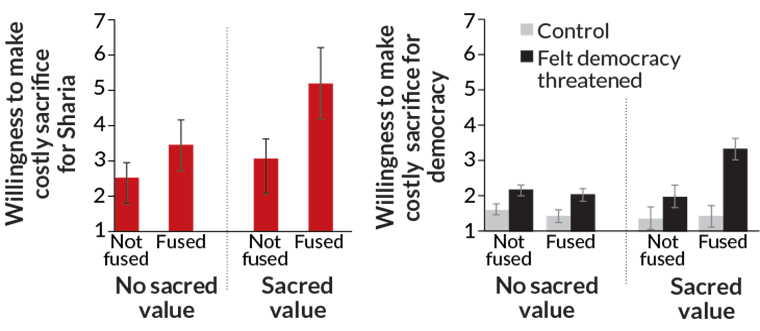
Figure 1. Interaction of Sacred Values and Identity Fusion: In jihadi-supporting Moroccan neighborhoods, people who viewed strict imposition of Islamic law, or Sharia, as a sacred value and who identified closely with a kin-like group (“fused”) most expressed willingness to kill and die for Sharia (left graph). Spaniards reported weaker willingness to kill and die for democracy as a sacred value when identifying closely with a kin-like group of friends, and only under explicit threat priming (right graph). Source: Atran et al., 2014.
Illustrating Field-Based Research: Will to Fight on the ISIS Front Line and Elsewhere
To illustrate the importance of policy to shaping basic research, and of research to informing policy analysis, our research team based at Artis International and the Changing Character of War Centre at the University of Oxford carried a series of behavioral and brain studies with frontline combatants, radical populations, and more typical Westerners.5Of course, scientists must retain strong independence to avoid co-option by bureaucratic or political interests and biases. The lion’s share of the US Department of Defense’s budget for social science and cultural knowledge went to programs like the Human Terrain System Military Intelligence Program, which sought to embed experts in combat units to “provid[e] social and cultural decision-making insight to operational commanders” (US Dep. Def. 2011). By September 2014, the program had cost more than $700 million for efforts generally shunned by academia and judged ineffective or worse by many military commanders (Sterling 2010, Gezari 2015). Another problem is that much USG survey work in conflict zones is hired out to foreign (local) contractors whose procedures can be dubious (e.g., conducting and discussing surveys with many people at once) and who tend to “discover” what they think the USG wants to find. Our team’s research in the field generally begins with interviewing political and military leaders to understand how elites may be thinking and to gain access to participants in areas we want to cover (while also gauging how to avoid elite influence and expectations regarding the research). After spending time in the field with participants—including fighters, militants, and would-be volunteers for combat—for the days, weeks, or years needed to establish trust, we carry out semi-structured interviews to generate hypotheses about behavior. Next, we design experiments and measures to be initially tested in laboratory settings or online, where we can carefully control procedures and monitor results. Then, we return to the field to more rigorously probe the participants. If field results prove robust, we follow up for generality with mass surveys incorporating experimental design that are given to populations from different regions and cultures.
When, in September 2014, The Islamic State (ISIS or ISIL) was at the height of power, President Barack Obama backed the verdict of his Director of National Intelligence: “We underestimated the Viet Cong … and overestimated the will of the South Vietnamese. In this case, we underestimated ISIL and overestimated the fighting capability of the Iraqi army…. It boils down to predicting the will to fight, which is an imponderable” (cit. in Payne 2014). Yet our research suggests quite the opposite: Predicting who will fight and who will not, and why, is quite ponderable and amenable to scientific study, as long as one takes seriously the sacred and spiritual dimensions of human conflict and does not restrict analysis to material and mundane costs and consequences.
In winter 2015, when the ISIS frontline was relatively stable, we found that willingness to fight and die was greatest for those who believed they were fighting for sacred values and who also perceived spiritual strength (ruhi bi ghiyrat, in both Arabic and Kurdish) to be more important than material strength (manpower or firepower), whether of their own group, allies, or enemies (Atran 2016). Only the secular Marxist-Leninist fighters of the PKK [Partiya Karkerên Kurdistanê (Kurdistan Worker’s Party)] who held the line matched religious ISIS fighters in terms of commitment to their beliefs and willingness to sacrifice (e.g., verified numbers of wounded and killed, time on battlefield even when wounded, etc.).6The U.S. considers ISIS and PKK terrorist organizations, which may feed resistance to learning proactive lessons from them.
Providing a scientific basis for interventions aimed at preventing or parrying violent extremism requires fieldwork (Horgan 2012) to discover what people believe and do (vs. prior suppositions; see Sommers 2019), which is then integrated into a more generalized theory and tested with rigorous methods (Freilich & LaFree 2016, Atran et al. 2017). In winter 2016, when US-led coalition forces began offensive operations to retake ISIS-held territory we conducted a field study with Iraqi Army forces of mixed Kurdish and Arab elements, Arab Sunni militia, and Peshmerga (Kurdish militia) (Gómez et al. 2017). All subjects had participated in a fierce fight for Kudilah village, one of the first battles in the offensive to retake Mosul, the largest Iraqi city under ISIS rule. For purposes of comparison and generalization, a final round of 14 studies in Spain with large online samples further tested hypotheses about the cognitive mechanisms underlying the frontline results. The field study critically informed the online studies, and together they revealed features of the greatest willingness to make extreme sacrifices: (a) commitment to the sacred values of fused groups and (b) readiness to forsake commitment to family and fused groups for those values, if necessary (with those values still attached to the imagined community of the Caliphate).7From an initial evolutionary vantage, we should expect kin or kin-like groups to be privileged over abstract ideals. Darwin (1871, pp. 159–60) himself puzzled over why individuals would self-sacrifice for notions that “come to be highly esteemed or even held sacred,” while also realizing that doing so would “certainly give an immense advantage” to groups populated by those who would “by their example excite …the spirit” of self-sacrifice in others. The privileging by devoted actors — those who are willingly duty bound to self-sacrifice for sacred values and the group those values are embedded in — of values over kin backs the thesis that humans forge powerful (and potentially wide-reaching) religious and political bonds by readiness to sacrifice their life and loyalty to kin for a greater abstract ideal. The word Islam itself signifies “submission” of all tribal and group allegiances to God’s word and command, whereas Abraham’s readiness to slay his beloved son to prove devotion to a sacred imperative is the principal parable of monotheism. More generally (Fukuyama 2012), subordination of family and tribe was arguably necessary for the historical formation of larger groups built upon political principles.
Sacred values were identified by a complete refusal for any trade-offs under any conditions. To measure identity fusion, subjects were presented with series of increasingly overlapping pairs of circles (Swann et al. 2012): One circle represented the respondent, and the other circle represented a group identified with a recognizable flag or banner. Participants who chose an entirely overlapping pair were judged fused with the group, resulting in a dichotomous measure (i.e., fused or non-fused). Our prior field and online studies in Western Europe and North Africa suggested that although identity fusion and sacred values independently motivate willingness to make costly sacrifices, the interaction of these two factors maximizes the willingness to sacrifice (Fig. 1 above, cf. Sheikh et al. 2016).
At least since World War II, most studies of the military history and psychology of combat troops have emphasized commitment to comrades over cause (Stouffer et al. 1949, Smith 1983, Whitehouse et al. 2014). When soldiers truly believe in the sacredness of their cause, however, as is arguably the case with ISIS, PKK, Viet Cong (Moskos 1975), or antifascist Lincoln Brigade volunteers in the Spanish Civil War (Dollard 1944), then cause may trump group. The most committed fighters would make wrenching decisions when compelled to choose between group and value: PKK and captured ISIS fighters recounted to us that they gave up defense of their families for their cause (Kurdish homeland or Islamic Caliphate; see Atran 2016)—a behavior that also runs counter to the evolutionary rationale of sacrifice as intergenerational investment (Azzam 2005).
In 2017–2018, we followed up with studies of young men emerging from ISIS rule in the Mosul region (Atran et al. 2018). We first asked senior policy makers in the US, British, German, and French governments what questions they most wanted answered with help from social science research. Broadly, they responded: What do people think of ISIS? What do they think of a unified Iraq? What political future do they want? What would they tolerate? We also asked the young men how they themselvessaw their situation and what values and outcomes they preferred.
In the field, most people we interviewed initially embraced ISIS as “the revolution” (al-Thawra). Although many came to reject ISIS’s brutality, ISIS had imbued about half of our sample of young Sunni Arab men with its two most sacred values, for which they expressed willingness to self-sacrifice: strict belief in Sharia and in a Sunni Arab homeland, as opposed to a unified Iraq. Those believing in these values expressed significantly greater willingness to fight and die than supporters of a unified Iraq did. Whereas ISIS might have lost its territorial control, it had not necessarily lost the allegiance of the region’s young Sunni Arabs to its core values.
In addition, we found no significant support for democracy across our post-ISIS study population. In the West, elections under universal suffrage represent a late stage in liberal democracy’s development. Absent prior establishment of liberal institutions (freedom of expression, independent judiciary, minority guarantees, etc.), elections are prone to yield a tyranny of the majority. That’s how Iraq’s Sunni minority considers the Shia majority that took power under US-sponsored elections. Moreover, while liberal democracy has been successful in promoting consensus in industrial nation-states among people of diverse backgrounds who are unknown to each other (Anderson 1983), it may not be very effective at arbitrating across ethnic, tribal, and confessional conflicts (just as it does not help in family disputes).
Further brain and behavior studies with radicalizing populations complement the findings of research with combatants in Iraq and noncombatants in Spain. Previous research indicates that discrimination toward Muslim immigrants leads to their social and economic exclusion (Adida et al. 2010). Moreover, when those who feel marginalized continue to face discrimination, their support grows for radical groups (Lyons-Padilla et al. 2015) that are seen to enhance community cohesion while promoting violence in the community’s defense (Gómez et al. 2011, Alcalá et al. 2017). We wanted to find out if social exclusion increases commitment to sacred values or even leads to sacralization and sacrifice on behalf of values not initially considered sacred.
We used ethnographic surveys and psychological tests to explore the identities of 535 young Muslim men of Moroccan origin in Barcelona, where ISIS supporters murdered 13 people and maimed 100 in August 2017 (Pretus et al. 2018). The focus was on neighborhoods that law enforcement deemed susceptible to jihadi recruitment. Half of the young men showed vulnerability on all measures of extremist recruitment. Of these, 38 (whose average age was 19) who had already expressed a “willingness to engage in or facilitate violence associated with jihadi causes” agreed to a two-stage neuroimaging experiment.
In the first stage, we identified participants’ sacred values and then probed their willingness to sacrifice for values. We found such willingness to be greater for sacred values (e.g., forbidding cartoons of the Prophet, preventing gay marriage) than for nonsacred but important values (e.g., women wearing a veil, unrestricted construction of mosques). In the second stage, those in the neuroimaging study played a ball-tossing game, Cyberball, against players with Spanish names. While playing, half of the study’s subjects were suddenly excluded from being passed the ball.
After the game, while being scanned, all participants were asked about their willingness to sacrifice for their values, including fighting and dying. For sacred values, their brains showed greater activity in the left inferior frontal gyrus, an area associated with deontological, rule-bound decision-making that we had previously found to be associated with sacred values in a mainstream US sample (Berns et al. 2012). The Barcelona-Moroccan scans revealed less deliberative, more rapid responses (consistent with duty-bound rather than utilitarian reasoning) when questions concerned sacred versus nonsacred values, as well as greater willingness to fight and die for sacred values. We replicated these findings in Barcelona among immigrant Pakistani supporters of Lashkar-e-Taiba, an al-Qaeda associate (Hamid et al. 2019).
Most strikingly, among the participants excluded during the ball-tossing game, the willingness to sacrifice for nonsacred values elicited levels of left inferior frontal gyrus activity similar to those shown for sacred values. Excluded subjects also expressed greater willingness to fight and die for these sacralized values, and the interaction between value sacredness and social exclusion reliably affected the emotional intensity allied with defending the values. The neurological impact of being marginalized indicated that issues that excluded participants had previously considered nonsacred became more important, morphing into sacred values worth fighting and dying for.
In prior behavioral studies in Iran (Dehghani et al. 2010), we found that international sanctions—a more general, political form of exclusion8In recent behavioral and brain-imaging experiments, we find that discrimination/marginalization elicits much the same pattern of neural activity related to aggressive behavior whether directed at a particular individual or at a group to which that person belongs (Marcos-Vidal et al. 2024).,—had apparently sacralized belief in the nuclear program among 11 to 13 percent of the population (mainly rural religious backers of the regime) as well as behaviors tied to the program (e.g., increased and higher uranium enrichment and production of centrifuges consistent with possible weapons development). Today, those who view nuclear development as a sacred value frequently invoke the Quran as a justification along with national rights. This implies that as preferences evolve, they do not need to be part of longstanding cultural or political traditions to be sacralized, but in becoming sacred they often are affirmed so.
These studies suggest that social and political exclusion foster radicalization and consolidation of sacred values for which people are willing to fight and die (often prompted by a catalyst event, such as a grave insult, police brutality, or imprisonment; see Silke 2003, Khosrokhavar 2016). Other research indicates that sharing painful experiences of marginalization or direct violence favors identity fusion, which motivates self-sacrifice, including willingness to fight for the group (Whitehouse 2018). If so, policymakers might be wise to counteract social exclusion and sacralization of values to forestall radicalization.
Dealing with Value-Driven, Socio-Political Conflicts
As reported to the US Congress (US Senate 2010) and UN Security Council (Atran 2015), our field studies with terrorists, with populations susceptible to radicalization, and in conflict zones indicate that counternarratives that seek simply to delegitimize (rather than to reinterpret and reframe) the sacred values of others usually backfire, increasing the others’ willingness to use violence. Threats or enticements to abandon or compromise values that have become sacralized usually boomerang, arousing emotions both negative (e.g., anger) and positive (e.g., joy of revenge; see de Quervain et al. 2004), inciting moral outrage (e.g., as intimated by amygdala activity; see Berns et al. 2012), and leading to enduring conflict. Examples of this escalation would be the Israeli-Palestinian conflict (pitting Palestinians’ right of return against Israelis’ right to settle in Greater Israel; see Atran et al. 2007, Ginges et al. 2007) or increasingly intractable conflicts over gun rights, abortion, and immigration. These issues are currently sacred, or are being sacralized, amid an acute political polarization in which each side is thought to marginalize the other.
The overall take from our behavioral and brain studies is that without rigorous attention to the cultural mores and values of peoples in conflict, understandings toward attenuation of conflict can fall short, or fail altogether, and the conflict itself may appear to be intractable or only resolvable by application of massive force. Yet, despite intermittent interest and evidence of the importance of non-material factors in war and other extreme forms of intergroup conflict, focus on material factors such as optimal use of physical strength, manpower, and firepower remain the dominant concerns of US and allied military training, decision making, and related academic literature. For example, in US and allied military circles, recent reports suggest that material factors alone cannot account for critical outcomes, including: The French resistance at Verdun in WWI, Soviet persistence against the initially overwhelming German onslaught in WWII, Communist Vietnam’s resistance and eventual victory against French then American military might, Afghan resistance to the Soviets and Americans, the Islamic State’s defeat of the Iraqi and Syrian armies (Connable, et al., 2018, see also Karsten 1998). Nevertheless, such reports, which sometimes note but to do not rigorously explore the socio-cultural context, generally contain no systematic set of standards or findings by which to evaluate the truth and generality of claims.
In the wake of military and policy failures in Iraq and Afghanistan, and underestimation of Ukraine’s fighting ability,9President Biden: “We gave [Afghan forces] every tool they could need…. What we could not provide them was the will to fight” (White House 2021). Gen. Scott Berrier, US Defense Intelligence Agency director, acknowledged misjudging Ukraine’s ability to resist Russia: “I questioned their will to fight. That was a bad assessment” (Merchant 2022). Congress urged that attention be committed to “assessing will to fight.”10Section 6521 of the FY2023 defense bill seeks evaluation of “the methodology of the intelligence community for measuring [and] assessing the military will to fight and the national will to fight”; that is, the resolve to fight on “even when the expectation of success decreases or the need for significant political, economic, and military sacrifices increases.” However, without adequate resources and rigorous measures, evaluation efforts likely will remain contentious, fragmented, and meagre. As one US senator declared: “Will to fight is not a discrete area of intelligence you can go out and collect on it” (cit. in Barnes 2022). This may well remain so without awareness of what social science might reveal about will to fight.
To help fill this gap, in collaboration with the US Air Force Academy, we conducted studies of will to fight in Iraq, Palestine, and Morocco. We found that personal spiritual formidability is more strongly associated with the willingness to fight and make costly self-sacrifices for the group than physical formidability.11The notion of “spiritual formidability” or “spirit with bravery” (ruhi bi giyrah, in both Arabic and Kurdish) was first spontaneously evoked by ISIS and PKK fighters who rejected our measures of physical formidability (represented in terms of musculature and body size) as a consideration of their will to fight. After adopting the notion into our studies and providing a dynamic measure (also in terms of musculature and body size but under a different verbal frame), both combatant and non-combatant participants recurrently described spiritual formidability in terms of “courage to defend what is most cherished,” “what is in our heart,” and “strength of belief in what we are fighting for” (Gómez et al. 2017). A follow-on study among cadets of the US Air Force Academy further revealed that this effect is mediated by a stronger loyalty to the group, a finding replicated in a separate study with a large sample of ordinary European citizens (Tossell et al., 2022). With support from DoD’s Minerva Research Initiative, we next conducted 31 studies with thousands of participants from dozens of nationalities in 9 countries. These involved different data-collection methods, including field and online studies with populations involved in armed conflict, such as war refugees, imprisoned jihadists, militant nationalists, violent gangs, U.S. military, and Ukrainian citizens, as well as samples from Palestine, Iraq, Turkey, Lebanon, UK, and a Western European ally of Ukraine. Following initial studies to establish the relevant variables (fusion with groups and values, spiritual and physical formidability, trust), results fully replicated 17 times in 7 countries provide evidence for a statistically robust mediation model representing a transcultural causal pathway to the will to fight. The model reveals fusion to be positively associated with the will to fight, first through perceived spiritual formidability, and second via trust. The model applies to fusion with, and sacrifice for, primary reference groups and core values, while also implicating perceived spiritual formidability of, and trust in, individual leaders (Gómez et al. 2023).
Artis researchers with other colleagues recently studied how information is processed in social media that is relevant to the will to fight (Pretus et al. 2023, 2024). Results show that misinformation pertaining to in-group sacred (vs. non-sacred) values is more likely to be shared, to activate brain networks that support social cognition and identity processes, and to be highly resistant to interventions and counter-messaging — however evidence-based and logically consequent — that challenge those values or seek to penetrate a shared bubble. Extremist and polarized groups (e.g., on the far right) seem wired to prioritize identity-based incentives that are value-laden, bypassing neural networks associated with analytic deliberation. For these populations, social incentives and interventions that appeal to identities and associated values are more effective than evidence-based arguments and interventions in reducing willingness to fight.
In sum, understanding and managing the will to fight in lethal conflicts may remain imponderable — and associated security challenges may remain seemingly insoluble without overwhelming force — if we marginalize the cultural and cognitive factors that social science treats, and only observe matters through the narrow lenses of instrumental rationality and material capacity. Without rigorously assessing non-material cultural and psychological sensibilities through social science, including among civilian populations, conflict can appear intractable or only resolvable with massive force; and the U.S. and allies may continue to overrate or underrate allies, armies, and peoples. Will to fight represents but one critical example of the need to integrate social science understandings to improve national security.
The Challenge of Foreign-Backed Malign Influence Operations: The Case of Russia
Whereas the principal threat from transnational terrorism is violence, the challenge from foreign influence operations (IO) is often less manifestly kinetic yet perhaps more pernicious. Influence operations involving the exploitation of psychological biases and cultural preferences in spreading subversive messages allow their operators to avoid direct confrontation with their opponents, neutralizing any hard-power advantages. But even more insidious and effective in the long run, by degrading faith in opponents’ societal structures, or pushing viral cascades at moments when pivotal decisions are made, malign influence operations can inflict damage and affect key individuals, vulnerable societal groups, and the general population. This can lead to co-opting or collapse of societal functions, political institutions, and the state itself.
State-sponsored hostile influence campaigns are instruments of national power that focus on the use of social media to injuriously mislead or falsely report information to drive wedges within and between the populations of its adversaries. Malign campaigns exploit psychological biases and political vulnerabilities in the socio-cultural landscape of nations, and among transnational and substate actors, which has already led to new ways of resisting, reinforcing, and remaking political authority and alliances. Such campaigns also can be powerful force multipliers for kinetic warfare and affect economies. Although pioneered by state actors, disinformation tools are now readily available to anyone or any group with internet access to deploy at low cost. This “democratization” of influence operations, coupled with democracies’ vulnerabilities owing to political tolerance and free speech, requires open societies to create new forms of resilience and deterrence. Yet, despite significant “bottom-up” networking among “organic” operators (i.e., real persons with their own beliefs rather than by bots or tolls) that enable small clusters of malign influence and anti-Western hate messaging to spread across platforms and defy policing (Johnson et al. 2019), the heavy hand of states and criminal enterprise often determines whether such online behaviors become viral, endure, and effectively generate actions detrimental to US and allied interests.
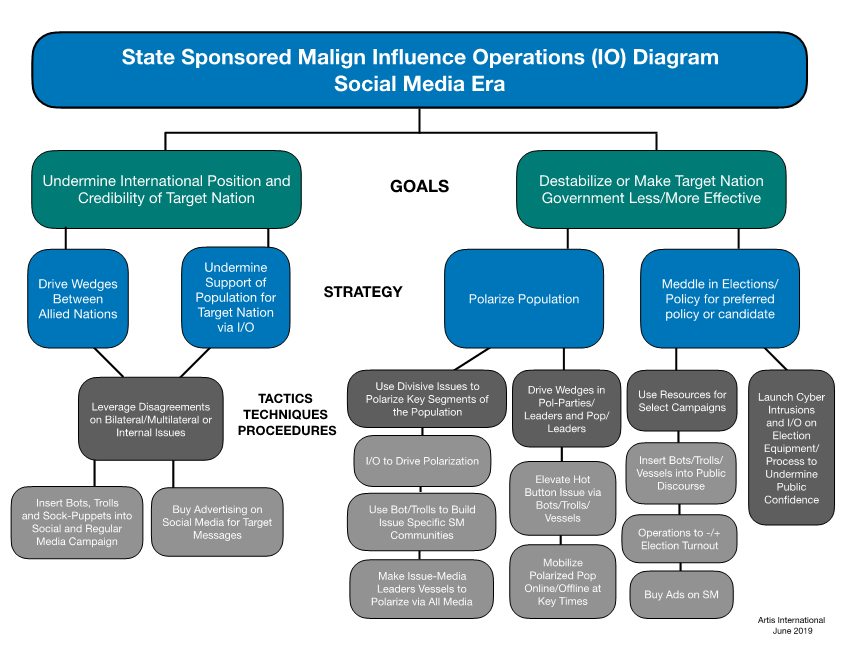
Figure 2. General outline of Malign Influence Operations based on observed behaviors (light gray boxes) about issues of concern to US National Security (trade, NATO, EU, immigration, etc.), further parsed and summarized (dark gray boxes) as elements of strategy (blue boxes) to achieve the goals (green boxes) of malign influence campaigns (from Artis briefing to NSC staff, White House, May 2019).
Russia’s Malign Influence Strategy, Value-Based IO
Despite recent technical innovations, such as the use of social media, Russia’s current malign influence campaigns follow those of its Soviet predecessor. Unless we understand these strategies, we remain vulnerable to them. The 2018 National Security Strategy acknowledged the return of great power competition along with a fundamental shift in the locus of struggle away from armed conflict toward cyberspace and non-kinetic information warfare. Nevertheless, US and allied actions within the information domain, especially in social media, remain reactive rather than proactive, and mired in a lack of awareness of how our adversaries, especially Russia, structure and implement malign influence campaigns. As a result, we are being attacked through vulnerabilities created by our own core values, with Russian efforts succeeding at polarization by amplifying both sides of contentious political and social issues. In parallel, it has attacked democratic values (e.g., due process, freedom of opinion, tolerance of minorities, etc.) and subverted trust in related institutions of democratic governance (e.g., judiciary, press, representation of societal diversity). It has become skilled at triggering viral cascades when pivotal decisions are made, and in undermining key personalities and political institutions, vulnerable social groups, and the mutual respect needed for reasoned debate and consensus among the general population.
Russia’s objective was, and now is again, to actively discredit, disorient, and subvert pro-Western forces as a self-defense measure against Western encroachment, encirclement, and envelopment. To achieve these ends, Russia’s malign influence campaigns in Eastern Europe, increasingly in Western Europe and most recently across Africa’s Sahel, have strategically played on cultural values (e.g., love of family, community, cultural tradition, national sovereignty, etc.) and cognitive susceptibility psychological biases (negative framing of issues, confirmation of prior beliefs, establishing causal stories between independent or fictive events and items, etc.). This strategy employs lessons from Russia’s own internal endeavors to maintain control and allegiance of is various ethnic groups and nationalities beginning with Stalin’s stint as head of the People’s Commissar of Nationalities (1917-1923), when he first coined the term dezinformatsiya (дезинформа́ция, Paceba & Rychak, 2013). A complementary effort has persistently sought to discredit pro-Western forces as foreign, immoral, and dangerous. The marked erosion of traditional values in the West (Fao & Mounk 2017) provides a preexisting source of fracture and cleavage in our own society into which malign operations can burrow and widen.
According to former KGB operations chief Gen. Oleg Kalugin, during the Cold War, the aim was: “Subversion… to weaken the West, to drive wedges in the Western community alliances of all sorts, particularly NATO, to sow discord among allies” (Kalugin 2007). Realizing that they could not match US technological or economic development, Soviet strategists sought to neutralize the advantage by exploiting psychological vulnerabilities and cultural preferences in human decision-making processes: Disorient and disarm the ability to decide, formulate, or execute commands or policy, and political, economic, or military power can be rendered useless (Bagge 2019).
Arguably Soviet disinformation’s greatest successes occurred in the late 1940s and early 1950s, when it facilitated the expansion of Soviet control over Eastern Europe and created serious threats of communist takeover in key Western European countries—France, Italy, and Greece. According to Gen. Ion Mihai Paceba of the Romanian Secret Police, the Soviet bloc had more people engaged in disinformation than in the armed forces and defense industry combined. A central tenet “for disinformation to succeed… was that a story should always be built around ‘a kernel of truth’ that would lend credibility”(Paceba and Rychlak 2013, p. 38). Although the U.S. began to recognize the Soviet strategy as early as 1946-1947, it was slow to mobilize the human resources needed to contain and counter it: From a budget of $4.7 million with 302 personnel and 7 foreign stations in 1947, by 1952 the numbers grew to $80 million with nearly 6,000 personnel in 47 foreign stations (Gaddis 1982).
The U.S. appears similarly slow today in addressing the threat to our homeland, as well as our allies. Without informed countermeasures, the Russian strategy may reverse the world’s general postwar trend toward greater tolerance and less violence, including the spread of liberal democracies.12Democracies increased from 35 countries in 1970 to more than 100 in the early 2000s, although many since increasing “illiberal,” or like Venezuela or Russia itself, reverting to authoritarian (for recent trends, see International IDEA 2023). Freed of the ideological constraints of the Soviet era, Russia has greater flexibility and agility in trying and testing disinformation tactics, while denying the U.S. a clear ideological target.
By closely studying American and European societies, Russia has discovered the strategic advantages of appearing to embrace traditional values that we accused them of attacking during the Cold War: family, religion, nation, and longstanding cultural and ethnic mores. Russian agencies and institutions working today on “nationalities” and “values” include Russian Special Services, the Federal Ethnic Affairs Agency, and various Institutes of the Russian Academy of Sciences populated by former Soviet and Russian generals and ministers, in addition to their scientists. Many of the leading scientists are area experts trained in the disciplines of classic anthropology, including ethnology, archaeology, and linguistics. They seek an encyclopedic understanding of the target populations’ social, political, and economic makeup. Combined with basic research on social and psychological processes, that knowledge facilitates Russia’s ability to know whom, when, and how to target specific interventions that further their strategic goals. In fact, interaction with such Russian expertise could prove beneficial to both our countries, as it has in counterterrorism efforts on the ground and in social media, although Moscow has chosen to play most other areas as a zero-sum game.
What is lacking in Russian social science, however, are rigorous social science methods of hypothesis testing and experimental design, as well as sophisticated AI for the design of automated countermeasures in real-time (though Putin has declared ramping up AI to be a national priority). Although the U.S. has an advantage in the use of scientific methods and AI, the effectiveness of their deployment depends on how well we understand our adversaries’ goals, tools, and tactics; their perceptions of our strengths and weaknesses; and what those strengths and weaknesses really are. For the persistent engagement that faces us, our strategies and tactics need to be informed by expertise in the psycho-cultural factors that affect political, economic, and social shifts in populations of interest. Without that expertise, we will persist in such demonstrably ineffective practices as countering disinformation only with truth and evidence, however logically consistent or factually correct it may be. In fact, we have decades of research into the greater persuasive effectiveness of leveraging cognitive biases and cultural norms that defend deeply held beliefs (Mercier and Sperber 2017). Coupled with our advanced computational capabilities, rigorous social science analysis of psychological vulnerabilities and cultural preferences could offer a powerful countermeasure to overcome Russia’s well-practiced Soviet-style influence campaigns, powered up by modern social media.
Countering Malign IO with Culturally and Cognitively Informed AI
Based on findings from our behavioral and brain research on will to fight, Artis has developed a DoD-supported programmable Artificial Intelligence Reader that filters at scale, in near-realtime, open-source internet data curated in terms of the devoted actor framework. Our platform allows basic science questions to be asked (e.g., what and who is persuasive, what changes people’s stance on issues, how does Target Audience A in Country X think about a specific conflict – what moves A to a different position, etc.). We also can identify and attribute state and non-state-backed information campaigns at scale to observe how they shape the attitudes and stances of key target audiences toward any issue, such as support for sustaining or ending a conflict. Further, our platform includes a Realtime-Effects-Monitor developed with DoD support (DARPA, AFOSR, ONR, Combatant Commands). The monitor measures when an individual moves from one stance to another (e.g. Pro-War to Neutral-War, Anti-War to Pro-War, etc.), pinpointing the messaging most salient in the shift. Through our monitor, we can track shifting stances among political players, warfighters, the general population, or selected segments. For example, while monitoring private military company (PMC) activity in Ukraine on social media we found systematic complaints by Russian soldiers about material factors: incorrect payment, insufficient training and equipment, difficulty in receiving fighter benefits, and legal combat veteran status (so that families can be taken care of). The longer these complaints went on, the greater the doubts expressed about support for war. Such shifts in stance open possibilities for shifts in performance that indicate changes in will to fight.
Our readers can identify, geolocate, and prioritize messages containing content that we code as relevant, and which are most likely to affect public stance on conflict to the extent they go viral and endure. In a series of internet studies involving Russian interference in Brexit (the UK’s withdrawal from the EU) and Germany’s initial consent to Russian gas supply through the Nord Stream 2 pipeline, we found that three psycho-social drivers of effective and enduring viral messaging: embedding in causal argument, threats to core values, and negative framing (Mousavi et al. 2022). Currently, we are globally monitoring millions of messages daily related to Russian, Chinese, and Iranian influence operations. This involves analysis of value formation and behavioral change at scale of Russia’s Special Military Operation (SMO) in Ukraine since February 2022 and Iran’s proxy war related to the Gaza conflict since October 2023. It includes aggregation and visualization of organic content at scale on Facebook, X/Twitter, and Vkontakte, as well as monitoring of Telegram and TikTok channels used to organize both military efforts and antiwar sentiment in the Middle East and Eastern Europe. While monitoring anti-Western internet discourse in Africa we discovered evidence of a coordinated campaign by Russia and China, part of a 2021 novel and formal agreement between them, which is being expanded to other world regions and complements recent moves on military cooperation.
To counter adversarial messaging, Artis also has developed an AI writer that is machine-trained by our adversaries’ own psycho-social tactics to automatically formulate counter messages that can better resist these tactics and turn them to advantage (e.g., appealing to the antiwar sentiments of Russian mothers). Machine learning for both reader and writer is also updated and refined by inputting results from field and online behavioral studies with vulnerable populations (in Eastern Europe, the Indo-Pacific Region, Latin America, Africa, and the Middle East). These studies are designed to reveal psycho-social factors, such as those responsible for the will to fight, that are most liable to effectively and enduringly affect a target population’s stance toward or away from a malign player.
Addressing Structural Impediments to National Security Research
The effectiveness of the Artis research program depends on its flexibility: in venturing with social science theory and methods into myriad conflict zones, in focusing studies on policy-relevant problems of general interest and importance, in crossing disciplinary boundaries to bring in insights from other sciences (including integration with natural sciences), and in mobilizing diverse expertise and youthful enterprise from different walks of life. Owing to institutional constraints, and a preference for convenience or habit, such flexibility is currently lacking in academic and government-sponsored basic social science research.
Many policy and research leaders assume that the USG has adequate resources dedicated to the problems of emerging threats, even those stemming from societal fragmentation. Let’s consider that here. Nearly all policy offices across the Departments and Agencies are structured around State and Regional Desks. They consume information from a variety of sources, including intelligence, about the countries or regions for which they have responsibility. Very little of that information, or none, originates from primary data collection with groups of people in those regions or countries. Most of the information related to emerging threats comes from intelligence analysts who make assessments based upon open source or clandestine data, not scientists who try to put their hypotheses to rigorous empirical tests to understand the causes and effects, values and influences, that will likely shape the future in any locale. Even DoD’s Net Assessment Office has a narrower task; their responsibility is to think about the military’s future. That task is critical but does not promote the study of groups of people in existing or emerging hotspots.
The intelligence community has its own limitations. For example, the small neighborhood of Jemaa Mezuak in Tetuan, Morocco produced the core group that plotted the 2004 Madrid train bombing, Europe’s worst terrorist attack, as well as numerous suicide bombers faced by American and coalition forces in Iraq. The neighborhood also sent many others to fight for ISIS in Iraq and Syria. The intelligence community could not put an agent into that neighborhood to understand what was happening and why. This is not permissible for our intelligence officers. And, even if it were, they likely would not have the skills to move neighborhood youth away from culturally and religiously savvy appeals to self-sacrifice.
So, then, who does have the remit to think about such things? The primary responsibility for conducting field-based scientific research in foreign countries is housed in the Army Research Office, the Office of Naval Research, the Air Force Office of Scientific Research, the Air Force Research Lab, and the Minerva Research Initiative in the Office of the Secretary of Defense. Additional funding agencies include the National Science Foundation, DARPA, and IARPA, but they tend to have other priorities. Private foundations provide some research funds but typically do not support research to further national security.
The vast majority of social science studies occur in and around major research universities, mostly with college students who receive course credit or a small sum of money for participating (Rad et al. 2018). What little follow-up of their actual behaviors over time often has doubtful relevance for understanding what really goes on in the larger world (Schulz et al. 2019). Moreover, academic and government human subjects protections for basic behavioral studies, which were initially developed after WWII to avoid abuses associated with gruesome Nazi medical experiments, were subsequently reconfigured for social science to protect the emotional sensibilities of college students. The blanket application of human subjects protocols in disregard of context or target population severely limits inquiry into situations of distress or conflict (Atran et al. 2017). With some populations (e.g., captured ISIS fighters, active Al Qaeda associates), certain protocols are simply unrealistic (e.g., providing participants with contact information of personnel on university review boards, requiring participants to sign consent forms specifically acknowledging DoD sponsorship,).
Scientists who seek to conduct research in areas of concern for the United States must go through a set of obstacles that have become so legalistic and bureaucratic that it significantly diminishes the number of researchers and research offices willing to fund such efforts. It’s then easier for all, researcher and funder alike, to study conflict and war in the classroom, lab, or as an exercise. Indeed, government agencies are generally even more demanding than the Institutional Review Boards (IRBs) of American colleges and universities. The most draconian component of the human subjects requirements is the consent of “the Host Country for the United States Government to Conduct Research on People in the Country.” Which authority does one ask in Donbas or Palestine for permission to study populations there? On one occasion, researchers spoke to the Israeli Minister of Science and Technology to provide a letter approving research within the country because it was requested by one of the aforementioned research offices. His response was, “why should we give you permission, it is not needed. We don’t ask your government permission to do research on Americans nor do your universities need to ask our government permission to do research here.” As a result, the project was not funded. Faced with such difficulties, Artis established its own IRBs. Artis IRBs operate under federally-approved guidelines (e.g., allowing participants to refuse or withdraw from a study at any time, for any reason); however, Artis IRBs also permit self-funded studies that drop pro forma demands that are contextually unrealistic. There can be several remedies to the human subjects’ constraints on government-sponsored or university-approved research, including making field studies in conflict areas a national security priority in ways that bring no real harm to study participants.
Field research in combatant zones is often outsourced to non-US operatives. The general approach is to hire a firm in Country X, which may then hire a firm in Country Y, to contract a local firm in the target country to perform research. Such studies risk providing little validated benefit because they are typically attitudinal studies, with no experimental design and little or no competition; and they are frequently performed by individuals who do not have the same scientific standards as top-notch American investigators. Neither do contracted foreign researchers usually have the same vested interest in America’s future as do those within the US military, USG generally, or in many US universities.
Finally, and most challenging, the offices that do conduct valuable research in conflict areas do not have the appropriate top cover from a Presidential or Congressional mandate to inoculate them from the yearly bureaucratic wrangling that threatens billets and budgets (a common complaint in policy circles is that no one has time to read anything in depth or follow research closely because of ever bureaucratic tasking). The strategic imperative should be to build a national capacity to produce empirical evidence from hotspots that provide decision-makers with information about how to forestall conflict without “boots on the ground,” and thus to save national treasures and lives while boosting national security.13Within the Armed Services, there is a notion of Phase “0” operations. The concept is to apply influence in a potential theatre of operation to prevent the need for “boots on the ground.” The principle of Phase “0” is sound; however, there is little ability for the Armed Services to use influence operations to prevent conflict. The Armed Services simply do not have the psychological, social and cultural knowledge that would dissuade any group of people from fighting against US and allied interests. Yet, such a capacity is valuable, if not vital, to all.
Our description of how Artis operates, and the research products it provides, is intended to illustrate an innovative and flexible approach to improving evidence-based statecraft through social science. In finding ways around budgetary and bureaucratic constraints, Artis research is better able to demonstrate how the power of ideas and processing of information may critically affect national security. But these achievements are possible only on a limited, piecemeal scale because these constraints are so pervasive. Our broader aim in presenting Artis research, then, is to encourage a coordinated effort at the national level – perhaps through a national center or consortium – that upscales the kind of innovative and flexible approach that Artis exemplifies. This effort would include interagency coordination, collaboration with the academic and business communities, and mobilizing the creative power of youth in real-world contexts to bolster national security and international stability, reduce the human and material costs of conflict, and preserve and advance open society.






Community Adaptation for a Water Festival Without Clean Water