
About the Authors
Asena Johnson is a graduate student at American University’s School of International Service and served as an intern with the Stimson Center’s Global Governance, Justice & Security Program from February-May 2024.
Joris Larik is Assistant Professor of Comparative, EU, and International Law at Leiden University College The Hague and the Europa Institute at Leiden Law School, Leiden University. Moreover, he is Senior Advisor at the Stimson Center’s Global Governance, Justice & Security Program. He holds a Ph.D. from the European University Institute and is an expert in global governance reform and EU external relations.
Richard Ponzio is Senior Fellow and Director of the Stimson Center’s Global Governance, Justice & Security Program and Co-Director of the Global Governance Innovation Network. An expert in global governance reform in the security, economic, and environmental sphere, he has held senior positions in the United Nations and U.S. State Department and directed the Madeleine Albright-Ibrahim Gambari Commission on Global Security, Justice & Governance.
Global Governance Innovation Network Policy Brief Series
This series provides a platform for leading and up-and-coming authors’ thinking on major contemporary global governance challenges with a view to stimulating and influencing policy debates. This Global Governance Innovation Network (GGIN) Policy Brief represents the perspective of the author alone and not necessarily the views of the Stimson Center or other cosponsoring partner institutions of the Global Governance Innovation Network. This GGIN Policy Brief was funded by the Stockholm-based Global Challenges Foundation (GCF), which has not played an editorial role or necessarily endorses the conclusions reached by the author.
Editorial Team
Joris Larik (series editor), Richard Ponzio (project lead), Henrietta Skareng (associate editor and GGIN Youth Fellow), Nudhara Yusuf (GGIN Facilitator). This policy brief benefitted from feedback received at the 2024 Annual Meeting of the Academic Council on the United Nations System (ACUNS) in Tokyo and at the 2024 Annual Conference of the Global Transformations and Governance Challenges (GTGC) program at Leiden University.
About the Global Governance Innovation Network
The Global Governance Innovation Network brings world class scholarship together with international policy-making to address fundamental global governance challenges, threats, and opportunities. Research focuses on the development of institutional, policy, legal, operational, and normative improvements in the international global governance architecture. GGIN is a collaborative project of the Stimson Center, Academic Council on the United Nations System (ACUNS), Plataforma CIPÓ, Leiden University, the Savannah Center for Diplomacy, Democracy, and Development, the Council on Energy, Environment & Water, and the Global Institute for Strategic Research.
About Stimson
The Stimson Center promotes international security and shared prosperity through applied research and independent analysis, global engagement, and policy innovation. For more than three decades, Stimson has been a leading voice on urgent global issues. Founded in the twilight years of the Cold War, the Stimson Center pioneered practical new steps toward stability and security in an uncertain world. Today, as changes in power and technology usher in a challenging new era, Stimson is at the forefront: Engaging new voices, generating innovative ideas and analysis, and building solutions to promote international security, prosperity, and justice. Stimson’s Global Governance, Justice & Security Program aims to advance more capable global and regional institutions to better cope with existing and emerging global challenges, and to create new opportunities through effective multilateral action, including with the global business community and civil society.
About Leiden University
Leiden University was founded in 1575 and is one of the leading international research universities in Europe. Leiden University College The Hague is the international Honours College of Leiden University, as part of the Faculty of Governance and Global Affairs located in The Hague. The Europa Institute of Leiden Law School is one of the oldest academic institutes specialised in the law of the European Union and the European Convention on Human Rights. It was established in 1957, the same year as the European Economic Community itself.

Abstract
From continued volatility and inequality in the global financial and economic system and fears of renewed health risks to the present triple planetary crisis (climate change, biodiversity loss, and pollution) and need to overcome growing divisions between the BRICS+ and G7 countries, the world needs a more coherent and effective way for managing global financial, economic, social, and environmental governance. In response to these global challenges and in light of upcoming diplomatic opportunities, this policy brief recommends the creation of a Biennial UN-G20+ Summit on the Global Economy. The proposal aims both to take forward and raise the ambition of a related idea for adoption at this September’s UN Summit of the Future in New York and under consideration too for the G20 Summit this November in Rio de Janeiro. The Biennial Summit would convene the Group of 20, the UN’s 193 Member States, major regional organizations, the Secretary-General, and heads of international financial institutions, WTO, and ILO—during the General Assembly’s High-Level Week—to shepherd a more sustainable and resilient global economy. Importantly, the Biennial Summit will focus this “UN-G20+” on mitigating and managing cross-border shocks, fostering continued broad-based socioeconomic recovery from the pandemic, and addressing rising global economic inequality. The policy brief builds on and further develops the original thinking from the report of the 2015 Commission on Global Security Justice & Governance (Albright-Gambari Commission) and the 2021 Our Common Agenda report of the UN Secretary-General António Guterres.
Introduction: Raising the Ambition
Multilateral diplomacy in the domain of economic and financial governance has been put to the test over the past two decades. Major crises and challenges have included the response to the 2008-9 global financial crisis, the socioeconomic fallout worldwide from the COVID-19 pandemic, and the imperative of getting on track for meeting both the targets of the Sustainable Development Goals (SDGs) and the climate goals of the Paris Agreement. All of these highlight the need for enhanced multilateral coordination to foster a globally coherent approach to recovery and transition, both to prevent and to respond effectively to economic shocks, and to work toward greater economic equity.
The Group of Twenty (G20) has positioned itself as the “premier forum” overseeing international economic and financial cooperation since its Pittsburgh Summit of September 2009.1G20. 2009. “Leaders’ Statement: The Pittsburgh Summit.” September 24-25. Although the group collectively represents a clear majority of the world’s gross domestic product (GDP), trade, and population, and despite having some success in preventing global financial meltdowns,2Kirton, J. 2021. “Growing G20 Legitimacy.” In The Crisis of Legitimacy in Global Governance, edited by Gonca Oguz Gok and Hakan Mehmetcik. 55-71, 60. London: Routledge. the G20 has been plagued with accusations of lacking legitimacy and being a form of elitism. Critics argue that it excludes the “other” 174 UN Member States and does not sufficiently focus on making globalization work for everyone, both within and between countries.3Larik, J. and Ponzio, R. 2021. “Deepening G20-UN System Cooperation To Foster Socio-Economic Recovery From The Pandemic and Reduce Inequality Worldwide: Towards A G20+.” Think20 Italy. September 14.
To close this legitimacy deficit, some important steps have recently been taken, of which two should be highlighted. First, in 2021, the G20 in collaboration with the Organisation for Economic Co-operation and Development (OECD) launched an ambitious project addressing the tax challenges arising from the digitalization of the economy.4mfn]OECD. Tax Challenges Arising from Digitalisation of the Economy – Global Anti-Base Erosion Model Rules (Pillar Two): Inclusive Framework on BEPS. OECD/G20 Base Erosion and Profit Shifting Project. OECD Publishing, Paris: OECD Publishing. Second, at the New Delhi Summit of the G20 in September 2023, the African Union (AU) was admitted as a permanent member.5Munyati, C. 2023. “The African Union has been made a permanent member of the G20 – what does it mean for the continent?”. World Economic Forum. September 14. Last visited July 24, 2024. This makes the AU the second regional organization, alongside the European Union, to become part of the G20. This means that 54 African countries, in addition to South Africa, which was already a member, are now collectively represented at the G20, increasing the group’s representativeness from the Global South—while also further boosting its share of global GDP, trade, and population.
However, in the current (geo)political climate, without forward-looking leadership and the ability to actually set in motion a critical mass of capacities, countries—large and small, including those represented in the Group of 20—are likely to turn inward, blame foreign influences for their troubles, and erect shortsighted barriers to international exchanges. Thus, with a view to boosting the role of the G20 even more, while embedding it better into the wider global governance architecture with the UN at its center, the UN Secretary-General’s Our Common Agenda report, published in 2021, called for a “Biennial Summit at the level of heads of State and Government between the members of the G20 and the members of the Economic and Social Council, the Secretary-General and the heads of the international financial institutions to work toward a more sustainable, inclusive and resilient global economy.”6United Nations. 2021. Our Common Agenda – Report of the Secretary-General. New York, NY. 54. A subsequent policy brief following Our Common Agenda, stressed that the Summit of the Future, to be held in September 2024, presents a critical opportunity to agree on such a Biennial Summit.7United Nations. 2023. Our Common Agenda Policy Brief 6: Reforms to the International Financial Architecture. United Nations. May 8.
While a laudable proposal exhibiting the right spirit, this Global Governance Innovation Network Policy Brief makes the case for raising the ambition and profile of the proposed Biennial Summit, building on earlier research by the authors, which commenced in the framework of the Albright-Gambari Commission on Global Security, Justice & Governance (2015),8Commision on Global Security, Justice and Governance. 2015. Confronting the Crisis of Global Governance. June. 67. and the T20 Policy Brief on “Deepening G20-UN System Cooperation” (2021).9Larik, J. and Ponzio, R. 2021. “Deepening G20-UN System Cooperation To Foster Socio-Economic Recovery From The Pandemic and Reduce Inequality Worldwide: Towards A G20+.” Think20 Italy. September 14. Branded as the Biennial UN-G20+ Summit on the Global Economy, it would respond to today’s complex set of economic, social, and environmental problem-sets by filling crucial systemic gaps.
After identifying chief challenges to be addressed by this new forum, the policy brief turns to major characteristics and functions performed by the proposed Biennial UN-G20+ Summit. Subsequently, it concludes with thoughts on a strategy for reform.
A Threefold Challenge: The G20’s Input, Output, and Throughput Legitimacy
This policy brief seeks to enhance the coordination and representation among the G20, United Nations, the World Bank and International Monetary Fund (IMF) (also known as the Bretton Woods Institutions), the World Trade Organization (WTO), and International Labour Organization (ILO) through a Biennial UN-G20+ Summit, anchored to the General Assembly’s High-Level Week, to encourage broader multilateral coordination and equity in the areas of global economic, social, and environmental governance. To provide effective leadership and facilitate sustainable and equitable economic growth, these global bodies must together overcome their deficiencies in representation and consensus-building. To unpack and structure the challenges faced by the G20 and its incomplete integration in wider global governance structures, the policy brief distinguishes between the three dimensions of input, throughput, and output legitimacy.10Kirton, “Growing G20 Legitimacy,” 57; Schmidt, V. A. 2013. “Democracy and legitimacy in the European Union revisited: input, output and throughput.” Political Studies 61, 2–22.
First, input legitimacy refers to legitimacy through representativeness and inclusiveness. The G20 has long been criticized for its lack of representation (consisting of 19 influential countries plus the European Union). In part to address this perceived deficit, as noted above, the G20 invited the AU to join as a permanent member in 2023, increasing diversity by adding a collective representation for 55 African countries to the G20.
However, the G20 remains a self-selected club, which operates in a relatively disconnected way from the wider global governance architecture, especially the UN. To address the needs of the 21st century economy, the gap between this club and the international community as represented by the 193 UN Member States needs to be closed. Moreover, while the inclusion of the AU next to the EU is a welcome step forward, it raises questions about the lack of collective representation from other world regions, such as Latin America and Southeast Asia.
Second, throughput legitimacy refers to legitimacy through transparent and efficient decision-making and the general quality of an entity’s governance structures. Beginning with the 2008-9 global financial crisis, the G20 elevated its finance ministerial meetings to annual summits with the heads of state and governments. More recently, these alternate between Global North and South countries and covers wide-ranging agendas that engage ministers from across the G20 governments.11mfn]Kirton, “Growing G20 Legitimacy,” 62–63; Puri, L. 2023. “What made India’s G20 Presidency so successful? —A deep dive into the New Delhi Leaders’ Declaration.” December 3. Observer Research Foundation. Last visited July 24, 2024. For a recent example, notable achievements of the 2023 New Delhi Summit included the launch of Global Biofuel Alliance (GBA) which was initiated by Argentina, Brazil, India, Italy, Mauritius, South Africa, UAE, and the U.S.12G20. 2023. India’s G20 Presidency: A Synopsis. November 30. This initiative aims to foster global collaboration for the advancement and widespread adoption of biofuels. Announced in September 2023, already 24 countries and 12 international organizations have agreed to join the alliance.13Government of India. Ministry of Petroleum and Natural Gas. 2024. About Global Biofuels Alliance (GBA). Last visited July 24, 2024.
Moreover, the G20 is called upon and subsequently embraces initiatives launched elsewhere. For instance, the Partnership for Global Infrastructure and Investment (PGI), initially launched by the G7 in 2022, was brought into the ambit of the G20 and received further support at the 2023 Delhi Summit.14Government of India. Ministry of External Affairs. 2023. “Partnership for Global Infrastructure and Investment (PGII) & India-Middle East-Europe Economic Corridor (IMEC).” September 9. Last visited August 7, 2024. Under the PGI, the G7 aims to mobilize U.S. $600 billion by 2027 in global infrastructure investments, including in partnership with the private sector, and collaboration for achievement of SDGs. Another example is the Bridgetown Initiative, initiated by Barbados to reform the global financial architecture to better respond to global challenges and foster global equity.15Ellmers, B. 2023. “The Bridgetown Initiative to reform the international financial architecture.” February 22. Global Policy Forum. Last visited August 7, 2024. Among other things, it recommends transferring U.S. $100 billion of Special Drawing Rights (SDRs) to programs that support climate resilience and aid low-income countries. It further calls upon G20 countries to “redesign their Common Framework for restructuring the debt of poor countries in default, notably by speeding up debt relief talks and allowing middle-income countries to access it.”16Jessop, S. and Thomas, L. 2023. “Explainer: What is the ‘Bridgetown Initiative’ asking for at Paris financial summit?” June 20. Reuters. Last visited August 7, 2024.
At the 2023 G20 Summit in Delhi, while not explicitly referencing the Bridgetown Initiative or committing to reform of the Common Framework, the Leaders’ Declaration responded positively to the proposal regarding the U.S. $100 billion of SDRs.17G20. 2023. G20 New Delhi Leaders’ Declaration. September 9-10. New Dehli, India. 21-22. It should be noted, lastly, that the IMF and World Bank work closely with the G20 to ensure global economic growth and international financial stability. The Managing Director of the IMF and the President of the World Bank, plus the Chairs of the International Monetary and Financial Committee (IMFC) and the Development Committee, also participate in G20 meetings on an ex-officio basis.18International Monetary Fund. 2023. A Guide To Committees, Groups, and Clubs. March. Last visited August 7, 2024.
However, policy areas such as climate and health remain “silos” in G20 deliberations,19Kirton, “Growing G20 Legitimacy,” 65. receiving only sporadic attention with the main outcomes being legally non-binding summit commitments. Moreover, due to relying on rotating presidencies charged with organizing the summits and other meetings, the G20 lacks continuous institutional memory, which could help keep track of its performance (i.e., ensure accountability) and contribute to the greater coherence of its activities.
Third, output legitimacy refers to the effectiveness of an entity to achieve the goals it has set itself or which are expected of it to produce. As observed by Kirton, the G20 has been relatively effective in terms of its members living up to the political commitments they make.20Kirton, “Growing G20 Legitimacy,” 63–64. The G20’s ambitions have also increased in recent times, as can be seen from the above mentioned examples of its expanding agenda. With the growth in ambitions—including repeated commitments to accelerate efforts to make up for lost time and deliver on the 2030 Agenda for Sustainable Development and Paris Climate Agreement—comes a growing need to revisit the G20’s relationship with the broader (and more formal) global governance architecture.
As the self-proclaimed premier forum for world economic cooperation, the G20 can be considered to bear responsibility for the well-being of the global economy. Its main mission includes not only promoting economic growth, but also advancing global economic equity. From its notable role in the aftermath of the 2008-9 global financial crisis, to its help in building the case for the Paris Climate Agreement in 2015,21G20. 2015. G20 Leaders’ Communiqué agreed in Antalya. November 15-16. and its contribution to the world’s COVID-19 response (2020-2023), the G20 has provided a relatively effective platform for economic recovery and dialogue among countries representing the majority of the world’s population and GDP.
However, there remains significant untapped potential for the G20 to deliver on its own commitments and make critical contributions to global objectives. Given the complex nature of contemporary global challenges, many issues transcend national borders and require a strengthened multilateral response through a reimagined and reinvigorated “G20+.”22United Nations. Department of Economic and Social Affairs. 2023. “UN Secretary-General calls for radical transformation of global financial system to tackle pressing global challenges.” Feb. The climate crisis, the COVID-19 pandemic, and the horrific conflicts in Ukraine and the Middle East have all exhibited negative ripple effects on the global economy.23United Nations. Department of Economic and Social Affairs. 2023. “UN Secretary-General calls for radical transformation of global financial system to tackle pressing global challenges.” Feb. Global economic inequality continues to rise,24Oxfam. 2024. Inequality Inc.: How corporate power divides our world and the need for a new era of public action. January 15; UN DESA. 2023. “One year of the war in Ukraine leaves lasting scars on the global economy.” March 6. while conflict escalation and geopolitical tensions, including polarization between the G7 and BRICS+ countries, disrupt international trade, causing broader implications for global activity.25World Bank Group. 2024. Global Economic Prospects. January.
Moreover, there is a lack of a coordinated response to the economic impacts of climate change. The SDGs also remain largely unmet, with bleak prospects for their realization by the 2030 deadline, with the UN Secretary-General urging the G20 to endorse an annual $500 billion stimulus to support the SDGs.26International Institute for Sustainable Development. SDG Knowledge Hub. 2023. “UN Calls for USD 500 Billion per Year for Sustainable Development.” March 1.
Better and broader coordination within the international system is thus required, and the proposed Biennial UN-G20+ Summit on the Global Economy offers a platform for this. This international forum would facilitate more inclusive dialogue, bringing together the 193 UN Member States, G20 leaders, and heads of various relevant institutions. While there is a broader need to reform the G20 to maximize its potential, the proposed Biennial UN-G20+ Summit builds on and raises the ambition of the UN Secretary-General’s recommendation from his Our Common Agenda report. It can make a decisive contribution to all three dimensions of the G20’s legitimacy: giving greater voice to the international community at large, fostering more integrated deliberations and decision-making structures, and delivering better results.
Proposal: The Biennial UN-G20+ Summit and Networked Secretariat
Even with the recent welcoming of the African Union (representing 55 states) into the G20, around half of the United Nations’ 193 Member States are currently not represented formally in G20 decision-making. Though historically dominated by Western countries, China, and Russia, the more recent G20 presidencies by Indonesia in 2022, India in 2023, Brazil in 2024, and South Africa in 2025 offer hope for more inclusive representation.27Coalition for the U.N. We Need. 2023. Interim Peopleʼs Pact for the Future: 2023 Civil Society Perspectives on the Summit of the Future. May 19. Furthermore, the UN (the world’s most universal international governing body) stands to benefit by drawing upon the economic expertise and research capacities of the World Bank, International Monetary Fund, and World Trade Organization (WTO), as they play crucial roles in guiding and monitoring the impact of collective economic decision-making by countries of all sizes.
The G20, United Nations, Bretton Woods institutions, WTO, and ILO, especially when joined through a unity of purpose, wield immense potential to support shared global economic, social, and environmental governance outcomes. To provide effective leadership and facilitate sustainable and equitable economic growth worldwide, these global bodies must overcome their present inadequacies in representation, coordination, and accountability which, together, can undermine their collective impact.
For better fostering socioeconomic recovery from the pandemic, mitigating and managing cross-border shocks, and addressing rising global inequality, world leaders should agree between this September’s Summit of the Future and the November G20 Summit to convene a Biennial UN-G20+ Summit on the Global Economy (Biennial Summit) with leaders from the world body’s 193 Member States, major regional organizations, the G20 Presidency, and heads of the UN, international financial institutions (IFIs), WTO, and ILO.28This proposal builds on over a decade of policy research, showcased initially as the “G20+” proposal in: Commision on Global Security, Justice and Governance. 2015. Confronting the Crisis of Global Governance. June. 87-89. It could serve as an important platform for a regular exchange on major economic priorities.
At the same time, our research has concluded that rather than anchoring this proposal around the fifty-four members of the Economic and Social Council (ECOSOC)—as proposed by the UN Secretary-General,29United Nations. 2021. Our Common Agenda – Report of the Secretary-General. New York, NY. 54. it makes more strategic and practical sense to convene such a biennial gathering during High-Level Week of the UN General Assembly with all 193 Member States, the leaders of the G20, the Secretary-General, and heads of the international financial institutions, World Trade Organization, and International Labour Organization. While going with ECOSOC is not only less inclusive, as only about a quarter of the UN membership would be represented, it also risks downplaying issues of global economic governance by connecting them to a politically largely sidelined UN body.
In contrast, the proposed Biennial Summit is far more inclusive and emphasizes the political importance of economic governance issues, thereby increasing the overall potential for important, strategic decision-making, gaining necessary ownership, and delivering on commitments, in the spirit of “inclusive, networked, and effective multilateralism.”30Ponzio, R., Petcu, C., Larik, J., Arjomand, B., and Durch, W. (editor). 2021. Beyond UN75: A Roadmap for Inclusive, Networked & Effective Global Governance. Stimson Center. June 21. 33-36.
A more ambitious and higher-profile version of the Biennial Summit, as proposed here, would also benefit the UN. For instance, only four of the five Heads of State of the permanent members of the UN Security Council attended the UN General Assembly (UNGA) in September 2023.31Toosi, N. 2023. “It’s the Biden show as other top leaders skip UNGA.” September 15. Politico. Last visited August 7, 2024. Convening a Biennial UN-G20+ Summit at the start of High-Level Week could provide the necessary incentive for these leaders to return to New York in person. Rather than having parallel governance structures next to the UN that might drift apart and further fragment the world, or placing the G20 atop the international economic and financial system, the Biennial UN-G20+ Summit reaffirms the centrality of the UN and unmatched legitimacy of the General Assembly in global affairs.
Increased inclusiveness and raising the profile of the Biennial Summit would mean little without proper planning, follow-up, and attention for coherence between different policy fields in which the G20 is engaged. Therefore, as part of this proposal, we advocate for establishing a small, cost-efficient “networked secretariat,” that would primarily operate online, facilitating coordination and ensuring the smooth flow of technical knowledge and operational guidance across the entire global governance system. It would be led by the UN Deputy Secretary-General and engage select senior technical staff from the IFIs, WTO, ILO, and rotating G20 presidency, both to ensure accountability of decisions reached and to serve as a knowledge center to collect, validate, and push out collective analysis across the international system between the summits. Using the clout and momentum of the enhanced UN-G20+ Summit, and with support from the networked secretariat, the G20 can assume a more prominent role in coordinating on major global issues with financial implications, such as the green transition (including the European Green Deal and similar efforts elsewhere), AI regulation and harnessing its power for good, and more. Additionally, the G20 can help deliver on the Sustainable Development Goals, focusing on prioritizing global financial and economic issues beyond immediate shocks, while placing greater emphasis on economic equity. In the following concluding section, we make specific recommendations on how to position this proposal coming out of the Summit of the Future and in the final run-up to the G20 Summit in Brazil, and how to achieve its goals.
Strategy for Reform
Taking the Biennial UN-G20+ Summit on the Global Economy forward and realizing its full ambition will benefit from three concrete steps: i.) elaborating upon the rather limited corresponding text in the Summit of the Future outcome document; ii.) garnering political support for the Biennial Summit idea from an Impact Coalition; and iii) ensuring “proof of concept” through the successful convening of the inaugural Biennial Summit.
Strengthening the Biennial Summit operative language in the Pact for the Future:
The “Revision 2 Draft” of the Summit of the Future’s outcome document, the Pact for the Future, states the following on the Biennial Summit idea:
73. We acknowledge the important role of the United Nations in global economic governance, while fully respecting existing governance mechanisms and mandates independent of the United Nations that preside over specific organizations and rules. We welcome the initiative to convene a Biennial Summit at the level of Heads of State and Government to strengthen existing and establish more systematic links and coordination between the United Nations and the international financial institutions, and we stress the importance of inclusive participation.32United Nations. 2024. Revision 2 of the Pact for the Future. July 17.
This operative text could be improved at the November G20 Summit in Rio de Janeiro, drawing upon the analysis and arguments put forward in this policy brief, by having it read instead (with proposed edits in bold):
73. We acknowledge the important role of the United Nations in global economic governance, while fully respecting existing governance mechanisms and mandates independent of the United Nations that preside over specific organizations and rules. We welcome the initiative to convene during the General Assembly’s High-Level Week a Biennial UN-G20+ Summit on the Global Economy at the level of Heads of State and Government. It should convene the members of the Group of 20 and the members of the General Assembly, the UN Secretary-General, major regional organization, and the heads of to strengthen existing and establish more systematic links and coordination between the United Nations and the international financial institutions, World Trade Organization, and International Labour Organization, and we stress the importance of inclusive participation and building a stronger and fairer global economic and financial architecture. A networked secretariat, consisting of senior technical officials from these organizations and the G20 rotating presidency, and led by the UN Deputy Secretary-General, will prepare both preparatory meetings and the Biennial Summit gathering.
This enhanced language will allow for the formation of a Biennial UN-G20+ Summit on the Global Economy that is more politically robust, by likely securing higher-level participation if convened in connection with the General Assembly’s High-Level Week meeting in September in New York (rather than in connection with ECOSOC’s calendar). Moreover, meeting mainly virtually on a regular basis in executing its duties, the proposed networked secretariat will work to ensure accountability of decisions reached and serve as a knowledge center to collect, validate, and push out collective analysis across the international system between the summits (see further details below on these two central functions).
Growing A Multistakeholder Impact Coalition in Support of the Biennial Summit:
To raise the ambition and take forward specific, high-impact global governance innovations adopted at the September 2024 Summit of the Future, more than twenty, multistakeholder “ImPact Coalitions” were stood-up at the 2024 United Nations Civil Society Conference in support of the Summit of the Future, held from May 9-10 at the UN complex in Nairobi.33United Nations Civil Society Conference. 2024. ImPact for the Future Outcome Package. May 30. Consisting of like-minded state and non-state (including governments, think tanks, NGO advocacy organizations, multinational corporations, and international organizations, among others) organizations, the Impact Coalitions bring together a wealth of technical expertise and political networks for advancing, in particular, big ticket reform initiatives for which the Summit of the Future is likely to be most remembered.
In support of a Biennial UN-G20+ Summit on the Global Economy and related reforms in the global economic governance space, a new International Financial Architecture Reform and Financing for Development Impact Coalition, co-convened by the Club de Madrid and Global Public Investment Network, is well-positioned to garner political support and offer targeted technical inputs in the new global economic governance forum’s initial roll-out phase. This coalition will be critical for pursuing, monitoring, feeding in technical inputs, and, over time, realizing the full potential of the Biennial UN-G20+ Summit idea. The ImPact Coalition is poised to rally around two major events on the diplomatic calendar, in 2025, that can help to propel the significance and substantive focus of the Biennial Summit, namely the 4th International Conference on Financing for Development (June 30 – 3 July, 2025 in Madrid) and the Second World Summit on Social Development (November 4-6, 2025 in Doha).
Ensuring “Proof of Concept” Through A Successful Biennial Summit in September 2025:
Nothing will validate the need and garner widespread support for a Biennial UN-G20+ Summit more than a successful first convening. Ideally, held over one of the initial three days during UNGA High-Level Week in 2025 (21-27 September),34Note: The UN will also convene the Second World Summit for Social Development at the start of UNGA High-Level Week in September 2025. its initial three-point agenda could delve into the three thematic areas presented in box 1.
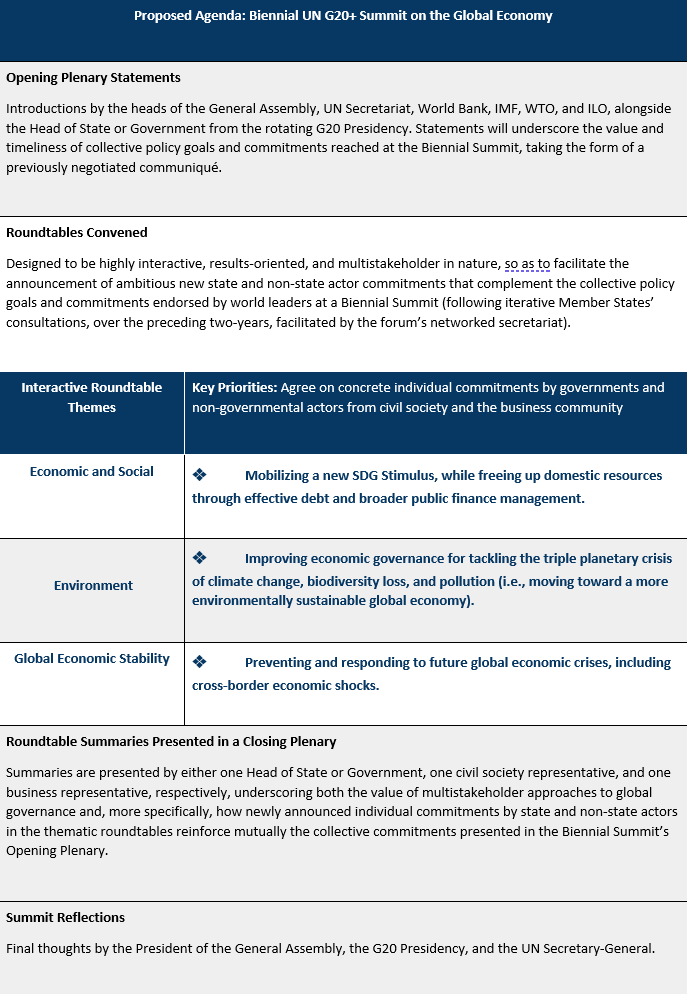
Source: Original Box, Stimson Center.
Carefully coordinated with the critical agenda-setting roles, in 2025, of the G20 Presidency (led by South Africa) and President of the General Assembly (led by Cameroon), the Biennial Summit’s success will also rely on its networked secretariat’s rigorous technical work and widely consulted preparations of a detailed, consensus-based communiqué. Finalized in advance of the summit, the communiqué will accentuate concrete collective commitments realized, in particular, through the actions and deployed resources of global and regional multilateral institutions. In addition, another chief function of the networked secretariat is to produce a mid-term (annual) and biennial comprehensive scorecard or compliance report for collective and individual—whether by governments or non-governmental actors—commitments reached at a Biennial Summit.35Besides the suggested indicators and overall methodology presented in the Global Governance Innovation Report 2024 logical framework (see annex I in the Global Governance Innovation Report 2024), the Biennial Summit’s proposed mid-term (annual) and biennial comprehensive scorecard or compliance report can draw ideas and inspiration from the annual compliance reports produced by the (independent) G20 Research Group at the University of Toronto (visit: http://www.g20.utoronto.ca/analysis/index.html#compliance).
A Biennial UN-G20+ would provide a new forum for more inclusive global economic governance, allowing for all UN Member States to engage more effectively powerful economic and political actors, thereby contributing to global economic dialogue and decision-making. As the G20 currently stands, economic governance is driven disproportionately by a small number of major governments (channeling, in turn, the interests and policy priorities of their country’s leading national, and often multinational, corporations). This essentially leaves large numbers of countries from the Global South at a severe disadvantage in policy-making that directly affects their citizens’, as well as national public and private bodies’, economic, social, and environmental interests.
The Biennial UN-G20+ Summit on the Global Economy would be well-positioned to champion measures to reduce inequality worldwide and promote green development, including by aligning with Secretary-General Guterres’ call for a US$500 billion annual stimulus in support of Sustainable Development Goals implementation. In short, the world needs a more coherent and effective way for managing global economic, social, and environmental governance, and the Biennial Summit serves as one solution toward realizing a more resilient, just, and sustainable global economy.
***
Learning from the G20 response to the 2008-9 global financial and 2020-present COVID-19 pandemic crises, and recognizing the untapped potential of further UN-G20 integration, world leaders should adopt strong language on establishing a Biennial UN-G20+ Summit for the Global Economy between this September’s Summit of the Future in New York and this November’s G20 Summit in Rio de Janeiro. Ideally, by the General Assembly’s High-Level Week in September 2025, they should convene the inaugural Biennial Summit.
Fifteen years ago, the G20 Summits in London (April 2009) and Pittsburgh (September 2009) coordinated national economic stimulus and relief plans for the poorest countries, creating the conditions for a slow yet steady global rebound. In the early 2020s, we witnessed a similar effort by the world’s largest economies, including in connection with the Debt Service Suspension Initiative, which helped countries to focus their resources on responding to the COVID-19 pandemic and protecting the lives of millions of vulnerable people. To engage the other UN Member States not yet represented (directly or through the EU and AU) in the G20 in consequential global economic governance decision-making that directly affects their citizens, a Biennial UN-G20+ Summit is an idea whose time has come. Such an initiative and associated enhanced collective and individual commitments offer the best chance to save lives, rebuild economies, double down on climate action, avert future cross-border economic shocks, and make up for the lost time largely squandered in recent years through the present, still too highly-fragmented, unequal, and ineffective system of global governance.







Community Adaptation for a Water Festival Without Clean Water