
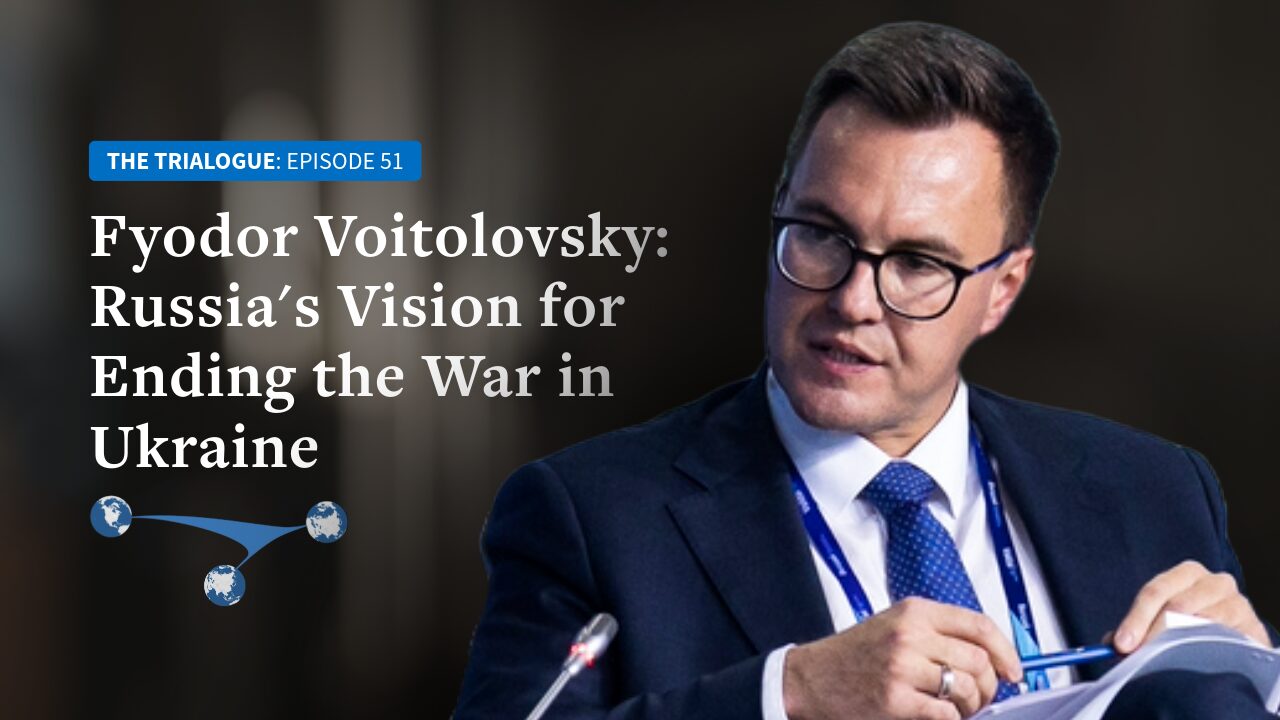
Peter Slezkine: My guest today is Fyodor Voitolovsky, director of the Institute of World Economy and International Relations at the Russian Academy of Sciences. This is Fyodor’s second appearance on the podcast. We recorded an episode about this time last year when he and Alexander Dynkin visited Washington. Fyodor was back in town a couple of weeks ago, so we sat down for another conversation. I hope you enjoy the episode.
Fyodor, welcome to the podcast.
Fyodor Voitolovsky: Thank you. Thank you, Peter, for bringing me here, and I’m very glad to be here with Stimson for the second time during the last two years.
Peter Slezkine: Yeah, you’re here in the flesh in Washington. You were here a year ago. You’ve returned. You just arrived, what, two days ago?
Fyodor Voitolovsky: Yes. And I came to meet with my colleagues in Washington, DC, with people from the expert community, from different think tanks. And I am very glad that Stimson today hosted a seminar with me, and we have discussed all these issues we have discussed. So we can try to cover some of them during this podcast. And the previous one had a very interesting reaction, and I have received some emails and words from American and European experts who have been listening to it.
Peter Slezkine: Who listened to the episode that we recorded last time you were in Washington.
Fyodor Voitolovsky: Yes.
Peter Slezkine: Well, let’s hope that they listen again.
Fyodor Voitolovsky: Yeah, I believe so.
Peter Slezkine: Questions for you following our conversation. So if you read the Western press, Russia has run out of resources for the war it is waging in Ukraine. I was recently at a conference in Estonia, and one official after another stood up on stage and proclaimed self-confidently, or very confidently, that Russia was losing the war. At the same time, if you read Russian Telegram, some of the premier Russian publications, you hear something of the same sentiment expressed in different terms — that perhaps Russia has reached the limits of what it’s capable of in this context, and that perhaps the terms of engagement need to be shifted in some way. So how do you react to this?
Fyodor Voitolovsky: I think that people who are seriously talking about Ukraine winning the war are trying to make themselves believe in the mythology they have been creating during all these four years.
Peter Slezkine: But note that I didn’t say that Ukraine was winning, but that you hear more and more that Russia may be losing or that Russia is stuck.
Fyodor Voitolovsky: I think that what we are facing in reality is the situation when Russia is making slow progress on the ground. Really slow, that’s true. But at the same time, Ukraine is not successful in any of its offensive operations. It has become, to some extent, a little bit more effective in defensive operations. But I believe that in case we will not be successful with a diplomatic political solution, Russia will be able to manage the conflict for one or two years more and will receive all military goals, or even more than that, on the ground. And I think that Russia is having enough capabilities, military and economically, to sustain the way the conflict is going for a long period of time. Because it’s very hard to concentrate significant military power when you are having this massive usage of drones on both sides. It’s impossible, for example, to concentrate on the front line a mechanized brigade with tanks and all hard tactics. But with these tactics of small groups attacking each other and confronting each other with usage of conventional light weapons and drones, it can go for a very long period of time. Now we have this competition of drones and small groups trying to, you know, concentrate some resources to reach the next village, to protect the next village. So it’s a long, time-consuming process.
Peter Slezkine: But that is what I mean when I say that Russia may have run out of momentum — that there was a feeling maybe a year ago that time was on Russia’s side, that over the long haul Russia’s size would allow it to press its advantage. But if we’re talking about the next year or two, that Russia can sustain this level of pressure, Ukraine may be able to as well. Europe certainly seems committed to supporting Ukraine for the next couple of years. So in a battlefield suffused by drones, what will change over the next two years? You say that the military objectives will be met, achieved. How?
Fyodor Voitolovsky: In reality, if the conflict will be lasting longer, I think that if it will be a competition of two economies — you know, Ukrainian economy is incomparable to the Russian economy. Mobilization capabilities of Russia are much bigger.
Peter Slezkine: But Ukrainian economy is not the only factor. It’s Ukraine’s economy sustained by the EU, which is—
Fyodor Voitolovsky: Absolutely. Absolutely. And—
Peter Slezkine: —mobilization potential of Russia might be high, but it hasn’t mobilized, and for good reason, whereas Ukraine is mobilized, which makes it a match in manpower for Russia.
Fyodor Voitolovsky: Ukraine is mobilized, and this mobilization capability is getting more and more exhausted. If Russia would make a political decision to start a new wave of mobilization, it will be, of course, rather sensitive for society. But we can also sustain it, and we can bring three, 400,000 more people onto the battlefield. And even taking into account all these drone tactics, it can be a significant manpower to change the situation on the ground. But it will, of course, bring more victims, more people dying for this 15 percent of Donbas, which Russia is asking to get released from Ukraine and to become a matter of political diplomatic agreement.
And I’m sure that the Zelensky administration is opposing it not because it was so engaged with this part of Donbas and so concerned about the future of Sloviansk and Kramatorsk. Of course, these fortresses are significant, but the main reason is quite different, and it is a domestic political reason. They are understanding that if the conflict will be ended, it will be the most significant domestic political challenge for both Zelensky and his party because they will face presidential and parliamentary elections, and I’m sure that they will not win it, and they are understanding it. And in the Ukrainian political system, control over political power always means control over economic assets. And for this business bureaucratic group, it will be the end of their control over the Ukrainian economy and all the money coming from the European Union, the United States — they are using it not only for defensive goals, I can put it like this.
Peter Slezkine: But if you believe that the Ukrainian government or Ukrainian leaders have an economic incentive to continue the war, how do you see it ever ending?
Fyodor Voitolovsky: If Donald Trump’s administration will be not so focused on the conflict with Iran, I believe that the dialogue Moscow and Washington have started on resolving the conflict in Ukraine could be much more productive. Because we had a very good initial start. We had, before Anchorage and after it, we had this regular exchanges, consultations. And I think it was quite different with the Biden administration, which believed that people there — they believed that Russia could be strategically defeated, as they call it, with the conflict in Ukraine. And the only goal was to support Ukraine economically, militarily, politically, without any questions.
We have seen what result we can get. And I think that Donald Trump and his team, they have started to understand that during this conflict, for more than four years — because it’s lasting much more than four years, it started in 2014 — but especially during the last four years, we have been balancing on the brink of direct military conflict between Russia and NATO, and we still are balancing on the brink. And it’s not a sustainable position in which both the European Union, the United States, and Russia will perceive themselves secured and guaranteed from an unexpected military clash, which can drive us into such a dramatic conflict that we can hardly even imagine.
Peter Slezkine: But assuming that the United States at some point resolves the Iranian problem that it has created and focuses once more on Ukraine, what can be achieved? Because there were conversations that lasted almost a year before the war in Iran shifted focus elsewhere, and it is very clear that Trump and his administration seemed serious about reestablishing relations with Russia and ending the war in Ukraine. But in terms of on-the-ground changes, very little has come of these conversations. So was there something agreed in Anchorage — the famous spirit of Anchorage — that could be applied in practice?
Fyodor Voitolovsky: We have limited open information about what has been agreed in Anchorage, but we have this, you know, wording of “spirit of Anchorage.” But anyway, I believe that if sides will choose the right model of ending the conflict — with, for example, an agreement over a complete diplomatic political solution of the conflict, not freezing the conflict, but ending it — that’s the principal thing. If it will go together with a decision about new borders of Russia and Ukraine, which should be delimited and should be well-defined, and it should go together with the end of military conflict on the ground — it should follow it directly. Then we need to have agreement over guarantees for both sides, not only for Ukraine, as it’s usually mentioned, but also for Russia, because this conflict is not about Russia and Ukraine. It’s much more about Russia and NATO. And Russia is interested in guarantees that Ukraine will not become a member of NATO, will not become a member of any other form of military alliances aimed to contain Russia.
For Russia, the issue of deployment of foreign military forces on Ukrainian territory is also critical. We obviously see how Ukrainian cruise missiles and drones are attacking Russian cities. And for Russia, it’s a matter of national security, because not only Ukraine, but any other army deployed on Ukrainian territory who would have such capabilities, it would be a matter of daily threat perception for Russia and for Russian society.
Peter Slezkine: I mean, I suppose the obvious retort here is that Russia possesses the capability to attack Kyiv with rockets, so a settlement might require a symmetrical capability on the Ukrainian side. That’s certainly the European and Ukrainian argument — that they already live under this threat perception, or with the threat perception.
Fyodor Voitolovsky: Of course, but for example, Russia was rather restrained in using its missile capabilities, especially against Kyiv. Now we have seen that after the tragedy in Starobelsk, and after a series of Ukrainian attacks against Russian cities and Russian infrastructure, Russia has started to use part of its capabilities against Kyiv. And of course, not only military goals are achieved by Russian missiles, and of course on both sides a lot of civilians are dying and suffering from that.
And concerning the ending of the conflict, I think that if we would have some compromises guaranteed by the United States — compromises between Russia and Ukraine about deployment of forces, about non-alignment with any military blocs of Ukraine — even without limitations of Ukrainian military capabilities, it will be a sort of solution for this very dramatic situation. Because if Ukraine will be part of NATO, it will bring us closer to World War, much closer than we are even right now. For Russia and for Russian threat perception, it’s unacceptable. And our officials have many times repeated that we will be trying to reestablish relations with Ukraine, which will not be aimed, with its foreign and security policy, to challenge Russian national security. And in case it will have defensive capabilities to protect itself, we’re fine with it. Nobody is against that.
Peter Slezkine: So demilitarization, which was one of the initial goals, is no longer a priority, or at least it’s a flexible enough concept that Russia has now accepted that Ukraine will have a strong military?
Fyodor Voitolovsky: I think that Ukraine has, to a high extent, been demilitarized by this fight, by the special military operation. In this sense, the special military operation has received part of its goals. Of course, not the whole Donbas has been protected and controlled by Russian forces. Of course, we have this confrontation and usage and sometimes escalation. But I think that denazification, which used to be one of the goals of the special military operation, has also been reached, because all the radicals, far-right radicals — a huge part of them, who came into power in Ukraine, who have been controlling a significant part of the security structures, paramilitary and military structures in Ukraine — they’re gone. They have been wasted during this phase of conflict, I can put it cynically. That’s true. And people who are fighting right now in the Ukrainian army are not so enthusiastic as these far-right radicals used to be.
So in case we will find a solution for the territorial issue, in case we will find a solution and find compromise about not freezing the conflict, but ending the conflict, with the limitation of borders, with security guarantees for both sides, with probably building some safe zones and deciding how heavy arms should be moved from the border on both sides — it will be the complete solution of the crisis. But now it’s very hard to reach it. I believe that we are still in the phase of escalation. But what gives me hope, really, is that any military conflict always ends with a phase of high escalation. So now we will have this phase, and probably it will drive sides to a political diplomatic solution.
Peter Slezkine: But what will be the role of the United States? Wait, and by escalation in this case, you mean exchange of deep strikes — more strikes on Kyiv by Russia, and the Ukrainian deep strikes will continue to accumulate?
Fyodor Voitolovsky: Yes, this phase is on the run, that’s clear. And if, after that phase, probably together with the United States, with US guarantees — because without them, I can hardly imagine how we would manage to have real negotiations with the Ukrainians — if we would resolve this conflict and end it, as, for example, by the model which has been used in 1939, I’m a historian, I remember such things, between the Soviet Union and Finland — it’s a very, very productive model of a treaty and how it works. If we could reach such a treaty and resolve this issue by such a treaty, it can be a solution for many other things. But it will put on the table a lot of issues we are ignoring to discuss. For example, the architecture of future European security, relations between Russia and NATO, what will be the model of peaceful coexistence. Of course it will be coexistence with elements of confrontation and military planning against each other. But if we will find compromises on the model of how we can get along together — not balancing on the brink of direct military clash — it will be a fantastic success. And I have said it today at the meeting, I want to repeat it: the fact that we didn’t reach the escalation which can drive us to the direct military clash between Russia and NATO is the most significant result of the Ukrainian crisis.
Peter Slezkine: I’m certainly glad that we’re sitting here and not in a heap of ashes. So I would count that as a success. I agree. So as far as you’re concerned, demilitarization and denazification have been more or less achieved, and what is left is the strict delineation of borders, Ukrainian non-alignment — no Ukrainian NATO and no NATO troops in Ukraine — and some kind of agreement on reciprocal withdrawal of troops and weapon systems from both sides.
Fyodor Voitolovsky: Heavy weapons.
Peter Slezkine: Heavy weapons. It’s not a matter of light weapons and troops, it’s a matter of heavy weapons.
Fyodor Voitolovsky: Long-distance artillery, heavy drones, missiles. Even if they will be kept on the borderline, and if the borderline will be defined, of course it will be a situation of a long-lasting new Cold War. But the Cold War is better than the hot one. So if they will not be removed from the borderline, it will be an issue, but we can live with it. But if they will be withdrawn symmetrically — I mean heavy weapons from both sides — it can give some small guarantees for both sides that they’re not preparing the new conflict. Usually it works like this.
Peter Slezkine: But at this stage, the fixing of a new line of separation, the more formally recognized the better — that is the priority. That is the quickest ticket to an end of the conflict.
Fyodor Voitolovsky: Absolutely, because if borders will be brief, or there will be new borders without legal recognition, it will also be a matter of challenge and a matter of provoking one side or another for some steps or reciprocal steps. And it will also be a matter of permanent confrontation, and it will not be the ending of the conflict — it will be freezing of the conflict. And freezing is always dangerous, especially for such a huge conflict with engagement of a nuclear state on one hand, and with another state having significant military potential — I’m talking about Ukraine — and having all the support of nuclear powers and members of NATO.
Peter Slezkine: Well, I’ve written about this myself and definitely agree that formally recognizing the final line of control as a new international border is the best guarantee against a resumption of conflict and the best way to ensure security for both sides and allow for reconstruction in Ukraine and its integration into the West. You mentioned that the U.S. has a vital role to play in bringing about an end to this conflict. What precisely can the U.S. deliver? How is the U.S. going to motivate Ukraine and Europe to sign on to some final deal? And what is the role of the Ukrainians and the Europeans in this process? At what point do you believe that the top leadership in Russia will engage directly with the leadership in Kyiv or with European leaders? There have been talks in recent weeks on the European side about finding some representative to deal with the Russians. What do you make of that?
Fyodor Voitolovsky: I think that we had a very bad example of the situation when the United States were reluctant to the peace process — I mean the Minsk agreements. Without the United States, this process was absolutely ineffective, because the Ukrainian government perceived it as a privilege not to follow them. Europeans were absolutely not ready to push on Kyiv and to have a significant role in this process. Angela Merkel and François Hollande are even saying, from this moment, that they have been trying just to win time for Ukraine to get prepared for the war with Russia. I don’t know whether they were lying at the time or when they are saying such things for public interviews. But anyway, the absence of the United States in the peace process prevented it from success.
And right now, with the efforts of Donald Trump’s administration — we may like it or not — peace process negotiations between Russia and Ukraine, with engagement of the United States, have started. And if these obligations are really significant for Donald Trump and his administration, I think it could be the best foreign policy diplomatic result he and his team could ever imagine. And it will be for the benefit of all sides, because Ukraine will not be destroyed and exhausted by two, three years of war more. Russia will receive some guarantees and will resolve this crisis and will reach the goal of, you know, a more secure environment. Russia and the EU, and Russia and the United States especially, could rebuild our economic and political relations, and it will, in the current complicated, competitive, polycentric world, give a lot of benefits for both sides — for Russians, for Americans, for Europeans.
Europeans are now not ready for such a way of thinking. Most of them — not all of them, but some of the leaders and some of the governments and a huge part of the European political elites — are so obsessed with this conflict, and they’re using it also to consolidate the European and Euro-Atlantic community. But I believe that if the conflict will be ended, they also will understand that they are much more safe, and they will not have all this military spending, which is planned for the next decade. Because it’s very hard for European economies to sustain such a level of military spending and, you know, with all this belief in rebuilding European, German, or whatever, French, German, British military potential. It will also be an exhausting factor for economic growth, especially in such a situation of energy insecurity of Europe, and the vulnerability of many European economies.
Peter Slezkine: But Europe has just begun to spend money on rearmament, so if that turns out to be too great a burden, the political cost will be felt at some point in the future. Right now, there seems to be considerable motivation in European capitals to continue to support Ukraine and to spend as much as necessary, at least for the next year or two. And everything you were saying about the rationale for a US-Russia deal was keenly felt here in Washington by the new administration when you were here a year ago. But the efforts that were made to achieve this new balance have so far led nowhere, in large part because making such a settlement over the heads of the Europeans and the Ukrainians proved impossible. So long as they are not satisfied with the Spirit of Anchorage or the 28-point plan, it’s very difficult to put it into practice unless Washington is willing to really try to compel these actors to follow its will. And even then, it’s unclear if they are capable of forcing this on Europe and Ukraine. So why are you still optimistic that a US-Russia agreement might lead to a conclusion of the Ukrainian conflict?
Fyodor Voitolovsky: Because if we will not reach this agreement ending the conflict with US guarantees, the conflict will be lasting. Because for Ukraine, the only force in the world which can really influence them are the United States, and the only force they will trust in terms of guarantees will also be the United States. And Russia is interested in having US guarantees for such a deal because Europeans, they lost their credentials. I have explained why, during the Minsk process, and nobody believes in Moscow in the credibility of current European governments to become significant guarantors. Doesn’t mean that they shouldn’t be involved, but I think—
Peter Slezkine: At what point do they become involved and how, as far as Moscow is—
Fyodor Voitolovsky: It’s not an easy question to answer. But anyway, if they will support, with their guarantees, the treaty which can be reached between Russia and Ukraine with strong guarantees of the United States, there will be a positive, constructive role. If they will be trying to challenge this diplomatic process, like they have been trying to during last year, I don’t know who will be happy with this. Zelensky and his government, probably, but who else? I believe that China, the People’s Republic of China, India, and some other major players of the global polycentric system, will be supportive in terms of giving some guarantees and support for such a deal. I’m sure that if — especially China is significant — but if other members of the UN Security Council will support the resolution giving guarantees to such a treaty, when and if it will be reached, it will be the strongest guarantee for Russia, because Russia is still supporting the UN and still supporting the UN Security Council as the main source of global governance and international law.
Peter Slezkine: So what do you mean by guarantees? You’ve used the word several times. In the West, guarantees usually in this context are associated with security guarantees, physical presence of troops in Ukraine, Article 5 guarantees, and so forth. You presumably mean something different when you talk about China, India, the US signing some resolution in the UN Security Council. So what kind of—
Fyodor Voitolovsky: India’s a member—
Peter Slezkine: Sorry, yes, of course India is not. Well, you had mentioned India. So these major centers in a polycentric world—
Fyodor Voitolovsky: Yes—
Peter Slezkine: —signing on to some settlement, guaranteeing it how? Politically?
Fyodor Voitolovsky: Politically?
Peter Slezkine: So what does that mean?
Fyodor Voitolovsky: Yeah. Politically, juridically — if it will be a UN Security Council resolution, it will have juridical force, and it will support, strongly, the treaty and the juridical power of the treaty. Because what Russia is concerned with, and Russian officials are concerned with, is that we can, even with this government in Kyiv, reach some treaty. And next year, after elections, a new government with revanchist sentiments probably comes, and they will say, “Okay, let’s drop all these guarantees and all this treaty into the rubbish bin, and we want our territories back. We will fight for Donbas and Crimea.” They, for sure, know that they do not need Donbas and Crimea inside the Ukrainian domestic political system, because during the period they existed as part of Ukraine, they had been strongly, strongly influencing decision-making and all elections, because they used to have this pro-Russian population and political forces.
But anyway, if it will be the treaty which will be confirmed and supported by a UN Security Council resolution — and if all members of the UN Security Council will vote for it, or will not prevent it from—
Peter Slezkine: Yeah, Britain and France would need some—
Fyodor Voitolovsky: If they will not—
Peter Slezkine: —special regime.
Fyodor Voitolovsky: Yeah. If they will not put a veto on it, because they have, as permanent members—
Peter Slezkine: Does it need to be a Security Council resolution? Or if it’s India, China, US, Russia, is that sufficient?
Fyodor Voitolovsky: I believe that a UN Security Council resolution is juridically much stronger, but if it will be supported by other powers which are not members — like Brazil, India, and others, those who have been trying — South Africa, those who have been trying to suggest their peace, their role in the peace process before that — it will be the best result we can have.
Peter Slezkine: It’s just hard to imagine France and Britain signing on to any such documents at this stage. But you were saying that Russia would be worried that a deal signed with Ukrainian leadership could be thrown in the rubbish bin if the government changes. The Ukrainians and the Europeans always argue that deals with Russia are pointless because Russia will inevitably renege. So how would such a Security Council resolution deter Russia or prevent Russia from pursuing further claims? It has constitutional claims to regions that it currently does not control. So why should the West trust the Security Council resolution to settle the conflict, from the Russian perspective?
Fyodor Voitolovsky: Look, Russia was always supportive of any forms of juridical obligations concerning international security and guarantees. For example, it was not Russia who decided to break the INF Treaty, Intermediate Range Nuclear Forces. It was not Russia who decided to withdraw from the Open Skies Treaty. It was not Russia who decided not to continue the dialogue on strategic nuclear offensive capabilities after the end of the New START Treaty. And I think, really, that whatever newspapers or politicians are saying, Russia behaved always as a very responsible actor in terms of international security and international obligations.
But in case we are talking about a UN Security Council resolution, I think that for Russian authorities, for President Vladimir Putin, who is a lawyer by training, it’s a very significant instrument to support and to show that the compromises reached on the table of negotiations, and formed into any variety of bilateral treaty with international guarantees, is fixed, is supported with a decision of one of the few international bodies which is still respected in the world. Of course, there are a lot of talks about the UN and that it is losing its role in the world, but the UN Security Council is still the source of international law — one of the few sources. And, anyway, it’s the best we have. We do not have any other instrument to give juridical guarantees for this security and international agreements.
Peter Slezkine: So a UN Security Council resolution drawing a clear line of separation between Ukraine and Russia would be the most important step toward a definitive resolution of this war, in your—
Fyodor Voitolovsky: Believe it, in the opposite way. We need to have a treaty, an agreement, ending the conflict with preconditions — like, end it simultaneously in all parts of the conflict, in all, or during the conflict line. We are deciding on territorial exchange, or we are having a decision which will be satisfying both sides in terms of Donbas. And we are making a deal over the limitation of borders, of new borders. And we are making a deal about deployment of forces, especially deployment of foreign forces — that there will be no deployment of any foreign military forces in Ukraine, and Ukraine will not be a member of military alliances. And Russia, I think, in such a situation, would be ready to withdraw part of its heavy troops from the border — I mean heavy military equipment from the border. And the border guards on both sides will be controlling the border and preventing any incidents. And in case we will reach it on the level of diplomatic negotiations, and the conflict will be ended with it, it will be much stronger to support such an agreement with a UN Security Council resolution, and only in this case will it be working.
Peter Slezkine: Describe Russia’s relationship with China now, and the various trajectories that are possible depending on the state of affairs in Ukraine and elsewhere.
Fyodor Voitolovsky: I think that I can use the phrase which one of my colleagues, Alexander Dynkin, used to describe current relations between Russia and China, which is very good for this formula: not always together, but never against each other. This is the main logic of the strategic partnership between Russia and China. And of course it has significant economic backgrounds. Our trade turnover in goods with China, last year, reached 238 billion US dollars. That’s a figure comparable to what we used to have between Russia and the European Union in 2013.
Peter Slezkine: Do you think that figure is likely to continue to grow, or has it plateaued?
Fyodor Voitolovsky: I do not think it has reached a plateau, because there are a lot of opportunities, especially taking into account the conflict with Iran and the situation in the Hormuz Strait and in the whole Middle East region. During the first months of this year, China has significantly enlarged its oil and gas consumption from Russian sources. And also, Chinese companies, during these four years, have fulfilled niches and market opportunities in the previous period occupied by EU and American companies. And I believe that nothing brought Russia and China closer together than the conflict in Ukraine — and, from the beginning, from 2013 and 2014, and Western sanctions. I think Western sanctions have played a crucial role in bringing Russia and China closer together. And especially decisions to break economic interdependence and energy interdependence between Russia and the EU, and economic ties between Russia and — to reduce the presence of Western companies on the Russian market — opened it completely for Chinese companies. And I believe that these decisions were very, very stimulating for broader Russia-China cooperation — not only economic, but also political, and to some extent security.
Peter Slezkine: And this is a choice that was forced on Russia by Western sanctions. Is it now destiny that Russia will depend primarily on China for technology and trade?
Fyodor Voitolovsky: It depends. It depends also on how the conflict in Ukraine will be ended, what model of coexistence will be reached between Russia and the EU. Because Russia was always trying to diversify its foreign trade and economic ties, and always been trying to be more engaged with the EU, at the same time develop economic ties with China, and to diversify its international economic ties in Asia. Because we always have been cooperating closely with India, not only in the economic sphere, but also in security, military, technological sphere. And I think that the level of trust between Russia and India was always comparable to what Russia and China are having. But of course, Russia has to have its own system of relations, even with American allies — I mean economic, technological, with Japan, South Korea. Now it’s gone. We used to have billions of US dollars in our trade turnover with Japan. Now we have about one half of a billion. It’s fantastic. With South Korea, the situation was a little bit better, but we could have had fantastic progress if we wouldn’t have had this conflict and this sanctions policy.
Russia was always a very supportive and significant partner of Vietnam. We have a free trade agreement with Vietnam, and with other ASEAN countries. And to get on this path of closer relations, economic and political, with China — Russia is, of course, very grateful to the Chinese government and Chinese capital for this cooperation. But it’s not a matter of destiny. It was, to a high extent, not our choice, but this choice has been done by the United States and the European Union and other American allies. And we are going this path until we do not have any other opportunities and choices.
Peter Slezkine: So trade with China has obviously grown tremendously in the last number of years. Russian relations with India and Vietnam remain friendly, and trade is growing. With the US, Europe, Japan, and Korea, trade has dropped tremendously, almost all the way to zero. So let’s say that some settlement is reached in Ukraine. With whom will trade increase most? With existing partners like India, because the absence of sanctions will allow these existing relations to jump to a new level? Or will, I don’t know, everything that Dmitriev and Witkoff described be realized in Russian-American economic relations? Will Japan come back? Korea? Europe? With whom do you think Russian economic relations will improve most rapidly if sanctions are lifted?
Fyodor Voitolovsky: First of all, I think that it will be significantly dependent on the political situation — if and when the conflict will be ended, and if and when sanctions will be lifted. Moscow is very interested in guarantees that these processes will go simultaneously, because we can end the conflict, and then the United States government could say, “Okay, especially if the Congress will be controlled by Democrats, let’s keep sanctions for five more years.” And the European Union will follow this, and all the other members of G7, Japan, will follow this, and other countries. It will not be the solution, and it will block the opportunities we could have on a bilateral level between Russia and the United States, on the multilateral level, with engagement of the European Union, Japan, and South Korea.
And in case sanctions will really be lifted now, it can give a fantastic boost for foreign direct investments, for the returning of European and especially American companies, Japanese companies — because they are looking for it more than anybody else. They used to have very good positions.
Peter Slezkine: The Japanese?
Fyodor Voitolovsky: Japanese. Japanese, South Koreans, they had fantastic positions. South Koreans are still on the Russian market, but with a low profile. It can give a fantastic boost, but, of course, it will not happen in one day. It will take time, because both sides — I mean, on the level of private enterprise, on the level of governments — they will be interested in guarantees for the FDIs, for new establishment of new global value chains, of new trade operations, financial, you know, functioning of financial systems. Because Russia, Russian officials, Russian companies, Russian private enterprise was so shocked with the decisions which appeared after 2014, but especially after 2022, that the level of trust is rather low. And it will require lots of efforts on the political, legislative, diplomatic level to restore the environment, or comparable environment, to what we used to have, even before 2022.
Peter Slezkine: The AfD is now polling as the most popular party in Germany. There are elections coming up in France, in the UK. To what extent does Russia hope for a rapid transformation of the political landscape in Europe? Is that a scenario that is much thought about, or is the sense that Europe will remain an adversary for the indefinite future?
Fyodor Voitolovsky: Look, Russia is always ready to have connections, negotiations, with any government which is ready to have equal relations with our government. It doesn’t matter who is in charge. But the matter is the readiness, responsibility, effectiveness of this dialogue. I can give you several examples. We used to have very good relations with the Hungarian government under Orban. We still have good ties with the Slovakian government of Fico. And we can manage to have better relations with any government in Germany — social democratic, Christian democratic, or any other — in case they will be ready to have responsible, equal relations, and will support economic and political dialogue, and will not challenge our domestic political situation, sovereignty, or our national security. So it doesn’t matter who will be in the Bundestag — if they will be supportive of dialogue with Russia, it’s not a—
Peter Slezkine: No, but let me turn the question around a little bit. Perhaps Russia would be interested in engaging with any political party that is open to such a conversation within the framework that Russia puts down. But the reality is that some political parties may be more willing than others to engage in such dialogue. So is there any sense that with the CDU it’s impossible, but with the AfD there may be other opportunities? That with Macron, certain dynamics have already been well established, but Bardella might be a different kind of political entity?
Fyodor Voitolovsky: Who knows? You know, politicians, they can say one thing when they’re going into power and act in a different way when they are in charge. But anyway, I can give you a very good example. The best relations Russia ever had with Germany were during social democratic governments. But during the conflict in Ukraine, we have seen the government of Olaf Scholz, who was formerly a social democratic government, and we didn’t reach any progress with this government, and the relations even became worse. It depends. It depends on persons, it depends on domestic requirements and obligations, economic development, many factors.
So I’m very skeptical about the position of many American and European authors who are writing — and saying, experts and journalists — that Russia is always supporting right-wing forces in Europe and interfering in European domestic politics. That’s not true. That’s not true. I believe that, of course, Russia had some contacts and relations with different political forces in France and in Europe. But we remember how Russia has been accused of interfering in American elections, and now it’s absolutely clear that it didn’t happen. It was a myth created by the Democratic Party to attack Donald Trump during his first administration. Russia is not so focused on specific political forces. It is looking for — and Russian official position is quite clear about it — it is looking for people who will be reasonable, responsible, and ready to have partnerships. It could be any political force. History knows a lot of examples, during the Cold War, when not only socialist and left forces in France and Germany, but also much more conservative and traditional forces, were reasonable partners and reached, with the Soviet Union, a lot of agreements and had very good economic relations.
Peter Slezkine: Yeah, well, Nixon was a famous anti-communist Cold Warrior, and he visited Moscow as vice president, and China a decade later as president. Okay, so to finish, outline a vision of Russia’s future in the most positive terms possible. So where should the country head in the decades to come? What is the most optimistic, realistic scenario from Moscow’s perspective?
Fyodor Voitolovsky: I can say only from my perspective, of an expert, a political scientist. I believe in a prospering Russia’s economic growth and technological development. I believe in an independent voice of Russia in a very complicated, polycentric, interdependent world we are getting into. I think that Russia has everything, including natural resources, human resources, for economic development and for having a diversified, multilateral foreign policy, cooperating with different partners, including China, the United States, maybe someday with the European Union again, with India, Japan, African countries, South Korea, North Korea, and many others. So we have the privilege, as a major power, to have relations with different partners.
For example, in the Middle East, we used to have, until 2022, fantastic relations both with Israel and Iran, and we managed to do it, and very positive, constructive economic, political relations. And Russia is rather experienced in developing its foreign policy and its economic cooperation in this polycentric world to have it diversified. And I believe that the Russian population, political elites, private enterprise, are interested in such a developing-open-to-the-world Russia, having different partnerships. And it’s not a matter of economic growth — it’s also a matter of cooperation in the field of science, technology, innovation, and security.
Peter Slezkine: But what will be the main source of Russian strength in this world to come? Right now it relies, to a huge extent, on hydrocarbons. There is a new technological race in which there seem to be only two leaders, two contending parties — China and the United States — if we’re talking about AI. So how does Russia fit within this environment? If the energy picture changes, if the technological environment transforms, where in this global picture does Russia fit? What comparative advantage does it have?
Fyodor Voitolovsky: I think that, of course, natural resources are very significant in terms of the potential of Russia, but it’s not only oil and gas. We see how significant other critical resources are now becoming, especially in terms of development of microelectronics, semiconductors, and all this stuff. And we are well-equipped with all these natural resources. But more than that, Russia has fantastic human capital, and in terms of education, science — I mean fundamental science — we are still among the global leaders.
Of course, we are not so successful in terms of civil technology and innovations. But to a high extent, Russia has created its own digital platforms, separate from both American and Chinese. We are less productive and less successful in terms of hard technology, but we are successful in terms of soft technology. And Russian software is well-known in the world and used not only in Russia. Russia also has fantastic transportation capabilities for the global transportation system. Russia has not only a military industrial complex, but it has significant potential for industrial growth, and we are one of the biggest providers in the world for electricity and energy. We have not only hydro and gas power plants, but we have one of the best nuclear energy systems. And we have a lot of other things comparable to high standards of global technological leaders.
But of course, Russia is suffering a lot from the deficit of foreign direct investments and civil technology, and it will be very interested in cooperation with any partner which will be ready to bring it. Now it’s China, but China is successful with this monopoly — to a highly artificial extent, created, as I mentioned before, by Western sanctions and limitations. But if it will be the United States together with China, we will be fine with it. And I believe that the Russian market — it’s not so big as Chinese or Indian, but it’s a significant market, for 146 million people — which, in terms of consumption, can be very significant for the European Union, for Japan, for South Korea, for the United States.
And I think that we will have a lot to bring to the global economy, not only in terms of oil and gas and energy security. Russia has also become one of the most significant agricultural producers in the world. And we have other opportunities — for example, the global market of fresh water, and many, many others.
Peter Slezkine: Well, I hope your time in Washington proves productive and your conversation with your American colleagues constructive.
Fyodor Voitolovsky: Thank you very much, and I’m glad to be here. I’m very grateful to Stimson, and to you, for making it possible, and thank you for this discussion.
Peter Slezkine: Great. I look forward to your next visit and another round then.
Fyodor Voitolovsky: Thank you.
Peter Slezkine: Thanks for listening to The Trialogue Podcast. Make sure to subscribe to the show so you don’t miss out on any episodes. The Trialogue Podcast is hosted by the Stimson Center and produced by University FM.




Community Adaptation for a Water Festival Without Clean Water