
H.R. 1, known as the “One Big Beautiful Bill Act,” dramatically increases Pentagon and other military-related spending over the next five years. When combining H.R. 1 funding with the annual Pentagon budget, the law pushes Pentagon and military-related spending past the trillion-dollar threshold in fiscal year (FY) 2026. Debt impacts will span the coming decade.1H.R. 1 is projected to increase the federal debt by at least $3.4 trillion from 2025-2034, primarily due to tax cuts resulting in $4.5 trillion in lost government revenue over the same period. Congressional Budget Office. (2024). Publication 61570. https://www.cbo.gov/publication/61570
It is unusual for reconciliation bills, such as H.R. 1, to include substantial funding for the Department of Defense or other military-related programs in other departments. 2Congressional Research Service. (2024, March 21). Discretionary Budget Authority by Subfunction: An Overview. https://www.congress.gov/crs-product/R41726 However, H.R. 1 breaks from precedent by allocating $156 billion to “national defense.” This is problematic for four main reasons: (1) It benefits weapons-makers and contractors more than service members; (2) It lacks details on specific spending categories, effectively making it a slush fund; (3) It incentivizes future lawmakers to skirt the regular budget process, which is more deliberative and transparent than the reconciliation process; and (4) It increases Pentagon and military-related spending by over 13 percent from FY25, pushing “national defense” spending beyond the $1 trillion mark.
1. The military portion of H.R. 1 primarily benefits military contractors, not military service members or veterans.
Shipbuilding funds account for the largest portion of military-related spending in the bill, totaling $29 billion. A substantial portion of these funds are directed toward a handful of military contractors. The Virginia-class submarine, for example, is exclusively manufactured by General Dynamics Electric Boat (GD/EB) and its subcontractor Huntington-Ingalls Newport News Shipbuilding (HII-NNS).3Virginia Class. General Dynamics Electric Boat. https://www.gdeb.com/about/oursubmarines/virginia/ H.R. 1 provides $4.6 billion for a second Virginia-class nuclear-powered attack submarine in FY26 – a major policy decision that lawmakers would typically debate in the National Defense Authorization Act (NDAA), which sets the annual topline for Pentagon and military-related spending.4U.S. Congress. (2025, July 4). H.R. 1 – One Big Beautiful Bill Act. https://www.congress.gov/bill/119th-congress/house-bill/1/text
Funding for munitions and supply chain resiliency accounts for the second largest portion of the military section of H.R. 1, totaling $25 billion. The purpose of this section is to enhance or expand weapons production capacity. Altogether, spending on shipbuilding and the expansion of weapons production capacity makes up 35% of the military funding in H.R. 1. Integrated Air and Missile Defense alone makes up nearly 16% of H.R. 1’s military spending while spending on military personnel only accounts for about 5%. The table below summarizes the military-related funding included in H.R. 1.5Congressional Research Service. (2025, July 24). Defense Funding in the 2025 Reconciliation Law (H.R. 1; P.L. 119-21, Title II). https://www.congress.gov/crs-product/IN12580
Table 1: The Military Portion of H.R. 1, Broken Down (Funding Available FY 2025 through FY2029)
| Section Title | Budget authority in billions of U.S. dollars | % of total | Notes on funding included |
|---|---|---|---|
| Improving the Quality of Life for Military Personnel | 7.5 | 4.8% | Military housing projects, the Defense Health Program, and more. |
| Shipbuilding | 29.2 | 18.7% | A nuclear-powered attack submarine, two Guided Missile Destroyer (DDG) ships, and more. |
| Integrated Air and Missile Defense | 24.4 | 15.6% | Military space-based sensors, space-based and boost phase intercept capability development, and more. |
| Munitions and Supply Chain Resiliency | 25.4 | 16.3% | Next-generation automated munitions production factories, expansion of the one-way attack unmanned aerial systems (UAS) industrial base, and more. |
| Scaling Low-Cost Weapons into Production | 16.1 | 10.3% | Expansion of “programs to accelerate the procurement and fielding of innovative technologies,” and more. |
| Improving the Efficiency and Cybersecurity of the Department of Defense | 0.38 | 0.2% | Business systems replacement to accelerate the audits of the financial statements of the Department of Defense, and more. |
| Air Superiority | 8.6 | 5.5% | F-15EX production, Collaborative Combat Aircraft Program, and more. |
| Nuclear Forces | 14.7 | 9.4% | Expansion of production capacity for B-21 long-range bomber aircraft, risk reduction for Sentinel intercontinental ballistic missile |
| United States Indo-Pacific Command (INDOPACOM) | 12.7 | 8.1% | Development of infrastructure within INDOPACOM’S area of operations (including airfields), and more. |
| Readiness of the Armed Forces | 16.3 | 10.4% | Spares and repairs to keep Air Force aircraft mission capable, and more. |
| Border Support and Counterdrug Missions | 1.0 | 0.6% | Deployment of military personnel in support of border operations, and more. |
| DOD Oversight | 0.1 | 0.1% | Office of the Inspector General of the Department of Defense. |
| Total1Congressional Research Service. (2025, July 24). Defense Funding in the 2025 Reconciliation Law (H.R. 1; P.L. 119-21, Title II). https://www.congress.gov/crs-product/IN12580 | 156.38 Billion |
Note that this brief excludes budget items classified outside of Budget Function 050, formally known as “National Defense” spending.As evidenced throughout this brief, “National Defense” is a misnomer for this spending – which is largely shaped by the financial interests of military contractors. However, in technical terms, the “National Defense” function excludes relevant spending throughout the federal government. For example, the president’s FY26 budget request to Congress included $441.3 billion for the Department of Veteran’s Affairs and $6 billion for the State Department’s international security assistance program.6Department of Veterans Affairs. (2025, May). U.S. Department of Veterans Affairs FY2026 Budget Submission, 2. https://department.va.gov/wp-content/uploads/2025/05/2026-Budget-Highlights-Complete.pdf#page=2.; Department of State. (2025). Diplomatic Engagement and Foreign Assistance Discretionary Request FY2024-2026, 6. https://www.state.gov/wp-content/uploads/2025/05/FY-2026-State-CBJ-.pdf#page=13. These are relevant because they derive from U.S. military activities and weapons production, but they are rarely included in estimates of Pentagon and military-related spending.
2. H.R. 1 lacks detail, limiting congressional direction of reconciliation funding and hindering oversight.
The bill provides budget authority for certain purposes – like enhancing the Pentagon’s resources for munitions and defense supply chain resiliency – but it omits details about how the Pentagon will break down that spending.7Congressional Research Service. (2025, July 24). Defense Funding in the 2025 Reconciliation Law (H.R. 1; P.L. 119-21, Title II). https://www.congress.gov/crs-product/IN12580 Indeed, there is little supporting documentation to provide greater clarity on how much funding will go toward developing munitions versus producing them in large numbers. This lack of transparency obstructs accountability efforts, which is alarming given the scale of Pentagon and military-related spending in the bill. Some lawmakers characterized the reconciliation bill as a “slush fund” because it does not provide the budget justifications and detailed spending plans that accompany regular spending bills.8Breaking Defense. (2025, May 20). House narrowly passes reconciliation bill with $150B for defense. https://breakingdefense.com/2025/05/house-narrowly-passes-reconciliation-bill-with-150b-for-defense/ H.R. 1 sets a dangerous precedent for lawmakers to make major military policy and spending decisions through reconciliation rather than the regular NDAA process – which not only requires bipartisan buy-in, but offers civil society greater opportunity to weigh in on the bill.
One illustrative example of H.R. 1’s ambiguity is the Golden Dome missile defense system. It is not explicitly mentioned in the bill text, but the Armed Services Committees specified in a separate report that the $24.4 billion for “integrated air and missile defense” is for “Golden Dome for America.”9House Armed Services Committee. (2025). HASC/SASC Reconciliation Overview. https://armedservices.house.gov/uploadedfiles/hasc_reconciliation_overview.pdf. This program is a conceptual missile defense system for the entire United States. It is loosely based on the Reagan administration’s Strategic Defense Initiative, or Star Wars program, though it gets its name from Israel’s “Iron Dome” air defense system.10Center for Arms Control and Non‑Proliferation. Fact sheet: “Golden Dome” missile defense system. Retrieved (August 27, 2025). https://armscontrolcenter.org/fact-sheet-golden-dome/ There is little evidence to suggest that a homeland missile defense shield is feasible in a country as large as the U.S., and civil society groups have raised concerns about Trump administration officials’ financial conflicts of interest in Golden Dome.11Schwellenbach, N., & Gordon, N. (2025, August 25). Gold Rush: Top Trump officials’ Silicon Valley ties. Project On Government Oversight. https://www.pogo.org/investigations/gold-rush-top-trump-officials-silicon-valley-ties
3. Military funding is usually authorized in the NDAA. H.R. 1 changed this in FY26.
Reconciliation enables lawmakers to advance measures with a simple majority of 51 votes in the Senate rather than the usual 60 votes – expediting the enactment of new laws. H.R. 1 passed with zero support from Democrats in either the House or the Senate, clearing the latter chamber by a razor thin vote of 51-50.12GovTrack.us. (2025). Roll Call Vote S. 372, 119th Congress (2025). https://www.govtrack.us/congress/votes/119-2025/s372 Three Senate Republicans voted against the bill, leading Vice President JD Vance to cast the tiebreaker vote. President Trump signed H.R. 1 on July 4, 2025, securing a legislative victory for the Republican party.
H.R. 1 is the first reconciliation bill to shape the topline for Pentagon and military-related spending.13Congressional Research Service. (2025, August 6). Budget reconciliation measures enacted into law since 1980 (CRS Report No. R40480). https://www.congress.gov/crs-product/R40480 Indeed, lawmakers used the bill to push the boundaries of what they can achieve through the reconciliation process. In theory, the process exists to provide lawmakers with an easier legislative pathway to “reconcile” spending and tax laws with certain fiscal priorities. Ideally, Congress may use reconciliation to reduce the national debt by cutting spending and/or raising taxes. Historically, Congress has used the process to cut both spending and taxes. However, it is highly unusual for lawmakers to leverage reconciliation to dramatically impact the topline for military-related spending. Part of the reason for this is that reconciliation bills typically provide mandatory spending, and Pentagon spending is almost all discretionary spending.
There are two primary types of federal spending: mandatory and discretionary. Mandatory spending is essentially automatic federal spending; it does not require Congress’ annual approval, and it is mostly comprised of entitlement programs like Social Security, Medicare, and Medicaid. At the Department of Defense, mandatory spending is predominantly made up of healthcare and retirement benefits. It is a small fraction of the Pentagon budget, with discretionary spending accounting for about 95% of Pentagon spending.14Congressional Research Service. (2024, December 16). Defense Spending and Your District (CRS Report No. IF12274). https://www.congress.gov/crs-product/IF12274 H.R. 1 significantly increases mandatory spending at the Pentagon, but not because of significant increases in retirement, healthcare, or other spending to improve servicemembers’ quality of life.15See Table 1. Instead, H.R. 1 categorizes as mandatory spending what would normally be discretionary spending, which lawmakers authorize on an annual basis through the NDAA.
This is a significant shift in policymaking. Pentagon spending is mostly discretionary because questions about what and how many weapons the military develops, buys, and maintains are major defense policy matters that require thoughtful debate on an annual basis. By setting the military budget through reconciliation, Congress increases the likelihood that future lawmakers circumvent the regular NDAA process, in which major military spending decisions are usually made – because if they can approve a military budget with fewer votes in the Senate, they will. This is important because the NDAA process is far more deliberative and transparent than reconciliation – a partisan practice largely carried out behind closed doors.
4. Pentagon and military-related funding surpasses $1 Trillion when we include both the regular Pentagon budget and the H.R. 1 additions.
For FY2026, the president requested $892.6 billion dollars for “National Defense,” which includes $848.3 billion for the Department of Defense (DoD) and $44.3 billion in atomic activities in the Department of Energy and other “defense” related activities in other federal entities. The funding in H.R. 1 supplements this budget with an additional $156 billion, available from FY 2025 through FY2029 (as shown in Table 1, above). Both the White House and the Pentagon report that the DoD will direct $113.3 billion of this funding toward the Pentagon in FY26, with an additional $6 billion for military-related activities outside of the Pentagon, bringing total spending on “national defense” to over a trillion dollars in FY26 (as shown in Table 2, below). 16Office of Management and Budget. (2025, May). Fiscal year 2026 discretionary budget request. The White House. https://www.whitehouse.gov/wp-content/uploads/2025/05/Fiscal-Year-2026-Discretionary-Budget-Request.pdf#page=22; Office of the Under Secretary of Defense (Comptroller / Chief Financial Officer). (2025, June). Fiscal Year 2026 Budget Request: Defense Budget Overview. United States Department of Defense. https://comptroller.defense.gov/Portals/45/Documents/defbudget/FY2026/FY2026_Budget_Request.pdf#page=5 This means that military and related spending is over 13 percent higher in FY26 than in FY25.17Department of Defense. (2025, June 26). “Background Briefing on FY 2026 Defense Budget,” https://www.war.gov/News/Transcripts/Transcript/Article/4228828/background-briefing-on-fy-2026-defense-budget/
| Category | FY26 Budget Authority in Billions of U.S. Dollars | Notes |
|---|---|---|
| DOD Discretionary Spending | $848.3 | Budget subfunction 051 is the Department of Defense (Military) base budget. |
| Other Military-Related Discretionary Spending | $44.3 | Subfunctions 053 and 054 include spending on “Atomic Energy Defense Activities” and “Defense-Related Activities” throughout the federal government. |
| Defense Discretionary (Subtotal) | $892.6 | Budget Function 050, titled “National Defense,” includes 051, 053, 054 spending. |
| DOD Mandatory Spending in H.R. 1 | $113.3 | Department of Defense (Military) base budget (051). |
| Other Military-Related Mandatory Spending in H.R. 1 | $6.0 | “Atomic Energy Defense Activities” (053) and “Defense-Related Activities” (054) |
| H.R. 1/Reconciliation Bill (Subtotal) | $119.3 | |
| Total Defense | $1,011.9 Billion (Or $1 Trillion+) |
Conclusion
Lawmakers’ inclusion of substantial military spending in H.R. 1 undermines the regular NDAA process, through which Congress has set the topline for Pentagon and military-related spending for over 60 years. As a result, H.R. 1 reduces transparency and accountability of military spending. Rather than debating the potential merits and drawbacks of a homeland missile defense system, for example, Congress instead approved nearly $25 billion for “Golden Dome for America.” Congress approved the program without meaningful debate, much less bipartisan support, meaning that lawmakers who voted for the law are unaccountable to broad swaths of U.S. taxpayers. Additionally, some provisions in H.R. 1 fail to outline how the Pentagon should divvy up funds over a program’s lifecycle, potentially ceding power to the Pentagon to allocate money as it sees fit. For these reasons, H.R. 1 diminishes transparency around Pentagon and military-related spending. Meanwhile, it increases military and related spending by over 13 percent in FY26, pushing it beyond the $1 trillion mark. Should Congress continue to set the military budget through reconciliation, congressional and public capacity to hold the government accountable for Pentagon waste will deteriorate.
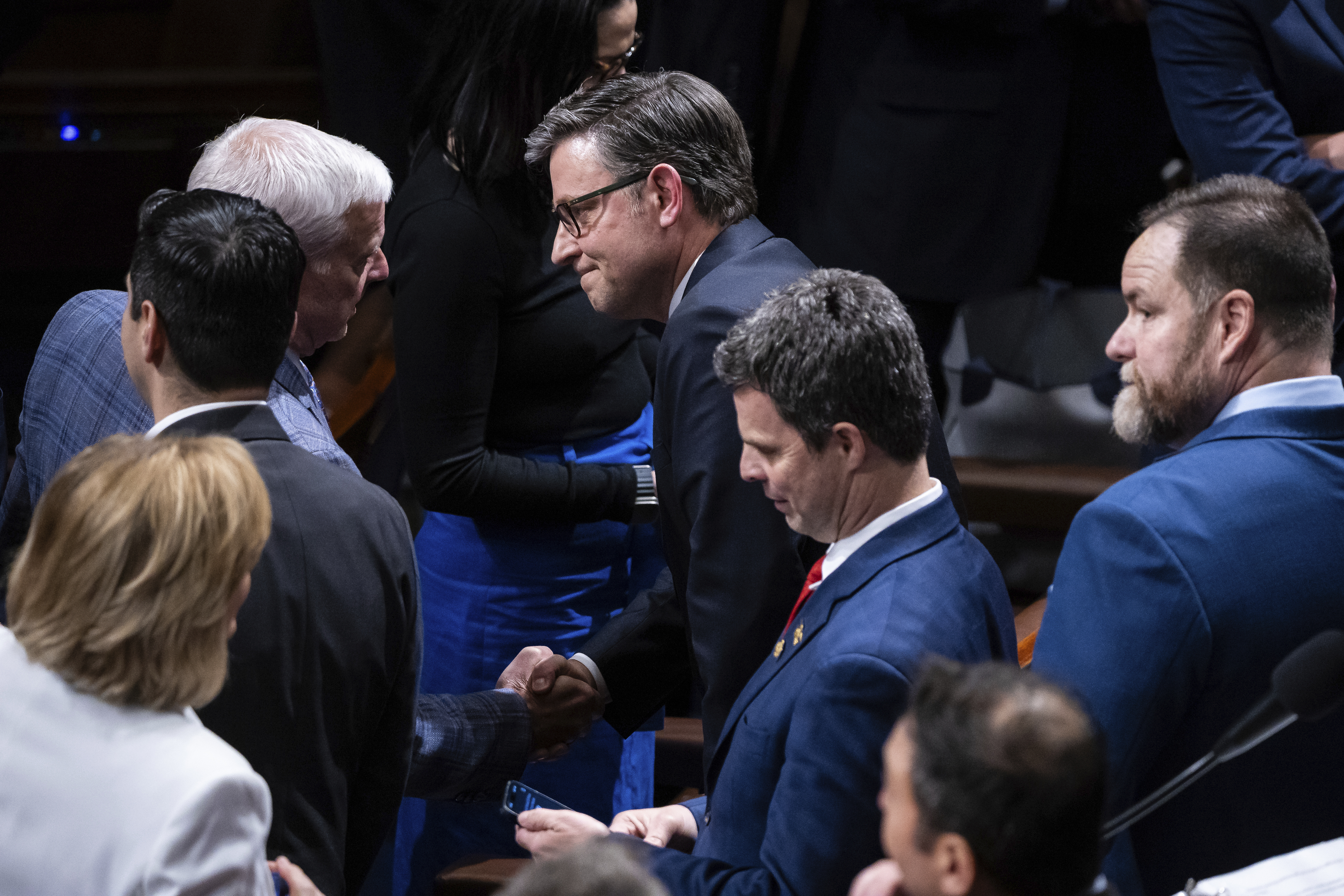
House Speaker Mike Johnson (R-La.) shakes hands with Rep. Steve Womack (R-Ark.) in the House chamber during the final vote on a budget reconciliation bill for President Trump’s legislative agenda at the U.S. Capitol July 3, 2025. (Francis Chung/POLITICO via AP Images)










Community Adaptation for a Water Festival Without Clean Water