
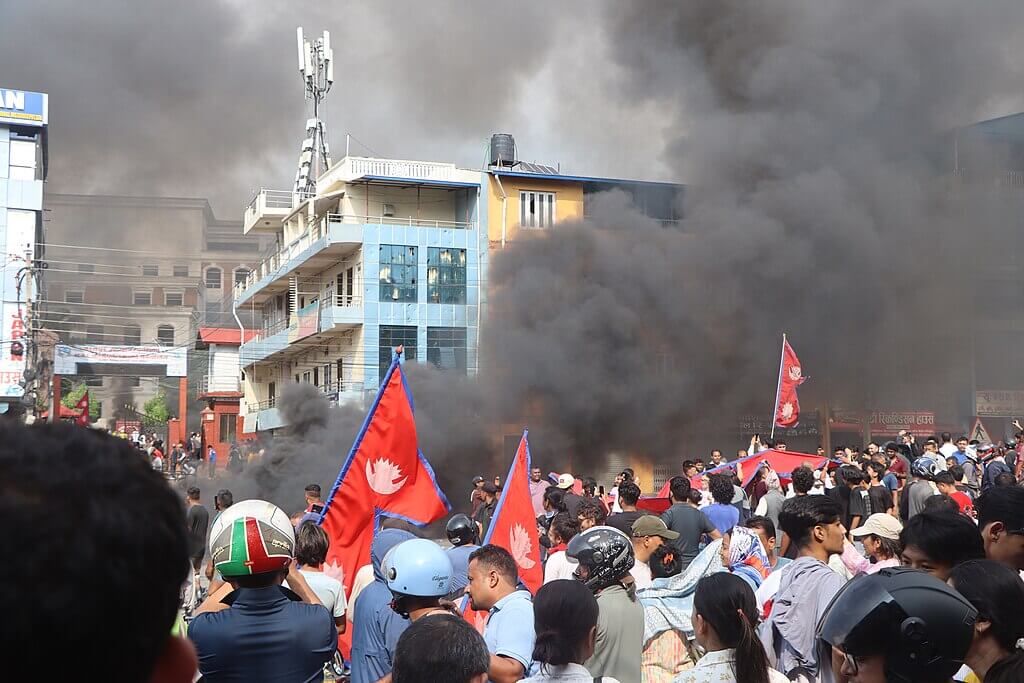
Gen Z, stifled by internet censors, corrupt governments, and a deficit of job opportunities, is wreaking havoc on governments in Africa and South and Southeast Asia. One after the other, youth-led protests have spread in Bangladesh, Kenya, Nepal, Indonesia, Morocco, and Madagascar, becoming a major political force, tumbling governments in Bangladesh, Nepal, and Madagascar and leading other states like Kenya and Morocco to reverse unpopular policies.
In South and Southeast Asia one-third or more of the population is under 25; in Africa, the statistic jumps to 60%, or some 750 million, with a median age of 19.7. In sum, Gen Z in Asia and Africa totals 1.5 billion. Youth-centric demographics are a double-edged sword: They can enable nations in the Global South to climb up the development ladder with the right mix of education, economic policies, and adequate governance, or they can be a source of instability and internal conflict where corruption and/or failing policies exist. For better or worse, Gen Z is driving political change — the outcome of which will ripple through the global economic and political order and, vice versa, be shaped by it.
A world of polycrises — a cascade of multiple inter-acting crises — adds another layer to the challenge that governments in these youthful nations face. Many of these states are trying to navigate their demographic challenges amid the entropy of an uncertain, unraveling world order; two predatory, economically coercive major powers; deep debt amidst shrinking aid and investment; and climate change. The World Bank lists 39 “fragile and conflict-affected states.” Less-developed countries have become the “losers” in a fragmenting world of growing North-South, South-South, and middle income vs. poorer divides.
In contrast, during the period of maximum globalization from the mid-1980s to 2008, an inclusive system of relatively open trade and capital flows reduced poverty and facilitated an export-led growth model that accelerated the emergence of a global middle class, most pronounced in East Asia, India, Brazil, and dramatically, in China. Abundant labor in China during the 1980s and 90s (a result of a median age of 22 in the country) fueled Deng Xiaoping’s reform and opening policies, spurring a spectacular rise from a $198 billion GDP in 1980 to $18.8 trillion in 2024. While China has become a leading global tech power, other achievers, Brazil and Mexico, as well as others, also fared well, steadily moving up the value chain from textiles to electronics and autos.
The current circumstances that Youth Bulge nations find themselves in are altering development possibilities. The backlash to globalization, protectionism, and China’s manufacturing overcapacity limit prospective markets. Capital flows are concentrated, disproportionately going to the U.S., and increasingly, to middle-income emerging markets. The $11.4 trillion of developing nation debt and diminished aid to and investment in many less-developed states are taking a toll. China is a prominent factor: Its manufacturing overcapacity, yielding a $1 trillion trade surplus (some of it shifting to the Global South due to U.S. tariffs), is crowding out manufacturing in developing nations; Beijing also holds a growing proportion of developing nation debt. The net effect is to impede efforts by many Youth Bulge nations seeking to replicate Asia’s export-led growth model.
Servicing debt consumes more than 10% of government revenues in 56 developing nations; for 17 of them, it is over 20%. Debt had already been building before the COVID pandemic, which forced developing nations to rapidly ramp up spending on near-term healthcare. Debt in Bangladesh, for instance, has grown exponentially over the past decade, amounting to over $103 billion. Servicing this debt consumes 13% of government revenues, crowding out funds for education, health, and other public services. Foreign debt, a weak tax base, and American tariffs of 35% are imperiling the country’s once robust textile industry, which is second only to China in terms of exports, and a major source of employment.
In Nepal, initial protests were triggered by a government ban on social media, which was viewed as an effort to silence criticism. Things escalated after repression by security forces left 72 dead. The underlying forces included a weak, largely informal economy that is dependent on emigrant remittances for 27% of GDP, a 20% youth unemployment rate, foreign debt service consuming 29% of government revenues, and limited spending on public services. For Indonesia and other ASEAN states, a surge in Chinese exports has led to factory closings and layoffs.
Africa’s demographic challenge is an order of magnitude greater than that of South Asia. World Bank economist Andrew Dabalen sums it up: “Over the next quarter century, Sub-Saharan Africa’s working-age population will grow by more than 600 million. The challenge will be matching this growing population with better jobs, given that only 24% of new workers today land wage-paying jobs.”
Africa’s predicament reveals the magnitude of the challenge. The continent is rife with some 35 internal conflicts, varying in severity from civil wars to terrorist attacks. Approximately 600 million lack modern energy services, a key enabler of development. Moreover, Africa is drowning in foreign debt: $745 billion, averaging 61 percent of states’ GDP, according to the African EXIM Bank. Twenty low-income countries are near bankruptcy or at risk of debt distress. Debt servicing amounts to about 24% of government spending for 25 African nations, which is more than most African governments spend on education or healthcare.
While World Bank-led efforts are underway to spread access to electricity for 300 million, Africans are seeking to leverage the vast potential of the continent’s natural resources and labor pool. A pan-African free trade agreement has taken hold, but the depth of the region’s problems remain. G20 efforts at debt rescheduling and sustainability have had only a modest impact. Africa has suffered disproportionately from the effects of climate change — floods, droughts, food insecurity — yet climate aid is shrinking. It is unclear where the investment — some $170 billion a year for infrastructure and more than $1 trillion (by 2030) for climate adaption/mitigation — will come from.
The Youth Bulge dividend is country-specific, and some states are better positioned than others. Apart from local questions of governance, external factors — current global trends — render local efforts problematic. The demise of neo-liberalism, a shift from the enlightened self-interest of the relatively open markets and aid flows of the post-WW2 era to inward looking nationalisms, climate pressures, and a slow-growth global economy are all negative pressures. U.S. priorities of gaining access to rare earth and critical minerals, as well as the race to build AI data centers, may become an asset to Youth Bulge nations, such has been the case in Pakistan.
However, the U.S. abandonment of multilateralism in general, as the largest actor in Bretton Woods institutions (International Monetary Fund (IMF)/World Bank) and bilateral aid donor, has perhaps the largest impact. The U.S. rejection of the UN Sustainable Development agenda and all climate finance makes both efforts increasingly aspirational.
The G20 has played an important role in the debt management of developing nations. It is unclear how U.S. skepticism toward such UN mechanisms will impact these efforts. It is increasingly unlikely that growing calls for major reform of the IMF, World Bank, and the World Trade Organization (WTO), which have been critiqued as not fit for purpose, will yield desired change. The G7 nations, with 13% of the world’s population, retain 59% of IMF and World Bank voting rights. As the U.S. hosts the G20 Summit in 2026, the shape of its future role should become less uncertain.
If these global factors affect the capacity of Youth Bulge governments to meet the Gen Z challenge, the outcome will almost certainly have a global impact. The success of many governments in Africa and South and Southeast Asia in realizing the demographic dividend would be a source of global growth and prosperity.
However, the degree to which the Youth Bulge becomes more of a burden will not only drive political change in those nations but also spill over globally. The stakes of a greater North-South divide are much larger. The consequences of terrorism, civil conflicts becoming internationalized, mass migration, and disease stemming from political and economic disruptions will increasingly impact industrialized nations in the West and East Asia, perhaps intensifying great-power competition.








Community Adaptation for a Water Festival Without Clean Water