
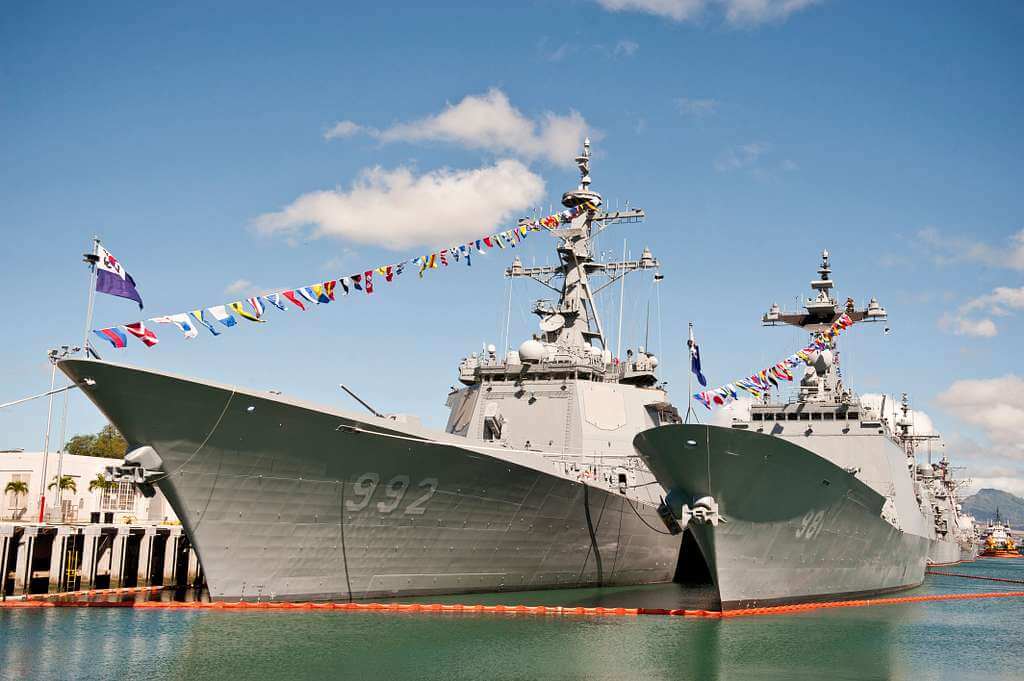

Over the past several years, the pacing challenge of a rapidly modernizing Chinese military has raised concerns about a growing gap in the capabilities of the People’s Liberation Army Navy (PLAN) and the U.S. Navy.1 Department of Defense. “Military and Security Developments Involving the People’s Republic of China 2024.” Department of Defense, December 18, 2024. https://media.defense.gov/2024/Dec/18/2003615520/-1/-1/0/MILITARY-AND-SECURITY-DEVELOPMENTS-INVOLVING-THE-PEOPLES-REPUBLIC-OF-CHINA-2024.PDF; NPR. “A former defense official warns about China’s military power.” NPR, April 25, 2024. https://www.npr.org/2024/04/25/1247095033/a-former-defense-official-warns-about-china-s-military-power; Eaglen, Mackenzie. “The U.S. Navy is falling behind China, and the Pentagon knows it.” American Enterprise Institute. Accessed March 20, 2025. https://www.aei.org/op-eds/the-u-s-navy-is-falling-behind-china-and-the-pentagon-knows-it/. The Pentagon’s own assessment from its most recent annual report projects PLAN to have 395 battle force ships by 2025 and 435 by 2030.2 Department of Defense. “Military and Security Developments Involving the People’s Republic of China 2024.” Department of Defense, December 18, 2024. https://media.defense.gov/2024/Dec/18/2003615520/-1/-1/0/MILITARY-AND-SECURITY-DEVELOPMENTS-INVOLVING-THE-PEOPLES-REPUBLIC-OF-CHINA-2024.PDF. The Government Accountability Office’s latest report, however, shows that the United States has remained at 290-300 for the past decade even though there has been a consistent call for 350 or more dating back to the Obama administration.3 Government Accountability Office. “Navy Shipbuilding: Actions Needed to Improve Shipyard Performance and Address Persistent Capacity Challenges.” Government Accountability Office. Accessed March 20, 2025. https://files.gao.gov/reports/GAO-25-106286/index.html; U.S. Naval Institute. “Shipbuilding: A Deep Dive.” Proceedings. U.S. Naval Institute, February 2025. https://www.USni.org/magazines/proceedings/2025/february/shipbuilding-deep-dive; U.S. Navy Chief of Naval Operations. “Navigation Plan.” 2022. https://www.dvidshub.net/publication/issues/64582. One reason for this delay has been an inefficient domestic shipbuilding industry with little incentive to innovate or compete due to decades of protectionism and risk-averse investor sentiment.4 Grabow, Colin; Inu Manak; and Daniel J. Ikenson. “The Jones Act: A Burden America Can No Longer Bear.” Cato Institute. Accessed March 20, 2025. https://www.cato.org/publications/policy-analysis/jones-act-burden-america-can-no-longer-bear; Bollinger, Martin J. “Shareholder Institutes are at Odds with Navy Needs.” Proceedings. U.S. Naval Institute, February 2025. https://www.USni.org/magazines/proceedings/2025/february/shareholder-interests-are-odds-navy-needs. Shipbuilders also face infrastructure and workforce challenges that have made the Navy’s goals difficult to accomplish. A combination of these factors has added up to what current National Security Advisor Mike Waltz has called an “absolute mess.”5 Panella, Chris. “Trump Tackling the Navy’s Shipbuilding Problem, but It’s Hard Fight.” Business Insider, March 2025. https://www.businessinsider.com/trump-tackling-the-navys-shipbuilding-problem-but-its-hard-fight-2025-3 Some prescriptive recommendations for these problems include policy change or increasing reliance on private venture firms (e.g., non-publicly traded companies like Anduril or General Atomics) and/or foreign defense contractors (e.g., Fincantieri or Austal).6 Grabow, Colin; Inu Manak; and Daniel J. Ikenson. “The Jones Act: A Burden America Can No Longer Bear.” Cato Institute. Accessed March 20, 2025. https://www.cato.org/publications/policy-analysis/jones-act-burden-america-can-no-longer-bear.
The idea of turning to a familiar ally with manufacturing scale and efficiency that rivals the Chinese shipbuilding industry—South Korea (the Republic of Korea, or the ROK)—has recently been gaining momentum. This paper seeks to explore the potential for a shipbuilding partnership between South Korea and the United States by considering South Korea’s shipbuilding capacity and the promise that it brings to unlocking one of the national security challenges that the United States faces in its strategic competition with China. The discussion will also touch on domestic hurdles that stand in the way of unleashing South Korea’s shipbuilding potential for the U.S. Navy, followed by prescriptive recommendations on what needs to change for U.S.-South Korea shipbuilding cooperation to be a successful enterprise that moves beyond existing arrangements.
The key takeaways from this paper are as follows:
- South Korea possesses world-class shipbuilding capacity;
- Entry into the U.S. market (for both commercial and military shipbuilding) can help South Korea remain competitive against China;
- South Korean shipbuilders must overcome some significant barriers to market entry;
- Some possible options, including direct investment in the United States or industrial partnerships or a combination of both, are explored; and
- U.S. policymakers must clear away some or all of the regulatory obstacles to make shipbuilding cooperation possible.
Capacity to Deliver
Two days after winning the U.S. presidential election in 2024, President-elect Donald Trump received a call from South Korean President Yoon Suk-yeol.7 Jung, Min-kyung. “Yoon, Trump vow to boost alliance, cooperation in 1st phone call since U.S. election.” Korea Herald. Accessed March 20, 2025. https://www.koreaherald.com/article/3849488. Following a brief congratulatory remark, Yoon emphasized the importance of building “strong solidarity and partnerships in the Asia-Pacific region based on the South Korea-U.S. alliance.” Among the topics mentioned during the 12-minute conversation were North Korea and the possibility of a U.S.-ROK Summit in 2025. But the policymaking community in Washington was especially keen to hear about Trump’s interest in cooperation on shipbuilding. Trump pointed out that “the shipbuilding industry in the United States has noticeably shrunk, which is why it is important to cooperate in such areas.”
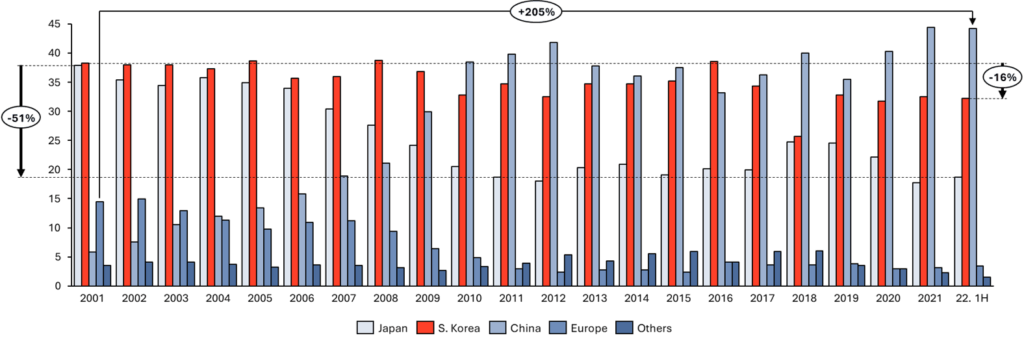
Worldwide Shipbuilding Completion by Country/Region, 2001-2022 (Unit: %)8 Clarksons. “World Fleet Register.” Clarksons Research.
Source: Clarksons
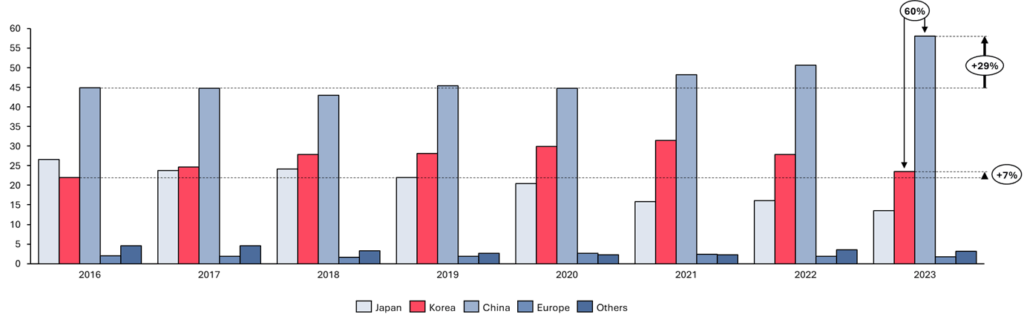
Comparison of Orderbooks by Country/Region, 2016-20239 BRS. “Shipping and Shipbuilding Markets” Annual Review. 2017-2024. BRS Shipbrokers.
Source: BRS
Global shipbuilding data reflects the sentiment shared by President Trump, which shows U.S. shipbuilding capacity lagging far behind that of other countries around the world. According to BRS’s latest report, the United States only had four work orders in 2023, while China and South Korea combined registered nearly 1,300 that same year. Data on the number of completed ships and work orders shows that the three dominant players in the market are all in Asia, with China being in a clear pole position as of 2010.10 Ibid. While demand for South Korean ships has picked up in recent years, this may change over time as China continues to improve its efficiency and scale.
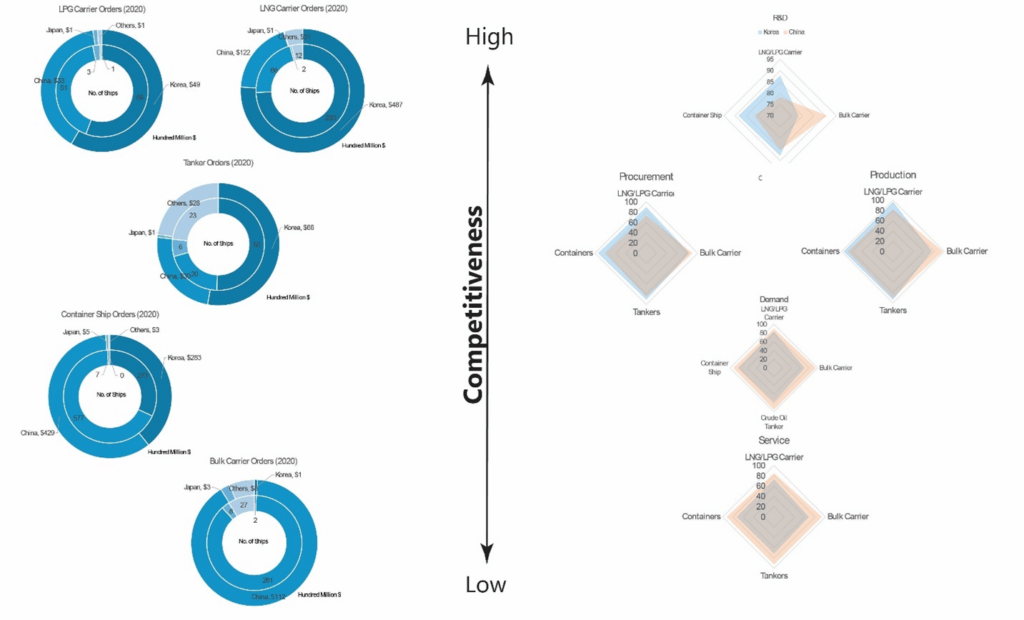
Competitiveness of South Korean and Chinese Shipbuilders11 이상원 외. 『주요 산업의 한중 가치사슬 분석과 시사점 (제1권) 조선, 석유화학, 통신기기 등을 중심으로』. 산업연구원 (KIET), 2023.
Source: KIET
According to the Korea Institute of Industrial Economics and Trade’s (KIET) latest assessment of the South Korean shipbuilding industry, South Korea’s comparative advantage is in the manufacturing of more sophisticated platforms such as liquefied natural gas (LNG) or liquefied petroleum gas (LPG) carriers and tankers. China has already overtaken South Korea in the production of bulkers and container ships. This explains China’s relative advantage over South Korea in the overall market demand and service even though the latter still maintains the edge in procurement, production, and research and development (R&D). This too, however, is likely to change, as KIET projects China to surpass South Korea in all areas of specialization within the next five years. The main reason is that China has the edge over South Korea in terms of pricing and the sheer market size of the vessels in which it is competing.
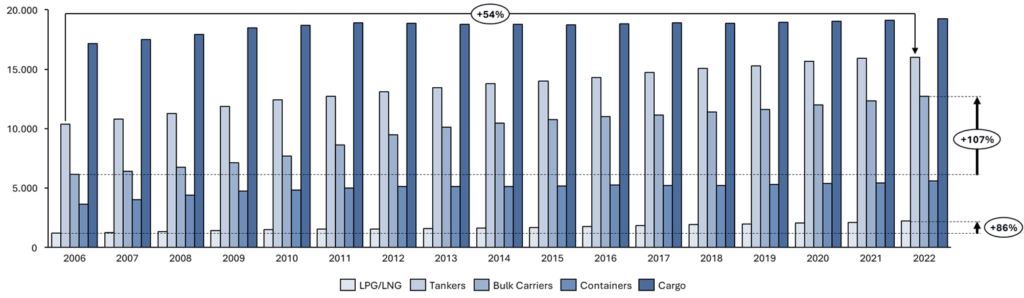
Worldwide Ships by Type, 2006-2022 (Unit: Number of Ships)12 Clarksons. “World Fleet Register.” Clarksons Research.
Source: Clarksons
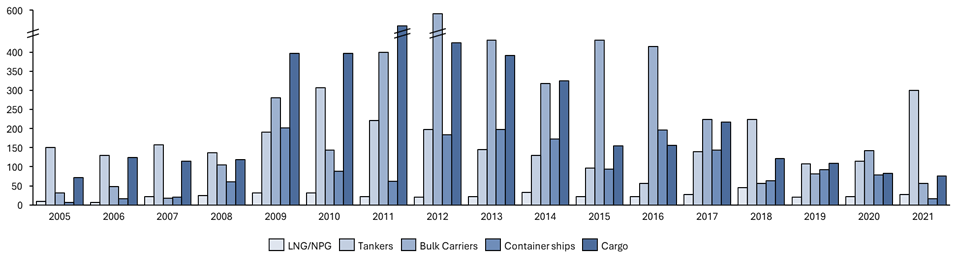
Worldwide Disposal of Ships by Type, 2006-2022 (Unit: Number of Ships)13 Clarksons. “Shipping Review & Outlook September 2022”
Source: Clarksons
Clarksons’ annual data on the number of ships in operation and disposal provides a picture of where the market stands. For instance, the markets for general cargo ships, tankers, and bulk carriers are much larger than those of containers and more specialized LNG/LPG carriers. From a financial standpoint, the global LNG carrier market in 2023 was valued at $17.6 billion with a compounded annual growth rate (CAGR) of 3.0 percent, while the LPG carrier market was only $202 million with CAGR of 5.2 percent.14 “LNG Carriers Global Industry Business Analysis Report 2024-2030: Geopolitical Tensions and Trade Routes Realignment Spur Growth in Strategic LNG Carrier Deployments.” Globe Newswire, February 11, 2025. https://www.globenewswire.com/news-release/2025/02/11/3023969/28124/en/LNG-Carriers-Global-IndU.S.try-Business-Analysis-Report-2024-2030-Geopolitical-Tensions-and-Trade-Routes-Realignment-Spur-Growth-in-Strategic-LNG-Carrier-Deployments.html; “Global LPG Tanker Market.” Maximize Market Research. November 2024. https://www.maximizemarketresearch.com/market-report/global-lpg-tanker-market/116990/. In comparison, the cargo shipping market alone in 2025 is expected to be $658 billion with a CAGR of 4.9 percent.15 “Cargo Shipping Market – Growth, Trends, COVID-19 Impact, and Forecasts.” Mordor Intelligence. 2025. https://www.mordorintelligence.com/industry-reports/cargo-shipping-market.
To South Korea’s benefit, the global fleet of LNG/LPG carriers and tankers grew by 86 percent and 54 percent, respectively, during 2006 and 2022. However, the number of LNG/LPG carriers and tankers accounted for only 53 percent of bulkers, container ships, and general cargo ships, excluding combos, Ro-Ro, passenger and cruise liners, dredgers, and tugs. If we account for these excluded categories, tankers and LNG/LPG carriers are only about 20 percent of the latter category of fleets, suggesting that without some change in this relative balance, South Korea may be outmuscled by the Chinese competitors.
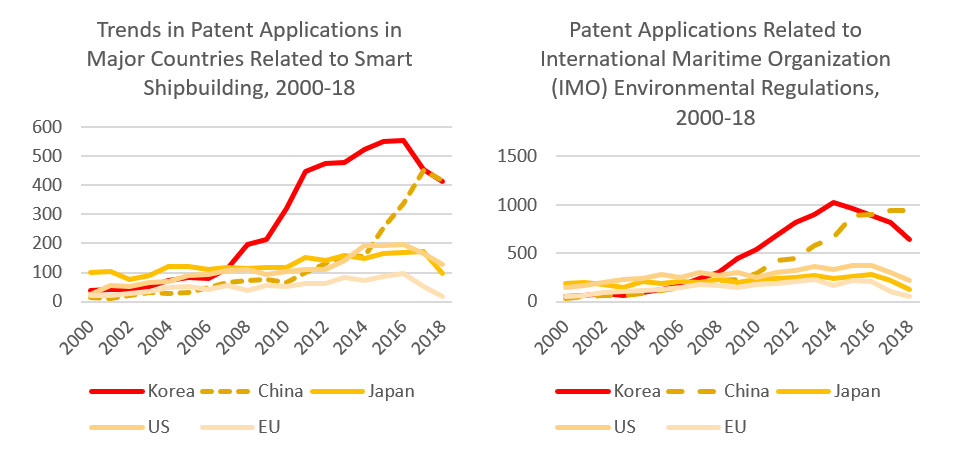
Even if South Korea has a robust advantage in its sophisticated vessels , the data on the number of patents issued in areas such as smart and green shipbuilding shows that Chinese shipbuilders are on pace to overtake their Korean counterparts in R&D. The race is a difficult one for Korean firms when the competitor is heavily subsidized by a government with deeper pockets and an adequate supply of cheap inputs and labor.
South Korea’s R&D in Shipbuilding Versus Other Countries, 2000-1816 이상원 외. (KIET), 2023.
Source: KIET
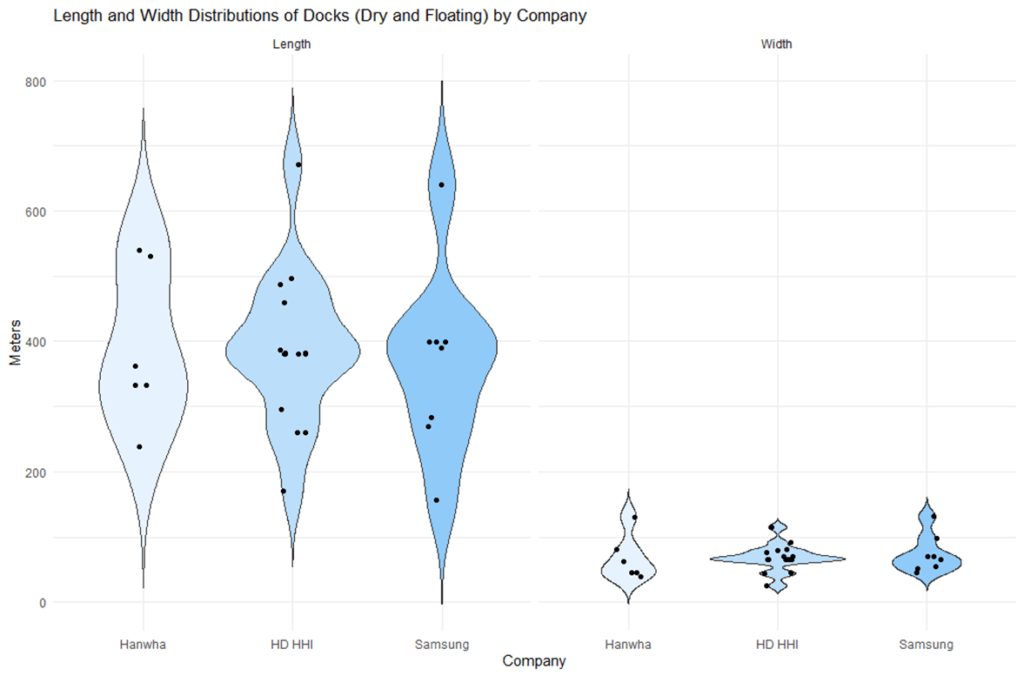
In thinking about capacity, one cannot ignore the facilities available to build and repair ships. South Korea currently boasts the world’s largest shipyard in Ulsan with 10 dry docks owned and operated by HD Hyundai Heavy Industries (HD HHI). HD HHI possesses 19 docks worldwide, including two dry docks in Vietnam. Hanwha Ocean operates two dry docks and two floating docks in their Okpo Shipyard in Geoje; its recently acquired Philly Shipyard in the United States has two dry docks. Samsung Heavy Industries possesses three dry docks, four green docks, and one floating dock in Geoje. The distributive size of these facilities suggests that South Korea’s Big Three have hardly any limitations in fulfilling their work orders. When we include smaller companies like K Shipbuilding, HJ, and DH Shipbuilding, there are approximately 30 dry docks managed by South Korean shipbuilding companies which can be operational on any given day to produce ships in two to three-year cycles, depending on size and sophistication. The productivity of these facilities will determine whether the South Korean shipbuilding companies survive and remain a major player in the global shipbuilding market.
Shipyards Operated by South Korean Big Three Shipbuilders
Sources: Hanwha Ocean, HD HHI, and Samsung HI
Navigating Tricky Waters
Enter strategic competition between the United States and China and the degradation of the U.S. shipbuilding industry. The South Korean shipbuilding industry can be an important player in addressing the needs of American shipping and shipbuilding. Navigating the intricacies of this arrangement, while not insurmountable, will require overcoming many significant obstacles and challenges. One notable problem is the existing statutory rules and regulations regarding ships manufactured overseas and national security-related restrictions on cross-border partnerships. Numerous research and analyses on this issue, as they apply to both commercial and military shipbuilding, have not shied away from naming regulations and deeply entrenched interests linked to these regulations that would make cross-border cooperation on shipbuilding difficult.
Major Regulations on U.S. Shipbuilding
| Statute | Year | Content | Exceptions |
|---|---|---|---|
| Buy American Act (BAA) | 1933 | Directs federal agencies to give a procurement preference to items that have been “manufactured in the United States substantially all from articles, materials or supplies mined, produced, or manufactured” in the United States must exceed 55% of the cost of all components, or it must be commercially available off-the-shelf item. | If an agency head determines that the preference for U.S. goods is inconsistent with public interest; if the item exists in sufficient and reasonable available commercial quantities and of a satisfactory quality; if the added cost is unreasonable (if the domestic bid is at least 50% higher than the lowest foreign bid); purchases of information technology acquisitions for commercial items and commissary resales. Products meant for use outside of the U.S. Does not apply to 27 countries with reciprocal procurement agreements (European, Australia, Canada, Egypt, and Japan) and 60 countries that have dollar threshold above which Buy American Act requirements are waived. Korea is one of these countries – under the WTO exemption, dollar threshold above which BAA does not apply is $180,000 and under the KORUS FTA, it is $100,000. |
| Berry Amendment and Specialty Metals Restriction Provision (10 U.S.C. 4863) | 1941 (1972) | DoD purchased items must be 100% domestic in origin if they fall into the following five categories: textiles, clothing, food, and hand or measuring tools (including flatware and dinnerware). Prohibits the DoD from acquiring certain military platforms or weapons systems – or components of these platforms and systems – that contain any amount of specialty metal that is not melted or produced in the U.S. The restriction applies to aircraft, missiles, space systems, ships, tank, automotive items, weapon systems, and ammunition. DoD and its contractors are prohibited from acquiring specialty metals (i.e., steel with more than 1.65% manganese, 0.6% silicon, 0.6% copper or 0.25% of aluminum, chromium, cobalt, niobium, molybdenum, nickel, titanium, tungsten, or vanadium; alloy metals that’s more than 10% of nickel, iron-nickel, and cobalt; titanium; zirconium) if they are not melted or produced in the U.S. | DoD can purchase foreign sourced items when they are unavailable from American manufacturers at satisfactory quality and sufficient quantity or when they are used in support of combat or contingency operations. Congress has enacted permanent waivers for specific product, like flame resistant rayon fabric and yarns used in anti-ballistic body armor. If “compliant specialty metal of satisfactory quality and sufficient quantity, and in required form, cannot be procured as and when needed”; acquisitions conducted outside the U.S. in support of combat or contingency operations. |
| Kissell Amendment (American Recovery and Reinvestment Act) | 2009 | DHS must use funds directly related to national security interests to purchase textiles, clothing, and footwear from domestic sources (hand or measuring tools, and flatware and dinnerware are excluded). | |
| Merchant Marine Act | 1920 | Restricts domestic waterborne transportation vessels to be U.S. registered and built. All ships with homeport in the U.S. must be crewed and owned by U.S. individuals and companies. | |
| Military Cargo Preference Act | 1904 | All items owned or purchased by the military must be exclusively transported on available U.S. flagged vessels provided the rates are not excessive or otherwise unreasonable. | |
| Tollefson Amendment (DoD Appropriations Act) codified in 14 U.S.C. 1151 Restriction on Construction of Coast Guard Vessels in Foreign Shipyards | 1965 | Prohibits appropriated funds from being used for construction of major components of vessels or its components to be used for Coast Guard in foreign shipyards | The President can make exceptions to this rule if doing so is necessary for U.S. national security. However, before any contract under this exception can be made, the President must inform Congress of the decision. Once Congress is notified, there is a 30-day waiting period before the contract can proceed. Inflatable boats are exempted from this rule. |
| Byrnes Amendment (DoD Appropriations Act) 10 U.S.C. 8679 Construction of Vessels of Armed Forces in Foreign Shipyards: Prohibition | 1968 | Prohibits all federal government funds to be Used for construction of vessels for the armed forces in foreign shipyards | |
| International Traffic in Arms Regulation (ITAR) of the Arms Export Control Act and Executive Order 13637 | 1976 | Regulates the export of defense articles, defense services and technical data listed on the U.S. Munitions List. U.S. companies with overseas operations are prohibited from sharing ITAR technical data with employees local to those countries unless State Department authorization is secured. U.S. companies that work with non-U.S. subcontractors are also subject to this rule. | Few companies have secured exemptions based on specific purposes, including in Canada, the UK, and Australia. |
| Export Administration Regulations (EAR) of the Export Administration Act (EAA) and Export Control Reform Act (ECRA) | 1979; 2018 | Regulates various. commercial items that are critical to national security or can be diverted for U.S.es contrary to national security or in support of terrorism |
| Statute | Year | Content | Exceptions |
| Buy American Act (BAA) | 1933 | Directs federal agencies to give a procurement preference to items that have been “manufactured in the United States substantially all from articles, materials or supplies mined, produced, or manufactured” in the United States must exceed 55% of the cost of all components, or it must be commercially available off-the-shelf item. | If an agency head determines that the preference for US goods is inconsistent with public interest; if the item exists in sufficient and reasonable available commercial quantities and of a satisfactory quality; if the added cost is unreasonable (if the domestic bid is at least 50% higher than the lowest foreign bid); purchases of information technology acquisitions for commercial items and commisary resales. Products meant for use outside of the US. Does not apply to 27 countries with reciprocal procurement agreements (European, Australia, Canada, Egypt, and Japan) and 60 countries that have dollar threshold above which Buy American Act requirements are waived. Korea is one of these countries – under the WTO exemption, dollar threshold above which BAA does not apply is $180,000 and under the KORUS FTA, it is $100,000. |
| Berry Amendment and Specialty Metals Restriction Provision (10 U.S.C. 4863) | 1941 (1972) | DoD purchased items must be 100% domestic in origin if they fall into the following five categories: textiles, clothing, food, and hand or measuring tools (including flatware and dinnerware). Prohibits the DoD from acquiring certain military platforms or weapons systems – or components of these platforms and systems – that contain any amount of specialty metal that is not melted or produced in the U.S. The restriction applies to aircraft, missiles, space systems, ships, tank, automotive items, weapon systems, and ammunition. DoD and its contractors are prohibited from acquiring specialty metals (i.e., steel with more than 1.65% manganese, 0.6% silicon, 0.6% copper or 0.25% of aluminum, chromium, cobalt, niobium, molybdenum, nickel, titanium, tungsten, or vanadium; alloy metals that’s more than 10% of nickel, iron-nickel, and cobalt; titanium; zirconium) if they are not melted or produced in the U.S. | DoD can purchase foreign sourced items when they are unavailable from American manufacturers at satisfactory quality and sufficient quantity or when they are used in support of combat or contingency operations. Congress has enacted permanent waivers for specific product, like flame resistant rayon fabric and yarns used in anti-ballistic body armor. If “compliant specialty metal of satisfactory quality and sufficient quantity, and in required form, cannot be procured as and when needed”; acquisitions conducted outside the U.S. in support of combat or contingency operations. |
| Kissell Amendment (American Recovery and Reinvestment Act) | 2009 | DHS must use funds directly related to national security interests to purchase textiles, clothing, and footwear from domestic sources (hand or measuring tools, and flatware and dinnerware are excluded). | DoD can purchase foreign sourced items when they are unavailable from American manufacturers at satisfactory quality and sufficient quantity or when they are used in support of combat or contingency operations. Congress has enacted permanent waivers for specific product, like flame resistant rayon fabric and yarns used in anti-ballistic body armor. If “compliant specialty metal of satisfactory quality and sufficient quantity, and in required form, cannot be procured as and when needed”; acquisitions conducted outside the U.S. in support of combat or contingency operations. |
| Merchant Marine Act | 1920 | Restricts domestic waterborne transportation vessels to be US registered and built. All ships with homeport in the US must be crewed and owned by US individuals and companies. | |
| Military Cargo Preference Act | 1904 | All items owned or purchased by the military must be exclusively transported on available US flagged vessels provided the rates are not excessive or otherwise unreasonable. | |
| Tollefson Amendment (DoD Appropriations Act) codified in 14 U.S.C. 1151 Restriction on Construction of Coast Guard Vessels in Foreign Shipyards | 1965 | Prohibits appropriated funds from being used for construction of major components of vessels or its components to be used for Coast Guard in foreign shipyards | The President can make exceptions to this rule if doing so is necessary for U.S. national security. However, before any contract under this exception can be made, the President must inform Congress of the decision. Once Congress is notified, there is a 30-day waiting period before the contract can proceed. Inflatable boats are exempted from this rule. |
| Byrnes Amendment (DoD Appropriations Act) 10 U.S.C. 8679 Construction of Vessels of Armed Forces in Foreign Shipyards: Prohibition | 1968 | Prohibits all federal government funds to be used for construction of vessels for the armed forces in foreign shipyards | The President can make exceptions to this rule if doing so is necessary for U.S. national security. However, before any contract under this exception can be made, the President must inform Congress of the decision. Once Congress is notified, there is a 30-day waiting period before the contract can proceed. Inflatable boats are exempted from this rule. |
| International Traffic in Arms Regulation (ITAR) of the Arms Export Control Act and Executive Order 13637 | 1976 | Regulates the export of defense articles, defense services and technical data listed on the US Munitions List. US companies with overseas operations are prohibited from sharing ITAR technical data with employees local to those countries unless State Department authorization is secured. US companies that work with non-US subcontractors are also subject to this rule. | Few companies have secured exemptions based on specific purposes, including in Canada, the UK, and Australia. |
| Export Administration Regulations (EAR) of the Export Administration Act (EAA) and Export Control Reform Act (ECRA) | 1979; 2018 | Regulates various commercial items that are critical to national security or can be diverted for uses contrary to national security or in support of terrorism |
From a technical standpoint, Section 27 of the Merchant Marine Act of 1920, better known as the Jones Act, applies strictly to commercial shipping and shipbuilding. Yet, the Jones Act is often portrayed as having national security implications, as civilian merchant mariners are sometimes tapped to transport troops and equipment for the U.S. military. However, this claim is somewhat questionable due to the capital-intensive and high-cost nature of the shipping business. According to the Maritime Administration (MARAD), the operating cost differential between U.S.-flagged and foreign-flagged vessels was on average $6.2-6.5 million in 2018.17 Moore, Kirk. “GAO Says U.S. Flag Fleet in Danger from Rising Costs, Fewer Mariners.” WorkBoat, AugU.S.t 13, 2018. https://www.workboat.com/bluewater/gao-says-u-s-flag-fleet-in-danger-from-rising-costs-fewer-mariners. This differential has grown to such an extent that as of 2022, U.S.-flagged vessels ($11 million) cost approximately 4.4 times more than their foreign-flagged counterparts ($2.5 million).18 Grabow, Colin. “Trump Administration Considers Punishing Americans with New Fees, Costly Shipping Requirements.” Cato Institute, February 26, 2025. https://www.cato.org/blog/trump-administration-considers-punishing-americans-new-fees-costly-shipping-requirements.
Aside from cost, there is simply not enough commercial vessels in the United States to accommodate the needs of the Department of Defense. At the conclusion of World War II, the United States maintained the largest merchant fleet in the world, but as of 2022 MARAD shows only 180 U.S.-flagged vessels exceeding 1,0000-ton capacity in the national inventory.19 Vohr, Alex. “Learning from History to Strengthen the Nation’s Military Logistics Distribution Network.” National Defense Transportation Association, April 27, 2022. https://www.ndtahq.com/learning-from-history-to-strengthen-the-nations-military-logistics-distribution-network/. When U.S. forces were deployed to Saudi Arabia during Operations Desert Shield and Desert Storm, the military was more than twice dependent on foreign-flagged vessels than U.S.-flagged commercial vessels, only one of which was Jones Act-compliant.20 U.S. Transportation Command and Strategic Deployment for Operation Desert Shield / Desert Storm. “So Many, So Much, So Far, So Fast.” Joint History Office. Office of the Chairman of the Joint Chiefs of Staff and Research Center. 1992. Part of the problem is that the domestic commercial fleet is at capacity to serve market consumption in Hawaii, Alaska, Puerto Rico, and Guam.21 Vohr. 2022. Transport of energy products to areas without adequate pipeline infrastructure would also require ships to make this transport possible. In short, there are just not enough ships.
Restrictions laid out by the Buy American Act and Berry Amendment can be circumvented by various exemption requirements under the law. Similarly, the Byrnes-Tollefson Amendments (U.S. Code Title 10 Section 8679 and Title 14 Section 1151), which prohibit the construction of vessels for the U.S. armed forces and the Coast Guard in foreign shipyards, allow the President to make exemptions if doing so is necessary for U.S. national security. However, before any contracts under this exception can be signed, the President must inform Congress of the decision. Once Congress is notified, there is a 30-day waiting period before the contract can proceed.
ITAR speaks more directly to any type of cross-border defense industrial cooperation. While there are some examples of successes in this area, which will be discussed below, the regulation often stands in the way of cooperation by restricting exchange of sensitive technologies that can impact the national security interests of the United States and therefore would require extensive review and determination by the U.S. State Department, which can take many months if not years. EAR relates to any compliance-related issues about foreign business dealings that can stand in the way of any kind of cooperative joint ventures as well.
Furthermore, rules laid out in laws such as the Military Cargo Act and Byrnes-Tollefson Amendment are difficult to overcome. Barring an executive order that goes unchallenged, changes to laws like these would require congressional action, which would be difficult since there are strong entrenched interests, such as the Shipbuilders Council of America and companies like Huntington Ingalls Industries and General Dynamics EB/NASSCO, not to mention the numerous. ancillary groups that depend on the domestic shipbuilding industry. These players have much to lose from foreign outsourcing of shipbuilding contracts by the U.S. Navy.
According to MARAD, for instance, the U.S. shipbuilding industry directly employed 105,652 workers in 2023 and for every shipyard job created in this sector, there were 2.6 jobs created in the domestic supplier base.22 U.S. Department of Transportation, Maritime Administration. “Fact Sheet: Domestic Shipbuilding.” July 2024. https://www.maritime.dot.gov/outreach/policy-papers-and-fact-sheets/fact-sheet-domestic-shipbuilding-july-2024. This means the total economic activity associated with the industry supports approximately 400,000 jobs across the country and generates more than $42.4 billion for the economy.
Putting aside the lobbying efforts to prevent any changes to existing legislation, even if Congress was able to find a path forward on legislative solution to this issue, special interests can still seek to challenge this action through litigation, which can derail if not delay and even raise the cost of bilateral cooperation. An illustrative example is the recent dispute between the Westinghouse Corporation and Korean Consortium on the export of a civil nuclear power plant to the Czech Republic.23 “U.S., Korea Sign MOU for Nuclear Cooperation.” American Nuclear Society, January 14, 2025. https://www.ans.org/news/2025-01-14/article-6685/US-korea-sign-mou-for-nuclear-cooperation/; “Westinghouse Protests Czechia Nuclear Tender Decision.” WestinghoU.S.e Electric Company, AugU.S.t 26, 2024. https://info.westinghousenuclear.com/news/westinghouse-protests-czechia-nuclear-tender-decision. Without serious diplomatic intervention and very costly legal actions, it would have been difficult for the Korea Hydro and Nuclear Power Company (KHNP) and Doosan Enerbility to move forward with their work to build the reactors in the Czech Republic this year.24 U.S. Department of Energy. “U.S., Republic of Korea Reach Provisional Agreement on Nuclear Cooperation.” November 4, 2024. https://www.energy.gov/articles/US-republic-korea-reach-provisional-agreement-nuclear-cooperation; U.S. Department of Energy. “Joint Statement by the United States of America and the Republic of Korea on Expansion of Peaceful Nuclear Energy Cooperation.” January 8, 2025. https://www.energy.gov/articles/joint-statement-united-states-america-and-republic-korea-expansion-peaceful-nuclear-energy; Nam, In-Soo. “KHNP, Westinghouse end legal dispute; Korea news Czech nuclear deal.” The Korea Economic Daily, January 17, 2025. https://www.kedglobal.com/energy/newsView/ked202501170001.
Sales and Operating Profits of the South Korean Big Three, 2020-24, (in USD Millions)25 Hanwha Ocean. “IR Data.” Hanwha Ocean. https://www.hanwhaocean.com/investors/ea?requestPageUri=%2Finvestors&pageNo=1&boardMstrSeqNo=87&langKey=KO¬cSeqNo=-1&searchTitle=; HD Hyundai Heavy Industries. “IR Information.” HD Hyundai Heavy Industries. https://www.hhi.co.kr/IR/ir05_2; Samsung Heavy Industries. “IR Data.” Samsung Heavy Industries. https://www.samsungshi.com/Ko/Ir_data.aspx#pageTop.
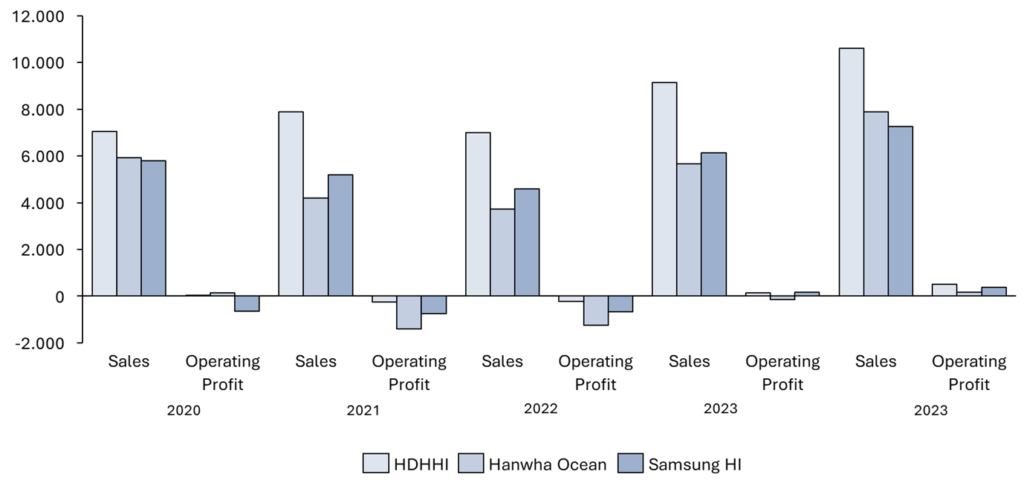
Source: HD HHI, Hanwha Ocean, and Samsung HI
Note: Exchange rate conversions derived by using the U.S. IRS recommended annual exchange rate, which was applied to the figures extracted from the financial statements reported by each firm on a quarterly or monthly basis.26 Internal Revenue Service. “Yearly Average Currency Exchange Rates.” Accessed March 20, 2025. https://www.irs.gov/individuals/international-taxpayers/yearly-average-currency-exchange-rates. This was then annualized in Korean won.
One idea being proposed by some observers is to have South Korean shipbuilding companies invest more in the United States as Hanwha Ocean has done through its recent $100 million acquisition of the Philly Shipyard. This purchase, however, has not translated into an immediate ramp-up of production.
One challenge is profitability. As noted in the previous section, the shipbuilding industry is highly competitive; hence, low margins are typical. If we review the financial statements of the South Korean Big Three, we can see how low their operating profit margins are. What this means is that scale, along with some sense of bounded predictability in demand, is of utmost importance when deciding on additional investments and capital expenditure.
The restrictions imposed on the domestic shipping sector due to the protectionist policies in shipbuilding are a significant concern for South Korean companies contemplating additional investments in the United States.27 Grabow, Manak, and Ikenson. 2018. The fact that the domestic maritime shipping industry is almost entirely operated and owned by foreign entities is indicative of this feature of the U.S. market. For instance, approximately 80 percent of U.S. port terminals are owned and operated by foreign firms.28 Vineyard, Jared. “Another Foreign Company Purchases U.S. Port Terminals & ILWU Ratifies Contract.” Universal Cargo, September 5, 2023. https://www.universalcargo.com/another-foreign-company-purchases-u-s-port-terminals-ilwu-ratifies-contract/. European companies control 54 percent of global container shipping market while Asian allies control over 20 percent.29 Kennedy, Mark and Jeffrey Kucik. “It’s Time for a Comprehensive National Maritime Strategy.” War on the Rocks, March 28, 2024. https://warontherocks.com/2024/03/its-time-for-a-comprehensive-national-maritime-strategy/.
For companies like Hanwha Ocean, guarantees on profitability mean being somewhat assured about a steady stream of demand coming on the heels of efficient, high-quality manufacturing and competitive pricing of a product line that can stand toe-to-toe with the competition in China, Japan, Vietnam, India, Italy, France, and the Philippines. Strong domestic demand from the shipping industry would be a big plus in this regard. If not, South Korean shipbuilders will have to figure out how to make ends meet, especially when companies like Hanwha Ocean depend heavily on sales of commercial vessels for its revenue.
Percentage of Sales by Product Type for Hanwha Ocean, 2024 (Unit: %)30 Hanwha Ocean.
“Global Ocean Solution Provider: Hanwha Ocean 2024년 연간•4분기 실적발표 [Global Ocean Solution Provider: Hanwha Ocean 2024 Annual and 4th Quarter Results Presentation].” Investor Relations presentation, 2025.
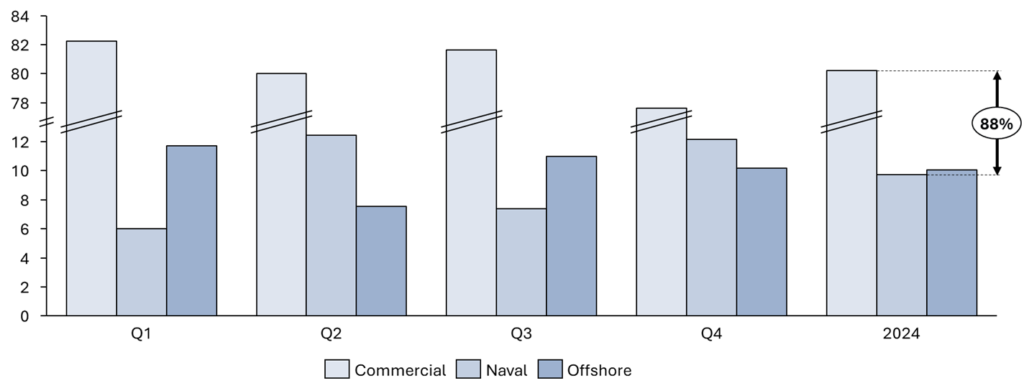
Source: Hanwha Ocean
On the other side of the balance sheet is cost. In particular, adequate supply and affordable price of quality input such as steel and labor are both concerns that would weigh heavily on the minds of any management team. The Congressional Budget Office (CBO) estimate released in January 2025 indicates that the total shipbuilding costs would average $40 billion (in 2024 dollars) over the next 30 years, which is 17 percent higher than the U.S. Navy’s estimates. This implies that the U.S. Navy’s total budget would need to increase from $255 billion today to $340 billion (in 2024 dollars) by 2054.31 Congressional Budget Office. “An Analysis of the Navy’s Fiscal Year 2024 Shipbuilding Plan.” January 2025. https://www.cbo.gov/publication/61155. Additionally, the Section 232 25 percent tariffs on steel and aluminum imposed by President Trump will also add to the higher price of domestic steel and may lead to a supply shortage.32 Swanson, Anna and Jeanna Smialek. “Trump Tariffs Steel Aluminum.” The New York Times, March 12, 2025. https://www.nytimes.com/2025/03/12/US/politics/trump-tariffs-steel-aluminum.html; “Trump Plans to Impose 25 Percent Tariffs on Steel and Aluminum.” Maritime Executive, February 9, 2025. https://www.maritime-executive.com/article/trump-plans-to-impose-25-percent-tariffs-on-steel-and-aluminum; Magill, Kate. “Steel tariffs could drive up domestic prices and capacity, but unlikely to create jobs.” Manufacturing Dive. February, 12, 2025. https://www.manufacturingdive.com/news/trump-steel-tariffs-industry-impact-jobs-costs-2025/739832/.
With respect to labor, the industry would need approximately 330,000 new welding professionals by 2028 to meet the demand for military ship production and repair.33 Hardman, Rex; Ken Hyun; and Ryan O’Dell. “Future Trends and How to Overcome Welding Challenges in Shipbuilding with Innovation.” Miller Welds. August 8, 2024. https://www.millerwelds.com/resources/article-library/future-trends-and-how-to-overcome-welding-challenges-in-shipbuilding-with-innovation. As of 2024, 21.4 percent of 771,000 welding professionals are 55 years or older with over 159,000 approaching retirement. In Virginia alone, there are 10,000 current openings for shipbuilding jobs; the number is expected to quadruple by 2030. The problem is also the average skill level of employees. As one domestic shipbuilding executive notes, the average electrical supervisor in the mid-1990s had 20 years of experience but “today, the average electronic supervisor has been there four and a half years.”34 Panella, Chris. “A top U.S. Navy shipbuilder says the problem isn’t that the industry doesn’t know how to build warships.” Business Insider, February 21, 2025. https://www.businessinsider.com/industry-knows-how-to-build-warships-navy-shipbuilding-insider-2025-2.
One way to address the shortage of skilled labor is to bring in skilled workers from countries like South Korea. In fact, Hanwha Ocean has announced a plan to more than double its employees at the Philly Shipyard over the next 10 years, which currently stand at about 1,700.35 Kin, Hyung-Kyu. ” Hanwha to more than double staff at U.S. Philly Shipyard in 10 years.”Korea Economic Daily, January 7, 2025. https://www.kedglobal.com/shipping-shipbuilding/newsView/ked202501070010. Congress has tried on more than one occasion to help companies like Hanwha by proposing the Partner with Korea Act, which would expand the number of temporary, non-immigrant E-4 visas for skilled workers from South Korea.36 “Kim, Connolly, Mullin, Hirono Reintroduce PARTNER with Korea Act.” Office of Congresswoman Young Kim. April 26, 2023. https://youngkim.house.gov/2023/04/26/kim-connolly-mullin-hirono-reintroduce-partner-korea-act/; U.S. Congress, House. “H.R. 2827, 118th Congress.” Accessed March 20, 2025. https://www.congress.gov/bill/118th-congress/house-bill/2827/text; This attempt, however, has yet to bear fruit with the most recent introduction being in April 2023.37 U.S. Congress, Senate. “S. 1301, 118th Congress.” Accessed March 20, 2025. https://www.congress.gov/bill/118th-congress/senate-bill/1301.
There is also the problem of labor shortage in South Korea. Take welding, for example. It accounts for approximately 70 percent of the total shipbuilding process.38 Nayel, Sharar. “South Korean Shipbuilders in Dilemma as Vietnamese Welders Found Ineligible.” Container News, November 8. 2022. https://container-news.com/south-korean-shipbuilders-in-dilemma-as-vietnamese-welders-found-ineligible/. The South Korean shipbuilding industry is estimated to face a shortage of around 14,000 workers with an additional 45,000 needed to meet current demands.39 “What Are the Main Challenges of Korean Shipbuilding?” Maritime Hub. January 27, 2025. https://maritime-hub.com/what-are-the-main-challenges-of-korean-shipbuilding/. Although the South Korean government has expanded the annual quota for skilled worker visas and established training partnerships with neighboring countries to address this issue, the problem of adequate skilled labor will continue to plague the South Korean shipbuilding industry given its expected decline in population.40 “S. Korean Shipyards Labor Disruptions Ahead.” Hellenic Shipping News. September 08, 2024. https://www.hellenicshippingnews.com/s-korean-shipyards-labor-disruptions-ahead/; “South Korea Population Decline Aging Crisis.” Morgan Stanley. January 14, 2025. https://www.morganstanley.com/ideas/south-korea-population-decline-aging-crisis.
Catching the Next Wave
If not setting up shop in the United States, an alternative is to find a mutually beneficial arrangement for South Korea and the United States. Although there are numerous political and legislative hurdles as mentioned above, there is at least one example of successful naval shipbuilding cooperation between South Korea and the United States that is worth a closer look.
The KDX-III Program, now in its second phase, began in 2008 as a plan to modernize the ROK Navy by adding 12 new Aegis destroyers.41 “DRS Wins Multiplexing Contract for Korean Aegis Destroyers.” Defense Industry Daily, Accessed March 20, 2025. https://www.defenseindustrydaily.com/drs-wins-multiplexing-contract-for-korean-aegis-destroyers-0431/. The Aegis Combat System is a U.S. technology owned by Lockheed Martin. This arrangement required prior approval by the U.S. government to allow for Foreign Military Sale of the Aegis Combat System. The KDX-III Batch I began in 2008 with the commissioning of ROKS Sejong the Great. The ship was built by HHI. ROKS Yulgok Yi I was completed by Daewoo Shipbuilding and Marine Engineering (now Hanwha Ocean) in August 2010. ROKS Seoae Ryu Seong-Ryong was delivered by HHI in August 2012. All of these ships can carry a crew of 320 servicemen and are fitted with Hyunmoo 3/Cheon Ryong land attack missiles, SM-2 surface-to-air missiles, and SPY radar to serve as multi-mission destroyers for air defense, anti-ship, land attack, and anti-submarine warfare.42 Wertheim, Eric. “South Korea’s KDX-III: Most Heavily Armed Aegis Warship Afloat.” U.S. Naval Institute Proceedings, March 2022. https://www.usni.org/magazines/proceedings/2022/march/south-koreas-kdx-iii-most-heavily-armed-aegis-warship-afloat.
KDX-III Batch II kicked off with the commissioning of ROKS Jeongjo the Great in October 2024 by HD HHI. A second destroyer of this next batch is scheduled to be delivered in 2026, followed by a third ship in 2027. KDX III Batch III will involve upgrading the KDX III Batch I to operate SM-3 and SM-6 missiles while six new KDDX destroyers all housing the latest version of the Aegis Combat System will begin to be commissioned as of 2036.
What the KDX-III Program showcases is not only South Korea’s ability to deliver naval ships using U.S. technology in partnership with U.S. defense contractors but also sets a precedent for overcoming the regulatory hurdles associated with defense industrial cooperation. One very simple solution to the U.S. Navy’s problem of falling behind in the number of combat-ready ships in a relatively short period of time is to purchase South Korean manufactured military vessels. The only hurdle is figuring out how to work around the existing restrictions on these purchases.
A second possible option is to promote and encourage private sector partnerships backed by government incentives to address the shortcomings in American shipbuilding industry. Instead of trying to do everything at home, work out an arrangement where both sides can gain something and address the delays in shipbuilding for the U.S. Navy. The KDX-III Program shows that this type of partnership is possible if the shipbuilding industries in both countries can come to an agreement with government support. There are numerous. examples, one of which is the lesson learned from the civil nuclear power plant agreement reached between Westinghouse and KHNP. Although the exact terms of that agreement have not been announced, it would be difficult to conceive both sides settling this matter outside of the courthouse without some benefit to be had for all parties.43 “Westinghouse Announces Global Settlement Agreement with KEPCO and KHNP.” Westinghouse Electric Company, January 16, 2025. https://info.westinghousenuclear.com/news/westinghouse-announces-global-settlement-agreement-with-kepco-and-khnp. There is no reason why similar arrangements cannot be made between the major shipbuilders and steel companies in the United States and South Korea. In fact, some announcements, such as the strategic partnership between HD HHI and Anduril Systems to design and produce autonomous systems, have already been made, which suggests that this type of arrangement is not out of range.44 Katz, Justin. “Anduril, South Korean Shipbuilder HD Hyundai Announce New Partnership for Autonomous Systems.” Breaking Defense, April 15, 2024. https://breakingdefense.com/2024/04/anduril-south-korean-shipbuilder-hd-hyundai-announce-new-partnership-for-autonomous-systems/.
Looking Out Over the Horizon
During his latest address to the joint session of Congress, President Trump stated that his administration “will create a new office of shipbuilding in the White House and offer special tax incentives” to “resurrect the American shipbuilding industry, including commercial shipbuilding and military shipbuilding.”45 “Trump Speech Congress 2025 Transcript.” Time. March 5, 2025. https://time.com/7264688/trump-speech-congress-2025-transcript/. It is difficult to imagine how this would be possible without South Korea’s involvement as a shipbuilding powerhouse. The President’s speech lacked details, but recent developments, such as the establishment of a South Korean pan-governmental task force for U.S.-South Korea shipbuilding cooperation involving the Ministry of Trade, Industry and Energy, Ministry of Foreign Affairs, and Ministry of National Defense, and the launch of U.S.-Korea working-level consultative bodies to promote bilateral cooperation in shipbuilding, all seem to suggest that momentum is building for South Korea to play an integral role in revitalizing the U.S. shipbuilding sector.46 Kim, Na-young. “S. Korea to launch consultative bodies with tariff negotiations: industry minister.” Yonhap News Agency, March 4, 2025. https://en.yna.co.kr/view/AEN20250304009151320. However, as the above discussion shows, there are significant hurdles and challenges that need to be addressed to make this possible. So far, all indicators suggest that the Trump administration is moving toward addressing them.
Acknowledgements
An earlier version of this paper was presented at the National War College on February 10, 2025. The author wishes to thank the participants in that seminar for their helpful feedback and comments. The author also wishes to thank Colin Grabow, Glenn Baek, Ray Colston, Danny O’Brien, Junseok Yeo, Chun Yungwoo, and Rachel Lee for their comments and critiques on earlier versions of this paper. Standard caveats apply for all errors and omissions.









Community Adaptation for a Water Festival Without Clean Water