
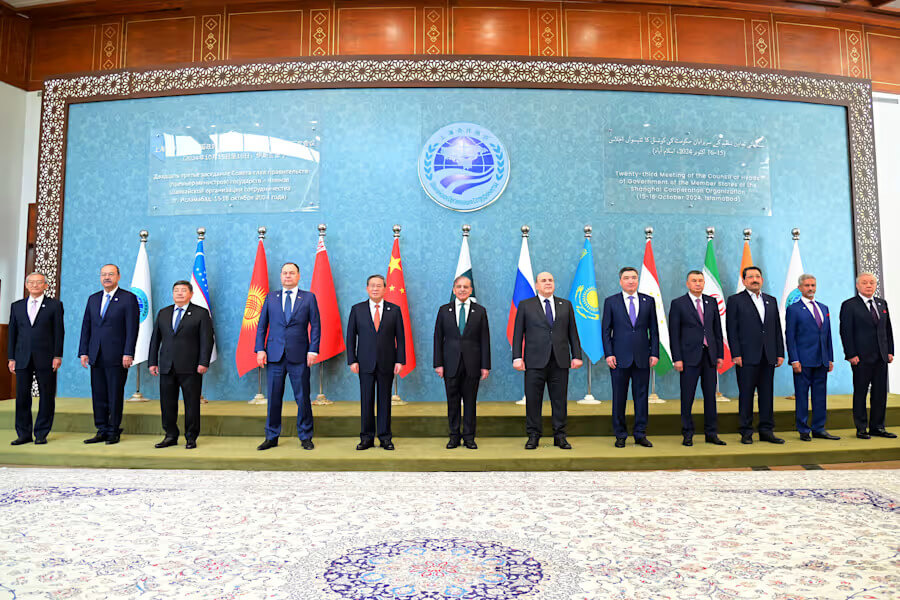
Elizabeth Threlkeld: A very warm welcome this morning or evening, whenever you’re tuning in from. My name is Elizabeth Threlkeld, and I am the Director of the South Asia Program at the Stimson Center in Washington, D.C. It’s a pleasure to have you all with us and to be joined by such a really outstanding group of panelists to do our best to unpack what truly was a consequential year in South Asia.
We titled this event South Asia 2025: A Year of Shocks and Shifts. And I think that, at least to my mind, encapsulates what we’ve just been through over the past 12 months or so. So, just for those of you who perhaps aren’t following as closely, and truly even for those of us who are, because I think it bears some recollection, everything that’s happened this year, I will kick things off by running through truly just the highlights of what we’ve seen, and then we’ll get to dive deep over the next hour with our panelists.
So 2025 was a year that saw seismic shifts in the geopolitical landscape of South Asia. We had a youth-led protest movement in Nepal that overthrew the nation’s government. Meanwhile, the after effects of similar movements in Bangladesh and Sri Lanka continued to be felt. Regional alignments also shifted, with India-Afghanistan, Bangladesh-Pakistan, and India-China ties warming. And tensions between erstwhile allies, Pakistan and the Taliban, meanwhile, boiled over into kinetic conflict.
2025 also witnessed the most significant conflict between India and Pakistan in decades, when the two nuclear armed adversaries tested the limits of conventional fighting under the nuclear umbrella and drove U.S. diplomatic intervention to secure a ceasefire. Washington’s relationship with New Delhi soured in the aftermath of the crisis, alongside tensions over trade and ties to Russia, while U.S.-Pakistan ties enjoyed an unexpected boost buoyed by counter-terrorism cooperation, investment potential, and engagement in the Middle East.
So with all of that, what are the implications of these developments domestically, regionally, and globally? We are so fortunate to be joined by three experts who will help us break down the key takeaways from 2025 and look ahead for what the coming year might hold. I have to say, my crystal ball is looking a little bit hazy these days, so I’m looking forward to learning from all of you. Quick introductions are in order, though I’m sure our audience is familiar with those of us joining on the screen today.
So first, Suhasini Haidar is the Diplomatic Editor at The Hindu in New Delhi, where she regularly covers foreign policy and hosts the weekly show, Worldview. With a 28-year career, she’s reported on conflicts in regions like Pakistan, Libya and Syria, and covered India’s foreign affairs beat extensively. She previously served as foreign affairs editor and primetime anchor for CNN-IBN and worked for CNN International. She is the recipient of multiple awards, including the Prem Bhatia Award for print journalism.
Also joining us today is Kamran Yousaf, who is himself a senior journalist with two decades of experience working for both print and electronic media. He’s the host of the popular show, The Review on Express News, and writes for the Express Tribune in additional to international outlets. He covers Pakistani politics, foreign policy, and national security issues.
Last but not least, we have Nilanthi Samaranayake, who is a Washington D.C. based analyst, author, and speaker who serves as an adjunct fellow at the East-West Center. Her research focuses on U.S. strategy, the Indian Navy, and great power rivalry involving small states. Previously, she was a former visiting expert at USIP and an adjunct professor at the NESA Center. She also directed CNA’s strategy and policy analysis program and analyzed public opinion for the Pew Research Center. She writes and speaks widely on national security with analysis appearing in Foreign Policy and The New York Times.
So a very warm welcome to all of you. And to kick things off, I thought we’d do a lightning round of sorts. So, with all of the twists and turns this year in South Asia, I’d like to come to each of you briefly. What is the development that most surprised you in the part of the region that you focus on? Why and what are the implications you’re following? So Suhasini, I’ll come to you with that first.
Suhasini Haidar: Well, I think you spoke about twists and turns and shock, and I don’t think anything can compare to the impact of Trump shock. Not just because of what Trump’s new administration, the Trump 2.0 administration has done in terms of actions in the last year, but in terms of what New Delhi was expecting.
So, the Indian government went into this year with a huge kind of optimism and almost a buoyancy. I remember at one point, External Affairs Minister Jaishankar being asked, “How do you feel about this incoming presidency?” And he said, “I know that there are concerns in the rest of the world, but in India, we feel pretty comfortable.”
So India almost saw itself in the lines of a Trump whisperer. They had dealt with him successfully in his first term, so there seemed to be no reason why we couldn’t pick up where we left off. And just what we saw right at the beginning, the foreign minister, external affairs minister made two trips, one in December, one in January, met with people in the Trump ecosphere, if you like.
And then he was there for the swearing in, for the inauguration. He attended the first Quad foreign minister’s meeting with Marco Rubio. A month later, Prime Minister Modi becomes one of the first leaders to meet with Trump in the White House, and then things start to just go off the rails.
And very quickly, if I could just give you a sense from Delhi of the kind of parts of Indian security and dependence, or the idea that there was a certain stability coming, that Mr. Trump’s policies have really shattered. The first is economic security. So the idea of the tariffs and the trade, and the H1B, and the clampdown on immigration, and as a result, remittances for Indians and all the other measures is just one part of it.
His relationship with Pakistan that is new, and also the kind of almost amorphous relationship with China. We still don’t know where it will land, but looking at the national security strategy, we certainly know this is not Trump 1.0. So the regional security implications for India in a place where Pakistan and China are it’s two biggest challenges, saw them seeming to really come together during the Operation Sindhoorconflict. That’s another big worry.
Trump’s position on Indo-Pacific security, making defending Taiwan a goal, but not by any nature saying that, “This is what the U.S. is going to lead as an operation,” talking much more about what everyone else can do in the Indo-Pacific. And finally, on energy security, by no means small to put a surcharge of 25% on India’s procurement of Russian oil.
This is a president who already forced India in his first term to give up Iranian oil, to give up Venezuelan oil. Now, he is virtually making India give up Russian oil. It’s already down a third, I think by the end of December, possibly more. It just gives the sense that you cannot be sure of what your energy inputs are going to be if there is one country that is constantly going to demand different sacrifices from India, if you like. So I’ll stop there.
Elizabeth Threlkeld: That’s really helpful, and we’ll have a chance to dig in a little bit deeper into much of what you mentioned. Kamran, I want to come to you. Same question. What was most surprising to you?
Kamran Yousaf: Well, I think 2025 was certainly an eventful year, and usually as journalists, we often use this word eventful. And sometimes those events are not really eventful, but certainly 2025 was eventful. So many things have happened. But if I were to pick really one major development, I think how Pakistan’s strategic profile has risen from being oblivion or diplomatically isolated to, again, being relevant, whether it is in South Asia or even in the Middle East.
And I believe that nobody, even Pakistan’s staunchest supporter could have written a script that relationship between Pakistan and the United States under President Trump would really improve to the extent, where I don’t think so I can recall that any U.S. president previously praised Pakistani civilian and the military leadership so much, and it has a domino effect.
For example, because that at the moment Pakistan and the U.S. are aligned, though it may be temporary, we have seen how Pakistan and Saudi Arabia signed a defense pact, and other U.S. allies really warming up to Pakistan. This was certainly, I believe that many, I think, analysts and observers and even myself never predicted and could never predict that. And I believe that is something that we need to watch out for.
And of course, on a side note and on a lighter note, this year, another incident or event really stood out for me, that the Indian High Commission here in Pakistan has done away the practice of sending Diwali sweets to their Pakistani friends. This also indicates, this may be inconsequential, but that really indicates or highlights the level of relationship currently between the two countries, that now two neighbors are doing away with the normal courtesies even.
Elizabeth Threlkeld: Yeah, that’s a really interesting anecdote of how deeply this is felt and how much things have changed. Nilanthi, how about on your end? What was most surprising?
Nilanthi Samaranayake: Sure. Thanks, Elizabeth, for the invitation to be here. I’ll share my personal views today. I think among the smaller South Asian countries that border India, the Nepal protests, as you mentioned, and the ousting Prime Minister K.P. Oli was a really a standout moment for the region. Why? Well, because last year we saw a similar occurrence take place in Bangladesh with the mass protests ousting of Sheikh Hasina.
And then in 2022, we saw a similar development with the mass protests and ousting of President Rajapaksa in Sri Lanka. So, these aren’t necessarily isolated occurrences, but suggest a pattern that’s going on within the smaller South Asian countries. Also, the cyclone that struck Sri Lanka, not surprising because Sri Lanka deals with these environmental challenges, but the sheer scope of the disaster and what we’re seeing now in terms of the international delivery of assistance.
I’ll make a case though for the dog that didn’t bark, essentially Maldives under President Muizzu. The fact that relations have been so strong between Maldives and India has been surprising to me when you consider just how difficult relations were when he entered office, and the dispute over the operation of surveillance aircraft. And also, when you consider the reports of a Chinese survey ship that visited Maldives and also a Pakistan naval ship that visited, but none of that created a media uproar.
None of that has disrupted the very positive relations that Maldives and India have had, which included in the past year, Prime Minister Modi’s visit to Maldives to celebrate the 60th anniversary of Maldives’independence. In terms of implications, I think this suggests a successful case of a smaller South Asian country in terms of figuring out how to approach its relationship with India and really how to seemingly assure India of its intentions.
Elizabeth Threlkeld: That’s a great point, Nilanthi. There’s so much that’s gone on. We also need to focus on some of the things that haven’t grabbed as many headlines that are somewhat surprising. All right. So for our audience tuning in from around the world, I should say we will be taking question and answers towards the end of our discussion today.
So please do put your thinking caps on and come up with questions. You can input them through the Q&A function in Zoom. I will take our panelists through a few more questions, drilling down on their views on the region, and then we’ll come to audience questions.
So Suhasini, I want to come back to you and really drill down on India’s foreign policy over the past year. You just so well articulated the surprising turn of events in the India-U.S. relationship. We’ve also seen a thaw with China, though as you say, it’s still somewhat tentative, renewal with Russia after President Putin’s visit.
But a question that I’ve been thinking about, particularly given India’s longstanding focus on maintaining strategic autonomy, having an egg in multiple baskets, I wonder how different India’s approach is today than it would have been had things remained more positive with Washington, on an even keel. So in other words, have there been any real concrete steps this year that could meaningfully change or shape India’s future direction?
Suhasini Haidar: Well, I think Elizabeth, there’s no question that India still, at least in terms of statements, stands by its position of strategic autonomy. Of various synonyms that we hear, which are some are euphemisms, some don’t exactly mean the same thing, but we hear them being spoken about. Non-alignment is no longer spoken about, but certainly our policy planners, our foreign policy heads will speak about multi-alignment, multipolarity, strategic autonomy, and the idea that India is going to have to just diversify and find new partners, and also that the world itself is moving to a different place. We’re moving from the idea of the American uni-polarity to an area of many poles, and India does not like the idea of the world heading back into the Cold War.
Now, what does that really mean on the ground? In the last year, as I said, the Trump shock was there. Kamran pointed out the Pakistani reaction to Operation Sindhoor and the India-Pakistan conflict. Certainly for India, on the Indian side, there’s been a sense that this may have been a military success, but there were diplomatic disappointments in terms of not just, as I said, the support that India, so China give Pakistan, but also other countries, like Turkey, like Malaysia diplomatically, like the fact that the neighborhood came really out in solidarity for India after the Pahalgam terror attacks, but we didn’t hear so much after the conflict. What happened with Saudi Arabia and Pakistan a few months later signing a mutual defense pact, and other Gulf states as well.
So we’re seeing India doing a kind of reassessment of just what its diplomatic messaging has to be in this case, because it is clear, it is established that when it comes to terrorism, India will get the support of nearly the entire world. But when it comes to a conflict with its, as we keep saying, it’s nuclear empowered neighbor, there is not so much appetite for that. And within even 24 hours off that escalation, we started to see the rest of the world get involved, come closer. So there has to be a recalibration of how India wants to keep its diplomatic message going.
With Russia and with China, it’s a difficult one. And next year, and we can talk about this later, India will host the BRICS Summit as well. So India is very firmly in this SCO, BRICS sphere as well, but the question is, India is always seen as a kind of laggard even there. So if it’s seen by the Western states as a country that is not really getting on board, also by many of these states that don’t see India taking the tough positions. India refused, for example, to join an SEO statement on Iran when Israel attacked Iran. Later, of course, there was a change in that position when it came to the BRICS statement, which was more or less the same on Iran.
So we are seeing India running with these half measures. Yes, Mr. Putin was in Delhi, but we didn’t really see the big ticket defense deals or nuclear, or space cooperation, or anything slightly strategic that could be expected to get antennas up in the West. Some of it is because India’s in the middle of a lot of very, very difficult, complex free trade agreement negotiations, all of which are coming to a head right now, and may spill into 2026. And therefore, it has to keep this balancing act going.
Finally, I think India’s own concept of its neighborhood, and even if you cut out the Pakistan problem area, does mean that there has to be a constant attention on the neighborhood. Nilanthi reeled off this entire list of things that happened with Sri Lanka, the Maldives, but the uprising in Nepal was surprising for India, and it was something that made Indians pause again as we saw the Gen Z that came out on the streets are not necessarily great fans of India either. And we see the problems building with Bangladesh. A lot depends on those elections next year. And then there was the new rapprochement with the Taliban. That too is something we can speak about. But I genuinely feel there is a sense now that India is looking for friends and shoring up the friends it has, and perhaps not as secure of its foreign policy as we have heard it being in the last few years.
Elizabeth Threlkeld: No, it’s really interesting, and a time of flux in so many ways. Kamran, I want to come to you almost for the other side of that coin, right? From a Pakistan that had perhaps fewer friends or at least more questions than answers this time last year. Now, as you’ve mentioned with the deepening relationship with Washington and continued ties to Beijing, I wonder about the balancing act that Pakistan is seeking to walk between the two.
So on the U.S. side, you detailed it so well. Obviously with China, we saw Pakistan’s use of Chinese weapon systems in the May conflict with India. And putting both of those together in the context of, I think what are some continued questions about how both Washington and Beijing are approaching their relationship with each other. From Pakistan’s perspective, how sustainable would you say is the balancing act between these two great powers, and how has Islamabad sought to manage its ties with both sides over this year?
Kamran Yousaf: Well, this has remained a major, I think, headache for policymakers, but I think over the years, if you see Pakistan’s history, they have successfully managed that delicate balance. And we also understand the approach of both China and the U.S.. U.S. probably is vary of Pakistan’s close relationship, strategic relationship with China, and they certainly would always warn that Pakistan does not get too close to China where U.S. interests are heard, but we have to also understand how China see all these relationship.
I think if you talk to the Chinese officials and their experts, they are always welcoming any rapprochement or any reset in the relationship between Pakistan and the United States. And given the fact that it was Pakistan that first opened that diplomatic channel between the U.S. and China way back in the 1970s, so they always look at it from this perspective.
And even after the recent reset or unprecedented reset between Pakistan and the Trump administration, I was able to speak to a few of the Chinese officials, so they were not concerned too much. They believe that as long as Pakistan’s relationship with the U.S. do not hurt Chinese interests, they are perfectly fine with that.
In fact, they always advocate that Pakistan should have good relationship with the U.S., as this is the policy of China, because China also trying to pursue a better relationship with the U.S. despite all the challenges that they are facing.
So given the history, I always believe that the Pakistani policymakers are pretty confident that they can manage these relationship. And why? Because Pakistan believe that they should have good relations with all the big powers, whether China, Russia, or the United States.
China certainly, as you mentioned, how Pakistan now heavily dependent on Beijing when it comes to Pakistan’s defense needs and other strategic objectives. But at the same time, we have to accept that the U.S. still controls the global financial system. We are still under the IMF program. We certainly need support of the U.S..
And importantly, I think what we saw earlier this year, the conflict between India and Pakistan, Pakistan believes that the only country that can play a role or prevail upon India or the two countries, or deescalate the situation, it is not China, it is rather the U.S..
So certainly for these kind of support and those things, Pakistan need the good relationship with the United States, and for long-term strategic objectives, they would look up to China. And I believe so farthey are managing this relationship well.
And also, given the fact that President Trump himself seeking a reset in the relationship, the recent meeting between President Xi and President Trump is also seen as a positive sign, and the next year both may be taking reciprocal visits.
So Pakistan hopes that while so much focus is on Pakistan navigating relationship between the two big powers, the two big powers eventually join hands or try to figure out their differences so that make their life, Pakistan’s life much easier.
Elizabeth Threlkeld: Thanks, Kamran. Nilanthi, coming to you and zooming in a little bit on what you laid out in your remarks earlier in terms of this almost domino effect that we’ve seen of Gen Z protests across the region, I want to ask more of a comparative question.
So what parallels do you see across this wave of youth-driven unrest in South Asia? And specifically, what lessons can policymakers in states, either that have been impacted or those that haven’t, learn from the protests?
Nilanthi Samaranayake: Sure. Yeah. Nepal is the third of the five smaller South Asian countries since 2022 that has experienced this type of domestic upheaval. And of course, all of those countries are unique on their own terms, but we can see a few factors across them. But you mentioned the youth factor. That was certainly the case in Nepal and Bangladesh.
In Sri Lanka, the protests were on a much more mass scale, but also corruption among the elites, dissatisfaction about low prospects for jobs, especially among the youth, the role of technology and social media in also advancing the comments, the commentary about the discontent and coordination.
Two factors that I’m studying are really at the structural level, international and regional levels, really thinking about how the factors of economic transition in the international financial system and great power competition can actually have effects at the domestic level in terms of instability.
So in terms of economic transition, certainly there are economic challenges in Nepal, but over the decades, Nepal is actually on the positive side of the success story here. When we think economically and poverty reduction in 2020, it actually graduated from low income status, according to the World Bank, to lower middle income status. It’s also set for late next year to graduate from the least developed country status. And incidentally, Bangladesh is also in that same position as well late next year.
But I think of this, despite this economic success, there’s the price of their success, and because of this new economic category and transition, they have less access to assistance and less favorable terms when it comes to trade and loans.
So the second factor is really just major power competition, where you see for these countries, development, economic development and growth are really the top priorities. However, there is the politicization of development, infrastructure, where we see this because of the tensions between these large powers.
So some examples are China’s Belt and Road Initiative in Nepal. We’ve seen the politicization of infrastructure development there. Also, the U.S., it’s Millennium Challenge Corporation Compact with Nepal and the politicization of that project.
We’ve got elections scheduled in Nepal in March, and Nepal can certainly look at the experiences of Sri Lanka and Bangladesh because they’re a bit further along in terms of their journeys in experiencing domestic upheaval.
Suhasini’s point about India right now looking for more friends is interesting because that could actually be a factor that could mitigate some of this complex tension and dilemmas that those smaller South Asian countries are facing with regard to major power rivalry.
Elizabeth Threlkeld: That’s really helpful. Thanks, Nilanthi. Suhasini and Kamran, I want to dive into a topic that is clearly on the minds of our audience. I’m actually going to be folding in a couple questions from the audience here, but that is the May conflict between India and Pakistan, which has come up a few times already today.
So Suhasini, I’ll start with you. And from my perspective, certainly was following this closely here from Washington, and this was a conflict that crossed multiple thresholds as compared to previous crises and raised real concerns in Washington, as we’ve seen, over-escalation risk between these two nuclear armed states. And as you’ve noted, President Trump has repeatedly claimed credit for mediating a ceasefire between the two sides, to the apparent frustration of Prime Minister Modi’s government.
And so I think a question in all of this, and particularly drawing on Kamran’s comment about, from Pakistan’s perspective, the unique role that the U.S. can play in bringing about a ceasefire. If we are to see another crisis during this Trump administration, how do you think India might respond to efforts to manage the crisis from the U.S., and what might that mean in terms of finding off-ramps from escalation?
Suhasini Haidar: Elizabeth, I have to say in the world we live in, one can be forgiven for quickly forgetting what has happened in the past. The truth is, the U.S. has been involved in conversations with both India and Pakistan every time the temperature goes up, that’s not something new. In 2019 when India and Pakistan, we saw India attack Balakot with the aircraft positioned over the LoC, and Pakistan then hit back and then an Indian plane fell inside Pakistan. An Indian pilot was captured there and then finally he was released.
People seem to forget that it was Mr. Trump who announced that the pilot would be released by the Imran Khan government long before the government said it or long before the Indian side accepted knowledge of it. So this was not something new, even so to have Mr. Trump announce a ceasefire half an hour before the Indian government had a chance to get to the press conference and do it, certainly was irksome for the government.
It didn’t play well domestically, it didn’t play well politically. It made it very difficult for India to make the point that this was a ceasefire that was negotiated between the two countries, and it was a ceasefire that India said Pakistan had asked for after India’s last round of hitting. So now to your question, what happens the next time?
I don’t think that there is a question that if, and we certainly hope there isn’t another conflict, but if there is another conflict, that the U.S. would get involved once again, for whatever reason, including its new relationship with Pakistan, the critical minerals inside Pakistan that Mr. Trump was shown a model of and seemed to be very interested in. Or whether it will be about this kind of track record of being part of helping find solutions with eight different conflicts leading up to the possibility of a Nobel Peace Prize. Whatever it is, it seems quite clear that the U.S. would get involved.
And while nobody officially would ever accept it, I definitely think that the difference in the way New Delhi went about its reaction to the Delhi blast that we saw last month that involved, allegedly, a radicalized group of Indians, some of them from Kashmir, some from outside Kashmir, with fertilizer that essentially was explosive. The government’s reaction was so measured, I think because they didn’t want it to get to that next step, and they didn’t want to unnecessarily walk into an arena where then you can’t necessarily stop the escalation ladder.
And so I think what we have seen is the ability of these situations to be contained when necessary for the narrative with a very difficult Indian media, as everyone says, being able to reign them in or reign themselves in and not necessarily straightaway put the blame anywhere. Instead, we saw an inquiry take place and the inquiry is still ongoing. And so far, it does not seem like it has reached the kind of levels that the Pahalgam attack had. Of course, the difference in the attacks also makes a huge difference to that, and the clear indications that the Pahalgam attack did have support from Pakistan as opposed to this one.
I think there are two more things involved here, Elizabeth, about the future, is that the government has now shown a certain pattern of escalation. So in 2016, when the government hit back after the Uri strikes on Indian soldiers across the LoC, the government kept it contained to the line of control, and it was essentially an army operation of going in and coming out. And Pakistan denied that anything had happened on the lines, and so neither side really had to take it very forward. In 2019, as I’ve just described, the escalation happened very fast over air force operations, and then it was brought down. But at that time, the Indian government actually bombed a part of Pakistan that was not a disputed territory. This was not a cross LoC operation. This was now a target in KPK, in Khyber Pakhtunkhwa.
In 2025, we see the next level, which is essentially the bombardment of terror targets, not just in that side of Kashmir, Pakistan-occupied Kashmir, but in other parts of Pakistan as well. And also then followed by once the Pakistani military responded, attacks on Pakistani military basis across the country. So the question now is what would the next escalation look like? I think there’s a lot of food for thought there. What we know is Prime Minister Narendra Modi has put out what he calls the new normal, and the new normal consists of three definite lines. Now, how they are going to deal with it is something I think even in the U.S., they must be reading this very closely.
Those three lines are every next act of terror will be seen as an act of war, without explaining exactly how large the attack has to be. Every act of terror will be an act of war. The second, that we will not bow to nuclear blackmail. In other words, the fact that both our nuclear capable nations will not deter India from taking action. And the third, that India will not differentiate between terror targets and the targets involving their supporters or backers. Now, those are very difficult lines. So, I think the next one will be watched very closely, and there’s no question in my mind that there will be some kind of not just crisis management, but stopping the conflict in a sense, efforts from the West.
Elizabeth Threlkeld: Thanks, Suhasini. And Kamran, coming to you with this question of what the next time might look like, I’m curious from Pakistan’s perspective, what would you say are the most significant lessons that are being learned out of this May crisis?
And bringing in one of our audience questions, we’ve had a lot of interest in the recent structural changes following amendments to the Army Act and the 27th Amendment in Pakistan. So, help us understand how might the recent structural changes that we’ve seen in Pakistan’s military, which saw Field Marshal Munir named Chief of Defense Forces, impact Pakistan’s response to a future crisis?
Kamran Yousaf: Well, in terms of the lessons that Pakistan must have learned from what happened in May, I think there are certainly many lessons. For example, although Pakistan do say that they were able to shoot down certain number of Indian fighter jets, but of course, given the fact that India managed to hit missiles deep inside Pakistan, even on the 6th and the 7th May, and then of course after that.
So there are, of course, certain questions regarding the air defense system of Pakistan. Of course, that Pakistan needs to look at, and they are already working on it. For example, that they have now created the Rocket Command Force, which indicates that in future there may be more such conflicts where both countries can exchange missiles, but in order to avoid any confusion, this army Rocket Command Force will actually separate the nuclear weapons from the conventional weapons.
Then the structure that you talked about, so they have abolished the chairman joint chiefs of staff position, which is in any case was a figurehead and a ceremonial post. And instead, now they have created a new post, the Army Strategic Command Force. That probably will be more powerful to align with the current realities.
And as far as the overall structure is concerned in Pakistan, as you know that the army chief always calls the shot among the three military services, chairman joint chief of staff has always been a figurehead. So, they actually, through these amendments, that reflect more of a reality.
And also the other day when the field marshal and the army chief inaugurated the new chief of defense forces headquarters, he did talk about, rather warned India that next time if India tries to do quote, unquote, “Any misadventure,” Pakistan’s response will be more swift.
So, from Pakistan’s perspective or Pakistan’s army’s perspective, this creation of the chief of defense force will have more synergy whenever they want to respond to any further escalation with India. And it also suggests that Pakistan is not ruling out the possibility of the such events in the future.
But also, let me add here, probably I think this conflict we can debate, and this will be debated years to come, but some of the other, it appears that it proves to be a blessing in disguise for Pakistan, even for the military leadership, how then he was elevated as a field marshal.
And even many Pakistanis, I just returned today early morning from Doha, and there was a huge number of Pakistani expats are there. And many people were talking about this thing, that before this conflict, many Arab countries, though historically they were Pakistan’s friend, they were taking us for granted.
But that May incident, the way perception was created that Pakistan managed to resist the bigger neighbor, the bigger country in terms of their influence, the size. Now, the Arab friends are not taking it for granted. So on many fronts, Pakistan, of course, has gained a lot from this thing.
And many people feel that Pakistan may be politically weak, may have economic vulnerabilities, but when it comes to the military, they are still a force to be reckoned with. So these are, I think, the positive takeaways, but it depends.
I think the other factor, and quickly I will close my discussion here, that complacency, I think, is the key that Pakistan needs to watch out. Of course, next time, if there is a conflict, India probably will be better prepared.
This time, of course, they probably were not prepared. So, I think Pakistan needs to be careful that they should not be complacent, because if there’s a next, any conflict, India will be better prepared and Pakistan needs to respond it accordingly.
Elizabeth Threlkeld: Thanks, Kamran. And also, realistically, expectations are going to be higher after this last crisis, too. I think that’s a great point. Nilanthi, I want to come to you and turn our attention to the role of Bangladesh, which is fascinating. And I think it’s my mind a little bit understudied, at least here in Washington, so kudos to you for making us smart there.
But I wonder, how do you assess prospects for Bangladesh’s shifting regional ties as it explores greater cooperation with Pakistan while still managing its complex relationship with India, especially given the upcoming election in 2026?
Nilanthi Samaranayake: Sure. Well, from India’s perspective, the ousting of Sheikh Hasina was a significant development because overall, on balance, she was a good partner to India. So I think any leader in Bangladesh that somehow gives less than that level, it represents a risk to the stability that India had grown accustomed to for the past 15 years.
But from Bangladesh’s perspective, as a smaller neighbor with fewer capabilities, I think it’s trying to course correct, and trying to get back to a level of limited international engagement with Pakistan, diversify its international base of relationships. And I think we’ve seen some of this with Pakistan with trade, ship visits and senior leader visits.
The bilateral ties right now between India and Bangladesh are quite poor under the interim government. So I think thinking ahead to the elections are scheduled in February, I think India, we’ve seen it’s really shown a willingness to reach out to leaders in the smaller South Asian countries and cultivate relationships.
One example is last year with Dissanayake in Sri Lanka, that there was certainly concern about him and the JBP Party about their positions with regard to India, but I think Delhi understood that there was a chance that he could win the election, which he ended up winning.
So India had reached out to him well before the election and invited him to come to Delhi, and we’ve seen actually pretty positive Sri Lanka-India relations since he’s been in office.
For Bangladesh’s part, India is its most important bilateral relationship. Bangladesh’s growth and security really depend on having a stable and functional relationship with India. I think assuming all goes smoothly with the elections in Bangladesh, we certainly hope so, whoever the new leader is, I think they’re going to want to articulate their intentions with regard to Bangladesh’s international engagement, diplomacy, military engagement.
And I think they’re going to want to clarify really the extent of that engagement, the limits of that engagement with some of the countries that India has threat perceptions of, like Pakistan, like China.
And I think one template that we can look to in the smaller South Asian countries is Maldives under President Muizzu, as I mentioned before, where he seems to have successfully clarified the contours of Maldives’ international engagement and really seems to have assured India of Maldives’ intentions.
Elizabeth Threlkeld: Thanks, Nilanthi. So Suhasini, I want to come back to you for another memorable moment of 2025, which was the visit of Taliban foreign minister Muttaqi to India, which capped a remarkable uptick in ties between the two sides. Curious what you see as India’s foreign policy objectives vis-a-vis Afghanistan, and to what extent does Pakistan factor in?
Suhasini Haidar: Sure. And the visit by Amir Khan Muttaqi was definitely something we have not seen, unprecedented. Nothing like how India treated the Taliban during its 1.0 when it was last in power from ’96 to 2001. And then the announcements that we saw of India’s assistance to Afghanistan, the reopening of the trade corridors, which have to be by air since Pakistan is not being very helpful on that. In fact, it has really blocked India for years in trading with Afghanistan.
And also, in announcing that they would be exchanging high commissioners. Or certainly not high commissioners, excuse me, in announcing that they would be upgrading the missions on both sides. What is interesting is that we haven’t yet seen how that has turned out because we haven’t yet seen the officers on both sides being sent, because the next big question was, if India is allowing the Taliban to upgrade the mission here, would that mean a Taliban charge d’affaires affairs? Would that mean the Taliban flag flying on India’s Shantipath? These are all questions that would accrue from there.
But your question was more on why India is doing it. I think there are several reasons. The first is pragmatism. It is clear that Taliban has near control of Afghanistan in terms of security and doesn’t have an effective political opposition to it. The second, that given that a country like Russia, which India is close to, has already recognized the Taliban. And others have already upgraded the missions, allowed ambassadors to come in, like China, like Pakistan and Central Asian countries, a few Gulf countries have set up embassies. Even if the UN and the United Nations agencies don’t recognize the Taliban, India might find itself left out, cut out of the game in the region.
Another reason, of course, is the old Mandala concept, my neighbor is my enemy and my neighbor’s neighbor is my friend. And the tensions and the conflict between Afghanistan and Pakistan over the past year clearly means that for New Delhi. They are welcome allies to have right now, especially when Delhi feels squeezed otherwise on the neighborhood, particularly with Bangladesh.
I think India genuinely also wants to find ways to continue its humanitarian assistance. Hospitals, children’s hospitals across Afghanistan have been set up by India, have been funded by India, have been stocked by India. They don’t want to give up the ability to help with development projects, to keep the kind of work India did between 2001 and 2021 going so that the average Afghan who is benefited should not be hurt. And I think that is also a genuine reason.
Elizabeth Threlkeld: No, great point, Suhasini. Kamran, coming to you briefly now as we come to the end of our time, I wonder from Pakistan’s perspective. So, over the past year, we’ve really seen the cratering of Pakistan-Afghanistan ties, despite Pakistan’s longstanding support for the Taliban. Militant attacks within Pakistan have spiked this year, including a recent bombing in Islamabad.
Pakistan blames the Taliban, of course, for supporting the TTP, and has conducted strikes in Kabul and Kandahar as talks between the two sides seemingly remain deadlocked. So how would you say that Pakistan’s security strategy has evolved over the past year? And going forward, does Islamabad still believe that stability is achievable with the Taliban in power next door?
Kamran Yousaf: Well, if you allow me, I wanted to comment on what Suhasini was saying regarding the rapprochement, apparent rapprochement between the Afghan-Taliban government and India. That is quite fascinating, given the fact that we had very extensive discussions with Indian diplomats, Indian officials, and even journalists when we talked about the future of Pakistan-India relationship.
And India of late used to say that, look, that we are happy. We again sustain this policy of not talking to Pakistan, given the fact that our stature is now different. We are part of the G20 and probably we may join G7. But what happened, I think, during the last 12 months, now India portrays having talks or reaching out to Taliban as some kind of a diplomatic success. So that you can see a turnaround, the India’s foreign policy.
On the flip side, this is also a lesson for Pakistan because Pakistan invested on Afghan-Taliban for all those decades. Took the blame for playing a double game in the fight against terrorism, hoping that one day when Afghan-Taliban returned to power, they would look after Pakistan’s security interests.
And what were those security interests? That they would not allow the Indian influence in Afghanistan. And look what happened, that Pakistan, all the energy and the resources that they spent on Afghan-Taliban, and the Afghan-Taliban eventually apparently joining hand with India. So that is, of course, something that Pakistan needs to ponder.
But overall, I believe that what happened or what is happening between Pakistan and the Afghan-Taliban is not surprising. It is inevitable. And I think we can trace back this change to the change of the army command. I think the current army chief or the field marshal has a different take on Afghan-Taliban. He has actually changed Pakistan’s decades old Afghan policy towards Afghan-Taliban.
And clearly, the previous administration, though they had certain issues with that, but they were ready to following carrot and stick policy while negotiating with the Afghan-Taliban, but not going to the extent where a relationship really unraveled.
But here, I think the current security establishment or the government are ready to take that risk. And I believe, based on what I interacted with people, I believe that already I think both sides reached a point of no return. And I don’t see things are really returning to normalcy, at least unless there is some big miracle.
Elizabeth Threlkeld: We can always hope for that in 2026, but thanks for that assessment. And actually, that’s a good transition. Nilanthi, I know you’re going to have to depart a few minutes early, so I want to come to you first for our last round of Q&A here.
And certainly, an opportunity to add in anything that we weren’t able to touch on during the discussion, but particularly curious as well, what is one key trend in the region that you will be keeping an eye on in 2026?
Nilanthi Samaranayake: Sure. Essentially, the elections that are planned in Bangladesh and Nepal, essentially in February and March of ’26. Also, both of those countries are expected to graduate from least developed country status at the end of the year. And also, will they try to postpone that, just given the domestic upheavals that they’ve been facing? And also, Bangladesh and India, they are set to renew the Ganges Water Treaty, but whether that can come about, especially under a new government in Bangladesh, that’ll be important.
But then also looking at the new U.S. administration that’s in office, what those relations look like with the smaller South Asian countries. I think we’ve seen the tariffs headline pass, and Bangladesh and Sri Lanka, theirs landed on 20% because the U.S. is their most important export destination. But we’ve actually seen a mix of creative entrepreneurial spirits, and actually some outputs from each of the smaller South Asian countries that appeal to this administration’s business ethos and burden sharing appeal. SoI’m really curious to see how that continues to play out.
Elizabeth Threlkeld: Well, fantastic. Look forward to getting back together with you in the new year to keep an eye on those things. Thank you so much for joining Nilanthi. I really appreciate it.
Suhasini, I’ll come to you now with that same question. So anything that we left on the table that need to talk to you further, and what will you be keeping an eye on in the year ahead?
Suhasini Haidar: Well, the first quarter of the year is going to be focused on relationships with the Western world, and particularly trade relationships. We’re going to have a slew of visitors that German chancellor’s expected, the EU leadership, von der Leyen, Costa are expected, and they’re going to announce the free trade agreement, supposed to, EU-India Summit. There’s the AI Summit that many will watch very closely, French President Macron expected to come. In the next month, we’re expecting the Canadian Prime Minister as well. So a lot of Western visitors expected.
I think the two that will make a lot of headlines would be, of course, Mr. Trump, because India was supposed to host the Quad this year, hasn’t been able to. So will it be able to host it next year, perhaps when Mr. Trump actually goes to China, which would make it that much more interesting or not? So that’s one visitor.
The other one that was not really being expected, but has confirmed that he’s planning to come, although he is postponed his visit, is Benjamin Netanyahu. And Prime Minister Modi is next week in Jordan. It will be interesting to see if India takes back a kind of role in that crisis. India is not only expected to now host the Quad next year, but also the BRICS. So visits by Mr. Putin, Mr. Xi Jinping could just happen.
So these are all things to watch. However, we know that when relations are not at their optimum or there’s a lot of geopolitical turmoil, the multilateral summits tend to get short shrift, but like Nilanthi, we’ll also be watching very closely on the elections in the neighborhood.
Elizabeth Threlkeld: So it sounds like you have your work cut out for you in 2026. Look forward to staying tuned there. Kamran, what’s on your mind for things to keep an eye on going forward?
Kamran Yousaf: I think we need to watch out Pakistan, Afghan-Taliban relationship. I think 2026 will be very critical, and many things may unfold and will determine the future of Pakistan, Afghan-Taliban relationship.
And the second thing that we haven’t yet talked about, of course, that how Pakistan will play its role in the Gaza peace plan, because as you know, that indications are that Pakistan will be part of that international stabilization force. That will not be an easy decision because of domestic compulsions and other issues involved.
But given the fact that Pakistan is deeply involved in this process, and Pakistan really sees it as a benefit, given that if they get involved in this Middle East process more proactively, they can have more leverage with the Trump administration, also with other Arab countries. And I think we need to watch out for that, that if at some point Pakistan takes that decision, how it will manage its implications and many other facets that may involve.
Elizabeth Threlkeld: Great point, Kamran. Well, with that, we have reached the end of the hour. Though, I’m sure we could keep going for quite some time. Thank you both so much for joining us. Thanks to our audience at home for tuning in.
And please do keep following the Stimson South Asia Program’s work over the year ahead. We look forward to hosting many more discussions along these lines. Thank you all so much.





Community Adaptation for a Water Festival Without Clean Water