

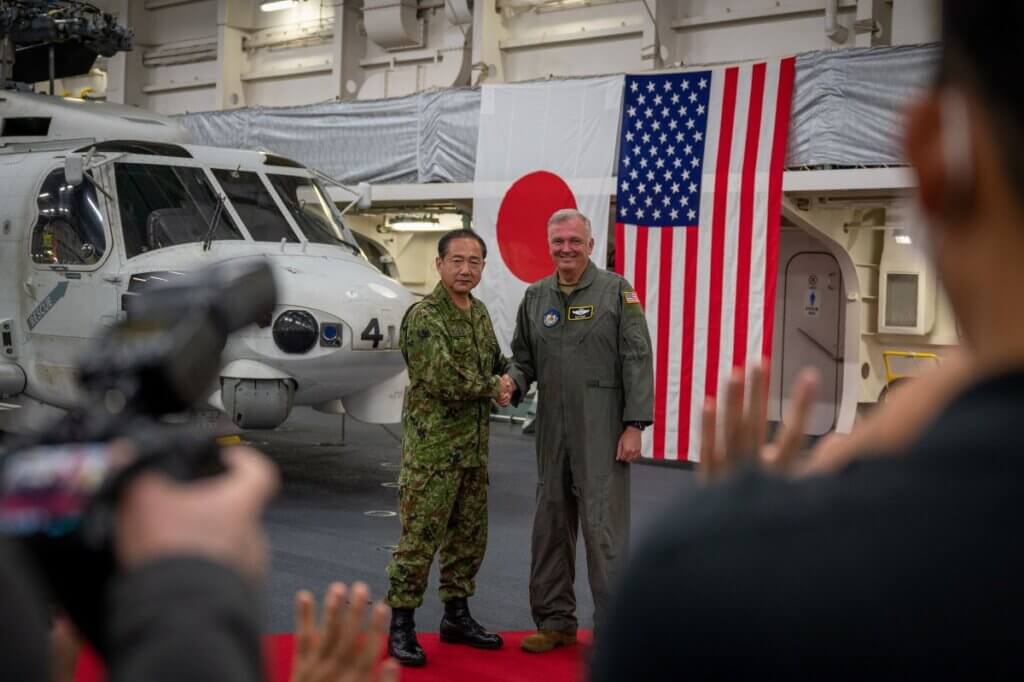
Editor’s Note: Since 2013, Stimson’s Japan Program has been collaborating with the Embassy of Japan in Washington, D.C. on a publication series Views from the Next Generation, a collection of essays by emerging Japanese policy experts on issues critical to the future of the U.S.-Japan alliance. With new leadership in both Washington and Tokyo, 2025 will be a pivotal year for the alliance as the two countries mark its 65th anniversary and the 80th anniversary of the end of World War II.
Between January and March 2024, Stimson recruited three next-generation experts to contribute commentaries on key issues for the alliance’s long-term health: the role of the U.S.-Japan alliance in a global context, U.S. congressional perspectives on Japan and the U.S.-Japan relations, and ongoing bilateral consultation on the command and control (C2) structure and coordination between U.S. forces and the Japan Self-Defense Force (JSDF).
By Yuki Tatsumi, Senior Fellow and Director, Japan Program
Essential Context
Emerging Domains Surface As A New Driver in Alliance Cooperation
After the end of the Cold War, the U.S.-Japan alliance evolved by adapting to the shifting geostrategic environment. Following the initial efforts to revalidate the importance of the alliance as the “cornerstone” of peace and prosperity in the Asia-Pacific region in the 1990s, the bilateral alliance continued to expand its scope and depth, and this effort continues today.
In recent years, technological advancements have increasingly driven U.S.-Japan cooperation, especially with respect to emerging technologies in domains including artificial intelligence (AI), space, and cybersecurity. For instance, the two countries look to expand collaborative research and development in these areas with applications across both the civilian and defense sectors as the Japanese government increases defense budget investments in these technologies.
In the space domain, the National Aeronautics and Space Administration (NASA) and the Japan Aerospace Exploration Agency (JAXA) are deepening cooperation on satellite deployments and space situational awareness, contributing to both scientific progress and regional security such as through efforts to address risks related to anti-satellite capabilities. Moreover, cybersecurity collaboration has intensified, with both countries sharing threat intelligence, strengthening coordinated response mechanisms, and enhancing the resilience of critical infrastructure across sectors.
Economic Security Increasingly Important for the Alliance
Along with emerging domains, economic security is another area that has become increasingly important in the U.S.-Japan alliance. After all, these two areas are closely related, and a joint effort aims to bolster deterrence, drive innovation-led economic growth, and ensure that technological advances benefit the economic prosperity of the broader Indo-Pacific region.
In particular, Tokyo and Washington have been focusing their cooperation on strengthening supply chain resilience by diversifying sources of critical materials and semiconductors. Through frameworks such as the Indo-Pacific Economic Framework (IPEF), Japan and the United States are also shaping inclusive trade and investment rules that reflect high standards of transparency, sustainability, and innovation. Furthermore, the two allies are enhancing technological cooperation, including joint research and development in emerging fields to address shared economic and security challenges as well as contribute to regional stability and prosperity.
Cooperation With Other Partners Driven By Shared Interests in the Indo-Pacific Region and Beyond
Another development in the U.S.-Japan alliance is pursuing broader cooperation and deeper coordination with other partners in diplomatic engagement outside the Indo-Pacific region.
Highlighting an increasing connectivity between U.S. allies in the Atlantic and the Indo-Pacific, the North Atlantic Treaty Organization (NATO) and the European Union (EU) have become key partner organizations for the U.S.-Japan alliance. In particular, in addition to Japan’s growing engagement with NATO, Japan has stepped up its cooperation with the EU to promote digital advancement and the cybersecurity sector, including the Japan-EU annual digital partnership dialogue and the U.S.-EU joint cybersecurity collaboration. These developments highlight the growing global cooperation on technological and cybersecurity challenges.
Outside the network of allies and like-minded partners, the stability of the Middle East is a critical shared interest for the U.S.-Japan alliance, given the region’s critical role in global energy supply chains. As Japan heavily relies on Middle Eastern oil and gas, the United States and Japan have jointly strengthened coordination with key producers like Saudi Arabia and the UAE to ensure a stable energy supply from the region. Amid regional conflicts, including the ongoing Gaza-Israel conflict, the United States and Japan also support diplomatic efforts to maintain regional stability, recognizing the direct impact on global economic and energy security that the region’s upheaval can cause.
Additionally, given Africa’s increasing importance for energy security, helping Africa strengthen its energy infrastructure aligns well with both the U.S. and Japan’s broader strategy to promote stability and economic resilience in the Indo-Pacific region and beyond. Japan, with its long history of leading an international effort to support economic development in Africa through vehicles such as the Tokyo International Conference for African Development (TICAD), has encouraged its private sectors to invest in Africa, as demonstrated by Mitsui & Co.’s Liquified Natural Gas (LNG) development project in Mozambique which is aimed at boosting Mozambique’s role as the natural gas supplier to global markets, including the United States. Meanwhile, the United States launched the Prosper Africa Initiative during the first Trump administration, which focuses on increasing investment in Africa’s energy sector, promoting natural gas exports, and enhancing access to energy in Africa. While the U.S. and Japan pursued these efforts independently, they highlight the shared interests of the United States and Japan and how their initiatives can complement each other in a mutually beneficial way.
Robust Defense Cooperation Continues To Serve As the Foundation for the Alliance
Defense and security cooperation remain a foundation of the U.S.-Japan alliance. Since 2022, Japan has been enhancing its defense capabilities following the release of the National Security Strategy (NSS), National Defense Strategy (NDS), and the Defense Build-up Program (DBP), while placing parallel emphasis on promoting dialogue and multilateral cooperation to prevent escalation and foster regional stability. In fact, the U.S.-Japan alliance-based trilateral and mini-lateral cooperative frameworks have served as vehicles to promote issue-specific cooperation with various like-minded partners in the Indo-Pacific region. Among the most successful are trilaterals including U.S.-Japan-Australia, U.S.-Japan-India, U.S.-Japan-UK, and U.S.-Japan-Republic of Korea (ROK). Most recently, the U.S.-Japan-Philippines trilateral has also been emerging as a new framework that could benefit the United States and Japan’s shared interest in sustainable engagement to support Southeast Asia in their effort to deter China from taking more aggressive measures in the South China Sea. These efforts complement Japan and the United States’ broader engagement through regional platforms such as the Quad and ASEAN-led frameworks, which focus on transparency, capacity-building, and crisis management across the Indo-Pacific.
Challenges
One of the most pressing challenges in the U.S.-Japan alliance is the difficulty of ensuring seamless coordination in responding to regional and global security challenges. While both countries share broad strategic objectives, their immediate security priorities do not always align. For example, Japan remains heavily focused on threats closer to its own territory, such as North Korea, Taiwan Strait contingencies, and regional deterrence in the Indo-Pacific. Meanwhile, the United States has been deeply engaged in global conflicts, including Russia’s war in Ukraine and the ongoing crises in Gaza, which require its more immediate strategic attention. This divergence in focus has caused gaps in how the two countries coordinate policy, making it potentially difficult for the alliance to demonstrate unified leadership in addressing simultaneous security challenges both regionally and globally.
Secondly, the growing expectation for Japan to shoulder a much larger regional security role presents a significant burden that the alliance has yet to fully resolve. Following Japan’s adoption of the NSS in December 2022, Japan remains firmly committed to significantly increasing its defense spending and enhancing its defense capabilities. However, questions persist regarding how much more Japan realistically can contribute, particularly when it comes to collective security operations, intelligence-sharing, and defense coordination in times of crisis. Furthermore, Japan’s constitutional constraints, which stem from the existing interpretation of Article 9—under which Japan’s ability to exercise its rights for collective self-defense is strictly limited—continue to complicate its ability to project force beyond its immediate territory. As Japan navigates these legal and institutional limitations, the United States should carefully calibrate its expectations to avoid overburdening its ally or generating domestic backlash within Japan. Resolving these ambiguities is crucial for strengthening the alliance’s credibility and effectiveness.
Thirdly, economic friction between the two countries poses another critical challenge that could undermine long-term alliance cohesion. While both countries have placed increasing emphasis on economic security cooperation, including supply chain resilience, industrial security, and mitigating economic coercion, notable policy differences have emerged. For instance, the United States currently levies a 2.5 percent tariff on imported Japanese automobiles and technology products, which has sparked concern in Tokyo about potential economic disruptions. Moreover, differing approaches toward decoupling from China have exposed a subtle misalignment in their economic strategies. While the United States has adopted more confrontational economic policies against China, Japan has maintained a more cautious approach, balancing economic ties with strategic competition. Without a clear consensus on economic policy, the U.S.-Japan alliance risks contributing to economic tensions that could weaken bilateral cooperation.
Finally, a growing uncertainty for the future of U.S. policy on the global agenda under the second Trump administration can present a challenge in sustaining U.S.-Japan policy coordination on global issues. For instance, how the two countries will continue to coordinate their development assistance priorities remains in flux following U.S. Secretary of State Marco Rubio’s announcement of foreign aid cuts, the decision to shut down the U.S. Agency for International Development (USAID), and the integration of the development assistance management into the State Department.
Policy Recommendations
Continue to Deepen Cooperation in Emerging Domains Including Cybersecurity
The U.S.-Japan alliance has a unique opportunity to bolster technological and cybersecurity capacity in the Indo-Pacific and Global South, further enhancing regional stability and countering digital threats. To achieve this, both nations could establish a joint AI and cybersecurity fund to support other countries in improving cyber defense and promoting responsible AI use. Additionally, the United States and Japan could intensify space governance collaboration through platforms like the United Nations Committee on the Peaceful Uses of Outer Space (COPUOS). Aligning space technologies with maritime security, disaster response, and connectivity efforts will enhance both national security and regional infrastructure. This approach will strengthen the U.S.-Japan alliance’s position while empowering partner nations to improve their technological resilience, creating a more secure, innovative, and interconnected global order.
Further Advance Dialogue-Based Regional and Institutional Frameworks
In the face of growing geopolitical uncertainties, the U.S.-Japan alliance ought to prioritize dialogue-based regional frameworks like the Quad and ASEAN-led platforms. These frameworks are key to fostering mutual understanding and trust, addressing both traditional and emerging security challenges, including cyber threats, health crises, and climate change. A dialogue-driven approach offers major bilateral benefits. For Japan, this offers an opportunity to lead in non-military areas like climate action and digital innovation. For the United States, a dialogue-driven approach reinforces its global leadership and commitment to multilateral diplomacy. By focusing on dialogue, both nations can strengthen ties with regional partners like South Korea, India, and ASEAN, fostering greater regional cooperation and creating opportunities for joint ventures in sectors such as infrastructure, disaster response, and cybersecurity. This approach will contribute to a more secure, integrated, and economically resilient Indo-Pacific, benefiting both the United States and Japan.
Promote Transparent Strategic Communication and Engagement in Alliance Management
As both nations navigate political transitions, particularly with the Trump administration and the Ishiba administration in Japan, maintaining institutional continuity and adapting to changing political contexts will be crucial for preserving a stable and credible alliance. This includes upholding regular high-level dialogues such as the “2+2,” sustaining trilateral and multilateral cooperation frameworks, and ensuring that alliance management remains guided by long-term strategic objectives rather than short-term political calculations. The current Trump administration has emphasized reciprocity and “America First” as its core foreign policy principles. In the words of Rubio, this is an approach that looks at all U.S. foreign policy issues with the question of whether a given foreign policy approach will make the United States stronger, safer, or more prosperous, as articulated in his confirmation hearing in January. It is essential for Japan to craft messages that resonate with these priorities while safeguarding its broader strategic interests. At the same time, Japan must continue to demonstrate how the U.S.-Japan alliance advances U.S. national interests, particularly in preserving regional stability, fostering economic prosperity, and driving collaboration in emerging domains.






Community Adaptation for a Water Festival Without Clean Water