
Executive Summary
Multilateral security agreements, like NATO and the Quad, have grown more relevant since the end of the Cold War, but the United States’ first multilateral security agreement has largely fallen into obscurity. Indeed, the Inter-American Treaty of Reciprocal Assistance (Rio Treaty), signed in 1947, has largely become a dead letter, despite technically remaining in force. The Rio Treaty was the first collective defense agreement based on the principle that “an attack on one is an attack on all.” Rio therefore served as the template for NATO and other Cold War-era alliances. It was invoked from time to time, but, with the notable exception of the Cuban Missile Crisis 1962, rarely used for its intended purpose: to block Soviet influence in the Western Hemisphere. Rather, the Rio Treaty functioned primarily as a mechanism for resolving intra-American disputes in the 1950s and 60s, and since then has been mostly ignored.
The treaty’s initial appeal derived from states believing (or pretending to believe) that their interests are aligned — Latin American states were drawn to Rio with loose promises that economic development assistance would follow, and a desire for legitimacy in the new post-World-War-II world order. The United States likewise favored the appearance of multilateralism institution via Rio, but in practice reserved the right to act outside of its remit.
The 1982 Falklands War, when U.S. support for Britain over Argentina, exposed the fundamental disagreements within the Americas. Since then, some Latin American states have turned to alternatives, like the Pact of Bogotá, while others have withdrawn from Rio entirely. Since 1982, the treaty has only been invoked twice — once after 9/11 and the second time during the 2019 Venezuelan crisis.
The Rio Treaty’s trajectory demonstrates that alliance efficacy and legitimacy depends on the sustained convergence of interests among member states. Despite renewed U.S. focus on the Western Hemisphere under the Trump administration, the treaty may persist as a dead letter – and perhaps be resurrected during crises – but have little lasting impact.
Introduction
The Inter-American Treaty of Reciprocal Assistance, more commonly known as the Rio Treaty or the TIAR (Tratado Interamericano de Asistencia Recíproca), was the United States’ first codified multilateral security agreement. Signed by 19 countries in September 1947,1The original signatories on September 2, 1947, were Argentina, Bolivia, Brazil, Chile, Colombia, Costa Rica, Cuba, Dominican Republic, El Salvador, Guatemala, Haiti, Honduras, Mexico, Panama, Paraguay, Peru, United States, Uruguay, and Venezuela. Inter-American Treaty of Reciprocal Assistance (Rio Treaty), September 2, 1947, https://www.oas.org/juridico/english/sigs/b-29.html. nearly two years before the creation of NATO, it was, in many respects, a watershed. The central principle of the treaty is that an attack on one member should be considered an attack on all. But despite the fact that the Rio Treaty set a precedent that subsequent Cold War pacts — like NATO, ANZUS, the Southeast Asia Treaty Organization (SEATO), or the Central Treaty Organization (CENTO) — followed, it has received far less attention. Indeed, although it is technically still in place, and most of the original signatories — including the United States — remain a party to it, the treaty is often overlooked or even dismissed out of hand. Some leading scholars of U.S. alliances dispute that the United States is even bound by its terms.2Jason Davidson explains that by the late 1960s, “the United States had stopped treating the Rio Pact as a security guarantee.” See America’s Entangling Alliances: 1778 to the Present (Washington, DC: Georgetown University Press, 2020), 224, fn 10.
This paper reviews the Rio Treaty’s origins and its progressive decline — and considers whether it is relevant today. Between its signing in 1947 and the Falklands War in 1982, the treaty was invoked multiple times in response to various crises in the region.3Wilder Alejandro Sanchez, “TIAR 2.0: Breathing New Life into a Cold War-era inter-American Defense Treaty,” Geopolitical Monitor, last modified April 9, 2021, https://www.geopoliticalmonitor.com/tiar-2-0-breathing-new-life-into-a-cold-war-era-inter-american-defense-treaty/. The treaty language was relatively vague, which made it broadly applicable; rather than acting solely as a collective security agreement protecting the Americas from external threats, it also became a channel for settling intra-hemispheric disputes.4Justina Uriburu, “Organizing Peace in the Americas: Collective Security versus International Adjudication,” Journal of the History of International Law / Revue D’histoire Du Droit International 25, no. 4 (2024): 612, https://doi.org/10.1163/15718050-bja10101. Since 1982, however, the Rio Treaty has fallen mostly into disuse. In fact, it has been invoked only twice since that time — once following the September 11 terrorist attacks, and subsequently during the 2019 Venezuelan presidential succession crisis.5 “Meetings of Consultation of Ministers of Foreign Affairs,” Organization of American States (OAS), https://www.oas.org/council/MEETINGS%20OF%20CONSULTATION/minutes.asp; “RC. 30/RES. 2/19: the crisis in the Bolivarian Republic of Venezuela and its destabilizing effects on the hemisphere (Adopted at the plenary session held on December 3, 2019),” OAS, last modified December 3, 2019, https://www.oas.org/en/media_center/press_release.asp?sCodigo=S-027/19. This paper explores whether the United States’ first-ever multilateral security pact has become, for all intents and purposes, a dead letter, while other treaty alliances have endured or even grown in importance. It finds that the Rio Treaty, including its core function as a defensive alliance among states in the Western Hemisphere, came about because of a convergence of interests at a critical period in time, but it stopped being effective when those interests diverged and the geostrategic context changed.
Origins of the Rio Treaty
During the first 150 years of U.S. history, the country’s leaders stubbornly resisted efforts to bind the United States to other states. Their approach was informed by President George Washington’s Farewell Address, in which he warned the new nation to “steer clear of permanent alliances.” Independence was prized above all else; self-reliance was the watchword.
World War II changed all that. The sense that geographic distance — and water — would afford the United States the same level of protection as in the 18th or 19th centuries was shattered on December 7, 1941. Even before the attack on Pearl Harbor, however, U.S. merchant ships contended with German submarines intent on cutting off supplies to Great Britain. Other wartime innovations, including long-range bombers and even early rockets, figuratively shrank the Atlantic and Pacific “moats” that had guarded the country for most of its history.
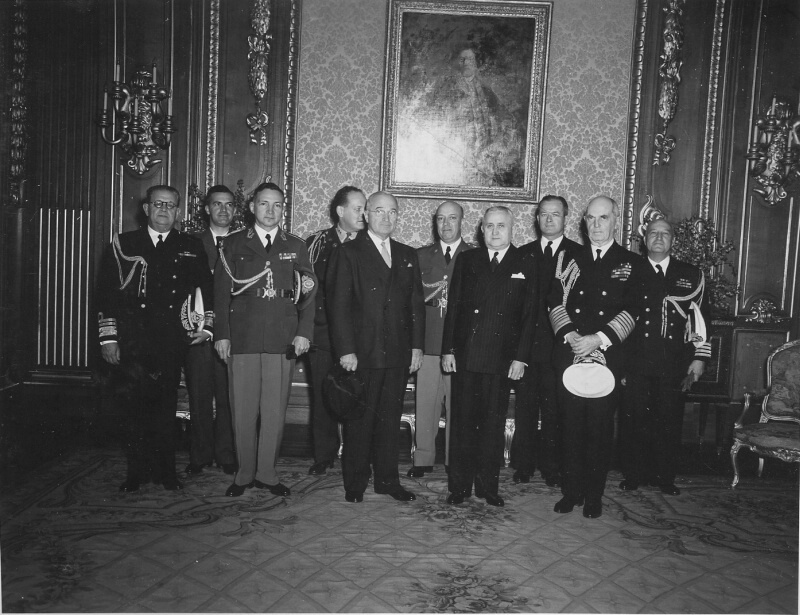
During World War II, U.S. leaders imagined ways to assemble a collective defense of the Western Hemisphere. These efforts bore fruit in an agreement signed in March 1945 in Chapultepec, Mexico, which committed the United States and other parties “to joint action to repel aggression against any American state.”6Davidson, America’s Entangling Alliances, 83. Emboldened by successful multilateral cooperation after the war ended, U.S. leaders pushed for something more binding.
Beyond merely addressing the anxiety created by World War II and the emerging Cold War, the United States had other reasons for seeking to establish a collective security agreement in the Americas. Some policymakers wanted to move past the paternalistic Monroe Doctrine, and Theodore Roosevelt’s Corollary, which opened the door to U.S. military interventions, leadership coups, and counter-coups throughout Latin America in the first three decades of the 20th century.7The Monroe Doctrine, first articulated by President James Monroe in 1823, is a U.S. foreign policy that opposes European colonialism in the Western Hemisphere. It holds that any intervention in the political affairs of the Americas by foreign powers is potentially hostile against the United
States. “Monroe Doctrine (1823),” National Archives, https://www.archives.gov/milestone-documents/monroe-doctrine. President Theodore Roosevelt expanded the Monroe Doctrine in his annual messages to Congress in 1904 and 1905. Roosevelt’s Corollary states that not only were the nations of the Western Hemisphere not open to colonization by European powers, but that the United States had the responsibility to preserve order and protect life and property in those countries. “Theodore Roosevelt’s Corollary,” National Archives, https://www.archives.gov/milestone-documents/roosevelt-corollary. President Franklin Delano Roosevelt’s (FDR’s) Good Neighbor Policy, on the surface at least, aimed to establish a more equitable relationship between the United States and Latin American countries. A more balanced multilateral framework, in the form of a treaty with the formal and explicit buy-in of all parties to it, was consistent with FDR’s promised shift away from the muscular unilateralism of his predecessors. Moreover, U.S. officials wanted Latin Americans to support the United Nations (U.N.) and feared that the new international body would fail without their solid backing. Others saw multilateralism as necessary to create a “better front against communism,” and a way to solidify Latin American states within a U.S. sphere of influence.8Gene A. Sessions, “The Multilateralization of the Monroe Doctrine: The Rio Treaty, 1947,” World Affairs 136, no. 3 (1973): 264.
Latin American states had their own reasons to enter a regional alliance. After being left out of the Dumbarton Oaks Conference in 1944, which established the groundwork for the U.N., they feared that the new international body would not represent their interests.9The Dumbarton Oaks Conference, or more formally, the Washington Conversations on International Peace and Security Organization, was an international conference at which proposals for the establishment of a “general international organization,” which was to become the U.N., were formulated. The conference was held at the Dumbarton Oaks estate in Washington, DC, from August 21, 1944 to October 7, 1944. They believed that they needed an organization without ties to the global multilateral organization — in other words, an inter-American system. Latin American states also took note of the Marshall Plan and the Truman Doctrine — manifestations of the United States’ newfound interest in Europe — and imagined that an alliance of the Americas could lead to similar economic aid for them.10Sessions, “The Multilateralization of the Monroe Doctrine,” 259-263.
Key differences remained, however. “Many Latin American nations,” explains historian Melvyn Leffler, “wanted to make distinctions between aggression emanating from inside and that from outside the hemisphere.” U.S. negotiators vehemently opposed such moves. U.S. Secretary of State George C. Marshall, Leffler continues, “wanted the treaty to provide a legal basis for U.S. action in case of internal unrest, intrigue, and espionage. [Marshall] worried more about domestic subversion than about an external attack. He wanted to thwart revolutions ‘inspired and abetted by a non-American state.’”11Melvyn Leffler, A Preponderance of Power: National Security, the Truman Administration, and the Cold War (Stanford University Press, 1992), 173.
Thus, discussion of dispute resolution for conflicts within the Americas was tabled in the Rio Treaty negotiations.12Tabling the discussions for intra-American conflict resolution in the Rio Treaty negotiations ultimately made this issue, and the subsequent uses of the Rio Treaty for Intra-American conflict resolution, subject to the relative dysfunction of the OAS. The American Treaty on Pacific Settlement, signed in 1948, commonly known as the Pact of Bogotá, directed that intrastate conflicts in the Americas be brought before the International Court of Justice (ICJ). But the United States never signed on to Bogotá, preserving its ability to intervene unilaterally in the hemisphere, even as the Rio Pact blocked external actors from doing so. In short, Rio became less a repudiation of the Monroe Doctrine than a “multilateralization” of longstanding practice. Although any state that wants to invoke the treaty can call for a “decision of the Organ of Consultation of the Inter-American System [the Organization of American States (OAS) system],”13A Meeting of Consultation of Foreign Ministers within the OAS functions as an Organ of Consultation when a majority of Rio Treaty states vote to hold a meeting under Article 13 of the Rio Treaty. Meetings of consultation can be convened under other jurisdictions, such as the Charter of the OAS. as Gene Sessions explains, “the United States [can] still move decisively against any revolution which it might adjudge externally inspired and supported…thus preserving the U.S. doctrine of hemispheric hegemony.” Sessions concludes, “The belief, then, that the United States gave up the Monroe Doctrine is an illusion.”14Sessions, “The Multilateralization of the Monroe Doctrine,” 270. Unlike in past eras, however, in 1947, Latin American states were willing to entertain this illusion, as long as they sensed an opportunity for mutual benefit.
The Rio Treaty in Practice
The Rio Treaty was used for its first 15 years mostly for resolving intra-American disputes, even though this was not the treaty’s intended purpose. For example, Haiti invoked the treaty in 1950, accusing neighboring Dominican Republic of hosting Haitian revolutionaries and assisting an incipient insurrection against Port-au-Prince.15Santiago Ortiz, “The Rio Treaty in Action,” World Affairs 113, no. 2 (1950): 45. In 1955, Costa Rica accused Nicaragua of “closing the San Juan River to commercial ships and increasing the presence of troops along the border.”16Justina Uriburu, “Organizing Peace in the Americas: Collective Security versus International Adjudication,” Journal of the History of International Law / Revue D’histoire du Droit International 25, no. 4 (2024): 612, https://doi.org/10.1163/15718050-bja10101. And, later that year, Ecuador invoked the treaty to resolve a border dispute with Peru, which, it said, “had deployed forces to a historically disputed border and stationed vessels near Ecuador’s coastline.”17Uriburu, “Organizing Peace in the Americas,” 612.
But, for the United States, old habits died hard. When the Eisenhower administration sensed that nefarious actions were occurring in Guatemala in 1954, it conspicuously ignored the Rio Treaty, opting instead for a covert operation to oust the sitting president, Jacobo Arbenz Guzmán. U.S. government officials suspected Guzmán of having pro-communist sympathies; scholars have subsequently concluded that his primary goal was not advancing the cause of international communism, but rather enacting land reforms that would have negatively impacted major U.S. corporations like the United Fruit Company. U.S. involvement in the coup came to light only many years later.18See Richard H. Immerman, The CIA in Guatemala (Austin: University of Texas Press, 1982); and Stephen C. Schlesinger et al., Bitter Fruit: The Story of the American Coup in Guatemala, rev. ed. (Cambridge, MA: Harvard University Press, 2005).
The Rio Treaty and the OAS did, however, play prominent roles in the most dangerous incident that occurred in the Western Hemisphere during the past half century. When the Kennedy administration discovered that the Soviet Union had stationed nuclear-capable intermediate-range ballistic missiles in Cuba in September 1962, it brought the matter to the OAS. Within days, a special Organ of Consultation explained that it was concerned that, though no “armed attack” had yet occurred, the situation could become “an effective threat to the peace and security of the Continent.”19Quoted in Francisco V. Garcia-Amador, “The Rio De Janeiro Treaty: Genesis, Development, and Decline of a Regional System of Collective Security,” The University of Miami Inter-American Law Review, Fall 1985, vol. 17, no. 1, 17. (From 67 Inter-American System 1, 164).
An OAS foreign ministers meeting held on October 2, 1962, in Washington, D.C., declared “the Soviet Union’s intervention in Cuba threatens the unity of the Americas” and “called for the adoption of special measures, both individual and collective” to counter such threats. These included additional sanctions on Cuba (which had been ejected from the OAS earlier that year).20 Garcia-Amador, “The Rio De Janeiro Treaty: Genesis, Development,” 17.
The Kennedy administration, for its part, sought and obtained OAS approval for the naval quarantine of Cuba that blocked further Soviet weapons shipments. These actions took advantage of OAS resolutions passed during the crisis, which allowed for collective self-defense in response to “threats” to peace and security, whereas neither the U.N. Charter’s self-defense clause (Article 51), nor the Rio Treaty’s Article 3 (which stipulated an “armed attack”), would have applied. Relying on the OAS allowed the Kennedy administration to circumvent the U.N. Security Council and still have the cover — and legitimacy — of a multilateral body.21Ryan Migeed, “International Law was Key to Solving the Cold War’s Greatest Crisis. It Still Provides Lessons for Managing Crises Today,” Just Security, October 16, 2023, https://www.justsecurity.org/89495/international-law-was-key-to-solving-the-cold-wars-greatest-crisis-it-still-provides-lessons-for-managing-crises-today/.; “Telegram From the Mission to the United Nations to the Department of State,” The Avalon Project, last modified December 3, 1962, https://avalon.law.yale.edu/20th_century/msc_cuba223.asp#b1.
Subsequent OAS resolutions sought to further isolate Cuba. A meeting of foreign ministers convened at Venezuela’s request in 1967 resolved that even those countries that were not OAS members should “restrict their commercial and financial operations with Cuba, as well as sea and air transport with that country.”2212th Meeting of Consultation of Ministers of Foreign Affairs, June 19-September 24, 1967, Final Act 1968, 9.
The Rio Treaty in Decline
The Cuban Missile Crisis might have been the Rio Treaty’s high-water mark. The interests of states in the Western Hemisphere, which seemed to be closely aligned during and after World War II, had become less so over time. Moreover, the composition and character of the states represented at the OAS also changed. Although the body’s several strongly worded resolutions directed all member states to cut off ties with Cuba, Mexico refused — and, in subsequent years, it pushed to relax such restrictions on others. Meanwhile, the OAS began to accept new members without requiring them to ratify the Rio Treaty. Jamaica, for example, admitted in 1969, is not a party to Rio and has maintained both commercial and diplomatic relations with Havana. Other member states admitted to the OAS after 1964 declared themselves not bound by resolutions that were passed before they joined. By the early 1970s, even longstanding Rio Treaty members, led by Peru, sought to restore ties with Cuba.23Argentina, Colombia, Mexico, Panama, Peru, Trinidad and Tobago and Venezuela maintained relations with Cuba in defiance of the sanctions. David Binder, “CUBA SANCTIONS, IMPOSED IN 1964, LIFTED BY O.A.S.,” New York Times, July 30, 1975, 1. In 1975, the OAS passed a resolution granting all Rio member states formal authority to restore relations with Cuba at their discretion.24Garcia-Amador, “The Rio De Janeiro Treaty: Genesis, Development,” 38.
Although the Cuban Missile Crisis might have served as a test case for what the Rio Treaty was ultimately designed to do — block Soviet involvement in the Western Hemisphere —it was unique. And though Rio was available to them, U.S. government officials employed a different tactic simultaneously — supporting military regimes throughout the Cold War.25In addition to the case of Guatemala, mentioned above, the United States supported coups in Brazil and Chile, among other states. For Brazil, see Nick Cleveland-Stout, “60 Years Since Coup, Brazilians Call on US to Declassify Its Role,” Responsible Statecraft, last modified March 31, 2024, https://responsiblestatecraft.org/brazil-military-coup/; and Anthony W. Pereira, “The US Role in the 1964 Coup in Brazil: A Reassessment,” Bulletin of Latin American Research 37, no. 1 (2016): https://doi.org/10.1111/blar.12518. For Chile, see Robert L. Scheina, Latin America’s Wars (Brassey’s, 2003), 319–327. The United States also offered tacit support to other militarized regimes in Latin America, including Argentina. See Carlos Osorio, “Argentina’s Military Coup of 1976: What the U.S. Knew,” National Security Archive, George Washington University, last modified March 23, 2021, https://nsarchive.gwu.edu/briefing-book/southern-cone/2021-03-23/argentinas-military-coup-what-us-knew. In fact, following the release of classified materials after the end of the Cold War, it became clear that the United States supported the covert Operation Condor, through which South American military regimes joined forces to target political opponents, often with little regard for human rights.26J. Patrice McSherry, “Tracking the Origins of a State Terror Network,” Latin American Perspectives 29, no. 1 (2002): 40, https://doi.org/10.1177/0094582×0202900103. Support for military regimes across Latin America proved effective as a way to combat leftist or Soviet influence, even as it aroused the ire of people in the region who resented Uncle Sam’s meddling. This further led to the irrelevance of the Rio Treaty because the United States had no need for such a treaty when many of the Latin American regimes were covert or overt U.S. clients. Thus, when the Cold War ended and many of the military regimes that were supported by the United States fell, for one reason or another, the governments that replaced them turned to other tools of the Inter-American system, such as the Treaty of Bogotá and the ICJ, or the OAS Charter itself.
Trouble in the Falklands
The breaking point in Latin American states’ confidence in the Rio Treaty may have occurred in 1982, when the Reagan administration backed the United Kingdom (U.K.) over Argentina in the Falkland Islands dispute.
Argentina had long protested British control of the islands (the Malvinas to the Argentinians). Indeed, during the initial negotiations over ratification of the Rio Treaty in 1947, Argentina had tried and failed to secure a U.S. commitment to support its claims; the United States insisted that the Rio Treaty would not cover territorial disputes between American and European states.27“Latin America and the United States After the Falklands/Malvinas Crisis: Hearings Before the Subcommittee on Inter-American Affairs of the Committee on Foreign Affairs,” House of Representatives, 97th Congress, Second Session, July 20 and August 5, 1982. (Washington, DC: U.S. Government Printing Office, 1982), 117. Thus, the treaty language ultimately excluded the Falklands/Malvinas from its remit.
Undeterred, the ruling military junta in Buenos Aires sent forces to seize control of the islands in early April 1982 and subsequently attempted to invoke the Rio Treaty’s collective defense provisions when the British resorted to force to take the islands back. But the Reagan administration turned these entreaties aside. As Thomas Enders, assistant secretary of state for Inter-American affairs, would later explain in testimony before Congress, because “the unlawful resort to force did not come from outside the hemisphere, this was not a case of extra-continental aggression against which we were — and are — all committed to rally.”28“Latin America and the United States After the Falklands/Malvinas Crisis,” Hearings, 97th Cong., 2nd sess., 1982, 118. An Organ of Consultation in the OAS adopted a resolution, with 17 states voting in favor, calling for an immediate truce, a peaceful resolution of the dispute, and recognition of the “rights of sovereignty of the Republic of Argentina over the Malvinas” — but the United States and three other countries abstained.29 John M. Goshko, “OAS Adopts a Resolution Overtly Favoring Argentina,” Washington Post, April 27, 1982
The sequence of events — Argentina initiated the crisis in April 1982, the U.K. responded, retaking all seized territories by June — was never disputed. And most countries in the region condemned Argentina’s decision to initiate the use of force. But, for many in Latin America, the details of the incident were less important than the inherent illegitimacy of British claims. The optics of British warships in South American waters called forth memories of European imperialism and conquest. In that context, some experts warned that the U.S. decision to support the British would have adverse consequences throughout the region. In hearings before the House Foreign Affairs Committee’s Subcommittee on Inter-American Affairs, for example, Robert Leiken, the Director of the Soviet-Latin American project at Georgetown’s Center for Strategic and International Studies, explained that most in the region viewed the U.K. “as defenders of the colonial status quo.” He continued:
“From this perspective U.S. aid to Britain was a renunciation not only of treaty obligations under the Rio Pact but a betrayal of the spirit of American unity. Although no Latin American country defended in principle Argentina’s armed (though bloodless) occupation of the island, the dispatch of the British fleet and U.S. logistical and political support awoke Latin American solidarity above and beyond ideological differences and traditional antipathies. And the anger focused on and felt toward the United States, as a hemispheric country, as the promoter of the Monroe Doctrine, the Rio Treaty, and the concept of Inter-American unity, was infinitely greater than the feelings of antagonism toward England.”30“Latin America and the United States After the Falklands/Malvinas Crisis,” Hearings, 97th Cong., 2nd sess., 1982, 43-44.
In an article in the journal Orbis, Francis X. Gannon, an advisor to the OAS, predicted that because regional security “machinery proved defective” in the Malvinas/Falklands dispute, “it now seems plausible that Latin American (sic) will press for a fundamental re-evaluation of the Rio Treaty.”31Quoted in “Latin America and the United States After the Falklands/Malvinas Crisis: Hearings Before the Subcommittee on Inter-American Affairs of the Committee on Foreign Affairs,” House of Representatives, Ninety-seventh Congress, Second Session, July 20 and August 5, 1982. (Washington, DC: U.S. Government Printing Office, 1982), 176.
Instead, the Falklands War exposed just how far U.S. and Latin American states’ interests had diverged, as shown by their different interpretations of the treaty. Rather than continue to use the Rio Treaty to settle intra-American disputes, Latin American states overwhelmingly turned to the treaty’s long-forgotten foil — the Pact of Bogotá. Although it was set up to mediate intra-American disputes, the pact had been completely ignored between 1948 and 1986. In that same time frame, however, American states turned toward the Rio Treaty, using it to mediate intra-American disputes seven times.32“Meetings of Consultation of Ministers of Foreign Affairs,” OAS, https://www.oas.org/council/MEETINGS%20OF%20CONSULTATION/minutes.asp. Since the Falklands War, however, Latin American states have so frequently used Bogotá that, in 2024 alone, of the five cases brought to the ICJ by Latin American countries, three of them were brought via the pact.33 U.N. ICJ, Report of the International Court of Justice 1 August 2023-31 July 2024, New York 2024, 44, 53, 54. The contrast is striking: The Rio Treaty has only been invoked after the Falklands conflict when the dispute concerned or involved the United States.
Rio and the 9/11 Attacks
The mostly dormant Rio Treaty was awakened within hours of the al-Qaeda attacks on the United States on the morning of September 11, 2001. Many ambassadors to the OAS had received instructions from their capitals to show solidarity with the United States. Several called for invoking the Rio Treaty. Hemispheric solidarity was aided by the fact that Secretary of State Colin Powell happened to be in Lima, Peru, on September 11 to sign the Inter-American Democratic Charter.34“Inter-American Democratic Charter,” OAS, last modified September 11, 2001, https://www.oas.org/charter/docs/resolution1_en_p4.htm.
The OAS Permanent Council met on September 19, 2001, and within two days the hemisphere’s foreign ministers had agreed upon a package of measures in response. The resolution, passed on September 21, included pledges by all Rio Treaty parties to:
- “use all legally available measures to pursue, capture, extradite, and punish” any persons involved in the September 11 attacks or any persons harboring the perpetrators; (para. 2) and,35OAS, “Terrorist Threat to the Americas,” Resolution RC.24/RES.1/01, 24th Meeting of Consultation of Ministers of Foreign Affairs, September 21, 2001, Washington, D.C.
- “render additional assistance and support to the United States and to each other, as appropriate, to address the September 11 attacks, and also to prevent future terrorist acts.” (para. 3).36OAS, “Terrorist Threat to the Americas,” Resolution RC.24/RES.1/01, 24th Meeting of Consultation of Ministers of Foreign Affairs, September 21, 2001, Washington, DC.
Some hoped that the September 11 attacks would galvanize Rio signatories and usher in a new age of “hemispheric solidarity.”37 Roger Francisco Noriega, “The Western Hemisphere’s Response to the September 11 Terrorist Attack on the U.S.,” speech, State Department Archive, last modified October 10, 2001, https://2001-2009.state.gov/p/wha/rls/rm/2001/5299.htm. That is not how things played out, however. Less than a year later, Mexico announced its intention to formally separate from the Rio Treaty (a process known as denunciation under Article 25 of the treaty). As noted above, Mexico’s frustrations had been building for years. Indeed, Mexican President Vicente Fox had declared in a public address on September 7, 2001 — four days before the September 11 terrorist attacks — that he was considering withdrawing from the alliance.38“MEXICO ANUNCIA EN LA OEA SU POSIBLE RETIRO DEL TRATADO INTERAMERICANO DE ASISTENCIA RECIPROCA (TIAR),” OAS, last modified September 7, 2001, https://www.oas.org/OASpage/press2002/sp/A%C3%B1o99/A%C3%B1o2001/sept01/090701-189.htm.
Fox shelved these plans for a time. He and U.S. President George W. Bush both had reasons to cooperate.39Dana Milbank and Mary Beth Sheridan, “Bush-Fox Friendship Serves Both,” Washington Post, last modified September 3, 2001, https://www.washingtonpost.com/archive/politics/2001/09/03/bush-fox-friendship-serves-both/840328f3-9f78-469c-b117-45197cdf805f/. But the spirit of solidarity so evident immediately after September 11, broke down as Bush’s Global War on Terror heated up, exacerbating longstanding fissures in the Rio Treaty. In the summer of 2002, the Bush administration was promoting war with Iraq and seeking allies to help prosecute it. Fox and the Mexicans declined to join. On September 6, 2004, after the requisite two-year waiting period had passed, Mexico pulled out of the Rio Alliance. Several other states — Bolivia, Ecuador, Nicaragua, and Venezuela — eventually followed Mexico’s lead.40James Bosworth, “Cold war defense treaty under fire in Latin America,” Christian Science Monitor, last modified June 8, 2012, https://www.csmonitor.com/World/Americas/Latin-America-Monitor/2012/0608/Cold-war-defense-treaty-under-fire-in-Latin-America. These states had their own reasons for leaving, but a common thread was the leftist orientation of their governments. Exiting the Rio Pact was a relatively low-cost, highly symbolic action they could take to signal opposition to American regional hegemony and what they called “American imperialism.”
Looking Ahead: Is the Treaty a Dead Letter or Will it Be Resuscitated?
The Rio Treaty aimed to convert the right of self-defense under the U.N. Charter into an obligation for collective self-defense in the Americas.41 Sessions, “The Multilateralization of the Monroe Doctrine,” 269. In practice, it rarely did that. Rio functioned instead as an extension of the Monroe Doctrine, one that Latin American states initially agreed to, in the hope of obtaining economic aid and a more equal footing with the hegemon to the north. But, when that did not happen, they sought other means for advancing their core interests. The Rio Treaty has laid mostly dormant for the last 40 years or so.
Whether that will remain the case is unclear. Take, for example, the recent case of Venezuela. In 2019, after opponents to Venezuelan leader Nicolas Maduro’s rule attempted and failed to dislodge him from power, rumors circulated that these same opposition leaders would invoke the Rio Treaty. At that time, Venezuela was not a party to the treaty; it had withdrawn in 2013. And it was not clear that domestic unrest in Venezuela caused by nearly two decades of oppression and mismanagement under Maduro and his predecessor, Hugo Chavez, constituted the sort of threat to regional security that Rio was designed to address. Nevertheless, opposition leader Juan Guaidó invoked his authority as the interim president of the Venezuelan National Assembly to have Caracas rejoin the alliance in August 2019.42Following Maduro’s widely disputed 2018 re-election, Juan Guaidó, the leader of the National Assembly, invoked an article of the Chávez-era constitution that stipulates that the president of the National Assembly assumes the interim presidency in the absence of a legitimate president. As Assembly president, Guaidó claimed the role of interim president in January 2019 — a constitutional interpretation originating within Venezuela and recognized by over 60 countries. Ruby Mellen, “What’s Going on in Venezuela?” Washington Post, February 25, 2019, https://www.washingtonpost.com/world/2019/02/25/venezuelas-political-crisis-is-getting-worse-heres-what-you-need-know/?noredirect=on. Then, on September 23, 2019, 16 of the 18 signatory states to the Rio Treaty approved a resolution that targeted current and former members of Maduro’s government for investigation and prosecution, froze their assets, and called for the creation of an intelligence-gathering network to uncover criminal activities that could be tied to Maduro and his supporters.43The resolution RC.30/RES. 1/19 was approved by 16 of the Rio signatories, voted against by Uruguay. Trinidad and Tobago abstained. see “RC. 30/RES. 2/19: the crisis in the Bolivarian Republic of Venezuela and its destabilizing effects on the hemisphere (Adopted at the plenary session held on December 3, 2019),” OAS, last modified December 3, 2019, https://www.oas.org/en/media_center/press_release.asp?sCodigo=S-027/19. A later resolution named 29 individuals that would be subjected to the sanctions passed in September, in addition to the more than 200 individuals already subject to U.S. unilateral sanctions.
Moving forward, could other attempts to invoke the Rio Treaty occur, as in the 2019 case? The Venezuelan Presidential Crisis is obviously a unique case, but the Trump administration is clearly concerned about the Americas. Mike Waltz, Trump’s former national security advisor, characterized the administration’s focus on the Western Hemisphere as the “Monroe Doctrine 2.0.”44Tim Hains, “Trump National Security Advisor Mike Waltz on Greenland, Panama Canal: ‘Call It Monroe Doctrine 2.0,'” Real Clear Politics, https://www.realclearpolitics.com/video/2025/01/09/trump_national_security_advisor_mike_waltz_on_greenland_panama_canal_call_it_monroe_doctrine_20.html. In an op-ed for the Wall Street Journal titled “An Americas First Foreign Policy,” Secretary of State Marco Rubio elaborated “U.S. foreign policy has long focused on other regions while overlooking our own. As a result, we’ve let problems fester, missed opportunities, and neglected partners. That ends now.” He explained that the administration’s priorities in the region would include “securing our borders and reversing the disastrous invasion abetted by the last administration.”45Marco Rubio, “Marco Rubio: An Americas First Foreign Policy,” Wall Street Journal, https://www.wsj.com/opinion/an-americas-first-foreign-policy-secretary-of-state-rubio-writes-western-hemisphere-too-long-neglected-a81707b0?gaa_at=eafs&gaa_n=ASWzDAgbgw5YX5mWS55B2GPXurCUrcwGJ2fj5HJPDANZSBLNAiMWIe4uL3buKJOkDog%3D&gaa_ts=687fee6a&gaa_sig=R_vhcpqh_pZ2b6pbVopcEQin-pe_EYUADNuWSbxPy7_EXLdZaiXAPWKmYY7zIf5S6M1k0_pE8Q13Yb_w3GEifg%3D%3D.
The Trump administration is unlikely to invoke the Rio Treaty to settle regional disputes, or staunch the influx of undocumented immigrants from the region, given President Donald Trump’s preference for bilateral deals. But if the United States, for example, were to attempt to retake the Panama Canal Zone by force from Panama, a member in good standing of the Rio Treaty, how would other states in the region respond? What if the buildup of U.S. troops on the Mexican border turned into a conflict of its own — would Mexico’s President Claudia Sheinbaum rejoin the Rio Treaty, as Juan Guaidó did with Venezuela in 2019? Could unilateral drone strikes against cartels in Mexico force a change in how Latin American states see the treaty? The longstanding U.S. position was that the treaty aimed to thwart military intervention or other forms of subversion or interference in the Western Hemisphere initiated by states from outside of the hemisphere. But not all signatories have interpreted the treaty the same way; many see its value as a vehicle for advancing peace in the region, often through collaboration and consultation.
In general, an alliance is sustained by each party’s belief that its interests are served by it. Few states will view the Rio Treaty favorably if it were to become merely a cover for future unilateral U.S. intervention. The United States, for its part, is unlikely to fully embrace what a truly multilateral Western Hemisphere would entail. In that respect, the Rio Treaty is only likely to be as effective as the hegemon wants it to be. That condition is necessary, but it is not sufficient. If the other parties to the treaty do not also see value in it, then it falls into disuse.
So, what will become of the Rio Treaty? If the past is prologue, it may endure as a functional dead letter, only to be resurrected when one or more parties to it perceive its utility — and quickly filed away again when a given crisis abates. In light of this, the wiser course for all parties would seem to be ad hoc arrangements, as opposed to invoking an anachronistic treaty which has outlived its usefulness.







Community Adaptation for a Water Festival Without Clean Water