
Dear Friend,
The 66th Annual Meeting of the Institute for Nuclear Materials Management (INMM) brought international practitioners, regulators, academics and civil society together for the last week in August in Washington, D.C., to consider workforce development for a potential global nuclear energy renaissance, the rapidly shifting nuclear nonproliferation landscape, the impact of technology-enabled disinformation, and research and ideas for responding to the challenges and opportunities of artificial intelligence (AI) and other disruptive technologies. The meeting capped a month in which the IAEA and G20 released a report on nuclear development in Africa, the U.S. Department of Energy selected firms for advanced nuclear fuel fabrication and construction of advanced test reactors, and AI company Anthropic announced development of a tool to distinguish between concerning and benign nuclear-related conversations using its models. Meanwhile, the safety and security situation continued to deteriorate at Europe’s largest nuclear power plant, Ukraine’s Russia-occupied Zaporizhzhia nuclear power plant (NPP), while drones and shelling threatened both Ukrainian and Russian NPPs. Don’t forget to catch up on INSF member updates and job announcements and note that the newsletter will not be published for September and October but should resume for November news and updates.
Warmly,
Christina
Director, International Nuclear Security Forum
Join the conversation on X: @INS_Forum
Follow INSF on LinkedIn here
Updates
- INSF hosted the most recent edition of its Summer Webinar Series on August 21featuring the Vienna Center for Disarmament’s Dr. Sarah Case Lackner. Dr. Case Lackner explored how AI is already influencing nuclear security, what its future trajectory might mean for states and institutions, and how the international community and civil society can prepare for the challenges ahead.
- INSF hosts the final edition of its Summer Webinar Series on September 3 with the Bellona Foundation, featuring distinguished experts Alexander Nikitin and Dmitry Gorchakov covering their report, The IAEA’s Role in Times of War. This session will delve into the IAEA’s operational challenges and responses in active conflict zones, key findings from Bellona’s environmental and nuclear safety analysis, implications for global nuclear security and transparency, and recommendations for future international cooperation and crisis response.
- FUNDING APPEAL: If you appreciate this newsletter, please consider a donation to ensure sustainability into the future. Donate and specify where indicated that your gift is intended to support the INSF. Institutional funding for civil society’s nuclear security work is increasingly hard to come by, as many readers already know, and the International Nuclear Security Forum appreciates your support!
Nuclear Security News
Impact: The Russian Invasion of Ukraine
- Update 307 – IAEA Director General Statement on Situation in Ukraine (August 2): The [International Atomic Energy Agency (IAEA)] team at Ukraine’s Zaporizhzhya Nuclear Power Plant (ZNPP) heard explosions and saw smoke coming from a nearby location where the plant said one of its auxiliary facilities was attacked [on August 2], Director General Rafael Mariano Grossi said. The IAEA team was informed by the ZNPP that the facility was struck by shelling and drones from 9am, around the same time as the team could hear military activity. The auxiliary facility is located 1,200 meters from the ZNPP’s site perimeter and the IAEA team could still see smoke from that direction in the afternoon. It was the latest in a series of incidents in recent weeks and months further highlighting possible dangers to nuclear safety during the military conflict at the ZNPP.
- Update 308 – IAEA Director General Statement on Situation in Ukraine (August 6): The IAEA team at Ukraine’s [ZNPP on the morning of August 6] heard several rounds of outgoing artillery fire coming from very near the site perimeter, the latest stark reminder of persistent nuclear safety dangers during the military conflict, Director General Rafael Mariano Grossi said. The IAEA team members were conducting a walkdown at the ZNPP’s dry spent fuel storage facility when they heard artillery fire for just over an hour from around 10:40am local time. “Indications of military activity taking place very close to this major nuclear power plant are deeply concerning. As I have repeatedly stated, maximum military restraint near nuclear power plants is a must in order to prevent the risk of a nuclear accident,” Director General Grossi said. The latest incident came just a few days after the team was informed by the ZNPP of shelling taking place near the plant’s transportation department, located outside the site perimeter. Further underlining the fragile nuclear safety and security situation, the IAEA team reported hearing military activities every day over the [week of August 4]. […] At Ukraine’s operating nuclear power plants (NPPs) – Khmelnytskyy, Rivne and South Ukraine – three of their total of nine units remain in shutdown for refueling and maintenance. The IAEA teams at these NPPs and the Chornobyl site reported hearing air raid alarms nearly every day over the [week of August 4]. At the Khmelnytskyy NPP, the team had to shelter three times.
- Update 309 – IAEA Director General Statement on Situation in Ukraine (August 13): The IAEA team at Ukraine’s [ZNPP on August 12] observed smoke while in the plant’s administrative building where its office is located, following reports of fire near the cooling towers, Director General Rafael Mariano Grossi said [on August 13]. There was no impact to nuclear safety at the plant, no casualties were reported and, using IAEA monitoring equipment, the team members found no increase in radiation levels. During a walkdown [on August 13], the team observed burnt trees close to the cooling towers. The team continues to investigate the event as part of its ongoing monitoring of nuclear safety and security at Europe’s largest [NPP]. The IAEA team has been informed of multiple instances of shelling in the industrial zone next to the plant over the [week of August 11]. The shelling was reported to have occurred close to the ZNPP, approximately 1.2 kilometers away from the site perimeter. While it did not have any direct impact on nuclear safety of the plant, the IAEA team at the ZNPP continues to hear military activities every day. […] The team received technical updates on water distribution across the site, including how water is fed to its nuclear safety and support systems. The team noted the increasing challenges of ensuring a reliable cooling water supply for the six reactors and their safety systems in their cold shutdown state, especially under current hot weather conditions, when the evaporation rate is high. […] Separately, the IAEA teams present to monitor nuclear safety and security at Ukraine’s operating NPPs — Khmelnytskyy, Rivne and South Ukraine NPPs – and the Chornobyl NPP site reported hearing air raid alarms nearly every day over the [week of August 11]. At the Khmelnytskyy NPP, the team had to shelter on [August 11]. […] The IAEA team at the Chornobyl NPP was informed that the site plans to start temporary repair work on the New Safe Confinement (NSC) in autumn 2025. The NSC, built to prevent any radioactive release from the reactor unit 4 destroyed in the 1986 accident and to protect it from external hazards, was severely damaged by a drone in February 2025. The IAEA team was informed that the Ukrainian State regulator, SNRIU, is reviewing the documentation related to the repairs. The IAEA will support Ukraine’s efforts to repair the NSC, under the framework of a Memorandum of Understanding signed during the Ukraine Recovery Conference 2025, held in Rome at the beginning of July 2025.
- Update 310 – IAEA Director General Statement on Situation in Ukraine (August 22): The sustained presence of the [IAEA] at the [ZNPP] has been essential to our ongoing efforts to reduce the risk of a nuclear accident amid the conflict, Director General Rafael Mariano Grossi said, as the IAEA approaches three years of continuous presence at the site. Over the [week of August 18], the IAEA team at the ZNPP reported hearing military activities almost every day, and the IAEA teams present at the Khmelnytskyy, Rivne and South Ukraine NPPs and the Chornobyl NPP site heard air raid alarms nearly every day, as well. On [morning of August 21], the IAEA team at Chornobyl was awakened by the sound of multiple explosions. They were later informed that several drones were detected above the Exclusion Zone, approximately 5 kilometers from the site, and the sounds the team heard were anti-aircraft fire. “My position remains unchanged. I’m deeply concerned about the increased frequency of reported drone activity near nuclear facilities,” Director General Grossi said. “I renew my call for maximum military restraint to prevent a nuclear accident.” Over the weekend [of August 16], the IAEA team based at the ZNPP was informed of a newly constructed dam to isolate one of ZNPP’s channels from its cooling pond. This channel currently supplies water for the cooling of several plant systems, such as unit transformers that provide power to the site’s six reactor units, which is needed for the operation of their safety systems. […] The IAEA team has also been informed that the site is pumping water from the cooling pond into the isolated part of this channel and that the current water level in the channel is more than a meter above the point where cooling pumps would cease to operate. The ZNPP is also considering other options for supplying power to its reactor units to maintain the operation of its safety systems, as well as other measures for the cooling of the unit transformers. […] Over the [weekend of August 16], two reactor units had their power levels reduced due to grid limitations. Both have since returned to nominal power levels.
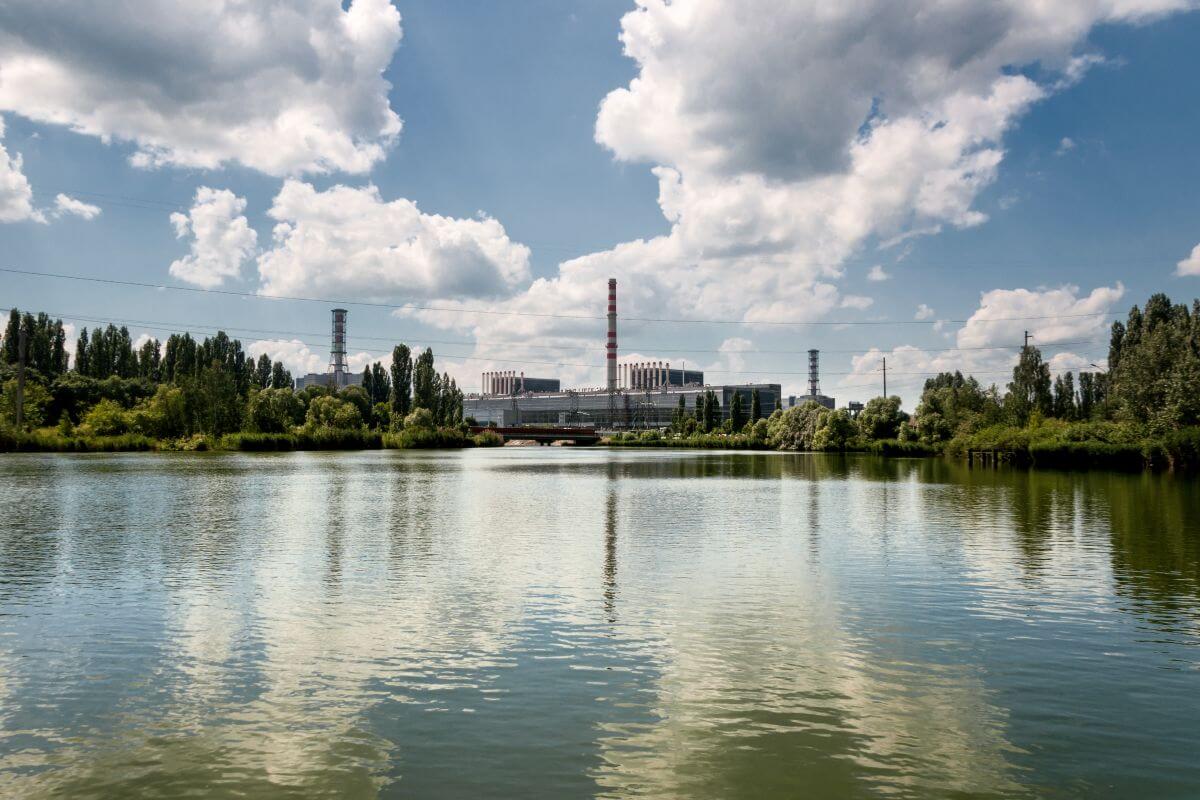
- Ukraine Drone Hits Russian Nuclear Plant, Sparks Huge Fire at Novatek’s Ust-Luga Terminal (August 24): Ukraine launched a drone attack on Russia on [August 24], forcing a sharp fall in the capacity of a reactor at one of Russia’s biggest nuclear power plants and sparking a huge blaze at the major Ust-Luga fuel export terminal, Russian officials said. Despite talk of peace by Russia and Ukraine, the deadliest European war since World War Two is continuing along the 2,000 km (1,250 mile) front line accompanied by missile and drone attacks deep into both Russia and Ukraine. Russia’s defense ministry said at least 95 Ukrainian drones had been intercepted across more than a dozen Russian regions on August 24, the day that Ukraine celebrates its declaration of independence from the Soviet Union in 1991. The Kursk nuclear power plant, just 60 km (38 miles) from the border with Ukraine, said that air defenses shot down a drone that detonated near the plant just after midnight, damaging an auxiliary transformer and forcing a 50% reduction in the operating capacity at reactor No. 3. Radiation levels were normal and there were no injuries from the fire which the drone sparked, the plant said. Two other reactors are operating without power generation and one is undergoing scheduled repairs. The [IAEA] said it was aware of reports that a transformer at the plant caught fire due to military activity and stressed that every nuclear facility should be protected at all times.
International Architecture
- IAEA Launches New Outlook on Nuclear Power for Development in Africa at G20: IAEA-Group of Twenty cooperation broke new ground with the release of a new publication examining the potential for nuclear power in Africa. The IAEA launched the publication at a side event co-organized with the Clean Energy Ministerial and the South African Department of Electricity and Energy on the margins of a key Group of Twenty (G20) energy transitions meeting in South Africa as the bloc explores clean energy options for sustainable development.
Threats
- AI Firm Rolls Out Tool to Detect Nuclear Weapons Talk: Artificial intelligence (AI) firm Anthropic has rolled out a tool to detect talk about nuclear weapons, the company said in a [August 21] blog post. “Nuclear technology is inherently dual-use: the same physics principles that power nuclear reactors can be misused for weapons development. As AI models become more capable, we need to keep a close eye on whether they can provide users with dangerous technical knowledge in ways that could threaten national security,” Anthropic said in the blog post. “Information relating to nuclear weapons is particularly sensitive, which makes evaluating these risks challenging for a private company acting alone,” the blog post continued. “That’s why last April we partnered with the U.S. Department of Energy (DOE)’s National Nuclear Security Administration (NNSA) to assess our models for nuclear proliferation risks and continue to work with them on these evaluations.” Anthropic said in the blog post that it was “going beyond assessing risk to build the tools needed to monitor for it,” adding that the firm made “an AI system that automatically categorizes content” called a “classifier” alongside the DOE and NNSA. The system, according to the blog post, “distinguishes between concerning and benign nuclear-related conversations with 96% accuracy in preliminary testing.”
Security Culture
- JAF, US Launch “Dragon Eye” Drill on WMD Response: The Jordan Armed Forces-Arab Army (JAF) on [August 17] launched the “Dragon Eye” field drill at the Chemical Support Group of the Royal Engineering Corps. According to a JAF statement, the exercise is conducted in cooperation with the US Defense Threat Reduction Agency (DTRA) and Oak Ridge National Laboratory of the US Department of Energy, under the Jordan-US program to counter weapons of mass destruction (WMD). The exercise is designed to enhance national response to nuclear and radiological incidents, identify strengths and gaps in security systems, bolster JAF’s ability to deal with unconventional threats, and improve procedures for handling WMD threats. It also seeks to raise level of joint coordination and interoperability between Jordanian and US forces in field training and operational practice.
Emerging Technologies
- DOE Makes First Pick for Advanced Fuel Pilot Project: Standard Nuclear has been announced as the first US company to be conditionally accepted into the Department of Energy’s program to establish a domestic nuclear fuel supply chain for testing new reactors. The fuel line pilot program supports the Department of Energy’s (DOE) new reactor pilot program, which aims to have at least three advanced reactor designs achieve criticality by July 4, 2026. The fuel line pilot program was launched with a Request for Application on July 15. The DOE is moving rapidly to “unleash innovation and maintain American leadership in nuclear energy development”, Secretary of Energy Chris Wright said. “Advanced nuclear reactors will be a game-changer for the United States, and with that comes the need to fabricate the fuel for these reactors. The Department of Energy is partnering private sector innovation with DOE expertise to assure stronger US nuclear supply lines. Standard Nuclear has been selected to “expand, build, and operate advanced fuel fabrication facilities for TRISO fuels in both Tennessee and Idaho”, according to information from the DOE. The company will be responsible for all costs associated with the construction, operation, and decommissioning of the facility. Reactor project developers will manage the sourcing of nuclear material feedstock for fuel fabrication, which could be acquired through DOE’s high-assay low-enriched uranium allocation program, the department said.
- US Selects 11 Projects for Program to Fast-Track Small Nuclear Test Reactors: The U.S. Department of Energy said on [August 12] it has made an initial selection of 11 projects for a pilot program seeking to develop high-tech test nuclear reactors and get at least three of them to begin operating in less than a year. As artificial intelligence and data centers boost power demand, the U.S. is aiming to develop small nuclear reactors which developers say will be cheaper to build per Megawatt of output than today’s large reactors because the parts could be replicated in factories. The department’s move comes after President Donald Trump issued executive orders in May seeking to speed permitting of nuclear reactors and reform the Nuclear Regulatory Commission, an independent agency. The orders allow the Energy Department to authorize the test reactors, without the NRC. “President Trump’s Reactor Pilot Program is a call to action,” said James Danly, deputy energy secretary. “These companies aim to all safely achieve criticality by Independence Day, and DOE will do everything we can to support their efforts.” The department selected the following companies: Aalo Atomics., Antares Nuclear, Atomic Alchemy, Deep Fission Inc., Last Energy, Oklo, Natura Resources LLC, Radiant Energy, Terrestrial Energy, and Valar Atomics. The department said each company will be responsible for all costs associated with designing, manufacturing, constructing, and decommissioning their test reactors.
- In Utah, a Bill Gates-Backed Nuclear Company is Exploring Where to Build a Power Plant: Utah is one step closer to hosting a nuclear plant. The Utah Office of Energy Development, land developer Flagship Companies and the Bill Gates-backed TerraPower announced Monday that they were officially on the hunt for a potential reactor and energy storage site in the Beehive State. The parties signed a memorandum of understanding, or MOU, proclaiming they will work together in search of suitable locations for the facility and come up with a preliminary list by the end of the year. “Utah has a proud history of energy innovation,” said Emy Lesofski, OED executive director, in a news release. “This agreement positions us to explore next-generation nuclear technology that can help meet our growing power needs while strengthening our energy independence,” TerraPower’s “Natrium” technology uses molten sodium to cool its reactors instead of water, which is generally considered safer and more efficient at generating energy from uranium fuel than traditional nuclear plants. […] The MOU is non-binding, however, and local community support is one factor TerraPower will consider in selecting a future reactor site.
Member Organization Announcements and Updates
Bellona Foundation
- Bellona has published its Nuclear Digest for June–July 2025, which reviews recent developments in nuclear security in Ukraine, the role of the Russian nuclear industry and Rosatom in these events, and Rosatom’s growing influence in international markets. Read the digest.
The Stimson Center
- Partnerships in Proliferation Prevention Program Director Christina McAllister and Mark Albon published a new commentary, “Parsing Protectionism and Proliferation,” arguing that U.S. tariff policies could make it harder to enforce WMD nonproliferation. Strategic trade control systems must be insulated from the volatility of tariff policy, and interagency coordination must evolve to treat proliferation detection as a core national security function rather than a discretionary add-on. Read the commentary.
- Christina McAllister also participated in the 66th Annual Conference of the Institute of Nuclear Materials Management (INMM), contributing a presentation to the session, “Opening the Aperture: Expanding Security and Protection Workforce Development.”
Institute of Peace and Conflict Studies
- The Institute of Peace and Conflict Studies (IPCS) in India and the Office of Nuclear Smuggling Detection and Deterrence (NSDD) of the US National Nuclear Security Administration hosted their Sixth Annual Radiological Security Dialogue from August 4-6 in the Maldives. The dialogue addressed the urgent need for informed conversations around the security of nuclear and radiological materials, and challenged common misconceptions in this critical area. The annual dialogue continues to foster a vital platform for collaboration among Indian and American policy experts, practitioners, technical specialists, and scholars, enabling them to share best practices and strengthen nuclear materials security.
International Institute for Strategic Studies
- Alexander Bollfrass was interviewed by AP News on the future of arms control. Read the story.
- Mark Fitzpatrick published a Survival article, titled ‘Attacking Iran and Tempting Fate,’ writing that the evidence suggests that Iran has retained significant nuclear capabilities and, fueled by nationalist fury and a sense of defensive necessity, could secretly use them to produce at least a handful of weapons. Read the article.
Nuclear Proliferation Prevention Project, University of Texas
- The Nuclear Proliferation Prevention Project published a new article in the Scientific American, “U.S. Nuclear Energy Plans Could Proliferate Weapons.” It argues that the Trump administration has now fully embraced bomb-prone nuclear fuel technology. This should stop before an arms race, atomic terrorism or even nuclear war results. Read the article.
Odesa Center for Nonproliferation
- Ali Alkis participated in the 66th Annual Conference of the Institute of Nuclear Materials Management (INMM), contributing to six sessions with presentations below:
- Nuclear Piracy: Weaponization of Nuclear Facilities
- Nuclear Power Plant Security During Armed Conflict
- Dirty Bombs: Weapons of Mass Disruption
- Nuclear Security: Making Gender Equality a Working Reality
- Nuclear Terrorism: Evolving Threat of Terrorism
- Insider Threats in the Nuclear Industry During Conflict Scenarios
Ali’s presentations emphasized that nuclear security is rapidly evolving and requires proactive, adaptable measures. He highlighted the growing risks of nuclear facility weaponization, the vulnerabilities of nuclear power plants in conflict zones, and the disruptive potential of dirty bombs. Additionally, he stressed the importance of integrating gender equality into nuclear security practices to strengthen resilience, addressed the shifting landscape of nuclear terrorism threats, and examined the critical challenge of insider threats during periods of conflict.
Vienna Center for Disarmament and Non-Proliferation
- On July 3, 2025, the Vienna Center for Disarmament and Non-Proliferation (VCDNP) and the Vienna Office of the United Nations Office for Disarmament Affairs (UNODA) hosted a webinar featuring UN Under-Secretary-General of Disarmament Affairs Izumi Nakamitsu. The discussion focused on current challenges to the global disarmament regime, particularly threats to the Treaty on the Non-Proliferation of Nuclear Weapons (NPT), and the need for greater multilateral cooperation. Watch the webinar.
Individual Member Updates
- Dr. Trevor Findlay, a principal fellow at the School of Social and Political Sciences at the University of Melbourne, joined NTI’s Logan Mintz to discuss the role of safeguards in a nuclear energy expansion. The interview touches on some of the ideas Dr. Findlay explored in a paper he published with NTI in June 2025. Read the interview.
- Dennis Solomon Balami published an article in the International Journal of Nuclear Security, “Empowering Voices: The Unsung Role of Women in Establishing and Sustaining the Pelindaba Treaty for an African Nuclear and Sustaining the Pelindaba Treaty for an African Nuclear Weapon–Free Zone Weapon–Free Zone.” Read the article.
- Dr. D.S. Prabakaran presented a guest lecture to the ADM College for Women on “Strategies to overcome radiation resistance in uterine cervical cancer.”
- Daniel Ajudeonu published an article for the European Leadership Network, “Moving beyond condemnation: European nuclear diplomacy in Africa in the wake of Russia’s full-scale invasion of Ukraine.” It examines how European nations can advance regional security through enhanced nuclear diplomacy with Africa, moving beyond simple condemnation of Africa’s neutrality toward more constructive engagement strategies. It argues that Europe can counterbalance Russian influence and foster African support for European security priorities by offering comprehensive nuclear energy partnerships that address Africa’s development ambitions—moving beyond limited cooperation toward genuine interdependence. Read the article.
- Mycle Schneider shares that the European Commission and the European Parliament will host the 2025 World Nuclear Industry Status Report Global Launch at the Europa Space in Rome on September 22, 2025. Those interested in attending this hybrid event can contact [email protected]. Find out more about WNISR.
Opportunities
- The Massachusetts Institute of Technology is seeking a Technical Associate, a postgraduate, pre-doctoral position designed to further the understanding of the risk of nuclear and non-nuclear attacks against critical infrastructures. Responsibilities include: developing and testing scientific software packages used by group members for simulations, including GUI interfaces for public use; performing statistical analysis using Bayesian and frequentist methods, performing model validations using both information-theoretic measure and cross-validation methods; helping to identify modeling solutions for low-computational-cost approaches to performing physics on graphs; and performing other related duties as required, including work performed at lower levels, when necessary. The position is for one year, renewable for up to one additional year pending funding and satisfactory performance. Read more.
- Stanford seeks an expert in international security and nuclear security to hold the Stanton Foundation Professorship in Nuclear Security. A joint appointment would be made at tenured rank of Associate Professor or Professor in a Stanford department or school and as a Senior Fellow on a continuing term with an endowed chair at the Center for International Security and Cooperation (CISAC), Freeman Spogli Institute for International Studies (FSI). Faculty from the social sciences, engineering, and physical sciences are all encouraged to apply. Applicants should possess an exceptional record of research and publication and be committed to teaching at the undergraduate and graduate levels and training pre- and post-doctoral fellows at CISAC to become the next generation of scholars on international security policy. Read more.
- TerraPower is seeking a highly motivated Senior Manager, Nuclear Security and Safeguards Programs to be a part of the Regulatory Affairs team. This position reports to the Senior Vice President of Regulatory Affairs and provides day-to-day support of TerraPower projects, develops Cyber Security, Physical Security, Information Security, Material Control and Accountability and International Safeguards Programs to meet established regulatory requirements. Read more.
- The Center for Strategic and International Studies (CSIS) seeks an intern to support the Project on Nuclear Issues (PONI) with its outreach and communication efforts. The PONI intern will support PONI programming and events. They will also help maintain the Next Generation Nuclear Network website, help manage PONI’s external communications and social media accounts, and provide general administrative support to the team. Interns have the opportunity to produce an independent research product for the Next Generation Nuclear Network website. Read more.
- The Center for a New American Security (CNAS) is partnering with Breaking Defense to launch Pathfinder, a new essay contest that will highlight emerging voices in national security. This contest provides students and early-career professionals with an opportunity to publish their work with both a leading think tank and a go-to defense outlet. The contest asks authors to write an essay between 800–1,000 words that analyzes a national security challenge and provides actionable policy recommendations that address it in a bold, innovative, and bipartisan way—key tenets of CNAS’s and Breaking Defense’s work. Read more.
- The Council on Foreign Relations is hiring a Research Associate in Nuclear Security for its David Rockefeller Studies Program. The Studies Program’s aim is to advance the discussion of American foreign policy and international affairs through its writing, publications, public outreach, and discussions. The Research Associate will conduct original and secondary research, coordinate events, provide administrative support, among other tasks. Read more.
- King’s College London’s EVIDENCE Network is actively inviting scholars to contribute to their research and new blog. The EVIDENCE Network is open to working with colleagues (academic, industry and all other sectors) on research in CBRN disinformation. Please reach out to the project officer Dr. Zenobia Homan and Zoha Naser or contact the Network at [email protected] for more information. Read more.
- The IAEA is inviting professionals in the nuclear field to submit abstracts for its 2026 International Conference on Topical Issues in Nuclear Installation Safety. Known as TIC2026, the conference will be held at the IAEA headquarters in Vienna, Austria, from 29 June to 3 July 2026. The deadline for submission of abstracts is 17 October 2025. Read more.
- Interested contributors have until September 15, 2025, to submit synopses for the IAEA’s International Conference on the Safe and Secure Transport of Nuclear and Radioactive Material. The conference, to be hosted in Vienna, Austria from March 23 to 27, 2026, will cover the legislative and regulatory framework for the transport of nuclear and other radioactive material, safety and security by design; safety and security during transport operations. It builds on previous events held in 2011 and 2021. Read more.
- Open Nuclear Network (ONN) is building a small, invitation-only roster of specialists whose insight will shape our monthly forecasts on nuclear-risk flashpoints. By joining, you become part of a discreet, impact-driven community that informs diplomats and decision-makers at precisely the moments when clear judgement matters most. Roster members act as rapid-response advisers. When a development in your region breaks (or when our analysts refine next month’s forecast) we may invite you to: share a quick reading of events, join a secure call to pressure-test scenarios, or draft a brief memo capturing recommended policy steps. Read more.
- The European Commission is seeking a data scientist for nuclear safeguards and non-proliferation. The position is for a data scientist in the Data Pole of the Digital Systems for Safeguards and Non-Proliferation Unit, strengthening the Unit’s activities on the side of Digital Transformation with applications in nuclear safeguards, non-proliferation and security analysis. Read more.
- PGS is seeking applicants for their Research Internship. The intern will primarily focus on researching nuclear security, nuclear energy, and transnational governance issues. Current research projects that interns will support include: exploring the nexus of climate change, nuclear power growth and global security; understanding the growth of nuclear energy in the Middle East and East Asia; tracking the evolution of nuclear security policies and governance structures; using existing voluntary frameworks as a model for nuclear security governance structures; and examining cybersecurity and other potential threats prompted by new technology developments. Read more.
- IB3 Global Solutions is seeking talented nuclear security/nonproliferation professionals, especially around the DC area, to support various programs under some of the national labs. Specific positions are not posted but those interested should apply to IB3’s general application. Read more.






Community Adaptation for a Water Festival Without Clean Water