
Overview
The SSS covers over 900,000 square kilometers of ocean within the territorial seas of Indonesia, Malaysia, and the Philippines. The SSS lies within the Coral Triangle, a global center of marine biodiversity, and is a rich fishing ground for tunas and small pelagic species. Approximately 40 million people are dependent on the seascape’s fishery resources (valued at US$1.18 billion1 University of British Columbia Institute for the Oceans and Fisheries, “Status, Trends, and the Future of Fisheries in the East and South China Seas,” Louise Teh et al., (2019): 9 – 10. https://open.library.ubc.ca/soa/cIRcle/collections/fac ultyresearchandpublications/52383/items/1.0379884.) for their food security and livelihoods.2 Ibid. SSS governments are committed to marine conservation and regulation at the national and regional scale, but they face implementation challenges that hamper sustainable fisheries management and efforts to eliminate illegal, unregulated, and unreported (IUU) fishing.
Overall, porous national boundaries in SSS waters limit monitoring, control, and surveillance (MCS) efforts. Vessels from Indonesia, Malaysia, and the Philippines encroach on the waters of their neighbors and fish outside of registered zones in their domestic waters.3 Senia Febrica and Lucas Myers. (2024). United States-Indonesia Maritime and Environmental Security in the Sulu-Sulawesi Sea. Policy Paper. Washington: the Hollings Center. https://www.hollingscenter.org/wp- content/uploads/2024/06/Sulu-Sulawesi-Sea-Report.pdf Foreign-flagged vessels in addition to transnational criminal enterprises encroach on territorial waters in the SSS. Compounding risks are overfishing and rising sea temperatures which deplete fish stocks. Intensifying weather patterns also introduce safety risks to artisanal fishers, threatening their food and economic security. These factors and others discussed below contribute to rampant IUU fishing in the SSS.4 Wilcox, C., Mann, V., Cannard, T., Ford, J., Hoshino, E., and Pascoe, S. 2021. A review of illegal, unreported, and unregulated fishing issues and progress in the Asia-Pacific Fishery Commission Region. Bangkok, FAO, and Hobart, CSIRO. https://doi.org/10.4060/cb2640en
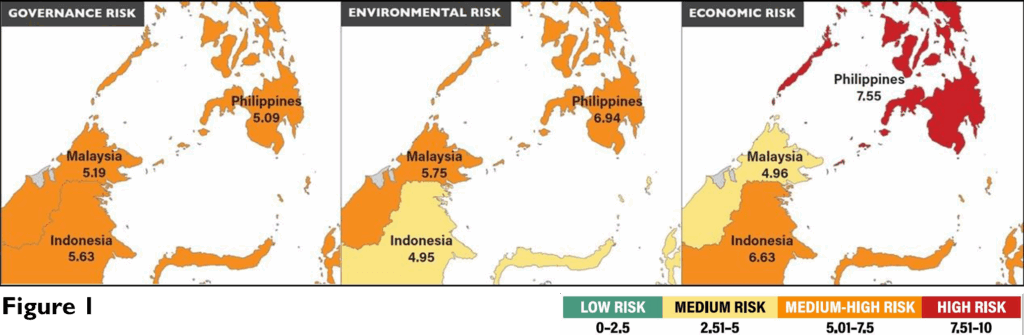
Risk scores on this fact sheet are derived from a IUU fishing risk survey method which assesses specific economic, environmental, and governance risk factors that drive IUU fishing in the SSS. A high risk score denotes a higher level of perceived risk associated with that category or indicator. Risk scores apply specifically to survey respondents’ perceptions of risk in the SSS; other data and information in this fact sheet are informed by desk research and expert interviews. Figure 1 suggests governance category scores at medium-high risk in all three countries while environmental risks as medium-high to medium risk. The greatest variance between scores were observed in the economic risks category with high risk in the Philippines, medium-high risk in Indonesia, while Malaysia was rated as medium risk. Learn more about survey methods, respondents, and IUU fishing risk in the SSS at the regional and country level, access a full report here.
Governance Risk
The average of five indicators in the governance category (Figure 2) suggests medium-high risk in Indonesia (5.63), Malaysia (5.19), and the Philippines (5.09). Porous national boundaries in the SSS limit MCS efforts and have allowed transnational criminal enterprises to fund IUU fishing and other illicit activities throughout the region. However, risk is tempered by positive perceptions of government initiatives to counter IUU fishing and promote sustainable fisheries management. Risk from encroachments by foreign-flagged vessels and criminal enterprises is reflected in the risk indicator contested maritime boundaries, with Indonesia (8.73) and the Philippines (8.52) reporting high risk. To combat this, the three SSS countries conduct joint patrols in shared waters, have bilateral Memorandums of Understanding (MoUs) surrounding at-sea enforcement, and other collaboration with foreign partners to improve MCS capacity. These initiatives are reflected in the risk indicator capacity for fisheries enforcement which is reported as medium risk in Indonesia (4.86) and the Philippines (4.96), indicating a greater capacity for counter-IUU fishing enforcement on the water, at ports, and in the seafood supply chain. Malaysia was reported as medium-high risk (6.21) reflecting reported institutional corruption, low IUU fishing prosecution rates, and limited at-sea enforcement. There is high political will to close current gaps in regional fisheries management and enforcement capacity, with government initiatives to counter-IUU fishing reported as a medium-low risk indicator in all three countries. Lower risk scores indicate a greater presence and effectiveness of government programming to combat IUU fishing and sustainably produce marine resources.
Environmental Risk
Environmental risk (Figure 3) is perceived as medium-high in the Philippines (6.94) and Malaysia (5.75), and medium risk (4.95) in Indonesia with notable concerns over the health of fish stocks among experts in all countries. The Philippines’ nearshore fish stocks (7.00) and offshore fish stocks (6.73) risk scores are highest within the region, while Malaysia and Indonesia note relatively less risk to stock health, at medium-high risk and medium risk, respectively. Seventy percent of fishing grounds have been overfished in the Philippines forcing fishers to travel farther and exert more fishing effort in search of ever-declining stocks.5 Government of the Republic of the Philippines, Bureau of Fisheries and Aquatic Resources, “Sardines Closed Fishing Season Now on its 12th Year Implementation, accessed
May 5, 2023, https://www.bfar.da.gov.ph/sardines- closed-fishing-season-now-on-its-12th-year-implementation. Experts in Malaysia identified IUU fishing Vietnamese-flagged vessels IUU fishing as the greatest threat to the sustainability of Sabah’s fish stocks. Experts noted Indonesia’s waters are still relatively abundant which has potentially attracted vessels from neighboring countries to illegally fish there. Relatively higher risk scores for Malaysia (5.89) and the Philippines (7.07) in environmental risk indicators extend to marine habitat health where experts reported damage to seabed ecosystems from trawling and illegal fishing practices. In the Philippines, additional there is increased pressure on marine habitats due to coastal land development. In all three countries, foreign and domestic vessels encroach on inshore exclusion zones (IEZ) reserved for small-scale fishers.
Economic Risk
Economic risk summary scores (Figure 4) vary in the SSS with the Philippines ranking high-risk (7.55), Indonesia at medium-high risk (6.63), and Malaysia at medium risk (4.96). In the Philippines, the economic category ranks as the highest risk category (7.55) when compared to environmental and governance risk. Among the three countries, the Philippines has the highest portion of its population engaged in fishing activities. Economic risk is also the highest risk category in Indonesia (6.63), but it is only rated as medium-high. Economic risk factors are perceived as medium risk in Malaysia (4.96), the lowest score among the three states as Malaysia is the least reliant on fisheries for economic productivity and local livelihoods. While risk from the percent of population employed by fisheries is relatively low (4.25), the percent of national fisheries that are artisanal (5.40) and coastal poverty rates (5.30) are medium-high. With 82 percent of fisherfolk living in poverty in Malaysia, addressing the medium-high risk associated with household economic dependence on fishing (5.15) and fisheries infrastructure (4.55) is integral to reducing IUU fishing by small-scale fishers.6 Ali Mohamed Omar Rhoumah, “Determinants of Factors That Affect Poverty among Coastal Fishermen Community in Malaysia,” IOSR Journal of Economics and Finance 7 no. 3 (2021), https://smartlib.umri.ac.id/assets/uploads/ files/7c3d1-b0703020912.pdf. Notably, Malaysia is the only state in the SSS that is not party to the Agreement on Port State Measures (PSMA), the only binding international agreement which seeks to prevent, deter, and eliminate IUU fishing by preventing vessels engaged in IUU fishing from using ports and landing their catches.
Recommendations
The following recommendations are oriented to enhance ongoing regional collaboration and cooperative efforts. To address funding shortcomings for domestic-level management and conservation initiatives, regional governments and NGOs should share best practices and increase investment in conservation efforts and fisheries management. One such best practice is improving capacity for fisheries management and conservation by working with nontraditional partners in the Indo-Pacific such as local communities, or trusted nations outside the SSS like the U.S., Australia, and Japan. Additionally, regional NGOs can promote dialogue between states to resolve boundary disputes and incursions, reducing required investment in at-sea enforcement, and promoting collaboration on management issues.
In order to advance marine conservation and transboundary MCS capacity in the SSS, regional organizations should promote and increase cooperation between state governments on data sharing. Through bilateral MoUs, the Trilateral Agreement, and ASEAN Network-IUU (AN-IUU), nations in the SSS already collaborate and share information and technology regarding at-sea enforcement of fisheries-related crimes. Regional organizations should promote expanding data-sharing to encompass fish stocks, vessels, and marine ecosystems to promote transboundary ecosystem-based management. Database sharing and standardization promotes trust between regional actors and is critical to identifying locations in the seascape that are at-risk. Data sharing and transboundary MCS development would improve enforcement against transnational criminal networks and foreign-flagged vessels in respective EEZs by improving trust between regional states, promoting further dialogue on collective management and conservation, and streamlining regulations in different territorial waters to reduce confusion amongst patrol officers and fisherfolk.








Community Adaptation for a Water Festival Without Clean Water