
Overview
The South China Sea (SCS) covers over 3.36 million square kilometers of water, stretching from Taiwan to the Straits of Malacca. The SCS is a rich fishing ground for small pelagic species, tuna, squid, and other commercially important species, and more than half of the world’s fishing vessels operate in the SCS.1 University of British Columbia Institute for the Oceans and Fisheries, “Boom or Bust: The Future of Fisheries in the South China Sea,” U. Rashid Sumaila and William W. L. Cheung, (2015): 9. https://www.admcf.org/research-reports/boom-or- bust-the-future-of-fish-in-the-south-china-sea/. The seascape is characterized by issues of territorial integrity, fishing and energy access rights, and declining fish stocks. Tensions also exist around political and economic sensitivities related to artisanal and small-scale fisheries. Overfishing, declining fish stocks and concerns regarding the effects of climate change have pushed some fishers to encroach on the territorial waters of neighboring states. The governments of Indonesia, Malaysia, Philippines, and Vietnam have all experienced contentious interactions with the People’s Republic of China (PRC) over access to fishing grounds.2
”Territorial Disputes in the South China Sea,” the Center for Preventative Action, 17 September 2024, https://www.cfr.org/global-conflict-tracker/conflict/territorial-disputes-south-china-sea\ These factors and others discussed below contribute to rampant illegal, unregulated, and unreported (IUU) fishing in the seascape.3 Wilcox, C., Mann, V., Cannard, T., Ford, J., Hoshino, E., and Pascoe, S. 2021. A review of illegal, unreported, and unregulated fishing issues and progress in the Asia-Pacific Fishery Commission Region. Bangkok, FAO and Hobart, CSIRO. https://doi.org/10.4060/cb2640en Regional states are strengthening mechanisms for collaboration on key issues related to fisheries management and marine conservation such as the ASEAN Secretariat Working Group on Fisheries (ASWGFi) and the Regional Plan of Action to Combat IUU Fishing (RPOA-IUU).
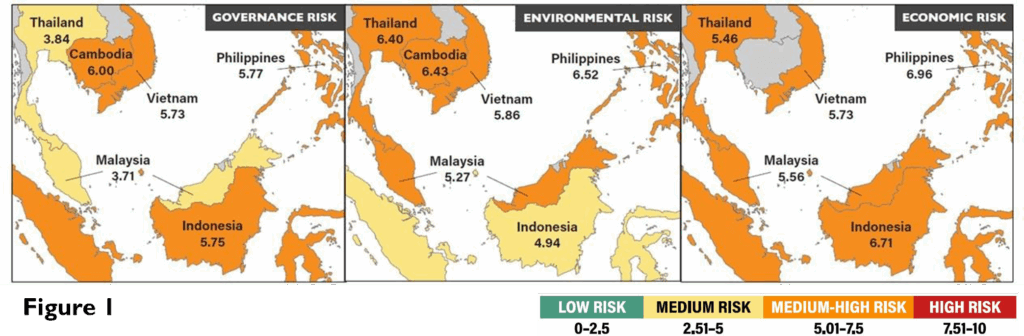
Risk scores on this fact sheet are derived from an IUU fishing risk survey method which assesses specific economic, environmental, and governance risk factors that drive IUU fishing in the SCS and surrounding region. A high risk score denotes a higher level of perceived risk associated with that category or indicator. Risk scores apply specifically to survey respondents’ perceptions of risk in the SCS; other data and information in this fact sheet are informed by desk research and expert interviews. Figure 1 shows the SCS ranks at medium to medium-high risk levels across governance, environmental, and economic risk categories. Risks in the environmental and economic categories are higher than those of the governance category. It is important to note, however, that governance risks are medium-high for four of the six countries bordering the SCS and are highest in Indonesia and Cambodia. To learn more about survey methods, respondents, and SCS IUU fishing risk at the regional and country level, access a full report here.
Governance Risk
The average score of risk indicators related to governance (Figure 2) suggests medium-high risk in Cambodia (6.00), Philippines (5.77), Indonesia (5.75), and Vietnam (5.73) and medium risk in Thailand (3.84) and Malaysia (3.71). When comparing these two groups, countries with higher per capita GDPs (Thailand and Malaysia) have lower governance risk, reflecting larger fiscal capabilities to address regulatory needs and smaller artisanal fishing populations to manage.
The contested maritime boundary indicator is reported as medium-high or high risk in all assessed countries except Cambodia (3.60) and Thailand (4.40). Maritime boundaries in the SCS are highly contested, and overlapping territorial claims can lead to unintentional incidents of IUU fishing. The Philippines (8.25) and Indonesia (8.73) report high risk, and Vietnam (7.07) and Malaysia (6.13) rate the indicator as medium-high risk. PRC and Vietnamese vessels both fish and patrol contested waters surrounding the Spratly Islands and Natuna Islands, harassing Indonesian-, Philippine-, and Malaysian-flagged vessels.4 “Threats to Indonesia’s sovereign rights in EEZ,” Indonesia Ocean Justice Initiative, 25 January 2022, https://oceanjusticeinitiative.org/2022/01/25/threats-to-indonesias-sovereign-rights-in-eez/.
Contested territorial claims incentivize unsustainable fishing practices and can result in the securitization of the fishing industry. Maritime militias established by the PRC and Vietnam escort fishing fleets, enforce against IUU fishing in territorial waters, and are a signal of sovereignty claims in contested waters. Oil and gas exploration activities by the PRC have resulted in tense standoffs in the Indonesian, Malaysian, and Vietnamese exclusive economic zones.5 Indonesia Ocean Justice Initiative, “Threats to Indonesia’s sovereign rights in EEZ.” Phuong, “Vietnam’s Maritime Militia.”
Environmental Risks
The average score of risk indicators (Figure 3) related to environmental risks reports medium-high risk in Philippines (6.52), Cambodia (6.43), Thailand (6.40), Vietnam (5.86), Malaysia (5.27) and medium risk in Indonesia (4.94). Climate change impacts on habitat health and fish stocks indicator was noted as high to medium-high risk, with all countries rating it as the leading environmental risk. Climate change resilience also ranked medium-high for most countries and partially reflects climatic changes that have caused stronger and more frequent typhoons. Storms damage infrastructure in coastal communities, vessels, and mariculture cages throughout the region. Similarly, the nearshore fish stocks indicator ranked medium to medium-high risk associated with reported overcapacity in artisanal fleets, poor management, and unsustainable harvesting practices. The Philippines (6.60) is experiencing increased pressure to exploit nearshore stocks due to the PRC’s occupation of traditional Filipino fishing grounds near Scarborough Shoal, and the PRC’s island-building activities in the Spratly Islands destroy traditional spawning grounds. In Vietnam (5.99) declining nearshore stocks are driving fishers to encroach on other countries’ waters.
Economic Risks
The average score of risk indicators related to economic risks (Figure 4) suggests medium-high risk in Philippines (6.96), Indonesia (6.71), Vietnam (5.73), Malaysia (5.56), and Thailand (5.46). An average score for Cambodia could not be calculated due to low sample size. Countries bordering the SCS have large, difficult to regulate artisanal fishing fleets. Across countries, experts reported that government attempts to reduce IUU fishing by local artisanal and small-scale fleets are a sensitive political issue. This reflects the regional risk analysis that rates risk associated with the percent of population employed by fisheries indicator at medium-high risk across available data on economic indicators for Philippines (7.80), Indonesia (7.00), Vietnam (6.40), and Thailand (5.80). These rankings track closely to the portion of national population employed in the fishing sector with the Philippines at the highest portion and Thailand at the lowest portion. Additionally, the percentage of national fisheries that are artisanal indicator ranks as medium-high risk in all five countries. For example, artisanal fishers make up as much as 90 percent of the fishing fleet in Indonesia.
Recommendations
The following recommendations are oriented to enhance ongoing regional collaboration and cooperative efforts. In order to advance marine conservation and security, regional organizations should promote and increase cooperation between governments in the region. Environmental degradation in the SCS – the destruction of reefs, overexploitation of fish stock, seabed ecosystem damage, and coral bleaching – often has transboundary implications. Geopolitical tensions hinder cooperative efforts and reduce trust between regional states. Unlike other vital regional seascapes, the SCS does not have a regional fisheries management organization (RFMO) or a fisheries management convening organization; as a result, it is almost impossible to conduct regional or national stock assessments and other joint research activities.6 ”Illuminating the South China Sea’s Dark Fishing Fleets,” CSIS, 9 January 2019, https://ocean.csis.org/spotlights/illuminating-the-south-china-seas-dark-fishing- fleets/#:~:text=Conducting%20accurate%20stock%20assessments%20and,or%20cooperation%20among%20regional%20states. The over-emphasized discourse of national sovereignty of contested maritime boundaries promotes both a “race-to-fish” mentality and the use of fishing fleets as tools for military objectives. Therefore, regional organizations should promote diplomatic engagement to resolve boundary incursions and to reduce tensions.
Regional states can build a greater capacity for monitoring, control, and surveillance (MCS) by promoting data sharing between states. In January 2022, ASEAN launched ASEAN Network-IUU (AN-IUU), a collaborative platform for fisheries enforcement agencies to report incidents of IUU fishing.7 “ASEAN, EU Ramp Up Efforts to Fight Illegal Fishing,” Association of Southeast Asian Nations, 18 July 2024, https://asean.org/ asean-eu-ramp-up-efforts-to-fight-illegal-fishing/ However, RPOA-IUU notes that efforts to promote data sharing by non-governmental partners are hindered by a lack of standardization within the respective database systems.8 M. Eko Rudianto, “Implementation of MCS in RPOA-IUU,” RPOA-IUU Secretariat, 24 August 2022, http://www.seafdec.or.th/ mcs/mcs-workshop-2022/presentations/Agenda_3_RPOA-IUU_MCS.pdf States bordering the SCS should build on collaborative efforts established through AN-IUU to establish formal regional mechanisms for sharing data on fish stock health, marine ecosystems, fleet size, and harvest locations. Sharing databases promotes trust between regional actors and is critical to identifying locations in the seascape that are at-risk. Additionally, ecological and IUU fishing data that is shared regionally on fish stocks, vessels, and marine ecosystems can reduce the limitations to transboundary governance of important natural resources. Highlighting hot spots of IUU fishing, combined with information and data on the health of key habitats for endangered, threatened, or protected (ETP) species, will focus regional attention around specific areas critical to preserving marine biodiversity and the long-term health of blue economies for all states in the region. Regional organizations have an opportunity to promote diplomatic engagement between states to reduce distrust, promote data sharing, and encourage harmonization of sub-national data systems to facilitate cooperation with partner organizations.








Community Adaptation for a Water Festival Without Clean Water