

Editor’s Note: Jeffsky Poincy is a governance and policy specialist with over eight years of multi-sectoral experience in economic and policy development in Haiti. He has held key positions within the Haitian government, including the Ministry of Youth as a Public Investment Analyst and the Ministry of Tourism, where he served as an Economic Development Advisor to the Ministry’s Cabinet. Jeffsky is an active advocate promoting good governance in Haiti, as a member of the anti-corruption organization “NouPapDomi”.
By Aude Darnal, Project Manager, The Global South in the World Order Project
Background
Haiti has been mired in a complex crisis characterized by a collapse of governance and a surge in gang violence, with severe social, economic, and humanitarian consequences. Since 2019, the country has experienced negative economic growth and rampant double-digit inflation. The violence has left more than half a million people internally displaced, and kidnappings and murders have reached catastrophic levels, with over 3,200 intentional killings documented in 2024 alone. Currently, more than 5.5 million Haitians are in need of humanitarian assistance and protection, with more than 44% of the population facing food insecurity.
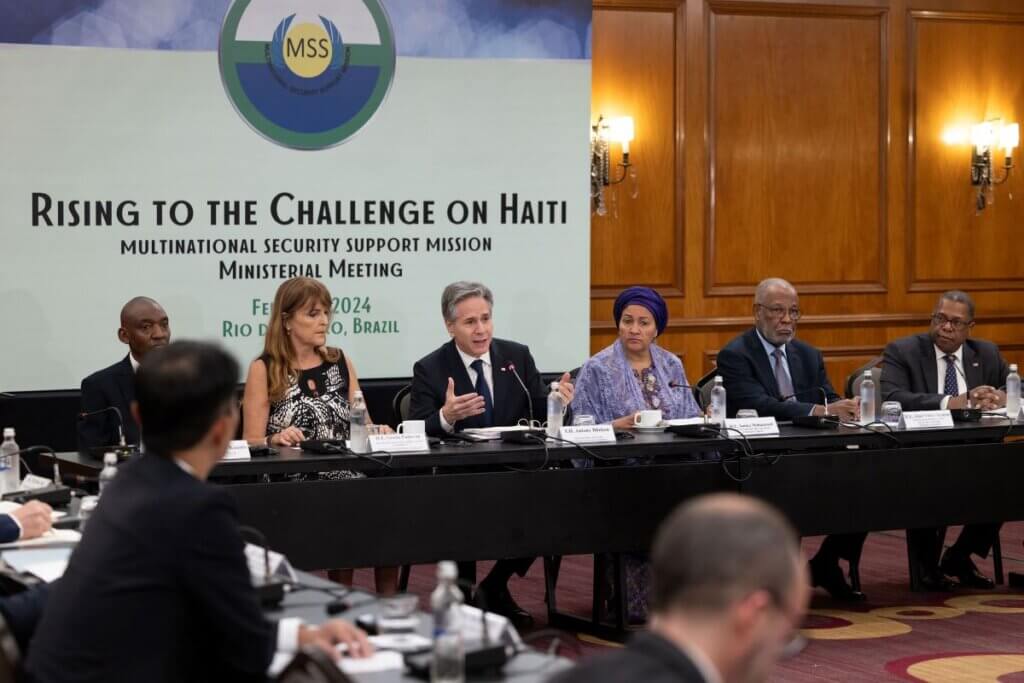
The United States has adopted a three-pronged approach to address the crisis: support the formation of a transitional government, the restoration of security, and the initiation of constitutional reform followed by elections. Addressing the security situation is central to this strategy because stability is needed to achieve success in the other areas. To this end, the United States has facilitated the Multinational Security Support (MSS) mission to help Haiti grapple with the challenges posed by gang violence and restore order and security to the country. This mission, which is led by Kenyan police and authorized by the United Nations Security Council (UNSC), is funded and sponsored primarily by the United States and includes the planned deployment of 1,500 Kenyan police officers and more than 1,000 military personnel from countries such as the Bahamas, Benin, and others.
Although the MSS mission is widely seen as a key solution to Haiti’s security problem, it is unlikely to achieve its goal in the current setting, as many experts have argued over the past few months. This policy memo examines the mission, identifies key problems, and argues for a new approach centered on direct investment in the Haitian security forces. This strategy emphasizes not only the military aspect of security but also the broader ecosystem and complex nature of the Haitian crisis.
Current Status of the MSS Mission
The deployment of the MSS mission, authorized by the UNSC on October 2, 2023, has been repeatedly delayed and postponed. The constitutionality and legality of Kenyan President William Rutos’ decision to deploy troops to Haiti has been questioned by legal entities in Kenya. In addition, the MSS mission has experienced resourcing difficulties. Several countries have pledged to participate by sending troops or making financial contributions, but few have followed through. Of the $118 million pledged by the international community, only $21 million has been contributed to the UN trust fund set up for the mission.
To date, 400 Kenyan police officers have been deployed to Haiti—but without a clear mandate. The officers have been seen patrolling the streets of Port-au-Prince alongside Haitian police and securing the perimeter of the U.S. Embassy, but their broader mission objectives and rules of engagement are unclear.
Key Issues
Lack of Haitian Stakeholder Engagement and Transparency
The legitimacy of the MSS mission is a critical concern. In Kenya, the mission faces significant controversy and legal challenges, raising doubts about its compliance with Kenyan laws. Similarly, in Haiti, the provisional status of the interim government limits the credibility of the government’s support for the mission and restricts the legitimacy it can confer on the MSS mission. Moreover, although authorized by the UNSC under Chapter VII of the UN Charter, the MSS mission operates outside of direct UN oversight.
Aside from the UNSC resolution, the only official document linking Haiti to the mission is a non-binding memorandum signed by the former Haitian Ministry of Environment and the Kenyan authorities to facilitate the mission’s deployment after the Kenyan High Court challenged its legitimacy. The MSS was designed with little involvement of Haitian actors, whether civil society or the Haitian authorities. According to the available documents, such as the Status of Forces Agreement (SOFA), the MSS mission is designed to operate as a separate entity with little influence from the Haitian state. Moreover, the agreement reached among Haitian stakeholders, which led to the creation of the Haitian Presidential Transitional Council, included in its Article 25 the creation of a National Security Council to define the terms of the mission with the parties involved, but this council was never created, nor was it a precondition to the deployment of the MSS mission.
The lack of specific mission objectives and operational guidelines contributes to widespread mistrust and ambiguity. Haitian authorities, including the Presidential Security Council and local law enforcement, seem to have limited knowledge of the MSS mission’s intended strategies and engagement protocols. This opacity not only affects public trust but also creates a gap between public expectations and the mission’s actual mandate. Although Haitians expect a muscular intervention to directly address gang violence, according to the memorandum signed by the Haitian and Kenyan authorities, the latter envision the MSS mission playing a more passive role, focusing on basic infrastructure security. This disparity in perceptions could exacerbate public discontent and heighten tensions, potentially undermining local buy-in of the MSS mission and escalating to outright rejection.
Absence of Clear Accountability Mechanisms
The MSS mission raises serious concerns owing to a lack of clear safeguards and accountability mechanisms. Leading human rights organizations and Haitian civil society groups have expressed serious reservations about the mission’s structure, which does not adequately address the potential for human rights violations and abuses. Although the UN resolution authorizing the MSS mission requires accountability and oversight processes, these are neither clearly defined nor reflected in the mission’s operating framework.
The SOFA signed by the Haitian and Kenyan authorities describes the privileges and immunities of MSS mission personnel, but there is no clear and independent framework for handling complaints of abuse. This omission reinforces the longstanding culture of impunity associated with previous peacekeeping missions in Haiti, such as MINUSTAH. Unlike MINUSTAH, however, the MSS is not a UN mission and is therefore not subject to internal UN procedures for processing complaints. As a result, Haitian citizens lack a legitimate mechanism to report potential abuses by MSS mission forces.
Several factors increase the potential for harm from the MSS mission. Haitian gangs are deeply entrenched in densely populated communities, and human rights organizations have reported significant numbers of children being recruited into gangs, increasing the risk of civilian casualties. The Kenyan forces leading the mission have a documented history of human rights abuses. Past international interventions in Haiti, particularly by the UN, have often resulted in high spillover effects, including civilian casualties and widespread human rights violations.
The absence of robust accountability mechanisms not only jeopardizes the safety and rights of Haitian citizens but also undermines the mission’s ability to gain local buy-in. Without clear safeguards and mechanisms to investigate and address complaints of abuse, and to ensure that MSS mission personnel are held to the highest standards of conduct, the MSS mission risks perpetuating the very cycle of violence and impunity that Haiti has experienced as a result of foreign intervention for decades. This could further destabilize Haiti and lead to more violence.
Short-Term Focus and Prioritization of Foreign Forces Over the Haitian Police
As currently designed, the MSS mission perpetuates a persistent trend of relying on foreign troops to manage Haiti’s security challenges, often at the expense of sustainable local solutions. This approach mirrors past UN peacekeeping missions, where foreign forces received disproportionate attention and resources compared to the Haitian police. The MSS mission budget is three times that of the Haitian National Police’s (PNH’s) annual budget, and little is allocated to directly support the PNH.
Since its creation in 1995, the PNH has received limited assistance from international partners, particularly the United States, owing to concerns about the potential militarization of the police force. This cautious approach stems from fears of a repeat of Haiti’s violent period under military control; direct assistance to the PNH was restricted to minimize potential risks to democratic governance. Such caution, however, has had unintended consequences. The PNH, struggling with meager resources and limited support, has been outgunned by well-armed gangs that operate with impunity, fueled by unrestricted access to illegal weapons.
Recent incidents, such as the strike by Haitian officers over unpaid dues, underscore the systemic neglect of the Haitian police. The precarious conditions and lack of support contribute to a significant attrition rate within the PNH, with approximately 3,000 officers leaving the force in the past three years. From January to May 2024 alone, another 1,000 officers left, largely due to poor working conditions and inadequate support. Equipment is also substandard. Only 21 of the 47 armored vehicles were operational by the end of 2023 due to lack of funds for maintenance.
Haitian police officers are paid an average of about $200 per month, have minimal benefits, and suffer from frequent payment delays. In contrast, Kenyan police officers deployed under the MSS mission receive significantly higher salaries, approximately $1,500 per month on top of their regular salaries, along with comprehensive benefits. MSS mission officers will benefit from guaranteed medical evacuation corridors to the Dominican Republic in the event of harm, in stark contrast to Haitian officers, who have no such assurances despite facing greater risks in the fight against criminal gangs. This disparity threatens to further erode the already low morale of Haitian police officers on the frontlines against gangs, ultimately undermining the cohesion of the force and further exacerbating attrition rates.
Military-Centric Approach and Lack of Focus on the Gang Ecosystem
Haiti’s security crisis is multifaceted and has often been met with military-focused foreign interventions, particularly aimed at fighting gangs. This strategy, exemplified by the current MSS mission, overlooks the underlying ecosystem that sustains gang activity.
A key lesson from past interventions, such as the 2007 UN mission, is that simply targeting and removing gang members does not address the underlying causes of gang violence and other nefarious activities. Despite efforts to dismantle groups of gang members during the MINUSTAH mission, new gangs quickly emerged to fill the void. This persistence underscores that Haiti’s security challenges are systemic and evolving and extend beyond individual gang members. Many of today’s gangs did not exist five years ago.
Gangs in Haiti are deeply intertwined with political figures and the private sector. Politicians often rely on gangs to intimidate, secure votes, and provide protection in exchange for resources. Similarly, businesses form alliances with gangs to gain logistical and financial advantages because gangs control key economic routes. This creates a resilient network that sustains gang activity.
The transnational dimensions of gang activity further complicate Haiti’s security landscape. Gangs maintain ties to regional organized crime and drug trafficking networks, which bolster their resources and influence, One of the most pressing issues is illicit arms trafficking, which originates primarily from the United States. Reports indicate that over 80% of weapons seized in Haiti from 2020 to 2022 were either from the United States or manufactured in the U.S. These weapons greatly enhance the capabilities of the gangs and enables them to outgun the police
The Need for a New Approach
The international community’s current policy of foreign intervention is not helping Haiti achieve long-term security and stability. From 1993 to the present, Haiti has had at least five security missions, including the current MSS mission operation. Not only have these operations failed to achieve long-term peace, they have also imposed significant socioeconomic costs and serious spillover consequences on the Haitian people, such as civilian casualties and human rights abuses.
Moreover, overreliance on foreign actors for security measures weakens local capacity-building and perpetuates a cycle of dependency in which Haiti must rely on the goodwill of international partners to tackle its security challenges.
Beyond immediate security measures, the transnational factors that perpetuate and exacerbate this security issue should be addressed. These include illicit arms trafficking, narcotics smuggling, and external criminal networks that seek to exploit Haiti’s weaknesses.
The international community has the potential to transform the MSS mission into a more effective and sustainable initiative that addresses immediate security concerns while laying the foundation for long-term peace in Haiti. Such efforts should include the following:
- Increase Haitian ownership and civil society participation. Ensure that Haitian authorities take ownership of the initiative through the National Security Council, as outlined in the agreement that led to the Presidential Transitional Council. Ensure the active participation of Haitian civil society groups and local authorities in the planning and implementation phases of the mission.
- Limit the scope of the MSS mission and redirect investments to Haitian institutions to serve the country’s long-term security needs. Prioritize long-term support and reform of local forces. Rather than deploying large numbers of foreign troops under the MSS mission, priority should be given to providing resources to strengthen the police and army. This would include comprehensive training programs, the provision of modern equipment, and organizational reforms to ensure that Haitian security forces can operate independently and effectively. This would not only strengthen their capacity to maintain law and order but also create conditions that encourage officers to remain in the service.
- Establish accountability mechanisms. Set up robust, independent oversight processes to address and investigate complaints of abuse by MSS mission personnel. This would include creating an independent body composed of both Haitian and international actors to monitor the actions of MSS mission personnel, with the authority to investigate and respond to allegations of misconduct. Regular assessments of the mission’s compliance with international human rights standards should be conducted, with strategies adjusted as necessary to mitigate potential harm to civilians.
- Prioritize eroding the connections among gangs, politicians, and businesses. Implement strategies to break the gang-political-business linkages and disrupt the power structures that facilitate gang violence. Bilateral and multilateral sanctions regimes, such as the UNSC sanctions regime, can serve as important tools to this end, if implemented with due process, leading to thorough investigations and prosecutions in cooperation with Haitian and international judicial institutions. The United States and Canada have imposed bilateral sanctions on Haitian political figures and the private sector. However, these sanctions, which serve as deterrents, are likely to have short-term and limited impact, as those involved are not criminally prosecuted.
- Develop comprehensive regional strategies to disrupt the flow of weapons and illicit goods that fuel gang activity. Haiti lacks the capacity to address this problem because of its porous borders and limited maritime security infrastructure. American citizens have also been victims of gang violence in Haiti, making this not only a Haitian problem but also a national security concern for the United States. The U.S. can play a critical role by developing and facilitating regional strategies to disrupt the flow of weapons and illicit goods coming from the United States that fuel gang activity in Haiti. Sustainable solutions should focus on cooperation and collaboration among regional and international law enforcement agencies, particularly the Caribbean Community (CARICOM) countries and regional security agencies such as the CARICOM Implementation Agency for Crime and Security and the Caribbean Crime Gun Intelligence Unit. The United States could integrate Haiti into the shared security partnership of the Caribbean Basin Security Initiative to better assist in strengthening Haiti’s security infrastructure. In addition, further operationalization and strengthening of the newly established Transnational Criminal Investigation Unit between Homeland Security Investigations and the Haitian police would facilitate the investigation and prosecution of transnational crimes.







Community Adaptation for a Water Festival Without Clean Water