
Dear Friend,
Our November newsletter reflects the intensifying pressure on safety and security at the Zaporizhzhia Nuclear Power Plant (ZNPP) as well as the energy grid as a whole and thus Ukraine’s other nuclear power plants, based on reports from the International Atomic Energy Agency’s monitoring teams as well as analysis from Foreign Policy this month. Ukraine’s use of U.S.- and UK-made long-range missile systems and Russia’s attack on Dnipro using the conventionally armed “Oreshnik” intermediate range ballistic missile marks a significant escalation in the war which could have additional impacts on the energy grid and supply of energy to the nuclear power plants of both countries. Meanwhile, in the United States, a thwarted “accelerationist” attack on a Tennessee electrical facility illustrates the continuing security threat to energy facilities, including nuclear facilities, from domestic violent extremists (DVE). The Stimson Center addressed this last year in two significant reports, one on the threat landscape, the other on policy recommendations to mitigate DVE insider threats. More recently, the Nuclear Threat Initiative convened an expert workshop on the related topic of DVE nuclear threats, demonstrating the valuable and unflagging work INSF members do to address both enduring and evolving nuclear security threats.
Warmly,
Christina
Director, International Nuclear Security Forum
Join the conversation on X: @INS_Forum
Follow INSF on LinkedIn here
Updates
- FUNDING APPEAL: If you appreciate this newsletter, please consider a donation to ensure sustainability into the future. Donate here and specify where indicated that your gift is intended to support the INSF. Institutional funding for civil society’s nuclear security work is increasingly hard to come by, as many readers already know, and the International Nuclear Security Forum appreciates your support!
Nuclear Security News
Impact: The Russian Invasion of Ukraine
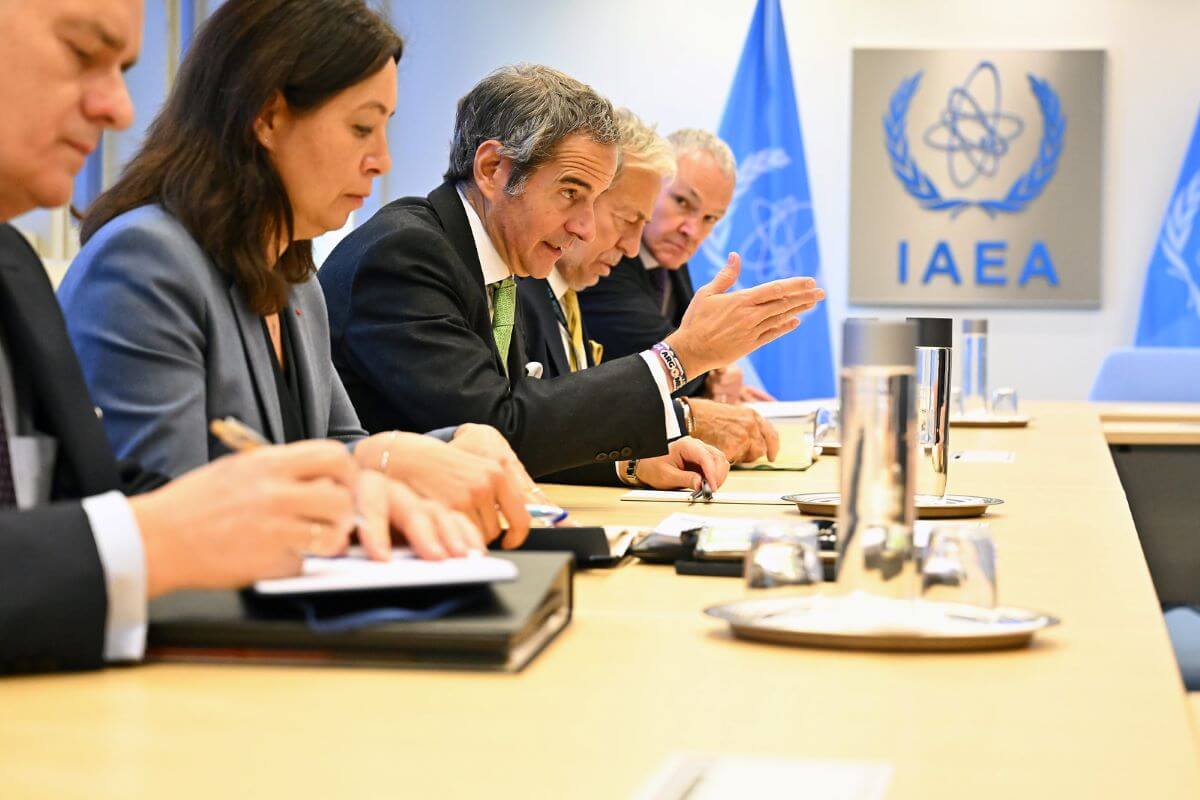
- Update 257 – IAEA Director General Statement on Situation in Ukraine (October 31): “At Ukraine’s Zaporizhzhya Nuclear Power Plant (ZNPP), repairs are being conducted in one of its six reactors after a small water leakage was detected from an impulse line – essentially a small pipe – connected to the unit’s primary circuit, with the work expected to be completed later this week, Director General Rafael Mariano Grossi of the International Atomic Energy Agency (IAEA) said [on October 31]. The IAEA expert team stationed at the ZNPP visited unit 1 on [October 29] after being informed that one of the impulse lines, part of the reactor coolant pump support systems, was leaking and required repair. For this work, the pressure in the primary circuit had to be decreased to atmospheric level. The team was informed [on October 31] that welding work had been completed and that radiography checks of the welds were on-going. ‘The Agency will continue to follow this issue closely, although we don’t see any immediate issue for nuclear safety. In general, we have identified regular equipment maintenance – which is vital to ensure sustainable nuclear safety and security – as a challenging area for the [ZNPP] during the conflict,’ Director General Grossi said.”
- Update 258 – IAEA Director General Statement on Situation in Ukraine (November 7): “A new expert team from the [IAEA] crossed the frontline [the week of November 4] to travel to Ukraine’s [ZNPP], replacing colleagues who have been monitoring nuclear safety and security at the site over the past several weeks as part of the IAEA’s non-stop efforts to help prevent a radiological accident during the military conflict. It is the 25th IAEA Support and Assistance Mission stationed at the ZNPP since Director General Rafael Mariano Grossi set up an Agency presence there in September 2022. It was followed a few months later by the establishment of similar IAEA missions at Ukraine’s four other nuclear facilities – the Khmelnytskyy, Rivne and South Ukraine nuclear power plants (NPPs) and the Chornobyl site. Over the [week of November 4], the teams at the three operating NPPs – which currently provide much of Ukraine’s electricity supplies – also rotated successfully.”
- IAEA Head Grossi: War No Reason Not to Operate Nuclear Power Plants (November 13): “The threat of a military attack on a nuclear power plant is not an argument against their operation and construction, [IAEA] Director General Rafael Grossi told DPA in Baku. ‘The problem is the war. The problem is not a nuclear power plant. I’m sorry,’ Grossi said on the sidelines of the UN Climate Conference in the Azerbaijani capital. ‘Well, you could say the same about having high-rises, buildings, airplanes crossing war zones,’ he said. Grossi said the fact that Russian troops occupied the [ZNPP] during their invasion of Ukraine is an isolated case. ‘It’s very, very regrettable, but to make a case against nuclear power plants because there is a war in Ukraine – it’s like moving the goalpost to find a new argument,’ he said.”
- Update 259 – IAEA Director General Statement on Situation in Ukraine (November 15): “Maintenance of several of the reactor safety systems is being conducted at Ukraine’s [ZNPP] an essential part of wider efforts to prevent a nuclear accident during the military conflict, Director General Rafael Mariano Grossi of the [IAEA] said [on November 15]. In its regular reporting on the situation at the ZNPP, the IAEA has previously identified ‘ensuring adequate and timely preventative maintenance of all structures, systems, and components important to safety’ as one of several challenges the plant is facing during the conflict, presenting a potential risk to long-term nuclear safety and security. Earlier this month, the IAEA expert team stationed at the ZNPP was informed that two safety trains – one in reactor unit 4 and the other in unit 5 – were placed under maintenance for work on their water regulation valves. The work is now complete and the two safety trains are back to standby mode. [The week of November 11], another two safety trains – in units 5 and 6 – were also taken out of service for planned maintenance. Each of the six reactors at the ZNPP has three separate, independent safety systems, called ‘safety trains’. These redundant systems are designed to ensure nuclear safety. Normally, these safety trains remain on standby but are ready to activate whenever needed to maintain the reactor’s safety. The six reactors of Europe’s largest nuclear power plant (NPP) are all in cold shutdown mode, but still require operational safety systems.”
- Russia Threatens To Expel UN Monitors From Zaporizhzhia Nuclear Plant (November 15): “Russia’s Foreign Ministry on Nov. 14 warned that it can expel [IAEA] inspectors from the occupied [ZNPP] if it finds their work ‘inappropriate.’ The statement comes a day after the agency’s director, Rafael Grossi, told the German news agency DPA that IAEA monitors would remain at the [ZNPP] until the war is ‘frozen.’ ‘We will continue to be there until the conflict comes to a new phase, at least less combat and maybe a ceasefire — no, a frozen conflict, whatever phase we enter into, but without this looming threat,’ Grossi said. The Russian Foreign Ministry issued a statement in response warning that IAEA experts are allowed at the [ZNPP] ‘only with the consent of the government of the Russian Federation.’ The nuclear monitors may only remain ‘as long as our country considers their stay there to be justified,’ the ministry said.”
- Update 260 – IAEA Director General Statement on Situation in Ukraine (November 17): “Ukraine’s operating [NPPs] reduced electricity production as a precautionary measure [the morning of November 17] following widespread military activities across the country that reportedly targeted its energy infrastructure, putting nuclear safety and security under further pressure, Director General Rafael Mariano Grossi of the [IAEA] said. Although the NPPs – Khmelnytskyy, Rivne and South Ukraine – were not directly impacted and did not shut down, several electrical substations on which they depend suffered further damage during the strikes, Director General Grossi said, citing information from Ukraine’s national regulator. The main power lines from four of the substations were disconnected. At the moment, only two of the country’s nine operational reactors currently generate electricity at 100 percent capacity. IAEA teams visited seven substations – located outside the NPPs across the country – in September and October to assess the damage from attacks in August and will assess whether further visits are required following today’s military activities, said Director General Grossi, who spoke to the head of the national regulator about the impact of the attacks.”
- Update 261 – IAEA Director General Statement on Situation in Ukraine (November 21): “Nuclear safety and security ‘remains in jeopardy’ at Ukraine’s [ZNPP], Director General Rafael Mariano Grossi told [the week of November 18’s] IAEA Board of Governors meeting, as the facility twice lost the connection to its only remaining 750 kilovolt (kV) power line within a few days. Caused by unspecified damage that occurred approximately 17 km from the plant, the first disconnection lasted for just over 30 hours from [the] morning [of November 16] until it was repaired and restored around noon the following day, Director General Grossi said, citing information from the IAEA’s team stationed at the ZNPP site. The line was lost again this morning. As a result of the disconnections, the ZNPP relied on its sole 330 kV back-up power line for the electricity it needs for reactor cooling and other key nuclear safety functions. The ZNPP’s connection to this line was itself lost twice in October, further underlining the fragility of its power supplies. Before the military conflict, Europe’s largest nuclear power plant (NPP) had four 750 and six 330 kV lines available.”
- Russia’s Missiles Threaten a Nuclear Meltdown in Ukraine (November 21): “In Ukraine, a surge in military hostilities has again thrown the safety of the country’s operational nuclear plants into jeopardy. Russia has been targeting conventional Ukrainian power stations, the transmission grid, and substations with the heaviest barrages in months—likely a reaction to the Biden administration’s recent authorization that allowed Ukraine to fire long-range U.S. missiles into Russia and subsequent green light to receive and deploy U.S.-made anti-personnel mines. The Russian drone and missile strikes on the Ukrainian energy system have now put the three nuclear stations that depend upon them—in Khmelnytskyi, Rivne, and South Ukraine—in grave danger. ‘Russia’s attacks on the power grid and Ukrainian conventional power plants is negatively affecting the safety of Ukraine’s nuclear fleet,’ Per Strand, director general of the Norwegian Radiation and Nuclear Safety Authority, said. (Norway works closely with Ukrainian regulators to maintain reactor safety.) ‘Russia is not targeting the nuclear plants themselves but rather damaging the electric system as a whole. This causes the power in the transmission grid to fluctuate, which undermines the reactors’ security.’”
- Update 262 – IAEA Director General Statement on Situation in Ukraine (November 28): “Ukraine’s three operating [NPPs] reduced their electricity generation [on November 28] following renewed attacks on the country’s energy infrastructure that further endangered nuclear safety during the military conflict, Director General Rafael Mariano Grossi of the [IAEA] said. For a second time in less than two weeks, the Khmelnytskyy, Rivne and South Ukraine NPPs lowered their power levels as a precautionary step during widespread military activities in the country, while air raid alarms sounded at the three sites, Director General Grossi said. Two of the IAEA teams deployed in Ukraine were forced to seek shelter. The operating NPPs have a total of nine reactors, all of which decreased output. One reactor, at the Rivne NPP, was also disconnected from the grid. The NPPs continued to receive external electricity, even though the Khmelnytskyy site lost the connection to two of its power lines. ‘Ukraine’s energy infrastructure is extremely fragile and vulnerable, putting nuclear safety at great risk,’ Director General Grossi said. ‘Once again, I call for maximum military restraint in areas with major nuclear energy facilities and other sites on which they depend.’”
International Architecture
- IAEA Completes International Physical Protection Advisory Service Mission in Rwanda: “An [IAEA] team of experts has concluded a two-week International Physical Protection Advisory Service (IPPAS) mission in Rwanda. The mission, conducted at the request of the Government of Rwanda, took place from October 28 to November 8, 2024. It was the first IPPAS mission to Rwanda. Hosted by the Rwanda Utilities Regulatory Authority (RURA), the six-person mission team reviewed Rwanda’s nuclear security regime for radioactive material, associated facilities and activities. As part of the review, the IPPAS team visited Gisagara Thermal Power Station, which utilizes radioactive sources to measure the level and consistency of peat fuel, in Southern Province of Rwanda. The team also visited the Rwanda Cancer Center, which is setting up their first brachytherapy unit, at the Kanombe Military Hospital in Kigali.”
- New IAEA and LinkedIn Practical Arrangement Brings Opportunities for Women in the Nuclear Field: “A new IAEA and LinkedIn Practical Arrangement will bring networking and training opportunities for women in the nuclear field. By joining forces, the IAEA and LinkedIn enter into a new partnership in workforce development and capacity building, especially in the nuclear energy and STEM sectors. This partnership will provide essential resources, including training, research, and access to LinkedIn’s extensive global network, helping to advance critical goals in these fields. The agreement was signed at the 29th Conference of the Parties to the United Nations Framework Convention on Climate Change (UNFCCC), or COP29, in Baku, Azerbaijan, by IAEA Director General Rafael Mariano Grossi and the co-founder of LinkedIn, Allen Blue, on Tuesday, November 12. ‘To achieve our goals and tackle the unprecedented challenges the world is facing, we need the right people. We need experts and leaders with fresh perspectives and skills,’ said Mr. Grossi. ‘LinkedIn’s vast network and insights will help us connect with those qualified people. It will also help women progress in the nuclear field, bringing greater diversity to the workforce.’”
- IAEA Conducts Disused Sealed Radioactive Sources Technical Centre Peer Review Mission in Slovenia: “An IAEA Disused Sealed Radioactive Sources Technical Centers (DSRS-TeC) peer review mission concluded in Slovenia this [November], marking the country’s first comprehensive examination of its procedures for managing disused sealed radioactive sources for the Agency for Radioactive Waste Management (ARAO). The mission, conducted at ARAO from 30 September to 2 October in Ljubljana, Slovenia, and comprised a team of two external experts along with two IAEA specialists. Launched last year, DSRS-TeC is a specialized IAEA peer review service that helps countries review operational standards and disused sealed radioactive sources (DSRS) management practices. It provides an independent review of current practices and offers suggestions for strengthened management over time. The review is focused on the early stages of source handling and aims to support countries in enhancing their standards and effectiveness in managing DSRSs.”
Threats
- What is Accelerationism, the White Supremacist Ideology Promoting Power Station Attacks: “A man ‘dedicated to white supremacist’ beliefs is facing federal charges in an alleged plot to use an explosives-laden drone to blow up a Nashville energy facility ‘in furtherance of his accelerationist ideology,’ a federal criminal complaint filed this week says. Accelerationism ‘refers to a white-supremacist belief that the existing state of society is irreparable and that the only solution is the destruction and collapse of the ‘system,’’ the complaint continues. It is ‘premised on the idea that steps can be taken to speed up the collapse of the system, to wit: the destruction of the US power grid, among other acts of violence.’ After his arrest [on November 2] in Nashville, Skyler Philippi, 24, was charged with attempted use of a weapon of mass destruction and attempted destruction of an energy facility, the US Justice Department said. He’s detained without bond and due back in court [on November 13]. His attorney told CNN he couldn’t comment on the case.”
Security Culture
- Don’t Rush to Media on Seizure of Radioactive Material: “The [Indian] Union Ministry of Home Affairs has asked all states and UTs to exercise restraint and do due diligence before making any media statement about the seizure of radioactive material as unsubstantiated and incorrect reports malign India’s image abroad. The decision to issue a written note was taken after the MHA recently noticed multiple instances where minutes after recovering some suspected radioactive material, local police issued statements to the media before any forensic confirmation or holding consultations with the Department of Atomic Energy (DAE). […] In August, Bihar Police arrested three persons from Gopalganj district and recovered 50 gm of a radioactive substance worth crores from their possession. In July, Uttarakhand police had arrested five persons in Dehradun for possessing boxes containing suspected radioactive material.”
Emerging Technologies
- Oklo Secures Up to 750 MW-Worth of New Data Center Partnerships: “Oklo, a fission power and nuclear fuel recycling company, announced it has received letters of intent (LOIs) and is partnering with two major data center providers to deliver up to 750 megawatts (MW) of power for data centers across the U.S. These commitments expand Oklo’s customer pipeline to approximately 2,100 MW. Under these LOIs, Oklo will work with ‘one of the fastest-growing data center companies,’ otherwise unnamed, to deploy its powerhouses in select markets. Oklo said this collaboration supports its expanding footprint, including its announced sites in Idaho, Ohio, Texas, and Wyoming. Oklo’s Aurora powerhouse design provides power directly on-site or nearby, with 15 MW and 50 MW units that can be deployed in phases. This approach aims to minimize project risks and reduce financing costs. ‘The strong customer response reflects confidence in Oklo’s clean, reliable, and affordable power solutions,’ said Jacob DeWitte, Co-Founder and CEO of Oklo. ‘Our approach helps enable customers to scale sustainably with reliable power aligned to their long-term goals.’”
Material Minimization
- NNSA Converts its 110th Research Reactor Following Decade-Long Effort in Japan: “The U.S. Department of Energy’s National Nuclear Security Administration (NNSA), in collaboration with Japan’s Kyoto University, recently converted the Kyoto University Critical Assembly (KUCA) ‘Core C’ from proliferation-sensitive highly enriched uranium (HEU) to high-assay low enriched uranium (HALEU) fuel. It is the 110th HEU facility that NNSA has converted or verified as shut down. The first HALEU fuel assembly loaded with uranium silicide fuel plates for KUCA’s Core C. The KUCA conversion project started in the late 2000s and has been an important part of U.S.-Japanese collaboration on nuclear nonproliferation ever since. NNSA and Japan’s Ministry of Education, Culture, Sports, Science, and Technology (MEXT) committed to converting KUCA from HEU to HALEU fuel in a joint statement at the 2016 Nuclear Security Summit and as part of the U.S.-Japan Nuclear Security Working Group.”
Weapons, Materials, and Facilities
- Hanford Patrol Locked Out of WA Nuclear Site as Contract Expires:“Security police officers for the Hanford nuclear site are not reporting to work [on November 27] after the Hanford Guards Union Local 21 contract expired. The union and Hanford Mission Integration Solutions, a Department of Energy contractor at the nuclear reservation, have been negotiating a new contract for the Hanford Patrol. HMIS President Amy Basche sent a memo [on November 26] to all Hanford site employees saying it had a contingency plan in place to provide security staff for Hanford until a new agreement is in place. The Hanford Patrol, an armed protective force, provides security for the 580-square-mile site adjacent to Richland, with duties that include protecting radioactive and classified materials, providing active shooter response, and deterring and responding to radiological and toxicological sabotage events by terrorists or others.”
Member Organization Announcements and Updates
Spotlight: Diversity, Equity, and Inclusion Lines of Effort
- Black Sea Women in Nuclear Network’s applications are open for their Fall 2025 Mentorship Program. The program connects young professionals with leaders in the CBRN space to develop their abilities, knowledge, and connections to create high-performing professionals. Find out more and apply.
Bellona Foundation
- Bellona has published its September 2024 Nuclear Digest featuring a survey of events in the field of nuclear and radiation safety relating to Russia and Ukraine. The newsletter analyzes the situation in order to assess the degree of Russia’s international influence on other countries and the risks connected with this, which includes comments from Alexander Nikitin and Dmitry Gorchakov, experts of Bellona’s nuclear project. Read the digest.
International Institute for Strategic Studies
- IISS published a report featuring Amy F. Woolf, Dr. Nikolai Sokov, and Dai Huaicheng where the three authors set out an examination of selected arms-control and risk-reduction proposals from their respective countries and assess their potential contributions to strategic stability. They also provide short critiques of the proposals tabled by the other two countries, thereby highlighting both the differences and the commonalities between the positions currently held by Washington, Moscow, and Beijing. Read the report.
Nuclear Threat Initiative
- Amid increasingly tense geopolitics, growing nuclear threats, and risks posed by rapidly evolving technologies, the Belfer Center for Science and International Affairs at Harvard Kennedy School, the Carnegie Endowment for International Peace, and the Nuclear Threat Initiative (NTI) announce the creation of a new high-level Task Force on Nuclear Proliferation and U.S. National Security. The bipartisan group, comprised of over a dozen former senior government officials and experts with deep national security experience, first met in October and will convene multiple times over the coming months to confront these pressing challenges. Members will address critical questions about how the changing geopolitical landscape could affect the proliferation of nuclear weapons and will issue a report with policy recommendations to guide the future of U.S. national security policy in a changing and challenging geopolitical environment. Find out about the task force.
Odesa Center for Nonproliferation
- Ali Alkis participated in the 2024 MEM Summit in Lugano, Switzerland, between 3-10 November. Ali discussed the importance of dialogue for conflict resolution. He also had a chance to the Seven Pillars of Nuclear Safety and Security and the Five Principles for the Protection of the Zaporizhzhia Nuclear Power Plant with the Federal Councilor of Switzerland, H.E. Ignazio Cassis, who chaired a meeting on the protection of Ukraine’s Zaporizhzhya nuclear power plant at the UN Security Council on 30 May 2023 during which Rafael Grossi, Director General of the International Atomic Energy Agency (IAEA), presented five principles to the Council to guarantee protection of the nuclear power plant.
- Ali Alkis presented his latest research at the international expert event on the protection of nuclear facilities in armed conflicts held in Ljubljana, Slovenia, between 14-15 November. Ali’s presentation reflected the need for operational and institutional solutions, with the ultimate aim of establishing a global convention to prohibit armed attacks against nuclear facilities.
Vienna Center for Disarmament and Non-Proliferation
- On October 28, VCDNP Senior Fellow Dr. Nikolai Sokov participated in the launch of a report “Evaluating Current Arms Control Proposals: Perspectives from the US, Russia and China” published by the International Institute for Strategic Studies (IISS). In the report, he assesses the Russian proposals on the freeze on deployment of INF-range missiles, which was made after the collapse of the 1987 Intermediate-Range Nuclear Forces (INF) Treaty in 2019. Read about his contribution to the report.
- In the latest brief of the VCDNP’s Governing the Atom series, Senior Research Associate Noah Mayhew and Research Intern Benedict Höfter describe the structure of the CTBTO Preparatory Commission, how its policy-making organs take decisions, what each of them considers, and the CTBTO’s contributions to science and capacity-building. Read the brief.
- In an article published by the European Leadership Network, written during his time at the VCDNP, former Research Intern Alexander Hoppenbrouwers explores the diversion risks of nuclear-powered submarine programs in non-nuclear-weapon States. Due to efforts by Australia and Brazil to acquire nuclear-powered submarines, the issue of naval nuclear propulsion and its impact on the nuclear non-proliferation architecture has been actively debated in recent years. Concern has focused on the potential diversion of nuclear reactor fuel used in these programs and the obstacles to verifying that this diversion does not occur. Read the article.
- In a New Voices feature in the November 2024 issue of Arms Control Today, written during his time at the VCDNP, former Research Intern Alexander Hoppenbrouwers lays out how States in the Global South differ in their approach to autonomous weapons regulations, and what this may mean for the future of discussions on the topic. Read the feature.
- On 25 October 2024, the Vienna Center for Disarmament and Non-Proliferation (VCDNP), the Istituto Affari Internazionali (IAI), and International Student/Young Pugwash (ISYP) held the second edition of the “Engagement Opportunities in Arms Control, Disarmament, and Non-Proliferation for Young Professionals and Students” event. The virtual meeting provided key insights and hands-on advice on youth engagement and careers in the arms control, disarmament, and non-proliferation space, and was attended by over 100 students and young professionals. Find out more about the event.
Individual Member Updates
- William Moon published a piece in Foreign Affairs arguing that Russia’s war on Ukraine is increasingly exposing Russian warheads to conventional war, and that Russia must move those warheads out of harm’s way. Read the piece.
- The UN Office on Drugs and Crime (UNODC) shared the following updates:
- On 21-22 October, UNODC co-organized with the Ministry of Foreign Affairs of Ecuador a legislative drafting workshop in Quito to support the country in bringing its existing counter-terrorism legislation and regulations in line with the international legal framework against terrorism, including by incorporating the obligations under the International Convention for the Suppression of Acts of Nuclear Terrorism (ICSANT). The activity was supported by Canada and Sweden. Read about the workshop.
- On 8 November, UNODC held an event on nuclear forensics case study during its Webinar Series on ICSANT, funded by the European Union (EU). Learn more about the event.
Opportunities
- GDIT and the U.S. Department of State are seeking a Program Advisor to oversee international capacity-building trainings aimed at addressing pressing nuclear security, proliferation, safety, and sovereignty challenges posed by aggressive civil nuclear reactor exports. This FIRST Program Advisor will serve as an on-site/hybrid contractor at the Department of State and assist CTR in developing, managing, and coordinating FIRST and civil nuclear security capacity-building efforts. The Program Advisor will be responsible for providing programmatic, financial, and technical oversight to assigned projects and activities while actively contributing to strategically advancing the FIRST team’s objectives and programming. Read more.
- The David Rockefeller Studies Program at the Council on Foreign Relations (CFR) is seeking to hire a Stanton Nuclear Security Senior Fellow. The fellow will be expected to conduct original research on nuclear security policy, which includes nuclear terrorism, nuclear proliferation, and nuclear weapons, and as it relates to nuclear security, nuclear energy. This is an extraordinary opportunity for an individual looking to shape new thinking and creative policy solutions on the spread of nuclear weapons to unstable and hostile states, the collapse of arms control and risk of conflict between nuclear-armed nations, the importance of nuclear weapons in great power competition, and the impact of new technologies such as AI and quantum on the nuclear balance. Read more.
- The Partnership for Global Security (PGS) is seeking applicants for their Research Internship. The intern will primarily focus on researching nuclear security, nuclear energy, and transnational governance issues. Current research projects that interns will support include: exploring the nexus of climate change, nuclear power growth and global security; understanding the growth of nuclear energy in the Middle East and East Asia; tracking the evolution of nuclear security policies and governance structures; using existing voluntary frameworks as a model for nuclear security governance structures; and examining cybersecurity and other potential threats prompted by new technology developments. Read more.
- The Partnership for Global Security (PGS) is seeking candidates for the Della Ratta Global Energy and Security Fellowship. This is a $15,000 stipend-supported six-month position. The applicant’s term will run from January-June 2025. The Della Ratta Fellowship is a unique opportunity for early career candidates to develop the skills and experience that are necessary for a rapidly evolving technological, security, and geopolitical environment. The primary focus is on addressing the intensifying intersection of nuclear energy and commerce, climate change, global security, geopolitics, and international energy security. Read more.
- The Laboratory of Applied Nuclear Physics (LANPh) is announcing two openings at the level of a postdoc and/or research scientist. The selected scientists will have the chance to work on groundbreaking research in nuclear physics applied to problems in nuclear security, such as arms control, cargo security, and nuclear detection. The principal duties include contributing to existing projects at LANPh in leading/co-leading roles’ guiding graduate and undergraduate students in their research, designing experiments and new engineering concepts, and co-authoring papers and proposals.Read more.
- The Nuclear Threat Initiative is seeking a Director, with a focus on Nuclear Energy, to join the Nuclear Materials Security (NMS) team. This position reports to the Vice President for NMS. This is a full-time hybrid position, working a minimum of three days a week in our Washington, DC office. Read more.
- The Raymond Frankel Nuclear Security Policy Fellowship provides an opportunity for an early-career professional with training in security studies or nuclear policy to learn about a career in public policy and administration. Reporting to the Chief Program Officer, the Fellow will assume primary responsibility for one or more workstreams within the Academy’s nuclear and global security portfolio. They will work in close coordination with Academy staff, the Academy’s Committee on International Security Studies (CISS), and project chairs to steward and advance the work of this program area. Read more.






Community Adaptation for a Water Festival Without Clean Water