

This resource was made possible by a grant from Carnegie Corporation of New York. The statements made and views expressed are solely the responsibility of the author.
Dear Friends,
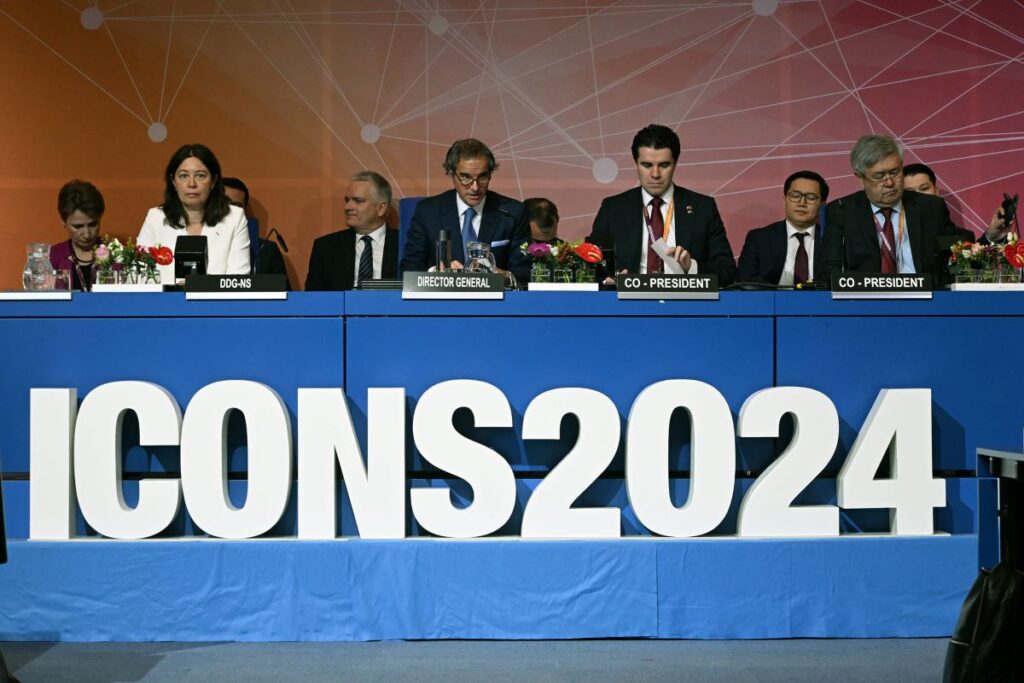
It was a pleasure to connect with so many of you in person at the recent International Conference on Nuclear Security (ICONS) 2024 in Vienna. While there is still much to process from the conference, the dedication and purpose of the some 2,000 participants in the event was evident. Despite disagreement by one national delegation which prevented consensus on the traditional Ministerial Declaration, the joint statement issued instead by the conference co-presidents emphasized that “any attacks or threats of attacks against nuclear facilities devoted to peaceful purposes may compromise nuclear security,” and expanded on the 2020 declaration in other notable ways. These included recognition of the “potential challenges and benefits” of emerging and innovative technologies and the importance of nuclear security considerations in advanced nuclear technologies and reactors and in transport of nuclear and other radioactive material. With the International Atomic Energy Agency (IAEA) warning again this month against attacks on or from Ukraine’s Russian-occupied Zaporizhzhia nuclear power plant and several reports of radioactive material out of regulatory control, the urgent relevance of the conference themes is clear. I invite you to read on for this month’s nuclear security headlines and member updates, including a wealth of information on ICONS 2024 events and presentations.
Christina
Director, International Nuclear Security Forum
Join the conversation on X: @INS_Forum
Follow INSF on LinkedIn.
Updates
- On behalf of the INSF, the Stimson Center’s Christina McAllister chaired a side event titled “The Future of Civil Society in Advancing Nuclear Security Culture” on May 23 at the IAEA’s International Conference on Nuclear Security in Vienna, Austria. Rhonda Evans, Margarita Kalinina-Pohl, Ali Alkis, and Simon Adu spoke on the panel about how civil society affects nuclear security and how international civil society organizations have unique impacts on their respective regions.
- NEW! The INSF now has a LinkedIn page. Follow us here: https://www.linkedin.com/company/international-nuclear-security-forum
- FUNDING APPEAL: If you appreciate this newsletter, please consider a donation to ensure sustainability into the future. Donate here and specify where indicated that your gift is intended to support the INSF. Institutional funding for civil society’s nuclear security work is increasingly hard to come by, as many readers already know, and the International Nuclear Security Forum appreciates your support!
Nuclear Security News
ICONS 2024
- Nuclear Security Through the Eyes of the Co-Presidents of ICONS 2024: “Kairat Umarov, First Deputy Minister of Foreign Affairs of Kazakhstan, and Tim Watts, Assistant Minister for Foreign Affairs of Australia, are the Co-Presidents of the International Conference on Nuclear Security: Shaping the Future (ICONS 2024). The Co-Presidents share their views about the significance of the conference, the contribution of nuclear security to sustainable development, and how the future will be shaped by emerging technologies such as AI and by emerging risks and threats in nuclear security.”
- International Community Meets to Discuss the Future of Nuclear Security: “Over 2000 Ministers, high-ranking officials, experts and delegates from all over the world will convene at the IAEA hosted, International Conference on Nuclear Security: Shaping the Future (ICONS 2024)…Taking place from 20 to 24 May, the focus of the conference will be on how to further strengthen global nuclear security and addressing challenges related to new risks, threats and emerging technologies.”
- Nuclear Security: Adapting to a Changing World: “Since the IAEA’s last International Conference on Nuclear Security (ICONS) in 2020, the world has experienced momentous change, including a global pandemic and a war, in Ukraine, where for the first time a major nuclear power program finds itself in the crossfire….All these opportunities depend on a strong and adaptive global nuclear security regime and laser-focused vigilance. Groups with malicious intent must not be given a chance to use nuclear and radioactive material to cause panic or harm.”
- Towards a Stronger Global Legal Framework for Nuclear Security: “More and more countries are joining international legal instruments that promote stronger nuclear security around the world, including countries that do not have domestic nuclear facilities or materials such as those used in nuclear power plants or research reactors. As of April 2024, a total of 136 States have become Parties to the Amendment to the Convention on the Physical Protection of Nuclear Material (A/CPPNM). The Amendment came into force in May 2016 and was developed as part of the aforementioned broader push to strengthen the global legal framework with the aim of preventing nuclear and other forms of terrorism involving weapons of mass destruction.”
Impact: The Russian Invasion of Ukraine
- IAEA Warns Against Attacks on, or from, Zaporizhzhia Nuclear Power Plant (May 10): “In his latest update on the situation at the six-unit Zaporizhzhia nuclear power plant, which has been under Russian military control since early March 2022, Grossi said that on the question of military action targeting the plant, or being launched from it ‘the five concrete principles – widely supported by the members of the United Nations Security Council – are very clear.’ He said that the agency’s experts at the plant had heard military activity on most days ‘including artillery and rocket fire some distance away … as well as small arms fire both near to and further away from the site.’ There had also been air-raid sirens on [May 8 and 9]. The IAEA was ‘aware of reports alleging that a training base for drone operators as well as drone launch pads have been deployed near the ZNPP’s reactor unit 6 and its training center. The IAEA experts have not seen any evidence of drones being launched, or the presence of training facilities or launching pads, within the site perimeter, but have requested access to the rooftop of a nearby laboratory building. The ZNPP has informed the IAEA team that the request is under consideration’…Another issue that the IAEA has been monitoring has been the staffing situation at the plant. The Russian operators say there are currently 5000 staff, an increase on last year but ‘still significantly fewer than it had before the conflict,’ the agency added. There are 800 open positions, and the operators have told the IAEA that staffing levels at Rosatom-operated nuclear power plants are generally ‘significantly lower than the corresponding staffing levels of Ukraine.’ The IAEA says its experts are ‘prevented from freely talking to main control room staff, affecting the agency’s ability to independently assess the knowledge and experience of these personnel that are essential to maintaining nuclear safety at the ZNPP.’”
- New IAEA Team Arrives at Zaporizhia NPP (May 21): “A new team of experts from the International Atomic Energy Agency (IAEA) has arrived at the Zaporizhia NPP (ZNPP), crossing the frontline to reach the site as part of the IAEA’s mission to help prevent a nuclear accident during the armed conflict, Director General Rafael Mariano Grossi said. This is the 19th team of IAEA experts stationed at the site since Grossi established a permanent presence there more than 20 months ago…‘The IAEA will remain present at the ZNPP for as long as it is needed. The nuclear safety and security situation at the plant remains extremely precarious and challenging. Thanks to our experts at the site, we can inform the world about developments there. We will continue to do everything in our power to keep this major nuclear facility safe and secure,’ Grossi said.”
- Update 229 – IAEA Director General Statement on Situation in Ukraine (May 23): Ukraine’s Zaporizhzhya Nuclear Power Plant (ZNPP) temporarily lost the connection to its sole remaining 750 kilovolt (kV) off-site power line […] due to a reported short-circuit, leaving it reliant on a single back-up line for more than three hours, Director General Rafael Mariano Grossi of the International Atomic Energy Agency (IAEA) said [on 23 May]. The disconnection of the 750kV Dniprovska line once again underlines the extremely precarious nuclear safety and security situation at the ZNPP during the armed conflict. It occurred at 1:31pm local time around six kilometers away from the ZNPP’s 750 kV open switchyard, in Russian-controlled territory. The ZNPP informed the IAEA experts stationed at the site that it was caused by a short-circuit, without providing further details. The line was re-connected at 4:49pm, the plant said. The event also amplifies concerns around attacks on the electrical power infrastructure elsewhere in Ukraine, as indicated last week, highlighting the risk to the ZNPP as well to the other operating nuclear power plants (NPPs) in the country. When the 750 kV line was disconnected, the ZNPP received external electricity from its only 330 kV back-up line and it is particularly vulnerable to such disruptions, as illustrated by [the May 23] event. Before the conflict, the plant had four 750 kV and six 330 kV lines available.
International Architecture
- Five-year Project to Enhance Nuclear Safety and Security in Romania Completed with Norway and IAEA Support: “Romania’s regulatory infrastructure for nuclear safety and security has been strengthened by a five-year project that was completed [in the end of April]. Funded by the Norway Grants and supported by the IAEA, the Enhancement of Nuclear Safety, Security and Emergency Preparedness in Romania (NORROM) project stands as a testament to international cooperation to improve nuclear safety and security. The closing conference of the project took place on 25 April in Bucharest and highlighted the collaborative effort to enhance nuclear safety and security in Romania and worldwide. Through its five-year lifespan, the project completed 138 activities, 83 of which were organized and supported by the IAEA. These activities were designed to review and develop regulations, guidelines, computer security inspection guides, procedures, and training materials. Additionally, through the NORROM project, the Romanian National Commission for Nuclear Activities Control (CNCAN) was able to establish a new emergency information and training center.”
- INSSP in Jordan Workshop Concludes: “The ‘Integrated Nuclear Security Sustainability Plan (INSSP) in Jordan’ workshop concluded recently. Organized by the Energy and Minerals Regulatory Commission (EMRC) in cooperation with the International Atomic Energy Agency (IAEA), the workshop aimed to review areas related to the INSSP by adopting a comprehensive approach to ensure the safe and secure use of radioactive and nuclear materials, facilitate the establishment of a national nuclear security system to address emerging challenges in the nuclear security field, including potential cyber threats, and contribute to collective efforts aimed at enhancing global security, EMRC President Ziad Saaideh said on [May 4].”
Weapons, Materials, and Facilities
- Sites with Radioactive Material More Vulnerable as Climate Change Increases Wildfire, Flood Risks: “As Texas wildfires burned toward the nation’s primary nuclear weapons facility, workers hurried to ensure nothing flammable was around buildings and storage areas. When the fires showed no sign of slowing, Pantex Plant officials urgently called on local contractors, who arrived within minutes with bulldozers to dig trenches and enlarge fire breaks for the sprawling complex where nuclear weapons are assembled and disassembled and dangerous plutonium pits — hollow spheres that trigger nuclear warheads and bombs — are stored. ‘The winds can pick up really (quickly) here and can move really fast,’ said Jason Armstrong, the federal field office manager at Pantex, outside Amarillo, who was awake 40 hours straight monitoring the risks…the size and speed of the grassland fires, and Pantex’s urgent response, underscore how much is at stake as climate change stokes extreme heat and drought, longer fire seasons with larger, more intense blazes and supercharged rainstorms that can lead to catastrophic flooding. The Texas fire season often starts in February, but farther west it has yet to ramp up, and is usually worst in summer and fall. Dozens of active and idle laboratories and manufacturing and military facilities across the nation that use, store or are contaminated with radioactive material are increasingly vulnerable to extreme weather. Many also perform critical energy and defense research and manufacturing that could be disrupted or crippled by fires, floods and other disasters.”
- Forum Pitches for Safety of Nuclear Material on Transit: “Kenya has amplified calls for collaboration in southern and eastern Africa in tackling threats associated with nuclear and radioactive material. This came as representatives of eight countries met in Nairobi for an East African symposium to explore ways of improving safety and security during the transportation of such material.”
- Canister of Radioactive Material Discovered at Local Scrapyard: “The City of Cape Town’s Fire and Rescue Hazmat team was called into action [on May 7] after a canister of radioactive material was discovered at a local scrapyard. Shortly before midday…the CoCT control room received an urgent distress call from a scrapyard in Beaconvale. While offloading a tipper truck, employees discovered a canister labelled as hazardous radioactive material. The city immediately dispatched its traffic services to secure the area while also dispatching the Fire and Rescue Hazmat teams. Upon arrival, Fire and Rescue personnel followed the proper protocols for dealing with radioactive materials. They were able to approach and assess the potential risk thanks to remote-controlled sensor technology. However, fears were confirmed when the suspicious container emitted high levels of gamma rays, indicating the presence of decaying radioactive waste within it.”
Threats
- Low-Activity Radioactive Equipment Stolen in Barcelona: “The Spanish Nuclear Security Council has reported that low-activity radioactive equipment was stolen in Barcelona on [May 7]. It was first reported that the event occurred in La Llagosta, just north of the Catalan capital. Catalan civil protection agents reported the information on social media and shared that the equipment was stolen on Riera d’Horta street in the neighborhood of Horta-Guinardó. The equipment is an orange suitcase that measures the density and humidity of soil. It has two radioactive sources and is considered risk level four of a five-level category, with five being the least dangerous. Category four is considered “very unlikely to harm humans,” as the radioactivity that it carries does not represent any radiological risks, while the equipment remains “closed and completed.” However, if the suitcase is opened or destroyed, the two radioactivity sources could be unprotected, posing a potential risk to humans. For this reason, authorities urge those who find it not to play with it and to call emergency services. The CPN brand equipment has the serial number M300805849 and contains sources Caesium-137 and Americium-241 (Am-241).”
- ‘No Public Threat’ As Radiological Material Found: “The Metropolitan Police said ‘small traces of radiological material’ had been detected during a counter-terrorism operation in Bedfordshire. Specialist officers have been searching a house in Caddington, near Luton, after suspicious substances were found earlier this month. A 31-year-old man from Bedford has been arrested on suspicion of terrorism offences and remained in custody.”
- IAEA Incident and Trafficking Database (ITDB) 2024 Factsheet: “The IAEA Incident and Trafficking Database (ITDB) is a component of the IAEA information management systems and supports the implementation of the IAEA Nuclear Security Plan. The ITDB contains authoritative information, voluntarily reported by participating States through their officially nominated Points of Contact (PoCs). This information is disseminated through the IAEA to participating States and relevant international organizations…As originally established, the ITDB recorded incidents of illicit trafficking of nuclear and other radioactive material. Its scope was later expanded to include all incidents in which nuclear and other radioactive material is or was out of regulatory control…As of 31 December 2023, the ITDB contained a total of 4243 confirmed incidents reported by participating States since 1993”
Security Culture
- NNSA Conducts Multi-laboratory Nuclear Forensics Exercise: “If nuclear material or a nuclear device were intercepted in the United States, decision-makers would need to know as quickly as possible where it came from and who was responsible. With that in mind, NNSA’s Office of Counterterrorism and Counterproliferation recently conducted the Epic Shadow exercise to demonstrate its Nuclear Forensics Material Analysis Program (NF-MAP) capabilities and answer these questions. The Office of Nuclear Forensics sustains NF-MAP, part of NNSA’s Nuclear Emergency Support Team (NEST), to support national decision-making and law enforcement efforts to attribute nuclear threats. ‘NF-MAP delivers timely, specific, state-of-the-art forensic results for nuclear materials found outside regulatory control, whether intercepted, discovered, or taken from an undetonated nuclear device,’ said Randall Weidman, acting NF-MAP Program Manager. ‘We hold Epic Shadow exercises twice a year to stay ready.’”
Emerging Technologies
- Tetris-Inspired Radiation Detector Uses Machine Learning: “Inspired by the tetromino shapes in the classic video game Tetris, researchers in the US have designed a simple radiation detector that can monitor radioactive sources both safely and efficiently. Created by Mingda Li and colleagues at the Massachusetts Institute of Technology, the device employs a machine learning algorithm to process data, allowing it to build up accurate maps of sources using just four detector pixels.”
Member Organization Announcements and Updates
Black Sea Women in Nuclear Network
- The Black Sea Women in Nuclear Network (BSWN) had a very successful week at the IAEA’s International Conference on Nuclear Security (ICONS) with a booth that was supported by the Swedish Radiation Safety Authority. The booth featured BSNW promotional materials and publications, including photo opportunities and live interviews with conference participants covering topics related to nuclear security and DEIA (diversity, equity, inclusion, and accessibility). Explore pictures and interviews from the event.
The Stimson Center
- Christina McAllister presented a paper at ICONS 2024 titled RadSecLexis: An Opensource Online Database and Tool for Radiological Source Security Frameworks in the “Strengthening Regulatory Frameworks for Radioactive Sources Throughout the Life Cycle” session on Thursday, May 23 from 4:00-5:30.
International Institute for Strategic Studies
- Zuzanna Gwadera published a Missile Dialogue Initiative titled “Poland set to bolster its long-range strike capability” on April 23, 2024. The article covers the U.S. approval of a possible sale of up to 1,800 air-launched missiles to Poland, including the long-range Joint Air-to-Surface Standoff Missile-Extended Range (JASSM-ER). Read the article.
- Antoine Levesque published a Missile Dialogue Initiative titled “India Shows its Deterrent Holds Chinese Cities at Risk” on April 19, 2024. The article covers India’s recent test of an Agni-V missile using a multiple independently targetable re-entry vehicle (MIRV), and how it serves as a milestone in the country’s long-held ambition to acquire an ICBM. Read the article.
- IISS published a series of podcasts:
- Robert Ward hosted Chris Hughes, Professor of International Politics and Japanese Studies at the University of Warwick, Dr Naoko Aoki, Associate Political Scientist at the RAND Corporation, and Joseph Dempsey, Research Associate for Defense and Military Analysis at the IISS for a discussion on Japan and North Korea on May 14, 2024. Listen to the episode.
- William Alberque hosted Anna Péczeli to discuss Russian perspectives on the Comprehensive Test Ban Treaty (CTBT) and the Partial and Threshold Bans on May 9, 2024. Listen to the episode.
James Martin Center for Nonproliferation Studies, Middlebury Institute of International Studies at Monterey
- This paper by James Martin Center for Nonproliferation Studies (CNS) Eurasia Nonproliferation Program Director Dr. Hanna Notte assesses the impact of Russia’s war against Ukraine on multilateral nuclear diplomacy, with a particular focus on dynamics between Russia and countries of the Global South. Read the paper.
- Christopher Nolan’s biopic Oppenheimer has captured the interest of nearly 100 million people around the world. Dr. Sig Hecker, Distinguished Professor of Practice at CNS and Director Emeritus, Los Alamos National Laboratory, provided the back story to some key elements of the film and shares his views on Oppenheimer’s and the Manhattan Project’s legacies, based on his more than five-decades associated with the laboratory Oppenheimer led. Watch the video.
- On May 14, 2024, CNS hosted a seminar centered around former CNS alum and current Senior Advisor for the Oppenheimer Project, Theo Kalionzes’ innovative piece in the Chronicle of Philanthropy. Delving into the crucial intersection of climate philanthropy and nuclear issues, Kalionzes not only presented his insightful arguments but also shared invaluable reflections from his time as a grant maker at the John D. and Catherine T. MacArthur Foundation. Watch the video.
- CNS Director Dr. William Potter and Eurasia Nonproliferation Program Director Dr. Notte discussed lessons from prior radiological weapons programs and past efforts to prohibit these weapons at an event organized by the Geneva Centre for Security Policy. The event was moderated by Dr Christina Schori Liang, Head of Counterterrorism and Preventing Violent Extremism, Research and Policy Advice Department, Geneva Centre for Security Policy. Read more and watch the discussion.
Nuclear Proliferation Prevention Project, University of Texas
- Alan Kuperman attended the IAEA’s International Conference on Nuclear Security from May 19-24, 2024, in Vienna, Austria. Read more.
Nuclear Threat Initiative
- NTI staff participated in ICONS 2024, including several technical sessions and side events:
- Jack Brosnan presented a paper titled Retaining a Diverse Nuclear Workforce for the Future in the “Competence Building and Human Resource Management for a Robust Nuclear Security Workforce” panel on Wednesday, May 22 from 11:00-12:30.
- Jessica Bufford presented a paper titled Civil Society Contributions to Nuclear Security in the “Exploring the Role of Civil Society in Shaping the Future of Nuclear Security Together” on Thursday, May 23 from 4:00-5:30.
- Nickolas Roth presented a paper titled 2023 Nuclear Security Index: Falling Short in a Dangerous World in the “Exploring the Role of Civil Society in Shaping the Future of Nuclear Security Together” on Thursday, May 23 from 4:00-5:30.
- Nickolas Roth presented a paper titled Mitigating Insider Threats Posed by Domestic Violent Extremists in the “Adapting to Adversity: Ensuring Nuclear Security in Complex and Challenging Environments” on Friday, May 24 from 1:00-2:30.
- Kyle Tucker presented a paper titled Redefining the Cooperative Threat Reduction Model for Multilateral Nuclear Security in the “Adapting to Adversity: Ensuring Nuclear Security in Complex and Challenging Environments” on Friday, May 24 from 1:00-2:30.
- NTI hosted the side event “Nuclear Security in Times of Crisis” on Thursday, May 23 from 12:45-1:45. The side event launched their new report of the same name that covers how increasingly frequent and intense global crises pose new threats to civilian nuclear facilities. The side event and report both evaluate existing strategies for reducing risks and recommend additional steps that governments, industry, and other stakeholders can take to build resiliency. Read the report.
- NTI also staffed a booth for conference attendees to meet the nuclear material security team and learn more about NTI’s work and exchange perspectives on key nuclear security issues.
Odesa Center for Nonproliferation
- Ali Alkis participated in the INSF’s ICONS side event titled “The Future of Civil Society in Advancing Nuclear Security Culture” on May 23, and spoke about the role of civil society organizations in reinforcing nuclear security in Türkiye. Alkis called for recognition of regional differences in nuclear security and for regional ICONS in the future.
- Ali Alkis was selected one of the Leaders 4 Nuclear (L4N) program by the International Youth Nuclear Congress. Read more.
Vienna Center for Disarmament and Non-Proliferation
- VCDNP experts participated in ICONS 2024, including speaking in and moderating two technical sessions and holding one side event on high-level engagement on nuclear security. Read the Papers and View the Presentations.
- The VCDNP’s side event at ICONS 2024 focused on effectively engaging parliamentarians and other high-level officials to advance nuclear security globally in general and promote the universality of legal instruments for nuclear security in particular. Panelists included Ambassador Brigitte Brenner (Inter-Parliamentary Union), Elena Buglova (IAEA), Ambassador Laura Holgate (United States), Dr. Khammar Mrabit (Morocco), and Dr. Boster Dearson Siwila (Zambia). VCDNP Executive Director Elena Sokova gave opening remarks and emphasized the critical role that parliamentarians play in advancing nuclear security goals domestically.
- Senior Fellow Dr. Sarah Case Lackner spoke during a technical session on “Charting the Way Forward: Assessing Current and Future Challenges on the Implementation of the A/CPPNM”.
- Senior Research Associates Ingrid Kirsten and Anthony Stott co-authored a paper on the role of civil society in shaping a more secure future for all. Ms. Kirsten presented the paper during a technical session focused on “Exploring the Role of Civil Society in Shaping the Future of Nuclear Security”. Non-Resident Senior Fellow Laura Rockwood moderated the session.
- The VCDNP, in cooperation with the Inter-Parliamentary Union, hosted 15 members of parliament and senior officials for a workshop on the importance of adhering to international legal instruments related to nuclear security. To support this message, the workshop featured high-level briefings and panel discussions focused on the importance of peaceful uses of nuclear technology and the role of nuclear security in reducing the risk of misuse of radioactive sources by malicious actors.Read more.
- VCDNP Program Director Gaukhar Mukhatzhanova will lead a multi-year research and dialogue program on nuclear disarmament, multilateral diplomacy, and institutions funded by the Government of Japan. Find out more about the program and her background.
- On 8 April 2024, the research consortium VeSPoTec (Verification in a Complex and Unpredictable World: Social, Political and Technical Processes) and the VCDNP held a workshop focused on the potential role of the International Atomic Energy Agency in verifying the irreversible reduction and elimination of military nuclear stockpiles. Read about the workshop.
- In a special feature in the newly published Hiroshima Report, VCDNP Senior Fellow Angela Kane reflects on the strengths and shortcomings of the “G7 Leaders’ Vision on Nuclear Disarmament”, adopted at the G7 Summit in Japan in May 2023. Read the Special Feature and Full Report.
- The VCDNP and International Affairs Institute convened the final meeting of the third edition of their Mentorship Program for young women in non-proliferation and disarmament. Read more about the event.
World Institute for Nuclear Security
- WINS staff participated in ICONS 2024, including presenting papers in numerous technical sessions and hosting two side events:
- Whitney Kathryn Isaacs presented a paper titled Contributing to the Advancements in Civil Nuclear Technologies for Sustainable and Long-Term Energy Demands in Latin America, Through Capacity Building and Workforce Development at the “Establishing Strong Nuclear Security Program” panel on Tuesday, May 21 from 11:00-12:30.
- Leyla Amur presented a paper titled Toward Gender Equality, Diversity, and Inclusion as a Core Nuclear Security Principle at the “Equality in Action: Strategies for Establishing an Inclusive Workforce” panel on Tuesday, May 21, from 14:30-16:00.
- Viviana Espinosa Moreno presented a paper titled AI Integration in Nuclear Security: Navigating Transformations, Risks, and the Imperative of Bias and Stereotype Mitigation at the “Exploring the Practical Uses and Potential Threats of Artificial Intelligence” panel on Wednesday, May 22, from 11:00-12:30.
- Anu Shrivastava presented a paper titled Revolutionizing Threat Analysis Using New Media Technology at the “Step One: The Use of DBT and Threat Assessment to Know the Adversary” panel on Thursday, May 23, from 4:00-4:30.
- Lars van Dassen presented a paper titled The NPT and Nuclear Security: Tracing and Strengthening an Important Relationship at the “From Commitments to Action: Perspectives on Implementing Legal Provisions for Nuclear Security” on Friday, May 24, from 10:45-12:15.
- WINS hosted the side event “Shaping the Future: Networking Event for the Next Generation of Nuclear Security Professionals” on Tuesday, May 21 from 4:15-6:15. Read about the side event.
- WINS hosted the side event “The Next Generation of Nuclear Security Professionals: How Gender Equality, Diversity, and Inclusion is Shaping the Future” on Wednesday, May 22, from 12:45-1:45. Read about the side event.
Individual Member Updates
- The UN Office on Drugs and Crime (UNODC) contributed to a Table-Top Exercise on Nuclear Forensics and Relevant Legal Frameworks “Glowing Tulip 2.0: From Crime Scene to Courtroom” from April 23-26, 2024, in The Hague, the Netherlands. The event was co-funded by the EU within the framework of the project promoting the International Convention for the Suppression of Acts of Nuclear Terrorism (ICSANT).
Opportunities
- Parsons Corporation is seeking a Project Manager for their Global Nuclear Security Projects portfolio – a U.S. Government contract. The Project Manager will provide direction and management for small to medium-sized international nuclear security projects. The projects work with nuclear material security, including efforts to ensure the secure storage and transportation of nuclear warheads, weapons-usable nuclear material, and high-threat radiological material. Read more.
- CRDF Global is seeking a Senior Program Manager for the Nuclear Technologies profile under the supervision of the Director of Nonproliferation and Counterproliferation Programs. The Senior Program Manager will be responsible for managing CRDF Global activity on one or more significant programs, has supervisory experience as well as program or project management experience, and experience managing high-impact activities. Read more.
- The Partnership for Global Security (PGS) is seeking applicants for their Research Internship. The intern will primarily focus on researching nuclear security, nuclear energy, and transnational governance issues. Current research projects that interns will support include: exploring the nexus of climate change, nuclear power growth and global security; understanding the growth of nuclear energy in the Middle East and East Asia; tracking the evolution of nuclear security policies and governance structures; using existing voluntary frameworks as a model for nuclear security governance structures; and examining cybersecurity and other potential threats prompted by new technology developments. Read more.
- The Nuclear Threat Initiative (NTI) is seeking an Outreach and Advocacy Specialist to join a strategic communications initiative to shift public perceptions, kickstart activism, and engage influential allies on growing nuclear threats. This is a remote contract position requiring a commitment of 20-40 hours per week through the end of 2024. Read more.
- The Laboratory of Applied Nuclear Physics (LANPh) is announcing two openings at the level of a postdoc and/or research scientist. The selected scientists will have the chance to work on groundbreaking research in nuclear physics applied to problems in nuclear security, such as arms control, cargo security, and nuclear detection. The principal duties include contributing to existing projects at LANPh in leading/co-leading roles’ guiding graduate and undergraduate students in their research, designing experiments and new engineering concepts, and co-authoring papers and proposals.Read more.
- ANSER is seeking a Nuclear Security Analyst providing support to the Office of the Deputy Assistant Secretary of Defense for Nuclear Matters (OASD(NCB/NM)) Directorate of Nuclear Forensics, Energy, and Survivability. The candidate will perform a variety of multifaceted scientific, technical, and analytical tasks regarding the national strategic deterrent and nuclear security. Read more.
- Ploughshares seeks applicants for a competitive, one-year paid position as a Roger L. Hale Fellow. The Fellow will gain practical daily experience and engage with a wide variety of nuclear weapons policy issues and leaders. This year, the Fellow will be based in Ploughshares’ Washington, DC office and support the organization’s field-building efforts.Read more.
Header image: ICONS 2024 by IAEA Imagebank






Community Adaptation for a Water Festival Without Clean Water