
Dear Friend,
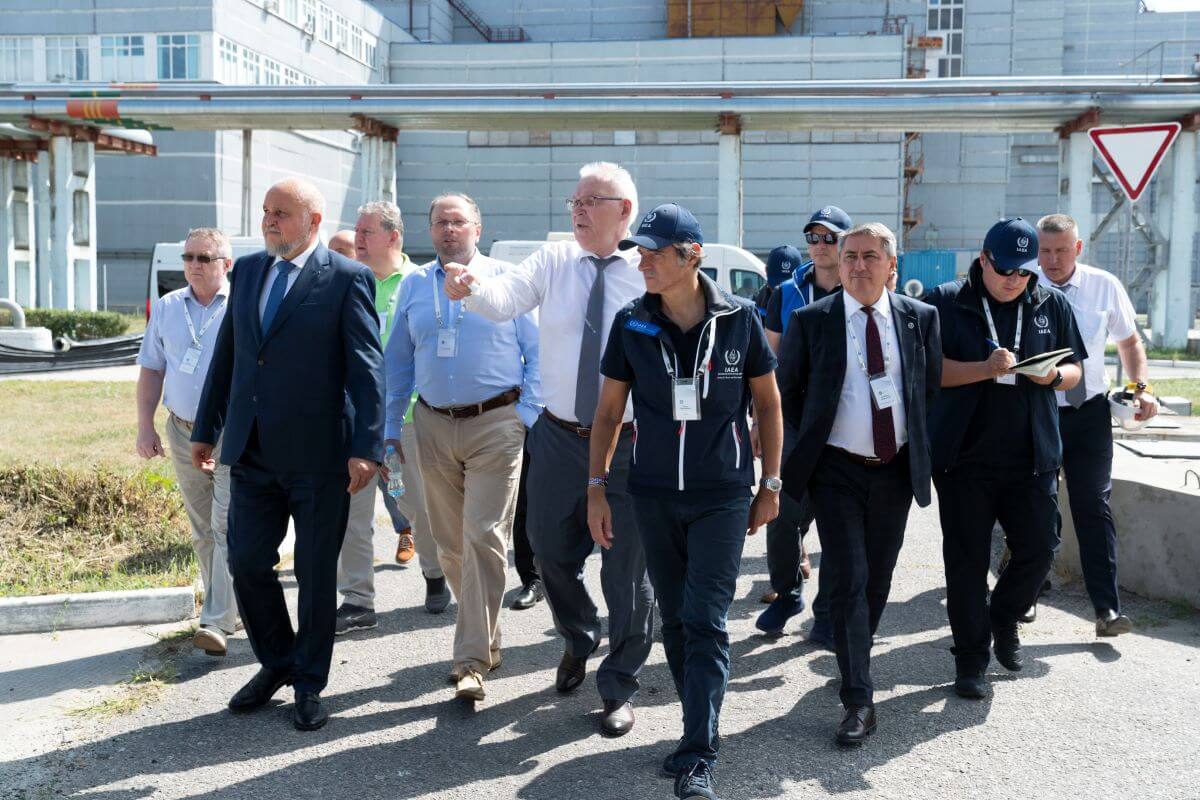
With Ukraine’s incursion into Russia in August, concern about whether the Kursk nuclear power plant (just 60 km from the border) could be a target has risen along with a spike in dangerous incidents at the Zaporizhzhia nuclear power plant (ZNPP) in Ukraine, now in its second year of Russian occupation. International Atomic Energy Agency (IAEA) Director General Mariano Grossi noted the Kursk plant’s vulnerability to a serious incident during his visit on August 27, citing the lack of a protective dome and calling for both Russia and Ukraine to observe the IAEA’s seven pillars of nuclear safety and security. Other commentary included in our roundup below argues that Ukraine’s incursion has exposed even broader Russian nuclear security vulnerabilities. Meanwhile, among other worrying developments, the IAEA observed fires in the vicinity of the ZNPP, including one underneath the plant’s last two remaining external power lines, and one that damaged one of the plant’s cooling towers.
Amid these troubling headlines, it is interesting to read about the UK Nuclear Advanced Manufacturing Research Centre’s work on applying artificial intelligence to the real-time detection of cyber-attacks against nuclear power plant and, of course, the excellent work that INSF members continue to do every day. We continue to spotlight members’ thoughtful work toward greater diversity, equity, and inclusion in our field despite the regrettable negative targeting of such efforts this month. For those enjoying the final days of the northern hemisphere summer, wishing you a refreshed and restored start to the autumn’s work and wishing all our members inspiration and resilience in carrying out this critical work.
Best wishes,
Christina
Director, International Nuclear Security Forum
Join the conversation on X: @INS_Forum
Follow INSF on LinkedIn here
Updates
- INSF is excited to announce the newest addition to its Advisory Board, Ali Alkış. Mr. Alkış is the World Institute for Nuclear Security Ambassador to Turkey and a Ph.D. candidate at Hacettepe University in Ankara, Turkey. He is a member of the Gender Champions in Nuclear Policy, serves as the Gender Champion at the Odesa Center for Nonproliferation, and is one of the emerging leaders of the NTI’s Global Dialogue on Nuclear Security Priorities.
- FUNDING APPEAL: If you appreciate this newsletter, please consider a donation to ensure sustainability into the future. Donate and specify where indicated that your gift is intended to support the INSF. Institutional funding for civil society’s nuclear security work is increasingly hard to come by, as many readers already know, and the International Nuclear Security Forum appreciates your support!
Nuclear Security News
Impact: The Russian Invasion of Ukraine
- Update 240 – IAEA Director General Statement on Situation in Ukraine (August 2): “The water level in the cooling pond at Ukraine’s Zaporizhzhya Nuclear Power Plant (ZNPP) continues to decrease. Despite all reactors remaining in a state of cold-shutdown, availability of this water is important for nuclear safety of the plant, Director General Rafael Mariano Grossi of the International Atomic Energy Agency (IAEA) said [on August 2]. Over the past weeks, IAEA experts at the plant have observed a continuous decrease in the water level of the plant’s cooling pond. If this trend continues, ZNPP staff confirmed that it will soon become challenging to pump water from the pond. Maintaining the level of the pond is made more difficult by the hot summer weather. Following the destruction of the Kakhovka dam last year, the ZNPP dug 11 groundwater wells to provide approximately 250 cubic meters of cooling water per hour to the sprinkler ponds. These ponds supply sufficient water to cool all six reactor units in their current cold shutdown state. During a site walkdown [on the week of July 22], the IAEA team observed that the sprinkler ponds are functioning well, with water at nominal levels. Any compromise to the availability of water to the sprinkler ponds might necessitate using the cooling pond as a backup source.”
- Update 241 – IAEA Director General Statement on Situation in Ukraine (August 8): “The occurrence of intense fires near Ukraine’s [ZNPP] continues to add to the growing challenges facing Europe’s largest nuclear power plant (NPP), IAEA Director General Rafael Mariano Grossi said [on August 8]. On several occasions over the [week of August 5], the IAEA Support and Assistance Mission to Zaporizhzhya (ISAMZ) observed several fires at various distances from the ZNPP and nearby villages. Over [August 3 and 4], the IAEA experts observed smoke coming from an area to the north of the ZNPP near the Zaporizhzhya Thermal Power Plant (ZTPP) inlet channel. The plant confirmed that the fire was underneath the overhead cables of the Dniprovska 750 kilovolt (kV) line and the Ferosplavna 1 330 kV back-up power line – the last two remaining external power lines for the ZNPP.”
- Update 242 – IAEA Director General Statement on Situation in Ukraine (August 11): “[IAEA] experts at Ukraine’s [ZNPP] witnessed thick dark smoke coming from the north-western area of the plant, after hearing multiple explosions throughout the evening. The team was informed that an alleged drone attack on one of the plant’s cooling towers took place [on August 11]. There is no impact on nuclear safety, IAEA Director General Rafael Mariano Grossi confirmed. The IAEA team reported hearing an explosion [on August 11] at the same time the ZNPP informed them that a drone had allegedly struck one of the plant’s two cooling towers. In order to ascertain the extent and possible cause of this event, the [ISAMZ team] is requesting immediate access to the cooling tower to assess the damage.”
- Ukraine and Russia Trade Blame Over Fire at Zaporizhzhia Nuclear Plant (August 11): “Ukraine and Russia have blamed each other after a fire broke out at the giant Zaporizhzhia nuclear power plant on [August 11]. Ukraine’s President Volodymyr Zelensky said Russian forces had started a fire at the plant, which has been occupied by Moscow’s forces for more than two years. Zaporizhzhia’s Kremlin-installed governor said Ukrainian shelling caused the blaze.”
- Update 243 – IAEA Director General Statement on Situation in Ukraine (August 12): “[IAEA] experts at Ukraine’s [ZNPP] [on August 12] visited the plant’s cooling towers to observe the impact of the fire [on August 11]. Following its request to immediately assess the impact of the fire, the [ISAMZ team] accessed the cooling tower area this morning. Based on the observations, the team assessed that it was unlikely that the primary source of the fire began at the base of the cooling tower, Director General Rafael Mariano Grossi said.”
- Update 244 – IAEA Director General Statement on Situation in Ukraine (August 13): “The [IAEA] at Ukraine’s [ZNPP] viewed evidence provided to the team [on August 13] that continues to indicate that [the] fire [on August 11] did not start at the base of the cooling tower, IAEA Director General Rafael Mariano Grossi said. Following its visit to the impact site [on August 12], the [ISAMZ] team returned [on August 13] to cooling tower 1. Due to safety reasons, the team observed from ground level as ZNPP staff filmed and photographed the fire damage to the interior of the tower from the water nozzle distribution level, which is approximately 10 meters high. The photographs and video footage were shown immediately to the team. The ISAMZ team was later provided with copies of the photos and footage which confirm extensive damage to the internal components at the water nozzle distribution level.”
- Update 245 – IAEA Director General Statement on Situation in Ukraine (August 17): “The nuclear safety situation at Ukraine’s [ZNPP] is deteriorating following a drone strike that hit the road around the plant site perimeter [on August 17], [IAEA] Director General Rafael Mariano Grossi said. ‘Yet again we see an escalation of the nuclear safety and security dangers facing the Zaporizhzhya Nuclear Power Plant. I remain extremely concerned and reiterate my call for maximum restraint from all sides and for strict observance of the five concrete principles established for the protection of the plant,’ said Director General Grossi.”
- Update 246 – IAEA Director General Statement on Situation in Ukraine (August 23): “Ukraine’s [ZNPP] lost connection to its only remaining off-site back-up power line [on August 22], leaving it once again precariously reliant on a single power source, Director General Rafael Mariano Grossi of the [IAEA] said [on August 23]. The [ISAMZ team] was informed by the ZNPP that the plant’s 330 kilovolt (kV) Ferosplavna 1 back-up power line was disconnected [on August 22] due to a short-circuit at approximately 16:00. The ZNPP confirmed that the Ukraine dispatcher had put the line under maintenance and that it was re-connected at 15:30 [on August 23]. The ISAMZ team was informed by the ZNPP that the cause of the short-circuit or the possible damage to the line is unknown. The team has confirmed that the line has been restored.”
Threats
- Russia Strengthens Security at Kursk Nuclear Power Plant Amid Ukraine’s Assault in Region (August 8): “Russia said [on August 7] that it strengthened security at the Kursk nuclear power plant amid Ukraine’s assault in the region. The Russian Guard Corps said it took additional measures to ensure the safety of the plant, including the deployment of additional units in the area. ‘As part of ensuring the safety of a particularly important facility, the Russian Guard Corps units took additional measures to protect the Kursk nuclear power plant,’ it said. It added that the security services increased their forces to combat the Ukrainian sabotage and reconnaissance groups in the Kursk and Belgorod regions.”
- Will Ukraine’s attack on Russian territory lead to the seizure of the Kursk Nuclear Plant? (August 9): “As the Ukrainian army’s cross-border incursion into Russia’s Kursk Region rages into its fourth day, the objectives of the surprise attack have been grist for media speculation. Some have suggested the Ukrainians might target the Kursk Nuclear Power Plant as payback for Russia’s long-running seizure of Ukraine’s Zaporizhzhia nuclear plant. It’s difficult to say how likely such a scenario is, but should it come to pass, it makes sense to briefly analyze the problems, risks, and dilemmas that would come of such an attack. The Kursk Nuclear Power Plant is the closest Russian nuclear power plant to the Ukrainian border—just 60 km away. The idea that it could be at risk of attacks during a full-scale war became evident in the early months of Russia’s full-scale invasion of Ukraine. The Russia seizure of the Zaporizhzhia plant and territory of Chernobyl, followed by vigorous Ukrainian counterattacks, made clear that this would be a full-scale and potentially prolonged war with consequences for Russian territories.”
- IAEA Director General Statement on Developments in the Russian Federation (August 9): “The IAEA has been monitoring the situation on the reported military activities taking place in the vicinity of the Kursk Nuclear Power Plant (NPP). This NPP has six units of two different reactor types: RBMK-1000 and VVER-510. Two of the RBMK-1000 are in shutdown and two are fully operational. The two VVER-510 units are under construction. In view of the reportedly significant military activity, I wish to remind all parties of the seven indispensable pillars for ensuring nuclear safety and security during an armed conflict. Additionally, I emphasize the five concrete principles to help to ensure nuclear safety and security which have been established for the Zaporizhzhya NPP in the context of the current conflict between the Russian Federation and Ukraine, and which are equally applicable in this situation. These include, among others, the imperative to ensure the physical integrity of a nuclear power plant. This is valid irrespective of where an NPP is situated.”
- Russia’s War in Ukraine Affects the Protection of Nuclear Facilities Across Russia (August 14): “Russia’s war against Ukraine gives another reason to talk about nuclear security. The unexpected Ukrainian Army’s cross-border incursion into Russia’s Kursk Region starting on August 6, 2024, raised concerns about the security of the [KNPP], located in the town of Kurchatov, approximately 70 km from the Ukrainian border. While it appears that there is no immediate threat to the NPP, information that became available during this incursion justifies concerns about the security of nuclear facilities across Russia in general.”
- Putin Accuses Ukraine of Trying to Strike Russia’s Kursk Nuclear Power Plant (August 22): “President Vladimir Putin on [August 22] accused Ukraine of trying to strike Russia’s Kursk nuclear power plant in an overnight attack and said Moscow had informed the U.N. nuclear safety watchdog about the situation. Putin, who did not provide further details about the incident or provide documentary evidence to back up his assertion, made the comments at a meeting of senior officials. There was no immediate comment from Ukraine whose lightning incursion into Kursk, the biggest into Russia by a foreign power since World War Two, saw thousands of Ukrainian troops punch through Russia’s western border on Aug. 6, apparently catching Moscow by surprise.”
- IAEA Informed of Drone at Kursk Nuclear Power Plant, Director General Grossi to Assess Site (August 22): “The [IAEA] has been informed by the Russian Federation [on August 22] that the remains of a drone were found within the territory of the [KNPP]. The drone fragments were reported to have been located roughly 100 meters from the plant’s spent fuel nuclear storage facility. The IAEA was informed that the drone was suppressed in the early morning of August 22. In this context, IAEA Director General Rafael Mariano Grossi confirmed his intention to personally assess the situation at the site during his visit [on the week of August 26]. During his visit, Director General Grossi will assess the situation on site and discuss modalities for further activities as may be needed to evaluate the nuclear safety and security conditions of the [KNPP]. ‘Military activity in the vicinity of a nuclear power plant is a serious risk to nuclear safety and security. My visit to KNPP…will provide us with timely access to independently assess the situation,’ Director General Grossi said.”
- Russia Accuses Ukraine of Trying to Attack Kursk Nuclear Power Plant With Drone (August 23): “Russia accused Ukraine on [August 23] of trying to attack the Kursk nuclear power station overnight in what it called an act of ‘nuclear terrorism’, days before the head of the U.N. atomic watchdog is due to visit the site. The Ukrainian defense ministry did not immediately respond to a request for comment on the allegation, the second that Moscow has made in two days. The nuclear plant is located in the Kursk region of western Russia, where fierce fighting has raged since Ukrainian forces launched a surprise incursion on Aug. 6, hitting back as Russian troops advance in eastern Ukraine.”
- IAEA Director General Statement on Kursk Nuclear Power Plant (August 26): “Given the serious situation, I am personally leading the [IAEA] mission to the [KNPP] in the Russian Federation. The safety and security of all nuclear power plants is of central and fundamental concern to the IAEA. Since new developments and increased levels of military activity in the vicinity of the KNPP, I have been closely following developments on the ground, especially with respect to the plant. It is important that when the Agency is called upon to fulfil its mandate to ensure that nuclear is used in a peaceful manner, we are present.”
- UN Watchdog Says Russian Nuclear Plant ‘Extremely Exposed’ if Attacked: “A nuclear plant in western Russia, where fighting is raging between Russian and Ukrainian forces, is especially vulnerable to a serious accident because it lacks a protective dome that could shield it from missiles, drones or artillery, the head of the U.N. nuclear watchdog said on [August 27]. Rafael Grossi, director general of the [IAEA], spoke after visiting the plant in the Kursk region, where Ukrainian forces pierced the border in a lightning incursion on Aug. 6 and Russia is still battling to eject them. Grossi told reporters that the RBMK-type facility – the same model as the Chornobyl plant in Ukraine that witnessed the world’s worst civilian nuclear disaster in 1986 – lacks the containment dome and protective structure that is typical of modern nuclear power stations. ‘This means that the core of the reactor containing nuclear material is protected just by a normal roof. This makes it extremely exposed and fragile, for example, to an artillery impact or a drone or a missile,’ he said.”
Weapons, Materials, and Facilities
- Sellafield Apologizes After Guilty Plea Over String of Cybersecurity Failings: “Sellafield has apologized after pleading guilty to criminal charges relating to a string of cybersecurity failings at Britain’s most hazardous nuclear site, which it admitted could have threatened national security. Among the failings at the vast nuclear waste dump in Cumbria was the discovery that 75% of its computer servers were vulnerable to cyber-attacks, Westminster magistrates court in London heard. Information that could threaten national security was left exposed for four years, the nuclear watchdog revealed, and Sellafield said it had been performing critical IT health checks that were not, in fact, being carried out.”
Security Culture
- Three Sides of India’s Nuclear Security Regime—And What More it Needs: “Three individuals were arrested in Bihar for the possession of a restricted nuclear material, californium, on August 10. This was based on a tip-off from the local police. While arrests were made and the Bhabha Atomic Research Centre determined these samples were not radioactive, the incident underscores the pressing need to discuss nuclear security as a function of responding to threats in India.”
Emerging Technologies
- New Wave of Nuclear Cybersecurity: “Researchers have demonstrated a new AI-based system to rapidly identify attempted cyber-attacks on nuclear power plants. The Nuclear [Advanced Manufacturing Research Centre] provided technical leadership for the project, which investigated the use of a machine-learning technology known as a wavy-attention network to identify potential attacks in real time.”
Member Organization Announcements and Updates
Spotlight: Diversity, Equity, and Inclusion Lines of Effort
- Shahneela Tariq, Graduate Research Assistant at the James Martin Center for Nonproliferation Studies, Middlebury Institute of International Studies, was selected as one of the recipients of the Diversity Inclusion grant by the Office of Radiological Security for INMM Annual Conference, Portland, 2024.
- Shahneela Tariq presented a paper at the INMM 2024 annual meeting titled ‘Women in Nuclear Security and Radiological Security: Addressing Underrepresentation and Promoting Progress’. The paper focused on highlighting tight-knit networks and the lack of role models in the Global South as the most important challenges causing women’s underrepresentation in the field of nuclear security. Read the paper.
- Ali Alkış participated in the DEIA panel during the 65th Annual Meeting of the Institute of Nuclear Materials Management (INNM). Ali talked about work on DEIA and underlined the importance of Gender Champions in Nuclear Policy (GCNP) for making gender equality a reality.
International Institute for Strategic Studies
- Timothy Wright and Douglas Barrie published an online analysis, “The Return of Long-Range US Missiles to Europe.” Read the piece.
- Timothy Wright published an online analysis, “Japan Tests New Hypersonic Glide Vehicle” for the Missile Dialogue Initiative. Read the piece.
- Douglas Barrie and Timothy Wright published a commentary, “Not More, but More Assured: Optimising US Nuclear Posture,” for Survival Online. Read the piece.
- Meia Nouwens, Douglas Barrie, and Timothy Wright released a new episode of the Sounds Strategic podcast, “Blast from the past: The Return of Long-range US Missiles to Europe.” Hear their perspectives.
Odesa Center for Nonproliferation
- Ali Alkış presented “Nuclear Security During Armed Conflict: The Way Forward” during the 65th Annual Meeting of the Institute of Nuclear Materials Management (INNM). Ali analyzed the current nuclear security framework and its inadequacy in addressing today’s threats. He suggested a few practical solutions for a robust international nuclear security regime.
- Ali Alkış gave a lecture at the James Martin Center for Nonproliferation Studies on “Turkish-Russian Nuclear Cooperation”. Ali pointed out the asymmetric relationship between the two countries. In addition, he evaluated the advantages and disadvantages of the cooperation for energy security and its political implications.
Vienna Center for Disarmament and Non-Proliferation
- VCDNP organized a panel during the IAEA International Symposium on Food Safety and Control to highlight the support provided by IAEA collaborating centers and the potential of machine-based radiation to improve access to the benefits of radiation for health, food safety and food security in developing countries, “The Future of Food: Globalizing Access to Innovative Technologies.” Find out more about the panel.
- VCDNP Research Intern Alexander Hoppenbrouwers explains how discussions on the regulation of autonomous weapons may change following the Vienna Conference on Autonomous Weapons Systems in a piece published by the Royal United Services Institute, “The Way Forward on Autonomous Weapons after the Vienna Conference.” Read the piece.
Individual Member Updates
- Stephen J. Cimbala and Lawrence J. Korb published “A Game Plan for Dealing with the Costly Sentinel Missile and Future Nuclear Challenges,” in the Bulletin of the Atomic Scientists. Read the piece.
- Nse-Abasi Ayara participated in the 65th Institute of Nuclear Materials Management (INMM) Annual Conference held from 21-25 July 2024 in Portland, Oregon, USA. The event was themed: Nuclear Stewardship in an Era of New Technology and Global Tensions. He presented a paper titled “Security Sector Perspectives on Nuclear and Radiological Security in Nigeria”. The presentation highlighted Nigeria’s nuclear security regime, the various actors involved, and challenges and prospects. Read the paper.
- Mycle Schneider shares that the Global Launch of the World Nuclear Industry Status Report 2024 (WNISR2024) will take place—during the IAEA’s GC—on 19 September 2024 at the Presseclub Concordia in Vienna, co-hosted by the Austrian Federal Ministry of Climate Action, Environment, Energy, Mobility, Innovation and Technology, the German Federal Office for the Safety of Nuclear Waste Management (BASE), BOKU University, and two foundations. Read the report on September 19.
Opportunities
- The National Nuclear Security Administration Minority Serving Institutions Internship Program (NNSA-MSIIP) is accepting applications for their 2025-2026 cohort. The program provides paid opportunities for undergraduate and graduate students at Minority Serving Institutions (MSIs) pursuing degrees in critical science, engineering, technology, mathematics, and other disciplines that complement current and future missions of the NNSA. Read more.
- The National Nuclear Security Administration Graduate Fellowship Program (NNSA-NGFP) is accepting applications for their 2025-2026 cohort. Fellows work alongside leading experts at NNSA program and site offices; participate in exclusive professional development, networking, and training opportunities; and engage with national security stakeholders and support leading events and activities around the world. Read more.
- The National Nuclear Security Administration is accepting applications for the first cohort of its post-bachelor’s fellowship. This opportunity is a career gateway that provides real-world experience working in the NNSA program and site offices making significant contributions to the nation; specialized training, leadership, and career development and networking; and collaboration with professionals and leading researchers in activities and events around the world. Read more.
- Parsons Corporation is seeking a Project Manager for their Global Nuclear Security Projects portfolio – a U.S. Government contract. The Project Manager will provide direction and management for small to medium-sized international nuclear security projects. The projects work with nuclear material security, including efforts to ensure the secure storage and transportation of nuclear warheads, weapons-usable nuclear material, and high-threat radiological material. Read more.
- CRDF Global is seeking a Senior Program Manager for the Nuclear Technologies profile under the supervision of the Director of Nonproliferation and Counterproliferation Programs. The Senior Program Manager will be responsible for managing CRDF Global activity on one or more significant programs, has supervisory experience as well as program or project management experience, and experience managing high-impact activities. Read more.
- The Partnership for Global Security (PGS) is seeking applicants for their Research Internship. The intern will primarily focus on researching nuclear security, nuclear energy, and transnational governance issues. Current research projects that interns will support include: exploring the nexus of climate change, nuclear power growth and global security; understanding the growth of nuclear energy in the Middle East and East Asia; tracking the evolution of nuclear security policies and governance structures; using existing voluntary frameworks as a model for nuclear security governance structures; and examining cybersecurity and other potential threats prompted by new technology developments. Read more.
- NTI is seeking a Program Officer/Senior Program Officer for their Nuclear Materials Security program. This selected candidate will help lead NMS efforts to improve global nuclear materials security, including in the area of nuclear energy. Responsibilities will include: developing and implementing activities related to securing, reducing, and safeguarding special nuclear materials; developing and implementing activities related to the responsible expansion of nuclear energy; developing and implementing activities related to building capacity in international institutions related to nuclear security; representing NTI at professional conferences and international diplomatic meetings; planning and implementing NMS program activities, including establishing milestones and mitigating project risks, as well as other project management tasks. Read more.
- The Laboratory of Applied Nuclear Physics (LANPh) is announcing two openings at the level of a postdoc and/or research scientist. The selected scientists will have the chance to work on groundbreaking research in nuclear physics applied to problems in nuclear security, such as arms control, cargo security, and nuclear detection. The principal duties include contributing to existing projects at LANPh in leading/co-leading roles’ guiding graduate and undergraduate students in their research, designing experiments and new engineering concepts, and co-authoring papers and proposals.Read more.
- HunaTek is seeking a Washington, DC based full-time International Nuclear Security Portfolio Manager to support the management and implementation of international nuclear security projects in support of the National Nuclear Security Administration (NNSA), Office of Global Material Security, Office of International Nuclear Security (INS). The International Nuclear Security Portfolio Manager will support INS federal staff with the oversight of international projects and portfolios, as assigned. The manager should be able to work in a fast-paced environment and have a background and experience in international affairs, national security, public policy, communications, or a related field. The manager will work closely with various stakeholders to implement strategies aimed at strengthening nuclear security measures, mitigating risks, and promoting international cooperation in nuclear security efforts. Read more.
- GDIT is seeking a candidate to serve as a FIRST Nuclear Security, Scientist Engagement, and Science Centers Program Analyst in support of the Bureau of International Security and Nonproliferation’s Office of Cooperative Threat Reduction (ISN/CTR) at the U.S. Department of State. ISN/CTR manages several nonproliferation assistance programs to reduce the threats posed by proliferator states and terrorist groups seeking to develop or acquire Weapons of Mass Destruction (WMD) material, equipment, or expertise, advanced conventional weapons, and delivery systems. It is a “dual-hatted” position with the candidate serving as a Program Analyst for both the Foundational Infrastructure for the Responsible Use of Small Modular Reactor (SMR) Technology (FIRST) and Science Centers programs. Read more.
- The IAEA’s Marie Sklodowska-Curie Fellowship Program (MSCFP) aims to help increase the number of women in the nuclear field, supporting an inclusive workforce of both men and women who contribute to and drive global scientific and technological innovation. Named after pioneer physicist and twice Nobel Prize laureate Marie Skłodowska-Curie, the Program aims to inspire and encourage young women to pursue a career in the nuclear field, by providing highly motivated female students with scholarships for master’s programs and an opportunity to pursue an internship facilitated by the IAEA. Selected students receive a scholarship for master’s programs in nuclear-related studies at accredited universities. They are also provided with an opportunity to pursue an internship facilitated by the IAEA for up to 12 months. Read more.





Community Adaptation for a Water Festival Without Clean Water