

Under the leadership of Prime Minister Narendra Modi, the Indian government has launched ambitious and far-reaching proposals for military modernization. Yet, a close examination reveals several limitations and challenges. This memo traces Modi’s initiatives and inherent structural debilities within the higher defense management. It examines the reforms’ nature, impact, and scope, highlighting how Modi’s military modernization programs complicate the Indian military’s integration/jointness drive. The memo also traces the financial support, pace of implementation, and legislative changes to expose the organizational fault lines within the system, arguing that until the Indian political class takes its military governing roles seriously, organizational reforms will fail to achieve intended goals. It concludes with alternative ways to improve the Indian military’s effectiveness.
Financial Support for Military Modernization Initiatives
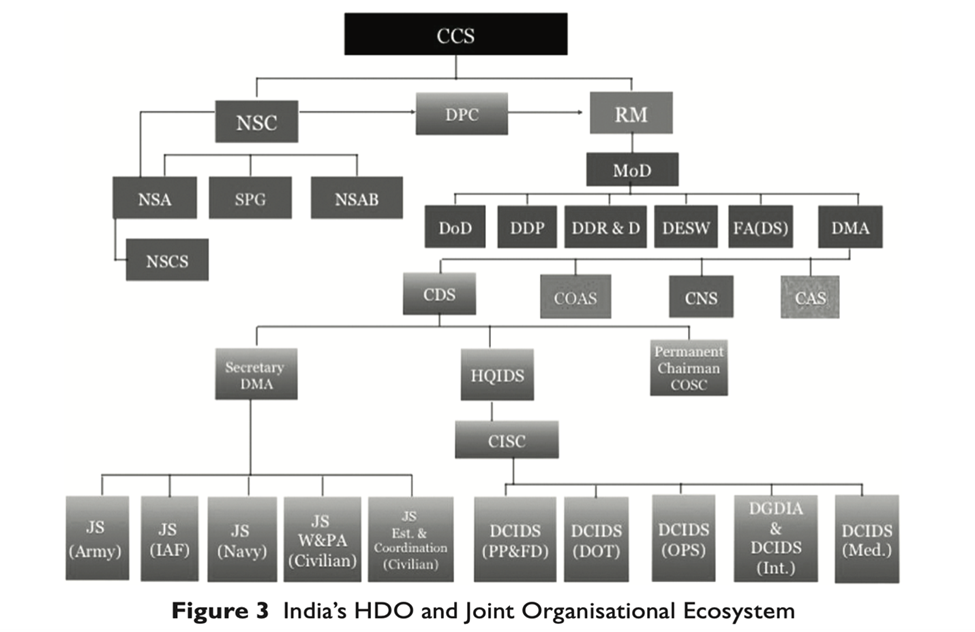
Since 2014, India has initiated unprecedented military modernization.1 In this memo organizational restructuring is also considered as a modernization initiative. See, Government of India, Ministry of Defence, “Defence Reforms,” https://www.mod.gov.in/sites/default/files/MoD2RE7621.pdf. Modernization aims to sharpen synergy within the Higher Defense Organization (HDO), India’s apex defense management system comprised of political executives, civilian bureaucrats, and military organizations (see Appendix 1).2 Appendix 1, provides a snapshot of the HDO. For more details see, Ladhu R. Choudhary, “Evaluating Jointness in the Indian Military: A Conceptual and Methodological Approach,”, Journal of Defence Studies, https://www.idsa.in/system/files/jds/jds-16-1-2022-ladhu-r-choudhary_compressed.pdf; Arun Prakash, “India’s Higher Defence Organisation: Implications for National Security and Jointness,” Journal of Defence Studies 1, no. 1 (2007): 13- 31; Arun Vishwanathan, “India’s Higher Defence Organisation: Recent Reforms and the Way Ahead,” in Anshuman Behera and Sitakanta Mishra (eds.) Varying Dimensions of India’s National Security (New Delhi, Springer, 2022), pp- 61-73. Modernization programs have three main goals: the first is to improve defense preparedness in the face of complex national security challenges, enabling India’s military to support its foreign policy; the second goal is to revitalize defense acquisition policy and procurement procedures, to streamline and rationalize the acquisition and allocation of scarce resources; and the third is to develop a defense industrial ecosystem, which is necessary to meet any exigencies and sustain India’s global rise. In 2021, India’s Defence Minister Rajnath Singh released a booklet of 20 reforms designed to make India a military-industrial power,3 Elizabeth Roche, “Rajnath Singh releases compendium of 20 reforms undertaken by defence ministry,” mint, June 07, 2021, https://www.livemint.com/news/india/rajnath-singh-releases-compendium-of-20-reforms-undertaken-by-defence-ministry-11623077157783.html. For more details see: Government of India, Ministry of Defence, “Defence Reforms,” https://www.mod.gov.in/sites/default/files/MoD2RE7621.pdf. indirectly pointing to these three goals. The Modi government’s priority for building up India’s military-industrial complex is in large part due to Modi’s vision of India as not simply a regional power but a rising global power.
Before the Modi regime, India’s military modernization evolved in four major phases (see Table 1).4 Vipul Dutta, Making Officers out of Gentlemen (New Delhi, Oxford University Press, 2021); Srinath Raghavan, “Civil-Military Relations in India: The China Crisis and After,” Journal of Strategic Studies 32, no 1(February 2009): 149-175. https://doi.org/10.1080/01402390802407616; Samir K. Sen, Technology as a Substitute: Nukes, Missiles and Other Stories (New Delhi: Manas Publications, 2016); Anit Mukherjee, “Failing to Deliver: Post-Crises Defence Reforms in India, 1998-2010,” IDSA Occasional Paper No. 18, 2011, https://www.idsa.in/system/files/OP_defencereform.pdf. However, due to wars with Pakistan and China, strategic complexities, and other domestic factors, each phase remained incomplete and had suboptimal trade-offs for the modernization motives.
Table 1: Evolution of India’s military modernization
| Period | Focus of modernization initiatives |
|---|---|
| 1947-1962 | Restructuring colonial institutions and building new military organizations. |
| 1962-1972 | Ensuring the autonomy of military institutions |
| 1972-1999 | Expansion of the technological base of the armed forces |
| 1999-2014 | Improving inter-service coordination/jointness |
Source: Author’s conceptualization based on various sources
Modi’s initiatives represent these reforms’ fifth phase (2014-present) and aspire to complete previously unfinished tasks. Some analysts argue that these are the most momentous and comprehensive defense reforms in the history of independent India.5 Vivek Chadha, CDS and Beyond Integration of the Indian Armed Forces (New Delhi: KW Publishers, 2021).
Modi came to power with a promise to reform India’s defense organizations and ecosystem.6 Bharatiya Janata Party, “BJP Manifesto 2014,” https://www.bjp.org/bjp-manifesto-2014. In 2015, Modi made reforming higher defense management, promoting jointness, transforming defense manufacturing, and overhauling defense procurement policies as part of his government’s vision and priorities.7 Government of India, Prime Minister’s Office, “PM Chairs Combined Commanders Conference on Board INS Vikramaditya at Sea,” https://pib.gov.in/newsite/printrelease.aspx?relid=133265. Some declassified reports of early 2020 reveal that the government has implemented 99 of 188 recommendations of a Committee of Experts (Shekatkar Committee) that set “the guiding principle for ongoing defense reforms.”8 Snehesh Alex Philip, “What is Shekatkar report, defence ministry’s first order of business after lockdown,” The Print, April 20, 2020, https://theprint.in/defence/what-is-shekatkar-report-defence-ministrys-first-order-of-business-after-lockdown/405435/. Sandip Dighe, “Key recommendations ignored by defence ministry: Shekatkar panel,” The Times of India, November 8, 2017, Government of India, Ministry of Defence, “Report of Shekatkar Committee,” February 04, 2019, https://pib.gov.in/newsite/PrintRelease.aspx?relid=188022. For an official version, see Government of India, Ministry of Defence, “Report of Shekatkar Committee,” February 04, 2019, https://pib.gov.in/newsite/PrintRelease.aspx?relid=188022. Subsequently, the Defence Planning Committee (DPC) was constituted under the chairmanship of the National Security Advisor in 20189 Other members of the committee are Foreign Secretary, Defence Secretary, Chief of Defence Staff, Chiefs of the three Services, expenditure secretaries of Ministry of Finance. The Chief of the Integrated Defence Staff is a member secretary of the committee. to “facilitate a comprehensive and integrated planning for defense matters.”10 Laxman Kumar Behera, “Creation of Defence Planning Committee: A Step Towards Credible Defence Preparedness,” IDSA Comment, April 19, 2018, https://idsa.in/idsacomments/creation-of-defence-planning-committee-lkbehera-190418. Its primary objective is to prepare India’s national security strategies and doctrines. It was also tasked to ensure optimal utilization of scarce resources, infrastructure, and effective rationalization by minimizing duplication and fast-tracking procurements.
In 2018, the government established three tri-service agencies that three-star officers would lead to institutionalize jointness and handle critical modern warfare challenges in cyber, space, and special operations.11 Rajat Pandit, “Agencies take shape for special Operations, space, cyber war,” The Times of India, May 16, 2019. https://timesofindia.indiatimes.com/india/india-begins-setting-up-new-tri-service-agencies-to-handle-special-operations-space-and-cyberspace/articleshow/69346012.cms. However, the expenditure incurred by the Headquarters Integrated Defence Staff (HQ IDS) for the “capability building” of more than 120 joint organizations has been minuscule (see Table 2).12 Lok Sabha Secretariat, Ministry of Defence, “Standing Committee on Defence (2022-23)-Thirty-Sixth Report,” pp. 41-43, March 2023, https://loksabhadocs.nic.in/lsscommittee/Defence/17_Defence_36.pdf.
Table 2: Percentage Share of Joint Staff Budget (in USD Millions)
| Year | Budget Estimate [Defence Services Estimates (DSE)] # (Millions USD) | Joint Staff (BE Allocation) (Millions USD) | Percentage share |
|---|---|---|---|
| 2018-19 | 32,450 | 456 | 1.40 |
| 2019-20 | 36,700 | 493 | 1.34 |
| 2020-21 | 38,800 | 536 | 1.38 |
| 2021-22 | 41,700 | 546 | 1.30 |
| 2022-23 | 46,200 | 536 | 1.16 |
*#DSE includes Army, Navy, Air Force, Joint Staff, DRDO, Ordnance Factories, NCC, & DGQA budget. (Source: Author’s compilation from the Standing Committee on Defence, March 2023)
*The original spending is in INR. The expenditure is converted from INR to USD using conversion rates of 1st January 2024. The conversion rate is provided by the Reserve Bank of India.
Moreover, despite organizational reforms, budgetary projections, actual allocations, and expenditures for joint staff indicate significant inconsistencies and glaring gaps (Figure 1).
The Chief of Defence Staff (CDS) was appointed to head the newly curated Department of Military Affairs (DMA) to enhance jointness, integration, and theaterization within the Indian military.13 In December 2019, the DMA was created to promote jointness in procurement, training and staffing; to facilitate restructuring of military commands for optimal utilization of resources, including creation of theatre commands; and to seek defense indigenization and procurement prioritization. The CDS acts as the Secretary of the DMA and Permanent Chairman of Chiefs of Staff Committee (PCoCSC). The CDS is a key member of the Defence Acquisition Council (DAC) and DPC. The government committed to institutionalize jointness in operations, training, logistics and transport within three years of the first CDS assuming office. The DMA is rolling off three joint logistic nodes at Mumbai, Guwahati and Port Blair. See, Government of India, Cabinet Secretariate, “Cabinet approves creation of the post of Chief of Defence Staff in the Rank of four star General,” Press Information Bureau, December 24, 2019, https://pib.gov.in/PressReleseDetail.aspx?PRID=1597425. Without the CDS, the political leadership could not get a unified military perspective to assess threats and manage crises. The Department of Military Affairs integrated the autonomous, service-specific headquarters within the Ministry of Defence (MoD). Further, the Indian parliament passed the Inter-Services Organisations Act in 2023 (ISO Act) to govern the reformed “integrated system” and to regulate the personnel deputed in joint inter-service organizations.14 The Gazette of India, Ministry of Law and Justice, “The Inter-Services Organisations (Command, Control and Discipline) Act, 2023,” August 15, 2023. The ISO Act is intended to operationalize the Integrated Theatre Commands (ITCs). The ITCs are envisioned to reorganize India’s existing 17 service-specific operational commands into three ITCs, which are largely modeled on the U.S. Theatre Commands. The DMA and the CDS are responsible for curating the ITCs for short-and-swift wars.
The Department of Military Affairs is also boosting the “Aatmanirbhar Bharat” (self-reliant India) drive. So far, they have listed over 500 highly complex weapon systems, sensors, ammunition, and other items that will be procured only from indigenous sources.15 Government of India, Ministry of Defence, “Major announcements by Raksha Mantri during the plenary session of Swavlamban 2.0,” October 04, 2023, https://pib.gov.in/PressReleasePage.aspx?PRID=1964272#:~:text=Prominent%20items%20include%20Futuristic%20Infantry,Army%2C%20Medium%20Range%20Precision%20Kill The Department of Military Affairs also took substantial measures to meet the cost-cutting and combat capability enhancement goals. They have closed a range of unproductive and obsolete outlets, reviewed training methodology, and opted for new schemes for recruitment (e.g., Agnipath Scheme, which is a tour of duty type scheme designed to reduce expenditure) to optimize the use of limited resources.
However, the transformations lack firm financial commitments to execute the envisioned reforms. The budgetary allocation and utilization have been a continuation of the erratic trends of the defense plans since independence, which include uneven flows, lingering political approvals, higher rates of underutilization, and lack of rigorous analysis of the objectives of the allocated defense budget. India’s defense budget allocation remains far below the demand of 2.5 to 3 percent of the Gross Domestic Product (GDP). Contrary to the needs, the defense share of India’s GDP has declined and remains the lowest in the current financial year (2024-25) at 1.90 percent of the GDP in the last ten years (see Figure 2).16 Laxman Kumar Behera, “Examining India’s Interim Defence Budget 2024-’25,” Issue Brief, No 693, February 2024,
Due to poor political oversight, the defense budget has been highly inconsistent, “in the range of as high as 43 percent to as low as zero percent” annual growth rate.17 Laxman Kumar Behera, India’s Defence Economy (New York: Routledge, 2021), p. ii. On lack of political guidance in budgetary planning, see Amit Cowshish, “Financial Support for National Security,” in Gurmeet Kanwal (ed.) The New Arthashastra: A Security Strategy for India (New Delhi: HarperCollins Publishers, 2016), pp. 231-254. Defense spending patterns reveal that a significant pie of the defense budget is allocated for revenue expenditure rather than modernization (capital expenditure) of the armed forces.18 Behera, India’s Defence Economy, p. ii-iii. “Revenue expenditure” refers to pay, pension, and allowances to military personnel’s, day-to-day expenses, and maintenances charges. Hence, most of the modernization moves are either underfunded or experience mismanaged allocations. The MoD’s budgetary problems indicate the limitations and inherent structural problems within the Higher Defense Organization (HDO). This necessitates exploring the key question: What hinders Modi’s reforms?
The Roadblocks that Hinder Modi’s Reforms
The trust deficit within the HDO is a major hindrance to the initiated reforms. Historically, the Indian higher defense management system has failed to establish cordial dialogue between key stakeholders.19 Anit Mukherjee, The Absent Dialogue (New Delhi: Oxford University Press, 2020). Entrenched interests have overcome reform efforts, impacting Indian defense policy.20 Chris Smith, India’s Ad Hoc Arsenal: Direction or Drift in Defence Policy (New York: Oxford University Press, 1994) The pro tempore approach to defense planning, originating from within the system, has led to aimless arming.21 Stephen P. Cohen and Sunil Dasgupta, Arming Without Aiming (Washington, DC: Brookings Institution Press, 2013) The problems persisted because “reforms are announced, credit taken, and victory claimed without sufficient attention to the institutional challenges” to implementing initiated reforms.22 Anit Mukherjee, “The Great Churning: Modi’s Transformation of the Indian Military,” War on the Rocks, May 5, 2021, https://warontherocks.com/2021/05/the-great-churning-modis-transformation-of-the-indian-military/ Due to these systemic debilities, defense reforms remained ad-hoc, incremental, and disoriented.23 Harsh V. Pant and Yogesh Joshi, “RMA and India: Nothing Revolutionary About It,” in Jeffrey Collins and Andrew Futter (eds.) Reassessing the Revolution in Military Affairs (London: Palgrave Macmillan, 2015). The root cause of these problems is the flawed design of the HDO.
By design, the HDO hardly cultivates cordial relationships between the military and the civilian bureaucracy, specifically the Indian Administrative Service (IAS) and Defense Accounts Service officers, who are the civilians serving under the MoD. The civilian bureaucracy often lacks defense expertise. Historically, the HDO nurtured a service-specific culture of defense planning, operations, logistics, training, and doctrines instead of a symbiotic tri-service relationship with coordinated sustained dialogue between political leaders, bureaucracy, and military leaders. As a result, the three services of the Indian military – the Indian Army (IA), the Indian Navy (IN), and the Indian Air Force (IAF) – evolved and operated in silos.24 Anit Mukherjee, “Fighting Separately: Jointness and Civil-Military Relations in India,” Journal of Strategic Studies 40 (1-2): 6-34. Furthermore, the HDO has not produced periodic publicly debated defense reviews or national security strategies to bridge the silo culture. Without explicit political guidance, Indian defense policy becomes an amalgamation of inter-service or inter-ministerial interests and reactionary stands against external pressures.
The Modi administration has made unconventional decisions to reform these structural shackles. The appointment of the CDS has reconfigured relationships between the three services, civilian defense bureaucracy, and political leadership. The reforms have helped to integrate the armed forces as an effective instrument of statecraft. It facilitates a shift from a reactive, continental, and fragmented national security strategy to a proactive, joint, and deterrence-, and network-centric warfighting approach.25 Arjun Subramaniam, “Pushing Boundaries: Can the Indian Military Transform?,” Journal of Indo-Pacific Affairs, May-June 2023, https://media.defense.gov/2023/Jun/14/2003241440/-1/-1/1/01%20SUBRAMANIAM_FEATURE.PDF/01%20SUBRAMANIAM_FEATURE.PDF. However, despite their unconventional nature, Modi’s modernization moves have had no tangible impact on transforming the Indian armed forces.26 H S Panag, “8 years back, Modi promised to transform India’s military. Today, the plan is in disarray,” The Print, May 05, 2022, https://theprint.in/opinion/8-years-back-modi-promised-to-transform-indias-military-today-the-plan-is-in-disarray/942695/ For instance, the degree of distrust and parochialism between lead actors in the overhauled HDO is mounting. Under the revised “Allocation of Business Rules,”27 As per the Article 77 (3) of the Indian constitution, the President of the Republic of India “shall make rules for the more convenient transaction of the business of the Government of India, and for the allocation among Ministers of the said business.” The revised allocation of business rules for the MoD has created a new department of military affairs. the Department of Defence (DoD), headed by the Defence Secretary (DS), is a linchpin for the inter-departmental consultations and implementing initiated reforms,28 Amit Cowshish, “Who is Responsible for Defence of India?,” IDSA Comment, July 22, 2021, https://www.idsa.in/idsacomments/who-is-responsible-for-defence-of-india-acowshish-220721. and is also responsible for framing defense policy, and service-specific capital acquisitions. As per the warrant of precedence, the CDS is much senior to the DS, but as a secretary of the DMA, the former has to report to the DS.29 In the table of Precedence, the CDS ranks at the 12th position, whereas the secretaries of various departments of the Government of India is at the 23rd . See, “Warrant of Precedence Issued by the President’s Secretariat,” https://www.mha.gov.in/sites/default/files/table_of_precedence.pdf. This situation creates clashes between the CDS and Defence Secretary (DS) in a rank-conscious hierarchical military bureaucracy.30 Sanya Dhingra, “PM Modi’s CDS announcement leaves IAS fraternity anxious about seniority,” The Print, August 19, 2019, https://theprint.in/india/pm-modis-cds-announcement-leaves-ias-fraternity-anxious-about-seniority/278640/ On the condition of anonymity, a senior official of the ministry states that the CDS hardly attends meetings called by the DS, instead choosing to send a representative to such meetings.31 A senior officer of the MoD shared this on the condition of anonymity, 25 May 2023.
This not only adversely impacts the intended goals of integration and jointness but also hardly alters the persisting trust deficit between civilian bureaucracy, military professionals, and inter-service turfs. Consequently, the pace of reforms has been slow. The DMA and CDS have not been able to finish their integration plans within the speculated period of three years. Even after four years of its commissioning, the command-and-control powers of the CDS remain undefined, and several proposals related to integration and jointness are still in the pipeline and often “riddled with confusion and contradictions” between various stakeholders.32 Several media reports and veteran military leaders highlight inter-service bickering and trust deficit. See, G. Prakash, “Getting India’s military convergence formula right,” The Hindu, July 26, 2021; Rahul Bedi, “Is Bureaucracy Behind the Radio Silence Over the Delay I CDS’s Appointment,” The Wire, May 06, 2022, https://thewire.in/government/is-bureaucracy-behind-the-radio-silence-over-the-delay-in-cdss-appointment. For instance, the incumbent IAF Chief asserts that the “creation of an Integrated Air Defense Command may prove counterproductive.”33 Dinakar Peri, “Air Defence Command may be counter-productive, says IAF Chief,” The Hindu, July 15, 2022. The delay in appointing a second CDS also highlights the reforms’ significant political and legal weaknesses. The delay caused conspiracies and mistakes. For example, a former army chief asserts that the delay was a major setback to the modernization efforts and triggered “undesirable speculation and suspense” among senior military professionals.34 General V.P. Malik’s interview with Karan Thapar, “Five Month Delay in Appointing New CDS is Bad for India, Political Leadership to Blame: Gen VP Malik,” The Wire, https://www.youtube.com/watch?v=GXm2uGfWlwk. According to some reports, the military professionals suspected that “the delay in the CDS’s appointment is a sinister scheme hatched by the bureaucracy.”35 On December 08, 2021, India’s first CDS General Rawat died in a tragic helicopter crash. The second and incumbent CDS General Anil Chauhan was appointed almost ten months after his death. The delay in appointment has created several apprehensions and thwarted speed of the reforms. See, Rahul Bedi, “Is Bureaucracy Behind the Radio Silence Over the Delay I CDS’s Appointment,”; Manoj Joshi, “The Delay in appointing a new CDS is disappointing,” The Hindustan Times, August 12, 2022, https://www.hindustantimes.com/opinion/the-delay-in-appointing-a-new-cds-is-disappointing-101660308083658.html; Prakash Menon, “Delay in appointing new CDS after Gen. Rawat – Is it about
Passing the Loyalty test?, The Print, December 14, 2021, https://theprint.in/opinion/delay-in-appointing-new-cds-after-gen-rawat-is-it-about-passing-the-loyalty-test/780989/; Rahul Bedi, “The Longer the Modi Gove Delays Appointing a CDS, the More ‘Expendable’ the Post Becomes’” The Wire, July 30, 2022, https://thewire.in/security/cds-appointment-delay.
Limitations of the Reforms: A Critical Assessment of Legislation
The reforms’ limitations are reflected in various ways, such as limited financial support, the glacial pace of implementation against parochial organizational politics, insufficient civilian supervision, and weak legislative backing. The political leadership’s failure to provide a detailed process or timeline for executing reforms and their inadequate supervision of the implementation of initiated reforms has significantly hindered their successful execution. Additionally, the proclamation of a long-term strategic defense review and strategy has been pending with the government since 2018.36 Arun Sahni, “Defence Planning Committee right step for national security, but expectations should be rooted in reality,” Firstpost, April 26, 2018, https://www.firstpost.com/india/defence-planning-committee-right-step-for-national-security-but-expectations-should-be-rooted-in-reality-4446275.html. Further delay in the articulation of these documents makes it challenging to accurately determine the size, capabilities, and requirements of the Indian military. Without active political oversight, three services have been protecting their turfs over the creation of the ITC and other joint institutions.37 Rahul Bedi, “What’s Holding Back the Military’s Plan to Institute Integrated Theatre Commands?,” The Wire, November 02, 2023, https://thewire.in/government/whats-holding-back-integrated-theatre-commands-plan. Similarly, without incisive political guidance, the revamped HDO is least likely to end the “battle royale” between indigenous defense production units, R&D agencies, private enterprises, and the armed forces.38 Laxman Kumar Behera, “The State of India’s Public Sector Defence Industry,” ORF Occasional Paper, No 419, October 2023, https://www.orfonline.org/public/uploads/posts/pdf/20231026130405.pdf
The DPC has also failed to devise a composite and financially viable plan for all the myriad organizations of the MoD, partly due to an overburdened chairman and overlapping roles with the CDS and DMA (see Appendix 2).39 Appendix 2 – summary of major defense organization reforms under Prime Minister Narendra Modi and its limitations.
Appendix: Summary of major defense organization reforms under Prime Minister Narendra Modi and its limitations.
| Initiated Defense Reform | Goals | Status | Problems |
|---|---|---|---|
| Creation of Defense Planning Committee (2018) | Produce defense planning guidance documents and manage inter-ministerial coordination | Unknown | NSA is over-burdened; multiple organizations with similar functions; creation of CDS/DMA added further redundancy |
| Tri-Service Commands (2018) | Institutionalizing jointness | Under-capitalized | Limited resources mobilization, parochial jointness |
| DMA and CDS (2019) | Integration between three services and MoD | Polarization between services is very much visible | Bypasses established debates and roles; DMA, a cut piece of the HQ IDS |
| Inter-Services Bill (2023) | Making the DMA and CDS functional | Does not bypass existing service-specific rules/acts. | Law should proceed to create institutions, not the other way |
Yet, there is silence over the DPC deliberations’ functioning and outcomes. Without an empowered CDS, the contentious inter-service issues remain unsettled, holding back the creation of the ITC.40 The IA, IN and IAF have different priorities, threat perceptions and organizational culture. They have been proposing service-specific versions of jointness. The IAF has been opposing integration of theatre commands, citing limitations of resources. The integrated theatre commands were stymied due to mired inter-services issues. See, Bedi, “What’s holding back the Military’s Plan to Institute Integrated Commands?,” The integration of three services with the MoD and the appointment of the CDS have not resolved the financial bottlenecks and bickering between the constituent units because the appointment is not legislated through an Act passed by the parliament.41 The three services are not on the same page regarding the role of the CDS. The CDS is not empowered enough to enforce jointness, because of being a “first among equals” with the Service Chiefs. The MoD and the Service Headquarters (SHQs) still practices separate filing systems. Cumbersome procedures for approval of capital procurements are still quite frustrating and is out of the purview of the DMA and CDS. The DRDO’s monopoly over defense
R&D dissuade competitive innovations. See, Vinod Misra (ed.), Core Concerns in Indian Defence and the Imperatives for Reforms (New Delhi: Pentagon Press, 2015). Amit Cowshish, “It is Time to Accept that India’s Defence Planning is Crippled by Severe Financial Woes,” The Wire, August 24, 2020, https://thewire.in/security/india-defence-planning-procurement-finance-ministry. The CDS should have more clearly laid out power to resolve structural issues related to integration and to modernize the armed forces.42 Dinakar Peri, “CDS should be given capital procurements: Ex-Defence Secretary Sanjay Mitra,” The Hindu, January 31, 2020, https://www.thehindu.com/news/national/cds-should-be-given-capital-procurements-ex-defence-secretary-sanjay-mitra/article30695611.ece.
The weak legislative support is a key reason for the nominal integration. The MoD had no law for the last 22 years to govern the resources and personnel in joint institutions created back in 2001, namely the ANC, SFC, and HQ IDS, and recently institutionalized Defense Cyber, Defense Space, and Special Operations Agencies.43 Snehesh Alex Philip, “22 yrs after introducing tri-service commands, MoD seeks law to give commanders disciplinary powers,” The Print, March 15, 2023, https://theprint.in/defence/22-yrs-after-introducing-tri-service-commands-mod-seeks-law-to-give-commanders-disciplinary-powers/1445753/. The ISO Act 2023 also reinforces the centrality of the service-specific rules and regulations. It asserts that “Service personnel when serving in or attached to an Inter-Services Organization will continue to be governed by their respective Service Acts.”44 Government of India, Ministry of Defence, “Lok Sabha Passes Inter-Services Organisation.,” August 04, 2023, https://pib.gov.in/PressReleaseIframePage.aspx?PRID=1945699 Implementing the enacted legal provisions for integration and jointness is a challenge against status quo tendencies and the weak legal base of the CDS, whose responsibilities are established through an executive order rather than legislation. Leading analysts assert that “rules and procedures, it appears, are being made up as the situation evolves.”45 Amit Cowshish and Rahul Bedi, “As Officers Secure Civilian Ranks in the DMA, the Military’s Goal of Assimilation Moves Ahead,” The Wire, May 13, 2021, https://thewire.in/security/militar-officers-civilian-ranks-dma-assimilation-mod. Therefore, Modi’s reforms would not bring significant transformations toward jointness without a strong legislative Act for joint staff, similar to the U.S. Goldwater-Nichols Act. Without such a law, the pooled resources and personnel from the three services will not shed their loyalty to the parent organizations, which will be a major setback to India’s strategic needs.
Strategic Context of the Reforms
The growing Chinese threat has made India’s military modernization both inevitable and more challenging. India needs strategic reorientation and state-of-the-art military technologies to counter China’s threat, along with other threats. However, parochial politics and weak indigenous defense production hinder India’s military prowess. The poor designs of critical technologies, insufficient investment in defense research and development, and a feeble manufacturing sector have cumulatively impeded the development of the indigenous defense industries.46 S N Misra, “Make in India: Challenges Before Defence Manufacturing,” Indian Defence Review, 30: 1 Jan-March 2015, https://www.indiandefencereview.com/news/make-in-india-challenges-before-defence-manufacturing/#:~:text=The%20principal%20reason%20for%20this,the%20clue%20for%20know%20why. Instead of bridging the gap between defense science enterprises and production units, the HDO has compartmentalized the three services and nurtured their siloes. As a result, India has continued to be a top arms importer for the last three decades.47 Dipu Rai, “India continues to be world’s largest arms importer, says SIPRI report,” India Today, March 14, 2023, https://www.indiatoday.in/india/story/india-continues-to-be-worlds-largest-arms-importer-sipri-report-2346600-2023-03-14. Moreover, the scarcity of resources to spur defense R&D and critical strategic technologies is a severe limitation to improving relations between end-users, industries, and the scientific community.
Even under the reformed HDO, Atmanirbhar Bharat (self-reliant India) in defense manufacturing is becoming an unattainable goal with significant delays in production, poor quality, and high prices of the products.48 S. N. Misra, “The Myth of Atmanirbhar Bharat in Defense Manufacturing,” The Wire, October 11, 2021, https://thewire.in/political-economy/the-myth-of-atmanirbhar-bharat-in-defence-manufacturing. The budgetary allocation for modernization and joint staff remains very limited.49 An imbalanced budgetary allocation to the three services is a key concern. See, Lok Sabha Secretariat, Ministry of Defence, “ Standing Committee on Defence (2022-23)-Thirty-Sixth Report,” March 2023, https://loksabhadocs.nic.in/lsscommittee/Defence/17_Defence_36.pdf. Against this state of affairs, India’s arch-rival, China, has been taking significant steps to modernize its military through organizational restructuring and the incorporation of emerging technologies. The incumbent CDS warned the Standing Committee on Defense (2022-23) that compared to Chinese expenditure on military modernization, India’s is meager.50 Lok Sabha Secretariat, Ministry of Defence, “ Standing Committee on Defence (2022-23)-Thirty-Sixth Report,” March 2023, https://loksabhadocs.nic.in/lsscommittee/Defence/17_Defence_36.pdf. China’s proactiveness in global politics and reforms has facilitated the People’s Liberation Army’s (PLA) and People’s Liberation Army Navy’s (PLAN) warfighting capabilities and reach at the frontiers and in the Indian Ocean.51 Michael Kugelman, “China has become India’s Greatest Threat,” Foreign Policy, January 19, 2023, https://foreignpolicy.com/2023/01/19/india-china-military-threat-security-pakistan/#:~:text=India%20faces%20major%20threats%20from,presence%20in%20the%20Indian%20Ocean.
The revamped HDO with the DPC, DMA, and CDS is expanding India’s military-to-military cooperation by scaling up arms exports and establishing overseas military bases in South Asia, Central Asia, and the Indo-Pacific.52 Felix K. Chang, “Australia and India’s New Military Bases: Responses to China’s Naval Presence in the Indian Ocean,” November 6, 2023, https://www.fpri.org/article/2023/11/australia-and-indias-new-military-bases-responses-to-chinas-naval-presence-in-the-indian-ocean/; Samuel Bashfield, “Agalega: A glimpse of India’s remote island military base,” theinterpreter, March 2, 2021, https://www.lowyinstitute.org/the-interpreter/agalega-glimpse-india-s-remote-island-military-base; Snehesh Alex Philip, “Gissar Military Aerodrome- India’s first overseas base that came to the rescue in Afghan crisis,” The Print, August 23, 2021, https://theprint.in/defence/gissar-military-aerodrome-indias-first-overseas-base-that-came-to-the-rescue-in-afghan-crisis/720356/. It is establishing the Baaz Naval Air Station and the Kohassa Naval Air Station at Great Nicobar Island and North Andaman Island, respectively.53 “With INS Kohassa, India Set to get fourth air base in the Andamans,” The Hindustan Times, January 24, 2019, https://www.hindustantimes.com/india-news/with-ins-kohassa-india-set-to-get-fourth-air-base-in-the-andamans/story-XzsZdOBW0ruBgZ9a7eWlzM.html India is rolling off a 10-year infrastructure development plan in the Andaman and Nicobar Islands to increase the military’s deployment capability and host friendly foreign navies there.54 Abhijit Singh, “Militarising Andamans: The Costs and the benefits,” Hindustan Times, July 29, 2020, https://www.hindustantimes.com/analysis/militarising-andamans-the-costs-and-the-benefits/story-J3mGWFQS3NgLUiPYwIVb2N.html However, an effective strategy demands reorientations of military missions to manage China with more vigor.
Policy Recommendations
If the Modi administration wants its modernization moves to be effective, it needs to focus on four variables: 1) the Indian political class, 2) building trust, 3) reorienting to focus on China, and 4) bolstering defense ties with the United States.
Developing the Indian Political Class into Stakeholders
Due to highly polarized debates, there ought to be more serious dialogue between civilian and military stakeholders. The Indian political class needs to take a more proactive role in possible domains of military governance, providing political guidance, legislating joint activities, and offering necessary civilian supervision without adversely interfering in the military’s professional domain. The political class should seek constant feedback from military experts to deal with the limitations of the ongoing reforms and institutional challenges. It has been pending for long due to the misapprehension of the political class that a joint military under the empowered CDS can lead to a coup against them.
To foster cohesion among key stakeholders in national security, the Indian political leadership must enact amendments to the existing service-specific laws, such as the Indian Army Act, the IAF Act, and the Navy Act, for effective implementation of the ISO Act 2023. Reforming existing laws and developing a national security doctrine is necessary to provide a unified vision to mitigate organizational dysfunctionality.
Set up a Group of Ministers or Experts Committee to Evaluate Modernization Initiatives
The DPC, DMA, and CDS have not performed up to the expected level to cultivate trust and joint culture to spur innovations and healthy competition between various units of the HDO. This can happen with a cultural reset against organizational dogmas and shedding of single-service architectures. Proper management can be ensured through active supervision by a committee of politicians and experts to supervise and evaluate their performance since inception. It is important to conduct timely and impartial evaluations of newly introduced institutions to avoid redundancy or a lack of trust. Without such evaluations, it may be difficult to determine the effectiveness and necessity of these institutions, and their continued existence may be called into question.
Indian politicians need to develop proper legislation to identify the responsibilities and roles of the CDS, DS, and ITCs. Only legislation can redistribute resources to lower huge inter-service disparities, pause the perpetual trust deficit, and reduce fears of the civilian leadership, bureaucracy, and the three services vis-à-vis the CDS. Based on the committee report, the parliament should enact legislation to elucidate the functions and structure of the ITC. Without legislating the relationship between the CDS, service chiefs, and the theatre commanders, trust and joint culture would not inculcate.
India should also institutionalize a Joint Services War College, an idea pending since 1967.55 Gajinder Singh, “India’s National Defence University: A Dream Deferred or Disappeared?,” The Week, February 09, 2024, https://www.theweek.in/news/india/2024/02/09/indias-national-defence-university-a-dream-deferred-or-disappeared.html. Several defense reform committees have reiterated the need for such institutions to cultivate jointness and trust but the political class has not heeded their advice. The draft of the Indian National Defense University (INDU) Bill has been awaiting approval from the Modi government for the last ten years,56 Vijay Goyat, “Need for Indian Defence University,” February 20, 2024, https://cenjows.in/need-for-indian-defence-university/. and this deliberate delay adversely impacts ongoing defense reforms.
Reorient Military Missions to Manage the China Challenge
Traditionally, the Indian military’s posture and doctrines were largely Pakistan-centric, while India’s military strategy against China focused on continental aspects. However, in the contemporary strategic contexts, India needs to create ITCs to manage threats from Pakistan, China, and the maritime domain. Yet, parochial politics make it hard to materialize the plan.57 M. Matheswaran, “India’s rocky path to establishing joint theatre commands,” The Strategist, July 13, 2023, https://www.aspistrategist.org.au/indias-rocky-path-to-establishing-joint-theatre-commands/. The political class must reorient the missions of the three services and integrate cyber, special operations, and space warfare. More importantly, the Indian Navy needs significant financial support and political guidance to match China’s naval prowess to guide it through its Indo-Pacific commitments.
Bolster U.S.-India Defense Cooperation
In the defense sector, India’s Atamnirbhar Bharat aspiration cannot be fulfilled without deepening the U.S.-India defense partnership. The transfer of critical technologies from the U.S. can bring real transformation in ongoing modernization in the niche areas of cyber, space, and hybrid warfare. The U.S. has provided new designs, investments, and best practices to flourish the indigenous defense industries. The U.S. support through the US-India Defense Technology and Trade Initiative (DTTI) and India-U.S. Defense Acceleration Ecosystem (INDUS-X) has strengthened India’s position in the Indo-Pacific to counter China and boost defense manufacturing.
The U.S.-India defense partnership, seen through bilateral agreements such as the Communications Compatibility and Security Agreement (COMCASA), Logistics Exchange Memorandum of Agreement (LEMOA), and Basic Exchange and Cooperation Agreement (BECA), are yielding positive results. The legislation introduced in the 118th Congress would enhance India’s eligibility for arms sale and advance military-technological cooperation.58 K. Alan Kronstadt, “India-U.S.: Major Arms Transfers and Military Exercises,” Congressional Research Service, December 14, 2023, https://crsreports.congress.gov/product/pdf/IF/IF12438. It is intended to provide relaxations under the Arms Export Control Act for India. Recently, the Biden administration’s announcement to sell the MQ-9B reaper drones and other supporting systems is a path-breaking decision to bolster India’s military capabilities.59 Defense Security Cooperation Agency, “India-MQ-9B Remotely Piloted Aircraft,” February 1, 2024, https://www.dsca.mil/press-media/major-arms-sales/india-mq-9b-remotely-piloted-aircraft. Now, it is India’s turn to reform old bureaucratic hurdles and chart out new horizons of defense cooperation. Modernization, therefore, is essential, and it is in India’s long-term interests to prioritize and act on the recommended issues to achieve the intended goals of the military reforms.






Community Adaptation for a Water Festival Without Clean Water